

|
시장보고서
상품코드
2099476
메모리 중심 컴퓨팅 : 시장 점유율 분석, 업계 동향 및 통계, 성장 예측(2026-2031년)Memory-Centric Computing - Market Share Analysis, Industry Trends & Statistics, Growth Forecasts (2026 - 2031) |
||||||
 Mordor Intelligence
Mordor Intelligence에 의하면, 메모리 중심 컴퓨팅 시장 규모는 2025년 113억 6,000만 달러로 평가되었습니다. 2026년 137억 2,000만 달러에서 2031년까지 321억 6,000만 달러로 확대되어 2026년부터 2031년까지 연평균 복합 성장률(CAGR)은 18.57%를 나타낼 것으로 예측됩니다.
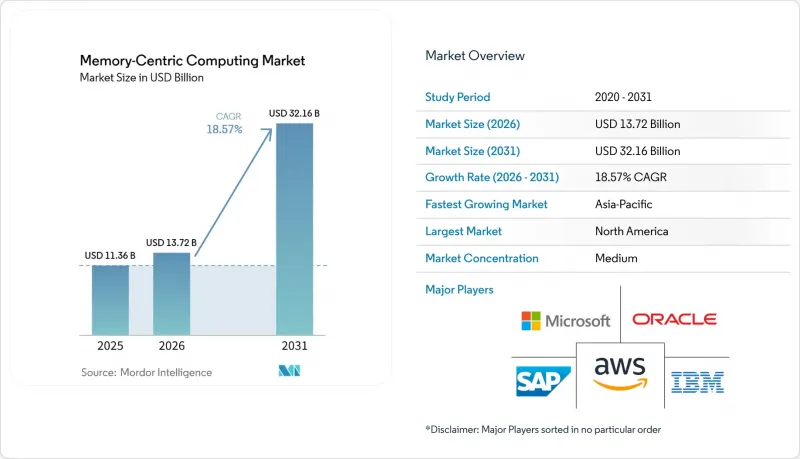
본 보고서는 구성 요소별(인메모리 데이터베이스 및 데이터 그리드 등), 배포 모드별(On-Premise 및 프라이빗 클라우드 등), 용도별(실시간 분석 및 비즈니스 인텔리전스 등), 최종 사용자별(은행, 금융서비스 및 보험(BFSI), IT 및 통신 등), 데이터 아키텍처별(퓨어 인메모리 아키텍처 등) 및 지역별로 분류되어 있습니다. 시장 예측은 금액(달러) 기준으로 제시되어 있습니다.
세계의 메모리 중심 컴퓨팅 시장 동향과 인사이트
AI 네이티브 워크로드 및 벡터 검색의 보급
AI 네이티브 용도는 추론, 검색, 에이전트 간 협업이 모두 저지연 상태 액세스에 의존하기 때문에 메모리 중심 컴퓨팅 시장을 엔터프라이즈 인프라 계획의 핵심으로 부상시켰습니다. Google Research는 메모리 중심 컴퓨팅을 데이터베이스 아키텍처의 구조적 재설계로 규정하며, 분산된 메모리 풀이 성능에 민감한 데이터 시스템을 보다 효율적으로 확장할 수 있는 길을 제공한다고 설명합니다. 이러한 변화가 중요한 이유는 에이전트형 시스템이 데이터를 고속으로 읽을 뿐만 아니라, 단순한 캐시 계층만으로는 확실히 제공할 수 없는 내구성 있는 멀티세션 상태를 필요로 하기 때문입니다. Aerospike는 2026년 3월, NoSQL Database 8용 LangGraph 통합을 출시하여, 스테이트리스 에이전트형 AI 워크플로우에 대해 내구성이 뛰어나고 지연 시간이 짧은 메모리 지원을 제공함으로써 이러한 방향성을 더욱 강화했습니다. AI를 실험 단계에서 생산 환경으로 도입하는 기업이 늘어남에 따라, 메모리 중심 컴퓨팅 시장은 단일 스택 내에서 지속성, 병렬성 및 신속한 복구를 필요로 하는 워크로드의 혜택을 받고 있습니다. 따라서 플랫폼 선정은 단순한 캐시 속도뿐만 아니라, 벤더가 에이전트 상태, 검색 파이프라인 및 트랜잭션 수준의 응답성을 얼마나 적절하게 지원하는지에 점점 더 좌우되고 있습니다.
디지털 뱅킹 및 사기 방지 분야에서 저지연 의사결정 엔진에 대한 수요 증가
메모리 중심 컴퓨팅 시장이 성장하고 있는 또 다른 이유는 실시간 금융 의사결정에서 처리 지연을 더 이상 용납할 여지가 없기 때문입니다. 『International Journal of Fundamental Mathematics Research』 저널의 2025년 조사에 따르면, 실시간 은행 사기 감지 파이프라인에서는 트랜잭션당 50밀리초 미만의 예상 지연 시간이 필요한 것으로 밝혀졌습니다. 또한, 같은 조사에서는 인메모리형 특징량 저장소가 디스크 I/O를 배제함으로써 사전 계산된 값을 1자리 밀리초 단위로 제공할 수 있다고 지적하고 있습니다. Volt Active Data가 발표한 아키텍처 벤치마크에 따르면, 한 Tier 1 은행은 초당 1만 건 이상의 트랜잭션을 처리하면서 50밀리초의 승인 시간 범위 내에서 2,000건 이상의 프로덕션 규칙을 실행하고 있었습니다. 이러한 운영 모델은 규정 준수, 고객 경험 및 사기 방지가 모두 동일한 저지연 인프라에 의존하게 됨에 따라 구매 결정 기준을 변화시키고 있습니다. 또한, 규제 대상 금융 기관들이 인메모리 플랫폼을 단순한 성능 향상용 옵션 소프트웨어가 아닌 핵심 운영 인프라로 계속해서 취급하고 있는 이유도 설명하고 있습니다. 메모리 중심 컴퓨팅 시장에서 금융 워크로드는 안정적인 지연 시간, 신속한 규칙 변경, 그리고 높은 트랜잭션 동시 처리 능력을 동시에 실현할 수 있기 때문에 여전히 중요한 위치를 차지하고 있습니다.
대규모 메모리 패브릭 도입에 따른 높은 하드웨어 및 인프라 비용
높은 하드웨어 비용은 여전히 메모리 중심 컴퓨팅 시장이 미드마켓 부문에 얼마나 신속하게 침투할 수 있는지를 제한하고 있습니다. 메모리를 많이 사용하는 전체 배포 환경에서는 플래시나 디스크를 주축으로 하는 아키텍처보다 더 고가의 용량 계획이 필요하며, 인프라 예산이 고정된 구매자에게는 승인 절차가 난항을 겪는 요인이 됩니다. 조직이 프로덕션 환경에서의 활용을 확대하기 전에 CXL 지원 서버로 업그레이드하거나 관련 통합 작업이 필요한 경우, 이 과제는 더욱 커집니다. Microsoft Azure의 CXL 기반 메모리 확장 지원은 이 기술이 상업적으로 실용화되고 있음을 보여 주지만, 한편으로는 도입이 호환 가능한 차세대 하드웨어에 의존하고 있다는 현실도 부각시키고 있습니다. 실제로 이로 인해 일부 기업은 특히 조달 위원회가 성능상의 이점과 다년간의 자본 계획을 저울질할 때, 원했던 것보다 더 오랫동안 하이브리드 설계를 유지할 수밖에 없는 상황에 처해 있습니다. 따라서 메모리 중심 컴퓨팅 시장은 성장을 이어가고 있지만, 엄격한 비용 관리가 여전히 구매자가 시범 도입에서 광범위한 인프라 교체로 전환하는 속도를 좌우하고 있습니다.
부문 분석
2025년, 인메모리 데이터베이스 및 데이터 그리드는 구성 요소 부문의 42.28%를 차지하며 메모리 중심 컴퓨팅 시장에서 가장 큰 구성 요소가 되었습니다. 이러한 우위는 BFSI(은행 및 금융 및 보험), IT 및 통신 분야의 트랜잭션량이 많은 이용 사례에서 일반적인 스토리지 시스템으로는 일관되게 제공할 수 없는 안정적인 저지연 읽기 및 쓰기가 여전히 필요하다는 사실을 반영합니다. 또한, 이러한 플랫폼은 응답 시간과 마찬가지로 신뢰성이 중시되는 운영 워크플로우에 깊이 통합되어 있다는 점에서도 장점이 있습니다. 인메모리 캐싱 및 용도 가속화 플랫폼은 용도 팀이 마이크로서비스와 백엔드 데이터베이스 사이에 분산 캐시 계층을 배치하여 트래픽 급증을 보다 효율적으로 흡수할 수 있게 됨에 따라, 2031년까지 18.99%라는 가장 높은 성장률을 나타낼 것으로 예측됩니다. 스트림 처리 및 이벤트 처리 플랫폼의 점유율은 계속해서 확대되고 있습니다. 이는 이벤트 파이프라인을 단순한 보고 채널이 아닌 실시간 운영 계층으로 취급하는 기업이 늘어나고 있기 때문입니다. Apache Flink 2.0은 스트리밍 SQL에 벡터 검색 및 LLM 추론 기능을 직접 추가함으로써 이러한 변화를 뒷받침했으며, 고급 이벤트 처리를 인메모리 실행에 한 걸음 더 가깝게 만들었습니다.
구성 요소 부문의 구조는 기능적 경계가 예전만큼 명확하지 않아짐에 따라 경쟁이 심화되고 있습니다. 캐시 벤더들은 보다 광범위한 상태 관리로 전환하고 있는 반면, 스트림 프로세서는 과거 전용으로 설계된 인메모리 데이터베이스에 한정되었던 워크로드를 점점 더 많이 처리하고 있습니다. 이러한 중복으로 인해 메모리 중심 컴퓨팅 시장의 전략적 범위가 확대되고 있습니다. 이는 구매자가 더 이상 핵심 데이터베이스의 교체뿐만 아니라 용도 가속화, 데이터 그리드, 혹은 실시간 스트림과 같은 경로를 통해 시장에 진입할 수 있게 되었기 때문입니다. 여러 포인트 도구를 관리하고 있는 기업들도 통합을 요구하고 있습니다. 캐시, 스트리밍, 그리드 운영마다 별도의 플랫폼을 사용하면 불필요한 운영 비용이나 거버넌스의 복잡성이 발생할 가능성이 있기 때문입니다. 이러한 상황에서는 통합형 솔루션이 통합에 따르는 오버헤드를 줄이면서 지연 시간 성능을 허용 범위 내로 유지할 수 있으므로, 판매상의 우위가 높아집니다. 따라서 메모리 중심 컴퓨팅 업계에서는 까다로운 이용 사례에서 ‘베스트 오브 브リ?ド(Best-of-Breed)’ 전문 벤더들이 여전히 확고한 입지를 차지하고 있지만, 구성 요소 수준에서 플랫폼의 수렴이 진행되고 있습니다.
매니지드 클라우드 및 SaaS는 2025년에 45.66%의 점유율을 차지하고, 예측 연평균 성장률(CAGR)도 19.16%로 최고치를 기록함에 따라 메모리 중심 컴퓨팅 시장에서 가장 유력한 제공 모델이 되었습니다. 이러한 이중 우위는 특히 신속한 도입이나 플랫폼 관리 부담 경감을 원하는 경우, 구매자들이 고정된 메모리 패브릭에 대한 투자보다 운영상의 유연성을 점점 더 중요하게 여기고 있음을 보여줍니다. 각 하이퍼스케일러 기업들이 엔터프라이즈 고객을 대상으로 매니지드 인메모리 서비스 포트폴리오를 지속적으로 확대하고 있기 때문에 퍼블릭 클라우드는 여전히 주요 선택지 중 하나입니다. On-Premise 및 프라이빗 클라우드도 여전히 중요하며, 특히 데이터의 기밀성, 주권 또는 인프라 통제가 신속한 마이그레이션보다 더 중요하게 여겨지는 규제 대상 워크로드의 경우 그 중요성은 여전히 높습니다. 『DSAG Investitionsreport 2026』에 따르면, 조사 대상인 독일어권 기업의 70%가 SAP S/4HANA로의 전환을 진행 중이거나 완료했으며, 이러한 추세는 SAP HANA를 핵심으로 하는 프라이빗 환경 및 관리형 환경에 대한 지속적인 수요를 뒷받침하고 있습니다. 또한, Oracle과 마이크로소프트는 2025년 3월, 엑사스케일 인프라스트럭처 상의 Exadata Database Service를 통합한 ‘Oracle Database&Azure’를 확충하여, 전용 Exadata 플랫폼에 비해 인프라스트럭처 비용을 최대 95% 절감했습니다.
도입 방식은 더 이상 On-Premise에서 클라우드로의 단순한 전환에 그치지 않습니다. 현재 하이브리드 모델이 기업 도입 사례의 대부분을 차지하고 있기 때문입니다. 2026년 6월, 노키아, SAP, 마이크로소프트는 'RISE with SAP'의 일환으로 노키아의 SAP S/4HANA 환경을 Microsoft Azure에서 운영하기 위한 다년 계약을 체결했습니다. 이는 대기업이 주요 변혁 프로그램에서 클라우드 관리형 인메모리 환경을 어떻게 활용하고 있는지를 보여줍니다. 이러한 전환은 메모리 중심 컴퓨팅 시장이 사설 인프라의 직접적인 대체뿐만 아니라 공존 모델을 통해 지속적으로 성장할 것임을 시사합니다. 많은 기업은 기밀 데이터에 대해서는 On-Premise 관리를 유지하면서, 분석, 내결함성, 확장성 측면에서 해당 환경을 관리형 플랫폼과 연계하고자 합니다. 벤더들은 완전한 클라우드 전환, 호스팅형 프라이빗 환경, 하이브리드 확장 등 각 시나리오에 동시에 대응해야 하므로, 도입 형태를 둘러싼 경쟁은 광범위하게 펼쳐지고 있습니다. 따라서 메모리 중심 컴퓨팅 업계는 순수한 기술적 차별화뿐만 아니라 유연한 이용 모델을 통해서도 형성되고 있습니다.
지역별 분석
2025년, 북미는 메모리 중심 컴퓨팅 시장 점유율의 42.34%를 차지하며, 매출 측면에서 여전히 가장 큰 기여 지역으로서의 지위를 유지했습니다. 이 지역은 금융 서비스 기술 구매자가 밀집해 있고, 하이퍼스케일 클라우드 인프라가 잘 갖춰져 있으며, 이미 대규모 플랫폼 포트폴리오에 인메모리 기능을 통합한 기업 소프트웨어 벤더가 존재한다는 점에서 혜택을 받고 있습니다. 미국은 사기 감지, 알고리즘 트레이딩, 실시간 개인화가 이미 충분한 자금을 지원받아 상업적으로 규모를 확대하고 있기 때문에 계속해서 도입의 중심지가 되고 있습니다. 캐나다는 금융 서비스 및 정부의 분석 수요를 통해 시장을 뒷받침하고 있으며, 멕시코는 니어쇼어링과 관련된 제조 인텔리전스 도입을 통해 입지를 강화하고 있습니다. 이러한 도입 기반을 통해 메모리 중심 컴퓨팅 시장은 전문 벤더와 대규모 통합 제공업체 모두가 새로운 기능을 신속하게 상용화할 수 있는 견고한 지역적 기반을 구축하고 있습니다.
유럽이 여전히 중요한 시장인 이유는 엔터프라이즈 용도의 현대화와 규제 준수가 동시에 수요를 형성하고 있기 때문입니다. 독일은 이 지역 최대 시장이며, DSAG는 2026년에 조사 대상인 독일어권 기업의 70%가 SAP S/4HANA로의 전환을 진행 중이거나 완료했다고 보고했습니다. S/4HANA 도입에는 SAP HANA가 필수적이기 때문에 이는 인메모리 인프라에 대한 수요를 직접 뒷받침하는 요소입니다. 영국과 프랑스 역시 금융 서비스 및 공공 부문의 디지털화 프로그램에 대한 지속적인 투자로 인해 여전히 큰 시장을 형성하고 있습니다. 2026년 6월, 노키아, SAP, 마이크로소프트는 노키아의 SAP S/4HANA 환경을 Microsoft Azure에서 운영하기 위한 다년 계약을 공식적으로 체결했습니다. 이는 유럽에서 진행 중인 기업용 인메모리 전환 활동의 규모를 여실히 보여주는 사례였습니다. 이탈리아 및 기타 유럽 국가에서는 광범위한 클라우드 전환보다는 은행업 및 자동차 제조업을 중심으로 한 수요로 인해 다소 완만한 성장이 예상됩니다.
아시아태평양은 2031년까지 19.46%라는 가장 높은 연평균 성장률(CAGR)을 보일 것으로 예상되며, 예측 기간 동안 인메모리 컴퓨팅 시장 규모에서 가장 강력한 성장세를 보일 것으로 전망됩니다. 이 지역 수요는 인도 및 동남아시아의 디지털 뱅킹 성장, 일본 및 한국의 민간 5G 산업 도입, 그리고 중국의 전자상거래 및 디지털 결제의 지속적인 확대에 의해 주도되고 있습니다. 한국은 산업용 엣지 수요가 증가하는 한편, 반도체 및 메모리 하드웨어 혁신의 최전선에 위치하고 있다는 이중의 우위를 가지고 있습니다. 일본은 산업용 IoT, 정밀 제조, 기업용 분석의 현대화를 통해 도입을 지속적으로 촉진하고 있습니다. 남미는 여전히 시장 규모가 작지만, 브라질 및 인근 시장의 하이퍼스케일 투자로 인해 도입 지연 요인이 줄어들면서 시장이 확대되는 추세입니다. 한편, 중동 및 아프리카에서는 스마트 시티 프로그램과 각국의 경제 다각화 정책에 따른 금융 부문 현대화 이니셔티브로 인해 시장이 탄력을 받고 있습니다.
기타 혜택 :
- 엑셀 형식 시장 예측(ME) 시트
- 3개월간의 애널리스트 지원
자주 묻는 질문
목차
제1장 서론
제2장 조사 방법
제3장 주요 요약
제4장 시장 구도
제5장 시장 규모 및 성장 예측
제6장 경쟁 구도
제7장 시장 기회 및 향후 전망
KTH 26.08.10According to Mordor Intelligence, the memory-centric computing market size is projected to expand from USD 11.36 billion in 2025 and USD 13.72 billion in 2026 to USD 32.16 billion by 2031, registering a CAGR of 18.57% between 2026 to 2031.
This report is Segmented by Component (In-Memory Databases and Data Grids, and More), Deployment (On-Premises and Private Cloud, and More), Application (Real-Time Analytics and Business Intelligence, and More), End User (BFSI, IT and Telecommunications, and More), Data Architecture (Pure In-Memory Architecture, and More), and Geography. The Market Forecasts are Provided in Terms of Value (USD).
Global Memory-Centric Computing Market Trends and Insights
Proliferation of AI-Native Workloads and Vector Search
AI-native applications have pushed the memory-centric computing market closer to the center of enterprise infrastructure planning because inference, retrieval, and agent coordination all depend on low-latency state access. Google Research described memory-centric computing as a structural redesign of database architecture, with disaggregated memory pools offering a path to scale performance-sensitive data systems more efficiently. That shift matters because agentic systems not only read data quickly, they also need a durable multi-session state that simple cache layers cannot reliably provide. Aerospike reinforced this direction in March 2026 when it launched LangGraph integration for NoSQL Database 8 to provide durable, low-latency memory support for stateless agentic AI workflows. As more enterprises move from AI experimentation to production deployment, the memory-centric computing market is benefiting from workloads that need persistence, concurrency, and fast recovery in the same stack. This is why platform selection is increasingly tied to how well vendors support agent state, retrieval pipelines, and transaction-grade responsiveness rather than raw caching speed alone.
Escalating Need for Low-Latency Decision Engines in Digital Banking and Fraud Control
The memory-centric computing market is also advancing because real-time financial decisioning no longer leaves room for deferred processing windows. A 2025 study in the International Journal of Fundamental Mathematics Research found that real-time banking fraud detection pipelines require prediction latency below 50 milliseconds per transaction, and it noted that in-memory feature stores can serve pre-computed values in single-digit milliseconds by removing disk I/O. Volt Active Data published an architecture benchmark showing that a Tier-1 bank ran more than 2,000 production rules within a 50ms authorization budget while handling throughput above 10,000 transactions per second. This operating model changes the buying logic because compliance, customer experience, and fraud prevention now depend on the same low-latency foundation. It also helps explain why regulated institutions continue to treat in-memory platforms as core operational infrastructure rather than optional performance software. In the memory-centric computing market, financial workloads remain important because they reward stable latency, rapid rule changes, and high transaction concurrency at the same time.
High Hardware and Infrastructure Cost for Large-Scale Memory Fabric Deployment
High hardware cost still limits how quickly the memory-centric computing market can move into the mid-market segment. Full memory-heavy deployments require more expensive capacity planning than flash- or disk-led architectures, and that increases approval friction for buyers with fixed infrastructure budgets. The challenge becomes larger when organizations need CXL-capable server refreshes and related integration work before they can scale production use. Microsoft Azure's support for CXL-based memory expansion shows that the technology is becoming commercially viable, but it also underlines the reality that adoption depends on compatible next-generation hardware. In practice, this keeps some enterprises in hybrid designs longer than they would prefer, especially when procurement committees weigh performance benefits against multi-year capital planning. The memory-centric computing market, therefore, continues to grow, but cost discipline still shapes the pace at which buyers move from pilot deployments to broad infrastructure replacement.
Other drivers and restraints analyzed in the detailed report include:
- Growth of High-Density Data Ingestion from Cloud-Native and Streaming Applications
- Shift Toward Persistent Memory and Storage-Class Memory for Performance Efficiency
- Data Gravity, Replication Overhead, and Inter-Cluster Latency Constraints
For complete list of drivers and restraints, kindly check the Table Of Contents.
Segment Analysis
In-Memory Databases and Data Grids held 42.28% of the component segment in 2025, which made them the largest building block inside the memory-centric computing market. Their lead reflects the fact that transaction-heavy use cases in BFSI, IT, and telecommunications still need stable, low-latency reads and writes that general storage systems do not deliver consistently. These platforms also benefit from being deeply embedded in operational workflows where reliability matters as much as response time. In-Memory Caching and Application Acceleration Platforms are projected to record the fastest growth at 18.99% through 2031, as application teams place distributed cache layers between microservices and back-end databases to absorb spikes more efficiently. Stream Processing and Event Processing Platforms continue to gain share because more enterprises now treat event pipelines as a live operating layer rather than a reporting channel. Apache Flink 2.0 supported this shift by adding vector search and LLM inference capabilities directly in streaming SQL, which pulled advanced event processing closer to in-memory execution.
The structure of the component segment is becoming more competitive because functional boundaries are no longer as clear as they once were. Caching vendors are moving toward broader state management, while stream processors are increasingly handling workloads that were once reserved for purpose-built in-memory databases. That overlap widens the strategic scope of the memory-centric computing market because buyers can now enter through application acceleration, data grids, or real-time streams instead of through a core database replacement alone. Enterprises that manage several point tools are also looking for consolidation, since separate platforms for cache, streaming, and grid operations can create extra operational cost and governance complexity. In this setting, unified offerings have a stronger selling position because they reduce integration overhead while keeping latency performance within acceptable limits. The memory-centric computing industry is therefore seeing platform convergence at the component level, even though best-of-breed specialists still hold strong positions in demanding use cases.
Managed Cloud and SaaS held 45.66% share in 2025 and also recorded the highest projected CAGR at 19.16%, which made it the strongest delivery model in the memory-centric computing market. That dual position shows how buyers increasingly prefer operational elasticity over fixed memory-fabric investments, especially when they want faster implementation and lower platform administration burden. Public cloud remains the next major path because hyperscalers continue to expand managed in-memory service portfolios across enterprise accounts. On-premises and private cloud still matter, particularly in regulated workloads where data sensitivity, sovereignty, or infrastructure control carry more weight than rapid migration. The DSAG Investitionsreport 2026 found that 70% of surveyed German-speaking enterprises had SAP S/4HANA migration running or completed, and that pattern supports durable demand for private and managed environments built around SAP HANA. Oracle and Microsoft also expanded Oracle Database@Azure in March 2025 with Exadata Database Service on Exascale Infrastructure, reducing minimum infrastructure costs by up to 95% versus dedicated Exadata platforms.
The deployment story is no longer a simple shift from on-premises to cloud, because hybrid models now define a large share of enterprise rollouts. In June 2026, Nokia, SAP, and Microsoft signed a multi-year agreement to run Nokia's SAP S/4HANA landscape on Microsoft Azure under RISE with SAP, which shows how large enterprises are using cloud-managed in-memory environments for major transformation programs. This kind of migration suggests that the memory-centric computing market will keep growing through coexistence models, not only through direct displacement of private infrastructure. Many enterprises still want on-premises control for sensitive data while linking those environments to managed platforms for analytics, resilience, and scaling. That keeps deployment competition broad, since vendors must serve full cloud migration, hosted private environments, and hybrid extension paths at the same time. The memory-centric computing industry is therefore being shaped as much by flexible consumption models as by raw technology differentiation.
Complete Report Scope:
- By Component
- In-Memory Databases and Data Grids
- In-Memory Caching and Application Acceleration Platforms
- Stream Processing and Event Processing Platforms
- By Deployment Mode
- On-Premises and Private Cloud
- Public Cloud
- Managed Cloud and SaaS
- By Application
- Real-Time Analytics and Business Intelligence
- Digital Applications, Caching, and Personalization
- Fraud Detection, Risk Management, and Financial Trading
- IoT, Edge Analytics, and Telemetry Processing
- AI/ML Applications and Decision Automation
- By End User
- BFSI
- IT and Telecommunications
- Retail, E-Commerce, and Digital Platforms
- Healthcare and Life Sciences
- Manufacturing and Automotive
- Government and Public Sector
- Other End Users
- By Data Architecture
- Pure In-Memory Architecture
- Hybrid In-Memory Architecture with Persistent Storage
- By Geography
- North America
- United States
- Canada
- Mexico
- Europe
- Germany
- United Kingdom
- France
- Italy
- Rest of Europe
- Asia-Pacific
- China
- Japan
- South Korea
- India
- Southeast Asia
- Rest of Asia-Pacific
- South America
- Middle East and Africa
- North America
Geography Analysis
North America held 42.34% of the memory-centric computing market share in 2025, which kept it as the largest regional contributor by revenue. The region benefits from a dense concentration of financial services technology buyers, hyperscale cloud infrastructure, and enterprise software vendors that already package in-memory capabilities into larger platform portfolios. The United States remains the center of adoption because fraud detection, algorithmic trading, and real-time personalization are already well funded and commercially scaled there. Canada adds support through financial services and government analytics demand, while Mexico is gaining relevance through nearshoring-linked manufacturing intelligence deployments. This installed base gives the memory-centric computing market a strong regional foundation where both specialist vendors and large integrated providers can commercialize new capabilities quickly.
Europe remains important because enterprise application modernization and regulatory discipline are shaping demand at the same time. Germany is the region's largest market, and DSAG reported in 2026 that 70% of surveyed German-speaking enterprises had SAP S/4HANA migration running or completed, which directly supports in-memory infrastructure demand because every S/4HANA deployment relies on SAP HANA. The United Kingdom and France also remain large markets because of sustained investment in financial services and public sector digital programs. In June 2026, Nokia, SAP, and Microsoft formalized a multi-year agreement to run Nokia's SAP S/4HANA landscape on Microsoft Azure, which highlighted the scale of enterprise in-memory migration activity taking place in Europe. Italy and the rest of Europe are growing more gradually, with demand centered on banking and automotive manufacturing rather than broad-based cloud migration.
Asia-Pacific is projected to record the fastest CAGR at 19.46% through 2031, which gives it the strongest expansion profile in the memory-centric computing market size over the forecast period. Demand in the region is being driven by digital banking growth in India and Southeast Asia, private 5G industrial deployments in Japan and South Korea, and continued scale in Chinese e-commerce and digital payments. South Korea has a dual advantage because industrial edge demand is rising while the country also remains close to semiconductor and memory hardware innovation. Japan continues to support adoption through industrial IoT, precision manufacturing, and enterprise analytics modernization. South America remains smaller but is improving as hyperscale investment reduces latency barriers in Brazil and nearby markets, while the Middle East and Africa is gaining traction from smart city programs and financial sector modernization initiatives aligned with national diversification agendas.
- Microsoft Corporation
- Oracle Corporation
- SAP SE
- IBM Corporation
- Amazon Web Services, Inc.
- Google LLC
- Redis Ltd.
- GridGain Systems, Inc.
- GigaSpaces Technologies Ltd.
- Hazelcast Inc.
- TIBCO Software Inc.
- Software AG
- SAS Institute Inc.
- Datastax, Inc.
- MemVerge, Inc.
- Hewlett Packard Enterprise Company
- Fujitsu Limited
- KX Systems, Inc.
- Volt Active Data, Inc.
- Aerospike, Inc.
- Exasol AG
Additional Benefits:
- The market estimate (ME) sheet in Excel format
- 3 months of analyst support
TABLE OF CONTENTS
1 INTRODUCTION
- 1.1 Study Assumptions and Market Definition
- 1.2 Scope of the Study
2 RESEARCH METHODOLOGY
3 EXECUTIVE SUMMARY
4 MARKET LANDSCAPE
- 4.1 Market Overview
- 4.2 Market Drivers
- 4.2.1 Proliferation of AI-Native Workloads and Vector Search
- 4.2.2 Escalating Need For Low-Latency Decision Engines in Digital Banking and Fraud Control
- 4.2.3 Growth of High-Density Data Ingestion From Cloud-Native and Streaming Applications
- 4.2.4 Shift Toward Persistent Memory and Storage-Class Memory for Performance Efficiency
- 4.2.5 Expansion of Edge Analytics in 5G, Industrial IoT, and Real-Time Telemetry
- 4.2.6 Rising Replacement Demand From Legacy Disk-Heavy Analytical Stacks
- 4.3 Market Restraints
- 4.3.1 High Hardware and Infrastructure Cost for Large-Scale Memory Fabric Deployment
- 4.3.2 Data Gravity, Replication Overhead, and Inter-Cluster Latency Constraints
- 4.3.3 Vendor Lock-In Risks in Proprietary In-Memory Platforms and Appliances
- 4.3.4 Shortage of Specialized Memory Systems Architects and Runtime Engineers
- 4.4 Supply-Chain Analysis
- 4.5 Technological Outlook
- 4.6 Regulatory Landscape
- 4.7 Porter's Five Forces Analysis
- 4.7.1 Bargaining Power of Suppliers
- 4.7.2 Bargaining Power of Buyers
- 4.7.3 Threat of New Entrants
- 4.7.4 Threat of Substitutes
- 4.7.5 Competitive Rivalry
5 MARKET SIZE AND GROWTH FORECASTS (VALUE)
- 5.1 By Component
- 5.1.1 In-Memory Databases and Data Grids
- 5.1.2 In-Memory Caching and Application Acceleration Platforms
- 5.1.3 Stream Processing and Event Processing Platforms
- 5.2 By Deployment Mode
- 5.2.1 On-Premises and Private Cloud
- 5.2.2 Public Cloud
- 5.2.3 Managed Cloud and SaaS
- 5.3 By Application
- 5.3.1 Real-Time Analytics and Business Intelligence
- 5.3.2 Digital Applications, Caching, and Personalization
- 5.3.3 Fraud Detection, Risk Management, and Financial Trading
- 5.3.4 IoT, Edge Analytics, and Telemetry Processing
- 5.3.5 AI/ML Applications and Decision Automation
- 5.4 By End User
- 5.4.1 BFSI
- 5.4.2 IT and Telecommunications
- 5.4.3 Retail, E-Commerce, and Digital Platforms
- 5.4.4 Healthcare and Life Sciences
- 5.4.5 Manufacturing and Automotive
- 5.4.6 Government and Public Sector
- 5.4.7 Other End Users
- 5.5 By Data Architecture
- 5.5.1 Pure In-Memory Architecture
- 5.5.2 Hybrid In-Memory Architecture with Persistent Storage
- 5.6 By Geography
- 5.6.1 North America
- 5.6.1.1 United States
- 5.6.1.2 Canada
- 5.6.1.3 Mexico
- 5.6.2 Europe
- 5.6.2.1 Germany
- 5.6.2.2 United Kingdom
- 5.6.2.3 France
- 5.6.2.4 Italy
- 5.6.2.5 Rest of Europe
- 5.6.3 Asia-Pacific
- 5.6.3.1 China
- 5.6.3.2 Japan
- 5.6.3.3 South Korea
- 5.6.3.4 India
- 5.6.3.5 Southeast Asia
- 5.6.3.6 Rest of Asia-Pacific
- 5.6.4 South America
- 5.6.5 Middle East and Africa
- 5.6.1 North America
6 COMPETITIVE LANDSCAPE
- 6.1 Market Concentration
- 6.2 Strategic Moves
- 6.3 Market Share Analysis
- 6.4 Company Profiles (includes Global Level Overview, Market Level Overview, Core Segments, Financials as available, Strategic Information, Market Rank/Share, Products and Services, Recent Developments)
- 6.4.1 Microsoft Corporation
- 6.4.2 Oracle Corporation
- 6.4.3 SAP SE
- 6.4.4 IBM Corporation
- 6.4.5 Amazon Web Services, Inc.
- 6.4.6 Google LLC
- 6.4.7 Redis Ltd.
- 6.4.8 GridGain Systems, Inc.
- 6.4.9 GigaSpaces Technologies Ltd.
- 6.4.10 Hazelcast Inc.
- 6.4.11 TIBCO Software Inc.
- 6.4.12 Software AG
- 6.4.13 SAS Institute Inc.
- 6.4.14 Datastax, Inc.
- 6.4.15 MemVerge, Inc.
- 6.4.16 Hewlett Packard Enterprise Company
- 6.4.17 Fujitsu Limited
- 6.4.18 KX Systems, Inc.
- 6.4.19 Volt Active Data, Inc.
- 6.4.20 Aerospike, Inc.
- 6.4.21 Exasol AG
7 MARKET OPPORTUNITIES AND FUTURE OUTLOOK
- 7.1 White-space and Unmet-Need Assessment


