

|
시장보고서
상품코드
2099499
폴리 카테터 시장 : 점유율 분석, 업계 동향 및 통계, 성장 예측(2026-2031년)Foley Catheters - Market Share Analysis, Industry Trends & Statistics, Growth Forecasts (2026 - 2031) |
||||||
 Mordor Intelligence
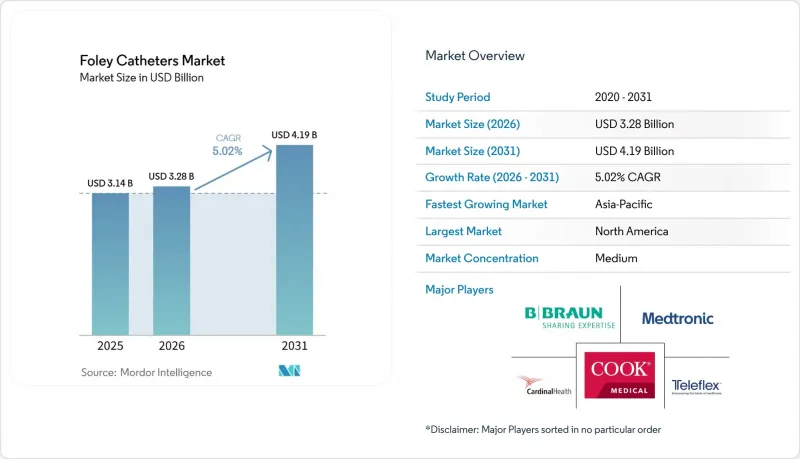
Mordor Intelligence에 의하면, 폴리 카테터 시장 규모는 2025년 31억 4,000만 달러에서 2026년에는 32억 8,000만 달러로 확대되어 2031년까지 41억 9,000만 달러에 이를 것으로 예상되고 있어 2026년부터 2031년까지 CAGR 5.02%로 성장할 전망입니다.
본 보고서는 제품 유형(2웨이, 3웨이, 4웨이), 재질(라텍스, 실리콘, 친수성 폴리머 코팅 라텍스, 실리콘 엘라스토머 코팅, PTFE 코팅 라텍스), 코팅 유형(항균, 친수성 또는 윤활, 코팅 없음), 최종 사용자(병원, 당일 수술센터(ASC), 장기 요양 시설, 재택 간호, 기타) 및 지역(북미, 유럽, 아시아태평양, 기타)별로 분류되어 있습니다. 시장 전망은 금액(달러) 기준으로 제시됩니다.
전 세계 폴리 카테터 시장 동향 및 인사이트
비뇨기 질환 및 양성 전립선 비대증 유병률 증가
폴리 카테터 시장은 이 부문에서 여전히 가장 큰 장기 수요 원천인 양성 전립선 비대증(BPH)의 부담 증가에 힘입어 성장하고 있습니다. 전 세계 BPH(양성 전립선 비대증) 유병자 수는 1990년 5,070만 명에서 2021년 1억 1,250만 명으로 증가했으며, 2035년까지 10만 명당 1,563명에 달할 것으로 예측됩니다. 이러한 부담은 특히 고령 남성에게서 두드러지며, 70세 이상 남성의 유병률은 80%에 달할 전망입니다. 따라서 약물 치료만으로는 불충분한 경우, 도뇨관 사용은 질환의 진행과 밀접한 관련이 있게 됩니다. 지리적 확산 또한 중요한 요소입니다. 아랍에미리트(UAE)에서는 1990년부터 2021년 사이에 BPH 유병률이 1,381% 증가했으며, 이는 상업적 관점에서 아직 미발달된 걸프 시장에서 향후 수요가 더욱 높아질 것임을 시사합니다. 미국에서는 2015년부터 2021년까지 메디케어의 종량제 보험 제도에 가입한 65세 이상 남성의 29%에서 35%가 BPH 및 LUTS를 앓고 있으며, 카테터 사용은 국내 최대 규모의 단일 보험자 제도 가입자층과 밀접한 관련이 있습니다.
고령화와 장기적인 방광 관리의 필요성
폴리 카테터 시장은 고령화의 영향을 받고 있으며, 이러한 변화는 단순히 수요량뿐만 아니라 사용 패턴에도 미치고 있습니다. 고령 환자들은 단기적인 급성기 치료보다는 더 긴 삽입 기간, 원활한 치료 전환, 그리고 수년에 걸친 안정적인 공급을 필요로 하는 경향이 강해지고 있습니다. 따라서 폴리 카테터 시장은 자극을 줄이고, 결석 형성 위험을 억제하며, 재택 간호 루틴에 쉽게 적응할 수 있는 제품으로 전환되고 있습니다. 전립선 비대증(BPH)의 유병률을 높이는 것과 같은 노화에 따른 질병 부담이, 반복적이거나 장기적인 방광 관리 지원이 필요한 환자층을 확대시키고 있습니다. 실제로 장기 사용자들은 쾌적한 소재, 감염 관리 기능, 그리고 반복 주문 및 사후 관리에 대응할 수 있는 유통 시스템에 대해 보다 안정적인 수요를 창출하고 있습니다.
카테터 관련 요로 감염(CAUTI)의 위험 및 법적 책임 위험
폴리 카테터 시장은 감염 관리 프로그램을 통해 불필요한 카테터 사용이 줄어들고 삽입 기간이 단축됨에 따라, CAUTI(카테터 관련 요로 감염) 위험으로 인한 직접적인 제약에 직면해 있습니다. 2023년, 미국의 의료시설은 CDC(미국 질병통제예방센터)의 'National Healthcare Safety Network'에 2만 1,525건의 CAUTI를 보고했으며, 1건당 평균 추가 비용은 1만 3,793달러, 1,000건당 36명의 초과 사망이 확인되었습니다. 이러한 수치는 고품질 제품에 대한 수요를 뒷받침하는 한편, 병원으로 하여금 카테터 삽입 적응증을 좁히고 조기 제거를 촉진하는 요인이 되고 있습니다. 미국에서는 급성기 의료 현장에서 CAUTI 발생률이 2022년부터 2023년까지 11% 감소했습니다. 이는 규정 준수를 통해 감축이 가능하며, 감시 체계가 잘 갖춰진 환경에서는 카테터 사용량을 줄일 수 있음을 보여줍니다. 중국의 8개 3차 의료기관 중환자실(ICU)을 대상으로 한 다기관 공동 연구에서도 번들 중재를 통해 CAUTI 발생률이 카테터 사용 일수 1,000일당 3.8건에서 1.3건으로 감소했으며, 카테터 사용률이 환자 일수 대비 71.3%에서 62.7%로 감소한 것으로 나타났으며, 이는 감염 관리가 사용량 증가를 직접 억제할 수 있음을 뒷받침합니다.
부문 분석
2웨이 폴리 카테터는 외과 치료, 집중 치료, 장기 배액 등 폭넓은 분야의 사용에 힘입어 2025년에는 폴리 카테터 시장 점유율의 48.27%를 차지했습니다. 이러한 선도적 지위는 임상적 유연성과 낮은 조달 비용에 기인하며, 이는 표준화된 병원 처방집에 잘 부합합니다. 폴리 카테터 시장에서 이 부문은 급속한 성장이라기보다는 이미 안정화된 상태에 있습니다. 특히 고소득 지역에서는 신규 수요보다 교체 수요가 더 안정적입니다. 다만, 아시아태평양 및 중동 및 아프리카에서는 의료 제공 역량이 지속적으로 확대되고 있어, 병원 증설을 통해 성장이 여전히 이어지고 있습니다.
3웨이 폴리 카테터는 배액과 세척이 모두 필요한 시술에서의 사용 증가에 힘입어, 2026년부터 2031년까지 연평균 성장률(CAGR) 5.49%를 기록하며 가장 빠르게 성장하는 제품 유형입니다. 전립선 경요도 절제술 및 기타 비뇨기과 내시경 수술에서는 수술 후 지속적인 세척이 여전히 일상적인 필요 사항이기 때문에 이러한 추세가 계속해서 뒷받침되고 있습니다. 따라서 폴리 카테터 시장에서 이 부문은 도입 규모는 작지만, 규모가 더 큰 2웨이 카테고리보다 더 강력한 성장 추세를 보이고 있습니다. 4웨이 폴리 카테터는 주로 3차 의료기관이나 학술 기관에서 치골상 카테터나 체온 측정 용도로 사용되는 틈새 전문 분야로, 수요는 제한적이지만 안정적입니다.
2025년 기준, 실리콘 재질의 폴리 카테터는 시장 규모의 39.38%를 차지하고 있으며, 이는 장기 삽입 사용에 대한 적합성, 결석 형성 위험이 낮다는 점, 그리고 라텍스 프리 관리 프로토콜에 부합한다는 점이 선호되고 있음을 반영합니다. 이러한 우위는 더 긴 사용 기간이 필요한 환자나, 소아 및 면역 결핍 환자 치료 시 라텍스 회피가 더욱 중요해지는 의료 현장에서 특히 두드러집니다. 폴리 카테터 시장에서 실리콘은 장기 사용에 따른 자극을 줄이고 내약성을 높이기 위한 병원의 노력으로부터도 혜택을 받고 있습니다. 단점은 여전히 가격에 있으며, 임상적 선호도가 명확하더라도 비용에 민감한 의료 시스템에 완전히 보급되는 것을 방해하고 있습니다.
실리콘 엘라스토머 코팅이 적용된 라텍스는 실리콘의 성능 일부와 라텍스의 비용적 우위를 모두 갖추고 있어, 2026년부터 2031년까지 연평균 성장률(CAGR) 6.72%를 기록하며 가장 빠르게 성장하는 소재 카테고리가 되고 있습니다. 이러한 조합을 통해, 특히 아시아태평양의 중규모 병원들에게는 완전한 실리콘으로의 전환에 따르는 전체 비용을 부담하지 않고도 기본적인 라텍스 제품에서 벗어날 수 있는 현실적인 경로가 제공됩니다. 표준 라텍스는 공급망이 확립되어 있고 구매 예산이 여전히 빠듯하기 때문에 저비용 환경에서 여전히 상당한 판매량을 유지하고 있습니다. 친수성 폴리머 코팅 라텍스 및 PTFE 코팅 라텍스는 삽입 용이성, 조직에 가해지는 부담 경감, 세균 부착 감소와 같은 특정 요구 사항을 지속적으로 충족하고 있습니다. 따라서 폴리 카테터 업계는 라텍스에서 단번에 벗어나기보다는 더 고품질의 코팅재나 혼합 소재로 단계적으로 전환하고 있습니다.
지역별 분석
2025년, 북미는 폴리 카테터 시장 점유율의 37.63%를 차지하며, 미국이 여전히 주요 수익원으로 남아 있습니다. 2015년부터 2021년까지 65세 이상 미국인 남성을 대상으로 한 전립선 비대증(BPH) 및 하부 요로 증상(LUTS) 보험 청구 기반 유병률은 31%에서 35% 사이였으며, 이는 메디케어 수급자층에서 꾸준한 잠재 수요를 뒷받침하고 있습니다. 또한, 감염 감시 체계 강화 및 인증 기준의 엄격화로 인해 항균성 및 친수성 코팅 제품은 병원의 구매 경향에서 계속해서 유리한 위치를 차지하고 있습니다. 캐나다에서는 고령화에 따른 장기 카테터 수요가 시장을 지탱하고 있으며, 멕시코에서는 병원 확장 및 기존 라텍스 카테터와 보급형 코팅 제품의 지속적인 사용으로 인해 판매량 증가가 예상됩니다.
아시아태평양은 2026년부터 2031년까지 연평균 성장률(CAGR) 6.09%를 기록하며, 폴리 카테터 시장에서 가장 빠르게 성장하는 지역입니다. 중국은 이 지역 내에서 전립선 비대증(BPH)의 절대 환자 수가 가장 많으며, 2021년에는 신규 사례가 320만 건, 유병 사례가 2,310만 건에 달하여, 이로 인해 해당 지역에는 카테터 사용을 위한 대규모의 장기적인 환자 기반이 형성되어 있습니다. 또한, 인도의 병원 확대, 한국의 보험 급여 제도 강화, 그리고 대도시권 의료 시스템 전반에 걸친 감염 관리 의식의 고조도 시장 성장을 뒷받침하고 있습니다. 호주 및 동남아시아 시장에서는 수술 건수 증가와 의료 기관의 조달 절차 표준화가 진행됨에 따라 수요가 더욱 확대되고 있습니다.
2025년, 유럽은 폴리 카테터 시장에서 중요한 위치를 차지하고 있으며, 독일, 영국, 프랑스, 이탈리아, 스페인이 주도적인 역할을 하고 있습니다. 이 지역은 EU 의료기기 규정에 따른 보다 엄격한 임상 증거 요건에 의해 형성되어 있으며, 이로 인해 증거가 불충분한 카테터 제품에 대한 진입 장벽이 높아지고, 충분한 문서를 갖춘 제조업체가 우위를 점하고 있습니다. 유럽의 재택 간호는 원격 비뇨기과 진료 및 지역 간호 모델이 지속적으로 발전함에 따라, 2031년까지 다른 지역의 최종 사용자 환경보다 빠르게 확대될 것으로 예측됩니다. 중동 및 아프리카는 여전히 시장 규모가 작지만, 걸프 국가들이 중요한 위치를 차지하고 있습니다. 이는 수입 의료기기에 대한 수요가 현지 공급을 웃도는 속도로 증가하고 있으며, 또한 UAE에서는 1990년부터 2021년까지 전립선 비대증(BPH) 유병률이 1,381% 증가한 것이 요인입니다. 남아프리카공화국이 아프리카 시장의 중심을 이루고 있지만, 이 지역의 다른 국가들은 인프라 및 보험 급여 제한으로 인해 여전히 제약을 받고 있습니다. 브라질과 아르헨티나가 주도하는 남미에서는 여전히 가격 민감도가 나타나고 있으나, 병원 인증 획득을 위한 노력에 힘입어 중가대 코팅 카테터 제품에 대한 수요가 점차 증가하고 있습니다.
기타 혜택:
- 엑셀 형식 시장 예측(ME) 시트
- 3개월간의 애널리스트 지원
자주 묻는 질문
목차
제1장 서론
제2장 조사 방법
제3장 주요 요약
제4장 시장 구도
제5장 시장 규모와 성장 예측
제6장 경쟁 구도
제7장 시장 기회와 향후 전망
JHS 26.08.05According to Mordor Intelligence, the foley catheters market size is expected to increase from USD 3.14 billion in 2025 to USD 3.28 billion in 2026 and reach USD 4.19 billion by 2031, growing at a CAGR of 5.02% over 2026-2031.
This report is Segmented by Product Type (2-Way, 3-Way, 4-Way), Material Type (Latex, Silicone, Hydrophilic Polymer Coated Latex, Silicone Elastomer Coated, PTFE Coated Latex), Coating Type (Antimicrobial, Hydrophilic or Lubrication, Uncoated), End User (Hospitals, Ascs, Long-Term Care, Home Care, Others), and Geography (North America, Europe, Asia-Pacific, and More). Market Forecasts are Provided in Value (USD).
Global Foley Catheters Market Trends and Insights
Rising Prevalence of Urological Disorders and Benign Prostatic Hyperplasia
The foley catheters market is being pushed by the growing burden of benign prostatic hyperplasia, which remains the largest long-duration demand source in this category. Global prevalent BPH cases rose from 50.7 million in 1990 to 112.5 million in 2021, and the projected prevalence rate is expected to reach 1,563 per 100,000 people by 2035. The burden is especially strong in older men, and prevalence reaches 80% among men older than 70, which keeps indwelling catheter use closely tied to disease progression when drug treatment is no longer enough. The geographic spread also matters because the UAE recorded a 1,381% increase in BPH prevalence between 1990 and 2021, which points to stronger future demand in Gulf markets that are still underdeveloped from a commercial standpoint. In the United States, BPH and LUTS affected 29% to 35% of men aged 65 and older in Medicare fee-for-service between 2015 and 2021, which keeps catheter use tied to the largest single-payer population in the country.
Aging Population and Longer-Term Bladder Management Needs
The foley catheter market is being shaped by aging in a way that changes not just volume, but also the pattern of use. Older patients are more likely to need longer dwell times, easier care transitions, and more dependable supply over several years rather than short, acute episodes. The foley catheters market therefore, shifts toward products that reduce irritation, limit encrustation risk, and fit home care routines more easily. The same age-linked disease burden that lifts BPH prevalence also enlarges the pool of patients who need repeat or long-term bladder management support. In practical terms, long-term users create a steadier demand for comfortable materials, infection control features, and distribution systems that can support repeat ordering and follow-up.
Catheter-Associated Urinary Tract Infection Risk and Liability Exposure
The foley catheters market faces a direct restraint from CAUTI risk because infection control programs reduce unnecessary catheter use and shorten dwell times. U.S. healthcare facilities reported 21,525 CAUTIs to the CDC National Healthcare Safety Network in 2023, and each event carried an average added cost of USD 13,793 with 36 excess deaths per 1,000 events. These figures support premium product demand, but they also push hospitals to narrow insertion indications and remove catheters sooner. In the United States, acute-care CAUTI rates fell 11% between 2022 and 2023, which shows that compliance-based reduction is possible and can reduce unit use in high-surveillance settings. A multi-center study in 8 Chinese tertiary hospital ICUs also showed that bundle interventions reduced CAUTI rates from 3.8 to 1.3 per 1,000 catheter days and reduced catheter utilization from 71.3% to 62.7% of patient days, which shows how infection control can directly limit volume growth.
Other drivers and restraints analyzed in the detailed report include:
- Rising Surgical Volumes Requiring Post-Operative Urinary Drainage
- Shift Toward Infection-Preventive Silicone and Antimicrobial-Coated Catheters
- Higher Cost of Silicone and Advanced Coated Catheters
For complete list of drivers and restraints, kindly check the Table Of Contents.
Segment Analysis
2-Way Foley Catheters held 48.27% of the Foley catheters market share in 2025, supported by broad use across surgical care, intensive care, and long-term drainage. Their leading position comes from clinical flexibility and lower procurement cost, which fit standardized hospital formularies well. In the Foley catheters market, this segment remains more established than fast moving, especially in higher-income regions where replacement demand is steadier than expansion demand. Growth still continues through hospital build-out in Asia-Pacific and Middle East & Africa, where installed care capacity is still rising.
3-Way Foley Catheters are the fastest-growing product type with a 5.49% CAGR from 2026 to 2031, driven by higher use in procedures that need both drainage and irrigation. Transurethral resection of the prostate and other endoscopic urology procedures continue to support that pattern because continuous irrigation remains a routine need after surgery. The Foley catheters market therefore gives this segment a stronger growth profile than the larger 2-way category, even though the installed base is smaller. 4-Way Foley Catheters remain a narrow specialty segment used mainly in tertiary settings and academic centers for suprapubic and thermometric applications, which keeps demand limited but stable.
Silicone held 39.38% of the Foley catheters market size in 2025, reflecting preference for long-term indwelling use, lower encrustation risk, and fit with latex-free care protocols. That position is strongest in patients who need longer use durations and in settings where pediatric or immunocompromised care makes latex avoidance more important. In the Foley catheters market, silicone also benefits from hospital efforts to reduce irritation and improve tolerance over extended use periods. Its drawback remains price, which slows full penetration in cost-sensitive systems even when clinical preference is clear.
Silicone elastomer-coated latex is the fastest-growing material category with a 6.72% CAGR from 2026 to 2031 because it balances part of silicone's performance with latex's cost advantage. That mix gives mid-tier hospitals, especially in Asia-Pacific, a practical route to move beyond basic latex without taking on the full cost of all-silicone conversion. Standard latex still carries meaningful volume in lower-cost settings because the supply chain is established, and buying budgets remain tight. Hydrophilic polymer-coated latex and PTFE-coated latex continue to serve specific needs linked to easier insertion, lower trauma, and reduced bacterial adhesion. The Foley catheter industry is therefore not moving away from latex in a single step, but rather through a staged shift toward higher-grade coated and blended materials.
Complete Report Scope:
- By Product Type
- 2-Way Foley Catheters
- 3-Way Foley Catheters
- 4-Way Foley Catheters
- By Material Type
- Latex
- Silicone
- Hydrophilic Polymer Coated Latex
- Silicone Elastomer Coated Latex
- PTFE Coated Latex
- By Coating Type
- Antimicrobial Coated
- Hydrophilic or Lubrication Coated
- Uncoated
- By End User
- Hospitals
- Ambulatory Surgery Centers
- Long-Term Care Facilities
- Home Care Settings
- Other End Users (Clinics, Medical Research Centers, among others)
- By Geography
- North America
- United States
- Canada
- Mexico
- Europe
- Germany
- United Kingdom
- France
- Italy
- Spain
- Rest of Europe
- Asia-Pacific
- China
- Japan
- India
- Australia
- South Korea
- Rest of Asia-Pacific
- Middle East & Africa
- GCC
- South Africa
- Rest of Middle East & Africa
- South America
- Brazil
- Argentina
- Rest of South America
- North America
Geography Analysis
North America accounted for 37.63% of the foley catheters market share in 2025, with the United States remaining the main revenue contributor. Claims-based prevalence for BPH and LUTS in U.S. men aged 65 and older ranged from 31% to 35% between 2015 and 2021, which supports steady underlying demand in the Medicare population. Strong infection surveillance and accreditation expectations also keep antimicrobial and hydrophilic coated products well-positioned in hospital buying patterns. Canada adds support through aging-related long-term catheter needs, while Mexico contributes incremental volume through hospital expansion and continued use of conventional latex and entry-level coated products.
Asia-Pacific is the fastest-growing region in the Foley catheters market with a 6.09% CAGR from 2026 to 2031. China carries the largest absolute BPH burden in the region, with 3.2 million incident cases and 23.1 million prevalent cases in 2021, which gives the region a large long-term patient base for catheter use. Growth is also supported by hospital expansion in India, stronger reimbursement structures in South Korea, and broader infection-control awareness across large urban systems. Australia and Southeast Asian markets add incremental demand as surgical volumes rise and institutional procurement becomes more standardized.
Europe held a significant position in the foley catheters market in 2025, led by Germany, the United Kingdom, France, Italy, and Spain. The region is being shaped by stricter clinical evidence expectations under the EU Medical Device Regulation, which raises barriers for weaker catheter offerings and supports manufacturers with stronger documentation. Home-based care in Europe is expected to expand faster than other regional end-user settings through 2031 as tele-urology and community care models continue to develop. The Middle East and Africa remain smaller, but Gulf states are important because imported device demand is rising faster than local supply and the UAE recorded a 1,381% increase in BPH prevalence between 1990 and 2021. South Africa anchors the African market, while the rest of the region remains constrained by infrastructure and reimbursement limits. South America, led by Brazil and Argentina, stays cost-sensitive, but hospital accreditation efforts are gradually improving demand for mid-tier coated catheter products.
- AdvaCare
- Amsino International, Inc.
- Angiplast Pvt Ltd
- Bactiguard AB
- B. Braun
- Beckton Dickinson
- Boston Scientific
- Cardinal Health
- Coloplast
- Convatec
- Cook Group
- Hollister
- Hospital Equipment Manufacturing Company (HEMC)
- Lepu Medical
- Medline Industries
- Medtronic
- Sterimed Group
- Teleflex
- UNOQUIP GmbH
- Vygon S.A.
Additional Benefits:
- The market estimate (ME) sheet in Excel format
- 3 months of analyst support
TABLE OF CONTENTS
1 Introduction
- 1.1 Study Assumptions & Market Definition
- 1.2 Scope of the Study
2 Research Methodology
3 Executive Summary
4 Market Landscape
- 4.1 Market Overview
- 4.2 Market Drivers
- 4.2.1 Rising Prevalence of Urological Disorders and Benign Prostatic Hyperplasia
- 4.2.2 Aging Population and Longer-Term Bladder Management Needs
- 4.2.3 Rising Surgical Volumes Requiring Post-Operative Urinary Drainage
- 4.2.4 Shift Toward Infection-Preventive Silicone and Antimicrobial-Coated Catheters
- 4.2.5 Expansion of Home-Based Catheter Care and Remote Follow-Up Workflows
- 4.2.6 Hospital Antibiotic-Stewardship Pressure Accelerating Device-Level Infection Control
- 4.3 Market Restraints
- 4.3.1 Catheter-Associated Urinary Tract Infection Risk and Liability Exposure
- 4.3.2 Patient Discomfort, Stigma, and Self-Removal Risk
- 4.3.3 Higher Cost of Silicone and Advanced Coated Catheters
- 4.3.4 Inconsistent Insertion Training and Maintenance Protocols in Resource-Constrained Settings
- 4.4 Value / Supply-Chain Analysis
- 4.5 Regulatory Landscape
- 4.6 Technological Outlook
- 4.7 Porter's Five Forces Analysis
- 4.7.1 Threat of New Entrants
- 4.7.2 Bargaining Power of Suppliers
- 4.7.3 Bargaining Power of Buyers
- 4.7.4 Threat of Substitutes
- 4.7.5 Industry Rivalry
5 Market Size & Growth Forecasts
- 5.1 By Product Type
- 5.1.1 2-Way Foley Catheters
- 5.1.2 3-Way Foley Catheters
- 5.1.3 4-Way Foley Catheters
- 5.2 By Material Type
- 5.2.1 Latex
- 5.2.2 Silicone
- 5.2.3 Hydrophilic Polymer Coated Latex
- 5.2.4 Silicone Elastomer Coated Latex
- 5.2.5 PTFE Coated Latex
- 5.3 By Coating Type
- 5.3.1 Antimicrobial Coated
- 5.3.2 Hydrophilic or Lubrication Coated
- 5.3.3 Uncoated
- 5.4 By End User
- 5.4.1 Hospitals
- 5.4.2 Ambulatory Surgery Centers
- 5.4.3 Long-Term Care Facilities
- 5.4.4 Home Care Settings
- 5.4.5 Other End Users (Clinics, Medical Research Centers, among others)
- 5.5 By Geography
- 5.5.1 North America
- 5.5.1.1 United States
- 5.5.1.2 Canada
- 5.5.1.3 Mexico
- 5.5.2 Europe
- 5.5.2.1 Germany
- 5.5.2.2 United Kingdom
- 5.5.2.3 France
- 5.5.2.4 Italy
- 5.5.2.5 Spain
- 5.5.2.6 Rest of Europe
- 5.5.3 Asia-Pacific
- 5.5.3.1 China
- 5.5.3.2 Japan
- 5.5.3.3 India
- 5.5.3.4 Australia
- 5.5.3.5 South Korea
- 5.5.3.6 Rest of Asia-Pacific
- 5.5.4 Middle East & Africa
- 5.5.4.1 GCC
- 5.5.4.2 South Africa
- 5.5.4.3 Rest of Middle East & Africa
- 5.5.5 South America
- 5.5.5.1 Brazil
- 5.5.5.2 Argentina
- 5.5.5.3 Rest of South America
- 5.5.1 North America
6 Competitive Landscape
- 6.1 Market Concentration
- 6.2 Market Share Analysis
- 6.3 Company Profiles (includes Global Level Overview, Market-level Overview, Core Segments, Financials, Strategic Information, Market Rank/Share, Products & Services, Recent Developments)
- 6.3.1 AdvaCare Pharma
- 6.3.2 Amsino International, Inc.
- 6.3.3 Angiplast Pvt Ltd
- 6.3.4 Bactiguard AB
- 6.3.5 B. Braun SE
- 6.3.6 Becton, Dickinson and Company
- 6.3.7 Boston Scientific Corporation
- 6.3.8 Cardinal Health, Inc.
- 6.3.9 Coloplast A/S
- 6.3.10 Convatec Group PLC
- 6.3.11 Cook Medical LLC
- 6.3.12 Hollister Incorporated
- 6.3.13 Hospital Equipment Manufacturing Company (HEMC)
- 6.3.14 Lepu Medical Technology
- 6.3.15 Medline Industries, LP
- 6.3.16 Medtronic plc
- 6.3.17 Sterimed Group
- 6.3.18 Teleflex Incorporated
- 6.3.19 UNOQUIP GmbH
- 6.3.20 Vygon S.A.
7 Market Opportunities & Future Outlook
- 7.1 White-space & Unmet-need Assessment


