

|
시장보고서
상품코드
2099504
유럽의 고객 여정 분석 : 시장 점유율 분석, 업계 동향 및 통계, 성장 예측(2026-2031년)Europe Customer Journey Analytics - Market Share Analysis, Industry Trends & Statistics, Growth Forecasts (2026 - 2031) |
||||||
 Mordor Intelligence
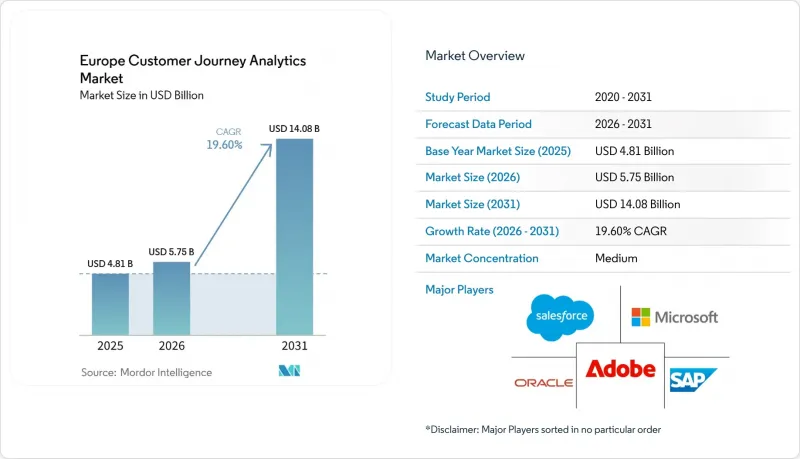
Mordor Intelligence에 의하면, 유럽의 고객 여정 분석 시장 규모는 2025년에 48억 1,000만 달러로 평가되었습니다. 2026년 57억 5,000만 달러, 2031년 140억 8,000만 달러에 이를 것으로 예측되며, 2026년부터 2031년에 걸쳐 CAGR 19.60%로 성장할 전망입니다.
본 보고서는 구성 요소(솔루션 및 서비스), 배포 방식(클라우드, On-Premise, 하이브리드), 용도(저니 매핑 및 시각화 등), 기업 규모(대기업, 중소기업), 최종 사용자 산업(정보 기술 및 통신 등), 지역별로 분류되어 있습니다. 시장 전망은 금액(달러) 기준으로 제시되어 있습니다.
유럽의 고객 여정 분석 시장 동향 및 인사이트
실시간 여정 오케스트레이션에 대한 수요 증가
정적 분석만으로는 더 이상 전환율이나 서비스 성과를 보장할 수 없게 됨에 따라, 유럽 전역의 기업들은 지연이 발생하는 여정 보고서를 대체하여 고객이 아직 활동 중인 동안 반응할 수 있는 시스템으로 전환하고 있습니다. 어도비는 2026년, CX Enterprise Coworker 내에서 ‘고객 여정 분석’, ‘여정 최적화 도구’ 및 ‘실시간 CDP’를 연동했습니다. 이는 실시간 의사결정 지원이 핵심 고객 워크플로우에 통합되고 있음을 보여줍니다. 또한, Contentsquare도 2026년에 AI 에이전트 기능, 프롬프트 분석, 대화 인텔리전스를 출시했습니다. 이는 수동적인 대시보드에서 능동적인 여정 모니터링으로의 전환을 반영합니다. FullStory는 2026년 6월 StoryAI 에이전트와 워크플로우 인텔리전스를 추가하여, 자율적인 발견과 조치를 디지털 경험 관리로 확대했습니다. 구매자들이 이러한 실행상의 격차를 메워감에 따라, 유럽의 고객 여정 분석 시장은 감지, 추천, 활성화를 단일 운영 계층으로 통합한 더 대규모의 플랫폼 계약으로 전환되고 있습니다.
개인정보 보호 제약이 있는 채널에서의 퍼스트파티 데이터 프로그램 확대
개인정보 보호 규제와 써드파티 신호 확보의 어려움으로 인해, 기업들은 자사의 행동 데이터, CRM 레코드, 로열티 프로그램 내 상호작용을 더욱 중시하며, 완전한 고객 여정을 재구성해야 하는 상황에 직면해 있습니다. 어도비는 2026년 자사의 ‘CX Analytics’ 출시가 포스트 쿠키 환경에서 크로스 채널 여정 측정에 대한 기업 수요를 충족시킬 것이라고 밝혔습니다. 이는 퍼스트 파티 데이터가 제품 설계의 중심에 있음을 보여줍니다. 또한 어도비는 2025년에 ‘Customer Journey Analytics B2B Edition’을 도입하여 개인, 구매 그룹, 계정, 영업 기회 전반에 걸친 여정을 분석할 수 있게 했습니다. 이는 복잡한 의사결정 주기에서 견고하고 자체 소유의 데이터 모델에 대한 광범위한 요구를 강조하는 것입니다. 실무적인 관점에서 볼 때, 이는 조직이 불안정한 외부 추적 기법에 의존하지 않고 더 강력한 가시성을 추구함에 따라 유럽의 고객 여정 분석 시장이 탄력을 받고 있음을 의미합니다. 그 결과, 데이터 통합의 품질이 대시보드의 심도만큼이나 중요하게 여겨지는 구매 패턴이 나타나고 있습니다. 이는 퍼스트 파티 데이터의 기반이 불충분하면 고급 모델링의 가치가 제한되기 때문입니다.
레거시 CRM 및 컨택 센터 시스템과의 통합 복잡성
고객 여정 분석이 제대로 작동하려면 CRM, 컨택 센터, 청구, 디지털 채널에서 나오는 데이터가 일관되게 연동되어야 하지만, 많은 대기업에서는 여전히 이것이 어려운 실정입니다. 이 문제는 기술 시대에 국한된 것이 아닙니다. 많은 기업에서 소유자가 서로 다르고, 워크플로가 다르며, 데이터 정의가 통일되지 않은 사업부별 시스템을 여전히 운영하고 있기 때문입니다. 도이치 텔레콤의 전환 사례는 기업이 왜 복잡한 전처리 환경에서 벗어나려고 하는지 보여주고 있지만, 동시에 클라우드 분석을 원활하게 운영하기 위해 필요한 아키텍처 작업의 규모가 얼마나 큰지를 여실히 드러내고 있습니다. 보다폰 이탈리아의 현대화 과정 역시 유사한 문제를 부각시키고 있습니다. 고객 데이터 워크플로우를 BigQuery로 이전하기 위해서는 단순한 소프트웨어 설치가 아닌 단계적인 변혁이 필요했기 때문입니다. 이로 인해 유럽의 고객 여정 분석 시장에서는 도입 주기가 장기화되고 있으며, 특히 통합 작업이 시작된 후에야 비로소 기존 시스템에 숨겨진 의존 관계가 드러나는 경우, 이러한 경향이 두드러집니다.
부문 분석
2025년에는 솔루션이 매출 점유율의 68.44%를 차지했으나, 서비스 부문은 2031년까지 연평균 성장률(CAGR) 22.68%를 나타낼 것으로 예측됩니다. 이러한 매출 우위는 특히 대규모 구매자가 이미 광범위한 소프트웨어 생태계를 활용하고 있는 경우, 엔터프라이즈 플랫폼 계약이 여전히 유럽의 고객 여정 분석 시장의 기반을 이루고 있음을 보여줍니다. 이러한 계약은 일반적으로 핵심 분석 기능, ID 관리, 보고 계층 및 여러 업무 기능에 걸친 여정 측정을 포괄합니다. 엔터프라이즈 플랫폼의 갱신 주기는 길고, 대규모 고객의 조달에서는 여전히 입지가 확고한 벤더가 우선시되기 때문에 이러한 도입 기반이 솔루션 매출을 지속적으로 견인하고 있습니다. 또한, 많은 조직이 먼저 기술 스택을 확보한 후 이를 기반으로 운영 모델을 확장해 나가는 이유도 여기서 설명됩니다.
서비스의 성장이 가속화되고 있다는 사실은 여정 데이터로부터 상업적 성과를 창출하기 위해서는 더 이상 소프트웨어만으로는 불충분함을 보여줍니다. 구매 기업들은 도입, 데이터 모델 설계, 거버넌스 구축, 대시보드 조정, 그리고本番 가동 후 비즈니스에의 정착 과정에서 점점 더 많은 지원을 필요로 하고 있습니다. 이러한 경향은 클라우드 전환, AI 워크플로우, 개인정보 보호 관리를 동시에 조정해야 하는 경우에 특히 두드러집니다. 그 결과, 유럽의 고객 여정 분석 시장은 플랫폼 구독과 자문 서비스 및 관리형 지원을 결합한, 보다 장기적인 벤더와의 관계로 전환되고 있습니다. 구체적으로, 서비스는 단순한 기본적인 판매 후 부가 기능이 아니라, 소프트웨어를 포괄하는 성능 계층으로 자리 잡고 있습니다.
2025년에는 도입 방식별 매출의 70.86%를 클라우드가 차지했으며, 탄력적인 인프라가 새로운 분석 투자에 있어 기본 설정이 되었음이 확인되었습니다. 이러한 우위는 대규모 행동 데이터 세트를 처리하고, 채널을 더 신속하게 통합하며, 무거운 On-Premise 하드웨어를 유지 관리하지 않고도 AI 기능을 지원해야 할 필요성을 반영합니다. 유럽의 고객 여정 분석 시장에서 클라우드 채택은 API 기반 아키텍처 및 데이터 웨어하우스와 연동된 워크플로우로의 광범위한 전환과 발을 맞추고 있습니다. 구매자들은 특히 계절이나 캠페인에 따라 고객 수가 변동하는 경우, 인프라 관련 마찰이 줄어들고 분석 기능 업데이트를 신속하게 배포할 수 있다는 점에 가치를 두고 있습니다. 이것이 바로 많은 주요 고객사에서 클라우드가 단순한 대체 도입 옵션에서 주요 아키텍처 표준으로 전환된 이유입니다.
규제가 엄격한 환경이나 주권을 고려해야 하는 환경, 특히 퍼블릭 클라우드에서의 처리에 대한 사내 승인 장벽이 높은 경우에는 On-Premise 배포가 여전히 중요하게 여겨지고 있습니다. 따라서 하이브리드 모델은 레거시 시스템을 급격하게 교체할 필요 없이 단계적으로 현대화를 추진할 수 있게 해주기 때문에 그 역할을 유지하고 있습니다. 도이치 텔레콤의 주권 플랫폼으로의 전환은 유럽의 데이터 보관 장소 관련 요건을 준수하면서도 클라우드 규모의 분석을 도입할 수 있음을 보여줍니다. 또한, 보다폰 이탈리아의 Google Cloud 및 BigQuery로의 전환은 비즈니스 연속성이 확보될 경우, 대기업들이 핵심 고객 데이터 워크플로우의 현대화에 적극적인 태도를 보이고 있음을 보여줍니다. 이러한 변화들이 맞물리면서, 유럽의 고객 여정 분석 시장에서 경쟁하는 벤더들에 대한 기준이 높아지고 있습니다. 이는 구매자들이 이제 규모와 지역별 규정 준수 대응을 모두 기대하고 있기 때문입니다.
기타 혜택 :
- 엑셀 형식 시장 예측(ME) 시트
- 3개월간의 애널리스트 지원
자주 묻는 질문
목차
제1장 서론
제2장 조사 방법
제3장 주요 요약
제4장 시장 구도
제5장 시장 규모 및 성장 예측
제6장 경쟁 구도
제7장 시장 기회 및 향후 전망
KTH 26.08.10According to Mordor Intelligence, the Europe customer journey analytics market size is projected to be USD 4.81 billion in 2025, USD 5.75 billion in 2026, and reach USD 14.08 billion by 2031, growing at a CAGR of 19.60% from 2026 to 2031.
This report is Segmented by Component (Solutions, and Services), Deployment Mode (Cloud, On-Premises, and Hybrid), Application (Journey Mapping and Visualisation, and More), End-User Enterprise Size (Large Enterprises, and Small and Mid-Size Enterprises), End-User Industry (Information Technology and Telecom, and More), and Geography. The Market Forecasts are Provided in Terms of Value (USD).
Europe Customer Journey Analytics Market Trends and Insights
Rising Demand for Real-Time Journey Orchestration
Enterprises across Europe are replacing delayed journey reporting with systems that respond while the customer is still active, because static analysis no longer protects conversion or service outcomes. Adobe connected Customer Journey Analytics, Journey Optimizer, and Real-Time CDP within CX Enterprise Coworker in 2026, which shows how live decision support is moving into core customer workflows. Contentsquare also launched AI agent capabilities, prompt analytics, and conversation intelligence in 2026, which reflects the shift toward active journey monitoring rather than passive dashboards. FullStory added StoryAI Agents and Workflow Intelligence in June 2026, extending autonomous discovery and action into digital experience management. As buyers close this execution gap, the Europe customer journey analytics market is moving toward larger platform contracts that combine detection, recommendation, and activation into a single operating layer.
Expansion of First-Party Data Programs Across Privacy-Constrained Channels
Privacy restrictions and weaker third-party signal availability are pushing companies to depend more on owned behavioral data, CRM records, and loyalty interactions to rebuild a complete customer path. Adobe said in 2026 that its CX Analytics launch addressed enterprise demand for cross-channel journey measurement in a post-cookie environment, which shows how first-party data has become central to product design. Adobe also introduced the Customer Journey Analytics B2B Edition in 2025 to analyze journeys across individuals, buying groups, accounts, and opportunities, underscoring a broader need for durable, owned data models in complex decision-making cycles. In practical terms, this means the Europe customer journey analytics market is gaining momentum as organizations seek stronger visibility without relying on unstable external tracking methods. The result is a buying pattern in which data integration quality matters as much as dashboard depth, because poor first-party foundations limit the value of advanced modeling.
High Integration Complexity with Legacy CRM and Contact Center Systems
Customer journey analytics only works when data from CRM, contact center, billing, and digital channels can be connected consistently, and that remains difficult in many large organizations. The problem is not limited to the technology age, because many enterprises still operate business-unit systems with separate owners, different workflows, and inconsistent data definitions. Deutsche Telekom's migration case shows why companies are leaving behind heavy-preprocessing environments, yet it also highlights the scale of architectural work required before cloud analytics can operate smoothly. Vodafone Italy's modernization path points to the same issue, because moving customer data workflows into BigQuery required a staged transformation rather than a simple software installation. This keeps deployment cycles long in the Europe customer journey analytics market, especially where hidden dependencies in older systems are discovered only after integration begins.
Other drivers and restraints analyzed in the detailed report include:
- Wider Adoption of AI-Based Journey Next-Best-Action Models
- Migration to Cloud-Native CX and Analytics Stacks
- Data Privacy Consent Fragmentation across European Markets
For complete list of drivers and restraints, kindly check the Table Of Contents.
Segment Analysis
Solutions held 68.44% revenue share in 2025, while services are projected to grow at a 22.68% CAGR through 2031. The revenue lead shows that enterprise platform contracts still anchor the Europe customer journey analytics market, especially where large buyers already use broad software ecosystems. These contracts usually cover core analytics capabilities, identity management, reporting layers, and journey measurement across several business functions. That installed base keeps solutions in front of current revenue, because replacement cycles for enterprise platforms are long and procurement still favors established vendors in large accounts. It also explains why many organizations first secure the technology stack and then expand the operating model around it.
The faster service growth shows that software alone is no longer enough to deliver commercial results from journey data. Buyers increasingly need help with implementation, data model design, governance setup, dashboard tuning, and business adoption after go-live. This pattern is especially evident when cloud migration, AI workflows, and privacy controls must be coordinated simultaneously. As a result, the Europe customer journey analytics market is shifting toward longer vendor relationships that mix platform subscriptions with advisory and managed support. In practical terms, services are becoming a performance layer around the software rather than a basic post-sale add-on.
Cloud accounted for 70.86% of deployment-mode revenue in 2025, confirming that elastic infrastructure has become the default setting for new analytics investments. That lead reflects the need to process larger behavioral datasets, unify channels faster, and support AI functions without maintaining heavy local hardware. In the Europe customer journey analytics market, cloud adoption aligns with the broader shift toward API-based architectures and warehouse-connected workflows. Buyers see value in lower infrastructure friction and faster rollout of analytics updates, especially when customer volumes change across seasons or campaigns. This is why cloud has moved from an alternative deployment choice to the main architecture baseline across many large accounts.
On-premises deployments still matter in regulated or sovereignty-sensitive settings, particularly where public cloud processing remains a harder internal approval path. Hybrid models, therefore, retain a role because they allow organizations to modernize in stages rather than force an abrupt replacement of legacy systems. Deutsche Telekom's sovereign platform migration illustrates how cloud-scale analytics can be introduced while still respecting European data location requirements. Vodafone Italy's move to Google Cloud and BigQuery also shows that major enterprises are willing to modernize core customer data workflows when operational continuity can be protected. Together, these shifts are raising the standard for vendors competing in the Europe customer journey analytics market, because buyers now expect both scale and regional compliance support.
Complete Report Scope:
- By Component
- Solutions
- Services
- By Deployment Mode
- Cloud
- On-Premises
- Hybrid
- By Application
- Journey Mapping and Visualisation
- Campaign and Journey Orchestration
- Brand and Product Management
- Customer Behaviour and Attribution
- By End-User Enterprise Size
- Large Enterprises
- Small and Mid-Size Enterprises
- By End-User Industry
- Banking, Financial Services, and Insurance (BFSI)
- Retail and eCommerce
- Information Technology and Telecom
- Healthcare and Life-Sciences
- Media and Entertainment
- Travel and Hospitality
- Automotive and Mobility
- Other End-User Industries
- By Geography
- Germany
- United Kingdom
- France
- Italy
- Spain
- Rest of Europe
List of Companies Covered in this Report:
- Adobe Inc.
- Salesforce, Inc.
- Oracle Corporation
- Microsoft Corporation
- SAP SE
- IBM Corporation
- NICE Ltd.
- Verint Systems Inc.
- Contentsquare SA
- Glassbox Ltd.
- FullStory, Inc.
- Quantum Metric, Inc.
- Mixpanel, Inc.
- Amplitude, Inc.
- Medallia, Inc.
- Tealium, Inc.
- Genesys Telecommunications Laboratories, LLC
- Calabrio, Inc.
- Woopra, Inc.
- CSG Systems International, Inc.
Additional Benefits:
- The market estimate (ME) sheet in Excel format
- 3 months of analyst support
TABLE OF CONTENTS
1 INTRODUCTION
- 1.1 Study Assumptions and Market Definition
- 1.2 Scope of the Study
2 RESEARCH METHODOLOGY
3 EXECUTIVE SUMMARY
4 MARKET LANDSCAPE
- 4.1 Market Overview
- 4.2 Market Drivers
- 4.2.1 Rising Demand for Real-Time Journey Orchestration
- 4.2.2 Expansion of First-Party Data Programs across Privacy-Constrained Channels
- 4.2.3 Wider Adoption of AI-Based Journey Next-Best-Action Models
- 4.2.4 Migration to Cloud-Native CX and Analytics Stacks
- 4.2.5 Growth of Composable Customer Data Architectures
- 4.2.6 Need for Cross-Channel Attribution in Complex Buying Journeys
- 4.3 Market Restraints
- 4.3.1 High Integration Complexity With Legacy CRM and Contact Center Systems
- 4.3.2 Data Privacy Consent Fragmentation across European Markets
- 4.3.3 Shortage of Journey Analytics Talent and Data Engineering Capacity
- 4.3.4 Model Drift and Governance Risk in AI-Driven Journey Decisions
- 4.4 Industry Value Chain Analysis
- 4.5 Impact of Macroeconomic Factors on the Market
- 4.6 Technology Outlook
- 4.7 Regulatory Landscape
- 4.8 Porter's Five Forces Analysis
- 4.8.1 Threat of New Entrants
- 4.8.2 Bargaining Power of Suppliers
- 4.8.3 Bargaining Power of Buyers
- 4.8.4 Threat of Substitutes
- 4.8.5 Competitive Rivalry
5 MARKET SIZE AND GROWTH FORECASTS (VALUE)
- 5.1 By Component
- 5.1.1 Solutions
- 5.1.2 Services
- 5.2 By Deployment Mode
- 5.2.1 Cloud
- 5.2.2 On-Premises
- 5.2.3 Hybrid
- 5.3 By Application
- 5.3.1 Journey Mapping and Visualisation
- 5.3.2 Campaign and Journey Orchestration
- 5.3.3 Brand and Product Management
- 5.3.4 Customer Behaviour and Attribution
- 5.4 By End-User Enterprise Size
- 5.4.1 Large Enterprises
- 5.4.2 Small and Mid-Size Enterprises
- 5.5 By End-User Industry
- 5.5.1 Banking, Financial Services, and Insurance (BFSI)
- 5.5.2 Retail and eCommerce
- 5.5.3 Information Technology and Telecom
- 5.5.4 Healthcare and Life-Sciences
- 5.5.5 Media and Entertainment
- 5.5.6 Travel and Hospitality
- 5.5.7 Automotive and Mobility
- 5.5.8 Other End-User Industries
- 5.6 By Geography
- 5.6.1 Germany
- 5.6.2 United Kingdom
- 5.6.3 France
- 5.6.4 Italy
- 5.6.5 Spain
- 5.6.6 Rest of Europe
6 COMPETITIVE LANDSCAPE
- 6.1 Market Concentration
- 6.2 Strategic Moves
- 6.3 Market Share Analysis
- 6.4 Company Profiles (includes Global Level Overview, Market Level Overview, Core Segments, Financials as available, Strategic Information, Market Rank/Share, Products and Services, Recent Developments)
- 6.4.1 Adobe Inc.
- 6.4.2 Salesforce, Inc.
- 6.4.3 Oracle Corporation
- 6.4.4 Microsoft Corporation
- 6.4.5 SAP SE
- 6.4.6 IBM Corporation
- 6.4.7 NICE Ltd.
- 6.4.8 Verint Systems Inc.
- 6.4.9 Contentsquare SA
- 6.4.10 Glassbox Ltd.
- 6.4.11 FullStory, Inc.
- 6.4.12 Quantum Metric, Inc.
- 6.4.13 Mixpanel, Inc.
- 6.4.14 Amplitude, Inc.
- 6.4.15 Medallia, Inc.
- 6.4.16 Tealium, Inc.
- 6.4.17 Genesys Telecommunications Laboratories, LLC
- 6.4.18 Calabrio, Inc.
- 6.4.19 Woopra, Inc.
- 6.4.20 CSG Systems International, Inc.
7 MARKET OPPORTUNITIES AND FUTURE OUTLOOK
- 7.1 White-Space and Unmet-Need Assessment


