
|
시장보고서
상품코드
2099505
리테일 미디어 네트워크(RMN) 기술 플랫폼 : 시장 점유율 분석, 업계 동향 및 통계, 성장 예측(2026-2031년)Retail Media Network (RMN) Technology Platform - Market Share Analysis, Industry Trends & Statistics, Growth Forecasts (2026 - 2031) |
||||||
 Mordor Intelligence
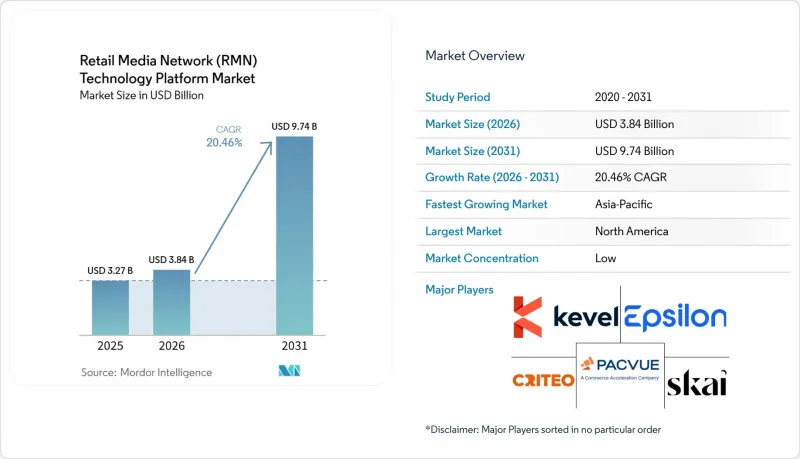
Mordor Intelligence에 의하면, 리테일 미디어 네트워크(RMN) 기술 플랫폼 시장 규모는 2025년 32억 7,000만 달러로 평가되었습니다. 2026년 38억 4,000만 달러에서 2031년까지 97억 4,000만 달러로 확대되어 2026년부터 2031년에 걸쳐 CAGR 20.46%를 나타낼 것으로 예측됩니다.
본 보고서는 플랫폼 유형(소매업체 소유 미디어 플랫폼 등), 광고 형식(디스플레이 광고, 검색 광고 등), 배포 방식(클라우드 기반, On-Premise형, 하이브리드형), 기업 규모(대기업, 중소기업), 최종 사용자 산업(CPG/FMCG 등), 지역별로 분류되어 있습니다. 시장 전망은 금액(달러) 기준으로 제시되어 있습니다.
세계의 리테일 미디어 네트워크(RMN) 기술 플랫폼 시장 동향 및 인사이트
써드파티 쿠키의 쇠퇴와 퍼스트파티 데이터의 부상
써드파티 오디언스에 대한 접근의 신뢰성이 떨어지고 있으며, 개인정보 보호 관련 규제도 강화됨에 따라 리테일 미디어 네트워크(RMN) 기술 플랫폼 시장은 현재 동의를 얻은 쇼핑객의 데이터에 점점 더 의존하고 있습니다. 로열티 프로그램, POS(판매 시점 정보 관리) 기록, 인증된 계정 시스템을 구축한 소매업체는 외부에서 구매한 부문이 아닌, 검증된 구매 행동을 기반으로 한 타겟팅을 제공할 수 있습니다. 이로 인해 미디어 배분이 변화합니다. 브랜드는 오디언스의 식별 정보, 거래 데이터, 전환 보고서가 이미 동일한 상용 시스템 내에 존재하는 환경에 광고비를 투입할 수 있게 되기 때문입니다. 또한, 활성화가 옵트인된 고객 기록과 밀접하게 연관되어 고위험 데이터 공유 모델에서 멀어짐에 따라 광고주의 규정 준수 체계도 강화됩니다. 이러한 상황이 주요 시장으로 확산됨에 따라, 리테일 미디어 네트워크(RMN) 기술 플랫폼 시장에서는 오디언스 활성화 기능을 소매업체의 데이터 스택과 긴밀하게 연계하고, 보다 명확한 동의 체계 내에 포함시키는 플랫폼이 우위를 점할 것입니다.
AI를 활용한 오디언스 활성화 및 자동화된 캠페인 운영
캠페인 설정, 입찰, 세분화, 보고서 작성 등 모든 과정이 신속한 자동화의 혜택을 받음에 따라, AI는 리테일 미디어 네트워크(RMN) 기술 플랫폼 시장에서 단순한 지원 도구에서 운영 계층으로 전환되고 있습니다. 그 결과, 소매업체들은 다양한 형식에 걸친 보다 정교한 캠페인을 시작하고 유지하기 위해 대규모 수작업 팀에 그다지 의존할 필요가 없어지고 있습니다. 월마트 커넥트는 ‘Luminate Bid Intelligence’를 통해 이러한 방향성을 더욱 강화했습니다. 이 솔루션은 월마트의 주간 쇼핑객 데이터에서 도출된 퍼스트파티 구매 신호를 디스플레이, 동영상, 스폰서 광고 슬롯에 걸친 실시간 타겟팅과 연동합니다. 또한 크리테오(Criteo)와 덴츠(Dentsu)는 2026년 5월에 실시된 완전히 통합된 MCP 캠페인 출시를 통해 리테일 미디어 실행에서 자연어 기반 오케스트레이션을 가능하게 함으로써, AI 인터페이스가 캠페인 관리를 어떻게 혁신하고 있는지 보여주었습니다. 이러한 도구의 도입이 용이해짐에 따라, 그동안 운영상의 복잡성으로 어려움을 겪어왔던 중견 소매업체나 소규모 광고주에게도 리테일 미디어 네트워크(RMN) 기술 플랫폼 시장 진입이 더욱 수월해지고 있습니다.
측정의 파편화와 증분 효과 입증의 취약성
각 네트워크가 여전히 리프트, 어트리뷰션 윈도우, 테스트 설계를 독자적인 방식으로 정의하는 경향이 있어 성과에 대한 직접적인 비교가 어렵기 때문에 측정은 여전히 큰 제약 요인으로 남아 있습니다. IAB 및 IAB Europe은 2025년 11월에 증분 효과에 관한 공동 지침을 발표했으나, 공통된 정의가 있다고 해서 네트워크 간에 통일된 운영이 보장되는 것은 아닙니다. 각 브랜드사는 분명히 성과에 대한 더 강력한 증명을 요구하고 있으며, Skai가 2026년에 실시한 측정 및 증분 효과에 관한 조사에 따르면, 이것이 여전히 예산 확대의 핵심 조건 중 하나임이 드러났습니다. 리테일 미디어 네트워크(RMN) 기술 플랫폼 시장의 문제는 비교 가능성이 낮아 신뢰성을 떨어뜨리고, 설령 단일 네트워크 내 캠페인 결과가 양호해 보이더라도 지출이 억제될 가능성이 있다는 점입니다. 플랫폼 간 측정 결과의 감사 가능성이 높아질 때까지는 리테일 미디어 네트워크(RMN) 기술 플랫폼 시장이 소매업체 간에 공정하게 비교할 수 있는 증거를 요구하는 광고주들의 예산 측면에서 저항에 직면할 가능성이 높습니다.
부문 분석
2025년, 소매업체 소유 미디어 플랫폼은 42.31%의 점유율을 차지했습니다. 이는 단일 상업 환경 내에서 쇼핑객의 신원, 재고, 어트리뷰션을 관리할 수 있다는 이점을 반영한 것입니다. 리테일 미디어 네트워크(RMN) 기술 플랫폼 시장에서 이 모델은 오디언스 및 전환 데이터를 트랜잭션 계층 근처에 유지하면서 트래픽을 직접 수익화할 수 있게 함으로써 최대 규모의 소매업체에 이익을 가져다줍니다. Amazon Ads와 Walmart Connect는 광고 수요, 소매 트래픽, 폐쇄형 루프 보고서가 서로 시너지를 발휘함으로써 이 구조가 얼마나 대규모로 확장될 수 있는지를 보여줍니다. 또한, 브랜드가 구매 연계형 측정 방식의 명확화나 광범위한 카테고리에 대한 도달을 추구할 때, 왜 대형 소매업체가 운영하는 플랫폼을 최우선으로 선택하는 경우가 많은지도 설명하고 있습니다. 따라서 소매업체 소유 부문이 주도적인 위치를 차지한 것은 단순히 미디어 인벤토리의 양이 많기 때문만이 아니라, 데이터의 깊이, 관리 능력, 측정 기능을 단일 운영 체제에 통합했기 때문입니다.
제3자 소매 미디어 플랫폼도 여전히 중요한 역할을 수행하고 있습니다. 광고주는 각 네트워크를 개별적으로 관리하는 대신, 단일 구매 지점을 통해 여러 소매업체와의 관계에 접근할 수 있기 때문입니다. 이를 통해 자체 플랫폼이 아직 발전 단계에 있는 중견 소매업체 전반에 광범위하게 도달해야 하는 브랜드의 경우, 워크플로우 부담이 경감됩니다. 또한, 리테일 미디어 네트워크(RMN) 기술 플랫폼 업계에는 소매업체 단독으로는 아직 충분한 규모를 확보하지 못한 경우, 수요를 집약하고 실행을 간소화할 수 있는 전문 업체를 위한 여지도 남아 있습니다. 소매업체들이 별도의 도구를 사용하지 않고도 사이트 내 광고, 사이트 외 프로모션, 매장 내 광고 매체 및 측정을 연계하는 통합 시스템을 요구하는 가운데, 옴니채널 플랫폼은 2031년까지 연평균 성장률(CAGR) 24.83%를 나타낼 것으로 예측됩니다. Mirakl의 MCP 네이티브 광고 배포 개시 및 Pacvue Prism은 시장이 고립된 포인트 솔루션이 아닌, 보다 광범위한 오케스트레이션으로 전환되고 있음을 보여줍니다.
2025년에는 검색 광고가 31.24%의 점유율을 차지했으며, 이는 스폰서 상품이 리테일 미디어 네트워크(RMN) 기술 플랫폼 시장에서 핵심적인 성과 기반 형식으로 계속 자리 잡고 있음을 뒷받침합니다. 그 강점은 높은 구매 의도, 구매와의 근접성, 그리고 광고주가 입찰 결정을 측정 가능한 상업적 성과와 쉽게 연결할 수 있다는 점에 있습니다. 또한, 검색 광고는 쇼핑 경험을 근본적으로 바꾸지 않고도 디스커버리 흐름에 통합될 수 있어 소매업체의 웹사이트나 앱에 자연스럽게 녹아듭니다. 디스플레이 광고와 스폰서 컨텐츠는 계속해서 인지도 향상과 구매 고려를 촉진하고 있지만, 예산의 중심은 여전히 전환 지향적인 광고 슬롯에 쏠려 있습니다. 네이티브 포맷의 점유율은 여전히 작지만, 수익화 수준이 높아지는 상황에서도 사용 편의성을 유지할 수 있는 광고 유닛이 소매업체에 요구되고 있기 때문에 그 중요성은 변함이 없습니다.
동영상 광고는 2031년까지 연평균 성장률(CAGR) 26.47%를 나타낼 것으로 예측되며, 이에 따라 리테일 미디어 네트워크(RMN) 기술 플랫폼 시장에서 가장 빠르게 성장하는 포맷이 될 것입니다. 이러한 변화는 커넥티드 TV의 보급, 더욱 풍부한 상품 스토리텔링, 그리고 퍼널 업스트림 단계의 노출과 커머스 성과를 연계하려는 노력의 확대와 밀접한 관련이 있습니다. IAB의 2026년 디지털 동영상 조사에 따르면, 동영상은 여전히 성장 분야이며, 셀프 서비스 도구를 통해 보다 광범위한 미디어 전략을 시도하고자 하는 광고주의 진입 장벽이 낮아지고 있습니다. 또한 Mirakl이나 Walmart Connect의 사례에서도 볼 수 있듯이, 동영상, 스폰서드 커머스, 오디언스 데이터가 다양한 매체 간에 더욱 긴밀하게 연계되기 시작하고 있습니다. 그 결과, 검색이 여전히 수익화의 기반이 되고 있는 리테일 미디어 네트워크(RMN) 기술 플랫폼 시장은 단일 하단 퍼널 형식에 대한 의존도를 점차 낮추고 있습니다.
지역별 분석
2025년, 북미는 전체 시장의 36.42%를 차지하며 리테일 미디어 네트워크(RMN) 기술 플랫폼 시장에서 가장 규모가 큰 지역 블록이 되었습니다. 이 지역은 소매업체 주도의 최대 규모 광고 사업의 존재, 광고주의 커머스 미디어에 대한 깊은 이해, 그리고 대규모 디지털 커머스 생태계와 연계된 쇼핑객 데이터의 광범위한 이용 가능성 등의 이점을 누리고 있습니다. 이 지역에서는 여전히 규모가 중요시되고 있습니다. 대형 사업자들은 소규모 네트워크 대다수보다 더 광범위한 인벤토리, 구매 연계형 보고서, 그리고 더 성숙한 활성화 도구를 제공할 수 있기 때문입니다. Walmart Connect의 지속적인 AI 투자와 광범위한 멀티 포맷 전개는 북미의 주요 기업들이 단순히 트래픽 규모에만 의존하지 않고, 광고주에게 제공하는 가치를 더욱 심화시키려 하고 있음을 보여줍니다. 동시에 측정 기준에 대한 기대가 높아지면서, 플랫폼 제공업체들은 리테일 미디어 프로그램 전반에 걸쳐 비교 가능성과 감사 가능성을 지속적으로 개선해야 하는 압박을 받고 있습니다.
아시아태평양은 2031년까지 연평균 성장률(CAGR) 24.19%를 나타낼 것으로 예측되며, 리테일 미디어 네트워크(RMN) 기술 플랫폼 시장에서 가장 두드러진 성장을 보이는 지역입니다. 이 지역에서는 몇몇 주요 경제권에서 디지털 커머스가 이미 구매 행동에 깊이 침투해 있으며, 밀도가 높은 퍼스트파티 신호 풀이 형성되어 있어 보다 신속한 확장이 가능합니다. 또한, 모바일 중심의 참여 패턴 덕분에 스폰서 광고 슬롯, 동영상, 통합된 캠페인 여정을 통해 커머스 플랫폼의 수익 창출이 용이해지고 있습니다. 이 지역의 많은 소매업체와 마켓플레이스는 이미 충분한 규모로 사업을 전개하고 있으며, 오디언스 활성화 및 클로즈드 루프 측정이 단순한 부가 서비스가 아닌 실질적인 수익원이 될 수 있는 단계에 이르렀습니다. 이러한 요인들이 맞물려 리테일 미디어 네트워크(RMN) 기술 시장이 점점 더 세계화되는 가운데, 아시아태평양은 계속해서 플랫폼 투자를 유치할 수 있는 유리한 위치에 있습니다.
유럽은 리테일 미디어 네트워크(RMN) 기술 플랫폼 시장에서 여전히 핵심 지역이며, GDPR(EU 개인정보보호규정)과 관련된 데이터 처리 요건 및 국경을 넘는 데이터 전송 제약이 그 발전 방향을 보다 직접적으로 형성하고 있습니다. 이러한 상황으로 인해 동의 관리, 데이터 최소화, 그리고 지역에 더 부합하는 활성화 워크플로우를 지원하는 아키텍처에 대한 수요가 증가하고 있습니다. 남미는 시범 단계에서 보다 체계적인 도입 단계로 전환되고 있으며, 리테일 미디어 확장을 위한 제공업체와의 제휴는 이 지역이 플랫폼 공급업체로부터 전략적인 주목을 받고 있음을 보여줍니다. 중동 및 아프리카는 여전히 초기 단계 시장이지만, 디지털 커머스에 대한 투자와 쇼핑객 데이터 인프라 확충을 통해 리테일 미디어 네트워크(RMN) 기술 플랫폼 시장에서 이 지역은 장기적인 성장 여지가 있습니다.
기타 혜택 :
- 엑셀 형식 시장 예측(ME) 시트
- 3개월간의 애널리스트 지원
자주 묻는 질문
목차
제1장 서론
제2장 조사 방법
제3장 주요 요약
제4장 시장 구도
제5장 시장 규모 및 성장 예측
제6장 경쟁 구도
제7장 시장 기회 및 향후 전망
KTH 26.08.10According to Mordor Intelligence, the retail media network (RMN) technology platform market size is projected to expand from USD 3.27 billion in 2025 and USD 3.84 billion in 2026 to USD 9.74 billion by 2031, registering a CAGR of 20.46% between 2026 to 2031.
This report is Segmented by Platform Type (Retailer-Owned Media Platforms, and More), Ad Format (Display Ads, Search Ads, and More), Deployment Mode (Cloud-Based, On-Premise, and Hybrid), Enterprise Size (Large Enterprises, and Small and Medium Enterprises), End-User Industry (CPG/FMCG, and More), and Geography. The Market Forecasts are Provided in Terms of Value (USD).
Global Retail Media Network (RMN) Technology Platform Market Trends and Insights
Third-Party Cookie Depreciation and First-Party Data Acceleration
The retail media network (RMN) technology platform market now relies more on consented shopper data because third-party audience access is becoming less reliable and privacy obligations are becoming stricter. Retailers that built loyalty programs, point-of-sale records, and authenticated account systems can offer targeting based on verified purchase behavior rather than rented external segments. That changes media allocation because brands can place spend inside environments where audience identity, transaction data, and conversion reporting already sit within the same commercial system. It also improves the compliance posture for advertisers because activation stays closer to opted-in customer records and away from more exposed data-sharing models. As those conditions spread across major markets, the retail media network (RMN) technology platform market is likely to favor platforms that keep audience activation close to the retailer data stack and inside clearer consent boundaries.
AI-Driven Audience Activation and Automated Campaign Operations
AI is moving from a support tool to an operating layer within the retail media network (RMN) technology platform market, as campaign setup, bidding, segmentation, and reporting all benefit from faster automation. The practical effect is that retailers do not need to rely as heavily on large manual teams to launch and maintain more sophisticated campaigns across formats. Walmart Connect strengthened that direction with Luminate Bid Intelligence, which links first-party purchase signals from its weekly shopper base to real-time targeting across display, video, and sponsored placements. Criteo and Dentsu also showed how AI interfaces are changing campaign management by enabling natural-language orchestration for retail media execution through a fully orchestrated MCP campaign launch in May 2026. As these tools become easier to deploy, the retail media network (RMN) technology platform market becomes more accessible to mid-tier retailers and smaller advertisers that previously struggled with operational complexity.
Measurement Fragmentation and Weak Incrementality Proof
Measurement remains a real constraint because each network still tends to define lift, attribution windows, and test design in its own way, making direct performance comparisons difficult. The IAB and IAB Europe released joint incrementality guidance in November 2025, but a shared definition alone does not ensure uniform execution across networks. Brands are clearly asking for stronger proof of outcome, and Skai's 2026 work on measurement and incrementality shows that this remains one of the central conditions for budget expansion. The problem for the retail media network (RMN) technology platform market is that weak comparability lowers confidence, which can cap spending even when campaign results look strong within a single network. Until measurement becomes more auditable across platforms, the retail media network (RMN) technology platform market is likely to face budget friction from advertisers that want proof they can compare across retailers on a fair basis.
Other drivers and restraints analyzed in the detailed report include:
- Retailer Monetization Pressure from High-Margin Media Revenue
- Omnichannel Orchestration Across On-Site, Off-Site, and In-Store Inventory
- Integration Complexity Across Legacy Retail Tech Stacks
For complete list of drivers and restraints, kindly check the Table Of Contents.
Segment Analysis
Retailer-owned media platforms held a 42.31% share in 2025, reflecting the advantage of controlling shopper identity, inventory, and attribution within a single commercial environment. In the retail media network (RMN) technology platform market, that model benefits the largest merchants by enabling them to monetize traffic directly while keeping audience and conversion data close to the transaction layer. Amazon Ads and Walmart Connect illustrate how far this structure can scale when ad demand, retail traffic, and closed-loop reporting reinforce one another. It also explains why brands often prioritize the biggest retailer-operated platforms first when they want clearer purchase-linked measurement and broad category reach. The retailer-owned segment, therefore, led not just because of media inventory, but because it packaged data depth, control, and measurement into a single operating system.
Third-party retail media platforms still play an important role because they let advertisers access multiple retailer relationships from a single buying point rather than managing each network independently. That reduces workflow strain for brands that need broader reach across mid-market merchants whose proprietary platforms are still developing. The retail media network (RMN) technology platform industry also leaves room for specialists that can aggregate demand and simplify execution where retailer scale is not yet sufficient on its own. Omnichannel platforms are projected to grow at a 24.83% CAGR through 2031, as retailers seek unified systems that connect on-site ads, off-site activations, in-store surfaces, and measurement without separate tools. Mirakl's MCP-native ad serving launch and Pacvue Prism both demonstrate how the market is moving toward broader orchestration rather than isolated point solutions.
Search ads held a 31.24% share in 2025, which confirms that sponsored products remain the core performance format for the retail media network (RMN) technology platform market. Their strength comes from intent, proximity to purchase, and the ease with which advertisers can connect bidding decisions to measurable commercial outcomes. Search placements also fit naturally into retailer websites and apps because they can be embedded in discovery flows without radically changing the shopping experience. Display and sponsored content continue to support awareness and consideration, but the budget center of gravity still sits closer to conversion-oriented placements. Native formats remain smaller, yet they matter because retailers need ad units that preserve usability as monetization intensity rises.
Video ads are projected to grow at a 26.47% CAGR through 2031, which makes them the fastest-growing format in the retail media network (RMN) technology platform market. That shift is closely tied to connected TV adoption, richer product storytelling, and the growing effort to link upper-funnel exposure with commerce outcomes. The IAB's 2026 digital video work shows that video remains a growth area, while self-serve tools are lowering entry barriers for advertisers that want to test broader media strategies. Mirakl and Walmart Connect also show how video, sponsored commerce, and audience data are moving into tighter operational alignment across surfaces. As a result, the retail media network (RMN) technology platform market is becoming less dependent on a single bottom-funnel format, even though search still anchors monetization.
Complete Report Scope:
- By Platform Type
- Retailer-Owned Media Platforms
- Third-Party Retail Media Platforms
- Omnichannel Retail Media Platforms
- By Ad Format
- Display Ads
- Search Ads
- Sponsored Content
- Video Ads
- Native Ads
- By Deployment Mode
- Cloud-Based
- On-Premise
- Hybrid
- By Enterprise Size
- Large Enterprises
- Small And Medium Enterprises
- By End-User Industry
- Retail & E-Commerce
- CPG/FMCG
- Consumer Electronics
- BFSI
- Healthcare
- Automotive
- Travel
- Telecom
- Other End-user Industries
- By Geography
- North America
- United States
- Canada
- Mexico
- South America
- Brazil
- Argentina
- Rest of South America
- Europe
- Germany
- United Kingdom
- France
- Italy
- Spain
- Russia
- Rest of Europe
- Asia-Pacific
- China
- India
- Japan
- South Korea
- Australia
- Rest of Asia-Pacific
- Middle East and Africa
- Middle East
- Saudi Arabia
- United Arab Emirates
- Rest of Middle East
- Africa
- South Africa
- Nigeria
- Rest of Africa
- Middle East
- North America
Geography Analysis
North America accounted for 36.42% of the market in 2025, making it the largest regional block in the retail media network (RMN) technology platform market. The region benefits from the presence of the biggest retailer-led advertising businesses, deep advertiser familiarity with commerce media, and broad availability of shopper data tied to large digital commerce ecosystems. Scale still matters here because large operators can offer inventory breadth, purchase-linked reporting, and more mature activation tools than most smaller networks. Walmart Connect's continued AI investment and broad multi-format activation show how North American leaders are trying to deepen advertiser value rather than rely only on traffic scale. At the same time, measurement expectations are rising, which continues to pressure platform providers to improve comparability and auditability across retail media programs.
Asia-Pacific is projected to grow at a 24.19% CAGR through 2031, which makes it the fastest-growing region in the retail media network (RMN) technology platform market. The region supports faster expansion because digital commerce is already deeply embedded in shopping behavior across several large economies, which creates dense first-party signal pools. Mobile-led engagement patterns also make commerce surfaces easier to monetize through sponsored placements, video, and integrated campaign journeys. Many retailers and marketplaces in the region already operate at a scale where audience activation and closed-loop measurement can become viable revenue engines rather than side offerings. That combination leaves Asia-Pacific well positioned to continue attracting platform investment as the retail media network (RMN) technology market becomes increasingly global.
Europe remained a core region within the retail media network (RMN) technology platform market, and GDPR-linked data-handling requirements and cross-border transfer constraints more directly shape its development path. Those conditions create a stronger demand for architectures that support consent control, data minimization, and more localized activation workflows. South America is moving from pilot activity toward more structured adoption, and provider partnerships around retail media scaling show that the region is gaining strategic attention from platform vendors. Middle East and Africa remain earlier-stage opportunities, but digital commerce investment and expanding shopper data infrastructure give the region a longer runway within the retail media network (RMN) technology platform market.
- Kevel, Inc.
- Epsilon Data Management, LLC
- Criteo S.A.
- Pacvue, Inc.
- Skai Inc.
- Pentaleap, Inc.
- Zitcha Pty Ltd
- Topsort, Inc.
- Koddi, Inc.
- Mirakl SAS
- Rokt Pte. Ltd.
- Inmar Intelligence LLC
- Moloco, Inc.
- The Trade Desk, Inc.
- Amazon.com, Inc.
- Walmart Inc.
- LiveRamp Holdings, Inc
- CitrusAd Pty Ltd
- Xnurta Inc.
- Vantage
Additional Benefits:
- The market estimate (ME) sheet in Excel format
- 3 months of analyst support
TABLE OF CONTENTS
1 INTRODUCTION
- 1.1 Study Assumptions and Market Definition
- 1.2 Scope of the Study
2 RESEARCH METHODOLOGY
3 EXECUTIVE SUMMARY
4 MARKET LANDSCAPE
- 4.1 Market Overview
- 4.2 Market Drivers
- 4.2.1 Third-Party Cookie Depreciation and First-Party Data Acceleration
- 4.2.2 Retailer Monetization Pressure From High-Margin Media Revenue
- 4.2.3 Omnichannel Orchestration Across On-Site, Off-Site, and In-Store Inventory
- 4.2.4 Self-Service Ad Platforms Expanding Access to Smaller Advertisers
- 4.2.5 AI-Driven Audience Activation and Automated Campaign Operations
- 4.2.6 Retail Media as a Commerce Content Operating System
- 4.3 Market Restraints
- 4.3.1 Measurement Fragmentation and Weak Incrementality Proof
- 4.3.2 Integration Complexity Across Legacy Retail Tech Stacks
- 4.3.3 Privacy, Consent, and Data Localization Compliance Burden
- 4.3.4 Ad Load Versus Shopper Experience Trade-Off
- 4.4 Impact of Macroeconomic Factors on the Market
- 4.5 Industry Value Chain Analysis
- 4.6 Technology Outlook
- 4.7 Regulatory Landscape
- 4.8 Porter's Five Forces Analysis
- 4.8.1 Threat of New Entrants
- 4.8.2 Bargaining Power of Suppliers
- 4.8.3 Bargaining Power of Buyers
- 4.8.4 Threat of Substitutes
- 4.8.5 Intensity of Competitive Rivalry
5 MARKET SIZE AND GROWTH FORECASTS (VALUE)
- 5.1 By Platform Type
- 5.1.1 Retailer-Owned Media Platforms
- 5.1.2 Third-Party Retail Media Platforms
- 5.1.3 Omnichannel Retail Media Platforms
- 5.2 By Ad Format
- 5.2.1 Display Ads
- 5.2.2 Search Ads
- 5.2.3 Sponsored Content
- 5.2.4 Video Ads
- 5.2.5 Native Ads
- 5.3 By Deployment Mode
- 5.3.1 Cloud-Based
- 5.3.2 On-Premise
- 5.3.3 Hybrid
- 5.4 By Enterprise Size
- 5.4.1 Large Enterprises
- 5.4.2 Small And Medium Enterprises
- 5.5 By End-User Industry
- 5.5.1 Retail & E-Commerce
- 5.5.2 CPG/FMCG
- 5.5.3 Consumer Electronics
- 5.5.4 BFSI
- 5.5.5 Healthcare
- 5.5.6 Automotive
- 5.5.7 Travel
- 5.5.8 Telecom
- 5.5.9 Other End-user Industries
- 5.6 By Geography
- 5.6.1 North America
- 5.6.1.1 United States
- 5.6.1.2 Canada
- 5.6.1.3 Mexico
- 5.6.2 South America
- 5.6.2.1 Brazil
- 5.6.2.2 Argentina
- 5.6.2.3 Rest of South America
- 5.6.3 Europe
- 5.6.3.1 Germany
- 5.6.3.2 United Kingdom
- 5.6.3.3 France
- 5.6.3.4 Italy
- 5.6.3.5 Spain
- 5.6.3.6 Russia
- 5.6.3.7 Rest of Europe
- 5.6.4 Asia-Pacific
- 5.6.4.1 China
- 5.6.4.2 India
- 5.6.4.3 Japan
- 5.6.4.4 South Korea
- 5.6.4.5 Australia
- 5.6.4.6 Rest of Asia-Pacific
- 5.6.5 Middle East and Africa
- 5.6.5.1 Middle East
- 5.6.5.1.1 Saudi Arabia
- 5.6.5.1.2 United Arab Emirates
- 5.6.5.1.3 Rest of Middle East
- 5.6.5.2 Africa
- 5.6.5.2.1 South Africa
- 5.6.5.2.2 Nigeria
- 5.6.5.2.3 Rest of Africa
- 5.6.5.1 Middle East
- 5.6.1 North America
6 COMPETITIVE LANDSCAPE
- 6.1 Market Concentration
- 6.2 Strategic Moves
- 6.3 Market Share Analysis
- 6.4 Company Profiles (includes Global Level Overview, Market Level Overview, Core Segments, Financials as available, Strategic Information, Market Rank/Share, Products and Services, Recent Developments)
- 6.4.1 Kevel, Inc.
- 6.4.2 Epsilon Data Management, LLC
- 6.4.3 Criteo S.A.
- 6.4.4 Pacvue, Inc.
- 6.4.5 Skai Inc.
- 6.4.6 Pentaleap, Inc.
- 6.4.7 Zitcha Pty Ltd
- 6.4.8 Topsort, Inc.
- 6.4.9 Koddi, Inc.
- 6.4.10 Mirakl SAS
- 6.4.11 Rokt Pte. Ltd.
- 6.4.12 Inmar Intelligence LLC
- 6.4.13 Moloco, Inc.
- 6.4.14 The Trade Desk, Inc.
- 6.4.15 Amazon.com, Inc.
- 6.4.16 Walmart Inc.
- 6.4.17 LiveRamp Holdings, Inc
- 6.4.18 CitrusAd Pty Ltd
- 6.4.19 Xnurta Inc.
- 6.4.20 Vantage
7 MARKET OPPORTUNITIES AND FUTURE OUTLOOK
- 7.1 White-Space and Unmet-Need Assessment

(주말 및 공휴일 제외)


