

|
시장보고서
상품코드
2099512
유전자 시퀀싱 : 시장 점유율 분석, 업계 동향 및 통계, 성장 예측(2026-2031년)Gene Sequencing - Market Share Analysis, Industry Trends & Statistics, Growth Forecasts (2026 - 2031) |
||||||
 Mordor Intelligence
Mordor Intelligence에 의하면, 유전자 시퀀싱 시장 규모는 2025년에 69억 4,000만 달러로 평가되었습니다. 2026년 78억 2,000만 달러, 2031년 141억 7,000만 달러에 이를 것으로 예측되며, 2026년부터 2031년에 걸쳐 CAGR 12.64%로 성장할 전망입니다.
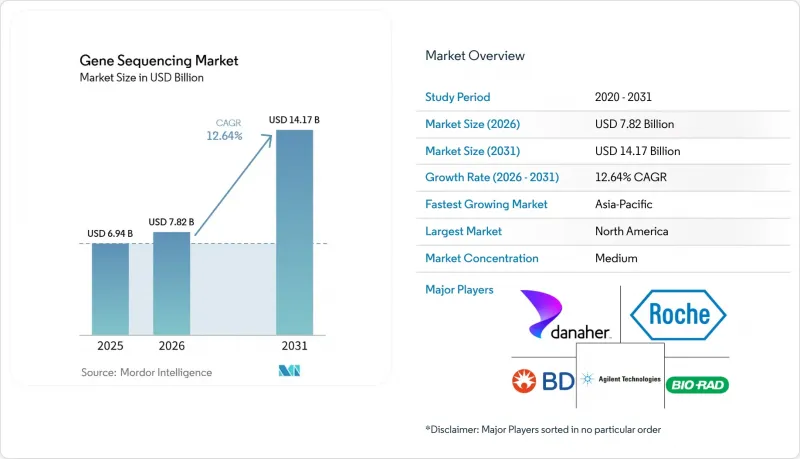
본 보고서는 기술 유형(차세대 시퀀싱, 샌거법 등), 제품(시퀀싱 장비, 소모품 등), 용도(임상 진단 등), 최종 사용자(병원·진단 검사 기관 등), 지역(북미, 유럽, 아시아태평양 등)별로 분류되어 있습니다. 시장 전망은 금액(달러) 기준으로 제시되어 있습니다.
세계의 유전자 시퀀싱 시장 동향 및 인사이트
정밀 종양학 패널의 임상 현장 도입 확대
종합적인 유전체 프로파일링은 대상 환자층에 대한 보급 여지가 여전히 남아 있기 때문에 임상 종양학은 유전자 시퀀싱 시장에서 가장 강력한 수요 동력으로 계속 자리 잡고 있습니다. 미국 메디케어·메디케이드 서비스 센터(CMS)는 차세대 시퀀싱 검사가 동반 진단으로 FDA의 승인 또는 인가를 받은 경우, 진행성 암 환자에 대해 NCD 90.2를 통해 보험 급여 기반을 지속적으로 제공하고 있으며, 이러한 체계가 검증된 플랫폼에 대한 실험실 투자를 뒷받침하고 있습니다. 또한, 해당 유전자 시퀀싱 시장은 미세 잔류 병변(MRD) 및 분자 잔류 병변(MRD) 모니터링으로부터도 뒷받침을 받고 있습니다. 이 분야에서는 액체 생검 검사를 반복적으로 실시함에 따라, 기존의 PCR 워크플로우를 대체할 고감도 시퀀싱의 필요성이 높아지고 있습니다. 이러한 추세는 중요한 의미를 지닙니다. 왜냐하면 연속적인 검사는 일회성 진단 사건이 아니라 지속적인 검사량을 창출하므로, 이미 도입된 장비의 활용도를 높이기 때문입니다. 더 많은 표적 치료제가 동반 진단의 지원을 필요로 함에 따라, 시퀀싱 능력을 갖추지 못한 검사실은 경쟁력이 떨어지고 임상적 의미를 갖기 어려워집니다. 이것이 바로 유전자 시퀀싱 시장이 검사 건수를 늘리고 있을 뿐만 아니라, 일상적인 치료 선택 과정에 점점 더 통합되고 있는 이유입니다.
염기당 시퀀싱 비용의 감소와 처리량 향상
유전자 시퀀싱 시장은 각 벤더들이 처리량 향상과 소모품 비용 절감을 상용 워크플로우에 통합함으로써 비용의 급격한 재설정이라는 혜택을 누리고 있습니다. PacBio는 2026년, 자사의 SPRQ-Nx 화학 기술과 SMRT 셀 재사용을 결합함으로써 샘플당 300달러 미만으로 대규모 HiFi 전체 유전체 시퀀싱이 가능해졌다고 발표했습니다. 이로써 롱 리드 시퀀싱은 더 광범위한 임상 프로그램이 감당할 수 있는 예산 수준에 가까워지고 있습니다. 일루미나(Illumina)도 2026년 2월, 기존 NovaSeq X 인프라를 기반으로 소모품비와 분석비를 합쳐 샘플당 395달러인 ‘TruPath Genome’을 출시했습니다. 이로써 연구소는 장거리 유전체 분석을 수행하기 위해 새로운 장비를 구매할 필요가 없어져 도입 장벽이 낮아졌습니다. 이러한 움직임은 구매 행태에 변화를 가져오고 있습니다. 샘플당 비용이 낮아짐에 따라, 장비의 정가 그 자체보다 검사량이나 워크플로우의 적합성이 더욱 중요해졌기 때문입니다. 유전자 시퀀싱 시장에서 이러한 변화는 시약 가격뿐만 아니라 소프트웨어, 분석법 설계, 데이터 분석, 품질 보증을 통해 고객을 유지할 수 있는 벤더에게 유리하게 작용합니다. 또한 이는 순수한 시퀀싱 성능이 경쟁력이 있더라도 워크플로우 통합 능력이 취약한 플랫폼은 어려움을 겪을 가능성이 있음을 의미합니다.
시퀀서와 자동화 시스템의 높은 자본 집약성
유전자 시퀀싱 시장은 진단 분야에서 여전히 가장 높은 자본 진입 장벽 중 하나를 안고 있습니다. 이는 고처리량 장비에 막대한 초기 투자가 필요하며, 실험실이 충분한 이익률을 확보할 수 있게 되기까지 수년에 걸친 감가상각 기간이 소요되기 때문입니다. 많은 지역 병원이나 지방 검사실의 경우, 리스 옵션, 공유 서비스 모델, 혹은 처리량에 대한 약정이 없다면 하이엔드 시스템 도입을 정당화하기는 여전히 어렵습니다. 이 문제는 시퀀서에만 국한되지 않습니다. 임상 규모로 운영하기 위해서는 액체 핸들링, 자동화된 라이브러리 준비, 그리고 안전한 정보 인프라도 필요하기 때문입니다. 시약 비용의 하락은 도움이 되지만, 안정적인 검체 흐름이 없는 검사실에서 발생하는 장비 가동률 저하의 부담을 해소해 주지는 못합니다. 이로 인해 유전자 시퀀싱 시장에는 양극화가 나타나고 있습니다. 재정력이 있는 학술 기관이나 참조 실험실은 더 많은 검체 수를 통해 비용을 분산시킬 수 있지만, 소규모 제공업체들은 수익성 있는 비즈니스 모델을 구축하는 데 어려움을 겪고 있습니다. 또한, 많은 저·중소득 국가 시장에서는 현지 시퀀싱 역량을 확대하기 전에 위험이 낮은 도입 모델이 필요하기 때문에 지리적 확장이 지연되고 있습니다.
부문 분석
2025년, 차세대 시퀀싱은 유전자 시퀀싱 시장 점유율의 68.57%를 차지했습니다. 이는 오랜 기간에 걸친 임상적 검증, 탄탄한 시약 생태계, 그리고 학술 기관 및 참조 검사실에서의 대규모 도입 실적을 반영한 것입니다. 고객은 이미 쇼트 리드 플랫폼과 연계된 검증된 워크플로우, 훈련된 팀, 조달 관계를 보유하고 있기 때문에 이 주도적 지위를 뒤집는 것은 여전히 어렵습니다. 샌거 시퀀싱은 확인 작업에서 규모는 작지만 확고한 역할을 유지하고 있습니다. 특히, 검사실이 차세대 시퀀싱의 완전한 워크플로우를 실행하지 않고 저처리량의 검증이 필요한 경우에 그 가치가 발휘됩니다. 이를 통해 대량 시퀀싱이 광범위한 패널, 엑솜, 유전체 분석으로 전환되는 상황에서도 기존 방식은 실용적인 위치를 유지하고 있습니다. 따라서 현재 유전자 시퀀싱 시장은 여전히 차세대 시퀀싱이 핵심을 이루고 있지만, 롱 리드 시스템의 비용 측면과 워크플로우 정비가 진행됨에 따라 그 독점적 지위는 점차 약화되고 있습니다.
3세대 시퀀싱은 2031년까지 연평균 성장률(CAGR) 12.96%로 확대될 것으로 예측되며, 유전자 시퀀싱 시장에서 가장 빠르게 성장하는 기술 카테고리가 될 전망입니다. 수요가 증가하고 있는 배경에는 구조적 변이 감지, 위상 기반 유전체 어셈블리, 메틸화 분석, 반복 영역 규명 등의 분야에서 네이티브 롱 리드가 쇼트 리드 방식으로는 완전히 실현할 수 없는 부가가치를 제공하기 때문입니다. PacBio사는 2026년, SPRQ-Nx 화학 기술을 통해 SMRT 셀의 재사용이 가능해져, 샘플당 300달러 미만으로 대규모 HiFi 전체 유전체 시퀀싱을 지원할 수 있게 될 것이라고 발표했습니다. 이는 프로그램의 보다 광범위한 도입을 위한 중요한 비용적 장벽이 될 것입니다. 일루미나(Illumina)사의 ‘TruPath Genome’ 역시, 숏 리드 분야의 기존 기업들이 그 수요를 롱 리드 전문 기업에 양보하는 대신, 기존 하드웨어에 롱 리드 분석 기능을 추가함으로써 고객을 유지하려 하고 있음을 보여줍니다. 2031년까지는 난해한 변이 해명이 필요한 연구소들이 롱 리드 기능을 도입하거나 추가할 이유가 더욱 커질 것이므로, 유전자 시퀀싱 시장의 기술 구도는 지금처럼 일방적이지 않게 될 가능성이 있습니다.
2025년에는 소모품이 매출의 52.79%를 차지했는데, 이는 유전자 시퀀싱 시장이 일회성 자본재 판매보다 지속적인 구매에 얼마나 크게 의존하고 있는지를 보여줍니다. 플로우셀, 시약 키트, 라이브러리 준비 제품은 실행할 때마다 구매되므로, 장비 도입 속도가 둔화되더라도 처리량이 향상되면 매출은 증가합니다. 이러한 추세로 인해 기존 공급업체는 보다 안정적인 기반을 확보할 수 있습니다. 가동 중인 각 장비가 수년에 걸쳐 소모품 수요를 지속적으로 창출하는 원천이 되기 때문입니다. 또한, 플랫폼 고객을 잃는 것은 단일 제품 판매가 아니라 지속적인 수익원에 영향을 미치므로, 신규 고객 확보와 마찬가지로 기존 고객 유지도 중요합니다. 따라서 유전자 시퀀싱 업계는 최대의 제품 기반을 지키기 위해 도입된 장비의 내구성, 워크플로우의 편의성, 그리고 분석의 일관성에 의존하고 있습니다.
유전자 시퀀싱 시장에서 시퀀싱 장비 시장 규모는 2026년부터 2031년에 걸쳐 연평균 성장률(CAGR) 13.52%로 확대될 것으로 예측됩니다. 이는 각 연구소가 구형 벤치탑 시스템을 업그레이드하고, 임상 패널, 엑솜, 전장 유전체 분석을 위한 고처리량 플랫폼을 추가하기 때문입니다. 또한, 검사를 분산형 임상 현장에 가깝게 수행해야 할 필요성도 장비 수요를 뒷받침하고 있습니다. 이러한 현장에서는 검사 소요 시간(턴어라운드 타임)과 검체 관리가 더욱 중요시되기 때문입니다. 다만, 장비 교체 주기는 수년 단위에 이르는 반면, 검사 실행 건수는 보다 지속적으로 증가할 가능성이 있어, 장기적인 수익 구조는 소모품 쪽으로 더욱 치우칠 것으로 보입니다. 이것이 각 벤더들이 단순히 장비 설치 대수에 의존하는 것이 아니라, 신제품 출시에 맞추어 이미 도입된 시스템의 가치를 높이는 화학 시약, 소프트웨어, 자동화 개선을 결합하고 있는 이유 중 하나입니다. 유전자 시퀀싱 시장에서 장비는 진입의 문을 여는 역할을 하지만, 수익 모델의 지속가능성을 결정짓는 것은 여전히 소모품입니다.
지역별 분석
2025년, 북미는 유전자 시퀀싱 시장 점유율의 41.37%를 차지하며 계속해서 가장 규모가 큰 지역 기여자로 자리매김했습니다. 미국에서는 CMS NCD 90.2가 진행성 암 환자를 대상으로 승인 또는 인가된 차세대 염기서열 분석 동반 진단을 지원하고 있어, 종양학 분야에서 더욱 견고한 보험 급여 기반의 혜택을 지속적으로 누리고 있습니다. 이러한 보험 급여 구조는 암 센터, 병원 검사실, 그리고 레퍼런스 네트워크 전반에 걸쳐 검증된 임상 시퀀싱 워크플로우에 대한 투자를 뒷받침하고 있습니다. 또한, 플로리다주의 메디케이드 프로그램도 2025년에 신속 전장 유전체 시퀀싱에 대해 검사당 2,716.9달러의 보험 급여를 시작했습니다. 이는 임상용 전체 유전체 시퀀싱이 주 차원에서 신생아 및 소아 희귀질환 사례로 확대되고 있음을 보여줍니다. 캐나다와 멕시코는 해당 지역 내에서 여전히 기여도가 낮지만, 비용 장벽이 낮고 희귀질환에 대한 접근성이 넓기 때문에 미국 이외의 지역에서도 유전자 시퀀싱 시장의 확대에 기여하고 있습니다.
2025년, 유럽은 2위 지역 블록이었으며, 독일, 영국, 프랑스가 이 지역의 매출 대부분을 차지했습니다. 영국에서는 ‘Genomics England’ 및 ‘NHS Genomic Medicine Service’를 통해 실용적인 기반이 마련되어 있어, 이를 통해 희귀질환 및 암 치료 분야에서 전장 유전체 시퀀싱 도입 경로가 더욱 명확해지고 있습니다. 또한, 독일의 법정 건강보험 제도도 종양학 분야에서의 종합적인 유전체 프로파일링에 대한 지원을 강화하고 있어, 이를 통해 시퀀싱이 학술 연구 기관의 범위를 넘어 더욱 보급되고 있습니다. 다만, 해당 지역의 성장은 여전히 GDPR(EU 개인정보보호규정)에 기반한 데이터 거주 요건 및 전송 요건에 의해 제약을 받고 있으며, 이러한 요건들은 인프라 비용을 상승시켜 소규모 연구소가 대규모 벤더와 동등한 운영 안정성을 확보하기 어렵게 만들고 있습니다.
아시아태평양은 2031년까지 연평균 성장률(CAGR) 14.53%로 확대될 것으로 예측되며, 유전자 시퀀싱 시장에서 가장 빠르게 성장하는 지역이 될 전망입니다. 중국의 경쟁 환경은 국내 플랫폼의 적극적인 포지셔닝과 외국 기업의 유전체 데이터 시장 진입에 대한 규제 강화로 인해 재편되고 있습니다. MGI Tech는 2026년 3월 STOmics 및 CycloneSEQ 인수를 발표했으며, 이를 통해 쇼트 리드 시퀀싱, 롱 리드 나노포어 시퀀싱, 공간 오믹스를 단일 포트폴리오 아래 포괄하는 체제를 확충했습니다. 한국도 롱 리드 및 레퍼런스 유전체에 대한 역량을 강화하고 있는 반면, 인도의 유전체 매핑 노력은 향후 몇 년 동안 장비 및 소모품에 대한 지속적인 수요를 뒷받침하고 있습니다. 중동 및 아프리카 및 남미는 여전히 초기 단계에 있지만, GCC 시장의 유전체 인프라 투자와 브라질의 임상 시퀀싱 네트워크 확대로 인해 유전자 시퀀싱 시장에 진입할 명확한 기회가 생겨나고 있습니다.
기타 혜택 :
- 엑셀 형식 시장 예측(ME) 시트
- 3개월간의 애널리스트 지원
자주 묻는 질문
목차
제1장 서론
제2장 조사 방법
제3장 주요 요약
제4장 시장 구도
제5장 시장 규모 및 성장 예측
제6장 경쟁 구도
제7장 시장 기회 및 향후 전망
KTH 26.08.10According to Mordor Intelligence, the gene sequencing market size is projected to be USD 6.94 billion in 2025, USD 7.82 billion in 2026, and reach USD 14.17 billion by 2031, growing at a CAGR of 12.64% from 2026 to 2031.
This report is Segmented by Technology Type (Next-Generation Sequencing, Sanger Sequencing, and More), Product (Sequencing Instruments, Consumables, and Others), Application (Clinical Diagnostics, and More), End User (Hospitals and Diagnostic Laboratories, and More), and Geography (North America, Europe, Asia-Pacific, and More). The Market Forecasts are Provided in Terms of Value (USD).
Global Gene Sequencing Market Trends and Insights
Rising Clinical Adoption of Precision Oncology Panels
Clinical oncology remains the strongest demand engine in the gene sequencing market because comprehensive genomic profiling still has room to penetrate a larger eligible patient pool. The US Centers for Medicare & Medicaid Services continues to provide a reimbursement foundation through NCD 90.2 for advanced cancer patients when next-generation sequencing tests carry FDA approval or clearance as companion diagnostics, and that framework is supporting lab investment in validated platforms. The same gene sequencing market is also gaining support from minimal residual disease and molecular residual disease monitoring, where repeated liquid biopsy testing raises the need for high-sensitivity sequencing instead of legacy PCR workflows. That pattern matters because serial testing creates recurring run volumes rather than one-time diagnostic events, which improves utilization for installed instruments. As more targeted therapies require companion diagnostic support, labs without sequencing capability face a weaker competitive position and a harder path to clinical relevance. This is why the gene sequencing market is not only adding test volume, but it is also becoming more embedded in routine treatment-selection pathways.
Falling Per-Base Sequencing Cost and Higher Throughput
The gene sequencing market is benefiting from a faster cost reset as vendors push throughput gains and lower consumables expenses into commercial workflows. PacBio stated in 2026 that its SPRQ-Nx chemistry, together with SMRT cell reuse, enabled HiFi whole-genome sequencing below USD 300 per sample at scale, which moves long-read sequencing closer to budget levels that broader clinical programs can support. Illumina also launched TruPath Genome in February 2026 at USD 395 per sample for consumables plus analysis on existing NovaSeq X infrastructure, which lowers adoption friction because labs do not need to buy a new instrument to access long-range genomic insight. These moves change buying behavior because lower per-sample costs make test volume and workflow fit more important than headline instrument pricing alone. In the gene sequencing market, that shift favors vendors that can hold customers through software, assay design, data interpretation, and quality assurance rather than through reagent pricing only. It also means that platforms with weaker workflow integration may struggle even when their raw sequencing performance is competitive.
High Capital Intensity of Sequencers and Automation
The gene sequencing market still carries one of the heavier capital barriers in diagnostics because high-throughput instruments require large upfront spending and multi-year depreciation before labs can earn healthy margins. High-end systems remain difficult for many community hospitals and regional laboratories to justify without leasing options, shared-service models, or volume commitments. The problem extends beyond the sequencer because clinical-scale operation also needs liquid handling, automated library preparation, and secure informatics infrastructure. Falling reagent costs help, but they do not remove the burden of underused instruments in labs that lack consistent sample flow. This creates a two-tier structure in the gene sequencing market, where well-funded academic centers and reference labs can spread costs over larger volumes while smaller providers struggle to build a viable business case. It also delays wider geographic expansion because many low- and middle-income markets need lower-risk deployment models before local sequencing capacity can scale.
Other drivers and restraints analyzed in the detailed report include:
- Population-Scale Genomics and Biobank Expansion
- Shift Toward Long-Read Sequencing in Structural Variant Discovery
- Data Governance, Privacy, and Cross-Border Genomic Data Limits
For complete list of drivers and restraints, kindly check the Table Of Contents.
Segment Analysis
Next-generation sequencing held 68.57% of the gene sequencing market share in 2025, reflecting years of clinical validation, a deep reagent ecosystem, and a large installed base across academic centers and reference laboratories. That leadership remains hard to displace because customers already have validated workflows, trained teams, and procurement relationships tied to short-read platforms. Sanger sequencing still retains a smaller but durable role in confirmation work, especially when labs need lower-throughput validation without running a full next-generation workflow. This keeps a practical place for older methods even as high-volume sequencing moves toward broader panel, exome, and genome use. The gene sequencing market therefore remains anchored by next-generation sequencing today, but that anchor is becoming less exclusive as long-read systems improve on cost and workflow readiness.
Third-generation sequencing is projected to expand at 12.96% CAGR through 2031, making it the fastest-growing technology category in the gene sequencing market. Demand is rising because structural variant detection, phased genome assembly, methylation analysis, and repeat region resolution are all areas where native long reads add value that short-read methods do not fully match. PacBio stated in 2026 that SPRQ-Nx chemistry allows SMRT cell reuse and supports HiFi whole-genome sequencing below USD 300 per sample at scale, which marks an important affordability threshold for broader program adoption. Illumina's TruPath Genome also shows that short-read incumbents are trying to keep customers by adding long-range insight on existing hardware rather than surrendering that demand to long-read specialists. By 2031, the technology mix in the gene sequencing market is likely to look less one-sided because labs that need difficult variant resolution will have stronger reasons to adopt or add long-read capability.
Consumables accounted for 52.79% of revenue in 2025, which shows how strongly the gene sequencing market depends on recurring purchases rather than one-time capital sales. Flow cells, reagent kits, and library preparation products are bought on every run, so revenue rises with throughput even when instrument placement slows. This pattern gives established vendors a more stable base because each active instrument becomes a repeat source of consumable demand over several years. It also means customer retention matters as much as new customer acquisition, since losing a platform account affects a recurring revenue stream rather than a single product sale. The gene sequencing industry, therefore, relies on installed-base durability, workflow convenience, and assay consistency to protect its largest product pool.
The gene sequencing market size for sequencing instruments is projected to expand at 13.52% CAGR from 2026 to 2031 as labs upgrade older benchtop systems and add higher-throughput platforms for clinical panels, exomes, and whole genomes. Instrument demand is also supported by the need to move testing closer to decentralized clinical settings, where turnaround time and sample control matter more. Even so, the long-run revenue mix is likely to lean further toward consumables because replacement cycles stretch across several years while run volumes can rise more continuously. This helps explain why vendors are pairing new instrument launches with chemistry, software, and automation changes that lift the value of each installed system rather than relying on placements alone. In the gene sequencing market, instruments open the door, but consumables still determine the durability of the revenue model.
Complete Report Scope:
- By Technology Type
- Next-Generation Sequencing (NGS)
- Sanger Sequencing
- Third-Generation Sequencing
- Others
- By Product
- Sequencing Instruments
- Consumables
- Others
- By Application
- Clinical Diagnostics
- Research and Academic Applications
- Drug Discovery and Development
- Population Genomics
- Others
- By End User
- Hospitals and Diagnostic Laboratories
- Pharmaceutical and Biotechnology Companies
- Academic and Research Institutes
- Others
- By Geography
- North America
- United States
- Canada
- Mexico
- Europe
- Germany
- United Kingdom
- France
- Italy
- Spain
- Rest of Europe
- Asia-Pacific
- China
- India
- Japan
- Australia
- South Korea
- Rest of Asia-Pacific
- Middle East and Africa
- GCC
- South Africa
- Rest of Middle East and Africa
- South America
- Brazil
- Argentina
- Rest of South America
- North America
Geography Analysis
North America held 41.37% of gene sequencing market share in 2025, which kept it as the largest regional contributor. The United States continues to benefit from a stronger reimbursement base in oncology because CMS NCD 90.2 supports approved or cleared next-generation sequencing companion diagnostics for advanced cancer patients. That coverage structure supports investment in validated clinical sequencing workflows across cancer centers, hospital labs, and reference networks. Florida's Medicaid program also activated reimbursement in 2025 for rapid whole-genome sequencing at USD 2,716.9 per test, which shows that clinical whole-genome sequencing is extending into neonatal and pediatric rare disease use cases at the state level. Canada and Mexico remain smaller contributors within the region, but lower cost thresholds and wider rare disease access are helping broaden the gene sequencing market beyond the United States.
Europe remained the second-largest regional block in 2025, with Germany, the United Kingdom, and France contributing most of the regional revenue. The United Kingdom has a working operational base through Genomics England and the NHS Genomic Medicine Service, which gives whole-genome sequencing a clearer pathway in rare disease and cancer care. Germany's statutory health insurance system has also deepened support for comprehensive genomic profiling in oncology, which is helping sequencing move further beyond academic centers. The region's growth is still moderated by GDPR-driven data residency and transfer requirements, which raise infrastructure costs and make it harder for smaller labs to match the operating resilience of large platform vendors.
Asia-Pacific is projected to expand at 14.53% CAGR through 2031, making it the fastest-growing geography in the gene sequencing market. China's competitive environment is being reshaped by aggressive domestic platform positioning and stricter control over foreign genomic data participation. MGI Tech announced in March 2026 the acquisition of STOmics and CycloneSEQ, which broadened its coverage across short-read sequencing, long-read nanopore sequencing, and spatial omics under one portfolio. South Korea is also strengthening long-read and reference genome capability, while India's genome mapping efforts are supporting sustained instrument and consumable demand over multiple years. The Middle East and Africa and South America remain at earlier stages, but genomics infrastructure spending in GCC markets and the expansion of clinical sequencing networks in Brazil are creating identifiable entry points for the gene sequencing market.
- 10x Genomics, Inc.
- Agilent Technologies
- Beckton Dickinson
- BGI
- Bio-Rad Laboratories
- Danaher
- Eurofins
- Roche
- Guardant Health, Inc.
- Illumina
- Invitae
- MGI Tech Co., Ltd.
- Myriad Genetics
- Natera, Inc.
- Novogene Co., Ltd.
- Oxford Nanopore Technologies plc
- Pacific Bioscience
- PerkinElmer
- QIAGEN
- Thermo Fisher Scientific
Additional Benefits:
- The market estimate (ME) sheet in Excel format
- 3 months of analyst support
TABLE OF CONTENTS
1 Introduction
- 1.1 Study Assumptions and Market Definition
- 1.2 Scope of the Study
2 Research Methodology
3 Executive Summary
4 Market Landscape
- 4.1 Market Overview
- 4.2 Market Drivers
- 4.2.1 Rising Clinical Adoption of Precision Oncology Panels
- 4.2.2 Expansion of Rare Disease and Undiagnosed Disease Programs
- 4.2.3 Falling Per-Base Sequencing Cost and Higher Throughput
- 4.2.4 Population-Scale Genomics and Biobank Expansion
- 4.2.5 Shift Toward Long-Read Sequencing in Structural Variant Discovery
- 4.2.6 Growing Use of Sequencing in Decentralized, Near-Patient Workflows
- 4.3 Market Restraints
- 4.3.1 High Capital Intensity of Sequencers and Automation
- 4.3.2 Uneven Reimbursement for Clinical Sequencing Across Markets
- 4.3.3 Data Governance, Privacy, and Cross-Border Genomic Data Limits
- 4.3.4 Shortage of Trained Bioinformatics and Clinical Interpretation Talent
- 4.4 Value and Supply-Chain Analysis
- 4.5 Regulatory Landscape
- 4.6 Technological Outlook
- 4.7 Porter's Five Forces Analysis
- 4.7.1 Threat of New Entrants
- 4.7.2 Bargaining Power of Buyers
- 4.7.3 Bargaining Power of Suppliers
- 4.7.4 Threat of Substitutes
- 4.7.5 Competitive Rivalry, Analysis
5 Market Size and Growth Forecasts
- 5.1 By Technology Type
- 5.1.1 Next-Generation Sequencing (NGS)
- 5.1.2 Sanger Sequencing
- 5.1.3 Third-Generation Sequencing
- 5.1.4 Others
- 5.2 By Product
- 5.2.1 Sequencing Instruments
- 5.2.2 Consumables
- 5.2.3 Others
- 5.3 By Application
- 5.3.1 Clinical Diagnostics
- 5.3.2 Research and Academic Applications
- 5.3.3 Drug Discovery and Development
- 5.3.4 Population Genomics
- 5.3.5 Others
- 5.4 By End User
- 5.4.1 Hospitals and Diagnostic Laboratories
- 5.4.2 Pharmaceutical and Biotechnology Companies
- 5.4.3 Academic and Research Institutes
- 5.4.4 Others
- 5.5 By Geography
- 5.5.1 North America
- 5.5.1.1 United States
- 5.5.1.2 Canada
- 5.5.1.3 Mexico
- 5.5.2 Europe
- 5.5.2.1 Germany
- 5.5.2.2 United Kingdom
- 5.5.2.3 France
- 5.5.2.4 Italy
- 5.5.2.5 Spain
- 5.5.2.6 Rest of Europe
- 5.5.3 Asia-Pacific
- 5.5.3.1 China
- 5.5.3.2 India
- 5.5.3.3 Japan
- 5.5.3.4 Australia
- 5.5.3.5 South Korea
- 5.5.3.6 Rest of Asia-Pacific
- 5.5.4 Middle East and Africa
- 5.5.4.1 GCC
- 5.5.4.2 South Africa
- 5.5.4.3 Rest of Middle East and Africa
- 5.5.5 South America
- 5.5.5.1 Brazil
- 5.5.5.2 Argentina
- 5.5.5.3 Rest of South America
- 5.5.1 North America
6 Competitive Landscape
- 6.1 Market Concentration
- 6.2 Market Share Analysis
- 6.3 Company Profiles (includes Global Level Overview, Market Level Overview, Core Segments, Financials as available, Strategic Information, Market Rank/Share, Products and Services, Recent Developments)
- 6.3.1 10x Genomics, Inc.
- 6.3.2 Agilent Technologies, Inc.
- 6.3.3 Becton, Dickinson and Company
- 6.3.4 BGI Group
- 6.3.5 Bio-Rad Laboratories, Inc.
- 6.3.6 Danaher Corporation
- 6.3.7 Eurofins Scientific SE
- 6.3.8 F. Hoffmann-La Roche Ltd.
- 6.3.9 Guardant Health, Inc.
- 6.3.10 Illumina, Inc.
- 6.3.11 Invitae Corporation
- 6.3.12 MGI Tech Co., Ltd.
- 6.3.13 Myriad Genetics, Inc.
- 6.3.14 Natera, Inc.
- 6.3.15 Novogene Co., Ltd.
- 6.3.16 Oxford Nanopore Technologies plc
- 6.3.17 Pacific Biosciences of California, Inc.
- 6.3.18 PerkinElmer, Inc.
- 6.3.19 QIAGEN N.V.
- 6.3.20 Thermo Fisher Scientific Inc.
7 MARKET OPPORTUNITIES AND FUTURE OUTLOOK
- 7.1 White-Space and Unmet-Need Assessment


