

|
시장보고서
상품코드
2099515
독일의 로보틱스 CNC 터닝 센터 시장 : 시장 점유율 분석, 업계 동향 및 통계, 성장 예측(2026-2031년)Germany Robotics CNC Turning Centers - Market Share Analysis, Industry Trends & Statistics, Growth Forecasts (2026 - 2031) |
||||||
 Mordor Intelligence
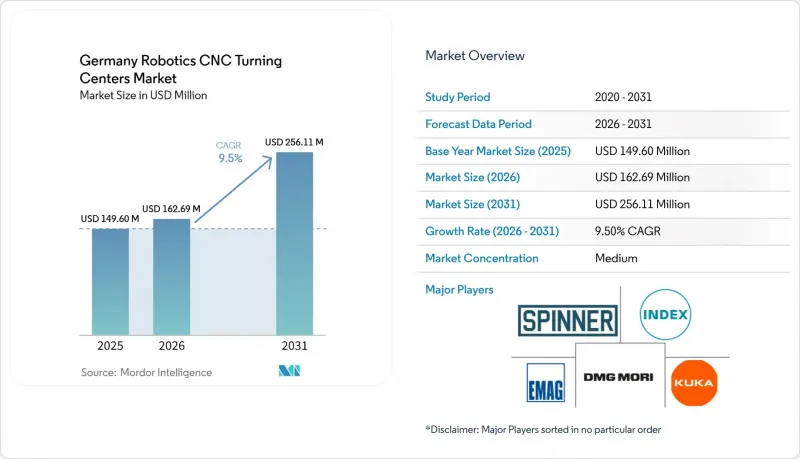
Mordor Intelligence에 의하면, 독일의 로보틱스 CNC 터닝 센터 시장 규모는 2025년에 1억 4,960만 달러로 평가되었고, 2026년 1억 6,269만 달러에서 2031년까지 2억 5,611만 달러에 이를 것으로 예측되며, 예측 기간(2026-2031년) CAGR은 9.5%를 나타낼 전망입니다.
본 보고서는 기계 유형별(수평형 로봇 선반, 수직형 로봇 선반 등), 로봇 유형별(다관절 로봇 등), 로봇 통합 유형별(OEM, 개조/애프터마켓 로봇 자동화), 최종 사용자 산업별(석유 및 가스·에너지, 항공우주 및 방위 등)으로 분류되어 있습니다. 시장 전망은 금액(달러) 및 수량(대수)으로 제시되어 있습니다.
독일의 로보틱스 CNC 터닝 센터 시장 동향 및 인사이트
로봇을 활용한 EV 파워트레인 선반 가공에 대한 자동차 업계의 강력한 수요
자동차 파워트레인 설계가 전기 구동 시스템으로 전환되고 있는 것이 독일의 로보틱스 CNC 터닝 센터 시장을 견인하고 있습니다. 로봇을 활용한 작업 부하를 갖춘 CNC 선반은 현재 전기차용 모터 샤프트, 로터 코어 및 기어박스 어셈블리 생산에서 핵심적인 역할을 수행하고 있습니다. BMW 그룹은 2억 유로(2억 3,530만 달러)를 투자한 후, 2024년 10월 란트슈투트 공장에서 ‘노이에 클라세’의 중앙 e-드라이브 하우징의 프리시리즈 생산을 시작했습니다. 이 공장에는 2020년 이후 이미 10억 유로(12억 달러)가 투입되었으며, 그중 5억 유로(5억 8,820만 달러)는 전동화를 위해 배정되었습니다. ZF 프리드리히스하펜(ZF Friedrichshafen)도 추가적인 전동 액슬 드라이브 모델에 대응하기 위해 자르브뤼켄 공장을 확장하고, 2025년부터 양산을 시작했습니다. 이러한 프로그램으로 인해 공차 요건이 더욱 엄격해지고 있어, 로봇을 이용한 적재는 단순한 효율화 수단이라기보다 생산상의 필수 요건으로 자리 잡고 있습니다. 이러한 영향은 1차 공급업체에 그치지 않고, 바덴뷔르템베르크주와 바이에른주의 2차 정밀 선반 부품 제조업체들도 전기차 관련 생산량 및 품질 목표를 달성하기 위해 로봇 셀 도입을 추진하고 있습니다.
견고한 제조거점이 첨단 CNC 자동화에 대한 투자를 견인
독일의 로보틱스 CNC 터닝 센터 시장은 세계에서도 손꼽히는 탄탄한 공작기계 생산 기반에 힘입고 있습니다. 독일은 2024년에도 공작기계 생산국으로서 2위 자리를 유지했으며, 총 생산액은 148억 유로(174억 달러), 업계 전체 종사자 수는 6만 5,500명에 달했습니다. 1,200개가 넘는 공작기계 및 관련 기업, 그리고 50개 이상의 저명한 대학 연구 기관으로 구성된 독일의 기반은 사용자 수요와 OEM의 혁신 사이에 서로를 강화하는 선순환을 만들어내고 있습니다. 독일의 공작기계 제조업체들은 연간 매출의 4% 이상을 연구개발에 투자하고 있으며, 매출의 15%는 신제품 개발에서 비롯됩니다. 이것이 독일의 로봇 연동 CNC 선반 시장에서 볼 수 있는 공정에 통합된 고도의 자동화 수준을 설명하는 한 가지 요인입니다. 또한, 국제적인 생산 네트워크도 중요한 요소로 작용하고 있습니다. 현재 독일의 주요 공작기계 제조업체 12곳이 해외에서 생산을 진행하고 있으며, 국내 엔지니어링 센터는 전 세계적인 자동화 전개와 긴밀히 연계되어 있습니다. 이러한 연계를 통해 물리적 생산 거점이 각지에 분산되어 있는 경우에도 제어 설계, 소프트웨어 통합, 셀 아키텍처 분야에서 독일의 역할이 강화되고 있습니다.
엄격한 지속가능성 및 규제 준수 요건이 투자의 복잡성을 가중시키고 있습니다.
EU 기계 프레임워크 규정이 2027년 시행을 향해 추진되는 가운데, 독일의 로보틱스 CNC 터닝 센터 센터 시장은 더욱 엄격해진 규정 준수 부담에 직면해 있습니다. 규정(EU) 2023/1230은 2027년 1월 20일부터 의무화되며, EU 시장에 출시되는 기계에 대해 사이버 보안 위험 평가, AI 관련 적합성 평가 및 디지털 기술 문서에 관한 새로운 요건이 추가됩니다. 이는 로봇이 통합된 선반 셀에 중요한 의미를 지닙니다. 현재 적응형 제어, 비전 가이드를 통한 위치 결정, 소프트웨어 기반 공정 인텔리전스를 갖춘 셀이 증가하고 있기 때문입니다. 또한 독일에서는 2025년 12월 6일 ‘MaschinenDG’를 통해 국내 이행 체계가 시행되어 시장 감시 권한 및 제재 규정이 확립되었습니다. 지속가능성에 관한 의무는 환경 관리, 에너지 효율 목표 및 유체 폐기량 감축 요건을 통해 추가적인 비용 부담을 초래합니다. 이러한 요인들로 인해 조달 일정이 장기화되고 있으며, 특히 자본 유연성이 제한된 중소 제조업체의 경우 수명 주기 중반에 설비를 교체하는 것을 정당화하기 어려워지고 있습니다.
부문 분석
2025년, 독일의 로보틱스 CNC 터닝 센터 시장에서 수평형 로봇 선반은 49.71%의 점유율을 차지했습니다. 이러한 우위는 대량 생산되는 자동차용 샤프트 및 베어링 레이스 제조 분야에서 적극적으로 채택된 데 기인합니다. 이 분야에서는 수평 스핀들 구조가 바 피더나 갠트리 로봇을 이용한 적재 시스템과 원활하게 연동됩니다. 이러한 도입 실적을 바탕으로, 수평형 시스템은 재현성, 처리량, 안정적인 자동화 레이아웃을 중시하는 생산 프로그램에서 여전히 중심적인 역할을 수행하고 있습니다. 이 부문은 대규모 산업용 가공 환경에서 확립된 역할 덕분에 계속해서 혜택을 누리고 있습니다.
멀티태스크형 로봇 선반은 독일의 로보틱스 CNC 터닝 센터 시장에서 가장 빠르게 성장하고 있는 기계 유형으로, 2026-2031년 연평균 성장률(CAGR) 11.24%가 예상됩니다. 이러한 성장은 항공우주 및 의료기기 제조 분야 수요 증가에 힘입은 것으로, 한 번의 세팅으로 가공을 완료할 수 있어 부품 취급 오류를 줄이고, 치수 편차를 감소시키며, 생산 공정을 단축할 수 있게 됩니다. OEM의 제품 개발 또한 더 고성능 플랫폼으로의 이러한 전환을 뒷받침하고 있습니다. DMG MORI가 2026년 1월에 출시한 ‘CTX 450 4A’는 36개의 공구 위치, 6μm의 위치 결정 정밀도, 그리고 10 m²라는 컴팩트한 설치 면적을 갖추고 있어, 고부가가치이자 공간 절약형 선반 플랫폼으로의 이러한 추세를 반영하고 있습니다.
2025년에는 관절식 로봇이 56.2%의 점유율을 차지했으며, 독일의 로보틱스 CNC 터닝 센터 시장에서 주요 로봇 유형으로 자리 잡았습니다. 관절형 로봇은 폭넓은 적재 중량 범위, 뛰어난 리치, 그리고 직접 스핀들 로딩 및 갠트리 지원에 의한 공작물 이송 모두와 높은 호환성을 갖추고 있어 여전히 기본 선택지로 자리 잡고 있습니다. 또한, 독일 자동차 업계에서는 오랫동안 관절형 로봇이 대규모로 채택되어 왔기 때문에 그 프로그래밍 환경도 성숙해 있습니다. 이러한 성숙도 덕분에 새로운 자동화 셀에서의 엔지니어링 리스크가 감소되었으며, 관절형 로봇은 대량 도입 현장에서 여전히 중심적인 위치를 차지하고 있습니다. 갠트리형 및 데카르트형 로봇 또한, 특히 처리량을 중시하는 부품 생산 라인에서 직선적인 로딩 속도가 가장 중요시되는 상황에서 안정적인 입지를 유지하고 있습니다.
독일의 로보틱스 CNC 터닝 센터 시장에서 코봇은 다른 어떤 로봇 유형보다 빠르게 성장하고 있으며, 2031년까지의 예측 연평균 성장률(CAGR)은 12.6%입니다. 위험이 낮은 로딩 작업이나 검사 지원, 공구 교환 지원과 같은 관련 기능 분야에서 도입이 진행되고 있습니다. 즉, 코봇은 핵심 생산 셀에서 다관절 로봇을 대체하는 것이 아니라, 대상 시장 기반을 확대하고 있는 것입니다. IFR의 발표에 따르면, 2024년 독일에서는 2만 6,982대의 산업용 로봇이 도입되었으며, 이는 유럽에서 가장 많은 대수로, 공장 전체의 지속적인 재구성 및 혼합 로봇 도입을 뒷받침하고 있습니다. 따라서 독일의 로보틱스 CNC 터닝 센터 시장은 다관절 로봇이 주요 선삭 공정을 주도하고, 코봇이 그 주변의 유연성 격차를 메우는 계층적인 로봇 구성으로 진화하고 있습니다.
기타 혜택 :
- 엑셀 형식 시장 예측(ME) 시트
- 3개월간의 애널리스트 지원
자주 묻는 질문
목차
제1장 서론
제2장 조사 방법
제3장 주요 요약
제4장 시장 구도
제5장 시장 규모 및 성장 예측
제6장 경쟁 구도
제7장 시장 기회 및 향후 전망
AJY 26.08.11According to Mordor Intelligence, the Germany robotics CNC turning centers market size was valued at USD 149.60 million in 2025 and is estimated to grow from USD 162.69 million in 2026 to reach USD 256.11 million by 2031, at a CAGR of 9.5% during the forecast period (2026-2031).
This report is Segmented by Machine Type (Horizontal Robotic Turning Centers, Vertical Robotic Turning Centers, and More), by Robot Type (Articulated Robots, and More), by Robot Integration Type (OEM, Retrofit/Aftermarket Robotic Automation), and by End-User Industry (Oil, Gas, & Energy, Aerospace & Defense, and More). The Market Forecasts are Provided in Terms of Value (USD) and Volume (Units).
Germany Robotics CNC Turning Centers Market Trends and Insights
Strong Automotive Demand for Robot-Tended EV Powertrain Turning
The shift in automotive powertrain design toward electric drivetrains is lifting the Germany robotics CNC turning centers market. CNC turning centers with robotic loading are now central to the production of EV motor shafts, rotor cores, and gearbox assemblies. BMW Group launched pre-series production of the Neue Klasse central e-drive housing at Plant Landshut in October 2024 after a EUR 200 million (USD 235.3 million) investment, and the site had already received EUR 1 billion (USD 1.2 billion), since 2020, with EUR 500 million (USD 588.2 million) directed to electromobility. ZF Friedrichshafen also expanded its Saarbrucken plant for additional electric axle drive variants, with series production beginning in 2025. These programs are raising tolerance requirements and making robotic loading less of an efficiency option and more of a production requirement. The effect is spreading beyond Tier 1 suppliers, as Tier 2 precision turned parts manufacturers in Baden-Wurttemberg and Bavaria are also retrofitting robot cells to meet EV-related volume and quality targets.
Strong Manufacturing Base Driving Investment in Advanced CNC Automation
The Germany robotics CNC turning centers market is supported by one of the world's deepest machine tool production bases. Germany remained the second-largest machine tool producer in 2024, with a total output of EUR 14.8 billion (USD 17.4 billion) and a workforce of 65,500 across the sector. The country's base of more than 1,200 machine tool and related companies, together with more than 50 recognized university research institutes, creates a self-reinforcing cycle between user demand and OEM innovation. German machine tool builders invest more than 4% of annual turnover in research and development, and 15% of turnover comes from newly developed products, which helps explain the strong level of process-integrated automation seen in the Germany robotics CNC turning centers market. A further layer comes from international production networks, as 12 larger German machine tool manufacturers now produce abroad, keeping domestic engineering centers closely linked to global automation rollouts. That linkage strengthens Germany's role in control design, software integration, and cell architecture even when physical output is distributed across regions.
Stringent Sustainability and Regulatory Compliance Requirements Increasing Investment Complexity
The Germany robotics CNC turning centers market faces a more stringent compliance burden as the EU Machinery Framework moves toward implementation in 2027. Regulation (EU) 2023/1230 will become mandatory from January 20, 2027, and adds new requirements around cybersecurity risk assessment, AI-related conformity evaluation, and digital technical documentation for machinery placed on the EU market. This matters for robot-integrated turning cells because more of them now include adaptive control, vision-guided positioning, and software-based process intelligence. Germany also brought its national implementation framework into force through MaschinenDG on December 6, 2025, which established market surveillance powers and sanction provisions. Sustainability obligations add another cost layer through environmental management, energy-efficiency targets, and reduced fluid-disposal requirements. These factors stretch procurement timelines and make mid-cycle equipment replacement harder to justify, especially for smaller manufacturers with limited capital flexibility.
Other drivers and restraints analyzed in the detailed report include:
- World-Leading Robot Density Supporting Mature Integration
- Government R&D Funding Targeting Human-Robot Interaction
- High Automation System Integration and Implementation Costs
For complete list of drivers and restraints, kindly check the Table Of Contents.
Segment Analysis
Horizontal robotic turning centers held 49.71% of the Germany robotics CNC turning centers market share in 2025. Their lead came from strong use in high-volume automotive shaft and bearing race production, where horizontal spindle architecture aligns well with bar feeders and gantry robot loading systems. This installed base keeps horizontal systems central to production programs that depend on repeatability, throughput, and stable automation layouts. The segment continues to benefit from its established role in large-scale industrial machining environments.
Multi-tasking robotic turning centers are the fastest-growing machine type in the Germany robotics CNC turning centers market, with a projected 11.24% CAGR during 2026-2031. Growth is being driven by rising demand in aerospace and medical device manufacturing, where complete machining in a single setup helps reduce part-handling errors, lower dimensional variation, and shorten the production sequence. OEM product development is also supporting this shift toward more capable platforms. DMG MORI's January 2026 launch of the CTX 450 4A, with 36 tool positions, 6 μm positioning accuracy, and a compact 10 m2 footprint, reflects this move toward higher-value and space-efficient turning platforms.
Articulated robots held a 56.2% share in 2025, making them the leading robot type in the Germany robotics CNC turning centers market. They remain the default choice because they offer broad payload coverage, strong reach, and high compatibility with both direct spindle loading and gantry-assisted part presentation. Their programming environment is also mature because Germany's automotive sector has used articulated robots at scale for many years. That maturity lowers engineering risk for new automation cells and keeps articulated robots central to large-volume installations. Gantry and Cartesian robots also retain a steady place where linear loading speed matters most, especially in throughput-driven component lines.
Cobots are expanding faster than any other robot type in the Germany robotics CNC turning centers market, with a forecast CAGR of 12.6% through 2031. Their adoption is rising in lower-risk loading tasks and in adjacent functions such as inspection support and tool-change assistance. That means cobots are widening the addressable base rather than replacing articulated robots in core production cells. IFR confirmed that Germany installed 26,982 industrial robots in 2024, the highest total in Europe, which supports ongoing reconfiguration and mixed robot deployment across plants. The German robotics CNC turning centers market is therefore evolving toward a layered robot mix where articulated units lead the main turning process, and cobots fill the flexibility gaps around it.
Complete Report Scope:
- By Machine Type
- Horizontal Robotic Turning Centers
- Vertical Robotic Turning Centers
- Multi-Tasking Robotic Turning Centers
- Others
- By Robot Type
- Articulated Robots
- Collaborative Robots (Cobots)
- Gantry/Cartesian Robots
- By Robot Integration Type
- OEM-Integrated Robotic Turning Cells
- Retrofit/Aftermarket Robotic Automation
- By End-User Industry
- Automotive & Commercial Vehicles
- Aerospace & Defense
- Medical Devices & Surgical Instruments
- Oil, Gas, & Energy
- Electrical, Electronics & Semiconductor Equipment
- General Industrial Machinery
- Others
List of Companies Covered in this Report:
- DMG MORI AG
- SPINNER Werkzeugmaschinenfabrik GmbH
- EMAG GmbH & Co. KG
- KUKA AG
- INDEX-Werke GmbH & Co. KG
- GROB-WERKE GmbH & Co. KG
- Siemens AG
- HELLER Maschinenfabrik GmbH
- WFL Millturn Technologies GmbH
- CHIRON Group SE
- Nakamura-Tome Precision Industry Co., Ltd.
- Yamazaki Mazak Corporation
- FANUC Corporation
- Yaskawa Electric Corporation
- ABB Ltd
- Citizen Machinery Co., Ltd.
- EMCO GmbH
- Okuma Corporation
- DN Solutions Co., Ltd.
- Hyundai WIA Corporation
Additional Benefits:
- The market estimate (ME) sheet in Excel format
- 3 months of analyst support
TABLE OF CONTENTS
1 Introduction
- 1.1 Study Assumptions & Market Definition
- 1.2 Scope of the Study
2 Research Methodology
3 Executive Summary
4 Market Landscape
- 4.1 Market Overview
- 4.2 Market Drivers
- 4.2.1 Strong Automotive Demand for Robot-Tended EV Powertrain Turning
- 4.2.2 Strong Manufacturing Base Driving Investment in Advanced CNC Automation
- 4.2.3 World-Leading Robot Density Supporting Mature Integration
- 4.2.4 Government R&D Funding Targeting Human-Robot Interaction
- 4.2.5 German Machine Tool Builders Embedding Automation in Product Design
- 4.2.6 UMATI Reducing Robot-CNC Integration Complexity
- 4.3 Market Restraints
- 4.3.1 Stringent Sustainability and Regulatory Compliance Requirements Increasing Investment Complexity
- 4.3.2 High Automation System Integration and Implementation Costs
- 4.3.3 Asian Manufacturers Erode Germany's International Market Share
- 4.3.4 High Robot-Integrated Solution Costs Limit Mittelstand Adoption
- 4.4 Value / Supply-Chain Analysis
- 4.4.1 Component & Raw Material Supply
- 4.4.2 Manufacturing & System Integration
- 4.4.3 Distribution & End-User Delivery
- 4.4.4 Aftermarket Services & Lifecycle Support
- 4.5 Regulatory Landscape
- 4.6 Technological Outlook
- 4.6.1 AI-Enabled Vision Guidance
- 4.6.2 Predictive Maintenance Integration
- 4.6.3 Digital Twin and Simulation Technologies
- 4.7 Automation Maturity Assessment by Industry
- 4.8 Digitalization Trends in CNC Machining
- 4.9 Investment and Procurement Models for Robotic CNC Turning Cells
- 4.10 Pricing Analysis
- 4.10.1 Average Selling Price (ASP) Benchmarking of Key Market Participants
- 4.10.2 Average Selling Price (ASP) Benchmarking by Automation Level
- 4.10.3 Average Selling Price (ASP) Benchmarking by Geography
- 4.11 Porter's Five Forces - Industry Attractiveness Scoring
- 4.11.1 Threat of New Entrants
- 4.11.2 Bargaining Power of Suppliers
- 4.11.3 Bargaining Power of Buyers
- 4.11.4 Threat of Substitutes
- 4.11.5 Industry Rivalry
- 4.12 Industry Case Studies
- 4.13 Impact of Geopolitical Events on the Market
5 Market Size & Growth Forecasts
- 5.1 By Machine Type
- 5.1.1 Horizontal Robotic Turning Centers
- 5.1.2 Vertical Robotic Turning Centers
- 5.1.3 Multi-Tasking Robotic Turning Centers
- 5.1.4 Others
- 5.2 By Robot Type
- 5.2.1 Articulated Robots
- 5.2.2 Collaborative Robots (Cobots)
- 5.2.3 Gantry/Cartesian Robots
- 5.3 By Robot Integration Type
- 5.3.1 OEM-Integrated Robotic Turning Cells
- 5.3.2 Retrofit/Aftermarket Robotic Automation
- 5.4 By End-User Industry
- 5.4.1 Automotive & Commercial Vehicles
- 5.4.2 Aerospace & Defense
- 5.4.3 Medical Devices & Surgical Instruments
- 5.4.4 Oil, Gas, & Energy
- 5.4.5 Electrical, Electronics & Semiconductor Equipment
- 5.4.6 General Industrial Machinery
- 5.4.7 Others
6 Competitive Landscape
- 6.1 Market Concentration
- 6.2 Strategic Moves
- 6.3 Market Share Analysis
- 6.4 Competitive Technology Benchmarking
- 6.5 Company Profiles (Includes Global Level Overview, Market Level Overview, Core Segments, Financials as Available, Strategic Information, Products & Services, and Recent Developments)
- 6.5.1 DMG MORI AG
- 6.5.2 SPINNER Werkzeugmaschinenfabrik GmbH
- 6.5.3 EMAG GmbH & Co. KG
- 6.5.4 KUKA AG
- 6.5.5 INDEX-Werke GmbH & Co. KG
- 6.5.6 GROB-WERKE GmbH & Co. KG
- 6.5.7 Siemens AG
- 6.5.8 HELLER Maschinenfabrik GmbH
- 6.5.9 WFL Millturn Technologies GmbH
- 6.5.10 CHIRON Group SE
- 6.5.11 Nakamura-Tome Precision Industry Co., Ltd.
- 6.5.12 Yamazaki Mazak Corporation
- 6.5.13 FANUC Corporation
- 6.5.14 Yaskawa Electric Corporation
- 6.5.15 ABB Ltd
- 6.5.16 Citizen Machinery Co., Ltd.
- 6.5.17 EMCO GmbH
- 6.5.18 Okuma Corporation
- 6.5.19 DN Solutions Co., Ltd.
- 6.5.20 Hyundai WIA Corporation
7 Market Opportunities & Future Outlook
- 7.1 White-Space & Unmet-Need Assessment


