
|
시장보고서
상품코드
2099519
아시아태평양의 기업 컨텐츠 관리(ECM) 시장 : 점유율 분석, 업계 동향 및 통계, 성장 예측(2026-2031년)Asia-Pacific Enterprise Content Management (ECM) - Market Share Analysis, Industry Trends & Statistics, Growth Forecasts (2026 - 2031) |
||||||
 Mordor Intelligence
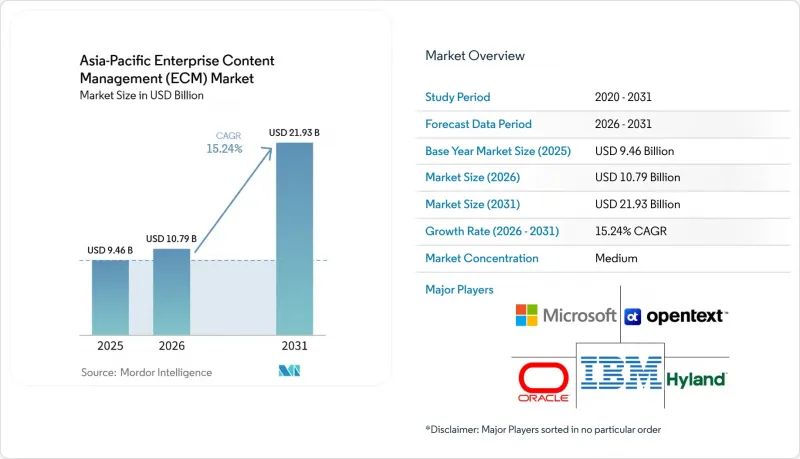
Mordor Intelligence에 의하면, 아시아태평양 기업 컨텐츠 관리(ECM) 시장 규모는 2025년 94억 6,000만 달러에서 2026년에는 107억 9,000만 달러로 확대되어 2026년부터 2031년까지 CAGR 15.24%로 성장을 지속하여, 2031년에는 219억 3,000만 달러에 이를 것으로 예측됩니다.
본 보고서는 솔루션 유형(문서 관리, 기록 관리 등), 도입 형태(On-Premise, 클라우드, 하이브리드), 기업 규모(중소기업(SME), 대기업), 최종 사용자 산업(은행, 금융서비스 및 보험(BFSI), 정부·공공 부문, 의료 등) 및 지역별로 분류되어 있습니다. 시장 전망은 금액(달러) 기준으로 제시되어 있습니다.
아시아태평양 기업 컨텐츠 관리(ECM) 시장 동향과 인사이트
클라우드 퍼스트를 통한 컨텐츠 아키텍처 현대화
아시아태평양의 기업 컨텐츠 관리(ECM) 시장에서 클라우드 도입은 더 이상 시험적인 시도가 아니라, 많은 신규 도입 사례에서 기본 출발점이 되고 있습니다. 마이크로소프트의 인도네시아 클라우드 투자 프로그램은 더 광범위한 지역 인프라 구축의 일환으로서, 기업들이 컨텐츠 워크플로를 하이퍼스케일러 환경에 가깝게 만들고 AI 기반 생산성 향상 도구를 채택하도록 장려하는 것이었습니다. 또한, 재팬 비즈니스 시스템즈는 2025년 1월, 기존 Microsoft 365 라이선스를 활용한 지방 자치 단체용 문서 관리 및 전자 승인 시스템을 출시했습니다. 이는 구매자가 완전히 독립된 스택에 자금을 투자할 필요 없이 클라우드 도입을 확대할 수 있음을 보여줍니다. 아시아태평양의 기업 컨텐츠 관리 시장에서 인프라 확장과 조달 프로세스의 원활화가 맞물리면서, 현대화 계획부터 실제 도입까지의 기간이 단축되고 있습니다. 또한, 고객들이 하드웨어 교체 주기를 연장하기보다는 내장된 확장성, 더 신속한 업그레이드, 그리고 더 쉬운 AI 통합을 점점 더 요구함에 따라 벤더 선정 기준도 변화하고 있습니다. 그 결과, 아시아태평양의 기업 컨텐츠 관리(ECM) 시장에서는 이전에는 관리형 On-Premise 환경을 선호하던 상황이었음에도 불구하고, 클라우드 네이티브 운영 모델로 전환되고 있습니다.
생성형 AI를 활용한 분류 및 검색 자동화
생성형 AI는 아시아태평양의 기업 컨텐츠 관리(ECM) 시장에서 플랫폼의 역할을 변화시키고 있습니다. 고객들은 이제 시스템이 컨텐츠를 단순히 저장하는 것뿐만 아니라 분류, 태그 지정, 검색, 요약까지 수행하기를 기대하고 있기 때문입니다. 2025년 마이크로소프트가 발표한 'SharePoint Embedded' 프로그램은 ECM 기능이 단순한 문서 저장용 백엔드 리포지토리가 아니라 AI 인프라로 자리매김하고 있음을 보여주었습니다. OpenText도 이에 발맞추어 2026년 6월 릴리스 사이클에서 컨텐츠 관리를 Microsoft Copilot 및 Guidewire와 더욱 긴밀하게 연동시켰습니다. 또한, 히타치 솔루션즈도 2025년 11월, 생성형 AI 기반의 속성 추출 기능과 검색 기능을 강화한 검색 기능을 탑재하여 컨텐츠 라이프사이클 매니저를 업그레이드함으로써, 기존 문서 자산 전반에 걸친 거버넌스가 적용된 검색에 대한 수요 증가를 반영했습니다. 이를 통해 도입 후 고객이 별도로 AI 도구를 추가로 도입해야 하는 부담을 덜어주면서, 지역 언어, 현지 형식, 규제를 준수하는 워크플로우에 적절히 대응할 수 있는 플랫폼의 가치가 높아지고 있습니다. 그 결과, 아시아태평양의 기업 컨텐츠 관리 시장은 리포지토리 중심의 구매에서 의사결정 지원, 검색 품질, 워크플로우 인텔리전스로 전환되고 있습니다.
레거시 리포지토리 마이그레이션에 수반되는 복잡성
많은 조직이 메타데이터 미비, 일관성 없는 접근 규칙, 불완전한 프로세스 기록을 안고 있는 레거시 리포지토리를 여전히 유지하고 있기 때문에 레거시 시스템의 마이그레이션은 아시아태평양의 기업 컨텐츠 관리(ECM) 시장에 여전히 큰 걸림돌이 되고 있습니다. 2025년 11월 『Journal of Computational Analysis and Applications』지에 게재된 조사에 따르면, 거버넌스에 기반한 정리 작업 없이 저품질 컨텐츠를 클라우드 시스템으로 마이그레이션할 경우, 규정 준수 위험이 높아지고 AI의 성능이 저하되며 도입 성과가 떨어질 우려가 있다고 합니다. 아시아태평양의 ECM 시장에서 이러한 위험은 특히 중요합니다. 많은 구매자가 현대화와 자동화를 동시에 추진하려 하고 있어, 시간이 많이 소요되는 사전 정리 단계에 할애할 여유가 별로 없기 때문입니다. 마이그레이션 지연은 구매 행동에도 영향을 미칠 가능성이 있습니다. 플랫폼 도입 프로젝트를 계획했던 조직이 소프트웨어의 가치가 드러나기도 전에 서비스 비용, 기록 수정, 사용자 교육에 자금을 투입해야만 하는 경우가 있기 때문입니다. 따라서 대규모 변혁 프로그램에서 경쟁하는 벤더에게 있어 실행의 철저함은 제품의 기능만큼이나 중요합니다. 또한, 기존 저장소는 구매자가 당초 예상했던 것보다 복잡하고 체계적이지 않기 때문에 APAC ECM 시장의 성장이 표면적인 수요가 시사하는 만큼 빠르게 진행되지 않을 가능성도 있음을 의미합니다.
부문 분석
2025년, 아시아태평양의 기업 컨텐츠 관리(ECM) 시장에서 문서 관리는 26.14%를 차지하며 가장 큰 솔루션 카테고리가 되었습니다. 이는 중앙 집중형 저장소가 여전히 대부분의 도입 기반을 이루고 있음을 뒷받침합니다. 이러한 상황은 아시아태평양 ECM 업계 전반에서 나타나는 단순한 운영상의 요구를 반영합니다. 기업과 공공기관은 그 위에 어떤 형태의 자동화를 도입하기 전에, 대량의 비정형 파일을 안전하게 보관하고 검색 가능한 상태로 만들어야 하기 때문입니다. 중국 중산(Zhongshan)시에서는 2026년까지 3만 4,000명 이상의 공무원이 60만 건 이상의 정책 문서를 처리할 수 있도록 지원하기 위해 중앙 집중형 문서 관리 플랫폼을 도입했습니다. 이는 리포지토리의 강점이 정부의 디지털화를 대규모로 광범위하게 지원할 수 있음을 보여줍니다. 기록 관리, 사안 관리, 디지털 자산 관리 및 웹 컨텐츠 관리는 특히 보존 기간 규칙, 사안의 추적 가능성, 미디어 처리 또는 공개 워크플로가 부서나 부문마다 다른 경우, 여전히 각각의 고유한 요구 사항을 충족시키고 있습니다. 아시아태평양의 ECM 시장에서 이는 인접 모듈이 점점 더 전문화되어 가는 상황에서도 문서 관리가 여전히 기반이 될 것임을 의미합니다.
워크플로우 및 비즈니스 프로세스 관리는 2026년부터 2031년까지 연평균 성장률(CAGR) 17.82%를 나타낼 것으로 예측되며, 구매자들이 단순한 보존에서 거버넌스 기반의 실행으로 전환함에 따라 가장 빠르게 확대되는 솔루션 카테고리가 되고 있습니다. 이러한 변화는 벤더의 전략에도 반영되어 있으며, Newgen사는 2026년 5월 ‘Enterprise Orchestration Layer’를 출시하여 AI 에이전트를 독립적인 오버레이로 제공하는 대신, 관리된 비즈니스 프로세스에 통합할 수 있도록 했습니다. 일본에서도 유사한 방향성이 확인되고 있으며, 히타치 솔루션즈는 컨텐츠 라이프사이클 매니저에 생성형 AI를 활용한 추출 기능과 대화형 검색 기능을 강화했습니다. 이 모든 것은 축적된 문서 자산에 대한 신속한 대응을 지원하는 것입니다. 디지털 자산 관리는 아시아태평양의 기업 컨텐츠 관리(ECM) 시장에서도 그 중요성이 커지고 있습니다. 이 지역에서는 소매, 미디어, 온라인 상거래 등 각 업계에서 버전 관리 및 컨텐츠의 신속한 재사용에 대한 요구가 높아지고 있습니다. 시간이 지남에 따라 이 카테고리의 구성은 고립된 단일 기능 도구에서 보다 광범위한 거버넌스 및 워크플로우 스택 내에서 각 솔루션이 얼마나 효과적으로 기능하는지로 초점이 이동하고 있습니다.
2025년, 아시아태평양의 기업 컨텐츠 관리(ECM) 시장에서 클라우드는 73.41%를 차지하며 압도적인 도입 모델로서의 입지를 확고히 했습니다. 이는 신규 프로젝트가 일반적으로 ‘클라우드 우선’이라는 전제 하에 시작된다는 사실을 뒷받침합니다. APAC의 기업 컨텐츠 관리 시장에서 이 점유율은 단순히 신규 도입(그린필드)에 의한 구매만을 나타내는 것은 아닙니다. 많은 고객이 현재 파편화된 파일 서버나 노후화된 On-Premise 저장소를 지속적으로 업데이트 가능한 구독형 플랫폼으로 교체하고 있기 때문입니다. 2025년 7월, 일본 항공자위대는 4만 7,000명 이상의 인력과 73개 기지에 Box를 도입했습니다. 이는 보안에 민감한 기관조차도 컨텐츠 운영을 클라우드 네이티브 플랫폼으로 통합할 의향이 있음을 보여줍니다. 또한 클라우드 모델은 임베디드 AI, 원격 액세스, 인프라 관리 부담 경감과 같은 요구 사항에도 부합하며, 이러한 요소들은 모두 컨텐츠 양이 증가함에 따라 그 중요성이 커지고 있습니다. 따라서 APAC 지역의 ECM 시장에서는 클라우드를 단순한 선택지가 아닌 표준 운영 환경으로 인식하는 경향이 강해지고 있습니다.
또한, 클라우드 시장은 2031년까지 연평균 성장률(CAGR) 18.24%로 확대될 것으로 예측되며, 기존 시스템 환경의 마이그레이션이 진행되는 가운데 여전히 가장 빠르게 성장하는 도입 경로임을 보여주고 있습니다. 아시아태평양의 기업 컨텐츠 관리(ECM) 시장에서는 하이브리드형에 대한 수요도 여전히 중요합니다. 이는 일부 구매자가 기밀성이 높은 기록을 국내 또는 관리되는 인프라에 보관하면서, 워크플로우 및 협업 계층은 클라우드에서 실행해야 하기 때문입니다. 이러한 경향은 비용 비교보다 주권 관련 규제가 도입 선택을 더 직접적으로 좌우하는 상황에서 특히 두드러집니다. 이로 인해 도입의 복잡성은 증가하지만, 벤더가 여러 환경에 걸친 정책 관리, 통합 및 지속적인 구성 관리를 수행해야 하므로 계약 규모가 증가할 가능성도 있습니다. 국방, 정보, 사법 분야의 워크로드에서는 클라우드로의 전환이 아직 완전히 승인되지 않았기 때문에 On-Premise 시스템이 여전히 안정적인 역할을 수행하고 있으며, 장기적인 방향성은 명확함에도 불구하고 도입으로의 전환은 여전히 고르지 못한 상황이 지속되고 있습니다.
기타 혜택:
- 엑셀 형식 시장 예측(ME) 시트
- 3개월간의 애널리스트 지원
자주 묻는 질문
목차
제1장 서론
제2장 조사 방법
제3장 주요 요약
제4장 시장 구도
제5장 시장 개요
제6장 시장 규모와 성장 예측
제7장 경쟁 구도
제8장 시장 기회와 향후 전망
JHS 26.08.05According to Mordor Intelligence, the Asia-Pacific enterprise content management (ECM) market size is expected to grow from USD 9.46 billion in 2025 to USD 10.79 billion in 2026 and is forecast to reach USD 21.93 billion by 2031 at 15.24% CAGR over 2026-2031.
This report is Segmented by Solution Type (Document Management, Records Management, and More), Deployment Mode (On-Premises, Cloud, and Hybrid), Enterprise Size (Small and Medium Enterprises (SME), and Large Enterprises), End-User Industry (BFSI, Government and Public Sector, Healthcare, and More), and Geography. The Market Forecasts are Provided in Terms of Value (USD).
Asia-Pacific Enterprise Content Management (ECM) Market Trends and Insights
Cloud-First Content Architecture Modernization
Cloud adoption is no longer a trial path in the Asia-Pacific enterprise content management (ECM) market, because it has become the default starting point for many new deployments. Microsoft's cloud investment program in Indonesia was part of a broader regional infrastructure push that encouraged enterprises to move content workflows closer to hyperscaler environments and to adopt AI-enabled productivity tools. Japan Business Systems also launched a document management and electronic approval system for local governments in January 2025 that leveraged existing Microsoft 365 licenses, demonstrating how cloud adoption could be expanded without requiring buyers to fund a fully separate stack. In the Asia-Pacific enterprise content management market, this combination of infrastructure expansion and lower-friction procurement is shortening the time between modernization planning and live rollout. It also changes vendor selection because customers increasingly want built-in scalability, faster upgrades, and easier AI integration rather than long hardware refresh cycles. As a result, the Asia-Pacific enterprise content management (ECM) market is moving toward cloud-native operating models even in settings that previously preferred controlled on-premises estates.
GenAI-Assisted Classification and Search Automation
Generative AI is changing the role of platforms in the Asia-Pacific enterprise content management (ECM) market, as customers now expect systems to classify, tag, retrieve, and summarize content rather than simply store it. Microsoft's SharePoint Embedded program in 2025 showed that ECM functions were being repositioned as AI infrastructure rather than just back-end repositories for document retention. OpenText followed suit, aligning content management more closely with Microsoft Copilot and Guidewire in its June 2026 release cycle. Hitachi Solutions also upgraded its content lifecycle manager in November 2025 with generative AI-based attribute extraction and retrieval-augmented search, reflecting rising demand for governed search across existing document estates. This is raising the value of platforms that can work well with regional languages, local formats, and regulated workflows without forcing customers to bolt on separate AI tools after deployment. In turn, the Asia-Pacific enterprise content management market is shifting from repository-led buying toward decision support, search quality, and workflow intelligence.
Legacy Repository Migration Complexity
Legacy migration remains a significant brake on the Asia-Pacific enterprise content management (ECM) market because many organizations still maintain legacy repositories with weak metadata, inconsistent access rules, and incomplete process records. Research published in the Journal of Computational Analysis and Applications in November 2025 stated that moving low-quality content into cloud systems without governance clean-up can increase compliance risk, weaken AI outputs, and reduce adoption outcomes. That risk is especially important in the Asia-Pacific ECM market because many buyers are trying to modernize and automate simultaneously, leaving less room for a slow preparatory clean-up phase. Migration delays can also change buying behavior, as organizations that expected a platform project sometimes end up funding services, record remediation, and user training before the software's value becomes visible. This makes execution depth almost as important as product capability for vendors competing in large transformation programs. It also means the APAC ECM market can grow more slowly than headline demand suggests, as older repositories are deeper and messier than buyers first assumed.
Other drivers and restraints analyzed in the detailed report include:
- Regulatory Digitization in Public Sector and Regulated Industries
- Remote Work and Distributed Knowledge Access Requirements
- Integration Friction With ERP, CRM, And Line-Of-Business Systems
For complete list of drivers and restraints, kindly check the Table Of Contents.
Segment Analysis
Document management accounted for 26.14% of the Asia-Pacific enterprise content management (ECM) market in 2025, making it the largest solution category and confirming that centralized repositories remain the foundation of most deployments. This position reflects a simple operational need across the Asia-Pacific enterprise content management industry, since enterprises and public bodies still need secure, searchable storage for large volumes of unstructured files before they can automate anything on top of them. Zhongshan City in China used a centralized document management platform to support more than 34,000 civil servants working on over 600,000 policy documents by 2026, which showed how repository strength can support wider government digitization at scale. Records management, case management, digital asset management, and web content management continue to serve distinct needs, especially when retention rules, case traceability, media handling, or publishing workflows differ across departments or sectors. In the Asia-Pacific ECM market, this means document management remains foundational even as adjacent modules become more specialized.
Workflow and business process management is projected to grow at a 17.82% CAGR from 2026 to 2031, which makes it the fastest-expanding solution category as buyers move from storage toward governed execution. That shift is visible in vendor strategy, as Newgen launched its Enterprise Orchestration Layer in May 2026 to embed AI agents into managed business processes rather than offering them as a separate overlay. The same direction appeared in Japan when Hitachi Solutions enhanced its content lifecycle manager with generative AI extraction and interactive search, both of which support faster action on accumulated document assets. Digital asset management is also gaining relevance in the Asia-Pacific enterprise content management market, where retail, media, and online commerce are placing greater pressure on version control and rapid content reuse. Over time, the category mix is becoming less about isolated point tools and more about how well each solution operates within a broader governance and workflow stack.
Cloud accounted for 73.41% of the Asia-Pacific enterprise content management (ECM) market in 2025, making it the clear lead deployment model and confirming that new projects typically begin with a cloud-first assumption. In the APAC enterprise content management market, this share reflects more than just greenfield buying, as many customers are now replacing fragmented file servers and aging on-premises repositories with subscription-based platforms that can be continuously updated. Japan's Air Self-Defense Force deployed Box across more than 47,000 personnel and 73 bases in July 2025, which showed that even security-sensitive institutions were willing to consolidate content operations on a cloud-native platform. The cloud model also aligns with demand for embedded AI, remote access, and lower infrastructure management burden, all of which matter more as content volumes rise. This is why the APAC ECM market increasingly views the cloud not as an alternative, but as the standard operating environment.
Cloud is also projected to expand at a 18.24% CAGR through 2031, indicating it remains the fastest-growing deployment path as existing estates continue to migrate. Hybrid demand remains important in the Asia-Pacific enterprise content management (ECM) market, as some buyers need sensitive records to remain in-country or on controlled infrastructure while workflow and collaboration layers run in the cloud. That pattern is especially relevant where sovereignty rules shape deployment choices more directly than cost comparisons do. It increases delivery complexity but can also boost contract value because vendors must manage policy controls, integration, and ongoing configuration across multiple environments. On-premises systems still play a stable role in defense, intelligence, and judicial workloads that have not fully moved to cloud authorization, so the transition to deployment remains uneven even as the long-term direction is clear.
Complete Report Scope:
- By Solution
- Document Management
- Records Management
- Workflow and Business Process Management
- Case Management
- Digital Asset Management
- Web Content Management
- Other Solutions
- By Deployment Mode
- On-Premises
- Cloud
- Hybrid
- By Enterprise Size
- Small and Medium Enterprises (SME)
- Large Enterprises
- By End-User Industry
- BFSI
- Government and Public Sector
- Healthcare
- IT and Telecommunications
- Manufacturing
- Retail
- Media and Entertainment
- Education
- Energy and Utilities
- Other End-User Industries
- By Geography
- China
- Japan
- India
- South Korea
- Australia
- Rest of Asia-Pacific
List of Companies Covered in this Report:
- Microsoft Corporation
- OpenText Corporation
- IBM Corporation
- Oracle Corporation
- Hyland Software, Inc.
- Box, Inc.
- Adobe Inc.
- M-Files Corporation
- Newgen Software Technologies Limited
- Laserfiche, Inc.
- DocuWare GmbH
- SAP SE
- Xerox Holdings Corporation
- Datamatics Global Services Limited
- Hewlett Packard Enterprise Company
- iManage LLC
- SER Group GmbH
- Fabasoft AG
- Egnyte, Inc.
- Everteam Global Services SAS
- iManage LLC
- Egnyte Inc.
Additional Benefits:
- The market estimate (ME) sheet in Excel format
- 3 months of analyst support
TABLE OF CONTENTS
1 INTRODUCTION
- 1.1 Study Assumptions and Market Definition
- 1.2 Scope of the Study
2 RESEARCH METHODOLOGY
3 EXECUTIVE SUMMARY
4 MARKET LANDSCAPE
5 Market Overview
- 5.1 Market Drivers
- 5.1.1 Cloud-First Content Architecture Modernization
- 5.1.2 GenAI-Assisted Classification And Search Automation
- 5.1.3 Regulatory Digitization In Public Sector And Regulated Industries
- 5.1.4 Remote Work and Distributed Knowledge Access Requirements
- 5.1.5 Sovereign Data Residency and Localization Programmes
- 5.1.6 Multilingual Content Operations Across Cross-Border Enterprises
- 5.2 Market Restraints
- 5.2.1 Legacy Repository Migration Complexity
- 5.2.2 Integration Friction With ERP, CRM, and Line-Of-Business Systems
- 5.2.3 Data Sovereignty Constraints on Cross-Border Cloud Rollouts
- 5.2.4 ECM Skills Shortage And Implementation Dependency On Specialists
- 5.3 Industry Value-Chain Analysis
- 5.4 Regulatory Landscape
- 5.5 Technological Outlook
- 5.6 Impact of Macroeconomic Factors on the Market
- 5.7 Porter's Five Forces Analysis
- 5.7.1 Threat of New Entrants
- 5.7.2 Bargaining Power of Buyers
- 5.7.3 Bargaining Power of Suppliers
- 5.7.4 Threat of Substitutes
- 5.7.5 Intensity of Competitive Rivalry
6 MARKET SIZE AND GROWTH FORECASTS (VALUE)
- 6.1 By Solution
- 6.1.1 Document Management
- 6.1.2 Records Management
- 6.1.3 Workflow and Business Process Management
- 6.1.4 Case Management
- 6.1.5 Digital Asset Management
- 6.1.6 Web Content Management
- 6.1.7 Other Solutions
- 6.2 By Deployment Mode
- 6.2.1 On-Premises
- 6.2.2 Cloud
- 6.2.3 Hybrid
- 6.3 By Enterprise Size
- 6.3.1 Small and Medium Enterprises (SME)
- 6.3.2 Large Enterprises
- 6.4 By End-User Industry
- 6.4.1 BFSI
- 6.4.2 Government and Public Sector
- 6.4.3 Healthcare
- 6.4.4 IT and Telecommunications
- 6.4.5 Manufacturing
- 6.4.6 Retail
- 6.4.7 Media and Entertainment
- 6.4.8 Education
- 6.4.9 Energy and Utilities
- 6.4.10 Other End-User Industries
- 6.5 By Geography
- 6.5.1 China
- 6.5.2 Japan
- 6.5.3 India
- 6.5.4 South Korea
- 6.5.5 Australia
- 6.5.6 Rest of Asia-Pacific
7 COMPETITIVE LANDSCAPE
- 7.1 Market Concentration
- 7.2 Strategic Moves
- 7.3 Market Share Analysis
- 7.4 Company Profiles (includes Global Level Overview, Market Level Overview, Core Segments, Financials as Available, Strategic Information, Market Rank/Share for Key Companies, Products and Services, and Recent Developments)
- 7.4.1 Microsoft Corporation
- 7.4.2 OpenText Corporation
- 7.4.3 IBM Corporation
- 7.4.4 Oracle Corporation
- 7.4.5 Hyland Software, Inc.
- 7.4.6 Box, Inc.
- 7.4.7 Adobe Inc.
- 7.4.8 M-Files Corporation
- 7.4.9 Newgen Software Technologies Limited
- 7.4.10 Laserfiche, Inc.
- 7.4.11 DocuWare GmbH
- 7.4.12 SAP SE
- 7.4.13 Xerox Holdings Corporation
- 7.4.14 Datamatics Global Services Limited
- 7.4.15 Hewlett Packard Enterprise Company
- 7.4.16 iManage LLC
- 7.4.17 SER Group GmbH
- 7.4.18 Fabasoft AG
- 7.4.19 Egnyte, Inc.
- 7.4.20 Everteam Global Services SAS
- 7.4.21 iManage LLC
- 7.4.22 Egnyte Inc.
8 MARKET OPPORTUNITIES AND FUTURE OUTLOOK
- 8.1 White-Space and Unmet-Need Assessment