

|
시장보고서
상품코드
2099520
임상 데이터 관리 시장 : 점유율 분석, 업계 동향 및 통계, 성장 예측(2026-2031년)Clinical Data Management - Market Share Analysis, Industry Trends & Statistics, Growth Forecasts (2026 - 2031) |
||||||
 Mordor Intelligence
Mordor Intelligence에 의하면, 임상 데이터 관리 시장 규모는 2025년 32억 1,000만 달러, 2026년 36억 3,000만 달러에서 2031년까지 67억 5,000만 달러로 확대되어 2026년부터 2031년까지 CAGR 13.20%를 나타낼 것으로 예측됩니다.
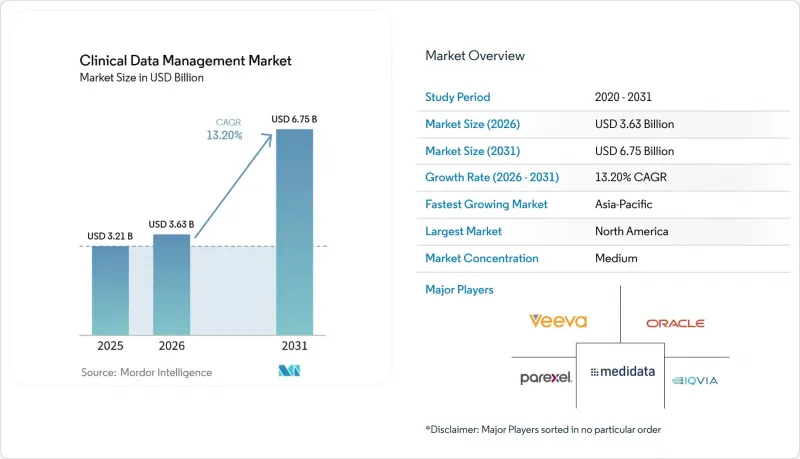
본 보고서는 구성 요소(소프트웨어, 서비스), 도입 형태(클라우드 기반, On-Premise형, 하이브리드형), 제품 유형(EDC, CDMS 플랫폼, 분석·표준화 도구), 용도(데이터 수집, 데이터 클렌징, 코딩, 안전성, 규제 보고), 최종 사용자(제약, CRO, 의료기기, 학술 기관, 병원), 지역(북미, 유럽, 아시아태평양, 중동 및 아프리카, 남미)별로 분류되어 있습니다. 예측치는 금액(달러)으로 표시되어 있습니다.
전 세계 임상 데이터 관리 시장 동향 및 인사이트
프로토콜의 복잡화 및 멀티모달 데이터 증가
현대 종양학 및 희귀질환 연구에서는 기존의 사례 보고서(CRF)에 더해 영상 데이터, 웨어러블 기기에서 전송되는 신호, eCOA 입력, 외부 검사 기관의 데이터가 결합되는 사례가 증가하고 있어, 수작업에 의존하는 워크플로는 실용적인 한계를 넘어서는 중입니다. 터프츠 대학교 의약품 개발 연구센터(Tufts Center for the Study of Drug Development)의 보고에 따르면, 2024년까지의 10년 동안 프로토콜의 평균 복잡도 점수는 36% 상승했으며, 이러한 상승의 대부분은 2상 종양학 연구 및 세포 및 유전자 치료 연구가 주도하고 있습니다. 임상 데이터 관리 시장에서 프로토콜이 수정될 때마다 새로운 편집 점검 프로그래밍, 데이터베이스 개정 및 검증 작업이 필요해지며, 과학적 변경에 따른 비용이 증가하고 있습니다. 각 벤더사는 메타데이터 기반 임상시험 설정 도구를 제공함으로써 이에 대응하고 있으며, Veeva사는 2026년 동향 보고서에서 구조화된 프로토콜 메타데이터를 기반으로 단 7회의 API 호출만으로 완료되는 EDC 설정 자동화를 강조했습니다.
감사 대응이 가능한 전자 기록에 대한 규제적 압력
2024년 10월 FDA가 최종 확정한 지침에서는 클라우드 기반 임상 시스템도 On-Premise형 시스템과 마찬가지로 21 CFR Part 11의 의무를 지게 됨이 명확해졌으며, 일부 보수적인 사용자들 사이에서 오랫동안 제기되었던 구매 관련 우려가 해소되었습니다. 2025년에 시행될 예정인 ICH E6(R3)에서는 계획적이고 위험 기반의 감사 추적 기록 검토가 임상시험 진행 중의 직접적인 ‘적정 임상시험 실시 기준(GCP)’ 요건이 됨에 따라 기대감이 높아질 것입니다. 대규모 3상 임상시험에서는 방대한 양의 감사 추적 기록이 생성될 가능성이 있어, 대규모의 수동적 지속적인 검토를 유지하기는 어렵습니다. 이러한 압박으로 인해 임상 데이터 관리 시장은 최종 단계에서의 검토가 아닌, 자동화된 이상 감지, 보다 정확한 문서화 및 지속적인 모니터링을 지원하는 시스템으로 전환되고 있습니다.
규제 대상 시스템에서 발생하는 높은 검증 및 변경 관리 부담
검증이 완료된 임상 시스템에는 설치 적합성 평가(IQ), 운영 적합성 평가(OQ), 성능 적격성 평가(PQ) 문서화, 접근 제어 구조 및 영구적인 감사 추적이 필요하며, 이로 인해 표준 기업 소프트웨어에 비해 도입 기간이 길어질 가능성이 있습니다. FDA는 도입 모델에 관계없이 규제 대상 전자 시스템에 대한 엄격한 검증 및 변경 관리를 계속해서 중시하고 있습니다. 임상 데이터 관리 시장에서 정기적인 업그레이드나 프로토콜 수정은 검증, 교육, 데이터베이스 로직, 편집 점검 및 문서화 각 분야에서 추가적인 요구 사항을 발생시킬 수 있으며, 특히 소규모 생명공학 기업의 경우 벤더 주도의 검증 지원이 점점 더 중요해지고 있습니다.
부문 분석
2025년에는 소프트웨어가 임상 데이터 관리 시장의 58.34% 점유율을 차지할 것으로 예측됩니다. 이는 On-Premise 환경에서 재검증 주기를 단축하는 구독형 플랫폼에 대해 스폰서가 강한 선호도를 보이고 있음을 반영합니다. 소프트웨어 계층은 현재 코딩, 위험 기반 품질 관리 도구, 분석 기능 및 신청 지원을 단일 환경으로 통합함으로써 기본적인 데이터 수집의 범위를 넘어섰습니다. 이러한 범위 확대로 인해 구매자들이 상호 연동되지 않은 여러 포인트 솔루션을 유지하는 것의 가치를 낮게 평가하게 되면서, 주요 벤더들은 기존 고객을 유지하기가 더 쉬워졌습니다. 또한, 규제 및 프로토콜 설계, 인공지능(AI) 활용 사례가 진화함에 따라 지속적인 업데이트가 필요해지는 점도 이 부문에 호재가 되고 있습니다.
서비스 분야는 더욱 빠르게 확대되고 있으며, 2031년까지의 연평균 복합 성장률은 14.53%로 예측됩니다. 이는 스폰서가 임상시험의 수행, 감독 및 지속적인 최적화에 대해 외부 지원을 구하는 경향이 있기 때문입니다. 계약 연구 기관(CRO)은 스폰서를 대신해 임상시험을 수행하는 동시에, 데이터 전략, 인공지능 기반 모니터링, 워크플로우 설계를 장기적인 서비스 계약에 포함시키고 있습니다. 알콘(Alcon)이 2025년에 보고한, 모니터링 대상 사이트 전체의 ‘당일 데이터 입력률’ 45%라는 수치는 디지털 시스템 내에서의 이용 행태가 서비스 품질의 측정 기준 중 하나로 자리 잡고 있음을 보여줍니다. 이러한 동향은 플랫폼의 기능과 관리형 서비스의 가치 간의 연계성을 강화하는 동시에, 소프트웨어의 주도적 지위를 유지하고 있습니다.
2026년에는 클라우드 기반 도입이 임상 데이터 관리 시장의 55.45%를 차지할 것으로 예상되며, 2031년까지의 예측 연평균 복합 성장률(CAGR)도 13.67%로 가장 높은 성장세를 보일 것으로 전망됩니다. 이러한 위상은 단기적인 갱신 주기라기보다는 업데이트 배포, 원격 액세스, 시험의 확장성, 그리고 여러 시설 간의 조정에 있어 명확한 이점을 반영한 것입니다. FDA의 2025년 지침은 클라우드 시스템과 On-Premise 시스템 모두 21 CFR Part 11에 따라 동일한 규정 준수 기준을 충족해야 함을 명확히 함으로써 클라우드 도입을 뒷받침하고 있습니다. 이러한 명확화를 통해 규제상의 불확실성으로 인해 전환을 미루던 구매자들의 조달에 대한 주저함이 완화될 것입니다.
또한, 클라우드 도입은 분산형 임상시험, 인공지능(AI)을 활용한 검토, 그리고 다자간 협업으로의 광범위한 전환을 촉진합니다. 이러한 이용 사례는 후원사, 계약 연구 기관(CRO) 팀, 임상시험 기관 사용자 간의 보다 신속한 데이터 교환과 용이한 접근에 의존하지만, 고립된 레거시 환경에서는 이를 관리하기 어렵습니다. 임상 데이터 관리 시장에서도 클라우드는 출시 시기의 표준화를 실현하고, 로컬 인프라 유지 관리에 따른 운영 부담을 경감할 수 있다는 점에서 혜택을 받고 있습니다. 다만, 엄격한 데이터 보관 규정이나 고도로 맞춤화된 내부 아키텍처를 갖춘 일부 대규모 조직에서는 On-Premise 시스템의 중요성이 여전히 남아 있습니다.
지역별 분석
북미는 2025년에 임상 데이터 관리 시장의 39.56% 점유율을 차지하고, 지역으로서의 주도적 지위를 유지할 전망입니다. 이 지역은 주요 바이오의약품 스폰서의 견고한 기반, 확립된 CRO(계약 연구 기관) 역량, 그리고 클라우드 네이티브 시스템에 대한 미국 식품의약국(FDA)의 지원적인 환경이라는 이점을 누리고 있습니다. 2025년 및 2026년 FDA의 바이오 연구 모니터링 활동에서는 전자 기록의 미비 사항이 계속해서 주요 초점이 될 전망이며, 이로 인해 스폰서 및 CRO의 각 계정에서 지속적인 업그레이드 주기가 촉진될 것입니다. 미국은 여전히 주요 수요 거점이지만, 캐나다와 멕시코도 미국이 관리하는 플랫폼에 데이터를 제공하는 임상시험 수행지로 그 중요성이 높아지고 있습니다.
유럽은 임상 데이터 관리 시장에서 여전히 2위의 규모를 자랑하며, 독일, 영국, 프랑스가 수요의 대부분을 차지하고 있습니다. 이 지역은 대규모 임상시험 기반, 성숙한 규제 요건, 그리고 다국간 규정 준수를 지원하는 시스템에 대한 지속적인 수요라는 강점을 가지고 있습니다. 2024년부터 임상시험 정보 시스템(CTIS) 환경을 통해 시행되고 있는 유럽의약품청(EMA)의 임상시험 규정 536/2014에 따라, 더욱 강력한 표준화와 다관할권 대응 기능을 갖춘 플랫폼에 대한 수요가 증가하고 있습니다. 이러한 요건은 신뢰할 수 있는 감사 추적 기록과 국가 간 효율적인 제출 조정을 제공하는 공급업체를 뒷받침하고 있습니다.
아시아태평양은 임상 데이터 관리 시장에서 가장 빠르게 성장하는 지역으로, 2031년까지 연평균 성장률(CAGR)이 14.56%를 나타낼 것으로 예측됩니다. 중국에서는 전자 임상 데이터 제출 기준의 현대화와 임상시험 등록 확대에 따라 수요가 증가하고 있는 반면, 일본에서는 계속해서 의약품 및 의료기기종합기구(PMDA)에 부합하는 전자 제출 요건이 채택되고 있습니다. 인도는 숙련된 분석가 기반과 현대화된 임상시험 승인 체계를 바탕으로, 임상 데이터 관리 서비스 아웃소싱 분야에서 비용 경쟁력 있는 제공 거점으로서의 입지를 강화하고 있습니다. 중동 및 아프리카 및 남미는 절대적인 규모로는 여전히 작지만, 다국적 후원사들이 더 광범위한 환자 접근성과 임상시험 기관의 신속한 가동을 요구함에 따라 그 중요성이 커지고 있습니다.
기타 혜택:
- 엑셀 형식 시장 예측(ME) 시트
- 3개월간의 애널리스트 지원
자주 묻는 질문
목차
제1장 서론
제2장 조사 방법
제3장 주요 요약
제4장 시장 구도
제5장 시장 규모와 성장 예측
제6장 경쟁 구도
제7장 시장 기회와 향후 전망
JHS 26.08.05According to Mordor Intelligence, the clinical data management market size is projected to expand from USD 3.21 billion in 2025 and USD 3.63 billion in 2026 to USD 6.75 billion by 2031, registering a CAGR of 13.20% between 2026 to 2031.
This report is Segmented by Component (Software, Services), Deployment Mode (Cloud-Based, On-Premise, Hybrid), Product Type (EDC, CDMS Platforms, Analytics & Standards Tools), Application (Data Collection, Cleaning, Coding, Safety, Regulatory Reporting), End User (Pharma, Cros, Med Device, Academic, Hospitals), and Geography (North America, Europe, Asia-Pacific, MEA, South America). Forecasts in Value (USD).
Global Clinical Data Management Market Trends and Insights
Rising Protocol Complexity and Multimodal Data Volume
Modern oncology and rare disease studies increasingly combine imaging, wearable signals, eCOA inputs, and external laboratory feeds with conventional case report forms, pushing manual workflows beyond practical limits. The Tufts Center for the Study of Drug Development reported a 36% increase in average protocol complexity scores over the decade ending in 2024, with Phase II oncology and cell and gene therapy studies driving much of the rise. In the clinical data management market, each protocol amendment can trigger new edit-check programming, database revisions, and validation work, increasing the cost of every scientific change. Vendors are responding with metadata-driven study setup tools, and Veeva highlighted automated EDC configuration completed in seven API calls from structured protocol metadata in its 2026 trend report.
Regulatory Pressure for Audit-Ready Electronic Records
The FDA's finalized October 2024 guidance clarified that cloud-based clinical systems carry the same 21 CFR Part 11 obligations as on-premise systems, addressing a long-standing purchasing concern among some conservative users. ICH E6(R3), expected to become operational in 2025, will raise expectations by making planned and risk-based audit trail review a direct Good Clinical Practice requirement during active trial conduct. Large Phase III trials can generate substantial volumes of audit trail entries, making continuous manual review difficult to sustain at scale. This pressure is shifting the clinical data management market toward systems that support automated anomaly detection, cleaner documentation, and ongoing monitoring rather than end-stage review.
High Validation and Change-Control Burden for Regulated Systems
Validated clinical systems require Installation Qualification (IQ), Operational Qualification (OQ), and Performance Qualification (PQ) documentation, controlled access structures, and durable audit trails, which can extend implementation timelines compared to standard enterprise software. The FDA continues to emphasize disciplined validation and change control for regulated electronic systems, regardless of deployment model. In the clinical data management market, routine upgrades and protocol amendments can create additional requirements across validation, training, database logic, edit checks, and documentation, making vendor-led validation support increasingly important, especially for smaller biotech users.
Other drivers and restraints analyzed in the detailed report include:
- AI-Enabled Data Cleaning, Coding, and Reconciliation
- Expansion of Decentralized and Hybrid Trials
- Fragmented Data Architecture Across Trial Platforms
For complete list of drivers and restraints, kindly check the Table Of Contents.
Segment Analysis
Software is expected to hold 58.34% of the clinical data management market share in 2025, reflecting strong sponsor preference for subscription-based platforms that reduce on-premise revalidation cycles. The software layer now extends beyond basic data capture by integrating coding, risk-based quality tools, analytics, and submission support in one environment. This broader scope helps large vendors retain installed accounts, as buyers see less value in maintaining multiple disconnected point solutions. The segment also benefits from the need for continuous updates as regulations, protocol designs, and artificial intelligence use cases evolve.
Services are expanding faster, with a 14.53% compound annual growth rate projected through 2031, as sponsors seek external support for execution, oversight, and ongoing optimization. Contract Research Organizations are running studies for sponsors while also packaging data strategy, artificial intelligence monitoring, and workflow design into longer-term service relationships. Alcon's reported 45% same-day data entry rate across monitored sites in 2025 shows how usage behavior within digital systems is becoming part of service quality measurement. This trend strengthens the link between platform capability and managed-service value while keeping software in the lead.
Cloud-based deployment is expected to hold 55.45% of the clinical data management market in 2026, while also registering the fastest projected compound annual growth rate of 13.67% through 2031. This position reflects clear advantages in update delivery, remote access, study scaling, and multi-site coordination rather than a short-term replacement cycle. The FDA's 2025 guidance supports adoption by clarifying that cloud systems and on-premise systems must meet the same compliance standard under 21 CFR Part 11. This clarification reduces procurement hesitation among buyers that delayed migration due to perceived regulatory uncertainty.
Cloud deployment also supports the broader shift toward decentralized studies, artificial intelligence-assisted review, and multi-party collaboration. These use cases depend on faster data exchange and easier access across sponsors, Contract Research Organization teams, and site users, which isolated legacy environments make harder to manage. The clinical data management market also benefits from cloud's ability to standardize release timing and reduce the operational burden of local infrastructure upkeep. However, on-premise systems remain relevant in some large organizations with strict residency rules or deeply customized internal architectures.
Complete Report Scope:
- By Component
- Software
- Services
- By Deployment Mode
- Cloud-Based
- On-Premise
- Hybrid
- By Product Type
- Electronic Data Capture
- Clinical Data Management System Platforms
- Clinical Trial Management Integration Suites
- Clinical Data Analytics and Reporting Tools
- Clinical Data Standards and Validation Tools
- By Application
- Data Collection and Capture
- Data Cleaning and Query Management
- Coding and Dictionary Management
- Safety and Adverse Event Reconciliation
- Submission and Regulatory Reporting
- By End User
- Pharmaceutical and Biotechnology Companies
- Contract Research Organizations
- Medical Device Companies
- Academic and Research Institutions
- Hospitals and Healthcare Providers
- By Geography
- North America
- United States
- Canada
- Mexico
- Europe
- Germany
- United Kingdom
- France
- Italy
- Spain
- Rest of Europe
- Asia-Pacific
- China
- India
- Japan
- Australia
- South Korea
- Rest of Asia-Pacific
- Middle East and Africa
- GCC
- South Africa
- Rest of Middle East and Africa
- South America
- Brazil
- Argentina
- Rest of South America
- North America
Geography Analysis
North America is expected to hold 39.56% of the clinical data management market share in 2025, maintaining its leading regional position. The region benefits from a strong base of large biopharma sponsors, established contract research organization (CRO) capacity, and a supportive Food and Drug Administration (FDA) environment for cloud-native systems. FDA Bioresearch Monitoring activity in 2025 and 2026 is expected to keep electronic record deficiencies in focus, supporting continued upgrade cycles across sponsor and CRO accounts. The United States remains the primary demand center, while Canada and Mexico are gaining relevance as trial locations that feed data into U.S.-managed platforms.
Europe remains the second-largest region in the clinical data management market, with Germany, the United Kingdom, and France accounting for a major share of demand. The region benefits from a large trial base, mature regulatory expectations, and sustained demand for systems that support multi-country compliance. The European Medicines Agency's Clinical Trial Regulation 536/2014, enforced through the Clinical Trials Information System (CTIS) environment since 2024, has increased demand for platforms with stronger standardization and multi-jurisdiction capabilities. This requirement supports vendors that offer reliable audit trails and efficient submission coordination across countries.
Asia-Pacific is the fastest-growing geography in the clinical data management market, with a projected CAGR of 14.56% through 2031. China is seeing stronger demand as electronic clinical data submission standards modernize and trial registrations expand, while Japan continues to rely on Pharmaceuticals and Medical Devices Agency (PMDA)-aligned electronic submission requirements. India is strengthening its position as a cost-competitive delivery hub for outsourced clinical data management services, supported by a skilled analyst base and modernized trial approval frameworks. The Middle East and Africa and South America remain smaller in absolute value, but they are gaining relevance as multinational sponsors seek broader patient access and faster site startup.
- Accenture
- BioClinica, Inc.
- Castor EDC, Inc.
- Clario Holdings, Inc.
- Cognizant
- Dassault Systemes
- eClinical Solutions
- ICON
- IQVIA
- Labcorp Holdings Inc.
- Medidata Solutions, Inc.
- Medrio
- OpenClinica, LLC
- Oracle
- Parexel International
- Siena Analytics, Inc.
- Tata Consultancy Services
- Veeva Systems
- Wipro
- YPrime, LLC
Additional Benefits:
- The market estimate (ME) sheet in Excel format
- 3 months of analyst support
TABLE OF CONTENTS
1 INTRODUCTION
- 1.1 Study Assumptions and Market Definition
- 1.2 Scope of the Study
2 RESEARCH METHODOLOGY
3 EXECUTIVE SUMMARY
4 MARKET LANDSCAPE
- 4.1 Market Overview
- 4.2 Market Drivers
- 4.2.1 Rising Protocol Complexity and Multimodal Data Volume
- 4.2.2 Regulatory Pressure for Audit-Ready Electronic Records
- 4.2.3 Expansion of Decentralized and Hybrid Trials
- 4.2.4 AI-Enabled Data Cleaning, Coding, and Reconciliation
- 4.2.5 EHR-EDC Interoperability and Site Workflow Simplification
- 4.2.6 Rising Outsourcing of Clinical Operations to CROs
- 4.3 Market Restraints
- 4.3.1 High Validation and Change-Control Burden for Regulated Systems
- 4.3.2 Fragmented Data Architecture Across Trial Platforms
- 4.3.3 Shortage of Skilled Clinical Data Management Talent
- 4.3.4 Integration Risk Across Legacy and Cloud Systems
- 4.4 Value/Supply Chain Analysis
- 4.5 Regulatory Landscape
- 4.6 Technological Outlook
- 4.7 Porters Five Forces Analysis
- 4.7.1 Bargaining Power of Buyers
- 4.7.2 Bargaining Power of Suppliers
- 4.7.3 Threat of New Entrants
- 4.7.4 Threat of Substitutes
- 4.7.5 Competitive Rivalry
5 MARKET SIZE AND GROWTH FORECASTS (VALUE, USD)
- 5.1 By Component
- 5.1.1 Software
- 5.1.2 Services
- 5.2 By Deployment Mode
- 5.2.1 Cloud-Based
- 5.2.2 On-Premise
- 5.2.3 Hybrid
- 5.3 By Product Type
- 5.3.1 Electronic Data Capture
- 5.3.2 Clinical Data Management System Platforms
- 5.3.3 Clinical Trial Management Integration Suites
- 5.3.4 Clinical Data Analytics and Reporting Tools
- 5.3.5 Clinical Data Standards and Validation Tools
- 5.4 By Application
- 5.4.1 Data Collection and Capture
- 5.4.2 Data Cleaning and Query Management
- 5.4.3 Coding and Dictionary Management
- 5.4.4 Safety and Adverse Event Reconciliation
- 5.4.5 Submission and Regulatory Reporting
- 5.5 By End User
- 5.5.1 Pharmaceutical and Biotechnology Companies
- 5.5.2 Contract Research Organizations
- 5.5.3 Medical Device Companies
- 5.5.4 Academic and Research Institutions
- 5.5.5 Hospitals and Healthcare Providers
- 5.6 By Geography
- 5.6.1 North America
- 5.6.1.1 United States
- 5.6.1.2 Canada
- 5.6.1.3 Mexico
- 5.6.2 Europe
- 5.6.2.1 Germany
- 5.6.2.2 United Kingdom
- 5.6.2.3 France
- 5.6.2.4 Italy
- 5.6.2.5 Spain
- 5.6.2.6 Rest of Europe
- 5.6.3 Asia-Pacific
- 5.6.3.1 China
- 5.6.3.2 India
- 5.6.3.3 Japan
- 5.6.3.4 Australia
- 5.6.3.5 South Korea
- 5.6.3.6 Rest of Asia-Pacific
- 5.6.4 Middle East and Africa
- 5.6.4.1 GCC
- 5.6.4.2 South Africa
- 5.6.4.3 Rest of Middle East and Africa
- 5.6.5 South America
- 5.6.5.1 Brazil
- 5.6.5.2 Argentina
- 5.6.5.3 Rest of South America
- 5.6.1 North America
6 COMPETITIVE LANDSCAPE
- 6.1 Market Concentration
- 6.2 Market Share Analysis
- 6.3 Company Profiles (includes Global Level Overview, Market Level Overview, Core Segments, Financials as available, Strategic Information, Market Rank/Share, Products and Services, Recent Developments)
- 6.3.1 Accenture plc
- 6.3.2 BioClinica, Inc.
- 6.3.3 Castor EDC, Inc.
- 6.3.4 Clario Holdings, Inc.
- 6.3.5 Cognizant Technology Solutions Corporation
- 6.3.6 Dassault Systemes SE
- 6.3.7 eClinical Solutions LLC
- 6.3.8 ICON plc
- 6.3.9 IQVIA
- 6.3.10 Labcorp Holdings Inc.
- 6.3.11 Medidata Solutions, Inc.
- 6.3.12 Medrio, Inc.
- 6.3.13 OpenClinica, LLC
- 6.3.14 Oracle Corporation
- 6.3.15 Parexel International Corporation
- 6.3.16 Siena Analytics, Inc.
- 6.3.17 Tata Consultancy Services Limited
- 6.3.18 Veeva Systems Inc.
- 6.3.19 Wipro Limited
- 6.3.20 YPrime, LLC
7 MARKET OPPORTUNITIES AND FUTURE OUTLOOK
- 7.1 White-Space and Unmet-Need Assessment


