

|
시장보고서
상품코드
2099527
초전도선 시장 : 점유율 분석, 업계 동향 및 통계, 성장 예측(2026-2031년)Superconducting Wire - Market Share Analysis, Industry Trends & Statistics, Growth Forecasts (2026 - 2031) |
||||||
 Mordor Intelligence
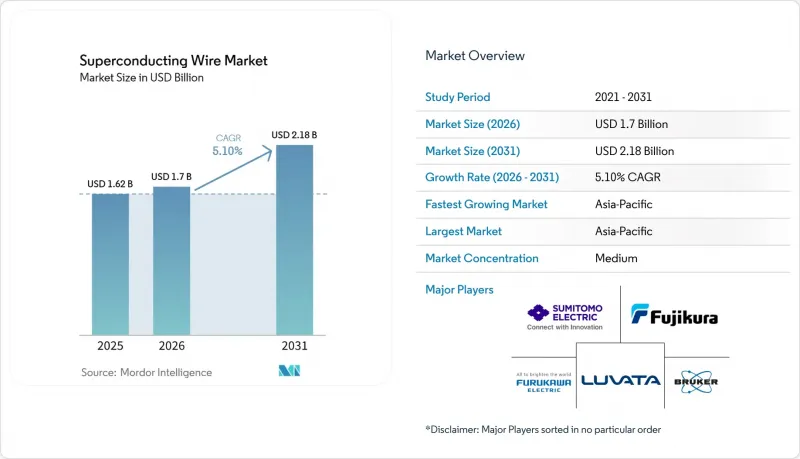
Mordor Intelligence에 의하면, 초전도선 시장은 2025년에 16억 2,000만 달러 규모가 되어, 2026년 17억 달러에서 2031년까지 21억 8,000만 달러로 확대되어 2026년부터 2031년까지 예측 기간에서 CAGR 5.10%로 성장할 전망입니다.
본 보고서는 초전도체의 유형(저온 초전도체(LTS), 중온 초전도체(MTS) 등), 최종 사용자(의료, 에너지 및 전력, 연구 등), 지역(아시아태평양, 북미, 유럽, 남미, 중동 및 아프리카)별로 분류되어 있습니다. 시장 전망은 금액(달러) 기준으로 제시되어 있습니다.
전 세계 초전도선 시장 동향 및 인사이트
MRI 기존 설비의 업그레이드 및 고자기장·헬륨 프리 자석 플랫폼으로의 전환
의료용 영상 진단은 초전도선 시장에 있어 확실한 수요 원천이 되고 있으며, 그 성장은 스캐너 대수 자체보다 기존 설비의 업그레이드에 의해 점점 더 주도되고 있습니다. 1.5테슬라에서 3.0테슬라로의 전환에 따라 자석 어셈블리당 선재 사용량이 증가하고 있으며, 퍼시스턴트 모드에서의 자기장 안정성에 대한 성능 요건이 더욱 엄격해지고 있습니다. 또한, 헬륨 프리 자석의 개발로 제품 사양이 변화하고 있으며, 새로운 시스템에서는 개선된 냉각 아키텍처 하에서 안정적으로 작동하는 도체가 요구되고 있습니다. 2026년 1월, 브루커(Bruker)는 차세대 MRI 시스템을 위한 고성능 초전도체를 공급하기 위해 두 개의 세계 헬스케어 기업과 총액 5억 달러 규모의 다년 계약을 체결했습니다. 이는 조달이 프로그램 기반 계약으로 전환되고 있음을 보여줍니다. 이러한 추세로 인해 초전도선 시장에는 보다 안정적인 수요 하한선이 형성되며, 프로젝트 주도형 용도에서 흔히 나타나는 단기적인 변동이 완화될 것입니다.
재생에너지를 통합하기 위한 송전망 현대화 및 도시 지역에서의 HTS 케이블 구축
고밀도 도시 네트워크에서는 새로운 부지 확보에 따른 지연이나 비용 없이 추가 송전 용량이 필요하기 때문에 초전도선 시장은 전력 사업에서 그 중요성이 커지고 있습니다. 뮌헨에 설치된 NKT사의 총 길이 15킬로미터, 110kV 'SuperLink' 케이블 시스템은 2025년에 광범위한 시험을 완료하여, HTS 케이블이 표준 배전 회랑 내에서 500MW를 초과하는 전력을 송전할 수 있음을 입증했습니다. 2025년 11월, 넥산즈(Nexans)는 SupraMarine 컨소시엄에 참여하여 해상 풍력 발전소와의 연계를 위한 고전압 교류(HVAC) 초전도 해저 송전 실증 시스템 개발에 착수했습니다. 시험은 2028년까지 실시될 예정입니다. 이러한 프로그램을 통해 초전도선 시장은 고립된 시범 사업에서 공식적인 납기일이 설정된 계획적인 인프라 프로젝트로 전환되고 있습니다. 유럽의 정책 환경도 이러한 방향성을 더욱 뒷받침하고 있습니다. 재생에너지 통합 목표와 송전 회랑의 혼잡으로 인해 전력 회사들은 기존 부지 내에서 발전 용량을 확대할 수 있는 해결책을 모색할 수밖에 없기 때문입니다.
도체의 높은 단가와 극저온 플랜트 관련 설비 비용이 자본 프로젝트 이외의 분야에서 도입을 제한하고 있습니다.
초전도선 시장은 비용 장벽에 직면해 있습니다. 기술적으로 검증된 시스템이라 하더라도 극저온 시스템 일체를 포함하면 경제적 타당성을 입증하기 어려운 경우가 많기 때문입니다. 미국 에너지부의 제조 개선 프로그램에서는 고온 초전도(HTS) 전선의 비용을 1킬로암페어미터당 50달러 미만으로 낮추는 것을 목표로 하고 있지만, 2025년에 제시된 기술 분석에 따르면 이 수준이라 하더라도 광범위한 송전망에 도입하는 데 필요한 기준치의 10배 이상 높은 상태로 남아 있는 것으로 나타났습니다. 비용 압박은 전선에서만 발생하는 것이 아닙니다. 극저온 냉각 장치, 진공 피복 도관, 액체 질소 취급 등이 각 설치에 막대한 설비 투자 및 운영 비용을 추가하고 있기 때문입니다. 이 때문에 초전도선 시장의 대부분은 광범위한 송전망 교체라기보다는 MRI, 핵융합, 혹은 특정 대상에 한정된 송전망 업그레이드 등 성능 면에서 명확한 부가가치를 얻을 수 있는 용도로 제한되어 있습니다. 또한, 저온 초전도체(LTS)를 활용한 용도의 경우, 헬륨 공급의 집중 문제가 여전히 우려 사항으로 남아 있어, 예측 가능한 수명 주기 비용을 필요로 하는 병원이나 인프라 계획 담당자들에게 조달 리스크를 높이고 있습니다.
부문 분석
2025년 시점에서 HTS는 초전도선 시장의 52.82% 점유율을 차지하고 있으며, 2031년까지 연평균 성장률(CAGR) 10.82%를 나타낼 것으로 예측됩니다. 이에 따라 HTS는 초전도선 시장에서 가장 크고 가장 빠르게 성장하는 도체 카테고리가 되었습니다. 이러한 위상은 핵융합용 자석, 도시 케이블 시스템, 데이터센터의 버스바에 대한 구조적인 수요에 힘입은 것입니다. 이러한 분야에서는 더 높은 작동 온도와 우수한 자기장 성능이 요구되며, LTS로는 효율적으로 대응할 수 없는 이용 사례를 지원하고 있습니다. 이 부문은 REBCO 및 YBCO가 주를 이루지만, 시스템 설계 및 인증 프로세스가 이미 확립된 특정 용도에서는 1세대 BSCCO 테이프도 여전히 중요한 역할을 하고 있습니다. SuperPower, 후지쿠라, SuNam은 핵융합 등급 제품에 투자하고 있으며, SuperPower는 2025년에 자사의 FM 등급 와이어가 20K 및 20테슬라에서 더 높은 임계 전류 성능을 달성하는 것을 목표로 한다고 발표했습니다. 이는 초전도선 업계의 고자기장 수요와 부합하는 것입니다. 이러한 기술력을 바탕으로, 성능이 극히 중요한 프로그램을 위한 조달 시 HTS는 표준 도체 등급보다 강력한 가격 경쟁력을 갖게 됩니다.
LTS가 초전도선 시장에서 여전히 중요한 위치를 차지하고 있는 이유는 NbTi 선재가 임상용 MRI 제조에 깊이 정착되어 있으며, 기존의 OEM 인증으로 인해 단기적인 대체 수요가 억제되고 있기 때문입니다. MTS는 이붕화 마그네슘 선재를 주력 제품으로 삼아, 특수 시스템에서 중간 온도 냉각이 실용적인 비용 효율성을 제공하는 분야에서 초전도선 업계 내 입지를 다져가고 있습니다. NASA는 2024년, Hyper Tech Research사에 고출력 밀도의 항공기용 모터용 초미세 필라멘트 MgB2 와이어 개발을 추진하기 위한 '중소기업 기술 혁신 연구(SBIR)' 계약을 수여했습니다. 이는 해당 범주와 관련된 장거리 전기 항공이라는 주제를 뒷받침하는 것입니다. 이 세 가지 재료 분류 모두에서 IEC TC90에 따른 표준화의 중요성이 점점 더 커지고 있습니다. 이는 문서화된 성능의 일관성이 초전도선 시장에서 공공 부문 및 프로그램 주도형 조달 요건을 형성하고 있기 때문입니다.
지역별 분석
아시아태평양은 2025년 초전도선 시장의 38.65% 점유율을 차지하고 있으며, 2031년까지 연평균 성장률(CAGR) 9.81%로 확대될 것으로 예상되어 가장 크고 가장 빠르게 성장하는 지역 시장이 되고 있습니다. 일본은 스미토모 전기공업, 후지쿠라, 후루카와 전기공업이 주도하는 확고한 생산 거점과 장기적인 중앙 신칸센 초전도 리니어 프로젝트를 통해 이러한 위상을 뒷받침하고 있습니다. JR 주부는 2025년 해당 프로젝트 비용이 7조 엔(480억 달러)을 넘어섰다고 발표했으며, 이에 따라 지역 공급망 전반에서 교통 관련 초전도 기술 개발이 계속해서 중요한 위치를 차지하고 있습니다. 중국은 수입에 의존하는 고온 초전도(HTS) 소재에 대한 의존도를 낮추기 위해 국내에서 희토류 바륨 구리 산화물(REBCO) 테이프 생산을 확대하고 있는 반면, 한국은 케이블 및 테이프 용도의 제조 능력 확충을 계속하고 있습니다. 2026년 3월 효성TNC가 CAN Superconductors와 제휴한 것은 한국 기업이 국내에서 생산 능력을 확대함과 동시에 유럽 시장 직접 진출을 위한 체제를 갖추고 있음을 보여줍니다.
북미와 유럽은 초전도선 시장에서 가장 높은 가치를 지닌 HTS 조달의 큰 비중을 차지하고 있으며, 두 지역 모두 핵융합 연구에 대한 자금 지원, 첨단 의료용 OEM(주문자 상표 생산) 활동, 그리고 송전망 실증 프로그램을 결합하고 있습니다. 미국에서는 2025년 10월에 발표된 에너지부(DOE)의 핵융합 로드맵이 수십년단위의 투자 프레임워크를 제시하고 있으며, 이는 초전도선 공급업체가 장기적인 수요 계획을 수립하는 데 중요한 지침이 되고 있습니다. AMSC는 2026년 5월, 12개월 분의 수주 잔고가 2억 8,000만 달러를 넘고 분기 매출이 8,500만 달러를 돌파했다고 보고했는데, 이는 북미의 첨단 전력 인프라에 대한 기관들의 강력한 수요를 반영한 것입니다. 유럽에서는 독일의 ‘SuperLink’ 프로젝트, 영국의 핵융합 프로그램, 그리고 프랑스가 ‘SupraMarine’ 컨소시엄 및 보다 광범위한 조사 네트워크에서 수행하는 역할을 통해 계속해서 중요한 위치를 차지하고 있습니다. 두 지역의 공공 송전망 및 청정 에너지 프로그램은 구매 주기에 편차가 있음에도 불구하고 고부가가치 조달을 뒷받침하고 있습니다.
남미, 중동 및 아프리카는 초전도선 시장에 대한 기여도가 여전히 미미하지만, 지역별로 수요 추세는 각기 다릅니다. 브라질과 아르헨티나는 대규모 상용 케이블 구축보다는 조사 및 송전망의 내결함성 향상을 위한 초기 단계의 노력과 더 밀접하게 관련되어 있습니다. 사우디아라비아와 아랍에미리트(UAE)는 첨단 에너지 인프라에 투자하며 초전도 기술 적용을 위한 잠재적 기반을 마련하고 있지만, 현재로서는 대부분의 전력 사업 프로그램에서 이 기술이 아직 직접적인 예산 항목으로 반영되지는 않고 있습니다. 남아프리카공화국에서는 ‘스퀘어 킬로미터 어레이(SKA)’ 프로젝트 및 관련 특수 초전도 부품을 통해 연구 주도형 수요 기반이 형성되고 있습니다. 한편, 이 지역의 다른 많은 국가들에서는 국내 제조나 송전망 프로젝트보다는 주로 수입된 의료용 영상 진단 시스템에 수요가 의존하는 상태가 지속되고 있습니다.
기타 혜택:
- 엑셀 형식 시장 예측(ME) 시트
- 3개월간의 애널리스트 지원
자주 묻는 질문
목차
제1장 서론
제2장 조사 방법
제3장 주요 요약
제4장 시장 구도
제5장 시장 규모와 성장 예측
제6장 경쟁 구도
제7장 시장 기회와 향후 전망
JHS 26.08.05According to Mordor Intelligence, the superconducting wire market was valued at USD 1.62 billion in 2025 and is estimated to grow from USD 1.70 billion in 2026 to USD 2.18 billion by 2031, at a CAGR of 5.10% during the forecast period 2026 to 2031.
This report is Segmented by Superconductor Type (Low-Temperature Superconductor (LTS), Medium-Temperature Superconductor (MTS), and More), End User (Medical, Energy & Power, Research, and More), and Geography (Asia-Pacific, North America, Europe, South America, and Middle-East and Africa). The Market Forecasts are Provided in Terms of Value (USD).
Global Superconducting Wire Market Trends and Insights
MRI Installed-Base Upgrade and Transition to Higher-Field, Helium-Free Magnet Platforms
Medical imaging provides dependable demand for the superconducting wire market, with growth increasingly driven by upgrades within the installed base rather than by scanner count alone. The transition from 1.5 tesla to 3.0 tesla platforms increases wire content per magnet assembly and tightens performance requirements for field stability in persistent mode. Helium-free magnet development is also changing product specifications, as newer systems require conductors that perform reliably under revised cooling architectures. In January 2026, Bruker secured USD 500 million in multi-year agreements with two global healthcare companies to supply high-performance superconductors for next-generation MRI systems, indicating that procurement is shifting toward program-based commitments. This pattern provides the superconducting wire market with a more stable demand floor and reduces short-term volatility that is more common in project-driven applications.
Grid Modernization and Urban HTS Cable Deployment to Integrate Renewable Energy
The superconducting wire market is gaining utility relevance as dense urban networks require additional capacity without the delays and costs associated with new rights-of-way. NKT's 15-kilometer, 110-kV SuperLink cable system in Munich completed extensive testing in 2025, demonstrating that HTS cables can transmit more than 500 MW within a standard distribution corridor. In November 2025, Nexans joined the SupraMarine consortium to develop a high-voltage alternating current (HVAC) superconducting subsea transmission demonstrator for offshore wind links, with testing planned by 2028. These programs move the superconducting wire market away from isolated pilots and toward planned infrastructure projects with formal delivery schedules. The policy environment in Europe further supports this direction, as renewable integration targets and corridor congestion are pushing utilities toward solutions that add power capacity within existing footprints.
High Conductor Unit Costs and Cryogenic Balance-Of-Plant Expenses Limit Deployment Outside Capital-Project Settings
The superconducting wire market faces a cost barrier, as technically proven systems are often difficult to justify economically once the full cryogenic package is included. The U.S. Department of Energy's manufacturing improvement program targets an HTS wire cost below USD 50 per kiloampere-meter; however, technical analysis presented in 2025 indicated that even this level remains more than 10 times above the threshold required for broad grid deployment. Cost pressure does not stem solely from the wire, as cryocoolers, vacuum-jacketed conduits, and liquid nitrogen handling add significant capital and operating costs to each installation. This limits much of the superconducting wire market to applications where performance offers a clear premium, such as MRI, fusion, or targeted grid upgrades, rather than broad network replacement. Helium supply concentration also remains a concern for low-temperature superconductor (LTS)-based applications, adding procurement risk for hospitals and infrastructure planners that require predictable lifecycle costs.
Other drivers and restraints analyzed in the detailed report include:
- Fusion and High-Field Magnet Programs are Driving Large-Volume HTS Procurement
- Hyperscale Data-Center Adoption of HTS Busbars and Cabling for AI-Driven Workloads
- Scale-Up Yield and Quality Consistency Challenges in Rare Earth Barium Copper Oxide (REBCO) Tape Manufacturing Restrict Volume Production Capacity
For complete list of drivers and restraints, kindly check the Table Of Contents.
Segment Analysis
HTS held 52.82% of the superconducting wire market share in 2025 and is expected to grow at a 10.82% CAGR through 2031, making it both the largest and fastest-growing conductor category in the superconducting wire market. This position is driven by structural demand in fusion magnets, urban cable systems, and data center busbars, where higher operating temperatures and stronger field performance support use cases that LTS cannot serve as efficiently. The segment is centered on REBCO and YBCO, with first-generation BSCCO tapes still relevant in selected applications where system design and qualification paths are already established. SuperPower, Fujikura, and SuNam are investing in fusion-grade products, and SuperPower stated in 2025 that its FM-grade wire was targeting stronger critical current performance at 20 K and 20 tesla, which aligns with high-field demand in the superconducting wire industry. This technical capability gives HTS a stronger pricing position than standard conductor classes when buyers are procuring for performance-critical programs.
LTS remains relevant in the superconducting wire market because NbTi wire is deeply embedded in clinical MRI manufacturing, and existing OEM qualifications reduce the short-term case for replacement. MTS, led by magnesium diboride wire, is building a position in the superconducting wire industry where intermediate-temperature cooling offers a practical cost balance for specialized systems. NASA awarded Hyper Tech Research a Small Business Innovation Research (SBIR) contract in 2024 to advance fine-filament MgB2 wire for high-power-density aircraft motors, which supports the long-range electric aviation theme associated with this category. Across all three material classes, IEC TC90 standardization is becoming increasingly important as documented performance consistency shapes public-sector and program-led procurement requirements in the superconducting wire market.
Complete Report Scope:
- By Superconductor Type
- Low-temperature Superconductor (LTS)
- Medium-temperature Superconductor (MTS)
- High-temperature Superconductor (HTS)
- By End User
- Medical
- Energy & Power
- Research
- Transportation
- Electronics
- Others
- By Geography
- Asia-Pacific
- China
- Japan
- India
- South Korea
- Rest of Asia-Pacific
- North America
- United States
- Canada
- Mexico
- Europe
- Germany
- United Kingdom
- France
- Italy
- Spain
- Russia
- Rest of Europe
- South America
- Brazil
- Argentina
- Rest of South America
- Middle-East and Africa
- Saudi Arabia
- United Arab Emirates
- South Africa
- Rest of Middle-East and Africa
- Asia-Pacific
Geography Analysis
Asia-Pacific held 38.65% of the superconducting wire market share in 2025 and is expected to expand at a 9.81% CAGR through 2031, making it both the largest and fastest-growing regional market. Japan supports this position through its established producer base, led by Sumitomo Electric, Fujikura, and Furukawa Electric, and through the long-term Chuo Shinkansen superconducting maglev program. JR Central stated in 2025 that the project cost had exceeded JPY 7 trillion (USD 48 billion), which keeps transportation-related superconducting development prominent across the regional supply chain. China is scaling domestic Rare Earth Barium Copper Oxide (REBCO) tape production to reduce reliance on imported High-Temperature Superconducting (HTS) material, while South Korea continues to build manufacturing capacity for cable and tape applications. Hyosung TNC's March 2026 partnership with CAN Superconductors indicates that Korean firms are expanding capacity domestically and positioning for direct access to the European market.
North America and Europe account for a significant share of the highest-value HTS procurement in the superconducting wire market, as both regions combine fusion funding, advanced medical Original Equipment Manufacturer (OEM) activity, and grid demonstration programs. In the United States, the Department of Energy (DOE) fusion roadmap published in October 2025 provides a multi-decade investment framework that supports long-range demand planning for wire suppliers. AMSC reported in May 2026 that its 12-month order backlog exceeded USD 280 million and quarterly revenue topped USD 85 million, reflecting strong institutional demand for advanced power infrastructure in North America. Europe remains relevant through Germany's SuperLink project, the United Kingdom's fusion programs, and France's role in the SupraMarine consortium and broader research networks. Public grid and clean energy programs in both regions support higher-value procurement, even as purchase cycles remain uneven.
South America, the Middle East, and Africa remain smaller contributors to the superconducting wire market, though demand profiles vary across these regions. Brazil and Argentina are more closely linked to research demand and early grid-resilience work than to large-scale commercial cable deployment. Saudi Arabia and the UAE are investing in advanced energy infrastructure, creating a potential pathway for superconducting applications, although the technology has not yet become a direct budget line in most current utility programs. South Africa adds a research-driven demand base through the Square Kilometre Array project and related specialized superconducting components, while much of the rest of the region remains tied primarily to imported medical imaging systems rather than domestic manufacturing or grid projects.
- Advanced Conductor Technologies LLC
- American Superconductor Corporation
- ASG Superconductors S.p.A.
- Bruker
- Eastern Superconducting Technology (Suzhou) Co., Ltd.
- Fujikura Ltd.
- FURUKAWA ELECTRIC CO., LTD.
- High Temperature Superconductors, Inc.
- Hyper Tech Research, Inc.
- Japan Superconductor Technology, Inc. (JASTEC)
- Kiswire Advanced Technology Co., Ltd.
- LS Cable & System Ltd.
- Luvata
- MetOx International, Inc.
- Nexans S.A.
- Sumitomo Electric Industries, Ltd.
- SuNam Co., Ltd.
- Supercon, Inc.
- SuperOx Group
- SuperPower Inc.
- THEVA Dunnschichttechnik GmbH
- Western Superconducting Technologies Co., Ltd.
Additional Benefits:
- The market estimate (ME) sheet in Excel format
- 3 months of analyst support
TABLE OF CONTENTS
1 Introduction
- 1.1 Study Assumptions & Market Definition
- 1.2 Scope of the Study
2 Research Methodology
3 Executive Summary
4 Market Landscape
- 4.1 Market Overview
- 4.2 Market Drivers
- 4.2.1 MRI installed-base upgrades and emerging-market scanner deployment
- 4.2.2 Grid modernization and high-capacity urban transmission needs
- 4.2.3 Fusion and high-field magnet procurement
- 4.2.4 Hyperscale data-center power-density demand for HTS cable solutions
- 4.2.5 Electric aviation and high-power electrified propulsion programs
- 4.3 Market Restraints
- 4.3.1 High conductor and cryogenic system cost
- 4.3.2 Scale-up yield and qualification bottlenecks
- 4.3.3 Lumpy project-led procurement and long validation cycles
- 4.4 Value Chain Analysis
- 4.5 Porter's Five Forces Analysis
- 4.5.1 Bargaining Power of Suppliers
- 4.5.2 Bargaining Power of Buyers
- 4.5.3 Threat of New Entrants
- 4.5.4 Threat of Substitutes
- 4.5.5 Competitive Rivalry
5 Market Size & Growth Forecasts (Value)
- 5.1 By Superconductor Type
- 5.1.1 Low-temperature Superconductor (LTS)
- 5.1.2 Medium-temperature Superconductor (MTS)
- 5.1.3 High-temperature Superconductor (HTS)
- 5.2 By End User
- 5.2.1 Medical
- 5.2.2 Energy & Power
- 5.2.3 Research
- 5.2.4 Transportation
- 5.2.5 Electronics
- 5.2.6 Others
- 5.3 By Geography
- 5.3.1 Asia-Pacific
- 5.3.1.1 China
- 5.3.1.2 Japan
- 5.3.1.3 India
- 5.3.1.4 South Korea
- 5.3.1.5 Rest of Asia-Pacific
- 5.3.2 North America
- 5.3.2.1 United States
- 5.3.2.2 Canada
- 5.3.2.3 Mexico
- 5.3.3 Europe
- 5.3.3.1 Germany
- 5.3.3.2 United Kingdom
- 5.3.3.3 France
- 5.3.3.4 Italy
- 5.3.3.5 Spain
- 5.3.3.6 Russia
- 5.3.3.7 Rest of Europe
- 5.3.4 South America
- 5.3.4.1 Brazil
- 5.3.4.2 Argentina
- 5.3.4.3 Rest of South America
- 5.3.5 Middle-East and Africa
- 5.3.5.1 Saudi Arabia
- 5.3.5.2 United Arab Emirates
- 5.3.5.3 South Africa
- 5.3.5.4 Rest of Middle-East and Africa
- 5.3.1 Asia-Pacific
6 Competitive Landscape
- 6.1 Market Concentration
- 6.2 Strategic Moves
- 6.3 Market Share/Ranking Analysis
- 6.4 Company Profiles {(includes Global level Overview, Market level overview, Core Segments, Financials as available, Strategic Information, Products & Services, and Recent Developments)}
- 6.4.1 Advanced Conductor Technologies LLC
- 6.4.2 American Superconductor Corporation
- 6.4.3 ASG Superconductors S.p.A.
- 6.4.4 Bruker
- 6.4.5 Eastern Superconducting Technology (Suzhou) Co., Ltd.
- 6.4.6 Fujikura Ltd.
- 6.4.7 FURUKAWA ELECTRIC CO., LTD.
- 6.4.8 High Temperature Superconductors, Inc.
- 6.4.9 Hyper Tech Research, Inc.
- 6.4.10 Japan Superconductor Technology, Inc. (JASTEC)
- 6.4.11 Kiswire Advanced Technology Co., Ltd.
- 6.4.12 LS Cable & System Ltd.
- 6.4.13 Luvata
- 6.4.14 MetOx International, Inc.
- 6.4.15 Nexans S.A.
- 6.4.16 Sumitomo Electric Industries, Ltd.
- 6.4.17 SuNam Co., Ltd.
- 6.4.18 Supercon, Inc.
- 6.4.19 SuperOx Group
- 6.4.20 SuperPower Inc.
- 6.4.21 THEVA Dunnschichttechnik GmbH
- 6.4.22 Western Superconducting Technologies Co., Ltd.
7 Market Opportunities & Future Outlook
- 7.1 White-space & unmet-need assessment


