|
시장보고서
상품코드
2099528
항공 윤활유 시장 : 점유율 분석, 업계 동향 및 통계, 성장 예측(2026-2031년)Aviation Lubricants - Market Share Analysis, Industry Trends & Statistics, Growth Forecasts (2026 - 2031) |
||||||
 Mordor Intelligence
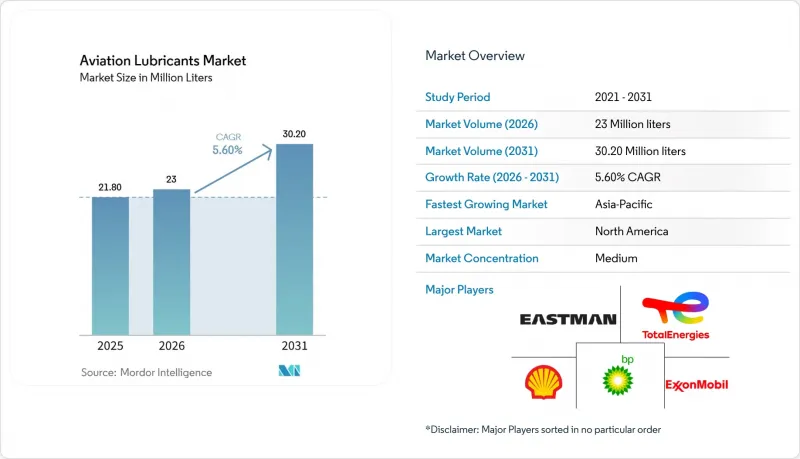
Mordor Intelligence에 의하면, 항공 윤활유 시장 규모는 2025년 2,180만 리터에서 2026년에는 2,300만 리터로 확대되어 2026년부터 2031년까지 CAGR 5.60%로 성장을 지속하여, 2031년에는 3,020만 리터에 이를 것으로 예측됩니다.
본 보고서는 유형(작동유, 엔진 오일 등), 기술(광물유계, 합성유계 등), 플랫폼(민간 항공 등), 용도(엔진 시스템 등), 최종 사용자(OEM 및 애프터마켓), 지역(아시아태평양, 북미, 유럽, 남미, 중동 및 아프리카)별로 분류되어 있습니다. 시장 전망은 수량(리터) 기준으로 제시되어 있습니다.
세계 항공 윤활유 시장 동향과 인사이트
항공기 기단의 확대와 허브 공항 개발이 기초 수요를 뒷받침하고 있습니다.
2026년에 발주된 항공기는 OEM(Original Equipment Manufacturer)의 초기 충전 요건 및 그 이후의 장기 유지보수 주기를 통해, 항공기 기단 도입이 항공 윤활유 시장에 어떻게 직접적으로 연결되는지를 보여줍니다. 에어아시아는 2026년 5월 A220-300 기종 150대를 주문함으로써, 신규 항공기 도입, 기단 유지 관리 및 라인 정비 준비와 관련된 향후 윤활유 수요를 크게 증가시켰습니다. 중국동방항공도 2026년 3월에 A320neo 기종 101대 구매 계약을 체결하여, 또 다른 주요 지역 항공사의 기단 확충 프로그램에서도 유사한 수요 패턴을 뒷받침하고 있습니다. 각 항공기의 인도에는 엔진, 유압 시스템, 랜딩 기어 및 기타 운영 시스템을 위해 승인된 윤활유가 필요하기 때문에 이러한 수주 건들은 항공기가 대규모 정비에 들어갈 때까지 항공 윤활유 시장을 지탱해 줄 것입니다. 허브 공항의 개발 또한 이러한 수요에 또 다른 차원을 더하고 있습니다. 공항 생태계가 확대됨에 따라 운항 및 지상 지원 활동을 위해 현장 저장, 엄격한 취급 절차, 그리고 공급 확보가 필요하기 때문입니다. 따라서 기단 확대는 눈에 보이는 항공기 수뿐만 아니라, 각 항공기 프로그램 전반에 걸쳐 윤활유 소비를 활발하게 유지하는 서비스 인프라를 모두 뒷받침하게 됩니다.
노후화되는 전 세계 항공기 기단을 바탕으로 한 지속적인 애프터마켓 수요
항공기가 일상적인 운용, 정기 점검 및 부품별 정비 작업을 통해 승인된 윤활유를 지속적으로 소비함에 따라, 항공 윤활유 시장은 애프터마켓 수요에 크게 지탱되고 있습니다. IATA 보고서에 따르면, 엔진 정비 비용이 MRO 총 지출에서 차지하는 비중이 2019년 41%에서 2024년에는 50%로 상승했으며, 정비의 경제성이 엔진 정비를 주축으로 하는 작업으로 이동하고 있음이 확인되었습니다. 이러한 작업에서는 윤활유의 품질과 공급의 확실성이 가장 중요합니다. 또한 IATA는 2026년 6월, LEAP(Leading Edge Aviation Propulsion) 엔진의 연간 정비 공장 입고 횟수가 2025년 600회에서 2040년까지 5,000회 이상으로 증가할 것으로 예측하고 있으며, 이는 시간이 지남에 따라 정비 부담이 대폭 증가할 것임을 시사합니다. 납품 지연으로 인해 구형 항공기 및 엔진이 더 오랜 기간 동안 계속 운용되고 있으며, 이는 항공 윤활유 시장에 긍정적인 요인으로 작용하고 있습니다. 노후화된 기체 군의 경우 일반적으로 더 빈번한 점검, 보충 및 인증 제품의 지속적인 공급이 필요하기 때문입니다. 2025년 애프터마켓 점유율이 72.7%라는 사실은 항공 윤활유 시장이 일회성 납품보다는 운용 중인 유지보수에 의해 더 강력하게 견인되고 있음을 보여줍니다. 이러한 구조는 기존 브랜드의 입지를 강화하는 요인이기도 합니다. 가동 시간 기반 계약이나 장기 MRO 계약에서는 윤활유 사양이 유지보수 체계에 포함되는 경우가 많으며, 빈번한 재입찰 대상이 되는 경우는 드물기 때문입니다.
원자재 가격 변동과 사양 측면의 압박으로 인해 이익률이 압박받고 있습니다.
항공 윤활유 시장은 원자재 가격 변동 위험에 지속적으로 노출되어 있습니다. 이는 정교한 배합이 특수 합성 원료에 의존하고 있어, 투입 비용이 변동하더라도 쉽게 대체할 수 없기 때문입니다. 항공 업계의 고객은 긴 정비 주기나 안전상 극히 중요한 시스템에서 일관성, 문서화 및 중단 없는 제품 성능을 요구하기 때문에 이 위험은 심각합니다. 항공 윤활유 시장의 사양 요건은 매우 엄격하며, 승인된 배합은 업계 및 군사 규격은 물론 엔진이나 플랫폼 고유의 승인 목록에도 부합해야 합니다. 그 결과, 배합의 사소한 변경조차도 추가적인 심사나 검증이 필요하기 때문에 블렌더는 기존 산업용 윤활유만큼 유연하게 비용 압박에 대응할 수 없습니다. 따라서 프리미엄 항공 윤활유는 구매력이 제한적이거나 현지 공급 체계가 취약한 중소 항공사 및 신생 항공 사업자에게 지속적인 비용 부담이 되고 있습니다. 그 결과, 항공 윤활유 시장은 꾸준히 성장하고 있는 반면, 이익률 압박, 배합 변경 결정 지연, 항공사 그룹 간 가격 부담 능력의 불균형과 같은 과제에 계속 직면하고 있습니다.
부문 분석
2025년, 엔진 오일은 항공 윤활유 시장 점유율의 42.2%를 차지하며, 최대 판매량 부문이 여전히 터빈의 신뢰성과 항공기의 운항 지속성과 밀접하게 연관되어 있음이 확인되었습니다. 윤활유 소비는 일회성 장착이 아닌 실제 운항, 정기적인 보충 및 정비 점검과 관련되어 있기 때문에 엔진 오일 수요는 견조한 추세를 보이고 있습니다. 항공사는 엔진 오일을 단순한 소모품으로 취급하는 경우가 거의 없습니다. 제품 성능에 편차가 있으면 정비 계획이나 승인된 운용 한계에 영향을 미치기 때문입니다. 이 때문에 교체 경향은 보수적이며, 승인된 정비 시스템에 이미 정착된 확고한 브랜드가 선호되고 있습니다. 작동유와 그리스는 규모가 작은 부문이지만, 모두 엄격한 적합성 요건이 요구되는 안전상 중요한 기계적 기능을 뒷받침하고 있기 때문에 항공 윤활유 시장에서 여전히 필수적인 존재입니다.
제품 유형의 구성만 보더라도, 항공 윤활유 시장의 성장이 단순히 판매량이 많은 카테고리에만 의존하는 것이 아님을 알 수 있습니다. 이는 장비의 복잡화에 따라 더 높은 사양을 요구하는 하위 부문의 중요성이 커지고 있기 때문입니다. ‘특수 윤활유 및 첨가제’는 2031년까지 연평균 성장률(CAGR)이 6.13%로 가장 빠르게 성장하는 부문이며, 표준 터빈 오일만으로는 침전물, 씰, 또는 열 관리 요구 사항을 충족할 수 없는 분야에서 특정 용도에 맞춘 배합에 대한 수요가 증가하고 있음을 반영합니다. 이 부문은 더욱 가혹한 가동 주기에서 청정도, 재료와의 상호작용, 그리고 성능 안정성에 대한 더 엄격한 관리가 요구되는 엔진 프로그램의 혜택을 받고 있습니다. 또한, 높은 성능과 취급 위험 감소, 그리고 모든 정비 환경에서 규정 준수 지원을 강화한 제품을 선호하는 고객들의 경향도 이 부문의 성장을 뒷받침하고 있습니다. 앞으로 항공 윤활유 시장에서는 판매량이 많은 표준 카테고리와 기술적 차별화가 진행되어 규모는 작지만 성장 속도가 빠른 프리미엄 제형 간의 격차가 더욱 확대될 전망입니다.
2025년에는 기술별로 볼 때 합성 윤활유가 항공기용 윤활유 판매량의 63.25%를 차지하고, 이는 터빈 엔진의 요구 사항과 폴리올 에스테르계 윤활유의 성능 특성 간의 적합성을 반영한 것입니다. 항공기용 윤활유 시장에서 합성 제품은 운영 관행에 확고히 자리 잡았습니다. 이는 현대의 항공기가 더 높은 온도에 노출되거나 더 엄격한 성능 허용 범위에 대응할 수 있는 윤활유에 의존하고 있기 때문입니다. 이에 따라 시장에는 주요 화학 성분이 기술적 요건과 승인 실적 모두에 의해 뒷받침되는 기술 구조가 형성되어 있습니다. 광물유계 제품은 구형 피스톤 엔진이나 레거시 용도에서 틈새 시장 지위를 유지하고 있지만, 그 도입 규모는 더 이상 항공 윤활유 시장의 중심적인 방향성을 결정짓는 요소가 아닙니다. 기체 운용이 점점 최신 터빈 플랫폼에 집중됨에 따라, 합성 윤활유는 그 지배적인 지위를 유지하고 있습니다.
바이오 유래 윤활유는 2031년까지 연평균 성장률(CAGR)이 7.05%로 가장 빠르게 성장하는 기술 부문이지만, 그 성장은 항공기용 윤활유 시장 내에서 비교적 작은 기반에서 시작되고 있습니다. 주요 촉진요인은 지속가능성 관련 정책과, 바이오 유래 기유가 상업적 조건에서 요구되는 성능을 충족시킬 수 있다는 실증 결과입니다. 2026년 2월 RSC 지속가능성 조사에 따르면, 바이오 유래 폴리올 에스테르 기유는 마찰학 성능 면에서 화석 유래 기유와 동등하면서도 수명 주기 전반에 걸친 탄소 강도를 낮출 수 있는 것으로 보고되었습니다. 한편, 2025년 『Journal of Aerospace Sciences and Technologies』지에 게재된 총설에서는 저온에서의 열산화 안정성이 항공기용 바이오 윤활유 인증에 있어 여전히 주요 장벽으로 남아 있다고 지적하고 있습니다. 시장에 본격적으로 침투할 수 있을지는 2031년까지 인증 절차와 승인된 적용 범위가 실질적으로 확대될지 여부에 달려 있을 것입니다.
지역별 분석
2025년, 북미는 항공 윤활유 시장에서 38.02%라는 최대의 지역 점유율을 유지했습니다. 이는 해당 지역의 정비·수리·정비(MRO) 인프라 확충, 대규모 운용 기체 수, 그리고 와이드바디 기체 및 민간 항공사의 높은 집중도를 반영한 것입니다. 북미 항공 윤활유 시장은 해당 지역의 풍부한 승인 실적, 광범위한 기술 서비스 전개, 그리고 민간 및 국방 양쪽의 요건을 지원하는 확고한 공급업체의 존재로부터도 혜택을 받고 있습니다. 신형 항공기가 점차 도입되고 있음에도 불구하고 정비 빈도는 여전히 높기 때문에 기체의 노후화가 진행되고 있는 상황이 윤활유 교체 수요를 지속적으로 뒷받침하고 있습니다. 캐나다와 멕시코는 항공사의 활동 확대 및 기체 지원 요건 증가를 통해 이 지역의 기반에 기여하고 있지만, 항공 윤활유 시장의 판매량을 주도하는 주역은 여전히 미국입니다.
아시아태평양은 2031년까지 연평균 성장률(CAGR)이 6.08%로 가장 빠르게 성장하는 지역이며, 항공 윤활유 시장의 중요한 성장 동력이 되고 있습니다. 주요 항공기 발주가 핵심 요인으로 작용하고 있으며, 에어아시아는 2026년 5월에 A220-300 기종 150대를 발주했고, 중국동방항공은 2026년 3월에 A320neo 기종 101대에 대한 계약을 체결했습니다. 이러한 프로그램은 향후 운용 기수를 확대시켜 항공 윤활유 시장 전체에서 OEM(Original Equipment Manufacturer)의 초기 충전 및 애프터마켓 수요를 모두 뒷받침하게 될 것입니다. 또한, 해당 지역에서는 정비 체계 확충도 진행되고 있습니다. 이는 윤활유 소비량이 항공기 대수뿐만 아니라 현지 정비 능력과 재고 관리에도 비례하기 때문에 중요한 의미를 지닙니다. 중국의 항공용 작동유에 관한 국내 인증의 진전은 아시아태평양이 항공 윤활유 시장에서 시간을 들여 현지 공급 능력을 구축해 나가고 있음을 보여줍니다.
유럽은 항공 윤활유 시장에서 중요한 위치를 차지하고 있지만, 그 성장 속도는 아시아태평양만큼 빠르지 않습니다. 이는 해당 지역이 강력한 MRO(정비·수리·오버홀) 수요와 엄격한 인증 요건, 그리고 지속가능성을 중시하는 제품 심사를 모두 갖추고 있기 때문입니다. 'ReFuelEU Aviation' 및 유럽항공안전청(EASA)의 지침은 평가 과정에서 SAF(지속 가능한 항공 연료)와의 호환성 및 관련 시스템 성능을 더욱 중시하도록 촉구함으로써, 유럽 내 조달에 관한 논의를 형성하고 있습니다. 독일, 영국, 프랑스는 주요 상업용 항공기 기단, 기술 서비스 역량, 대규모 정비 조직을 보유한 중요한 수요 거점으로 계속 자리 잡고 있습니다. 남미, 중동 및 아프리카는 항공 윤활유 시장 전체에서 차지하는 비중은 작지만, 각 지역에서 허브 확장, 기단 가동률 회복, 혹은 노후화된 항공기 보유로 인해 정비 수요가 유지되고 있는 분야로서, 특정 비즈니스 기회가 존재합니다. 이 지역들은 현재로서는 세계 순위에 영향을 미치지는 않지만, 틈새 인증, 지역적 유통, 혹은 방위·특수 유체 분야에서의 입지를 통해 경쟁을 펼치는 공급업체에게는 여전히 중요한 시장입니다.
기타 혜택:
- 엑셀 형식 시장 예측(ME) 시트
- 3개월간의 애널리스트 지원
자주 묻는 질문
목차
제1장 서론
제2장 조사 방법
제3장 주요 요약
제4장 시장 구도
제5장 시장 규모와 성장 예측
제6장 경쟁 구도
제7장 시장 기회와 향후 전망
JHS 26.08.05According to Mordor Intelligence, the aviation lubricants market size is expected to grow from 21.80 million liters in 2025 to 23 million liters in 2026 and is forecast to reach 30.20 million liters by 2031 at 5.60% CAGR over 2026-2031.
This report is Segmented by Type (Hydraulic Fluid, Engine Oil, and More), Technology (Mineral-Based, Synthetic, and More), Platform (Commercial Aviation and More), Application (Engine Systems and More), End User (OEM and Aftermarket), and Geography (Asia-Pacific, North America, Europe, South America, and Middle-East and Africa). The Market Forecasts are Provided in Terms of Volume (Liters).
Global Aviation Lubricants Market Trends and Insights
Fleet Expansion and Hub Development Sustain Base Demand
Aircraft orders placed in 2026 illustrate how fleet entry feeds directly into the aviation lubricants market through Original Equipment Manufacturer (OEM) fill requirements and subsequent long maintenance cycles. AirAsia placed an order for 150 A220-300 aircraft in May 2026, adding a large block of future lubricant demand tied to new aircraft induction, fleet support, and line maintenance preparation. China Eastern Airlines also signed a purchase agreement for 101 A320neo aircraft in March 2026, reinforcing the same demand pattern across another major regional fleet expansion program. These orders support the aviation lubricants market before aircraft age into major shop visits, as each delivery requires approved fluids for the engine, hydraulic, landing gear, and other operating systems. Hub development adds another layer to this demand, as expanding airport ecosystems require on-site storage, handling discipline, and supply assurance for flight operations and ground support activities. Fleet growth therefore supports both the visible aircraft population and the service infrastructure that keeps lubricant consumption active across each aircraft program.
Recurring Aftermarket Demand Anchored by an Aging Global Fleet
The aviation lubricants market is heavily supported by aftermarket demand, as aircraft continue to consume approved fluids through routine use, scheduled checks, and component-specific maintenance events. IATA reported that engine maintenance rose from 41% of total MRO spend in 2019 to 50% in 2024, confirming that maintenance economics are shifting toward engine-intensive work, where lubricant quality and availability matter most. IATA also stated in June 2026 that annual Leading Edge Aviation Propulsion (LEAP) engine shop visits are expected to rise from 600 in 2025 to more than 5,000 by 2040, indicating a significantly larger maintenance load over time. Delivery delays have kept older aircraft and engines in service longer, which benefits the aviation lubricants market as mature fleets typically require more frequent inspection, replenishment, and approved product continuity. The aftermarket share of 72.7% in 2025 indicates that the aviation lubricants market is driven more by in-service maintenance than by one-time deliveries. This structure also strengthens incumbent brands, as power-by-hour contracts and long-term MRO agreements often lock lubricant specifications into the maintenance framework rather than leaving them open to frequent rebidding.
Raw Material Volatility and Specification Pressures Compress Margins
The aviation lubricants market remains exposed to raw material price swings because advanced formulations rely on specialized synthetic inputs that cannot be readily substituted when input costs change. This exposure is significant because aviation customers require consistency, documentation, and uninterrupted product performance across long service intervals and safety-critical systems. The specification requirements in the aviation lubricants market are unusually stringent, as approved formulations must comply with industry and military standards, as well as engine- or platform-specific approval lists. As a result, blenders cannot respond to cost pressures as flexibly as in conventional industrial lubricants, since even minor formulation changes may trigger additional review and validation. Premium aviation lubricants therefore carry a persistent cost burden for smaller carriers and emerging operators that have limited purchasing leverage or weaker local supply depth. Consequently, the aviation lubricants market can grow steadily while still facing margin pressure, slower reformulation decisions, and uneven affordability across operator groups.
Other drivers and restraints analyzed in the detailed report include:
- Shift Toward Synthetic Lubricants Driven by Engine Performance Requirements
- SAF-Compatible Lubricant Formulation Opens Reformulation Opportunities
- Lengthy OEM and Airworthiness Approval Timelines Constrain Product Entry
For complete list of drivers and restraints, kindly check the Table Of Contents.
Segment Analysis
Engine oil held 42.2% of aviation lubricants market share in 2025, confirming that the largest volume segment remains tied to turbine reliability and aircraft dispatch continuity. Engine oil demand remains durable because lubricant consumption is linked to actual operations, routine replenishment, and maintenance checks rather than one-time installation. Operators rarely treat engine oil as a simple consumable, as deviations in product performance carry consequences for maintenance planning and approved operating limits. This keeps replacement behavior conservative and supports established brands already embedded in approved maintenance systems. Hydraulic fluids and greases represent smaller segments but remain critical to the aviation lubricants market, as each supports safety-critical mechanical functions with strict compatibility requirements.
The type mix also indicates that growth in the aviation lubricants market will not come exclusively from the highest-volume category, as higher-specification subsegments are gaining importance alongside increasing equipment complexity. Special lubricants and additives is the fastest-growing type segment at 6.13% CAGR through 2031, reflecting rising demand for targeted formulations in areas where standard turbine oils alone do not address deposit, seal, or thermal management needs. This segment benefits from engine programs requiring tighter control over cleanliness, material interaction, and performance stability across more demanding duty cycles. It also benefits from customer preference for products that combine high performance with lower handling risk and stronger compliance support across maintenance environments. Over time, the aviation lubricants market is likely to see a wider spread between high-volume standard categories and smaller, faster-growing premium formulations with greater technical differentiation.
Synthetic lubricants accounted for 63.25% of aviation lubricants volume by technology in 2025, reflecting the alignment between turbine engine requirements and polyol ester-based performance characteristics. In the aviation lubricants market, synthetic products are embedded in operating practice because modern fleets depend on fluids capable of handling higher temperature exposure and tighter performance tolerances. This gives the market a technology structure where the dominant chemistry is supported by both engineering requirements and approval history. Mineral-based products retain a niche in older piston-engine and legacy applications, but that installed base no longer defines the central direction of the aviation lubricants market. As fleet activity increasingly centers on modern turbine platforms, synthetic lubricants maintain their dominant position.
Bio-based lubricants are the fastest-growing technology segment at 7.05% CAGR through 2031, though growth starts from a smaller base within the aviation lubricants market. The primary drivers are sustainability policy and evidence that bio-derived base oils can meet required performance under commercial conditions. A February 2026 RSC Sustainability study reported that bio-based polyol ester base oils can match fossil-derived counterparts on tribological performance while lowering lifecycle carbon intensity. At the same time, a 2025 review in the Journal of Aerospace Sciences and Technologies noted that low-temperature thermooxidative stability remains a central certification barrier for aircraft biolubricants. Mainstream penetration will depend on whether certification pathways and approved application windows expand meaningfully before 2031.
Complete Report Scope:
- By Type
- Hydraulic Fluid
- Engine Oil
- Grease
- Special Lubricants and Additives
- By Technology
- Mineral-based
- Synthetic
- Bio-based
- By Platform
- Commercial Aviation
- Military Aviation
- Business and General Aviation
- By Application
- Engine Systems
- Hydraulic Systems
- Landing Gear
- Airframe
- Other Applications (Auxiliary and Other Systems)
- By End User
- OEM
- Aftermarket
- By Geography
- Asia-Pacific
- China
- India
- Japan
- South Korea
- ASEAN
- Rest of Asia-Pacific
- North America
- United States
- Canada
- Mexico
- Europe
- Germany
- United Kingdom
- France
- Italy
- Russia
- Rest of Europe
- South America
- Brazil
- Argentina
- Rest of South America
- Middle-East and Africa
- Saudi Arabia
- South Africa
- United Arab Emirates
- Rest of Middle-East and Africa
- Asia-Pacific
Geography Analysis
North America retained the largest regional share at 38.02% of the aviation lubricants market in 2025, reflecting the region's dense Maintenance, Repair, and Overhaul (MRO) infrastructure, large installed fleet, and high concentration of widebody and commercial operators. The North American aviation lubricants market also benefits from the region's extensive approval history, broad technical service presence, and established suppliers that support both civil and defense requirements. Mature-fleet conditions continue to sustain lubricant replacement demand, as maintenance intensity remains high even as newer aircraft gradually enter the mix. Canada and Mexico contribute to this regional base through expanding airline activity and fleet support requirements, though the United States remains the principal volume driver in the aviation lubricants market.
Asia-Pacific is the fastest-growing geography, with a 6.08% CAGR through 2031, making it a key regional growth engine in the aviation lubricants market. Major aircraft orders are a central factor, with AirAsia ordering 150 A220-300 aircraft in May 2026 and China Eastern signing for 101 A320neo aircraft in March 2026. These programs expand the future installed fleet and support both Original Equipment Manufacturer (OEM)-fill and aftermarket demand across the aviation lubricants market. The region is also developing greater maintenance depth, which is significant because lubricant consumption scales not only with aircraft numbers but also with local service capacity and inventory management. China's domestic certification progress in aviation hydraulic oil indicates that Asia-Pacific is developing local supply capability in the aviation lubricants market over time.
Europe held a significant position in the aviation lubricants market, though its growth profile is more measured than Asia-Pacific, as the region combines strong MRO demand with stringent certification requirements and sustainability-driven product scrutiny. ReFuelEU Aviation and European Union Aviation Safety Agency (EASA) guidance are shaping procurement discussions in Europe by placing greater emphasis on SAF compatibility and related system performance in the evaluation process. Germany, the United Kingdom, and France remain important demand centers, anchoring major commercial fleets, technical service capability, and large maintenance organizations. South America, the Middle East, and Africa together account for a smaller share of the aviation lubricants market, yet each presents targeted opportunities where hub expansion, recovery in fleet utilization, or older aircraft populations sustain maintenance demand. These regions do not alter the global ranking at present, but remain relevant to suppliers competing through niche approvals, regional distribution, or defense and specialty fluid positions.
- Aerospace Lubricants Inc.
- Anderol Specialty Lubricants
- BP p.l.c. (Castrol)
- Chevron Corporation
- Eastman Chemical Company
- Exxon Mobil Corporation
- Kluber Lubrication Munchen SE & Co. KG
- LANXESS AG
- Lubrizol Corporation
- NYCO SA
- Nye Lubricants, Inc.
- Phillips 66 Company
- PJSC LUKOIL
- Quaker Houghton
- ROCOL
- Shell plc
- Sinopec Lubricant Company
- The Chemours Company
- TotalEnergies
- Whitmore Manufacturing LLC
Additional Benefits:
- The market estimate (ME) sheet in Excel format
- 3 months of analyst support
TABLE OF CONTENTS
1 Introduction
- 1.1 Study Assumptions & Market Definition
- 1.2 Scope of the Study
2 Research Methodology
3 Executive Summary
4 Market Landscape
- 4.1 Market Overview
- 4.2 Market Drivers
- 4.2.1 Fleet expansion and higher aircraft utilization
- 4.2.2 Recurring aftermarket and MRO consumption intensity
- 4.2.3 Shift toward synthetic and high-temperature formulations
- 4.2.4 Aging fleet and deferred retirements raising overhaul cycles
- 4.2.5 SAF-compatible lubricant reformulation demand
- 4.3 Market Restraints
- 4.3.1 Raw material and specialty additive volatility
- 4.3.2 High cost of premium synthetic formulations
- 4.3.3 Lengthy OEM and airworthiness qualification cycles
- 4.4 Value Chain Analysis
- 4.5 Porter's Five Forces Analysis
- 4.5.1 Bargaining Power of Buyers
- 4.5.2 Bargaining Power of Suppliers
- 4.5.3 Intensity of Rivalry
- 4.5.4 Threat of New Entrants
- 4.5.5 Threat of Substitutes
5 Market Size & Growth Forecasts (Value and Volume)
- 5.1 By Type
- 5.1.1 Hydraulic Fluid
- 5.1.2 Engine Oil
- 5.1.3 Grease
- 5.1.4 Special Lubricants and Additives
- 5.2 By Technology
- 5.2.1 Mineral-based
- 5.2.2 Synthetic
- 5.2.3 Bio-based
- 5.3 By Platform
- 5.3.1 Commercial Aviation
- 5.3.2 Military Aviation
- 5.3.3 Business and General Aviation
- 5.4 By Application
- 5.4.1 Engine Systems
- 5.4.2 Hydraulic Systems
- 5.4.3 Landing Gear
- 5.4.4 Airframe
- 5.4.5 Other Applications (Auxiliary and Other Systems)
- 5.5 By End User
- 5.5.1 OEM
- 5.5.2 Aftermarket
- 5.6 By Geography
- 5.6.1 Asia-Pacific
- 5.6.1.1 China
- 5.6.1.2 India
- 5.6.1.3 Japan
- 5.6.1.4 South Korea
- 5.6.1.5 ASEAN
- 5.6.1.6 Rest of Asia-Pacific
- 5.6.2 North America
- 5.6.2.1 United States
- 5.6.2.2 Canada
- 5.6.2.3 Mexico
- 5.6.3 Europe
- 5.6.3.1 Germany
- 5.6.3.2 United Kingdom
- 5.6.3.3 France
- 5.6.3.4 Italy
- 5.6.3.5 Russia
- 5.6.3.6 Rest of Europe
- 5.6.4 South America
- 5.6.4.1 Brazil
- 5.6.4.2 Argentina
- 5.6.4.3 Rest of South America
- 5.6.5 Middle-East and Africa
- 5.6.5.1 Saudi Arabia
- 5.6.5.2 South Africa
- 5.6.5.3 United Arab Emirates
- 5.6.5.4 Rest of Middle-East and Africa
- 5.6.1 Asia-Pacific
6 Competitive Landscape
- 6.1 Market Concentration
- 6.2 Strategic Moves
- 6.3 Market Share/Ranking Analysis
- 6.4 Company Profiles {(includes Global level Overview, Market level overview, Core Segments, Financials as available, Strategic Information, Products & Services, and Recent Developments)}
- 6.4.1 Aerospace Lubricants Inc.
- 6.4.2 Anderol Specialty Lubricants
- 6.4.3 BP p.l.c. (Castrol)
- 6.4.4 Chevron Corporation
- 6.4.5 Eastman Chemical Company
- 6.4.6 Exxon Mobil Corporation
- 6.4.7 Kluber Lubrication Munchen SE & Co. KG
- 6.4.8 LANXESS AG
- 6.4.9 Lubrizol Corporation
- 6.4.10 NYCO SA
- 6.4.11 Nye Lubricants, Inc.
- 6.4.12 Phillips 66 Company
- 6.4.13 PJSC LUKOIL
- 6.4.14 Quaker Houghton
- 6.4.15 ROCOL
- 6.4.16 Shell plc
- 6.4.17 Sinopec Lubricant Company
- 6.4.18 The Chemours Company
- 6.4.19 TotalEnergies
- 6.4.20 Whitmore Manufacturing LLC
7 Market Opportunities & Future Outlook
- 7.1 White-space & unmet-need assessment