

|
시장보고서
상품코드
2099538
복수 시장 : 점유율 분석, 업계 동향 및 통계, 성장 예측(2026-2031년)Ascites - Market Share Analysis, Industry Trends & Statistics, Growth Forecasts (2026 - 2031) |
||||||
 Mordor Intelligence
에 의하면, 복수 시장 규모는 2025년에 18억 8,000만 달러로 평가되었고 2026년 19억 8,000만 달러에서 2031년까지 25억 6,000만 달러에 이를 것으로 예측되며, 예측 기간(2026-2031년) CAGR은 5.29%를 나타낼 전망입니다.
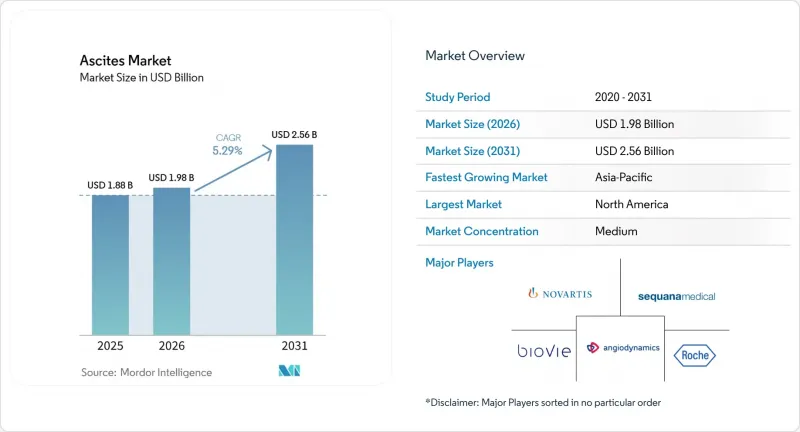
본 보고서는 제품별(치료법, 진단법), 복수 유형별(난치성, 재발성, 악성, 유즙성, 기타), 투여 경로별(경구, 비경구, 의료기기를 통한), 최종 사용자(병원, ASC, 전문 클리닉, 재택 간호), 유통 채널(병원, 소매, 온라인, 기타), 지역(북미, 유럽, 아시아태평양, 중동 및 아프리카, 남미)별로 분류되어 있습니다. 예측치는 금액(달러)으로 표시되어 있습니다.
세계 복수 시장 동향 및 인사이트
증가하는 간경변 및 MASH 관련 복수의 부담
복수 시장은 진행성 간 질환의 부담 증가와 밀접한 관련이 있으며, MASH와 관련된 간경변이 장기적인 수요의 주요 촉진요인으로 부상하고 있습니다. 『JAMA Network Open』지의 예측에 따르면, 미국의 MASH 사례 수는 2020년 1,490만 건에서 2050년까지 2,320만 건으로 증가할 것으로 예상되며, MASH 관련 간경변증 사례 수는 91.1% 증가하여 114만 7,000건에서 219만 2,000건에 달할 것으로 예측됩니다. 이는 복수가 간경변의 일반적인 말기 합병증이며, 입원, 알부민 사용, 영상 진단, 배액 및 경과 관찰에 대한 지속적인 수요를 유발하기 때문에 중요한 점입니다. 『Liver Cancer International』지에 따르면, 간경변을 동반한 MASH 환자의 총 의료비는 간경변이 없는 환자에 비해 1.3배에서 2.7배 더 높으며, 또한 보상성 질환에 비해 비보상성 질환의 입원 비용은 최대 13배에 달할 수 있는 것으로 나타났습니다. 2036년까지 중국에서 연령 조정된 대사 기능 장애 관련 지방간 질환(MASLD)과 관련된 간경변의 부담 증가 전망은 아시아태평양의 전망을 더욱 공고히 하며, 해당 지역의 치료 기반 확대를 뒷받침하고 있습니다.
난치성 복수에서의 재천자 수요
난치성 복수 관리에 있어 임상의들은 지속적인 근본적 개선보다는 증상 조절에 중점을 두고 있기 때문에 복수 시장은 반복적으로 시행되는 시술 수요로부터 계속해서 혜택을 받고 있습니다. 2025년에는 난치성 복수가 시장 점유율의 46.45%를 차지하며, 반복되는 대량 복수 천자, 알부민 보충 및 지속적인 모니터링을 통해 병원에 대한 지속적인 내원을 유도했습니다. 『Current Hepatology Reports』에 따르면, 1회의 대량 복수 천자마다 복수 1리터당 21g의 단백질이 제거되며, 이것이 영양실조 및 근감소증의 원인 중 하나가 되고 있다고 지적되고 있습니다. 이는 특히 말기 환자의 경우 반복적인 천자가 여전히 표준 치료법인 상황에서 키트, 소모품, 수액 요법 및 병원 서비스에 대한 지속적인 수요를 뒷받침하는 요인입니다. 영국에서 진행 중인 REDUCe2 임상시험에서는 완화 치료를 목적으로 한 장기 복강 배액관과 병원에서의 대량 복수 천자를 비교하고 있으며, 향후 수요가 감소하기는커녕 보다 분산형 치료 모델로 전환될 가능성이 있음을 시사하고 있습니다. 또한, 이와 유사한 치료 부담은 조기 개입에 대한 논의를 뒷받침하고 있으며, 이로 인해 말기 단계의 반복적인 시술에서 조기 개입 관리로 수익의 일부가 이동할 가능성이 있습니다.
근본 원인을 시정하기 위한 질환 수정 요법의 선택지가 제한적입니다.
복수 시장의 주요 구조적 제약은 확립된 간경변증에서 근본적인 질환 과정을 역전시킬 수 있는 널리 승인된 치료법이 부족하다는 점입니다. 『Annals of Hepatology』 저널의 2025년 총설에 따르면, 장기간 알부민 투여는 합병증 발생률을 낮출 수 있는 것으로 나타났으나, 무작위 대조 시험을 통한 증거로는 집단 수준에서 이식 불필요 생존 기간의 연장 효과가 아직 입증되지 않았습니다. 이러한 격차로 인해 치료 경로는 여전히 증상 관리에 중점을 두고 있으며, 반복되는 치료 주기를 통해 수요가 유지되고 있습니다. 그러나 이러한 치료 주기만으로는 환자의 위험 요인을 완전히 해소하거나 질병의 경과 기간을 대폭 단축할 수는 없습니다. 환자들은 여전히 하루 2,000mg 미만의 나트륨 제한을 준수해야 하고, 이뇨제 용량 조절에 오랜 시간이 소요되며, 반복적인 외래 방문과 지속적인 모니터링을 받아야 합니다. 이러한 요건들은 치료 순응도를 저하시키고, 표준 치료의 실제 세계에서의 유효성을 저해할 가능성이 있습니다. 그 결과, 시장은 만성기 치료에서 지속적인 수요를 창출하고 있지만, 지속적인 치료 혁신에 일반적으로 수반되는 가치 확대를 실현하는 데는 어려움을 겪고 있습니다. 치료가 대증 요법의 범위를 넘어설 때까지는 복수 시장이 치료 경로의 진정한 혁신이 아닌, 치료 건수 증가나 치료 강화를 통해 계속 성장할 것입니다.
부문 분석
치료 유형은 2025년 복수 시장 규모의 68.12%를 차지하고, 이는 체액 저류의 적극적인 관리가 전체 치료 경로를 통해 상업적 활동을 지속적으로 견인하고 있음을 보여줍니다. 이 부문에는 이뇨제, 복수 천자, 알부민 수액, 경경정맥 간내 문맥-체순환 션트(TIPS), 간 이식, 이식형 펌프 요법 및 완화적 장기 복강 배액이 포함됩니다.
진단 분야는 2031년까지 연평균 성장률(CAGR) 5.93%를 나타낼 것으로 예측되며, 2025년 매출 기준으로는 치료 분야에 비해 규모는 작지만, 복수 시장에서 가장 빠르게 성장하는 제품 카테고리가 될 전망입니다. 이러한 성장은 초음파 유도 하 복수 천자, 영상 진단을 기반으로 한 정량화, 그리고 보다 일관된 감별 진단을 바탕으로 한 프로토콜 주도형 치료 경로가 정착되고 있음을 반영합니다. 정기적인 질환 모니터링으로 인해 진단 용도가 증가하고 있으며, 각 영상 진단 기회가 치료법 선택, 시술 계획, 또는 합병증 경과 관찰에 도움이 되기 때문입니다.
난치성 복수는 2025년에 46.45%의 점유율을 차지하고, 이는 복수 시장에서 질환 유형별 최대 기여 요인이 될 뿐만 아니라, 진행기 환자가 수익에 미치는 영향의 크기를 여실히 보여줍니다. 이러한 환자들은 대개 반복적인 대량 천자, 빈번한 알부민 투여, 보다 면밀한 입원 관찰, 그리고 복잡한 치료 강화 결정이 필요하며, 이로 인해 자원 사용이 증가합니다. 이는 체액 저류에 그치지 않는 임상적 부담 때문인데, 난치성 질환에는 자발성 세균성 복막염, 간신 증후군 및 재입원이 수반되는 경우가 많기 때문입니다. 이 때문에 난치성 환자군은 복수 시장에서 계속해서 중심적인 위치를 차지하고 있으며, 특히 북미와 유럽에서는 전문적인 간 질환 치료 인프라가 대규모의 반복적인 시술 치료를 뒷받침하고 있습니다.
악성 복수는 연평균 성장률(CAGR) 6.67%로 확대될 것으로 예상되며, 2031년까지 복수 시장에서 가장 빠르게 성장하는 유형 부문 중 하나가 되어 혁신 주도형 주요 분야 중 하나가 될 전망입니다. 이러한 성장은 단순한 배액법의 점진적인 개선에 그치지 않고, 개발 파이프라인에 힘입은 진보에 의해 이끌어질 것으로 예측됩니다. 복강 내 투여되는 EpCAM-XCD3 이중 특이성 항체인 M701의 제3상 무작위 배정 임상시험 결과가 2026년 미국임상종양학회(ASCO)에서 보고될 전망이며, 이는 악성 복수 분야에서의 활발한 개발 상황을 뒷받침합니다. 사용자용 초안에서 언급된 자가 종양 반응성 T세포 및 기타 생물학적 접근법을 포함한 여러 초기 단계 프로그램은 복강 내 투여를 단순한 배액 과제가 아닌 치료적 표적으로 자리매김하고 있습니다.
지역별 분석
북미는 2025년에 복수 시장 점유율의 39.56%를 차지하고, 최대 지역 기여자가 될 뿐만 아니라 복수 시장의 상업적 중심지로서의 입지를 더욱 공고히 할 전망입니다. 미국은 이 지역을 주도하고 있으며, 그 배경에는 첨단 간 질환 네트워크, 높은 시술 능력, 견고한 병원 구매 시스템, 그리고 재발성 또는 난치성 간경변성 복수에 대해 최초로 승인된 능동형 이식형 의료기기의 존재가 있습니다. 2025년 4분기(Q4)에 예정된 ‘알파 펌프’의 출시로, 미국의 치료 경로에 의료기기를 기반으로 한 치료 옵션이 추가되어 반복적인 천자 배액에 대한 의존도가 낮아질 전망입니다. 2025년 10월 1일부터 시행되는 메디케어·메디케이드 서비스 센터(CMS)의 ‘신기술 추가 지급(NTAP)’ 지원에 따라 입원 환자에 대한 보험 급여가 개선되어 병원 내 도입이 촉진될 것으로 예측됩니다.
유럽은 확립된 간 질환 진료 체계, 천자 배액 및 알부민의 광범위한 사용, 그리고 기기 중심의 치료에 관한 관련 경험을 바탕으로 복수 시장에서 두 번째로 중요한 지역 블록으로 자리 잡고 있습니다. 독일, 영국, 프랑스, 이탈리아, 스페인 및 기타 유럽 국가에서는 전문의의 의뢰와 병원 기반 관리를 통해 진행성 간 질환에 대한 체계적인 치료 환경이 구축되어 있습니다. 유럽의 승인 절차를 통해 이미 알파펌프에 익숙한 만큼, 이 지역에서는 보험 급여 제도와 환자 선정 기준이 조화를 이룬다면 향후 도입을 위한 임상적 기반이 마련되어 있습니다. 영국에서 진행 중인 REDUCe2 임상시험은 완화 치료를 목적으로 한 장기 복강 배액관에 관한 의료 시스템 차원의 근거를 제공할 것으로 기대되며, 재택 치료 모델에서의 도입에 영향을 미칠 가능성이 있습니다.
아시아태평양은 연평균 성장률(CAGR) 8.56%로 확대될 것으로 예측되며, 2031년까지 복수 시장에서 가장 두드러진 성장을 보일 것으로 전망됩니다. B형 및 C형 간염 환자 수가 많고, 알코올 관련 간 질환의 부담이 여전히 존재하며, 또한 중재적 방사선학의 역량이 향상되고 있는 점이 이 지역의 성장을 뒷받침하고 있습니다. 인도는 여전히 중요한 시장으로, B형 간염 환자 4,000만 명, C형 간염 환자 1,200만 명이 있으며, ‘아유슈만 바라트’ 프로그램의 대상자가 5억 명에 달함에 따라 간 질환 의료 서비스에 대한 접근성 확대가 뒷받침되고 있습니다. 중국도 중요한 시장입니다. 2025년 『Gut』지에 게재된 임상시험에 따르면, 미국산 재조합 인간 혈청 알부민이 보상성 간경변증에서 혈장 유래 알부민과 동등한 효과를 보인 것으로 밝혀져, 공급 및 비용 동향에 영향을 미칠 가능성이 있습니다.
기타 혜택:
- 엑셀 형식 시장 예측(ME) 시트
- 3개월간의 애널리스트 지원
자주 묻는 질문
목차
제1장 서론
제2장 조사 방법
제3장 주요 요약
제4장 시장 구도
제5장 시장 규모와 성장 예측
제6장 경쟁 구도
제7장 시장 기회와 향후 전망
JHS 26.08.05According to Mordor Intelligence, the ascites market size was valued at USD 1.88 billion in 2025 and is estimated to grow from USD 1.98 billion in 2026 to reach USD 2.56 billion by 2031, at a CAGR of 5.29% during the forecast period (2026-2031).
This report is Segmented by Product (Treatment Type, Diagnosis), Ascites Type (Refractory, Recurrent, Malignant, Chylous, Others), Route of Administration (Oral, Parenteral, Device-Based), End User (Hospitals, Ascs, Specialty Clinics, Home Care), Distribution Channel (Hospital, Retail, Online, Others), and Geography (North America, Europe, Asia-Pacific, MEA, South America). Forecasts are Provided in Terms of Value (USD).
Global Ascites Market Trends and Insights
Rising Cirrhosis And MASH-Linked Ascites Burden
The Ascites Market remains closely tied to the growing burden of advanced liver disease, with MASH-linked cirrhosis emerging as a key long-term demand driver. JAMA Network Open projected United States MASH cases to increase from 14.9 million in 2020 to 23.2 million by 2050, while MASH cirrhosis cases are projected to rise by 91.1%, from 1.147 million to 2.192 million. This is important because ascites is a common late-stage complication of cirrhosis, creating sustained demand for hospitalization, albumin use, imaging, drainage, and follow-up care. Liver Cancer International showed that total healthcare costs for MASH patients with cirrhosis were 1.3 to 2.7 times higher than for those without cirrhosis, while inpatient costs were as much as 13 times higher in decompensated disease than in compensated disease. China's projected increase in the age-standardized Metabolic Dysfunction-Associated Steatotic Liver Disease (MASLD)-related cirrhosis burden through 2036 further strengthens the Asia-Pacific outlook and supports a broader treatment base in the region.
Repeat Paracentesis Demand In Refractory Ascites
The Ascites Market continues to gain from repeat procedure demand, as clinicians mainly manage refractory ascites through symptom control rather than durable reversal. Refractory Ascites held a 46.45% share in 2025, generating recurring hospital traffic through repeated large-volume paracentesis, albumin replacement, and ongoing monitoring. Current Hepatology Reports noted that each large-volume paracentesis session removes 21 g of protein per liter of ascitic fluid, contributing to malnutrition and sarcopenia. This reinforces recurring demand for kits, consumables, infusion therapies, and hospital services, especially where repeat drainage remains the standard pathway for late-stage patients. The REDUCe2 trial in England is comparing palliative long-term abdominal drains with hospital-based large-volume paracentesis, indicating that future demand may shift toward a more distributed care model rather than decline. The same treatment burden is also supporting earlier intervention discussions, which may move some revenue from late-stage repetitive procedures toward earlier interventional management.
Limited Disease-Modifying Options For Root-Cause Reversal
A key structural restraint in the Ascites Market is the lack of a broadly approved therapy that can reverse the underlying disease process in established cirrhosis. The 2025 review in Annals of Hepatology found that long-term albumin can reduce the incidence of complications, but randomized evidence has not yet demonstrated a transplant-free survival benefit at the population level. This gap keeps the treatment pathway focused on symptom control and sustains demand through repeated treatment cycles. However, these cycles do not fully reset patient risk or materially shorten disease duration. Patients must still follow sodium restriction below 2,000 mg/day, undergo long diuretic titration periods, make repeat hospital visits, and receive ongoing monitoring. These requirements can weaken adherence and reduce the real-world effectiveness of standard care. As a result, the market continues to generate demand from chronic care but struggles to unlock the value expansion typically associated with durable therapeutic change. Until care moves beyond palliative control, the Ascites Market will continue to grow through higher volume and treatment intensity rather than a true transformation of the treatment pathway.
Other drivers and restraints analyzed in the detailed report include:
- Broader Use Of Albumin After Large-Volume Paracentesis
- First US Approval Of An Active Implantable Ascites Pump
- Procedure Dependence And Infection Risk In Long-Term Drainage
For complete list of drivers and restraints, kindly check the Table Of Contents.
Segment Analysis
Treatment type is expected to account for 68.12% of the Ascites market size in 2025, showing that active management of fluid accumulation continues to drive commercial activity across the care pathway. This segment includes diuretics, paracentesis, albumin infusion, transjugular intrahepatic portosystemic shunt, liver transplantation, implantable pump therapy, and palliative long-term abdominal drainage.
Diagnosis is projected to grow at a CAGR of 5.93% through 2031, making it the fastest-growing product category in the Ascites Market despite its smaller 2025 revenue base compared to treatment. Growth reflects a more protocol-driven care pathway supported by ultrasound-guided paracentesis, imaging-based quantification, and more consistent differential diagnosis. Regular disease monitoring increases diagnostic use, as each imaging touchpoint can support treatment selection, procedural planning, or complication follow-up.
Refractory ascites is expected to hold a 46.45% share in 2025, making it the largest type-based contributor to the Ascites Market and highlighting the revenue impact of late-stage patients. These patients often need repeated large-volume paracentesis, frequent albumin use, closer inpatient observation, and complex escalation decisions, which increases resource utilization. The clinical burden extends beyond fluid accumulation, as spontaneous bacterial peritonitis, hepatorenal syndrome, and repeat hospitalization often accompany refractory disease. This keeps the refractory patient pool central to the Ascites Market, especially in North America and Europe, where specialized hepatology infrastructure supports recurring procedural care at scale.
Malignant ascites is expected to advance at a CAGR of 6.67%, making it the fastest-growing type segment and one of the key innovation-led areas of the Ascites Market through 2031. Growth is expected to come from pipeline-led advances rather than only incremental improvements in drainage. A Phase III randomized trial of M701, an EpCAMXCD3 bispecific antibody administered intraperitoneally, is expected to report results at American Society of Clinical Oncology (ASCO) 2026, underscoring active development in malignant ascites. Multiple early-phase programs mentioned in the user draft, including autologous tumor-reactive T-cell and other biologic approaches, are positioning the intraperitoneal setting as a therapeutic target rather than only a drainage challenge.
Complete Report Scope:
- By Product
- Treatment Type
- Diuretics
- Paracentesis
- Albumin Infusion
- Transjugular Intrahepatic Portosystemic Shunt
- Liver Transplantation
- Implantable Ascites Pump Therapy
- Palliative Long-Term Abdominal Drainage
- Diagnosis
- Physical Examination
- Ultrasound
- Computed Tomography
- Magnetic Resonance Imaging
- Diagnostic Paracentesis
- Laboratory Testing
- Treatment Type
- By Ascites Type
- Refractory Ascites
- Recurrent Ascites
- Malignant Ascites
- Chylous Ascites
- Other Ascites Types
- By Route of Administration
- Oral
- Parenteral
- Device-Based Delivery
- By End User
- Hospitals
- Ambulatory Surgical Centers
- Specialty Clinics
- Home Care Settings
- Others
- By Distribution Channel
- Hospital Pharmacy
- Retail Pharmacy
- Online Pharmacy
- Others
- By Geography
- North America
- United States
- Canada
- Mexico
- Europe
- Germany
- United Kingdom
- France
- Italy
- Spain
- Rest of Europe
- Asia-Pacific
- China
- India
- Japan
- Australia
- South Korea
- Rest of Asia-Pacific
- Middle East and Africa
- GCC
- South Africa
- Rest of Middle East and Africa
- South America
- Brazil
- Argentina
- Rest of South America
- North America
Geography Analysis
North America is expected to account for 39.56% of the ascites market share in 2025, making it the largest regional contributor and reinforcing its position as the commercial center of the ascites market. The United States leads the region, supported by advanced hepatology networks, high procedural capacity, strong hospital purchasing systems, and the first approved active implantable device for recurrent or refractory cirrhotic ascites. The expected alfapump launch in the fourth quarter (Q4) of 2025 is set to add a device-backed treatment option to the US care pathway and reduce reliance on repeated drainage. Centers for Medicare & Medicaid Services (CMS) New Technology Add-on Payment support, effective October 1, 2025, is expected to improve inpatient reimbursement and support hospital adoption.
Europe represents the second major regional block in the ascites market, backed by established hepatology practice, broad use of paracentesis and albumin, and relevant experience with device-led care. Germany, the United Kingdom, France, Italy, Spain, and the rest of Europe support a structured care environment for advanced liver disease through specialist referrals and hospital-based management. Prior familiarity with the alfapump under European approval pathways gives the region a clinical base for future uptake where reimbursement and patient selection align. The REDUCe2 trial in the United Kingdom is expected to provide health-system evidence on palliative long-term abdominal drains and may influence procurement in home-oriented care models.
Asia-Pacific is forecast to expand at a CAGR of 8.56%, making it the fastest-growing regional part of the ascites market through 2031. Large hepatitis B and hepatitis C patient pools, the continuing burden of alcohol-related liver disease, and improving interventional radiology capacity support regional growth. India remains a key market, with 40 million people affected by hepatitis B, 12 million affected by hepatitis C, and the Ayushman Bharat program reaching 500 million people, supporting broader access to hepatology services. China is also important, as a 2025 trial in Gut showed that rice-derived recombinant human serum albumin performed comparably to plasma-derived albumin in decompensated cirrhosis, with implications for supply and cost dynamics.
- AngioDynamics
- B. Braun
- Baxter
- Beckton Dickinson
- BioVie Inc.
- Boston Scientific
- Cardinal Health
- Cook Group
- Roche
- Fresenius SE and Co. KGaA
- Grifols
- Martin Pharmaceuticals, Inc.
- Medtronic
- Merck
- Novartis
- Ocelot Bio, Inc.
- Regeneron Pharmaceuticals
- Sanofi
- Sequana Medical N.V.
- Teleflex
- Teva Pharmaceutical Industries
Additional Benefits:
- The market estimate (ME) sheet in Excel format
- 3 months of analyst support
TABLE OF CONTENTS
1 INTRODUCTION
- 1.1 Study Assumptions and Market Definition
- 1.2 Scope of the Study
2 RESEARCH METHODOLOGY
3 EXECUTIVE SUMMARY
4 MARKET LANDSCAPE
- 4.1 Market Overview
- 4.2 Market Drivers
- 4.2.1 Rising Cirrhosis and MASH-Linked Ascites Burden
- 4.2.2 Repeat Paracentesis Demand in Refractory Ascites
- 4.2.3 Broader Use of Albumin After Large-Volume Paracentesis
- 4.2.4 First US Approval of an Active Implantable Ascites Pump
- 4.2.5 Earlier Intervention in High-Risk Decompensated Liver Disease
- 4.2.6 Remote Monitoring and Digital Follow-Up for Chronic Ascites Care
- 4.3 Market Restraints
- 4.3.1 Limited Disease-Modifying Options for Root-Cause Reversal
- 4.3.2 Procedure Dependence and Infection Risk in Long-Term Drainage
- 4.3.3 Reimbursement Variability Across Care Settings and Countries
- 4.3.4 Narrow Eligible Population for Device-Based Therapy
- 4.4 Value/Supply Chain Analysis
- 4.5 Regulatory Landscape
- 4.6 Technological Outlook
- 4.7 Porter's Five Forces Analysis
- 4.7.1 Bargaining Power of Suppliers
- 4.7.2 Bargaining Power of Buyers
- 4.7.3 Threat of New Entrants
- 4.7.4 Threat of Substitutes
- 4.7.5 Competitive Rivalry
5 MARKET SIZE AND GROWTH FORECASTS (VALUE, USD)
- 5.1 By Product
- 5.1.1 Treatment Type
- 5.1.1.1 Diuretics
- 5.1.1.2 Paracentesis
- 5.1.1.3 Albumin Infusion
- 5.1.1.4 Transjugular Intrahepatic Portosystemic Shunt
- 5.1.1.5 Liver Transplantation
- 5.1.1.6 Implantable Ascites Pump Therapy
- 5.1.1.7 Palliative Long-Term Abdominal Drainage
- 5.1.2 Diagnosis
- 5.1.2.1 Physical Examination
- 5.1.2.2 Ultrasound
- 5.1.2.3 Computed Tomography
- 5.1.2.4 Magnetic Resonance Imaging
- 5.1.2.5 Diagnostic Paracentesis
- 5.1.2.6 Laboratory Testing
- 5.1.1 Treatment Type
- 5.2 By Ascites Type
- 5.2.1 Refractory Ascites
- 5.2.2 Recurrent Ascites
- 5.2.3 Malignant Ascites
- 5.2.4 Chylous Ascites
- 5.2.5 Other Ascites Types
- 5.3 By Route of Administration
- 5.3.1 Oral
- 5.3.2 Parenteral
- 5.3.3 Device-Based Delivery
- 5.4 By End User
- 5.4.1 Hospitals
- 5.4.2 Ambulatory Surgical Centers
- 5.4.3 Specialty Clinics
- 5.4.4 Home Care Settings
- 5.4.5 Others
- 5.5 By Distribution Channel
- 5.5.1 Hospital Pharmacy
- 5.5.2 Retail Pharmacy
- 5.5.3 Online Pharmacy
- 5.5.4 Others
- 5.6 By Geography
- 5.6.1 North America
- 5.6.1.1 United States
- 5.6.1.2 Canada
- 5.6.1.3 Mexico
- 5.6.2 Europe
- 5.6.2.1 Germany
- 5.6.2.2 United Kingdom
- 5.6.2.3 France
- 5.6.2.4 Italy
- 5.6.2.5 Spain
- 5.6.2.6 Rest of Europe
- 5.6.3 Asia-Pacific
- 5.6.3.1 China
- 5.6.3.2 India
- 5.6.3.3 Japan
- 5.6.3.4 Australia
- 5.6.3.5 South Korea
- 5.6.3.6 Rest of Asia-Pacific
- 5.6.4 Middle East and Africa
- 5.6.4.1 GCC
- 5.6.4.2 South Africa
- 5.6.4.3 Rest of Middle East and Africa
- 5.6.5 South America
- 5.6.5.1 Brazil
- 5.6.5.2 Argentina
- 5.6.5.3 Rest of South America
- 5.6.1 North America
6 COMPETITIVE LANDSCAPE
- 6.1 Market Concentration
- 6.2 Market Share Analysis
- 6.3 Company Profiles (includes Global Level Overview, Market Level Overview, Core Segments, Financials as available, Strategic Information, Market Rank/Share, Products and Services, Recent Developments)
- 6.3.1 AngioDynamics, Inc.
- 6.3.2 B. Braun Melsungen AG
- 6.3.3 Baxter International Inc.
- 6.3.4 Becton, Dickinson and Company
- 6.3.5 BioVie Inc.
- 6.3.6 Boston Scientific Corporation
- 6.3.7 Cardinal Health, Inc.
- 6.3.8 Cook Medical LLC
- 6.3.9 F. Hoffmann-La Roche Ltd
- 6.3.10 Fresenius SE and Co. KGaA
- 6.3.11 Grifols, S.A.
- 6.3.12 Martin Pharmaceuticals, Inc.
- 6.3.13 Medtronic plc
- 6.3.14 Merck and Co., Inc.
- 6.3.15 Novartis AG
- 6.3.16 Ocelot Bio, Inc.
- 6.3.17 Regeneron Pharmaceuticals, Inc.
- 6.3.18 Sanofi S.A.
- 6.3.19 Sequana Medical N.V.
- 6.3.20 Teleflex Incorporated
- 6.3.21 Teva Pharmaceutical Industries Ltd.
7 MARKET OPPORTUNITIES AND FUTURE OUTLOOK
- 7.1 White-Space and Unmet-Need Assessment


