
|
시장보고서
상품코드
2099541
2D 크로마토그래피 시장 : 점유율 분석, 업계 동향 및 통계, 성장 예측(2026-2031년)2D Chromatography - Market Share Analysis, Industry Trends & Statistics, Growth Forecasts (2026 - 2031) |
||||||
 Mordor Intelligence
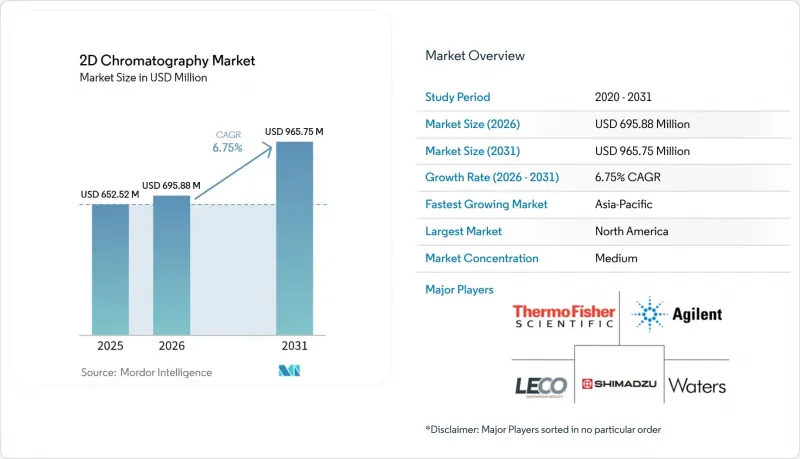
Mordor Intelligence에 의하면, 2D 크로마토그래피 시장 규모는 2025년에 6억 5,252만 달러, 2026년에 6억 9,588만 달러가 되어, 2031년까지 9억 6,575만 달러에 이를 것으로 예측되며, 2026년부터 2031년까지 CAGR 6.75%로 성장할 전망입니다.
본 보고서는 제품 유형(2D 가스 크로마토그래피, 2D 액체 크로마토그래피 등), 용도(제약·바이오기술 분야, 환경 분야 등), 검출 기술(질량 분석법 등), 최종 사용자(제약·바이오기술 기업 등), 지역(북미 등)별로 분류되어 있습니다. 시장 전망은 금액(달러) 기준으로 제시되어 있습니다.
전 세계 2D 크로마토그래피 시장 동향 및 인사이트
복잡한 시료에 대한 고분해능 분리 수요 증가
바이오의약품, 단백질체학 추출물, 환경 수질 시료 및 식품의 휘발성 물질 분석에서 공동 용출 문제가 발생하고 있기 때문에 복잡한 시료는 2D 크로마토그래피 시장의 주요 성장 요인으로 부상하고 있습니다. 이러한 매트릭스의 대부분에서 1차원 분석으로는 저농도 화합물이 강한 신호에 묻힐 가능성이 있어, 그 결과 불순물 프로파일링, 바이오마커 발견 및 미량 오염 물질 검출이 어려워집니다. 다차원 분리의 기술적 근거는 매우 견고합니다. 1차원에서 500개의 피크와 2D에서 50개의 피크를 조합하면 이론상 피크 용량은 25,000개 화합물에 달하기 때문입니다. 이러한 수준의 분리 정밀도는 연구소가 까다로운 불순물 쌍이나 밀접하게 관련된 분석 대상 물질이 규제 당국이나 과학적 심사를 견딜 수 있을 만큼 충분히 분리되었음을 입증해야 하는 경우에 중요합니다. 그 결과, 연구소가 기존의 단일 차원 플랫폼에서 하트컷형이나 종합적인 구성으로 전환함에 따라 2D 크로마토그래피 시장은 교체 수요의 혜택을 받고 있습니다. 또한, 분리 관련 과제가 더 이상 전문 연구소에 국한된 것이 아니게 되었기 때문에 규제 대상 분야나 연구 분야에서도 유사한 전환에 따라 도입이 확대되고 있습니다.
장비 및 분석법의 검증 비용 부담
높은 설비 투자 비용은 2D 크로마토그래피 시장에서 여전히 가장 두드러진 제약 요인 중 하나입니다. 특히 중규모 수탁 분석 기관, 공공 시험 기관, 그리고 고정된 조달 주기를 가진 연구소의 경우 더욱 그렇습니다. 종합적인 LC×LC-MS 및 GC×GC-TOFMS 시스템의 경우, 장비 구입뿐만 아니라 소프트웨어 라이선스, 부속품, 서비스 계약, 그리고 지속적인 소모품 조달도 필요합니다. 검증 측면에서도 마찬가지로 부담이 큽니다. ICH Q2(R2)에서는 분석 절차 전반에 걸친 재현성, 중간 정확도, 선형성, 특이성 및 견고성에 대한 증거가 요구되기 때문입니다. 실제로 이는 1차원 HPLC와 비교했을 때의 비용 차이가 장비 정가만으로 추산되는 것보다 훨씬 크다는 것을 의미합니다. 그 결과, 2D 크로마토그래피 시장에서는 도입 비용과 분석법의 적합성 확인에 소요되는 시간을 모두 감당할 수 있는 조직에서 여전히 가장 빠른 보급이 이루어지고 있습니다. 또한, 이 기술에 관심이 있지만 시스템 전체 도입을 결정하는 데 시간이 걸리는 상당한 규모의 중견 사용자층도 존재합니다.
부문 분석
2025년, 2D 액체 크로마토그래피는 52.15%의 점유율을 차지하며 2D 크로마토그래피 시장에서 가장 큰 제품 카테고리가 되었습니다. 또한, 이 부문은 2031년까지 연평균 성장률(CAGR) 7.38%로 확대될 것으로 예측되며, 현재 규모와 향후 성장 모멘텀 양면에서 다른 제품 유형을 계속해서 앞지를 전망입니다. 그 강점은 단백질, 펩타이드, 극성 대사산물과의 폭넓은 호환성에 있으며, 특히 바이오의약품의 품질 관리나 오믹스 분석과 관련된 워크플로우에서 두드러집니다. 또한, 분석 주기를 단축하고 기존 세대에 비해 일상적인 도입을 더욱 용이하게 하는 온라인 밸브 전환 방식도 도입 대수 확대를 뒷받침하고 있습니다. 이에 따라 각 연구소가 1차원 HPLC를 뛰어넘는 보다 실용적인 방법을 모색하는 가운데, 2D-LC는 2D 크로마토그래피 업계의 핵심으로 자리 잡고 있습니다. 또한, 다차원 분리가 필요하면서도 조작의 편의성을 추구하는 구매자들에게 이 부문이 여전히 기본적인 진입점으로 남아 있는 이유도 바로 여기에 있습니다.
2D 가스 크로마토그래피는 휘발성 또는 반휘발성 화합물이 매트릭스를 지배하는 석유화학 프로파일링, 향료·화장품 분야, 그리고 환경 스크리닝에서 여전히 중요한 역할을 수행하고 있습니다. TOFMS와 결합된 GC×GC는 복잡한 시료에서도 뛰어난 성능을 발휘하며, 탄화수소유형별 분석 및 비표적 오염 물질 분석에 지속적으로 기여하고 있어 그 기반은 안정적입니다. 2025년 연구에 따르면, 제1차원에 펜타플루오로페닐 컬럼, 제2D에 2개의 보완적인 컬럼을 사용한 멀티 2D LC×LC가 유럽산 약용 식물의 분석에서 표준 LC×LC와 비교하여 피크 수용 능력 91% 향상, 피크 분포 30% 개선을 가져왔음이 밝혀졌습니다. 이는 하이브리드 및 멀티모달 시스템이 단순한 틈새 실험에 그치지 않고, 2D 크로마토그래피 시장에서 중요한 하이엔드 성장 분야로 자리 잡고 있다는 관점을 뒷받침하는 것입니다. 시마즈 제작소의 Nexera UC-2D 플랫폼 역시 각 벤더들이 LC×LC와 초임계 유체 크로마토그래피를 연계하여 키랄 분리 및 바이오폴리머 분석으로의 응용 범위를 확대하고 있음을 보여줍니다. 더 광범위한 추세로 볼 때, 2D 크로마토그래피 업계는 확립된 2D-LC 수요를 기반으로 심화되면서, 보다 유연한 시스템 구성으로 확대되고 있습니다.
2025년에는 제약 및 생명공학 용도가 35.37%의 점유율을 차지하며, 2D 크로마토그래피 시장 규모에서 가장 큰 용도 분야가 되었습니다. 생명과학 연구 분야는 1차원 시스템으로는 제공할 수 없는 높은 피크 처리 능력이 필요한 단백질체학, 대사체학 및 멀티오믹스 프로그램에 힘입어, 2031년까지 연평균 성장률(CAGR) 8.01%라는 가장 높은 성장률을 나타낼 것으로 예측됩니다. 이 두 주요 분야의 차이는 중요하며, 2D 크로마토그래피 시장이 일상적인 규제 대응 수요와 확대되는 신약 개발 연구 수요 모두에 의해 뒷받침되고 있음을 보여줍니다. 약물 방출 시험, 안정성 시험, 불순물 프로파일링은 제약 및 생명공학 연구소에 계속해서 안정적인 워크플로우의 기반을 제공합니다. 동시에, 연구비 지원을 받는 학술 기관 및 전문 연구소에서는 프로테옴의 보다 상세한 분석, 바이오마커 발견, 시스템 생물학 분석을 위한 새로운 수요가 창출되고 있습니다. 이로 인해 용도의 성장은 순수하게 제약 산업에만 의존하는 사이클보다 더 균형 잡힌 양상을 띠고 있습니다.
환경 분석 분야 역시 PFAS 모니터링 및 기타 비표적 스크리닝 수요로 인해 연구소들이 더 고성능의 GC×GC 및 LC×LC 워크플로로 전환함에 따라 발전하고 있습니다. 식품 및 음료 검사는 안전 기준의 변동에 따라 향미 휘발성 물질, 농약 잔류물, 미코톡신 및 혼입 물질의 측정에서 여전히 중요한 위치를 차지하고 있습니다. 석유화학 및 천연가스 분석은 탄화수소 유형별 분석 및 공정 제어를 위해 GC 기반의 종합적인 워크플로가 이미 확립되어 있어, 보다 안정적인 수요에 기여하고 있습니다. 생명과학 연구 분야에서는 온라인 종합 2D-LC-QTOF-MS를 이용한 복잡한 제제의 체계적인 다성분 프로파일링을 지원하는 연구를 포함하여, 자동화 및 하이컨텐츠 다차원 분석법에 대한 근거가 확대되면서 그 중요성이 더욱 높아지고 있습니다. 이러한 근거에 힘입어 2D 크로마토그래피 시장은 전문가에 의한 도입에서 제약 과학, 중개 의학 및 천연물의 고도화된 특성 평가에 이르기까지, 보다 광범위한 기관에서의 활용으로 전환되고 있습니다. 또한, 향후 성장이 단일 최종 응용 분야에 의존할 위험도 감소됩니다.
지역별 분석
2025년, 북미는 41.23%의 점유율을 차지하며 2D 크로마토그래피 시장에서 최대의 입지를 확립했습니다. 이 지역은 바이오의약품 연구 개발 거점이 밀집해 있고, 이미 도입된 분석 기기가 다수 있으며, 고분해능 분석법의 신속한 도입을 뒷받침하는 규정 준수 문화가 정착되어 있다는 점 등의 혜택을 누리고 있습니다. 미국은 바이오의약품 개발, 숙주 세포 단백질 분석, 그리고 LC-MS/MS에 기반한 품질 관리 업무가 자체 개발 및 외부 위탁 환경 모두에서 지속적으로 확대되고 있기 때문에 여전히 수요의 중심지입니다. 분석 절차 개발 및 생물학적 제제의 특성 평가에 관한 규제 체계 또한, 보다 견고한 분석법의 타당성과 직교 분리의 필요성을 뒷받침하고 있습니다. 이에 따라 기술 개발에 기여하는 제약 기업, 수탁 분석 기관, 그리고 대학 부속 의료 센터 전반에 걸쳐 2D 크로마토그래피 시장은 견조하게 지지를 받고 있습니다. 캐나다에서는 고급 분석 플랫폼에 대한 수요가 증가하고 있는 연구 기관 및 규제 대상 시험소를 통해 규모는 작지만 안정적인 수요 기반이 형성되어 있습니다.
유럽은 독일, 프랑스, 이탈리아, 영국의 제약 제조거점에 힘입어 2D 크로마토그래피 시장에서 여전히 2위 지역 블록으로서의 지위를 유지하고 있습니다. 공공 연구 기관의 현대화와 첨단 오믹스 프로그램 또한 대학 및 연구 기관의 2D-LC 플랫폼 수요를 뒷받침하는 요인 중 하나입니다. 이 지역 수요 동향은 생물학적 제제에 대한 높은 품질 기대와, 워크플로우상의 이점이 명확한 경우 고사양 분석 인프라에 대한 투자를 지속하려는 태도에 의해 형성되고 있습니다. 독일이 두드러지는 이유는 기관의 조달 과정에서 용매 효율과 지속가능성이 점점 더 중요시되고 있으며, 장기적인 가동 주기 동안 용매 부하를 줄이도록 설계된 플랫폼이 선호되기 때문입니다. 이에 따라 유럽은 프리미엄 시스템의 교체와 고도의 분리에 대응하는 특수한 하이브리드 구성 모두에 있어 중요한 시장이 되고 있습니다.
아시아태평양은 2031년까지 연평균 성장률(CAGR) 8.45%를 나타낼 것으로 예측되며, 2D 크로마토그래피 시장에서 가장 빠르게 확장되고 있는 지역 블록입니다. 중국이 판매량의 주요 견인차 역할을 하고 있습니다. 이는 바이오시밀러의 제조 규모 확대와 하트컷법 및 종합적 2D-LC가 약전으로 인정됨에 따라 도입에 대한 주저함이 줄어들고 있기 때문입니다. 애질런트(Agilent)가 다롄, 미국, 독일에서 ‘Infinity III LC 시리즈’를 동시 출시한 것도 중국이 고정밀 분석 기기의 1급 출시 시장으로 자리매김하고 있음을 보여줍니다. 인도, 일본, 한국에서는 수탁 연구, 직교 특성 평가에 대한 수요, 바이오시밀러 품질 향상을 위한 투자를 통해 성장세가 더욱 가속화되고 있는 반면, 동남아시아와 호주에서는 식품, 환경, 향료, 석유화학 분야에서의 GCxGC 도입 확대가 호재로 작용하고 있습니다.
기타 혜택:
- 엑셀 형식 시장 예측(ME) 시트
- 3개월간의 애널리스트 지원
자주 묻는 질문
목차
제1장 서론
제2장 조사 방법
제3장 주요 요약
제4장 시장 구도
제5장 시장 규모와 성장 예측
제6장 경쟁 구도
제7장 시장 기회와 향후 전망
JHS 26.08.05According to Mordor Intelligence, the 2D chromatography market size is projected to be USD 652.52 million in 2025, USD 695.88 million in 2026, and reach USD 965.75 million by 2031, growing at a CAGR of 6.75% from 2026 to 2031.
This report is Segmented by Product Type (2D Gas Chromatography, 2D Liquid Chromatography, and More), by Application (Pharmaceutical and Biotechnology Applications, Environmental, and More), by Detection Technology (Mass Spectrometry and More), by End User (Pharmaceutical & Biotechnology Companies and More), and Geography (North America, and More). The Market Forecasts are Provided in Terms of Value (USD).
Global 2D Chromatography Market Trends and Insights
Rising Need for High-Resolution Separation in Complex Samples
Complex samples are becoming a core growth driver for the 2D chromatography market because co-elution problems now appear in biologics, proteomics extracts, environmental water samples, and food volatile analysis. In many of these matrices, a one-dimensional run can leave low-abundance compounds buried under stronger signals, which weakens impurity profiling, biomarker discovery, and trace contaminant detection. The technical case for multidimensional separation is strong because a 500-peak first dimension combined with a 50-peak second dimension yields a theoretical peak capacity of 25,000 compounds. That level of separation matters when laboratories must show that difficult impurity pairs or closely related analytes have been resolved well enough for regulatory or scientific review. As a result, the 2D chromatography market is benefiting from replacement demand as laboratories move from legacy single-dimension platforms toward heart-cut or comprehensive configurations. The same shift is also widening adoption across regulated and research settings because the separation problem is no longer limited to specialist laboratories.
High Instrument and Method Validation Cost
High capital cost remains one of the clearest restraints on the 2D chromatography market, especially for mid-sized contract laboratories, public testing agencies, and research groups with fixed procurement cycles. Comprehensive LCXLC-MS or GCXGC-TOFMS systems require not only instrument purchase but also software licenses, accessories, service coverage, and ongoing consumable commitments. The validation side is equally demanding because ICH Q2(R2) requires repeatability, intermediate precision, linearity, specificity, and robustness evidence across the full analytical procedure. In practice, that means the cost difference versus one-dimensional HPLC is much larger than the instrument list price alone suggests. The result is that the 2D chromatography market still concentrates fastest adoption among organizations that can absorb both acquisition cost and method qualification time. This also leaves a sizable middle tier of users interested in the capability but slower to commit to full-system deployment.
Other drivers and restraints analyzed in the detailed report include:
- Expansion of Biologics, Proteomics, and Metabolomics Workflows
- Tightening Quality and Impurity Profiling Requirements in Regulated Testing
- Growth of Hyphenated 2D Chromatography and Mass Spectrometry Workflows
- Shortage of Skilled Analysts and System Integrators
For complete list of drivers and restraints, kindly check the Table Of Contents.
Segment Analysis
2D liquid chromatography held 52.15% share in 2025, which made it the largest product category in the 2D chromatography market. The segment is also projected to expand at 7.38% CAGR through 2031, which keeps it ahead of other product types on both current scale and forward momentum. Its strength comes from broad compatibility with proteins, peptides, and polar metabolites, especially in workflows tied to biopharma quality control and omics analysis. The installed base is also being supported by online valve-switching formats that reduce analysis cycle time and make routine deployment more feasible than earlier generations. This keeps 2D-LC at the core of the 2D chromatography industry as laboratories seek more practical ways to move beyond single-dimension HPLC. It also helps explain why the segment remains the default entry point for buyers who need multidimensional separation but want operational familiarity.
2D gas chromatography still has an important role in petrochemical profiling, flavor and fragrance work, and environmental screening, where volatile or semi-volatile compounds dominate the matrix. That base is stable because GCXGC paired with TOFMS continues to serve hydrocarbon speciation and non-target contaminant analysis with strong performance in complex samples. A 2025 study also showed that multi-2D LCXLC using a pentafluorophenyl first dimension and 2 complementary second-dimension columns delivered a 91% gain in peak capacity and 30% better peak distribution than standard LCXLC for European medicinal plants. This supports the view that hybrid and multi-modal systems are becoming a meaningful high-end growth layer within the 2D chromatography market rather than a niche experiment. Shimadzu's Nexera UC-2D platform also shows how vendors are linking LCXLC with supercritical fluid chromatography to widen use in chiral separations and biopolymer analysis. The broader pattern is that the 2D chromatography industry is deepening around established 2D-LC demand while also widening into more configurable system architectures.
Pharmaceutical and biotechnology applications generated 35.37% share in 2025, which gave them the largest application position in the 2D chromatography market size. Life science research is forecast to record the fastest CAGR at 8.01% through 2031, supported by proteomics, metabolomics, and multi-omics programs that require higher peak capacity than one-dimensional systems can provide. The difference between the two leaders is important because it shows how the 2D chromatography market is being supported by both routine regulated demand and expanding discovery demand. Drug release testing, stability studies, and impurity profiling continue to give pharmaceutical and biotechnology laboratories a steady workflow base. At the same time, grant-backed academic centers and specialist institutes are creating new placements for deeper proteome coverage, biomarker discovery, and systems biology analysis. This makes application growth more balanced than a purely pharma-dependent cycle.
Environmental analysis is also advancing because PFAS monitoring and other non-target screening demands are pushing laboratories toward more capable GCXGC and LCXLC workflows. Food and beverage testing remains relevant for flavor volatiles, pesticide residues, mycotoxins, and adulterant measurement under evolving safety thresholds. Petrochemical and natural gas analysis contributes to a more stable demand, since comprehensive GC-based workflows are already well established for hydrocarbon speciation and process control. The life science research case is being strengthened by expanding evidence on automated and high-content multidimensional methods, including work that supports systematic multi-component profiling of complex formulations with online comprehensive 2D-LC-QTOF-MS. That kind of evidence helps the 2D chromatography market move from expert-only adoption toward broader institutional use across pharmaceutical science, translational medicine, and advanced natural product characterization. It also reduces the risk that future growth will depend on a single end application.
Complete Report Scope:
- By Product Type
- 2D Gas Chromatography
- 2D Liquid Chromatography
- Hybrid and Multi-Modal Systems
- By Application
- Pharmaceutical and Biotechnology Applications
- Environmental Analysis
- Food and Beverage Testing
- Life Science Research
- Petrochemical and Natural Gas Analysis
- Other Applications (Forensic Science, Clinical Toxicology, etc.)
- By Detection Technology
- Mass Spectrometry
- Flame Ionization Detection
- UV and Visible Detection
- Others (Charged Aerosol Detector (CAD), Fluorescence Detection (FLD), etc.)
- By End Use
- Pharmaceutical and Biotechnology Companies
- Academic and Research Institutes
- Clinical and Diagnostic Laboratories
- Environmental Testing Laboratories
- Food and Beverage Laboratories
- Petrochemical and Industrial Testing Facilities
- Other End Uses (CDMOs, CROs, etc.)
- By Geography
- North America
- United States
- Canada
- Mexico
- Europe
- Germany
- United Kingdom
- France
- Italy
- Spain
- Rest of Europe
- Asia-Pacific
- China
- Japan
- India
- South Korea
- Australia
- Rest of Asia-Pacific
- Middle East and Africa
- GCC
- South Africa
- Rest of Middle East and Africa
- South America
- Brazil
- Argentina
- Rest of South America
- North America
Geography Analysis
North America held 41.23% share in 2025, giving the region the largest position in the 2D chromatography market. The region benefits from a dense biopharmaceutical R&D base, a large installed analytical instrument fleet, and a compliance culture that supports faster adoption of higher-resolution methods. The United States remains the center of that demand because biologics development, host cell protein analysis, and LC-MS/MS-based quality control work continue to expand in both originator and outsourced settings. Regulatory frameworks for analytical procedure development and biological product characterization also reinforce the need for stronger method defensibility and orthogonal separation. This keeps the 2D chromatography market well supported across pharmaceutical companies, contract laboratories, and academic medical centers that contribute to technology development. Canada adds a smaller but stable base through research institutions and regulated testing laboratories that increasingly require advanced analytical platforms.
Europe remained the second-largest regional block in the 2D chromatography market, supported by pharmaceutical manufacturing depth in Germany, France, Italy, and the UK. Public research modernization and advanced omics programs are also helping sustain demand for 2D-LC platforms in university and research institute settings. The region's demand profile is shaped by strong biologics quality expectations and a continued willingness to invest in high-specification analytical infrastructure when workflow benefits are clear. Germany stands out because solvent efficiency and sustainability are becoming more relevant in institutional procurement, which favors platforms designed to reduce solvent burden over long operating cycles. This makes Europe an important market for both premium system replacement and specialized hybrid configurations that serve advanced separations.
Asia-Pacific is projected to grow at 8.45% CAGR through 2031, which makes it the fastest-expanding regional block in the 2D chromatography market. China is the main volume engine because biosimilar manufacturing scale-up and pharmacopoeial recognition of heart-cut and comprehensive 2D-LC are reducing hesitation around adoption. Agilent's simultaneous Infinity III LC Series launch in Dalian, the United States, and Germany also signaled that China now ranks as a first-tier launch market for high-precision analytical instruments. India, Japan, and South Korea add further momentum through contract research, orthogonal characterization needs, and biosimilar quality investment, while Southeast Asia and Australia are benefiting from broader GCxGC deployment in food, environmental, fragrance, and petrochemical testing.
- Agilent Technologies
- Bio-Rad Laboratories
- Bruker
- Danaher
- Gilson
- GL Sciences Inc.
- Hitachi
- JASCO Corporation
- KNAUER Wissenschaftliche Gerate GmbH
- LECO
- Merck
- PerkinElmer
- Phenomenex, Inc.
- Restek
- Sartorius
- SepSolve Analytical Ltd.
- Shimadzu
- Thermo Fisher Scientific
- Trajan Scientific and Medical
- Waters Corporation
Additional Benefits:
- The market estimate (ME) sheet in Excel format
- 3 months of analyst support
TABLE OF CONTENTS
1 INTRODUCTION
- 1.1 Study Assumptions and Market Definition
- 1.2 Scope of the Study
2 RESEARCH METHODOLOGY
3 EXECUTIVE SUMMARY
4 MARKET LANDSCAPE
- 4.1 Market Overview
- 4.2 Market Drivers
- 4.2.1 Rising Need for High-Resolution Separation in Complex Samples
- 4.2.2 Expansion of Biologics, Proteomics, and Metabolomics Workflows
- 4.2.3 Tightening Quality and Impurity Profiling Requirements in Regulated Testing
- 4.2.4 Growth of Hyphenated 2D Chromatography and Mass Spectrometry Workflows
- 4.2.5 Miniaturized and Automated Platforms Lowering Method Development Friction
- 4.2.6 AI-Assisted Peak Deconvolution and Retention Alignment Improving Analytical Throughput
- 4.3 Market Restraints
- 4.3.1 High Instrument and Method Validation Cost
- 4.3.2 Shortage of Skilled Analysts and System Integrators
- 4.3.3 Integration Complexity With Legacy Laboratory Workflows
- 4.3.4 Validation Burden for Regulated and Multi-Site Deployments
- 4.4 Supply Chain Analysis
- 4.5 Regulatory Landscape
- 4.6 Technological Outlook
- 4.7 Porter's Five Forces Analysis
- 4.7.1 Threat of New Entrants
- 4.7.2 Bargaining Power of Suppliers
- 4.7.3 Bargaining Power of Buyers
- 4.7.4 Threat of Substitutes
- 4.7.5 Competitive Rivalry
5 MARKET SIZE AND GROWTH FORECASTS (VALUE, USD)
- 5.1 By Product Type
- 5.1.1 2D Gas Chromatography
- 5.1.2 2D Liquid Chromatography
- 5.1.3 Hybrid and Multi-Modal Systems
- 5.2 By Application
- 5.2.1 Pharmaceutical and Biotechnology Applications
- 5.2.2 Environmental Analysis
- 5.2.3 Food and Beverage Testing
- 5.2.4 Life Science Research
- 5.2.5 Petrochemical and Natural Gas Analysis
- 5.2.6 Other Applications (Forensic Science, Clinical Toxicology, etc.)
- 5.3 By Detection Technology
- 5.3.1 Mass Spectrometry
- 5.3.2 Flame Ionization Detection
- 5.3.3 UV and Visible Detection
- 5.3.4 Others (Charged Aerosol Detector (CAD), Fluorescence Detection (FLD), etc.)
- 5.4 By End Use
- 5.4.1 Pharmaceutical and Biotechnology Companies
- 5.4.2 Academic and Research Institutes
- 5.4.3 Clinical and Diagnostic Laboratories
- 5.4.4 Environmental Testing Laboratories
- 5.4.5 Food and Beverage Laboratories
- 5.4.6 Petrochemical and Industrial Testing Facilities
- 5.4.7 Other End Uses (CDMOs, CROs, etc.)
- 5.5 By Geography
- 5.5.1 North America
- 5.5.1.1 United States
- 5.5.1.2 Canada
- 5.5.1.3 Mexico
- 5.5.2 Europe
- 5.5.2.1 Germany
- 5.5.2.2 United Kingdom
- 5.5.2.3 France
- 5.5.2.4 Italy
- 5.5.2.5 Spain
- 5.5.2.6 Rest of Europe
- 5.5.3 Asia-Pacific
- 5.5.3.1 China
- 5.5.3.2 Japan
- 5.5.3.3 India
- 5.5.3.4 South Korea
- 5.5.3.5 Australia
- 5.5.3.6 Rest of Asia-Pacific
- 5.5.4 Middle East and Africa
- 5.5.4.1 GCC
- 5.5.4.2 South Africa
- 5.5.4.3 Rest of Middle East and Africa
- 5.5.5 South America
- 5.5.5.1 Brazil
- 5.5.5.2 Argentina
- 5.5.5.3 Rest of South America
- 5.5.1 North America
6 COMPETITIVE LANDSCAPE
- 6.1 Market Concentration
- 6.2 Market Share Analysis
- 6.3 Company Profiles (includes Global Level Overview, Market Level Overview, Core Segments, Financials as available, Strategic Information, Market Rank/Share, Products and Services, Recent Developments)
- 6.3.1 Agilent Technologies, Inc.
- 6.3.2 Bio-Rad Laboratories, Inc.
- 6.3.3 Bruker Corporation
- 6.3.4 Danaher Corporation
- 6.3.5 Gilson, Inc.
- 6.3.6 GL Sciences Inc.
- 6.3.7 Hitachi High-Tech Corporation
- 6.3.8 JASCO Corporation
- 6.3.9 KNAUER Wissenschaftliche Gerate GmbH
- 6.3.10 LECO Corporation
- 6.3.11 Merck KGaA
- 6.3.12 PerkinElmer, Inc.
- 6.3.13 Phenomenex, Inc.
- 6.3.14 Restek Corporation
- 6.3.15 Sartorius AG
- 6.3.16 SepSolve Analytical Ltd.
- 6.3.17 Shimadzu Corporation
- 6.3.18 Thermo Fisher Scientific Inc.
- 6.3.19 Trajan Scientific and Medical
- 6.3.20 Waters Corporation
7 MARKET OPPORTUNITIES AND FUTURE OUTLOOK
- 7.1 White-space and Unmet-Need Assessment