

|
시장보고서
상품코드
2099755
HBM 정상 칩(KGD) 선별 및 테스트 : 시장 점유율 분석, 업계 동향 및 통계, 성장 예측(2026-2031년)HBM Known-Good-Die (KGD) Screening and Test - Market Share Analysis, Industry Trends & Statistics, Growth Forecasts (2026 - 2031) |
||||||
 Mordor Intelligence
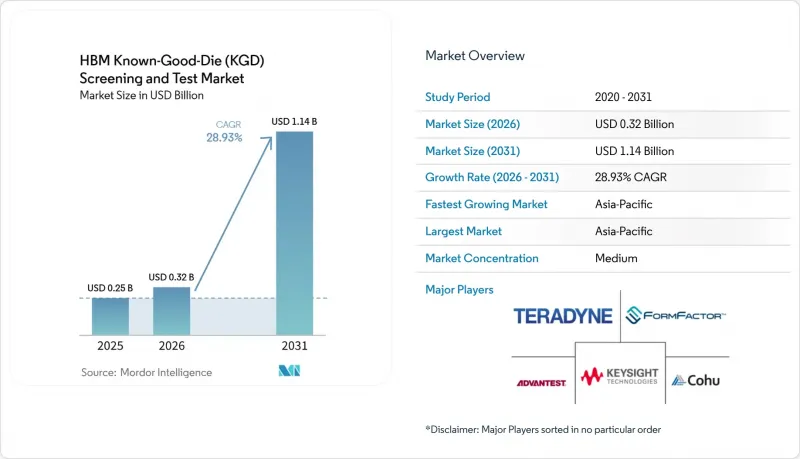
Mordor Intelligence에 의하면, HBM 정상 칩(KGD) 선별 및 테스트 시장 규모는 2025년 2억 5,000만 달러로 평가되었습니다. 2026년에는 3억 2,000만 달러로 확대되어 2031년까지 11억 4,000만 달러에 이를 것으로 예상되고 2026년부터 2031년에 걸쳐 CAGR 28.93%로 성장할 전망입니다.
본 보고서는 테스트 단계별(웨이퍼 레벨 테스트 등), 테스터 유형별(메모리 테스터 등), HBM 세대별(HBM2 및 HBM2E, HBM3 등), 테스트 기술별(내장형 자가 진단(BIST) 기반 스크리닝 등), 용도별(기기 등), 최종 이용 산업별(메모리 제조업체 등), 그리고 지역별로 분류되어 있습니다. 시장 전망은 금액(달러) 기준으로 제시되어 있습니다.
세계의 HBM 정상 칩(KGD) 선별 및 테스트 시장 동향 및 인사이트
AI 가속기 수요 증가가 KGD 스크리닝 강화를 촉진
HBM 정상 칩(KGD) 선별 및 테스트 시장은 확대 추세를 보이고 있습니다. 이는 AI 가속기에서 HBM이 단순한 메모리 업그레이드 옵션이 아니라 핵심 성능 구성 요소로서 필수 불가결한 요소가 되었기 때문입니다. 이러한 변화로 인해 다이 및 스택 결함으로 인한 영향이 더욱 심각해지고 있습니다. 결함이 발생할 경우, 단일 메모리 구성 요소가 아닌 훨씬 더 고가의 컴퓨팅 모듈 전체의 작동을 방해할 가능성이 있기 때문입니다. FormFactor는 2026년, AI와 HBM이 반도체 테스트의 우선순위를 바꾸고 있으며, 초기 단계에서의 결함 제거, 수율 안정성, 그리고 패키지 수준의 비용 보호에 대한 관심이 높아지고 있다고 밝혔습니다. 이와 유사한 압박은 고객의 디바이스 인증 방식에서도 뚜렷이 드러납니다. 더욱 엄격한 스크리닝은 더 이상 백엔드 품질에 대한 선호 사항이 아니라, 고부가가치 AI 하드웨어에 대한 상업적 요건의 일부가 되었습니다. AI 서버 도입이 확대됨에 따라, HBM 정상 칩(KGD) 선별 및 테스트 시장은 단위당 수요 증가와 디바이스당 스크리닝 공정 수 증가라는 두 가지 측면에서 혜택을 보고 있습니다. 이로 인해 웨이퍼 생산량 증가만으로는 장비 및 생산 능력 확충 속도를 완전히 설명할 수 없는 경우에도 테스트 수요는 높은 수준을 유지하고 있습니다.
멀티다이 수율을 확보하기 위한 '시프트 레프트(Shift Left)' 테스트 전략
HBM 정상 칩(KGD) 선별 및 테스트 시장은 제조 흐름에서 스크리닝 시점을 앞당기려는 명확한 움직임에 의해서도 형성되고 있습니다. FormFactor는 2026년 5월, 조기 테스트 전략이 매우 중요하다고 지적했습니다. 이는 제조된 다이가 ‘검증된 인증 소재’로서 스태킹 공정에 진입할지 여부를 결정하고, 다운스트림 공정의 수율과 비용을 보호하기 때문입니다. 이러한 논리는 스택이 소층 설계에서 12층 및 16층 설계로 전환됨에 따라 그 중요성이 더욱 커집니다. 단 하나의 불량 다이만으로도 조립된 제품의 가치 중 훨씬 더 큰 부분을 훼손할 가능성이 있기 때문입니다. Siemens EDA는 2026년 4월, HBM4로 인해 베이스 다이가 로직 파운드리형 접근 방식으로 전환되면서 테스트 프로그램 아키텍처가 변화할 것임을 보여주었습니다. 이로 인해 다이, 스택, 패키지의 각 단계에 걸친 검증의 연속성이 더욱 중요해지고 있습니다. 실제로 이는 HBM의 ‘KGD(Known-Good-Die)’ 스크리닝 테스트 시장이 더 이상 생산 라인상의 단일 지점에서 이루어지는 합격/불합격 판정에만 초점을 맞추는 것이 아니게 되었음을 의미합니다. 통합 가치가 높아짐에 따라 불량이 누적되는 것을 방지하기 위해, 일련의 보호 게이트를 중심으로 한 체계가 점점 더 중요해지고 있습니다.
고급 ATE 및 프로브 인프라의 높은 비용
HBM 정상 칩(KGD) 선별 및 테스트 시장은 여전히 큰 장벽에 직면해 있습니다. 그 이유는 첨단 메모리 테스트, 프로빙 및 핸들링 시스템의 인증에 막대한 비용이 소요될 뿐만 아니라 대규모 도입이 어렵기 때문입니다. Advantest가 2025년 12월에 출시한 'M5241 메모리 핸들러'는 최대 512개의 병렬 테스트 사이트를 지원하며, 처리량은 시간당 최대 4만 6,000개에 달하는데, 이는 최신 인프라가 얼마나 전문화되어 있는지를 보여줍니다. 또한, Aehr가 2025년 8월에 발주한 평가용 주문에서도 신규 프로그램의 경우 맞춤형 콘택터 설계나 평소보다 높은 전류 공급이 필요한 경우가 있어, 표준 테스트용 인서트를 뛰어넘는 추가적인 개발 노력이 요구된다는 점이 드러났습니다. Technoprobe의 2025년 캐피탈 마켓 데이(Capital Market Day) 프레젠테이션에서는 첨단 프로브 환경에서 수직 통합형 MEMS 역량이 필요하다는 점이 더욱 강조되었으며, 단순히 장비를 보유하는 것뿐만 아니라 공급 체제의 견고함도 마찬가지로 중요하다는 점이 시사되었습니다. 이러한 상황은 대량 생산을 통해 엔지니어링 비용을 분산할 수 있는 대형 메모리 제조업체나 충분한 자격을 갖춘 파트너에게 유리하게 작용합니다. 소규모 신규 진출기업도 HBM 정상 칩(KGD) 선별 및 테스트 시장에 진입하는 것은 가능하지만, 대부분의 경우 완전한 사내 플랫폼을 구축하기보다는 보다 제한적인 역할이나 서비스 모델을 통해 시장에 진입하게 될 것입니다.
부문 분석
2025년, 테스트 단계 부문 중 웨이퍼 레벨 테스트가 44.13%로 가장 큰 점유율을 차지하며, HBM 정상 칩(KGD) 선별 및 테스트 시장의 첫 번째 경제적 제어 지점이 되었습니다. 이러한 우위는 공정 흐름 내의 단순한 비용 논리를 반영합니다. 스택 전에 결함을 감지함으로써, 더 고가의 재료가 후공정으로 진행되는 것을 막을 수 있기 때문입니다. FormFactor는 2026년에 초기 스크리닝을 통해 제조된 다이가 적격 소재로 적층 공정으로 진행될지 여부가 결정된다고 밝혔으며, 이를 통해 웨이퍼 레벨 테스트는 다운스트림 공정의 수율 안정성에 직접적인 역할을 하고 있습니다. HBM 정상 칩(KGD) 선별 및 테스트 시장에서 웨이퍼 레벨에서의 판단은 수율뿐만 아니라 향후 각 스택에 투입되는 자본, 처리 시간, 그리고 패키지 조립에 드는 노력에도 영향을 미칩니다. 이것이 검증 요구 사항이 웨이퍼의 범위를 넘어 확대되었음에도 불구하고, 이 부문이 여전히 핵심 단계로 남아 있는 이유입니다.
테스트 단계의 기타 구성 비율은 여전히 확대되고 있습니다. 이는 첨단 HBM 프로그램에서 후공정 검증 단계를 생략할 수 없기 때문입니다. HBM4에서는 로직 파운드리 기반 다이가 도입되고, 웨이퍼 스크리닝만으로는 완전히 커버할 수 없는 더 복잡한 통합 공정이 채택됨에 따라, 패키지 수준 및 시스템 수준의 작업은 여전히 중요성을 유지하고 있습니다. 스택 다이 테스트는 가장 빠르게 성장하는 부문으로, 2031년까지 연평균 성장률(CAGR)이 29.67%에 달하며, 최종 패키지 조립 전 ‘알려진 양품 스택(KGS)’ 검증의 가치가 높아지고 있음을 뒷받침합니다. 스택의 높이가 증가하고, 디바이스가 CoWoS 및 기타 첨단 패키징 공정에 들어가기 전에 고객이 더 높은 신뢰성을 요구함에 따라 그 필요성은 더욱 커지고 있습니다. JEDEC의 HBM4 프레임워크는 더욱 까다로운 스택 구성을 공식적으로 규정함으로써 이러한 방향성을 뒷받침하고 있으며, 이로 인해 중간 검증 단계의 역할이 자연스럽게 확대되고 있습니다. 따라서 HBM 정상 칩(KGD) 선별 및 테스트 시장에서는 ‘조기 스크리닝은 비용 절감으로 이어지지만, 후기 단계의 스크리닝은 스택 및 통합을 통해 창출되는 훨씬 더 큰 가치를 보호한다’는 명확한 개념에 따라 각 단계의 비중이 확대되고 있습니다.
2025년, 메모리 테스터는 38.23%의 점유율을 차지하며 테스터 유형별 부문 중 최대 규모를 기록했습니다. 이는 웨이퍼 테스트, 기능 스크리닝, 그리고 여러 HBM 세대에 걸친 인증 주기에서 메모리 테스터가 수행하는 역할에 힘입은 결과입니다. 이러한 우위는 광범위한 도입 실적에 더해, HBM 정상 칩(KGD) 선별 및 테스트 시장에서 기존 메모리 테스트가 여전히 일상적인 생산 판단의 중심이 되고 있다는 사실에서 기인합니다. 2025년 하반기 Advantest의 제품 동향은 특히 높은 병렬 처리 능력과 안정적인 처리량을 필요로 하는 고성능 AI 메모리 디바이스 분야에서 각 벤더들이 이 기반을 지속적으로 강화하고 있음을 보여줍니다. 또한, 새로운 HBM 세대가 등장할 때마다 여전히 방대한 양의 전기적 특성 평가 및 양산 인증 테스트 컨텐츠가 필요하기 때문에 메모리 테스터의 중요성은 변함없습니다. 이로 인해 새로운 기법이 보급되고 있는 상황에서도 이 부문은 HBM 정상 칩(KGD) 선별 및 테스트 시장에서 확고한 입지를 계속 다지고 있습니다.
번인 시스템은 2031년까지 연평균 성장률(CAGR)이 29.58%로, 테스터 유형 중 가장 빠르게 성장하고 있으며, 고가의 AI 및 HBM 디바이스에서 잠재적 결함을 조기에 제거하려는 추세를 반영하고 있습니다. Aehr의 2025년 수주 현황 평가에 따르면, 다운스트림 공정에서의 고장 비용이 무시할 수 없을 정도로 높아진 경우, 고객들이 새로운 웨이퍼 레벨 번인 경로를 테스트할 의향이 있는 것으로 나타났습니다. 번인은 더 이상 단순한 최종 단계의 신뢰성 평가 공정으로만 취급되지 않습니다. HBM 정상 칩(KGD) 선별 및 테스트 시장에서 번인은 첨단 패키징을 통해 추가적인 가치가 확정되기 전의 ‘보호 게이트’ 역할을 점점 더 많이 수행하고 있기 때문입니다. 보다 엄격한 스크리닝에는 정확한 접촉, 안정적인 전류 공급, 그리고 재현성 있는 기계적 성능이 여전히 필수적이기 때문에 이러한 추세 속에서 프로브 카드와 웨이퍼 프로브 시스템은 여전히 없어서는 안 될 존재로 남아 있습니다. Technoprobe의 2025년까지의 확장 계획은 각 공급업체들도 이러한 증가하는 테스트 부하를 지탱하는 접촉층에서 지속적인 비즈니스 기회를 발견하고 있음을 보여줍니다. 그 결과, 현재 테스터 시장에서는 메모리 테스터가 여전히 주도적인 위치를 차지하고 있지만, 번인 시스템의 역할이 생산 경제성의 핵심으로 부상함에 따라 그 격차는 점차 좁혀지고 있습니다.
지역별 분석
2025년, 아시아태평양은 매출의 83.49%를 차지하며, HBM 정상 칩(KGD) 선별 및 테스트 시장에서 가장 큰 점유율을 확보했습니다. 또한, 2031년까지의 연평균 성장률(CAGR)이 29.78%로, 가장 빠르게 성장하고 있는 지역 부문이기도 합니다. 이 지역이 주도적인 위치를 차지하고 있는 이유는 HBM 생산, 테스트 장비 공급, 그리고 첨단 패키징 생산 능력이 모두 이 지역에 집중되어 있기 때문입니다. 한국은 주요 HBM 제조업체들이 초기 인증 작업의 대부분과 첨단 스크리닝 시스템에 대한 수요의 상당 부분을 주도하고 있어 여전히 주요 거점으로서의 지위를 유지하고 있습니다. 대만은 파운드리 및 패키징 역량을 통해 중요한 통합적 역할을 수행하고 있으며, 그 테스트 인프라는 보다 광범위한 HBM 출시 프로세스의 일부가 되고 있습니다. 일본은 메모리 테스트, 프로브, 계측 기술 역량을 통해 지역 기반을 강화하고 있는 반면, 중국은 인증 프로세스의 초기 단계에 있으며 여전히 현지 HBM 테스트 역량을 구축하는 단계에 있습니다.
또한, 아시아태평양은 정책 지원과 설비 확충을 통해 HBM KGD(Known-Good-Die) 스크리닝 및 테스트 시장에서의 장기적인 입지를 강화하고 있습니다. 일본의 반도체 관련 설비 투자 계획은 2025년 12월 기준으로, 일반 예산에서 총 4조 5,000억 엔(301억 달러), 추가 예산에서 총 6조 3,000억 엔(421억 달러)에 달했습니다. 이러한 지출 환경은 지역 공급망 전반에 걸쳐 테스트 장비, 프로브 기술 및 공정 역량에 대한 수요를 유지하는 데 기여하고 있습니다. 따라서 HBM 정상 칩(KGD) 선별 및 테스트 시장은 생산 점유율 측면에서 아시아태평양에 집중되어 있을 뿐만 아니라, 해당 지역의 제조, 통합 및 공급업체의 준비 태세라는 가장 탄탄한 조합에 의해 뒷받침되고 있습니다. 이로 인해 다른 지역이 단기간 내에 따라잡기 어려울 것으로 보이는 구조적 우위가 형성되고 있습니다.
북미는 2025년 기준 점유율이 낮았음에도 불구하고, 하이퍼스케일러 수요와 테스트 프로그램 주도권이 HBM 정상 칩(KGD) 선별 및 테스트 시장의 진화에 영향을 미치기 때문에 전략적으로 중요한 위치를 계속 차지하고 있습니다. 이 지역에는 주요 장비 및 솔루션 공급업체들이 거점을 두고 있으며, AI 인프라 고객의 구매력을 통해 인증 요건을 형성하는 역할도 수행하고 있습니다. 캘리포니아주에서 진행 중인 Aehr의 웨이퍼 레벨 번인(wafer-level burn-in) 활동은 북미가 HBM 웨이퍼의 직접 생산량 측면에서 아시아태평양에 미치지 못하더라도 초기 단계의 스크리닝 기법에 영향을 미칠 수 있음을 보여줍니다. 유럽과 남미는 여전히 규모가 작지만, 유럽은 Technoprobe와 같은 프로브 및 계측 전문 기업을 통해 중요한 역할을 계속하고 있습니다. 한편, 중동 및 아프리카는 여전히 초기 단계의 참여자이며, 그 중요성은 업스트림 HBM 스크리닝 역량보다는 하류 AI 시스템 수요와 더 밀접하게 관련되어 있습니다.
기타 혜택 :
- 엑셀 형식 시장 예측(ME) 시트
- 3개월간의 애널리스트 지원
자주 묻는 질문
목차
제1장 서론
제2장 조사 방법
제3장 주요 요약
제4장 시장 구도
제5장 시장 규모 및 성장 예측
제6장 경쟁 구도
제7장 시장 기회 및 향후 전망
KTH 26.08.10According to Mordor Intelligence, the HBM known-Good-Die (KGD) screening and Test Market size is expected to increase from USD 0.25 billion in 2025 to USD 0.32 billion in 2026 and reach USD 1.14 billion by 2031, growing at a CAGR of 28.93% over 2026-2031.
This report is Segmented by Test Stage (Wafer-Level Testing, and More), Tester Type (Memory Tester, and More), HBM Generation (HBM2 and HBM2E, HBM3, and More), Test Technology (Built-In Self-Test Based Screening, and More), Application (Equipment, and More), End-Use Industry (Memory Manufacturers, and More), and Geography. The Market Forecasts are Provided in Terms of Value (USD).
Global HBM Known-Good-Die (KGD) Screening and Test Market Trends and Insights
Rising AI Accelerator Demand Increasing KGD Screening Intensity
The HBM known-good-die (KGD) screening and test market is moving higher because AI accelerators now rely on HBM as a core performance building block rather than an optional memory upgrade. That shift raises the penalty for any die or stack failure, because defects can disrupt a much more expensive compute module rather than a stand-alone memory component. FormFactor stated in 2026 that AI and HBM are changing semiconductor test priorities by pushing more attention toward early defect removal, yield stability, and package-level cost protection. The same pressure is evident in how customers qualify devices, as stronger screening has become part of the commercial requirements for high-value AI hardware rather than a back-end quality preference. As AI server deployments widen, the HBM known-good-die (KGD) screening and test market is benefiting from both higher unit demand and more screening steps per device. This keeps test demand elevated even when wafer output growth alone does not fully explain the pace of equipment and capacity additions.
Shift-Left Test Strategies to Protect Multi-Die Yield
The HBM known-good-die (KGD) screening and test market is also being shaped by a clear move toward earlier screening points in the production flow. FormFactor noted in May 2026 that early test strategies are critical because they determine whether manufactured dies enter stacking as proven-qualified material, which protects downstream yield and costs. That logic becomes stronger as stacks move from fewer layers to 12- and 16-high designs, because a single weak die can compromise a much larger portion of the assembled value. Siemens EDA showed in April 2026 that HBM4 changes the test program architecture by shifting the base die toward a logic-foundry approach, making validation continuity across die, stack, and package stages more important. In practice, this means the HBM known-good-die (KGD) screening and test market is no longer centered solely on pass-or-fail screening at a single point in the line. It is increasingly organized around a sequence of protection gates that try to keep scrap from compounding as integration value rises.
High Cost of Advanced ATE and Probe Infrastructure
The HBM known-good-die (KGD) screening and test market still faces a meaningful barrier because advanced memory test, probing, and handling systems are expensive to qualify and difficult to deploy at scale. Advantest's December 2025 launch of the M5241 Memory Handler, with support for up to 512 parallel test sites and throughput up to 46,000 units per hour, shows how specialized the latest infrastructure has become. Aehr's August 2025 evaluation order also showed that new programs can require custom contactor design and unusually high current delivery, which adds another layer of development effort beyond standard test insertion. Technoprobe's 2025 Capital Market Day presentation further underscored the need for vertically integrated MEMS capabilities in advanced probe environments, suggesting that supply depth matters as much as simple equipment ownership. These conditions favor large memory manufacturers and well-qualified partners that can spread engineering costs across high volumes. Smaller participants can still enter the HBM known-good-die (KGD) screening and test market, but they often do so through narrower roles or service models rather than full in-house platform builds.
Other drivers and restraints analyzed in the detailed report include:
- Higher HBM Stack Heights Raising Defect Containment Needs
- Growing Use of Wafer-Level Burn-In for Latent Defect Removal
- Limited Throughput at High Parallelism Levels
For complete list of drivers and restraints, kindly check the Table Of Contents.
Segment Analysis
Wafer-level testing held the largest share among test-stage segments at 44.13% in 2025, making it the first economic control point in the HBM known-good-die (KGD) screening and test market. That lead reflects the simple cost logic of the flow, since defects caught before stacking prevent more expensive material from moving into later process steps. FormFactor stated in 2026 that early screening determines whether manufactured dies reach stacking as qualified material, which gives wafer-level testing a direct role in downstream yield stability. In the HBM known-good-die (KGD) screening and test market, wafer-level decisions shape not only yield but also the capital, handling time, and package assembly effort committed to each future stack. This is why the segment remained the anchor stage even as validation demands broadened beyond the wafer.
The rest of the test-stage mix is still expanding because later validation points cannot be removed from advanced HBM programs. Package-level and system-level work remain relevant as HBM4 introduces a logic-foundry base die and a more complex integration path that wafer screening alone cannot fully cover. Stacked-die testing is the fastest-growing segment, with a 29.67% CAGR through 2031, underscoring the growing value of known-good-stack verification before final package assembly. The need grows as stack height increases and as customers seek more confidence before devices enter CoWoS and other advanced packaging flows. JEDEC's HBM4 framework supports this direction by formalizing more demanding stack configurations, which naturally widens the role of intermediate validation gates. For the HBM known-good-die (KGD) screening and test market, the stage mix is therefore widening around a clear idea, early screens save money, but later screens protect the much larger value created by stacking and integration.
Memory testers were the largest tester type segment in 2025, with a 38.23% share, supported by their roles across wafer test, functional screening, and qualification cycles spanning multiple HBM generations. Their lead comes from broad installed use and the fact that conventional memory testing remains central to day-to-day production decisions in the HBM known-good-die (KGD) screening and testing market. Advantest's product activity in late 2025 showed how vendors continue to strengthen this base, especially for high-performance AI memory devices that need higher parallelism and steadier throughput. Memory testers also remain relevant because each new HBM generation still requires a substantial body of electrical characterization and production-qualified test content. That keeps the segment firmly embedded in the HBM known-good-die (KGD) screening and test market even as newer methods gain ground.
Burn-in systems are the fastest-growing tester type, with a 29.58% CAGR through 2031, reflecting the shift toward earlier removal of latent defects in expensive AI and HBM devices. Aehr's 2025 evaluation order showed that customers are willing to test new wafer-level burn-in paths when the cost of downstream failure becomes too high to ignore. Burn-in is no longer treated only as a late reliability step, because in the HBM known-good-die (KGD) screening and test market it increasingly acts as a protection gate before advanced packaging locks in more value. Probe cards and wafer probe systems remain essential around this trend, since stronger screening still depends on accurate contact, stable current delivery, and repeatable mechanical performance. Technoprobe's 2025 expansion plans underline that suppliers also see a durable opportunity in the contact layer that supports these rising test loads. The result is a tester landscape where memory testers still lead today, but burn-in systems are closing the gap because their role is moving closer to the center of production economics.
Complete Report Scope:
- By Test Stage
- Wafer-Level Testing
- Stacked-Die Testing
- Package-Level Testing
- System-Level Testing
- By Tester Type
- Memory Tester
- Wafer Probe Systems
- Probe Cards
- Burn-In Systems
- By HBM Generation
- HBM2 and HBM2E
- HBM3
- HBM3E
- HBM4
- By Test Technology
- Conventional Electrical Testing
- Built-In Self-Test Based Screening
- Wafer-Level Burn-In
- Advanced Probe and Metrology-Assisted Test
- By Application
- Artificial Intelligence and Machine Learning
- High-Performance Computing
- Gaming and Graphics Processing
- Network and Communication Equipment
- Automotive and Transportation
- By End-Use Industry
- Memory Manufacturers
- Integrated Device Manufacturers (IDMs)
- Foundries
- Outsourced Semiconductor Assembly and Test (OSAT)
- By Geography
- North America
- United States
- Canada
- Mexico
- Europe
- Germany
- United Kingdom
- France
- Italy
- Rest of Europe
- Asia-Pacific
- China
- Japan
- South Korea
- Taiwan
- India
- Rest of Asia-Pacific
- South America
- Middle East and Africa
- North America
Geography Analysis
Asia-Pacific commanded 83.49% of revenue in 2025, giving it the largest share of the HBM known-good-die (KGD) screening and testing market, and it is also the fastest-growing regional segment at a 29.78% CAGR through 2031. The region leads because HBM production, test equipment supply, and advanced packaging capacity are all concentrated there. South Korea remains the main anchor, since the leading HBM manufacturers drive most of the early qualification work and much of the demand for advanced screening systems. Taiwan plays a critical integration role through its foundry and packaging capacity, making its test infrastructure part of the wider HBM release path. Japan is strengthening its regional base through memory test, probe, and metrology capabilities, while China is still building local HBM test capacity from an earlier position on the qualification curve.
Asia-Pacific also benefits from policy support and equipment depth that reinforce its long-term position in the HBM known-good-die (KGD) screening and test market. Japan's semiconductor-related capital investment program totaled JPY 4.5 trillion (USD 30.1 billion) under the regular budget and JPY 6.3 trillion (USD 42.1 billion) under supplementary allocations as of December 2025. That spending environment helps sustain demand for test equipment, probe technology, and process capability across the regional supply chain. The HBM known-good-die (KGD) screening and test market is therefore not only concentrated in Asia-Pacific by production share, but also supported there by the deepest combination of manufacturing, integration, and supplier readiness. This creates a structural advantage that other regions are unlikely to close quickly.
North America held a smaller share in 2025, but it remains strategically important because hyperscaler demand and test program ownership influence how the HBM known-good-die (KGD) screening and test market evolves. The region is home to major equipment and solution providers, and it also shapes qualification requirements through the buying power of AI infrastructure customers. Aehr's wafer-level burn-in activity in California shows that North America can influence early-stage screening methods even without matching Asia-Pacific in direct HBM wafer output. Europe and South America remain smaller, though Europe keeps a meaningful role through probe and metrology specialists such as Technoprobe, while the Middle East and Africa are still early-stage participants whose relevance is linked more to downstream AI system demand than to upstream HBM screening capacity.
- Teradyne Inc.
- Advantest Corporation
- FormFactor, Inc.
- Cohu, Inc.
- Keysight Technologies, Inc.
- TECHWING INC.
- DI Corporation
- Shenzhen SEICHI Technologies Co., Ltd.
- Wuhan Jingce Electronic Group Co., Ltd.
- Suzhou Secote Precision Electronic Co., Ltd.
- Chroma ATE Inc.
- SPEA S.p.A.
- Tokyo Electron Limited
- Onto Innovation Inc.
- Kulicke and Soffa Industries, Inc.
- ASMPT Limited
Additional Benefits:
- The market estimate (ME) sheet in Excel format
- 3 months of analyst support
TABLE OF CONTENTS
1 INTRODUCTION
- 1.1 Study Assumptions and Market Definition
- 1.2 Scope of the Study
2 RESEARCH METHODOLOGY
3 EXECUTIVE SUMMARY
4 MARKET LANDSCAPE
- 4.1 Market Overview
- 4.2 Market Drivers
- 4.2.1 Rising AI Accelerator Demand Increasing KGD Screening Intensity
- 4.2.2 Shift-Left Test Strategies to Protect Multi-Die Yield
- 4.2.3 Higher HBM Stack Heights Raising Defect Containment Needs
- 4.2.4 Growing Use of Wafer-Level Burn-In For Latent Defect Removal
- 4.2.5 Tight Signal Integrity and Current Requirements Expanding Test Content
- 4.2.6 HBM4 Qualification Complexity Increasing Pre-Stack Validation Spend
- 4.3 Market Restraints
- 4.3.1 High Cost of Advanced ATE and Probe Infrastructure
- 4.3.2 Limited Throughput at High Parallelism Levels
- 4.3.3 Thermal and Power Delivery Constraints During Full-Rate Testing
- 4.3.4 Yield Loss Risk From Over-Screening and False Rejects
- 4.4 Industry Value Chain Analysis
- 4.5 Regulatory Landscape
- 4.6 Technological Outlook
- 4.7 Porter's Five Forces Analysis
- 4.7.1 Threat of New Entrants
- 4.7.2 Bargaining Power of Suppliers
- 4.7.3 Bargaining Power of Buyers
- 4.7.4 Threat of Substitutes
- 4.7.5 Intensity of Competitive Rivalry
- 4.8 Impact of Macroeconomic Factors on the Market
5 MARKET SIZE AND GROWTH FORECASTS (VALUE)
- 5.1 By Test Stage
- 5.1.1 Wafer-Level Testing
- 5.1.2 Stacked-Die Testing
- 5.1.3 Package-Level Testing
- 5.1.4 System-Level Testing
- 5.2 By Tester Type
- 5.2.1 Memory Tester
- 5.2.2 Wafer Probe Systems
- 5.2.3 Probe Cards
- 5.2.4 Burn-In Systems
- 5.3 By HBM Generation
- 5.3.1 HBM2 and HBM2E
- 5.3.2 HBM3
- 5.3.3 HBM3E
- 5.3.4 HBM4
- 5.4 By Test Technology
- 5.4.1 Conventional Electrical Testing
- 5.4.2 Built-In Self-Test Based Screening
- 5.4.3 Wafer-Level Burn-In
- 5.4.4 Advanced Probe and Metrology-Assisted Test
- 5.5 By Application
- 5.5.1 Artificial Intelligence and Machine Learning
- 5.5.2 High-Performance Computing
- 5.5.3 Gaming and Graphics Processing
- 5.5.4 Network and Communication Equipment
- 5.5.5 Automotive and Transportation
- 5.6 By End-Use Industry
- 5.6.1 Memory Manufacturers
- 5.6.2 Integrated Device Manufacturers (IDMs)
- 5.6.3 Foundries
- 5.6.4 Outsourced Semiconductor Assembly and Test (OSAT)
- 5.7 By Geography
- 5.7.1 North America
- 5.7.1.1 United States
- 5.7.1.2 Canada
- 5.7.1.3 Mexico
- 5.7.2 Europe
- 5.7.2.1 Germany
- 5.7.2.2 United Kingdom
- 5.7.2.3 France
- 5.7.2.4 Italy
- 5.7.2.5 Rest of Europe
- 5.7.3 Asia-Pacific
- 5.7.3.1 China
- 5.7.3.2 Japan
- 5.7.3.3 South Korea
- 5.7.3.4 Taiwan
- 5.7.3.5 India
- 5.7.3.6 Rest of Asia-Pacific
- 5.7.4 South America
- 5.7.5 Middle East and Africa
- 5.7.1 North America
6 COMPETITIVE LANDSCAPE
- 6.1 Market Concentration
- 6.2 Strategic Moves
- 6.3 Market Share Analysis
- 6.4 Company Profiles (includes Global Level Overview, Market Level Overview, Core Segments, Financials as available, Strategic Information, Market Rank/Share, Products and Services, Recent Developments)
- 6.4.1 Teradyne Inc.
- 6.4.2 Advantest Corporation
- 6.4.3 FormFactor, Inc.
- 6.4.4 Cohu, Inc.
- 6.4.5 Keysight Technologies, Inc.
- 6.4.6 TECHWING INC.
- 6.4.7 DI Corporation
- 6.4.8 Shenzhen SEICHI Technologies Co., Ltd.
- 6.4.9 Wuhan Jingce Electronic Group Co., Ltd.
- 6.4.10 Suzhou Secote Precision Electronic Co., Ltd.
- 6.4.11 Chroma ATE Inc.
- 6.4.12 SPEA S.p.A.
- 6.4.13 Tokyo Electron Limited
- 6.4.14 Onto Innovation Inc.
- 6.4.15 Kulicke and Soffa Industries, Inc.
- 6.4.16 ASMPT Limited
7 MARKET OPPORTUNITIES AND FUTURE OUTLOOK
- 7.1 White-Space and Unmet-Need Assessment


