

|
시장보고서
상품코드
2099772
로봇 CNC 터닝 센터 : 시장 점유율 분석, 업계 동향 및 통계, 성장 예측(2026-2031년)Robotics CNC Turning Centers - Market Share Analysis, Industry Trends & Statistics, Growth Forecasts (2026 - 2031) |
||||||
 Mordor Intelligence
Mordor Intelligence에 의하면, 로봇 CNC 터닝 센터 시장 규모는 2025년 22억 달러로 평가되었습니다. 2026년에는 25억 달러로 확대되어 2026년부터 2031년에 걸쳐 CAGR 11.40%로 성장을 지속하여, 2031년에는 43억 달러에 이를 것으로 예측됩니다.
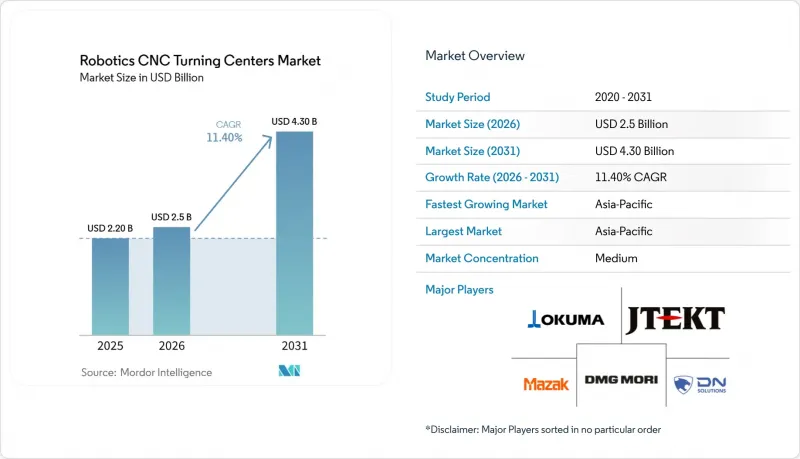
본 보고서는 기계 유형별(수평형 로봇 터닝 센터 등), 로봇 유형별(다관절 로봇 등), 로봇 통합 유형별(OEM 통합형 로봇 선반 셀 등), 최종 사용자 산업별(석유 및 가스·에너지 등), 지역별(북미, 남미 등)로 분류되어 있습니다. 시장 전망은 금액(달러) 및 수량(대)으로 제시되어 있습니다.
세계의 로봇 CNC 터닝 센터 시장 동향 및 인사이트
인건비 급등과 숙련된 작업자 부족이 로봇을 활용한 가공 지원 도입을 가속화하고 있습니다.
제조업 분야의 인건비 압박이 커지고 있는 것이 로봇 CNC 터닝 센터 시장을 견인하는 가장 명확한 요인 중 하나입니다. 미국 노동통계청(BLS)의 데이터에 따르면, 2025년에는 조사 대상인 NAICS(북미 산업 분류) 3자리 제조업 20개 업종 모두에서 제조업의 단위 노동 비용이 상승하여 평균 4.5% 증가했습니다. CNC 선반 현장에서 이러한 비용 동향은 중요한 의미를 지닙니다. 생산 일정이 점점 더 타이트해지는 가운데, 숙련된 기술을 요하는 셋업, 공작물 적재 및 작업 감시와 같은 업무를 확대하는 것은 여전히 어렵기 때문입니다. 또한, 자동화로 인해 인력이 감독, 프로그래밍, 공정 제어 쪽으로 전환되고, 남은 수작업의 역할이 더욱 전문화되면서 인력 확보가 어려워짐에 따라, 로봇 기반 CNC 터닝 센터 시장도 탄력을 받고 있습니다. 국제로봇연맹(IFR)은 노동력 부족 완화를 2025년 세계 로봇 기술의 주요 동향 중 하나로 꼽고 있으며, 이는 로봇을 통한 공정 관리가 단순한 선택적 업그레이드가 아닌 표준적인 생산 능력 대응책으로 자리 잡고 있다는 관점을 뒷받침합니다.
라이트아웃 및 무인 교대 생산의 확대
로봇 CNC 터닝 센터 시장은 선반 셀에서의 ‘라이트아웃 생산’ 보급에 의해서도 견인되고 있습니다. 과거에는 항공우주나 자동차 분야의 대규모 공장에 한정되었던 자동화가, 현재는 2교대 근무나 주말, 공휴일 기간 중에도 기계를 계속 가동하는 것을 목표로 하는 중규모 수탁 가공 공장으로 확대되고 있습니다. NIST는 2025년, 운영 기술 조사를 위한 개량형 로봇 워크셀에 관한 연구 성과를 발표하며, 무인 이산 제조가 공장 수준의 제한적인 실험에 그치지 않고 본격적인 조사 및 표준화 작업 단계로 접어들었음을 보여주었습니다. 실제 문제는 더 이상 무인 선반 가공이 가능한지가 아니라, 지그, 그리퍼, 재현성 있는 공작물 고정 장치가 수동 재설정 없이 안정적인 로트 전환을 지원할 수 있는지에 있습니다. 로봇 CNC 터닝 센터 시장에서 이 문제를 해결한 공장은 더 많은 가동 시간에 자본을 분산할 수 있지만, 해결하지 못한 공장은 가동률 향상이라는 혜택을 충분히 누리지 못한 채 자동화 비용을 계속 부담하게 될 것입니다.
통합형 로봇 셀에는 막대한 초기 투자가 필요
높은 초기 비용은 로봇 CNC 터닝 센터 시장의 보급 확대에 있어 여전히 가장 뚜렷한 장벽으로 남아 있습니다. 완전한 로봇 셀에는 선반 본체, 로봇, 암 끝단 공구, 안전 시스템, 소프트웨어 및 설치 작업이 포함되므로, 투자의 수익성은 높은 기계 가동률과 안정적인 수주량에 달려 있습니다. 소규모 수탁 제조업체는 시운전이 예상보다 길어지거나 부품 계열의 변경이 예상보다 빠르게 이루어질 경우 투자 회수 기간이 길어질 가능성이 있어 도입을 주저하는 경우가 많습니다. 이는 생산량이 불규칙한 로트별로 전용 자동화의 경제성을 입증해야 하는 혼합 생산 환경에서는 더욱 어려워집니다. 리스나 서비스 기반 자동화와 같은 새로운 자금 조달 모델은 향후 도움이 될 가능성이 있지만, 전 세계 선반 사용자의 대부분을 차지하는 중소기업 사이에서는 여전히 보급 범위가 제한적입니다.
부문 분석
2025년, 수평형 로봇 터닝 센터는 세계 시장의 52.41%를 차지하며, 로봇 CNC 터닝 센터 시장에서 가장 큰 기계 유형이 되었습니다. 이러한 우위는 실용적인 이점에서 비롯됩니다. 즉, 수평 레이아웃은 바 피더, 로봇 로더, 자동 공구 교환, 그리고 안정적인 무인 사이클을 지원하는 모듈식 보관 시스템과 호환성이 뛰어납니다. 수직형 선반은 로봇을 이용한 로딩 시, 중력이 공작물의 고정, 척킹의 일관성 및 지그의 안정성에 기여하는 대구경·중량물 가공 분야에서 계속해서 활용되고 있습니다. 멀티태스크형 로봇 시장은 2026년부터 2031년까지 연평균 성장률(CAGR) 17.1%를 나타낼 것으로 예측되며, 로봇 CNC 터닝 센터 시장에서 가장 빠르게 성장하는 기계 유형이 될 전망입니다.
이러한 성장은 공장이 자동화를 통해 얻는 가치를 평가하는 방식에 있어 더 광범위한 변화를 반영하고 있습니다. 구매자들은 현재 멀티태스크형 로봇 셀과, 여러 대의 기계, 추가 작업자, 여분의 바닥 면적, 그리고 공정 간 부품 이동으로 인해 발생하는 재공품 재고의 총 비용을 비교 검토하고 있습니다. 항공우주 및 의료기기 생산의 경우, 부품이 단일 제어 셀 내에 머무름으로써 형상 관계를 유지하기 쉬워지기 때문에 이러한 비교에서 단일 셋업 가공이 유리한 경우가 많습니다. 2025년 9월 DMG MORI가 발표한 3세대 NTX는 기계 제조업체가 초기 단계부터 자동화와의 호환성을 반영하여 밀-턴 플랫폼을 어떻게 설계하고 있는지를 보여주었습니다. 이러한 제품 전략은 시운전 부담을 줄이고, 과거 복잡한 다기능 셀에 수반되던 단점을 완화함으로써 로봇 CNC 터닝 센터 시장을 뒷받침하고 있습니다.
2025년, 로봇 CNC 터닝 센터 시장에서 관절형 로봇은 54.62%의 점유율을 차지하며 로봇 유형 중 1위를 유지했습니다. 이러한 위상은 가동 범위, 적재 중량, 사이클 속도, 그리고 단일 셀에서 여러 스핀들 및 가공 지점을 처리할 수 있는 능력 등 명확한 운영상의 강점을 반영합니다. 또한, 동일한 작업 범위 내에서 디버링, 마킹 또는 측정을 추가할 수 있는 대량 생산 환경에도 적합합니다. 갠트리형 및 데카르트형 로봇은 구조적 강성을 갖추고 있으며, 높은 적재 하중 작업에 적합한 단순명료한 동작을 실현하기 때문에 대형 부품의 선삭 가공에서 여전히 가치를 지니고 있습니다.
협동 로봇은 2026년부터 2031년까지 연평균 성장률(CAGR) 18%를 나타낼 것으로 예측되며, 로봇 CNC 터닝 센터 시장에서 가장 빠르게 성장하는 부문이 될 것입니다. IFR 보고서에 따르면, 2024년 협동 로봇 도입 대수는 12% 증가한 6만 4,500대에 달했으며, 전 세계 산업용 로봇 도입 대수에서 차지하는 점유율은 12%로, 2020년 대비 2배 이상 확대되었습니다. 이러한 증가는 다품종 소량 생산을 수행하는 수주 가공 업체에서 특히 중요합니다. 이러한 현장에서는 생산 로트가 작고 설비 전환이 빈번하게 이루어지기 때문에 최고 속도보다는 간단한 프로그래밍과 컴팩트한 설치가 더 중요시되기 때문입니다. 또한, ISO 10218-2 : 2025는 적절한 위험 평가가 이루어진 환경에서의 협동 로봇 도입 확대를 뒷받침하고 있으며, 처음으로 자동화를 도입하는 기업이 더 낮은 도입 장벽으로 로봇 CNC 터닝 센터 시장에 진입할 수 있도록 지원하고 있습니다.
지역별 분석
아시아태평양은 2025년에 로봇 CNC 터닝 센터 시장의 45.21% 점유율을 차지했으며, 2031년까지 연평균 성장률(CAGR) 14.9%를 기록하며 가장 빠르게 성장하는 지역 부문으로 자리매김할 것으로 전망됩니다. 이 지역은 중국, 일본, 한국, 인도에 걸쳐 있는 자동차, 전자, 정밀 공학 제조 클러스터가 밀집해 있다는 이점을 누리고 있습니다. 중국은 2024년에 29만 5,000대의 산업용 로봇 도입 대수를 기록하며, 단일 국가로는 사상 최대의 연간 총 도입 대수를 달성했습니다. 일본은 2024년에 4만 4,500대의 산업용 로봇 도입을 기록하며 로봇 밀도 면에서도 계속해서 1위를 유지했으며, 이는 무인 생산에서 로봇 선반 셀의 활용 확대를 뒷받침하고 있습니다. 인도는 2024년에 사상 최고치인 9,100대의 로봇 도입을 달성한 반면, 한국과 인도네시아, 베트남, 태국, 말레이시아 등 동남아시아 시장에서는 전자 및 자동차 하위 조립 제조 분야에서 계속해서 견조한 수요가 나타나고 있습니다.
유럽 및 북미는 로봇 CNC 터닝 센터 시장에서 여전히 기술 집약적인 지역이며, 수요는 풍부한 소프트웨어 기능을 갖추고 유연성이 높으며 안전 인증을 획득한 선반 셀에 집중되고 있습니다. 2024년, 독일은 2만 6,982대의 도입 대수를 기록하며 유럽 최대의 산업용 로봇 시장이 되었습니다. 이는 금형 제조, 자동차 1차 공급업체 및 정밀 기계 가공 분야에서 로봇 CNC 선반 도입을 뒷받침하고 있습니다. 독일의 공작기계 수주액은 2025년 4분기에 분기 기준 처음으로 회복 조짐을 보이며, 장기간 지속된 내수 부진을 딛고 전년 동기 대비 4% 증가했습니다. 북미에서는 ‘CHIPS for America’ 프로그램과 첨단 제조 장려책, 나아가 국내 정밀 가공 능력 확충이 필요한 방위 산업 확대 정책의 혜택을 지속적으로 누리고 있습니다. '리쇼어링 이니셔티브'에 따르면, 2024년에는 리쇼어링 및 외국인 직접 투자를 통해 미국에서 24만 4,000개의 제조업 일자리가 창출될 것으로 발표되었으며, 이는 새로운 선반 생산 능력 확충과 자동화율 향상의 필요성을 뒷받침합니다.
남미는 자동차 산업의 니어쇼어링, 상품 가격에 연동된 정밀 가공 수요, 그리고 산업 현대화 노력에 힘입어 로봇 CNC 터닝 센터 시장에서 여전히 신흥 기회로 부상하고 있습니다. 브라질은 이 지역 최대의 제조 거점으로서 수요의 중심을 담당하고 있으며, 자동차 조립이 로봇 선반 셀에 대한 당면 수요의 상당 부분을 주도하고 있습니다. 중동 및 아프리카 시장은 여전히 규모가 작지만, 사우디아라비아와 아랍에미리트의 산업 전략에 힘입어 국내 정밀 제조 역량에 대한 관심이 높아지고 있습니다. 남아프리카는 자동차 조립 및 광산기계 기반을 통해 수요를 뒷받침하고 있으며, 국방 및 에너지 분야에 대한 투자 계획이 예측 기간 동안 해당 지역의 도입을 촉진할 것으로 예측됩니다.
기타 혜택 :
- 엑셀 형식 시장 예측(ME) 시트
- 3개월간의 애널리스트 지원
자주 묻는 질문
목차
제1장 서론
제2장 조사 방법
제3장 주요 요약
제4장 시장 구도
제5장 시장 규모 및 성장 예측
제6장 경쟁 구도
제7장 시장 기회 및 향후 전망
KTH 26.08.10According to Mordor Intelligence, the robotics CNC turning centers market size is expected to grow from USD 2.20 billion in 2025 to USD 2.5 billion in 2026 and is forecast to reach USD 4.30 billion by 2031 at 11.40% CAGR over 2026-2031.
This report is Segmented by Machine Type (Horizontal Robotic Turning Centers, and More), by Robot Type (Articulated Robots, and More), by Robot Integration Type (OEM-Integrated Robotic Turning Cells, and More), by End-User Industry (Oil, Gas, and Energy, and More), and by Geography (North America, South America, and More). The Market Forecasts are Provided in Terms of Value (USD) and Volume (Units).
Global Robotics CNC Turning Centers Market Trends and Insights
Rising Labor Costs and Skilled-Operator Shortage Accelerating Robotic Tending Adoption
Manufacturing labor cost pressure has become one of the clearest supports for the robotics CNC turning centers market. United States Bureau of Labor Statistics data showed that manufacturing unit labor costs rose across all 20 covered three-digit NAICS manufacturing industries in 2025, with an average increase of 4.5%. In CNC turning environments, that cost trend matters because skilled setup, loading, and tending work remains hard to scale when output schedules tighten. The robotics CNC turning centers market also gains momentum as automation shifts labor toward supervision, programming, and process control, making the remaining manual roles more specialized and harder to fill. The International Federation of Robotics identified labor shortage mitigation as one of the top global robotics trends for 2025, which supports the view that robotic tending is becoming a standard capacity response rather than a discretionary upgrade
Growth of Lights-Out and Unmanned Shift Manufacturing
The robotics CNC turning centers market is also being driven by the wider use of lights-out production in turning cells. Automation, once limited to large aerospace and automotive plants, is now expanding into mid-sized job shops that aim to keep machines running through second shifts, weekends, and holiday periods. NIST published work in 2025 on an improved robotic workcell for operational technology research, demonstrating that unmanned discrete manufacturing has moved into active research and standards work rather than remaining a narrow plant-level experiment. The practical issue is no longer whether unattended turning is possible, but whether fixturing, grippers, and repeatable workholding can support stable batch changes without manual resets. In the robotics CNC turning centers market, plants that solve that problem can spread capital over more machine hours, while those that do not still bear the cost of automation without capturing full utilization gains.
High Upfront Capital Investment for Integrated Robotic Cells
High initial spending remains the clearest limit on wider adoption in the robotics CNC turning centers market. A full robotic cell includes the turning center, the robot, end-of-arm tooling, safety systems, software, and installation work, so the investment case depends on high machine utilization and stable order flow. Smaller contract manufacturers often hesitate because the payback can stretch when commissioning takes longer than expected or when part families shift faster than expected. This becomes even harder in mixed-production environments, where dedicated automation has to justify itself across batches with uneven volumes. New financing models such as leasing and service-based automation may help over time, but they still have limited reach among the smaller firms that make up much of the global turning base.
Other drivers and restraints analyzed in the detailed report include:
- Growing Complexity of Precision Components Driving Adoption of Robotic CNC Turning Cells
- Ramp-up of Next-Generation Aerospace Production Programs
- Lack of Standardized Robot-CNC Controller Interfaces
For complete list of drivers and restraints, kindly check the Table Of Contents.
Segment Analysis
Horizontal robotic turning centers held 52.41% of the global market in 2025, making them the largest machine format in the robotics CNC turning centers market. Their lead stems from a practical advantage: horizontal layouts work well with bar feeders, robot loaders, automatic tool changes, and modular storage systems that support steady, unattended cycles. Vertical turning centers continue to serve large-diameter and heavy-part work where gravity helps with seating, chucking consistency, and fixture stability during robotic loading. Multi-tasking robotic turning centers are projected to grow at a 17.1% CAGR from 2026 to 2031, making them the fastest-growing machine type in the robotics CNC turning centers market.
That growth reflects a broader change in how plants measure value from automation. Buyers are now comparing a multi-tasking robotic cell to the combined costs of several machines, more operators, extra floor space, and the work-in-progress inventory created by moving parts between steps. In aerospace and medical production, that comparison often favors single-setup machining because feature relationships are easier to protect when the part remains in a single controlled cell. DMG MORI's NTX 3rd Generation launch in September 2025 demonstrated how machine builders are designing mill-turn platforms with built-in automation compatibility from the start. That product direction supports the robotics CNC turning centers market by lowering commissioning effort and reducing the penalty that used to come with complex multi-function cells.
Articulated robots accounted for 54.62% of the robotics CNC turning centers market in 2025, which kept them in the lead among robot formats. Their position reflects clear operational strengths in reach, payload, cycle speed, and the ability to serve multiple spindles or process points from a single cell. They also fit high-volume environments where deburring, marking, or gauging can be added inside the same work envelope. Gantry and Cartesian robots still hold value in large-part turning because they offer structural stiffness and straightforward motion for heavy payload work.
Collaborative robots are forecast to grow at a 18% CAGR from 2026 to 2031, making them the fastest-growing segment of the robotics CNC turning centers market. IFR reported that cobot installations rose 12% in 2024 to 64,500 units, while their share of global industrial robot installations reached 12% and more than doubled from 2020. That increase matters most in high-mix job shops, where shorter runs and more frequent changeovers make simple programming and compact deployment more valuable than peak speed. ISO 10218-2:2025 also supports the wider use of collaborative setups under properly risk-assessed configurations, helping first-time automation buyers approach the robotics CNC turning centers market with a lower integration barrier.
Complete Report Scope:
- By Machine Type
- Horizontal Robotic Turning Centers
- Vertical Robotic Turning Centers
- Multi-Tasking Robotic Turning Centers
- Others
- By Robot Type
- Articulated Robots
- Collaborative Robots (Cobots)
- Gantry/Cartesian Robots
- By Robot Integration Type
- OEM-Integrated Robotic Turning Cells
- Retrofit/Aftermarket Robotic Automation
- By End-User Industry
- Automotive and Commercial Vehicles
- Aerospace & Defense
- Medical Devices and Surgical Instruments
- Oil, Gas, and Energy
- Electrical, Electronics and Semiconductor Equipment
- General Industrial Machinery
- Others
- By Geography
- North America
- United States
- Canada
- Mexico
- South America
- Brazil
- Argentina
- Chile
- Peru
- Rest of South America
- Europe
- Germany
- United Kingdom
- France
- Italy
- Spain
- Benelux (Belgium, Netherlands, and Luxembourg)
- NORDICS (Denmark, Finland, Iceland, Norway, and Sweden)
- Rest of Europe
- Asia-Pacific
- China
- India
- Japan
- South Korea
- Australia
- Southeast Asia (Indonesia, Vietnam, Thailand, Malaysia, Philippines)
- Rest of Asia-Pacific
- Middle East & Africa
- United Arab Emirates
- Saudi Arabia
- South Africa
- Nigeria
- Rest of Middle East & Africa
- North America
Geography Analysis
Asia Pacific held 45.21% of the robotics CNC turning centers market share in 2025 and is expected to remain the fastest-growing regional segment with a CAGR 14.9% through 2031. The region benefits from dense automotive, electronics, and precision engineering manufacturing clusters across China, Japan, South Korea, and India. China led global industrial robot installations in 2024 with 295,000 units, the highest annual total ever recorded for a single country. Japan recorded 44,500 industrial robot installations in 2024 and continued to lead in robot density, which supports wider use of robotic turning cells in lights-out production. India reached a record 9,100 robot installations in 2024, while South Korea and Southeast Asian markets such as Indonesia, Vietnam, Thailand, and Malaysia continue to see strong demand in electronics and automotive sub-assembly manufacturing.
Europe and North America remain technology-intensive regions in the robotics CNC turning centers market, with demand centered on software-rich, flexible, and safety-certified turning cells. Germany was the largest European market for industrial robots in 2024, with 26,982 installations, supporting robotic CNC turning adoption across toolmaking, automotive Tier 1 suppliers, and precision engineering applications. German machine tool order intake showed its first quarterly recovery signal in Q4 2025, rising 4% year over year after a prolonged period of weak domestic demand. North America continues to benefit from the CHIPS for America program, advanced manufacturing incentives, and defense industrial expansion policies that require greater domestic precision machining capacity. The Reshoring Initiative documented 244,000 United States manufacturing job announcements through reshoring and foreign direct investment in 2024, reinforcing the case for new turning capacity and higher automation intensity.
South America remains an emerging opportunity in the robotics CNC turning centers market, supported by automotive nearshoring, commodity-linked precision machining demand, and industrial modernization efforts. Brazil anchors regional demand as the largest manufacturing base, with automotive assembly driving much of the immediate need for robotic turning cells. The Middle East and Africa market remains smaller, but industrial strategies in Saudi Arabia and the United Arab Emirates are widening interest in domestic precision manufacturing capacity. South Africa adds support through its automotive assembly and mining equipment base, and planned investments in defense, and energy are expected to lift regional adoption through the forecast period.
- Yamazaki Mazak Corporation
- DMG MORI Co., Ltd.
- Okuma Corporation
- DN Solutions Co., Ltd.
- JTEKT Corporation
- Hyundai WIA Corporation
- Citizen Machinery Co., Ltd.
- INDEX-Werke GmbH & Co. KG
- EMAG GmbH & Co. KG
- Hwacheon Machinery Co., Ltd.
- Haas Automation, Inc.
- Hardinge Inc.
- Nakamura-Tome Precision Industry Co., Ltd.
- Tsugami Corporation
- SMEC Co., Ltd.
- Nidec Machine Tool Corporation
- Takisawa Machine Tool Co., Ltd.
- Goodway Machine Corporation
- Tongtai Machine & Tool Co., Ltd.
- KUKA Robotics
Additional Benefits:
- The market estimate (ME) sheet in Excel format
- 3 months of analyst support
TABLE OF CONTENTS
1 Introduction
- 1.1 Study Assumptions & Market Definition
- 1.2 Scope of the Study
2 Research Methodology
3 Executive Summary
4 Market Landscape
- 4.1 Market Overview
- 4.2 Market Drivers
- 4.2.1 Rising Labor Costs and Skilled-Operator Shortage Accelerating Robotic Tending Adoption
- 4.2.2 Growth of Lights-Out and Unmanned Shift Manufacturing
- 4.2.3 Growing Complexity of Precision Components Driving Adoption of Robotic CNC Turning Cells
- 4.2.4 Ramp-up of Next-Generation Aerospace Production Programs
- 4.2.5 Declining Cost and Improved Accessibility of Collaborative Robots
- 4.2.6 Government-backed Reshoring and Industrial Modernization Incentives
- 4.3 Market Restraints
- 4.3.1 High upfront capital investment for integrated robotic cells
- 4.3.2 Lack of standardized robot-CNC controller interfaces
- 4.3.3 Cybersecurity exposure of networked robotic-CNC systems
- 4.3.4 Safety certification and regulatory compliance complexity
- 4.4 Value / Supply-Chain Analysis
- 4.4.1 Component & Raw Material Supply
- 4.4.2 Manufacturing & System Integration
- 4.4.3 Distribution & End-User Delivery
- 4.4.4 Aftermarket Services & Lifecycle Support
- 4.5 Regulatory Landscape
- 4.6 Technological Outlook
- 4.6.1 AI-Enabled Vision Guidance
- 4.6.2 Predictive Maintenance Integration
- 4.6.3 Digital Twin and Simulation Technologies
- 4.7 Automation Maturity Assessment by Industry
- 4.8 Digitalization Trends in CNC Machining
- 4.9 Investment and Procurement Models for Robotic CNC Turning Cells
- 4.10 Pricing Analysis
- 4.10.1 Average Selling Price (ASP) Benchmarking of Key Market Participants
- 4.10.2 Average Selling Price (ASP) Benchmarking by Automation Level
- 4.10.3 Average Selling Price (ASP) Benchmarking by Geography
- 4.11 Porter's Five Forces - Industry Attractiveness Scoring
- 4.11.1 Threat of New Entrants
- 4.11.2 Bargaining Power of Suppliers
- 4.11.3 Bargaining Power of Buyers
- 4.11.4 Threat of Substitutes
- 4.11.5 Industry Rivalry
- 4.12 Industry Case Studies
- 4.13 Impact of Geopolitical events on the Market
5 Market Size & Growth Forecasts
- 5.1 By Machine Type
- 5.1.1 Horizontal Robotic Turning Centers
- 5.1.2 Vertical Robotic Turning Centers
- 5.1.3 Multi-Tasking Robotic Turning Centers
- 5.1.4 Others
- 5.2 By Robot Type
- 5.2.1 Articulated Robots
- 5.2.2 Collaborative Robots (Cobots)
- 5.2.3 Gantry/Cartesian Robots
- 5.3 By Robot Integration Type
- 5.3.1 OEM-Integrated Robotic Turning Cells
- 5.3.2 Retrofit/Aftermarket Robotic Automation
- 5.4 By End-User Industry
- 5.4.1 Automotive and Commercial Vehicles
- 5.4.2 Aerospace & Defense
- 5.4.3 Medical Devices and Surgical Instruments
- 5.4.4 Oil, Gas, and Energy
- 5.4.5 Electrical, Electronics and Semiconductor Equipment
- 5.4.6 General Industrial Machinery
- 5.4.7 Others
- 5.5 By Geography
- 5.5.1 North America
- 5.5.1.1 United States
- 5.5.1.2 Canada
- 5.5.1.3 Mexico
- 5.5.2 South America
- 5.5.2.1 Brazil
- 5.5.2.2 Argentina
- 5.5.2.3 Chile
- 5.5.2.4 Peru
- 5.5.2.5 Rest of South America
- 5.5.3 Europe
- 5.5.3.1 Germany
- 5.5.3.2 United Kingdom
- 5.5.3.3 France
- 5.5.3.4 Italy
- 5.5.3.5 Spain
- 5.5.3.6 Benelux (Belgium, Netherlands, and Luxembourg)
- 5.5.3.7 NORDICS (Denmark, Finland, Iceland, Norway, and Sweden)
- 5.5.3.8 Rest of Europe
- 5.5.4 Asia-Pacific
- 5.5.4.1 China
- 5.5.4.2 India
- 5.5.4.3 Japan
- 5.5.4.4 South Korea
- 5.5.4.5 Australia
- 5.5.4.6 Southeast Asia (Indonesia, Vietnam, Thailand, Malaysia, Philippines)
- 5.5.4.7 Rest of Asia-Pacific
- 5.5.5 Middle East & Africa
- 5.5.5.1 United Arab Emirates
- 5.5.5.2 Saudi Arabia
- 5.5.5.3 South Africa
- 5.5.5.4 Nigeria
- 5.5.5.5 Rest of Middle East & Africa
- 5.5.1 North America
6 Competitive Landscape
- 6.1 Market Concentration
- 6.2 Strategic Moves
- 6.3 Market Share Analysis
- 6.4 Competitive Benchmarking Analysis
- 6.5 Company Profiles (Includes Global Level Overview, Market Level Overview, Core Segments, Financials as Available, Strategic Information, Products & Services, and Recent Developments)
- 6.5.1 Yamazaki Mazak Corporation
- 6.5.2 DMG MORI Co., Ltd.
- 6.5.3 Okuma Corporation
- 6.5.4 DN Solutions Co., Ltd.
- 6.5.5 JTEKT Corporation
- 6.5.6 Hyundai WIA Corporation
- 6.5.7 Citizen Machinery Co., Ltd.
- 6.5.8 INDEX-Werke GmbH & Co. KG
- 6.5.9 EMAG GmbH & Co. KG
- 6.5.10 Hwacheon Machinery Co., Ltd.
- 6.5.11 Haas Automation, Inc.
- 6.5.12 Hardinge Inc.
- 6.5.13 Nakamura-Tome Precision Industry Co., Ltd.
- 6.5.14 Tsugami Corporation
- 6.5.15 SMEC Co., Ltd.
- 6.5.16 Nidec Machine Tool Corporation
- 6.5.17 Takisawa Machine Tool Co., Ltd.
- 6.5.18 Goodway Machine Corporation
- 6.5.19 Tongtai Machine & Tool Co., Ltd.
- 6.5.20 KUKA Robotics
7 Market Opportunities & Future Outlook
- 7.1 White-Space & Unmet-Need Assessment


