

|
시장보고서
상품코드
2099815
미국의 고정 무선 액세스 시장 : 시장 점유율 분석, 업계 동향 및 통계, 성장 예측(2026-2031년)United States Fixed Wireless Access - Market Share Analysis, Industry Trends & Statistics, Growth Forecasts (2026 - 2031) |
||||||
 Mordor Intelligence
Mordor Intelligence에 의하면, 미국의 고정 무선 액세스 시장 규모는 2025년 105억 6,000만 달러로 평가되었고, 2026년 122억 3,000만 달러에서 2031년까지 239억 4,000만 달러로 확대될 것으로 예측되며, 2026-2031년 CAGR 14.38%를 기록할 전망입니다.
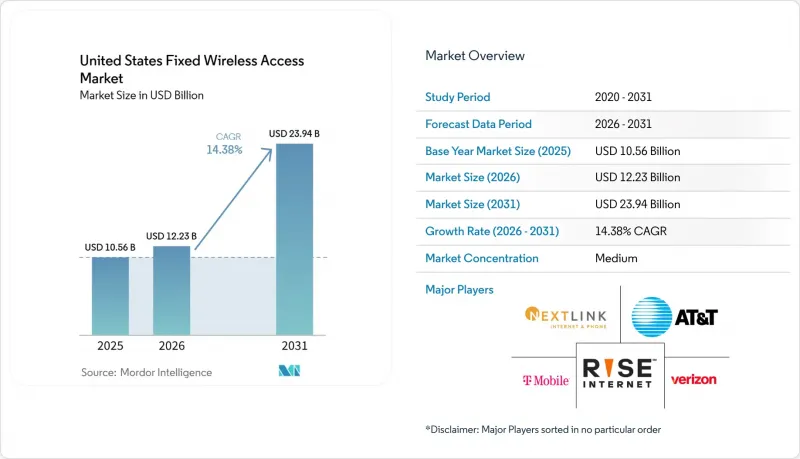
본 보고서는 유형별(하드웨어 및 서비스), 용도별(주거, 상업, 산업, 정부 및 공공 안전), 주파수 대역별(6GHz 미만, mm파(24GHz 이상), 비면허·공유 CBRS), 도입 형태별(실내용 CPE, 실외용 CPE, 자가 설치형 창문 장착 CPE)로 분류되어 있습니다. 시장 예측은 금액(달러)으로 표시되어 있습니다.
미국의 고정 무선 액세스 시장 동향 및 인사이트
5G의 확산에 따라 기가비트급 고정 무선 액세스가 확대되고 있습니다.
미국의 고정 무선 액세스 시장은 기존의 LTE 기반 서비스로는 실현할 수 없었던, 더욱 강력한 5G 성능 기반의 혜택을 누리고 있습니다. C-밴드(3.45GHz) 및 CBRS 중파 대역 주파수 대역을 통해 가정용 광대역 서비스 제공 범위가 확대되었으며, 일반적인 광대역 이용에 충분한 통신 속도가 실현되고 있습니다. 3대 주요 통신사는 2026년 1분기에 FWA 순 가입자 수를 100만 건 가까이 늘리며, 이 부문이 미국 광대역 성장의 대부분을 차지한다는 지난 몇 분기간의 추세를 이어갔습니다. 이러한 추세가 중요한 이유는 5G 커버리지 확대가 단순한 기술적 네트워크의 전환점에 그치지 않고, 이제 대규모 가입자 증가로 이어지고 있음을 보여주기 때문입니다. 또한, 5G 기반 서비스 계층은 기존 FWA 서비스보다 더 까다로운 트래픽 프로파일을 처리할 수 있기 때문에 미국의 고정 무선 액세스 시장은 부가가치가 더 높은 비즈니스 이용 사례로 전환되고 있습니다. 이로 인해 예측 기간 동안 네트워크 구축, 주파수 대역 재이용 및 서비스 차별화가 밀접하게 연계된 상태가 유지될 것입니다.
지방 광대역 자금 지원이 신속한 구축의 근거를 강화하고 있습니다.
미국의 고정 무선 액세스 시장은 농촌 지역 광대역 자금의 혜택을 받고 있습니다. 이는 무선 네트워크가 굴착 작업이 많이 필요한 유선 프로젝트보다 신속하게 구축될 수 있기 때문입니다. 이러한 속도는 서비스 격차가 여전히 크고, 가구가 장기간의 건설 기간을 기다릴 수 없는 인구 밀도가 낮은 지역에서 중요합니다. 그 매력은 지역적 조건이나 낮은 인구 밀도로 인해 유선망 확장이 지연되기 쉬운 중서부, 남부 및 산악 서부 지역에서 가장 두드러집니다. 이러한 자금 지원은 이미 통신탑 접근권 및 지역 커버리지에 대한 지식을 보유하고 있으며, 대규모 유선망 구축에 비해 서비스 개시까지의 기간이 짧은 지역 사업자들을 뒷받침하고 있습니다. 이러한 사업자들이 승인된 프로젝트를 실제 서비스 제공으로 전환함에 따라, 미국의 고정 무선 접속 시장에서는 농촌 지역 시장 진입이 계속해서 활발해질 것으로 예측됩니다. 따라서 자금 지원은 단기적인 수요 촉진책인 동시에 시장 진입 수단으로도 기능하게 될 것입니다.
중파 대역의 주파수 대역 제한이 이용량이 많은 회랑을 제약하고 있습니다.
미국의 고정 무선 접속(FWA) 시장은 이용 밀도가 높은 회랑에서 실질적인 상한선에 직면해 있습니다. 이는 FWA의 트래픽 부하가 일반적인 스마트폰 트래픽보다 훨씬 크기 때문입니다. 많은 가정용 광대역 사용자가 공유 셀룰러 인프라에 합류하면, 모바일 전용 성장 시나리오에 비해 혼잡 위험이 급격히 높아집니다. 이 때문에 일부 교외나 도시의 일부 지역에서는 주소 단위의 이용 적격성이 단순한 커버리지 문제가 아니라 네트워크 관리상의 과제가 되고 있습니다. 이 제약은 5G 커버리지가 이미 구축된 지역에서도 가입자 수 증가세가 둔화될 가능성이 있기 때문에 특히 중요합니다. 미국의 고정 무선 액세스 시장은 추가 주파수 대역이 할당될 뿐만 아니라, 운영 중인 네트워크에 완전히 도입될 때까지 이 문제에 계속 직면할 것입니다. 따라서 본래라면 견조한 수요를 억제하는 가장 명확한 단기적 제약 중 하나로 용량 계획을 꼽을 수 있습니다.
부문 분석
2025년, 미국의 고정 무선 액세스 시장에서 하드웨어는 62.12%의 점유율을 차지했습니다. 이는 통신 사업자들이 고객용 게이트웨이 및 액세스 유닛을 업그레이드하는 과정에서 5G CPE 도입이 광범위하게 이루어진 데 기인합니다. 이 부문은 여전히 주거용 시장의 확장에 따른 수량 효과를 반영하고 있습니다. 신규 가입자의 연결에는 단말기가 필요하며, 대부분의 경우 관련 액세스 인프라도 필요하기 때문입니다. 각 벤더가 실내 수신 성능 향상, 창가 설치, 업링크 성능 강화를 추진함에 따라 장비 설계는 지속적으로 개선되고 있습니다. Vantiva는 2026년 3월, Power Class 1.0을 지원하고 창가에 설치 가능한 폼 팩터를 갖추며, 중대역 효율 향상과 이용 가능한 셀 범위 확대를 목표로 하는 3세대 실내 안테나 시스템을 탑재한 ‘Hawk 5G FWA’ 홈 게이트웨이를 발표했습니다.
미국의 고정 무선 액세스(FWA) 서비스 시장 규모는 통신 사업자들이 매니지드 커넥티비티 및 엔터프라이즈급 패키지로 전환함에 따라 2026-2031년 연평균 성장률(CAGR) 15.55%로 확대될 것으로 예측되며, 이는 하드웨어 시장의 성장률을 상회하는 수치입니다. 이러한 추세가 중요하게 여겨지는 이유는 도입 대수가 이미 충분히 증가했으며, 지원, 오케스트레이션 및 계약 기반 서비스 계층이 가치 풀에서 더 큰 비중을 차지하게 되었기 때문입니다. 이러한 움직임은 디바이스의 경제성이 성숙해지는 한편, 소프트웨어, 라이프사이클 지원 및 성능 보증의 중요성이 높아지는 통신 업계 전반의 추세와도 부합합니다. T-Mobile US는 2026년, 액세스용 하드웨어에만 국한된 경쟁을 넘어 5G와 위성 연결을 통합한 관리형 비즈니스 솔루션을 제공함으로써 이러한 방향성을 더욱 강화했습니다. 미국 고정 무선 액세스 업계에서 이러한 변화는 장기적인 수익성이 단순히 출하 대수에만 의존하는 것이 아니라, 공급자가 서비스 품질, 오케스트레이션 및 내결함성을 얼마나 효과적으로 묶어 제공할 수 있는지에 크게 좌우된다는 점을 시사합니다.
2025년, 미국 고정 무선 접속 시장에서 주거용 부문이 65.33%를 차지했으며, 현재 수익의 주요 원동력이 되고 있습니다. 이 부문을 주도한 것은 케이블이나 DSL을 대체할 실용적인 대안으로서, 더 빠른 서비스 개통과 저렴한월이용료를 원하는 교외 및 반농촌 지역 가구들이었습니다. 이러한 기반을 통해 통신 사업자들은 라스트 마일 인프라 구축을 기다리지 않고 가입자를 늘릴 수 있었기 때문에 미국의 고정 무선 액세스 시장은 급속히 확대되었습니다. 또한, 이를 통해 광범위한 도입 기반이 형성되었으며, 이후 고성능 단말기, 실내 커버리지 강화, 그리고 고부가가치 요금제로의 업셀링을 뒷받침하게 되었습니다.
정부 및 공공 안전 분야는 2031년까지 연평균 성장률(CAGR) 14.88%로 확대될 것으로 예측되며, 이는 미국 고정 무선 액세스 시장의 용도 부문 중 가장 높은 성장률입니다. 이 시장 부문은 긴급 대응 요원의 통신, 시설의 연결 수요, 그리고 신속한 구축과 서비스 연속성을 중시하는 공공 네트워크의 내결함성 요건에 의해 뒷받침되고 있습니다. 또한 산업용 분야도 확대되고 있습니다. 이는 현장 기반 사업자들이 신속한 커버리지와 통제된 도입이 중요한 물류, 유틸리티 및 운영 환경에서 무선 연결을 활용하고 있기 때문입니다. 중소기업 및 여러 거점을 보유한 사용자들은 설치 시간이 짧고, 장기간의 건설 공사에 의존하지 않고도 서비스를 가동할 수 있다는 점을 중요하게 여기기 때문에 상업 분야 수요도 여전히 중요합니다. 미국 고정 무선 액세스 업계에서 이러한 구성의 변화로 인해, 예측 기간이 끝날 무렵에는 시장이 기존처럼 가정용 수요에만 의존하던 상황이 완화될 전망입니다.
기타 혜택 :
- 엑셀 형식 시장 예측(ME) 시트
- 3개월간의 애널리스트 지원
자주 묻는 질문
목차
제1장 서론
제2장 조사 방법
제3장 주요 요약
제4장 시장 구도
제5장 시장 규모 및 성장 예측
제6장 경쟁 구도
제7장 시장 기회 및 향후 전망
AJY 26.08.07According to Mordor Intelligence, the United States fixed wireless access market size is projected to expand from USD 10.56 billion in 2025 and USD 12.23 billion in 2026 to USD 23.94 billion by 2031, registering a CAGR of 14.38% from 2026 to 2031.
This report is Segmented by Type (Hardware and Services), Application (Residential, Commercial, Industrial, and Government and Public Safety), Frequency Band (Sub-6 GHz, Mmwave (Above 24 GHz), and Unlicensed/Shared CBRS), and Deployment Mode (Indoor CPE, Outdoor CPE, and Self-Install Window-Mount CPE). The Market Forecasts are Provided in Value (USD).
United States Fixed Wireless Access Market Trends and Insights
5G Rollout is Expanding Gigabit-Class Fixed Wireless Access
The United States fixed wireless access market is benefiting from a stronger 5G performance base than earlier LTE-based offerings could deliver. Mid-band spectrum in C-band (3.45 GHz) and CBRS has widened the serviceable footprint for home broadband and supported speeds that meet mainstream broadband use. The three largest carriers added nearly 1 million FWA net connections in the first quarter of 2026, extending a multi-quarter pattern in which this category has captured most U.S. broadband growth. That pace matters because it shows that 5G coverage expansion is now translating into subscriber additions at scale rather than staying as a technical network milestone. The United States fixed wireless access market is also moving into higher-value business use cases, as 5G-based service tiers can support more demanding traffic profiles than earlier FWA offerings. This keeps network rollout, spectrum reuse, and service differentiation tightly linked over the forecast period.
Rural Broadband Funding is Improving the Case for Rapid Deployment
The United States fixed wireless access market has benefited from rural broadband funding because wireless networks can be deployed faster than trench-heavy wired projects. That timing matters in low-density areas where service gaps remain large, and households cannot wait through long construction cycles. The appeal is strongest in the Midwest, the South, and the Mountain West, where geography and lower population density can slow wireline expansion. This funding backdrop also supports regional providers that already have tower access, local coverage knowledge, and lower time-to-service than large-scale wired builds. The United States fixed wireless access market should continue to see stronger rural participation as these operators convert approved projects into live coverage. That makes funding a market access lever as much as a short-term demand stimulus.
Mid-Band Spectrum Limits are Constraining High-Usage Corridors
The United States fixed wireless access market faces a real ceiling in dense usage corridors because FWA traffic loads are far heavier than those of ordinary smartphone traffic. When many home broadband users are added to shared cellular infrastructure, congestion risk rises faster than in mobile-only growth scenarios. This makes address-level eligibility a network management issue rather than a simple coverage issue in some suburban and urban pockets. The constraint is especially important because subscriber growth can slow even in areas where 5G coverage is already available. The United States fixed wireless access market will remain exposed to this issue until additional spectrum is not only assigned but fully deployed in operating networks. That leaves capacity planning as one of the clearest near-term limits on otherwise strong demand.
Other drivers and restraints analyzed in the detailed report include:
- Fixed Wireless Access is Serving as a Fiber Deferral Tool for Cost-Constrained ISPs
- Enterprise Demand for Resilience is Broadening the Revenue Base
- Fiber and Cable Pricing Pressure is Tightening Margins
For complete list of drivers and restraints, kindly check the Table Of Contents.
Segment Analysis
Hardware captured 62.12% of the United States fixed wireless access market share in 2025, supported by widespread 5G CPE deployment as operators upgraded customer gateways and access units. The segment still reflects the volume effect of residential expansion because every new subscriber connection needs a device and, in many cases, related access infrastructure. Equipment design continues to improve as vendors push better indoor reception, near-window placement, and stronger uplink performance. Vantiva introduced its Hawk 5G FWA home gateway in March 2026 with Power Class 1.0 support, a near-window form factor, and a third-generation indoor antenna system aimed at improving mid-band efficiency and extending usable cell reach.
The United States fixed wireless access market size for services is projected to expand at 15.55% CAGR over 2026-2031, ahead of hardware, as carriers shift toward managed connectivity and enterprise-grade packages. This pattern matters because the installed base is now large enough for support, orchestration, and contract-backed service layers to carry a larger share of the value pool. The move also fits a broader telecom pattern in which device economics mature while software, lifecycle support, and performance assurance become more important. T-Mobile US reinforced that direction in 2026 by combining 5G and satellite connectivity into a managed business offer rather than competing only on access hardware. Within the United States fixed wireless access industry, this shift suggests that long-term profitability will depend less on unit shipments alone and more on how effectively providers bundle service quality, orchestration, and resilience.
Residential accounted for 65.33% of the United States fixed wireless access market in 2025, making it the primary driver of current revenue. The segment was led by suburban and semi-rural households seeking a practical alternative to cable and DSL with faster activation and lower monthly pricing. This base enabled the United States fixed wireless access market to scale quickly, as carriers could add subscribers without waiting for last-mile infrastructure. It also created a broad installed base that supported later upselling into improved devices, stronger indoor coverage options, and higher-value plans.
Government and public safety are projected to expand at 14.88% CAGR through 2031, the fastest rate across application segments in the United States fixed wireless access market. This part of the market is supported by first-responder communications, facility connectivity needs, and public network resilience requirements that place emphasis on the speed of deployment and service continuity. Industrial use is also building as site-based operators use wireless connectivity for logistics, utilities, and operational settings where fast coverage and controlled deployment matter. Commercial demand remains important because small businesses and multisite users value short installation times and the ability to activate service without long construction dependencies. Within the United States fixed wireless access industry, this evolving mix should reduce the market's historical dependence on household demand alone by the end of the forecast period.
Complete Report Scope:
- By Type
- Hardware
- Consumer Premise Equipment (CPE)
- Access Units (Femto and Picocells)
- Services
- Hardware
- By Application
- Residential
- Commercial
- Industrial
- Government and Public Safety
- By Frequency Band
- Sub-6 GHz
- mmWave (Above 24 GHz)
- Unlicensed/Shared CBRS
- By Deployment Mode
- Indoor CPE
- Outdoor CPE
- Self-Install Window-Mount CPE
List of Companies Covered in this Report:
- Verizon Communications Inc.
- T-Mobile US, Inc.
- AT&T Inc.
- LTD Broadband
- Rise Broadband, Inc. (Rise Internet)
- Nextlink Internet
- Ericsson AB
- Nokia Corporation
- Samsung Electronics Co., Ltd.
- Qualcomm Technologies, Inc.
- Inseego Corp.
- Airspan Networks Holdings LLC
- Tarana Wireless, Inc.
- Cambium Networks Corporation
- DZS Inc.
- Arcadyan Technology Corporation
- Sercomm Corporation
- Zyxel Communications Corp.
- Adtran Holdings, Inc.
- Mavenir Systems, Inc.
Additional Benefits:
- The market estimate (ME) sheet in Excel format
- 3 months of analyst support
TABLE OF CONTENTS
1 INTRODUCTION
- 1.1 Study Assumptions and Market Definition
- 1.2 Scope of the Study
2 RESEARCH METHODOLOGY
3 EXECUTIVE SUMMARY
4 MARKET LANDSCAPE
- 4.1 Market Overview
- 4.2 Market Drivers
- 4.2.1 5G Roll-Out Accelerating Gigabit-Class Fixed Wireless Access Adoption
- 4.2.2 Rural Broadband Funding Favoring Rapid-Deploy Connectivity
- 4.2.3 Fixed Wireless Access as a Fiber Deferral Strategy for Cost-Constrained Builds
- 4.2.4 Enterprise Network Resilience Demand for Primary and Backup Broadband
- 4.2.5 AI-Optimized CPE and Self-Install to Cut Acquisition and Support Costs
- 4.2.6 Private Spectrum and Mid-Band Capacity Reuse Improving Economics in Dense Submarkets
- 4.3 Market Restraints
- 4.3.1 Mid-Band Spectrum Capacity Limits in High-Usage Markets
- 4.3.2 Fiber and Cable Price Competition Compressing Fixed Wireless Access Yield
- 4.3.3 mmWave Coverage and Line-of-Sight Sensitivity in High-Density Areas
- 4.3.4 Uneven Economics Where Fiber Payback Accelerates in Select Suburbs
- 4.4 Industry Value-Chain Analysis
- 4.5 Regulatory Landscape
- 4.6 Technological Outlook
- 4.6.1 Key Enablers for FWA Adoption
- 4.6.2 Vendor Initiatives and Partnerships
- 4.6.3 Business Considerations and Prerequisites
- 4.6.4 FWA vs FTTH / FTTdp Comparison
- 4.6.5 Rural, Semi-Urban and Urban Use-Case Models
- 4.7 Impact of Macroeconomic Factors on the Market
- 4.8 Porter's Five Forces Analysis
- 4.8.1 Bargaining Power of Suppliers
- 4.8.2 Bargaining Power of Buyers
- 4.8.3 Threat of New Entrants
- 4.8.4 Threat of Substitutes
- 4.8.5 Competitive Rivalry
5 MARKET SIZE AND GROWTH FORECASTS (VALUE)
- 5.1 By Type
- 5.1.1 Hardware
- 5.1.1.1 Consumer Premise Equipment (CPE)
- 5.1.1.2 Access Units (Femto and Picocells)
- 5.1.2 Services
- 5.1.1 Hardware
- 5.2 By Application
- 5.2.1 Residential
- 5.2.2 Commercial
- 5.2.3 Industrial
- 5.2.4 Government and Public Safety
- 5.3 By Frequency Band
- 5.3.1 Sub-6 GHz
- 5.3.2 mmWave (Above 24 GHz)
- 5.3.3 Unlicensed/Shared CBRS
- 5.4 By Deployment Mode
- 5.4.1 Indoor CPE
- 5.4.2 Outdoor CPE
- 5.4.3 Self-Install Window-Mount CPE
6 COMPETITIVE LANDSCAPE
- 6.1 Market Concentration
- 6.2 Strategic Moves
- 6.3 Market Share Analysis
- 6.4 Company Profiles (includes Global Level Overview, Market Level Overview, Core Segments, Financials as Available, Strategic Information, Market Rank/Share for Key Companies, Products and Services, and Recent Developments)
- 6.4.1 Verizon Communications Inc.
- 6.4.2 T-Mobile US, Inc.
- 6.4.3 AT&T Inc.
- 6.4.4 LTD Broadband
- 6.4.5 Rise Broadband, Inc. (Rise Internet)
- 6.4.6 Nextlink Internet
- 6.4.7 Ericsson AB
- 6.4.8 Nokia Corporation
- 6.4.9 Samsung Electronics Co., Ltd.
- 6.4.10 Qualcomm Technologies, Inc.
- 6.4.11 Inseego Corp.
- 6.4.12 Airspan Networks Holdings LLC
- 6.4.13 Tarana Wireless, Inc.
- 6.4.14 Cambium Networks Corporation
- 6.4.15 DZS Inc.
- 6.4.16 Arcadyan Technology Corporation
- 6.4.17 Sercomm Corporation
- 6.4.18 Zyxel Communications Corp.
- 6.4.19 Adtran Holdings, Inc.
- 6.4.20 Mavenir Systems, Inc.
7 MARKET OPPORTUNITIES AND FUTURE OUTLOOK
- 7.1 White-Space and Unmet-Need Assessment


