|
시장보고서
상품코드
2099823
바이오 필름 처리 시장 : 시장 점유율 분석, 업계 동향 및 통계, 성장 예측(2026-2031년)Biofilms Treatment - Market Share Analysis, Industry Trends & Statistics, Growth Forecasts (2026 - 2031) |
||||||
 Mordor Intelligence
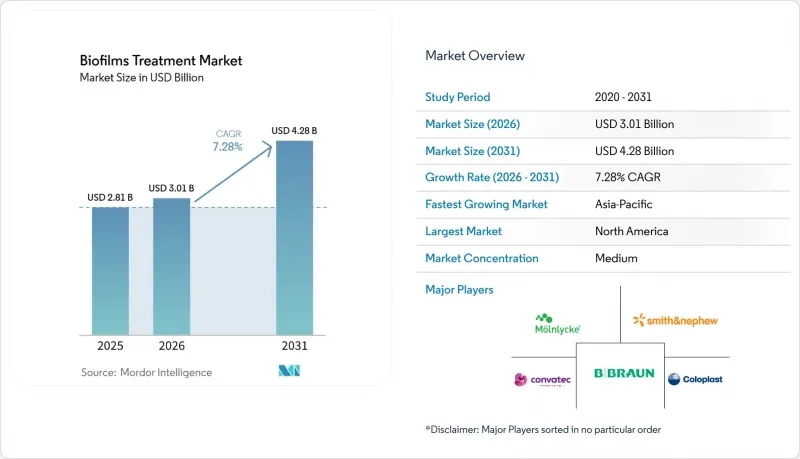
Mordor Intelligence에 의하면, 바이오 필름 처리 시장 규모는 2025년 28억 1,000만 달러로 평가되었고, 2026년 30억 1,000만 달러에서 2031년까지 42억 8,000만 달러로 확대될 것으로 예측되며, 2026-2031년 연평균 복합 성장률(CAGR)은 7.28%를 나타낼 전망입니다.
본 보고서는 제품 유형별(드레싱 및 이식편, 데브리드먼트용 기기 등), 치료법별(물리적 데브리드먼트, 화학적 및 소독 요법 등), 감염 유형별(만성 상처, 외과적 및 외상성 등), 최종 사용자별(병원, 전문 클리닉 등), 지역별(북미, 유럽 등)로 분류되어 있습니다. 시장 전망은 금액(달러) 기준으로 제시되어 있습니다.
세계의 바이오 필름 처리 시장 동향 및 인사이트
만성 상처의 유병률 및 바이오 필름으로 인한 부담 증가
미국에서는 매년 약 650만 명의 환자가 만성 상처로 고통받고 있으며, 치료비는 연간 250억 달러를 초과합니다. 이러한 부담의 대부분은 고령자 및 당뇨병 환자가 차지하고 있습니다. 바이오 필름은 치유를 지연시키고, 반복적인 치료를 유발하며, 내원 횟수를 늘리고, 치료 기간을 연장시켜 총 의료비를 증가시키기 때문에 이러한 추세는 바이오 필름 처리 시장 수요를 뒷받침하고 있습니다. 당뇨병성 족부 궤양은 당뇨병 환자의 생애 동안 19%에서 34%에 영향을 미치며, 이러한 사례의 60%에서 바이오 필름을 형성하는 세균 분리주가 검출되고, 궤양의 중증도가 높아질수록 그 비율은 증가하고 있습니다. 2045년까지 전 세계 당뇨병 환자 수가 7억 8,300만 명에 달할 것으로 예측됨에 따라, 지속적인 상처 감염 위험에 노출되는 환자층은 확대될 것으로 보입니다. 한편, 상처 피복재의 항균 위험에 대한 규제 당국의 관심이 높아지고 있는 것은 바이오 필름을 파괴하고 내성 관련 우려를 완화하는 제품에 대한 수요를 촉진하고 있습니다.
상처 피복재, 데브리드먼트, 외용 요법 분야에서 항바이오 필름 제품의 혁신 부상
바이오 필름 처리 시장의 제품 개발은 단일 작용기전을 가진 항균 제품에서 바이오 필름을 파괴하고 유효 성분을 전달하며 상처 환경을 지원하는 플랫폼으로 전환되고 있습니다. 2026년 『Scientific Reports』지에 게재된 연구에서는 상처 모델에서 다균성 바이오 필름을 근절하고 염증을 조절하는 차세대 항균성 피부 매트릭스가 입증되었으며, 표준 단일 성분 제품보다 더 폭넓은 치료적 가치를 지닌 것으로 나타났습니다. 콤바텍(Combatec)은 2025년 4월 ‘ConvaNiox’의 유럽 승인을 획득하고, 프랑스, 독일, 이탈리아, 폴란드, 스페인, 영국에서 판매를 시작했습니다. 임상시험 데이터에 따르면, 표준 치료에 비해 상처 면적 감소 속도가 3배 더 빠르고, 12주 이내 치유율이 60% 더 높은 것으로 나타났습니다. Kane Biotech사의 ‘Revyve’ 플랫폼도 이러한 변화를 반영하고 있으며, 2026년 『Frontiers in Antibiotics』지에 게재된 논문에서는 녹농균(P. aeruginosa) 및 황색포도상구균(S. aureus)의 항생제 내성 바이오 필름 세포가 3일 이내에 3.5-5.5 log CFU 감소한 것으로 나타났으며, 이에 따라 시장 진출기업들 사이에서 더욱 강력한 데이터와 명확한 임상적 차별화의 필요성이 높아지고 있습니다.
첨단 바이오 필름 처리의 높은 비용과 보험 급여의 불균형
고급 항바이오 필름 드레싱이나 데브리드먼트 제품은 대부분의 경우 표준 거즈나 기본적인 항균 드레싱보다 3-10배의 비용이 들기 때문에 바이오 필름 처리 시장에서 도입의 큰 장벽이 되고 있습니다. 미국에서는 HCPCS 코드에 기반한 첨단 상처 관리 제품에 대한 CMS(메디케어·메디케이드 서비스 센터)의 보험 급여가, 대상 상처 범주가 축소되거나 사용 기준이 엄격해질 가능성이 있는 정책 변경의 영향을 받기 쉬운 상황입니다. 유럽 전역에서는 의료 기술 평가 기준이 국가마다 다르기 때문에 독일에서 보험 적용 대상인 제품이라 하더라도 이탈리아나 스페인에서는 보험 적용 목록에 정상적으로 등재되는 것이 지연될 가능성이 있습니다. 아시아태평양 및 중동의 많은 시장에서는 주요 도시의 병원 이외의 장소에서 발생하는 본인 부담금이 여전히 고급 제품의 보급을 제한하고 있으며, 프리미엄 가격 책정을 뒷받침하기 위해서는 실제 임상 현장에서의 비용 대비 효과 및 치유에 관한 증거가 필수적입니다.
부문 분석
2025년, 상처 피복재 및 이식편은 바이오 필름 처리 시장 규모의 28.65%를 차지했습니다. 이는 만성 상처 관리 전반에 걸쳐 은계, PHMB 함유 및 하이드로파이버 형태의 제품이 임상 현장에서 널리 사용되고 있는 데 기인합니다. 이러한 제품들은 다양한 상처 유형에 대응하며 병원, 클리닉, 상처 전문 진료소에서 확고히 자리 잡고 있어 여전히 중심적인 위치를 차지하고 있습니다. 스미스 앤 네퓨(Smith & Nephew)가 2026년 3월에 출시한 ‘ALLEVYN COMPLETE CARE 폼 드레싱’은 프리미엄 드레싱 분야의 혁신성을 돋보이게 하고 있습니다. 5층 구조 설계로 인해 상처 부위에서 99% 이상의 세균을 차단하고, 최대 93%의 기계적 에너지를 흡수합니다. 또한, 바이오 필름의 파괴는 일반적으로 괴사 조직이나 비생존 조직의 제거에서 시작되기 때문에 데브리드먼트용 기기도 여전히 중요한 위치를 차지하고 있습니다.
상처 세정제나 세정액은 여전히 중요한 보조 제품이며, 상처 위생 프로토콜에서 1차 드레싱과 병용되는 경우가 많습니다. 2026년 2월 FDA 510(k) 승인을 획득한 케인 바이오테크(Kane Biotech)사의 ‘revyve 항균성 피부·상처 세정제’는 그동안 파편화되어 혁신 추진력이 부족했던 제품 분야에서 보다 체계적인 투자 초점을 반영한 것입니다. 2026년부터 2031년에 걸쳐 연평균 성장률(CAGR) 8.93%를 기록하며, 바이오 필름 처리 시장에서 가장 빠르게 성장하고 있는 제품 부문은 외용제입니다. 이는 젤 형태 및 효소계 제제가 표면 작용형 제품보다 바이오 필름 매트릭스에 더 효과적으로 침투할 수 있기 때문입니다.
2025년에는 물리적 데브리드먼트가 매출의 35.23%를 차지했는데, 이는 바이오 필름 통제를 위한 상처 준비의 표준적인 첫 단계로서의 역할을 반영한 것입니다. 바이오 필름 처리 시장은 괴사 조직이 잔존하는 상태에서는 첨단 제품이라도 효과적으로 기능하지 못하기 때문에 여전히 데브리드먼트에 의존하고 있습니다. 그러나 물리적 데브리드먼트만으로는 바이오 필름의 재발을 막을 수 없으며, 임상 지침에서도 이러한 한계가 점점 더 인식되고 있습니다. 이러한 격차로 인해 화학적 및 소독제 기반 치료는 2031년까지 연평균 성장률(CAGR) 9.67%를 기록하며, 치료법 중 가장 높은 성장률을 보일 것으로 전망됩니다.
일산화질소, 차아염소산, PHMB 및 은을 조합한 접근법은 바이오 필름을 파괴하는 역할을 뒷받침하는 증거가 강화됨에 따라 상업적인 주목을 받고 있습니다. 효소 요법은 취약한 상처 가장자리나 허혈성 상처 가장자리를 가진 환자, 특히 고령자의 욕창 관리에 있어 환자 부담이 적기 때문에 바이오 필름 처리 업계에서 독보적인 위치를 유지하고 있습니다. 데브리드먼트와 항균 드레싱을 결합한 병용 요법은 스튜어드십에 중점을 둔 상처 관리 하에서 더욱 보편적인 치료 모델로 자리 잡고 있습니다.
지역별 분석
북미는 밀집된 병원 네트워크, 만성 상처 부담의 높음, 그리고 첨단 상처 관리 제품의 광범위한 채택에 힘입어 2025년 바이오 필름 처리 시장 규모의 38.56%를 차지할 것으로 보고되고 있습니다. 미국은 여전히 이 지역의 중심이며, 800만 명 이상이 만성 상처로 고통받고 있으며, 바이오 필름의 지속이 많은 난치성 사례의 원인 중 하나가 되고 있습니다. 캐나다에서는 신제품 승인 및 2026년에 미국과 캐나다 전역에서 ‘Revyve’를 둘러싼 상업 활동이 재개될 것이라는 전망에 힘입어 전문 상처 관리 분야에서 성장세가 가속화되고 있습니다. 멕시코는 여전히 시장 기여도가 낮지만, 당뇨병 유병률의 상승과 민간 병원의 확장이 초기 수요를 지속적으로 뒷받침하고 있습니다.
유럽은 엄격한 임상 기준, 활발한 HTA(의료기술평가) 심사, 그리고 처방 행위에 대한 EWMA(유럽 상처 관리 협회) 지침의 강력한 영향에 힘입어, 바이오 필름 처리 시장에서 중요한 위치를 유지하고 있습니다. 2025년에 ConvaTec사의 'ConvaNiox'가 최초로 출시될 시장은 독일, 영국, 프랑스, 이탈리아, 스페인, 폴란드가 될 전망이며, 이는 엄격하게 감독되는 해당 지역의 의료 제도 내에서 근거 창출에 초점을 맞춘 전략을 반영한 것입니다. 브레멘에서 개최되는 ‘EWMA 2026’은 상처 관리 분야의 유럽 주요 임상 포럼으로, 콘바텍(ConvaTec)과 스미스 앤 네퓨(Smith & Nephew)는 이 포럼에서 새로운 데이터를 발표하고 상업적 입지를 강화할 예정입니다. 그 밖의 유럽 내 소규모 시장들도 상처 위생 프로토콜이 항생제 내성 대책 계획과 더욱 밀접하게 연계됨에 따라 발전하고 있습니다.
아시아태평양은 바이오 필름 처리 시장에서 가장 빠르게 성장하는 지역 부문으로, 2026-2031년 연평균 성장률(CAGR) 8.56%를 나타낼 것으로 전망됩니다. 중국과 인도는 당뇨병 부담 증가와 지속적인 의료 인프라 투자에 힘입어 여전히 주요 성장 동력으로 자리 잡고 있습니다. 인도에서는 의료기기 기반 시설과 병원 수용 능력이 확대되고 있는 반면, 중국에서는 공공 및 민간을 불문하고 첨단 상처 관리 제품의 사용이 증가하고 있습니다. 일본에서는 고령화가 진행됨에 따라 첨단 드레싱 재료에 대한 수요가 견조한 추세를 보이고 있습니다. 한편, GCC 국가, 브라질, 아르헨티나에서는 민간 병원의 확대, 조달량 증가, 보험 보급 및 공공 조달을 통해 접근성이 점차 개선되고 있습니다.
기타 혜택 :
- 엑셀 형식 시장 예측(ME) 시트
- 3개월간의 애널리스트 지원
자주 묻는 질문
목차
제1장 서론
제2장 조사 방법
제3장 주요 요약
제4장 시장 구도
제5장 시장 규모 및 성장 예측
제6장 경쟁 구도
제7장 시장 기회 및 향후 전망
AJYAccording to Mordor Intelligence, the biofilms treatment market size is projected to expand from USD 2.81 billion in 2025 and USD 3.01 billion in 2026 to USD 4.28 billion by 2031, registering a CAGR of 7.28% between 2026 to 2031.
This report is Segmented by Product Type (Dressings and Grafts, Debridement Devices, and More), Treatment Method (Physical Debridement, Chemical and Antiseptic, and More), Infection Type (Chronic Wound, Surgical and Traumatic, and More), End User (Hospitals, Specialty Clinics, and More), and Geography (North America, Europe, and More). The Market Forecasts are Provided in Terms of Value (USD).
Global Biofilms Treatment Market Trends and Insights
Increasing Chronic Wound Prevalence and Biofilm Burden
Chronic wounds affect an estimated 6.5 million patients each year in the United States, and treatment costs exceed USD 25 billion annually, with older adults and people with diabetes carrying a significant share of the burden. This trend supports demand in the biofilm treatment market, as biofilm slows healing, increases repeat treatment cycles, raises clinic visits, extends care duration, and adds to total spending. Diabetic foot ulcers affect 19% to 34% of people with diabetes over their lifetime, and 60% of these cases carry biofilm-forming bacterial isolates, with rates increasing in higher-grade ulcers. As diabetes prevalence is projected to reach 783 million people globally by 2045, the patient pool at risk of persistent wound infection is expected to expand, while evolving regulatory focus on antimicrobial risk in wound dressings supports products that disrupt biofilm and limit resistance concerns.
Rising Anti-Biofilm Product Innovation in Dressings, Debridement, and Topical Therapies
Product development in the biofilm treatment market is shifting from single-mechanism antimicrobial products to platforms that disrupt biofilm, deliver active agents, and support the wound environment. A 2026 study in Scientific Reports validated a next-generation antimicrobial dermal matrix that eradicates polymicrobial biofilms and modulates inflammation in wound models, indicating broader treatment value than standard single-agent products. ConvaTec received European approval for ConvaNiox in April 2025 and launched it in France, Germany, Italy, Poland, Spain, and the UK. Trial data showed wound area reduction three times faster and 60% higher healing within 12 weeks compared to standard care. Kane Biotech's Revyve platform also reflects this shift, with a 2026 Frontiers in Antibiotics publication showing a 3.5-5.5 log CFU reduction in antibiotic-tolerant biofilm cells of P. aeruginosa and S. aureus within three days, raising the need for stronger data and clearer clinical differentiation among market entrants.
High Cost and Reimbursement Variability for Advanced Biofilm Therapies
Premium anti-biofilm dressings and debridement products often cost 3-10 times more than standard gauze or basic antimicrobial dressings, creating a major adoption barrier in the biofilm treatment market. In the United States, CMS reimbursement for advanced wound care products under HCPCS codes remains exposed to policy changes that may narrow eligible wound categories or impose stricter use thresholds. Across Europe, varied health technology assessment standards can delay routine formulary access in Italy or Spain, even when a product receives reimbursement in Germany. In many Asia-Pacific and Middle East markets, out-of-pocket payments outside major urban hospitals continue to limit premium product uptake, making real-world cost and healing evidence essential to support premium pricing.
Other drivers and restraints analyzed in the detailed report include:
- Growing Clinical Emphasis on Antimicrobial Stewardship and Non-Antibiotic Alternatives
- Expanding Advanced Wound Care Adoption in Hospitals and Home Healthcare
- Limited Biofilm-Specific Clinical Endpoints in Routine Practice
For complete list of drivers and restraints, kindly check the Table Of Contents.
Segment Analysis
Dressings and grafts held 28.65% of the biofilm treatment market size in 2025, supported by broad clinical use of silver-based, PHMB-containing, and hydrofiber formats across chronic wound care. These products remain central because they address a wide range of wound profiles and are well established across hospitals, clinics, and wound specialist practices. Smith+Nephew's March 2026 launch of the ALLEVYN COMPLETE CARE Foam Dressing highlights innovation in premium dressings, with a 5-layer design that keeps over 99% of bacteria away from the wound bed and absorbs up to 93% of mechanical energy. Debridement devices also maintain a meaningful position because biofilm disruption typically starts with the removal of necrotic or nonviable tissue.
Wound cleansers and irrigation solutions remain important support products and are often used with primary dressings in wound hygiene protocols. Kane Biotech's revyve Antimicrobial Skin and Wound Cleanser, which received FDA 510(k) clearance in February 2026, reflects a more structured investment focus in a product area that had often been fragmented and less innovation-driven. Topical agents are the fastest-growing product segment in the biofilm treatment market at an 8.93% CAGR from 2026 to 2031, as gel-phase and enzymatic formats can penetrate biofilm matrices more effectively than surface-acting products.
Physical debridement represented 35.23% of revenue in 2025, reflecting its role as the standard first step in wound bed preparation for biofilm control. The biofilm treatment market continues to rely on debridement because advanced products cannot perform effectively when necrotic tissue remains in place. However, physical debridement alone does not prevent biofilm recurrence, and clinical guidance increasingly recognizes this limitation. This gap is driving chemical and antiseptic treatment toward the fastest growth rate among treatment methods, at 9.67% CAGR through 2031.
Nitric oxide, hypochlorous acid, PHMB, and silver-combination approaches are gaining commercial attention as evidence supporting their biofilm-disruption role strengthens. Enzymatic treatment retains a distinct position in the biofilm treatment industry because it is less traumatic for patients with fragile or ischemic wound margins, especially in pressure ulcer care among older adults. Combination therapy, which pairs debridement with antimicrobial dressings, is becoming a more common care model under stewardship-focused wound management.
Complete Report Scope:
- By Product Type
- Dressings and Grafts
- Debridement Devices
- Topical Agents
- Wound Cleansers and Irrigation Solutions
- Other Product Types
- By Treatment Method
- Physical Debridement
- Chemical and Antiseptic Treatment
- Enzymatic Treatment
- Combination Therapy
- By Infection Type
- Chronic Wound
- Surgical and Traumatic Wounds
- Diabetic Foot Ulcers
- Venous Leg Ulcers
- Pressure Ulcers
- Burn and Other Open Wounds
- By End User
- Hospitals
- Specialty Clinics and Wound Care Centers
- Home Healthcare Settings
- Ambulatory Surgical Centers
- By Geography
- North America
- United States
- Canada
- Mexico
- Europe
- Germany
- United Kingdom
- France
- Italy
- Spain
- Rest of Europe
- Asia-Pacific
- China
- India
- Japan
- Australia
- South Korea
- Rest of Asia-Pacific
- Middle East and Africa
- GCC
- South Africa
- Rest of Middle East and Africa
- South America
- Brazil
- Argentina
- Rest of South America
- North America
Geography Analysis
North America reported to account for 38.56% of the biofilm treatment market size in 2025, supported by a dense hospital network, a high chronic wound burden, and widespread adoption of advanced wound care products. The United States remains the regional core, as chronic wounds affect more than 8 million people, with biofilm persistence contributing to many non-healing cases. Canada is gaining traction in specialty wound care through newer product approvals and the expected return of commercial activity around Revyve across the United States and Canada in 2026. Mexico remains a smaller contributor, although rising diabetes prevalence and private hospital expansion continue to support early demand.
Europe maintains a significant position in the biofilm treatment market, driven by strict clinical standards, active HTA review, and the strong influence of EWMA guidance on prescribing behavior. Germany, the UK, France, Italy, Spain, and Poland are to be the first launch markets for ConvaTec's ConvaNiox in 2025, reflecting a strategy focused on evidence generation in the region's closely monitored health systems. EWMA 2026 in Bremen remains the key European clinical forum for wound management, where ConvaTec and Smith+Nephew plan to present new data and strengthen their commercial presence. Smaller markets across the rest of Europe are advancing as wound hygiene protocols become more closely linked to antimicrobial resistance planning.
Asia-Pacific is the fastest-growing regional segment in the biofilm treatment market, with a CAGR of 8.56% from 2026 to 2031. China and India remain the main growth engines, supported by a rising diabetes burden and continued healthcare infrastructure investment. India is expanding its medical device base and hospital capacity, while China is increasing the use of advanced wound care products across public and private settings. Japan's aging population supports steady demand for advanced dressings, while GCC countries, Brazil, and Argentina are gradually improving access through private hospital expansion, procurement growth, insurance penetration, and public purchasing.
- 3M
- B. Braun
- Coloplast
- Convatec
- Ecolab
- Essity
- Hydrofera LLC
- Integra LifeSciences
- Kane Biotech Inc.
- Lohmann and Rauscher GmbH and Co. KG
- Medline Industries
- MIMEDX Group
- Molnlycke Health Care
- Next Science Limited
- Organogenesis
- Sanara MedTech
- Smiths Group
- Solventum Corporation
- STERIS
- URGO Medical
Additional Benefits:
- The market estimate (ME) sheet in Excel format
- 3 months of analyst support
TABLE OF CONTENTS
1 INTRODUCTION
- 1.1 Study Assumptions and Market Definition
- 1.2 Scope of the Study
2 RESEARCH METHODOLOGY
3 EXECUTIVE SUMMARY
4 MARKET LANDSCAPE
- 4.1 Market Overview
- 4.2 Market Drivers
- 4.2.1 Increasing Chronic Wound Prevalence and Biofilm Burden
- 4.2.2 Expanding Advanced Wound Care Adoption in Hospitals and Home Care
- 4.2.3 Rising Anti-Biofilm Product Innovation in Dressings, Debridement, and Topicals
- 4.2.4 Growing Clinical Emphasis on Antimicrobial Stewardship and Non-Resistance-Building Therapies
- 4.2.5 Under-Treated Biofilm Recolonization After Standard Debridement
- 4.2.6 Increasing Use in Post-Surgical and Device-Associated Wound Management
- 4.3 Market Restraints
- 4.3.1 High Cost and Reimbursement Variability for Advanced Biofilm Therapies
- 4.3.2 Limited Biofilm-Specific Clinical Endpoints in Routine Practice
- 4.3.3 Product Performance Variability Across Wound Types and Exudate Conditions
- 4.3.4 Regulatory and Claims Substantiation Burden for Anti-Biofilm Labeling
- 4.4 Supply/Value Chain Analysis
- 4.5 Regulatory Landscape
- 4.6 Technological Outlook
- 4.7 Porter's Five Forces Analysis
- 4.7.1 Threat of New Entrants
- 4.7.2 Bargaining Power of Suppliers
- 4.7.3 Bargaining Power of Buyers
- 4.7.4 Threat of Substitutes
- 4.7.5 Competitive Rivalry
5 MARKET SIZE AND GROWTH FORECASTS (VALUE, USD)
- 5.1 By Product Type
- 5.1.1 Dressings and Grafts
- 5.1.2 Debridement Devices
- 5.1.3 Topical Agents
- 5.1.4 Wound Cleansers and Irrigation Solutions
- 5.1.5 Other Product Types
- 5.2 By Treatment Method
- 5.2.1 Physical Debridement
- 5.2.2 Chemical and Antiseptic Treatment
- 5.2.3 Enzymatic Treatment
- 5.2.4 Combination Therapy
- 5.3 By Infection Type
- 5.3.1 Chronic Wound
- 5.3.2 Surgical and Traumatic Wounds
- 5.3.3 Diabetic Foot Ulcers
- 5.3.4 Venous Leg Ulcers
- 5.3.5 Pressure Ulcers
- 5.3.6 Burn and Other Open Wounds
- 5.4 By End User
- 5.4.1 Hospitals
- 5.4.2 Specialty Clinics and Wound Care Centers
- 5.4.3 Home Healthcare Settings
- 5.4.4 Ambulatory Surgical Centers
- 5.5 By Geography
- 5.5.1 North America
- 5.5.1.1 United States
- 5.5.1.2 Canada
- 5.5.1.3 Mexico
- 5.5.2 Europe
- 5.5.2.1 Germany
- 5.5.2.2 United Kingdom
- 5.5.2.3 France
- 5.5.2.4 Italy
- 5.5.2.5 Spain
- 5.5.2.6 Rest of Europe
- 5.5.3 Asia-Pacific
- 5.5.3.1 China
- 5.5.3.2 India
- 5.5.3.3 Japan
- 5.5.3.4 Australia
- 5.5.3.5 South Korea
- 5.5.3.6 Rest of Asia-Pacific
- 5.5.4 Middle East and Africa
- 5.5.4.1 GCC
- 5.5.4.2 South Africa
- 5.5.4.3 Rest of Middle East and Africa
- 5.5.5 South America
- 5.5.5.1 Brazil
- 5.5.5.2 Argentina
- 5.5.5.3 Rest of South America
- 5.5.1 North America
6 COMPETITIVE LANDSCAPE
- 6.1 Market Concentration
- 6.2 Market Share Analysis
- 6.3 Company Profiles (includes Global Level Overview, Market Level Overview, Core Segments, Financials as available, Strategic Information, Market Rank/Share, Products and Services, Recent Developments)
- 6.3.1 3M Company
- 6.3.2 B. Braun SE
- 6.3.3 Coloplast A/S
- 6.3.4 ConvaTec Group Plc
- 6.3.5 Ecolab Inc.
- 6.3.6 Essity AB
- 6.3.7 Hydrofera LLC
- 6.3.8 Integra LifeSciences Holdings Corporation
- 6.3.9 Kane Biotech Inc.
- 6.3.10 Lohmann and Rauscher GmbH and Co. KG
- 6.3.11 Medline Industries, LP
- 6.3.12 MiMedx Group, Inc.
- 6.3.13 Molnlycke Health Care AB
- 6.3.14 Next Science Limited
- 6.3.15 Organogenesis Holdings Inc.
- 6.3.16 Sanara MedTech Inc.
- 6.3.17 Smith & Nephew plc
- 6.3.18 Solventum Corporation
- 6.3.19 STERIS plc
- 6.3.20 URGO Medical
7 MARKET OPPORTUNITIES AND FUTURE OUTLOOK
- 7.1 White-Space and Unmet-Need Assessment