|
시장보고서
상품코드
2099837
스마트 고속도로 및 자율주행 인프라 분야 광섬유 케이블 시장 : 시장 점유율 분석, 업계 동향 및 통계, 성장 예측(2026-2031년)Fiber Optic Cable For Smart Highways and Autonomous Vehicle Infrastructure - Market Share Analysis, Industry Trends & Statistics, Growth Forecasts (2026 - 2031) |
||||||
 Mordor Intelligence
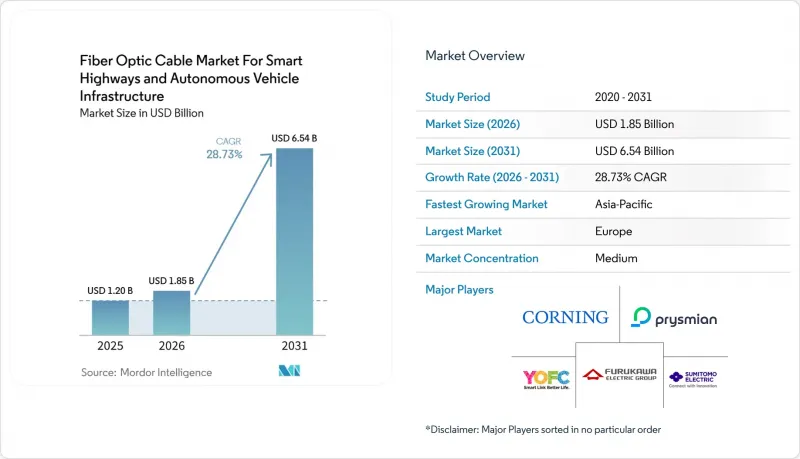
Mordor Intelligence에 의하면, 스마트 고속도로 및 자율주행 인프라 분야 광섬유 케이블 시장 규모는 2025년 12억 달러로 평가되었고, 2026년에는 18억 5,000만 달러로 확대될 것으로 추정되고, 2031년까지 65억 4,000만 달러에 이를 것으로 예상되며, 2026-2031년 CAGR 28.73%로 성장할 전망입니다.
본 보고서는 케이블 유형별(기갑 케이블 등), 광섬유 모드별(단일 모드 등), 설치 방법별(지하·매설 등), 용도별(도로변 통신 등), 최종 사용자별(정부·교통 당국 등) 및 지역별로 분류되어 있습니다. 시장 전망은 금액(달러) 기준으로 제시되어 있습니다.
스마트 고속도로 및 자율주행 인프라 분야 광섬유 케이블 시장 인사이트 및 동향
스마트 회랑 구축 프로그램의 가속화
정부가 지원하는 회랑 프로그램은 광범위한 교통 정책 단계에서 실제 조달 일정으로 전환되고 있으며, 이러한 변화에 따라 스마트 고속도로 및 자율주행 인프라 분야 광섬유 케이블 시장은 단기적인 수주 기반을 더욱 공고히 하고 있습니다. 미국 고속도로청은 2024년, 애리조나주, 텍사스주, 와이오밍주, 미시간주, 버지니아주를 대상으로 5,880만 달러 규모의 V2X 보조금을 지급했습니다. 이러한 프로젝트에서는 도로변 장비 연결을 위해 고정 백홀 회선이 필요했습니다. 또한, 미국의 국가 전개 계획에서는 2031년까지 국가 고속도로 시스템의 50%에서 V2X 커버리지 달성이라는 목표도 설정되어 있으며, 이에 따라 회랑 내 광섬유 수요는 임의의 예산 항목에서 보다 명확한 인프라 요건으로 전환되고 있습니다. 각 기관이 노드의 고밀도 배치를 전제로 고속도로 연결성을 설계하게 되면, 갠트리, 캐비닛, 엣지 디바이스가 추가될 때마다 신뢰성 높은 광섬유 경로와 예비 용량의 필요성이 높아집니다. 따라서 스마트 고속도로 및 자율주행 인프라 분야 광섬유 케이블 시장은 프로젝트 수 증가뿐만 아니라, 자금을 지원받은 각 회랑 내의 더욱 고밀도화된 건설 사양으로부터도 혜택을 받고 있습니다. 이러한 추세는 확장성이 뛰어난 케이블 아키텍처에도 유리하게 작용합니다. 사업자들은 대규모 토목 공사를 반복하지 않고도 향후 업그레이드에 대응할 수 있는 자산을 원하기 때문입니다.
지능형 고속도로 통신에서 우선적인 매체로 자리 잡은 광섬유
센서 밀도, 지연 요구 사항, 지속적인 데이터 전송이 모두 동시에 증가하는 고속도로 네트워크에서는 무선만을 이용한 백홀의 도입을 정당화하기가 점점 어려워지고 있습니다. 『Vehicle Communications』지에 게재된 2025년 동료 심사 연구에 따르면, 도로변 장치(ROU) 연결에 있어 광네트워크 솔루션은 지능형 교통 시스템(ITS) 환경에서 무선 기반 대안보다 훨씬 뛰어난 성능을 발휘하는 것으로 밝혀졌습니다. 이는 스마트 고속도로나 자율주행 인프라 분야의 광섬유 케이블 시장에 중요한 의미를 지닙니다. 도로 운영 사업자들이 현재 광섬유를 단순한 선택적 추가 기능이 아닌 설계상의 필수 요건으로 간주하고 있기 때문입니다. 이러한 추세는 광섬유를 통한 자동차용 멀티기가비트 광통신에 관한 IEEE 802.3cz 표준에 의해 더욱 가속화되고 있으며, 이 표준은 차량 시스템과 도로변 인프라 모두에 걸친 이용 사례에서 채택이 확대되고 있습니다. LiDAR, 레이더, 기상 센서, 카메라 클러스터 등이 각 도로변 노드를 통해 더 큰 데이터 부하를 발생시킴에 따라, 불안정하거나 혼잡한 백홀에 대한 허용도는 급격히 낮아지고 있습니다. 스마트 고속도로 및 자율주행 인프라 분야 광섬유 케이블 시장은 이러한 변화의 혜택을 받고 있습니다. 더 높은 성능 요구 사항은 대개 광섬유 가닥 수 증가, 감쇠율 감소, 그리고 내구성이 더 뛰어난 장거리 회랑 설계로 이어지기 때문입니다.
고속도로 회랑에서의 고액 토목 공사비 및 부지 취득비
스마트 고속도로 및 자율주행 인프라 분야 광섬유 케이블 시장에서 굴착 및 복구 공사는 여전히 가장 두드러진 구조적 비용 부담으로 남아 있습니다. Cartesian사와 공동으로 작성되어 2026년 1월에 발표된 Fiber Broadband Association의 연례 구축 비용 보고서에 따르면, 2025년 지하 설치 비용의 중앙값은 1피트당 18달러로 전년 대비 12% 증가했습니다. 동 보고서에 따르면 인건비가 총 건설비의 60-80%를 차지하고 있어, 행정 기관이 자재 구매만으로 인플레이션의 영향을 상쇄할 수 있는 여지는 제한적입니다. 2026년 1월 분석에 따르면, 광섬유 설치 비용의 75-90%가 도로 굴착 및 복구 공사에 기인하는 것으로 나타났으며, 초기 도로 건설 시 도관을 매설하는 ‘일회성 굴착’ 방침이缺如한 경우, 비용이 10배로 불어날 가능성이 있다는 결론이 도출되었습니다. IEC TR 63431:2025는 오픈 트렌치 공법에 비해 설치 비용을 50-75% 절감할 수 있는 마이크로덕트 시스템으로의 전환을 장려하고 있지만, 조달 주기가 하룻밤 사이에 바뀌는 것은 아니기 때문에 그 도입에는 여전히 시간이 걸립니다. 그 결과, 수요는 견조한 추세를 보이고 있으나, 납기 확보는 프로젝트 소유주가 토목 공사의 규모를 축소할 수 있는지 여부에 크게 좌우되는 시장 상황이 되고 있습니다.
부문 분석
2025년, 스마트 고속도로 및 자율주행 인프라 분야의 광섬유 케이블 시장에서 비장갑 케이블은 31.72%의 점유율을 차지했으며, 스마트 고속도로의 전체 이용 사례를 통틀어 주요 케이블 유형으로 자리매김하고 있습니다. 이러한 주도적인 지위는 많은 고속도로 프로젝트에서 광섬유가 도관을 통해 매설되고 있으며, 도관 자체가 장거리 회선 매설에 필요한 기본적인 기계적 보호 기능을 이미 제공하고 있다는 사실을 반영합니다. 이러한 환경에서 외피를 추가하면 케이블의 무게가 증가하고 설치 비용이 높아지며 현장 종단 처리가 복잡해지는 반면, 그에 상응하는 운영상의 이점은 얻을 수 없습니다. 마이크로덕트 및 블로우 파이버 케이블은 2031년까지 연평균 성장률(CAGR) 28.45%를 나타낼 것으로 예측됩니다. 이는 관련 기관들이 노선 전체를 재굴착하지 않고도 나중에 가닥을 추가할 수 있는 모듈식 시스템을 요구하고 있기 때문입니다. 스마트 고속도로 및 자율주행 인프라 분야 광섬유 케이블 시장은 수명 주기 전반에 걸친 유연성이 초기 설치 비용과 거의 동등한 중요성을 갖게 됨에 따라 이러한 요구에 부응하고 있습니다.
펜실베이니아 턴파이크의 사례는 여전히 중요한 의미를 지닙니다. 이 프로젝트에서는 500마일에 달하는 마이크로 트렌치용 도관 매설을 통해, 기존의 오픈컷식 트렌치 공법에 비해 50-75%의 비용 절감이 입증되었기 때문입니다. 또한 이 프로젝트는 사업자가 운송 시스템과 외부로부터의 광대역 임대 수요를 모두 지원하고자 할 때, 마이크로덕트의 예비 용량이 왜 진정한 가치를 지니는지 입증했습니다. 장갑 케이블은 남미 및 중동 및 아프리카의 직매설 방식 그린필드 프로젝트에서 여전히 그 중요성을 유지하고 있습니다. 이러한 지역에서는 덕트가 사전에 일관되게 설치되어 있다고 볼 수 없기 때문입니다. 리본 케이블은 경로의 유연성보다 다수의 케이블 연결 효율이 중시되는 교통 관리 허브에서 여전히 유용합니다. 스마트 고속도로 및 자율주행 인프라 분야 광섬유 케이블 시장 전반에 걸쳐, IEC TR 63431:2025는 도로 관리 기관이 조달상의 불확실성을 줄이면서 마이크로덕트 시스템을 사양으로 확정할 수 있도록 보다 명확한 근거를 제공하므로 유용한 기술 참고 자료가 되고 있습니다.
2025년 시점에서 광섬유 모드별로 살펴보면, 싱글모드 광섬유는 스마트 고속도로 및 자율주행 인프라 분야 광섬유 케이블 시장의 53.34%를 차지했으며, 2031년까지 연평균 성장률(CAGR) 27.63%를 나타낼 것으로 예측됩니다. 이러한 규모와 성장의 조합은 회랑형 네트워크의 기본적인 물리적 특성에 기인합니다. 도시 간 도로 연결은 멀티모드 시스템이 효율을 유지할 수 있는 범위를 훨씬 초과하여 뻗어 있는 경우가 많기 때문입니다. 교통 거점, 요금소, 센싱 클러스터 간의 긴 고속도로 구간에서는 거리에 따른 감쇠가 적고, 신호 재생의 필요성이 낮아야 합니다. 『Vehicle Communications』지의 2025년판 ‘도로변 연결성 조사’는 이러한 방향성을 뒷받침하며, 지능형 교통 환경에서 광네트워크 솔루션의 성능적 우위를 보여주고 있습니다. 따라서 스마트 고속도로나 자율주행 인프라 분야의 광섬유 케이블 시장에서는 단거리용 대안이 아닌, 단일 모드 방식의 구축이 계속해서 백본 수요의 기반을 이루고 있습니다.
연결된 도로 회랑에서 LiDAR, 레이더, 이미징, 환경 센싱의 부하가 증가함에 따라 이러한 추세는 더욱 공고해지고 있습니다. 또한, IEEE 802.3cz 규격 역시 도로 및 차량 인프라와 관련된 멀티 기가비트급 자동차 통신 분야에서 유리 광섬유의 채택을 뒷받침하고 있습니다. 멀티모드 광섬유는 링크 길이가 짧고 종단 처리가 용이해야 하는 요금소, 교통 관리 시설, 정비 거점 내에서는 여전히 실용적인 역할을 수행하고 있습니다. 또한, 플라스틱 광섬유도 장거리 전송보다는 굽힘 유연성이 중시되는 좁은 도로변 캐비닛이나 차량 내 근거리 링크에서 소폭의 틈새 시장을 유지하고 있습니다. 따라서 스마트 고속도로 및 자율주행 인프라 분야의 광섬유 케이블 시장 전체에서는 싱글모드가 여전히 명확한 성능의 기반임에도 불구하고, 회랑의 백홀 및 시설 수준의 상호 연결 분야에서 수요가 확대되고 있습니다.
지역별 분석
2025년, 유럽은 스마트 고속도로 및 자율주행 인프라 분야 광섬유 케이블 시장에서 32.67%의 점유율을 차지하며 계속해서 가장 규모가 큰 지역 기여자로 자리매김했습니다. 이 지역의 우위는 ‘유럽 연결 시설(CEF) 디지털’ 프레임워크 하에 정해진 상호 운용성 목표, 적극적인 양도 모델, 그리고 회랑의 자금 조달 구조를 반영한 것입니다. 이탈리아의 ‘탄젠자레 디 나폴리’ 는 2026년 6월 이탈리아 최초의 인증 스마트 도로가 되었으며, 이 회랑에는 217대의 지능형 카메라, 15기의 교통 감지 갠트리, 8곳의 기상 관측소, 그리고 40기의 V2I 및 셀룰러 V2X 통신 안테나가 도입되었습니다. 이 프로젝트가 중요한 이유는 다른 유럽 사업자들에게 이론적인 정책 목표가 아닌, 실질적인 규정 준수 모델을 제시하고 있다는 점에 있습니다. 독일, 프랑스, 영국은 커넥티드카의 교통량과 실시간 분석 부하가 증가함에 따라 고속도로 제어 시스템의 꾸준한 용량 업그레이드가 지속적으로 요구되고 있어, 여전히 가장 큰 개별 국가 시장으로 남아 있습니다.
북미는 스마트 고속도로 및 자율주행 인프라 분야 광섬유 케이블 시장에서 여전히 2위 규모를 유지하고 있으며, 이는 미국의 V2X 도입 계획과 ‘초당적 인프라법’에 기반한 회랑 현대화 자금에 힘입은 결과입니다. 캘리포니아주만 해도 2026년에는 대규모 활동이 예상되며, 소노마 카운티의 101번 고속도로를 따라 진행되는 약 1억 5,000만 달러 규모의 광섬유 인프라 공사나, 미국 50번 고속도로에서 진행 중인 미들마일 회랑 처리 관련 활발한 노력 등이 포함됩니다. 2026년 4월, Cavnue사는 버지니아주 교통국과 계약을 체결하여 리치먼드 지역의 95번 주간고속도로에 자사의 ‘스마트 로드 플랫폼’을 도입하게 되었습니다. 이는 차선 수준의 회랑 운영 데이터에 대한 관리형 서비스 모델을 지원하는 것입니다. 캐나다와 멕시코에서는 중간 수준의 비즈니스 기회가 예상되지만, 남미는 규모는 작으나 활발한 움직임을 보이고 있으며, 브라질과 아르헨티나에서는 재정적 제약으로 인해 프로젝트 연기 위험이 높아지고 있음에도 불구하고 스마트 고속도로 시범 사업이 진행되고 있습니다.
아시아태평양은 2031년까지 연평균 성장률(CAGR) 28.76%를 나타낼 것으로 예측되며, 스마트 고속도로 및 자율주행 인프라 분야 광섬유 케이블 시장에서 가장 빠르게 확대될 지역이 될 전망입니다. 인도는 NHAI(인도 국도청)의 디지털 고속도로 네트워크 계획이 이미 주요 시범 구간에서 시행되고 있으며, 전국 규모의 노선망을 기반으로 하고 있어 계속해서 해당 지역의 주요 성장 견인차 역할을 하고 있습니다. 일본도 모바일 통신과 광섬유 각 계층이 어떻게 연계될 수 있는지 검증하고 있으며, 2025년에는 신토메이 고속도로에서 레벨 4 자율주행 시험을 실시하여, 전용 도로용 광섬유를 완전히 대체하기보다는 5G를 활용하여 선택적인 상호 보완성을 평가할 예정입니다. 중동 및 아프리카은 국가 비전 프로젝트와 스마트 시티 인프라에 대한 투자를 통해 발전하고 있으며, 이를 통해 도로 연결성이 보다 광범위한 디지털 교통 프로그램에 통합되고 있습니다. 튀르키예는 20,141킬로미터의 고속도로 광섬유 부설 목표를 제시하고 있으며, 2025년까지 7,931킬로미터가 완공되고 나머지 구간도 건설이 계속되고 있어 구체적인 지역 벤치마크가 되고 있습니다.
기타 혜택 :
- 엑셀 형식 시장 예측(ME) 시트
- 3개월간의 애널리스트 지원
자주 묻는 질문
목차
제1장 서론
제2장 조사 방법
제3장 주요 요약
제4장 시장 구도
제5장 시장 규모 및 성장 예측
제6장 경쟁 구도
제7장 시장 기회 및 향후 전망
AJY 26.08.11According to Mordor Intelligence, the fiber optic cable market size for smart highways and autonomous vehicle infrastructure industry is expected to increase from USD 1.2 billion in 2025 to USD 1.85 billion in 2026 and reach USD 6.54 billion by 2031, growing at a CAGR of 28.73% over 2026-2031.
This report is Segmented by Cable Type (Armored, and More), Fiber Mode (Single-Mode, and More), Installation (Underground and Buried, and More), Application (Roadside Communications, and More), End User (Government and Transport Authorities, and More), and Geography. The Market Forecasts are Provided in Terms of Value (USD).
Insights and Trends of Fiber Optic Cable Market For Smart Highways and Autonomous Vehicle Infrastructure
Accelerated Smart Corridor Build-Out Programs
State-backed corridor programs are moving from broad transport policy into live procurement schedules, and that shift is giving the fiber optic cable market for smart highways and autonomous vehicle infrastructure a stronger near-term order base. The Federal Highway Administration released USD 58.8 million in V2X grants in 2024 across Arizona, Texas, Wyoming, Michigan, and Virginia, and those projects required fixed backhaul links for roadside unit connectivity. The U.S. national deployment plan also set a target for V2X coverage across 50% of the National Highway System by 2031, which moves corridor fiber demand from a discretionary line item into a more visible infrastructure requirement. Once agencies design highway connectivity around dense node placement, every added gantry, cabinet, and edge device raises the need for reliable fiber paths and spare capacity. The fiber optic cable market for smart highways and autonomous vehicle infrastructure is therefore benefiting not only from higher project counts, but also from denser build specifications inside each funded corridor. This pattern also favors scalable cable architectures because operators want assets that can support later upgrades without repeating the heaviest civil works.
Fiber As The Preferred Medium For Intelligent Highway Communication
Wireless-only backhaul has become harder to justify on high-speed road networks where sensor density, latency demands, and continuous data movement all rise together. A 2025 peer-reviewed study in Vehicle Communications found that optical network solutions for roadside unit connectivity materially outperform wireless alternatives in intelligent transportation settings. This matters for the fiber optic cable market for smart highways and autonomous vehicle infrastructure because corridor operators are now treating fiber as a design requirement rather than an optional add-on. The move is reinforced by the IEEE 802.3cz standard for automotive multigigabit optical communications over glass fiber, which is being adopted for use cases spanning both vehicle systems and roadside infrastructure. As LiDAR, radar, weather sensing, and camera clusters push higher data loads through each roadside node, the tolerance for unstable or congested backhaul drops sharply. The fiber-optic cable market for smart highways and autonomous vehicle infrastructure benefits from this shift, as higher performance requirements often translate into higher fiber counts, lower attenuation specifications, and more durable long-haul corridor designs.
High Civil Works And Right-Of-Way Costs In Highway Corridors
Excavation and reinstatement remain the clearest structural cost burden in the fiber optic cable market for smart highways and autonomous vehicle infrastructure. The Fiber Broadband Association's annual deployment cost report, produced with Cartesian and released in January 2026, placed median underground installation costs at USD 18 per foot in 2025, up 12% year over year. The same report showed that labor accounted for 60-80% of total construction spending, leaving limited room for agencies to offset inflation through product purchasing alone. A January 2026 analysis tied 75-90% of fiber installation costs to road excavation and reinstatement, and concluded that missing dig-once policies can multiply costs by 10 times compared with placing conduit during original road construction. IEC TR 63431:2025 supports a move toward microduct systems that can reduce installation costs by 50-75% versus open trenching, but adoption still takes time because procurement cycles do not change overnight. The result is a market where demand stays strong, but delivery timing depends heavily on whether project owners can lower civil intensity.
Other drivers and restraints analyzed in the detailed report include:
- Government Mandates For Intelligent Transportation Systems
- Need For Route Diversity And Resilience In Highway Networks
- Long Permitting Cycles For Highway Infrastructure Projects
For complete list of drivers and restraints, kindly check the Table Of Contents.
Segment Analysis
Non-Armored Cable held 31.72% of the fiber optic cable market for smart highways and autonomous vehicle infrastructure share in 2025, making it the leading cable type across smart highway use cases. Its lead position reflects the fact that many highway projects route fiber through conduit, so the duct itself already provides the core mechanical protection required for long corridor runs. In those settings, added armoring can raise cable weight, increase installed cost, and complicate field termination without delivering proportional operating benefit. Microduct and Blown Fiber Cable are projected to grow at a 28.45% CAGR through 2031, as agencies seek modular systems that allow them to add strands later without reopening the entire route. The fiber optic cable market for smart highways autonomous vehicle infrastructure is responding to that preference as lifecycle flexibility now matters almost as much as first-pass installation cost.
The Pennsylvania Turnpike example remains important because its 500-mile microtrench conduit deployment demonstrated documented cost savings of 50-75% compared to conventional open-cut trenching. The same project also demonstrated why spare microduct capacity has real value when operators want to support both transport systems and external broadband leasing demand. Armored Cable still holds relevance in direct-buried greenfield projects across South America and Middle East and Africa, where conduit is less consistently pre-installed. Ribbon Cable remains useful at traffic management hubs where high-count splicing efficiency matters more than route flexibility. Across the fiber optic cable market for smart highways and autonomous vehicle infrastructure industry, IEC TR 63431:2025 has become a useful technical reference because it gives highway agencies a clearer basis for specifying microduct systems with less procurement uncertainty.
Single-Mode Fiber accounted for 53.34% of the fiber optic cable market for smart highways and autonomous vehicle infrastructure by fiber mode in 2025 and is projected to grow at a 27.63% CAGR through 2031. That combination of scale and growth reflects the basic physics of corridor networking, because inter-city road links often stretch far beyond the range where multimode systems stay efficient. Long highway paths between traffic centers, toll nodes, and sensing clusters favor lower attenuation and lower regeneration needs over distance. The 2025 roadside connectivity study in Vehicle Communications supports this direction, showing the performance advantage of optical network solutions in intelligent transportation environments. The fiber optic cable market for smart highways autonomous vehicle infrastructure, therefore, continues to anchor its backbone demand in single-mode builds rather than short-reach alternatives.
This preference is becoming more entrenched as LiDAR, radar, imaging, and environmental sensing loads climb on connected corridors. The IEEE 802.3cz standard has also strengthened the case for glass fiber in multigigabit automotive communications tied to road and vehicle infrastructure. Multimode Fiber still retains a practical role inside toll plazas, traffic management buildings, and maintenance depots where link lengths are short and easier termination is useful. Plastic Optical Fiber also keeps a small niche in tight roadside cabinets and in-vehicle proximity links where bend flexibility matters more than long-distance transmission. Across the fiber optic cable market for smart highways and autonomous vehicle infrastructure industry, demand is therefore widening across corridor backhaul and facility-level interconnects, even though single-mode remains the clear performance anchor.
Complete Report Scope:
- By Cable Type
- Armored Cable
- Non-Armored Cable
- Ribbon Cable
- Microduct and Blown Fiber Cable
- Other Cable Types
- By Fiber Mode
- Single-Mode Fiber
- Multimode Fiber
- Plastic Optical Fiber
- By Installation Type
- Underground and Buried
- Aerial and Overhead
- Submarine and Under-Water
- Tunnel and Bridge Integrated Deployments
- By Application
- Roadside Communications and V2X Backhaul
- Traffic Monitoring and Incident Management
- Smart Tolling and Revenue Collection
- Autonomous Vehicle Support Corridors
- Environmental Monitoring and Weather Sensing
- By End User
- Government and Transport Authorities
- Private Highway Operators
- Logistics and Fleet Operators
- Automotive OEMs and Mobility Ecosystem Providers
- By Geography
- North America
- United States
- Canada
- Mexico
- South America
- Brazil
- Argentina
- Rest of South America
- Europe
- Germany
- United Kingdom
- France
- Italy
- Spain
- Russia
- Rest of Europe
- Asia-Pacific
- China
- Japan
- India
- South Korea
- Australia
- Singapore
- Rest of Asia-Pacific
- Middle East and Africa
- Middle East
- Saudi Arabia
- United Arab Emirates
- Turkey
- Rest of Middle East
- Africa
- South Africa
- Nigeria
- Egypt
- Rest of Africa
- Middle East
- North America
Geography Analysis
Europe held 32.67% of the fiber optic cable market for smart highways and autonomous vehicle infrastructure share in 2025, which kept it as the largest regional contributor. The region's lead reflects binding interoperability goals, active concession models, and corridor funding structures under the Connecting Europe Facility Digital framework. Italy's Tangenziale di Napoli became the country's first certified Smart Road in June 2026, and the corridor deployed 217 intelligent cameras, 15 traffic detection gantries, 8 weather stations, and 40 V2I and Cellular V2X communication antennas. That project matters because it gives other European operators a practical compliance template rather than a theoretical policy target. Germany, France, and the United Kingdom remain the largest individual national markets because motorway control systems there continue to require steady capacity upgrades as connected vehicle traffic and real-time analytics loads increase.
North America remained the second-largest region in the fiber optic cable market for smart highways and autonomous vehicle infrastructure, supported by the U.S. V2X deployment plan and corridor modernization funding under the Bipartisan Infrastructure Law. California alone had major 2026 activity, including approximately USD 150 million of fiber optic infrastructure work along Highway 101 in Sonoma County and active middle-mile corridor processing on U.S. Highway 50. In April 2026, Cavnue won a Virginia Department of Transportation contract to deploy its Smart Road Platform on Interstate 95 in the Richmond region, which supports a managed service model for lane-level corridor operations data. Canada and Mexico offer moderate opportunities, while South America remains smaller but active, with Brazil and Argentina pursuing smart highway pilots even though fiscal constraints still create a higher risk of project deferral.
Asia Pacific is projected to grow at a 28.76% CAGR through 2031, making it the fastest-expanding region in the fiber optic cable market for smart highways and autonomous vehicle infrastructure industry. India remains a major regional growth anchor because NHAI's digital highway network plan is already active on flagship pilot corridors and is built around national-scale route coverage. Japan is also testing how mobile and fiber layers can work together, with a 2025 Level 4 autonomous driving trial on the Shin-Tomei Expressway using 5G to evaluate selective complementarity rather than full replacement of dedicated road fiber. Middle East and Africa is moving forward through national vision projects and smart city infrastructure spending, which is pulling road connectivity into broader digital transport programs. Turkey adds a concrete regional benchmark because it committed to a 20,141-kilometer highway fiber target, with 7,931 kilometers completed by 2025 and construction continuing on the rest.
- Prysmian Group
- Corning Incorporated
- Sumitomo Electric Industries, Ltd.
- Furukawa Electric Co., Ltd.
- Yangtze Optical Fibre and Cable Joint Stock Limited Company
- Fujikura Ltd.
- CommScope Holding Company, Inc.
- Nexans S.A.
- LS Cable and System Ltd.
- OFS Fitel, LLC
- Sterlite Technologies Limited
- Hengtong Optic-Electric Co., Ltd.
- ZTT Group
- Proterial, Ltd.
- Belden Inc.
- Hexatronic Group AB
- Finolex Cables Limited
- Taihan Fiberoptics Co., Ltd.
- Nokia Corporation
- Cisco Systems, Inc.
Additional Benefits:
- The market estimate (ME) sheet in Excel format
- 3 months of analyst support
TABLE OF CONTENTS
1 INTRODUCTION
- 1.1 Study Assumptions and Market Definition
- 1.2 Scope of the Study
2 RESEARCH METHODOLOGY
3 EXECUTIVE SUMMARY
4 MARKET LANDSCAPE
- 4.1 Market Overview
- 4.2 Market Drivers
- 4.2.1 Accelerated Smart Corridor Buildout and V2X Backhaul Demand
- 4.2.2 Fiber as the Preferred Medium for Low-Latency Roadside Edge Connectivity
- 4.2.3 Government Mandates for Intelligent Transportation Systems and Highway Digitalization
- 4.2.4 Need for Route Diversity and Resilient Communications in Autonomous Vehicle Test Corridors
- 4.2.5 Monetization of Corridor Data Through Connected Roadside Infrastructure
- 4.2.6 Increasing Fiber Density Requirements for Multi-Use Highway Utility Corridors
- 4.3 Market Restraints
- 4.3.1 High Civil Works and Right-of-Way Coordination Costs
- 4.3.2 Long Permitting Cycles for Highway, Tunnel, and Bridge Deployments
- 4.3.3 Interoperability Challenges Across DSRC, C-V2X, and Legacy Highway Systems
- 4.3.4 Project Deferrals from Budget Competition with Other Transportation Priorities
- 4.4 Value Chain Analysis
- 4.5 Regulatory Landscape
- 4.6 Technological Outlook
- 4.7 Porter's Five Forces Analysis
- 4.7.1 Bargaining Power of Suppliers
- 4.7.2 Bargaining Power of Buyers
- 4.7.3 Threat of New Entrants
- 4.7.4 Threat of Substitutes
- 4.7.5 Competitive Rivalry
5 MARKET SIZE AND GROWTH FORECASTS (VALUE)
- 5.1 By Cable Type
- 5.1.1 Armored Cable
- 5.1.2 Non-Armored Cable
- 5.1.3 Ribbon Cable
- 5.1.4 Microduct and Blown Fiber Cable
- 5.1.5 Other Cable Types
- 5.2 By Fiber Mode
- 5.2.1 Single-Mode Fiber
- 5.2.2 Multimode Fiber
- 5.2.3 Plastic Optical Fiber
- 5.3 By Installation Type
- 5.3.1 Underground and Buried
- 5.3.2 Aerial and Overhead
- 5.3.3 Submarine and Under-Water
- 5.3.4 Tunnel and Bridge Integrated Deployments
- 5.4 By Application
- 5.4.1 Roadside Communications and V2X Backhaul
- 5.4.2 Traffic Monitoring and Incident Management
- 5.4.3 Smart Tolling and Revenue Collection
- 5.4.4 Autonomous Vehicle Support Corridors
- 5.4.5 Environmental Monitoring and Weather Sensing
- 5.5 By End User
- 5.5.1 Government and Transport Authorities
- 5.5.2 Private Highway Operators
- 5.5.3 Logistics and Fleet Operators
- 5.5.4 Automotive OEMs and Mobility Ecosystem Providers
- 5.6 By Geography
- 5.6.1 North America
- 5.6.1.1 United States
- 5.6.1.2 Canada
- 5.6.1.3 Mexico
- 5.6.2 South America
- 5.6.2.1 Brazil
- 5.6.2.2 Argentina
- 5.6.2.3 Rest of South America
- 5.6.3 Europe
- 5.6.3.1 Germany
- 5.6.3.2 United Kingdom
- 5.6.3.3 France
- 5.6.3.4 Italy
- 5.6.3.5 Spain
- 5.6.3.6 Russia
- 5.6.3.7 Rest of Europe
- 5.6.4 Asia-Pacific
- 5.6.4.1 China
- 5.6.4.2 Japan
- 5.6.4.3 India
- 5.6.4.4 South Korea
- 5.6.4.5 Australia
- 5.6.4.6 Singapore
- 5.6.4.7 Rest of Asia-Pacific
- 5.6.5 Middle East and Africa
- 5.6.5.1 Middle East
- 5.6.5.1.1 Saudi Arabia
- 5.6.5.1.2 United Arab Emirates
- 5.6.5.1.3 Turkey
- 5.6.5.1.4 Rest of Middle East
- 5.6.5.2 Africa
- 5.6.5.2.1 South Africa
- 5.6.5.2.2 Nigeria
- 5.6.5.2.3 Egypt
- 5.6.5.2.4 Rest of Africa
- 5.6.5.1 Middle East
- 5.6.1 North America
6 COMPETITIVE LANDSCAPE
- 6.1 Market Concentration
- 6.2 Strategic Moves
- 6.3 Market Share Analysis
- 6.4 Company Profiles (includes Global Level Overview, Market Level Overview, Core Segments, Financials as available, Strategic Information, Market Rank/Share, Products and Services, Recent Developments)
- 6.4.1 Prysmian Group
- 6.4.2 Corning Incorporated
- 6.4.3 Sumitomo Electric Industries, Ltd.
- 6.4.4 Furukawa Electric Co., Ltd.
- 6.4.5 Yangtze Optical Fibre and Cable Joint Stock Limited Company
- 6.4.6 Fujikura Ltd.
- 6.4.7 CommScope Holding Company, Inc.
- 6.4.8 Nexans S.A.
- 6.4.9 LS Cable and System Ltd.
- 6.4.10 OFS Fitel, LLC
- 6.4.11 Sterlite Technologies Limited
- 6.4.12 Hengtong Optic-Electric Co., Ltd.
- 6.4.13 ZTT Group
- 6.4.14 Proterial, Ltd.
- 6.4.15 Belden Inc.
- 6.4.16 Hexatronic Group AB
- 6.4.17 Finolex Cables Limited
- 6.4.18 Taihan Fiberoptics Co., Ltd.
- 6.4.19 Nokia Corporation
- 6.4.20 Cisco Systems, Inc.
7 MARKET OPPORTUNITIES AND FUTURE OUTLOOK
- 7.1 White Space and Unmet Need Assessment