|
시장보고서
상품코드
2099850
무혈성 괴사 시장 : 시장 점유율 분석, 업계 동향 및 통계, 성장 예측(2026-2031년)Avascular Necrosis - Market Share Analysis, Industry Trends & Statistics, Growth Forecasts (2026 - 2031) |
||||||
 Mordor Intelligence
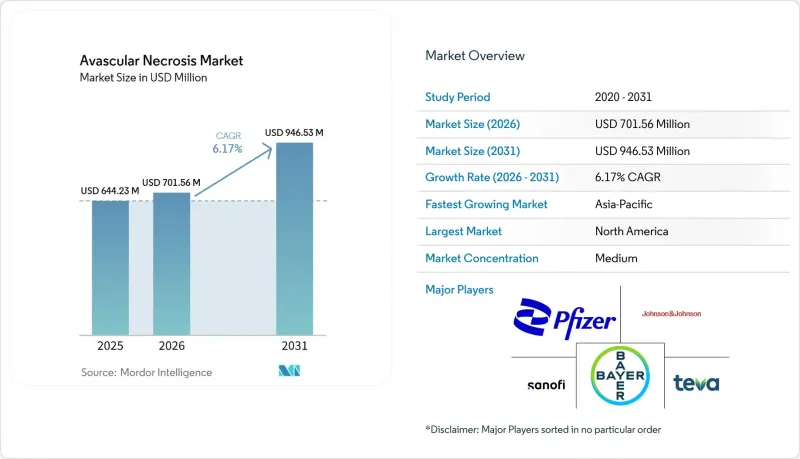
Mordor Intelligence에 의하면, 무혈성 괴사 시장 규모는 2025년 6억 4,423만 달러로 평가되었고, 2026년에는 7억 156만 달러로 확대될 것으로 추정되고, 2026-2031년 CAGR 6.17%로 성장을 지속할 전망이며, 2031년에는 9억 4,653만 달러에 이를 것으로 예측됩니다.
본 보고서는 치료법별(의약품, 골 대체 기기 및 임플란트), 질환별(외상성, 비외상성 무혈성 괴사 등), 진단법별(영상 진단, 생검 등), 최종 사용자별(병원, 전문 클리닉 등), 지역별(북미, 유럽, 아시아태평양, 중동 및 아프리카, 남미)로 분류되어 있습니다. 시장 전망은 금액(달러) 기준으로 제시되어 있습니다.
세계의 무혈성 괴사 시장 동향 및 인사이트
스테로이드 유발성 및 외상 관련 골허혈 발생률 증가
코르티코스테로이드 투여는 여전히 무혈성 괴사 시장에서 가장 강력한, 조절 가능한 수요 촉진요인으로 작용하고 있습니다. 『Diagnostics』 저널의 2024년 총설에서는 고용량 코르티코스테로이드를 투여받는 환자의 발병률이 3%에서 37% 사이인 것으로 보고되었으며, 추가적인 위험 요인이 없는 고용량 사용자에서도 21%의 발병률이 확인되었다고 지적하고 있습니다. 2025년 『Journal of Orthopaedic Research』지에 게재된 총설에서는 코로나19 이후 무혈성 괴사(AVN) 발병과 관련하여 평균 잠복기가 126일이며, 프레드니솔론 환산으로 1,198 mg의 누적 스테로이드 노출량과 연관되어 있다고 밝혔습니다. 이러한 경향이 중요하게 여겨지는 이유는 이러한 환자의 상당수가 30-45세 연령대에 속하며, 즉시 인공관절 치환술보다는 관절 보존술에 대한 수요가 증가하고 있기 때문입니다. 외상과 관련된 AVN 또한 무혈성 괴사 시장을 지탱하는 요인이 되고 있습니다. 골절, 탈구, 압박 손상은 여전히 수술 건수가 많은 정형외과 분야에서 안정적인 수술 대상 환자층을 형성하고 있기 때문입니다. 이러한 시너지 효과로 인해 무혈성 괴사 시장 전체에서 약물, 감압술, 임플란트, 재생의학을 뒷받침하는 치료의 적용 범위가 확대되고 있습니다.
관절 치환술 및 골 보존술 시술 건수의 확대
수술 건수의 확대는 여전히 무혈성 괴사 시장의 성장을 뒷받침하는 가장 명확한 요인 중 하나입니다. 미국 관절 치환 등록부(American Joint Replacement Registry)의 기록에 따르면, 2024년까지 440만 건 이상의 고관절 및 무릎 관절 치환술이 시행되었으며, 해당 등록부의 2025년 연례 보고서에서는 수술 건수가 전년 대비 8.8% 증가한 것으로 나타났습니다. 이러한 추세는 팬데믹으로 인한 혼란이 가라앉은 후에도 진행 단계에 있는 치료 수요가 여전히 높은 수준을 유지하고 있음을 뒷받침합니다. 무혈성 괴사 시장은 진행된 대퇴골두 괴사 사례의 상당 부분을 여전히 인공 고관절 전치환술이 차지하고 있기 때문에 직접적인 혜택을 받고 있습니다. 또한, 골보존 수술은 특히 구조적 붕괴가 발생하기 전에 진단받은 환자의 경우, 질환의 초기 단계에서도 여전히 중요한 역할을 하고 있습니다. 당일 인공관절 치환술의 승인 범위 확대와 의료기기의 지속적인 출시로 인해, 예측 기간 동안 수술 건수 증가가 무혈성 괴사 시장의 핵심 성장 요인으로 계속 작용할 것으로 전망됩니다.
높은 수술 비용과 보험 급여를 둘러싼 마찰
보험 급여는 여전히 무혈성 괴사 시장에 있어 가장 뚜렷한 걸림돌 중 하나입니다. Aetna사는 2025년 11월 보험 적용 지침 CPB 0753을 개정하여, 보험 적용 대상인 코어 감압술과 새로운 CPT 코드에 따라 청구되는 실험적 세포를 이용한 보조적 처치 간의 구분을 엄격화했습니다. 이로 인해 임상적 근거가 강화되었음에도 불구하고, 많은 재생의료 접근법이 여전히 일반 보험 급여 대상에서 제외되고 있습니다. 따라서 무혈성 괴사 시장에서는 의료적 가능성과 상업적 접근성 사이에 괴리가 나타나고 있습니다. 중국에서도 정부의 조달 압력으로 인해 고관절 임플란트의 보고 가격이 3만 5,000위안(4,900달러)에서 7,000위안(980달러)으로 하락한 결과, 기존 의료기기의 이익률이 감소하고 있습니다. 이로 인해 제조업체들은 프리미엄 시스템으로의 전환을 강요받고 있으며, 단위 수요가 증가하고 있음에도 불구하고 무혈성 괴사 시장의 일부는 여전히 가격 압박에 시달리고 있습니다.
부문 분석
2025년에는 골 대체용 기기 및 임플란트가 53.83%의 점유율을 차지한 것으로 평가되었으며, 이 부문은 2031년까지 연평균 성장률(CAGR) 7.15%로 가장 높은 성장률을 기록하며 확대될 것으로 전망됩니다. 이러한 주도적인 위상은 무혈성 괴사 시장이 여전히 구조적 붕괴가 발생한 후 후기 단계의 외과적 개입에 얼마나 의존하고 있는지를 보여줍니다. 인공 고관절 전치환술, 재치환술 및 시멘트리스 고정 시스템은 이 부문의 주요 수익원으로 계속 자리 잡고 있습니다. 또한, 이 부문은 외과의사들의 익숙한 사용, 강력한 등록 데이터베이스의 지원, 그리고 로봇 및 내비게이션 연동 플랫폼에서의 꾸준한 신제품 출시 주기의 혜택을 받고 있습니다. 따라서 초기 단계의 치료 경로가 확대되고 있음에도 불구하고, 무혈성 괴사 시장은 여전히 의료기기에 의해 지탱되고 있습니다.
출처 초안에 인용된 호주의 레지스트리 데이터는 시멘트리스 시스템의 상업적 모멘텀이 강함을 보여주고 있으며, 해당 레지스트리에서 스트라이커(Stryker)사의 ‘트라이던트(Trident)’ 비구 쉘이 가장 많이 이식된 시멘트리스 비구 시스템으로 확인되었습니다. 이는 중요한 점입니다. 왜냐하면 골내 성장을 통한 고정은 인공 고관절 전치환술을 받게 될 많은 AVN 환자의 요구와 잘 부합하기 때문입니다. 골 이식이나 혈관화 이식 기술도 여전히 중요하지만, 그 채택은 전문의의 기술과 시설의 역량에 크게 좌우됩니다. 약물은 질환의 초기 단계에서 통증, 염증 및 혈관 위험 요인을 관리함으로써, 여전히 무혈성 괴사 시장에서 지속적인 보조적 역할을 수행하고 있습니다. 2026년 『Scientific Reports』지에 게재된 연구에 따르면, 스테로이드 유발 모델에서 프라바스타틴과 피브린 실란트에 봉입된 골수 줄기세포의 병용 요법이 더 우수한 회복 결과와 더 강력한 VEGF 발현과 관련이 있는 것으로 나타났습니다. 이는 의약품과 생물학적 제제의 경계가 더욱 좁혀지고 있음을 시사합니다. 이러한 경계의 모호화로 인해, 진행된 질환에서 임플란트의 핵심적인 역할을 훼손하지 않으면서도 무혈성 괴사 시장에서 치료 옵션이 점차 확대될 가능성이 있습니다.
2025년 기준, 비외상성 무혈성 괴사(AVN)는 무혈성 괴사 시장의 60.38%를 차지했으며, 2031년까지 연평균 성장률(CAGR)이 6.76%로 가장 빠르게 성장하는 질환 부문이기도 합니다. 이러한 추세로 인해 스테로이드 노출, 전신성 질환 및 혈관 장애가 무혈성 괴사 시장의 핵심 과제로 대두되고 있습니다. 이 부문이 특히 중요한 이유는 다발성 병변을 유발하기 쉬우며, 여러 관절에 걸쳐 반복적인 영상 진단, 치료 및 경과 관찰이 필요하기 때문입니다. 출처 초안에 인용된 2025년 보고서에서는 코르티코스테로이드 치료를 받고 있는 환자에서 다발성 골괴사 증가가 지적되었으며, 이로 인해 사례당 평균 부담이 증가하고 있습니다. 이러한 추세로 인해 무혈성 괴사 시장에서는 단일 관절 수술 모델이 시사하는 것보다 더 광범위한 서비스 및 제품에 대한 수요가 발생하고 있습니다.
비외상성 무혈성 괴사(AVN) 중 스테로이드 유발성 질환은 여전히 가장 큰 하위 유형이지만, 특발성 및 방사선 관련 사례는 규모는 작으나 예측하기 어려운 환자 집단을 형성하고 있습니다. 또한, 겸상적혈구증이나 루푸스와 관련된 사례도, 임상 현장에서 이러한 기저 질환이 더 두드러지게 나타나는 특정 지역에서 수요를 형성하고 있습니다. 외상성 AVN은 여전히 큰 2차 환자 집단을 차지하고 있으며, 초안에서는 이 부문이 전체의 40%에 육박하는 것으로 나타났고, 골절, 탈구, 수술 후 경과를 통해 치료를 받는 사례가 많이 관찰됩니다. 『Frontiers in Endocrinology』지에 게재된 2026년 네트워크 메타분석에 따르면, 고용량 자가 줄기세포 치료와 코어 감압술을 병용할 경우, 감압술 단독 치료에 비해 고관절 기능 부전이나 대퇴골두 붕괴의 위험이 감소하는 것으로 밝혀졌습니다. 이 연구 결과는 상업적으로도 중요한데, 외상성 사례가 조기에 확인되면 고관절 보존 전략에 적합할 가능성이 있기 때문입니다. 이러한 경향들이 맞물리면서 무혈성 괴사 시장은 복잡한 전신성 질환 관리와 외과적으로 정의된 외상 관련 치료 모두에 계속해서 초점을 맞추었습니다.
지역별 분석
2025년, 북미는 무혈성 괴사 시장의 38.63% 점유율을 차지하며 계속해서 최대 지역 기여자로서의 지위를 유지했습니다. 미국은 임플란트의 광범위한 접근성, MRI 설비의 확충, 성숙한 정형외과 의뢰 네트워크, 그리고 주요 관절 치환술에 대한 보험 급여 지원을 통해 이러한 위상을 주도하고 있습니다. 2025년 ‘미국 관절 치환 등록부(American Joint Replacement Registry)’ 보고서에 따르면, 2024년까지 누적 440만 건 이상의 고관절 및 무릎 관절 치환술이 시행되었으며, 이는 해당 지역의 풍부한 수술 실적을 반영합니다. 이러한 인프라는 무혈성 괴사 시장에 대해 진행 단계의 수술과 영상 진단을 기반으로 한 조기 개입 모두에 있어 견고한 기반을 제공합니다. 캐나다와 멕시코도 이 지역의 수술 건수를 끌어올리고 있는데, 캐나다에서는 안정적인 공적 의료 보험이 제공되고, 멕시코에서는 특정 의료 기관에서 국경을 초월한 정형외과 의료가 지원되고 있습니다.
유럽은 독일, 프랑스, 영국의 대규모 의료 시스템이 영상 진단, 수술 및 경과 관찰에 대한 접근성을 뒷받침하고 있어 무혈성 괴사 시장에서 계속해서 안정적인 위치를 차지하고 있습니다. 또한 이탈리아와 스페인의 고령화도 질환 관리에 대한 수요를 활발하게 유지하고 있습니다. 서유럽에서는 로봇 보조 고관절 치환술 및 AI 기반 안내 시스템의 도입이 급속히 진행되고 있으며, 이는 무혈성 괴사 시장의 프리미엄 의료기기 분야를 강화하고 있습니다. 선진 치료 의약품에 관한 유럽의약품청(EMA)의 프레임워크는 해당 지역 전체의 세포 치료 상업화에 있어 계속해서 중요한 역할을 할 것입니다. 동유럽 시장은 여전히 비용에 민감하여 제네릭 의약품의 사용과 중저가 임플란트의 채택이 선호되고 있습니다.
아시아태평양은 무혈성 괴사 시장에서 가장 빠르게 성장하는 지역으로, 2031년까지 연평균 성장률(CAGR)이 7.04%를 나타낼 것으로 예측됩니다. 중국이 이 지역 시장 기회를 주도하고 있으며, 출처가 된 초안에 따르면 비외상성 대퇴골두 괴사의 누적 사례 수는 800만 건을 초과하고, 매년 15만-20만 건의 신규 진단이 이루어지고 있습니다. 또한 중국에서는 조달 압박으로 인해 수술 접근성이 확대되는 동시에 기존 임플란트 가격이 하락하는 추세가 나타나고 있으며, 이로 인해 공급업체들은 로봇 호환 프리미엄 시스템으로 눈을 돌리고 있습니다. 일본에서는 혁신적인 임플란트 기술이 발전하고 있으며, 2025년 9월에는 감염 관리에 중점을 두는 정형외과 의료에서 매우 중요한 요오드 처리된 인공 고관절 시스템에 대해 지머 바이오메트(Zimmer Biomet)사가 PMDA의 승인을 획득했습니다. 한국에서는 규모는 작지만 고품질의 재생의료 분야가 지원되고 있는 반면, 중동 및 아프리카 및 남미의 경우 보험 환급 격차, 인력 부족, 주요 도시 외 지역의 MRI 보급률 저하 등의 이유로 여전히 초기 단계 시장 기회에 머물러 있습니다.
기타 혜택 :
- 엑셀 형식 시장 예측(ME) 시트
- 3개월간의 애널리스트 지원
목차
제1장 서론
제2장 조사 방법
제3장 주요 요약
제4장 시장 구도
제5장 시장 규모 및 성장 예측
제6장 경쟁 구도
제7장 시장 기회 및 향후 전망
AJYAccording to Mordor Intelligence, the avascular necrosis market size is expected to grow from USD 644.23 million in 2025 to USD 701.56 million in 2026 and is forecast to reach USD 946.53 million by 2031 at 6.17% CAGR over 2026-2031.
This report is Segmented by Treatment Type (Drugs, Bone Replacement Devices & Implants), Disease Type (Traumatic, Non-Traumatic Avascular Necrosis, and More), Diagnosis (Imaging, Biopsy, and More), End User (Hospitals, Specialty Clinics, and More), and Geography (North America, Europe, Asia-Pacific, Middle East & Africa, South America). The Market Forecasts are Provided in Terms of Value (USD).
Global Avascular Necrosis Market Trends and Insights
Rising Incidence of Steroid-Induced and Trauma-Related Bone Ischemia
Corticosteroid exposure remains the strongest modifiable demand driver in the avascular necrosis market. A 2024 review in Diagnostics reported incidence ranging from 3% to 37% in patients receiving high-dose corticosteroids, and it noted a 21% rate even in high-dose users without added risk factors. A 2025 review in the Journal of Orthopaedic Research linked post-COVID AVN onset to a mean latency of 126 days and cumulative steroid exposure of 1,198 mg prednisolone equivalent. This pattern matters because many of these patients are in the 30-45 age group, which increases demand for joint preservation instead of immediate replacement. Trauma-related AVN is also supporting the avascular necrosis market, because fractures, dislocations, and crush injuries still create a durable surgical pool in high-volume orthopedic systems. The combined effect is a wider treatment funnel that supports drugs, decompression, implants, and regenerative care across the avascular necrosis market.
Expanding Joint-Replacement and Bone-Preservation Procedure Volumes
Procedure expansion remains one of the clearest growth supports for the avascular necrosis market. The American Joint Replacement Registry recorded more than 4.4 million hip and knee arthroplasty procedures through 2024, and its 2025 annual report showed an 8.8% year-over-year increase in procedure count. That trend confirms that late-stage intervention demand remains elevated, even after pandemic-related disruption has passed. The avascular necrosis market benefits directly because total hip arthroplasty still absorbs a large share of advanced femoral head collapse cases. Bone-preserving surgeries also remain relevant in earlier disease, especially when patients are diagnosed before structural collapse. Wider approval for same-day arthroplasty and continued device launches should keep procedure volume growth central to the avascular necrosis market over the forecast period.
High Procedure Costs and Reimbursement Friction
Reimbursement remains one of the clearest brakes on the avascular necrosis market. Aetna updated coverage policy CPB 0753 in November 2025 and tightened the distinction between covered core decompression use and experimental adjunctive cell-based procedures billed under newer CPT codes. That keeps many regenerative approaches outside routine reimbursement, even as clinical evidence becomes stronger. The avascular necrosis market, therefore shows a mismatch between medical promise and commercial access. In China, price compression in hip implants has also reduced conventional device margins, after reported prices moved from CNY 35,000 (USD 4,900) to CNY 7,000 (USD 980) under national procurement pressure. This pushes manufacturers toward premium systems and leaves parts of the avascular necrosis market exposed to pricing pressure even when unit demand is rising.
Other drivers and restraints analyzed in the detailed report include:
- Rising Adoption of Early MRI-Based Diagnosis and Risk-Stratified Screening
- Growing Pipeline for Regenerative and Cell-Based Joint-Preservation Therapies
- Late Presentation and Low Primary-Care Recognition
For complete list of drivers and restraints, kindly check the Table Of Contents.
Segment Analysis
Bone replacement devices and implants held 53.83% share in 2025, and this category is also projected to grow at the fastest 7.15% CAGR through 2031. This leadership shows how much of the avascular necrosis market still depends on late-stage surgical intervention after structural collapse has occurred. Total hip arthroplasty, revision procedures, and cementless fixation systems remain the main revenue base in this segment. The category also benefits from surgeon familiarity, strong registry support, and a steady launch cycle in robotic and navigation-linked platforms. That has kept the avascular necrosis market anchored to devices even as earlier-stage treatment pathways expand.
The Australian registry evidence cited in the source draft points to strong commercial traction for cementless systems, with Stryker's Trident acetabular shell identified as the most implanted cementless acetabular system in that registry. This matters because bone ingrowth fixation is well aligned with the needs of many AVN patients who progress to total hip arthroplasty. Bone grafts and vascularized graft techniques remain relevant, but their uptake depends more heavily on specialist skill and center capability. Drugs still play a durable supporting role in the avascular necrosis market by addressing pain, inflammation, and vascular risk factors in earlier disease stages. A 2026 Scientific Reports study also linked pravastatin plus fibrin sealant-embedded bone marrow stem cells with better repair outcomes and stronger VEGF expression in a steroid-induced model, which suggests that drug and biologic boundaries may keep narrowing. That crossover could gradually broaden the treatment mix inside the avascular necrosis market without displacing the central role of implants in advanced disease.
Non-traumatic AVN accounted for 60.38% of the avascular necrosis market share in 2025, and it is also the fastest-growing disease segment with a 6.76% CAGR through 2031. This pattern places steroid exposure, systemic disease, and vascular compromise at the center of the avascular necrosis market. The segment is especially important because it often creates multifocal disease and repeated imaging, treatment, and follow-up needs across several joints. A 2025 report cited in the source draft described rising multifocal osteonecrosis in corticosteroid-treated patients, which lifts the average burden per case. That dynamic gives the avascular necrosis market a broader service and product requirement than a single-joint procedural model would suggest.
Steroid-induced disease remains the largest subtype within non-traumatic AVN, while idiopathic and radiation-related cases add smaller but harder-to-predict patient pools. Sickle cell disease-associated and lupus-related presentations also shape demand in selected regions where those underlying disorders are more visible in clinical practice. Traumatic AVN still represents a large secondary pool, near 40% of the segment in the source draft, and it often reaches care through fracture, dislocation, and post-surgical pathways. A 2026 network meta-analysis in Frontiers in Endocrinology found that high-dose autologous stem cell therapy combined with core decompression lowered the risk of hip failure and femoral head collapse relative to decompression alone. That finding is commercially relevant because traumatic cases can be well-suited to hip-preserving strategies when they are identified early enough. Together, these patterns keep the avascular necrosis market focused on both complex systemic disease management and surgically defined injury-related care.
Complete Report Scope:
- By Treatment Type
- Drugs
- Nonsteroidal Anti-Inflammatory Drugs
- Cholesterol-Lowering Drugs
- Blood Thinners
- Other Drugs
- Bone Replacement Devices and Implants
- Bone Grafts
- Joint Replacement Surgery
- Cementless Prosthesis
- Drugs
- By Disease Type
- Traumatic Avascular Necrosis
- Fracture-Induced
- Dislocation-Induced
- Post-Surgical
- Crush Injury-Related
- Sports Injury-Associated
- Non-Traumatic Avascular Necrosis
- Steroid-Induced
- Alcohol-Induced
- Sickle Cell Disease-Associated
- Lupus-Related
- Radiation Therapy-Induced
- Idiopathic
- By Diagnosis
- Imaging
- Biopsy
- Computed Tomography Scan
- Positron Emission Tomography
- X-Ray
- By End User
- Hospitals
- Specialty Clinics
- Rehabilitation Centers
- Ambulatory Surgical Centers
- Home Care Settings
- By Geography
- North America
- United States
- Canada
- Mexico
- Europe
- Germany
- United Kingdom
- France
- Italy
- Spain
- Rest of Europe
- Asia-Pacific
- China
- Japan
- India
- Australia
- South Korea
- Rest of Asia-Pacific
- Middle East & Africa
- GCC
- South Africa
- Rest of Middle East & Africa
- South America
- Brazil
- Argentina
- Rest of South America
- North America
Geography Analysis
North America held 38.63% of the avascular necrosis market share in 2025, which kept it as the largest regional contributor. The United States drives this position through broad implant availability, dense MRI capacity, mature orthopedic referral networks, and reimbursement support for major joint replacement procedures. The 2025 American Joint Replacement Registry report documented more than 4.4 million cumulative hip and knee arthroplasty procedures through 2024, which reflects the depth of the regional procedural base. This infrastructure gives the avascular necrosis market a strong platform for both advanced-stage surgery and earlier imaging-led intervention. Canada and Mexico add to regional volume, with Canada offering stable public coverage and Mexico supporting cross-border orthopedic care in selected centers.
Europe remains a stable part of the avascular necrosis market because large health systems in Germany, France, and the United Kingdom support access to imaging, surgery, and follow-up care. Aging populations in Italy and Spain also keep disease management demand active. Western Europe is moving faster in robotic hip arthroplasty and AI-enabled guidance, which strengthens the premium device layer of the avascular necrosis market. The European Medicines Agency framework for advanced therapy medicinal products will remain important for cell-based commercialization across the region. Eastern European markets remain more cost sensitive, which favors generic drug use and mid-tier implant adoption.
Asia-Pacific is the fastest-growing region in the avascular necrosis market, with a projected 7.04% CAGR through 2031. China dominates the regional opportunity, and the source draft cited more than 8 million cumulative non-traumatic femoral head necrosis cases with 150,000 to 200,000 new diagnoses each year. China also shows how procurement pressure can expand procedure access while reducing conventional implant pricing, which is pushing suppliers toward premium robot-compatible systems. Japan is advancing novel implant technology, and Zimmer Biomet received PMDA approval in September 2025 for an iodine-treated total hip system that directly matters for infection-conscious orthopedic care. South Korea supports a smaller but premium regenerative segment, while Middle East and Africa and South America remain earlier-stage opportunities because of reimbursement gaps, workforce shortages, and lower MRI penetration outside major cities.
- Athersys, Inc.
- Aurobindo Pharma Ltd.
- Bayer
- Bone Therapeutics
- Dr. Reddy's Laboratories
- Exactech
- Integra LifeSciences
- Johnson & Johnson
- Medtronic
- Merck
- Mesoblast Limited
- Novartis
- Pfizer
- Regrow Biosciences Pvt. Ltd.
- Sanofi
- Smiths Group
- Stryker
- Teva Pharmaceutical Industries
- Vericel
- Zimmer Biomet
Additional Benefits:
- The market estimate (ME) sheet in Excel format
- 3 months of analyst support
TABLE OF CONTENTS
1 Introduction
- 1.1 Study Assumptions & Market Definition
- 1.2 Scope of the Study
2 Research Methodology
3 Executive Summary
4 Market Landscape
- 4.1 Market Overview
- 4.2 Market Drivers
- 4.2.1 Rising Incidence of Steroid-Induced and Trauma-Related Bone Ischemia
- 4.2.2 Expanding Joint-Replacement and Bone-Preservation Procedure Volumes
- 4.2.3 Rising Adoption of Early MRI-Based Diagnosis and Risk-Stratified Screening
- 4.2.4 Growing Pipeline for Regenerative and Cell-Based Joint-Preservation Therapies
- 4.2.5 Increasing Use of Specialty Orthopedic Referral Pathways
- 4.2.6 Expanding Medical Tourism for Advanced Orthopedic Care
- 4.3 Market Restraints
- 4.3.1 High Procedure Costs and Reimbursement Friction
- 4.3.2 Late Presentation and Low Primary-Care Recognition
- 4.3.3 Limited Long-Term Evidence for Regenerative Interventions
- 4.3.4 Shortage of Skilled Orthopedic Surgeons in Emerging Markets
- 4.4 Value / Supply-Chain Analysis
- 4.5 Regulatory Landscape
- 4.6 Technological Outlook
- 4.7 Porter's Five Forces Analysis
- 4.7.1 Threat of New Entrants
- 4.7.2 Bargaining Power of Suppliers
- 4.7.3 Bargaining Power of Buyers
- 4.7.4 Threat of Substitutes
- 4.7.5 Industry Rivalry
5 Market Size & Growth Forecasts
- 5.1 By Treatment Type
- 5.1.1 Drugs
- 5.1.1.1 Nonsteroidal Anti-Inflammatory Drugs
- 5.1.1.2 Cholesterol-Lowering Drugs
- 5.1.1.3 Blood Thinners
- 5.1.1.4 Other Drugs
- 5.1.2 Bone Replacement Devices and Implants
- 5.1.2.1 Bone Grafts
- 5.1.2.2 Joint Replacement Surgery
- 5.1.2.3 Cementless Prosthesis
- 5.1.1 Drugs
- 5.2 By Disease Type
- 5.2.1 Traumatic Avascular Necrosis
- 5.2.2 Fracture-Induced
- 5.2.3 Dislocation-Induced
- 5.2.4 Post-Surgical
- 5.2.5 Crush Injury-Related
- 5.2.6 Sports Injury-Associated
- 5.2.7 Non-Traumatic Avascular Necrosis
- 5.2.8 Steroid-Induced
- 5.2.9 Alcohol-Induced
- 5.2.10 Sickle Cell Disease-Associated
- 5.2.11 Lupus-Related
- 5.2.12 Radiation Therapy-Induced
- 5.2.13 Idiopathic
- 5.3 By Diagnosis
- 5.3.1 Imaging
- 5.3.2 Biopsy
- 5.3.3 Computed Tomography Scan
- 5.3.4 Positron Emission Tomography
- 5.3.5 X-Ray
- 5.4 By End User
- 5.4.1 Hospitals
- 5.4.2 Specialty Clinics
- 5.4.3 Rehabilitation Centers
- 5.4.4 Ambulatory Surgical Centers
- 5.4.5 Home Care Settings
- 5.5 By Geography
- 5.5.1 North America
- 5.5.1.1 United States
- 5.5.1.2 Canada
- 5.5.1.3 Mexico
- 5.5.2 Europe
- 5.5.2.1 Germany
- 5.5.2.2 United Kingdom
- 5.5.2.3 France
- 5.5.2.4 Italy
- 5.5.2.5 Spain
- 5.5.2.6 Rest of Europe
- 5.5.3 Asia-Pacific
- 5.5.3.1 China
- 5.5.3.2 Japan
- 5.5.3.3 India
- 5.5.3.4 Australia
- 5.5.3.5 South Korea
- 5.5.3.6 Rest of Asia-Pacific
- 5.5.4 Middle East & Africa
- 5.5.4.1 GCC
- 5.5.4.2 South Africa
- 5.5.4.3 Rest of Middle East & Africa
- 5.5.5 South America
- 5.5.5.1 Brazil
- 5.5.5.2 Argentina
- 5.5.5.3 Rest of South America
- 5.5.1 North America
6 Competitive Landscape
- 6.1 Market Concentration
- 6.2 Market Share Analysis
- 6.3 Company Profiles (includes Global Level Overview, Market-level Overview, Core Segments, Financials, Strategic Information, Market Rank/Share, Products & Services, Recent Developments)
- 6.3.1 Athersys, Inc.
- 6.3.2 Aurobindo Pharma Ltd.
- 6.3.3 Bayer AG
- 6.3.4 Bone Therapeutics SA
- 6.3.5 Dr. Reddy's Laboratories Ltd.
- 6.3.6 Exactech, Inc.
- 6.3.7 Integra LifeSciences Holdings Corporation
- 6.3.8 Johnson and Johnson
- 6.3.9 Medtronic plc
- 6.3.10 Merck and Co., Inc.
- 6.3.11 Mesoblast Limited
- 6.3.12 Novartis AG
- 6.3.13 Pfizer Inc.
- 6.3.14 Regrow Biosciences Pvt. Ltd.
- 6.3.15 Sanofi SA
- 6.3.16 Smith and Nephew plc
- 6.3.17 Stryker Corporation
- 6.3.18 Teva Pharmaceutical Industries Ltd.
- 6.3.19 Vericel Corporation
- 6.3.20 Zimmer Biomet Holdings Inc.
7 Market Opportunities & Future Outlook
- 7.1 White-space & Unmet-need Assessment