

|
시장보고서
상품코드
2099853
반려동물사료 기계 시장 : 시장 점유율 분석, 업계 동향 및 통계, 성장 예측(2026-2031년)Pet Food Machinery - Market Share Analysis, Industry Trends & Statistics, Growth Forecasts (2026 - 2031) |
||||||
 Mordor Intelligence
Mordor Intelligence에 의하면, 반려동물사료 기계 시장은 2025년 45억 달러로 평가되었고, 2026년 47억 5,000만 달러에서 2031년까지 62억 달러로 성장할 전망이며, 2026-2031년 CAGR 5.47%를 나타낼 것으로 예측됩니다.
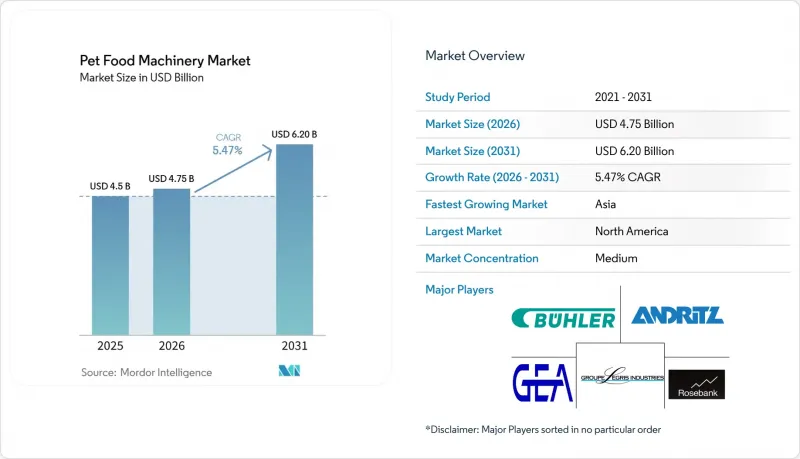
본 보고서는 설비 유형별(압출, 혼합 등), 제조 공정별(건식, 습식 등), 제품 형태별(건식 사료, 통조림 등), 반려동물 유형별(개, 고양이) 및 지역별(북미, 남미 등)로 분류되어 있습니다. 시장 전망은 금액(달러) 기준으로 제시되어 있습니다.
세계의 반려동물사료 기계 시장 동향 및 인사이트
반려동물사료 생산의 프리미엄화
반려동물사료 기계 시장은 주요 반려동물사료 카테고리 전반에 걸친 프리미엄 및 슈퍼 프리미엄 제품으로의 전환에 힘입어 성장하고 있습니다. 프리미엄 제품 라인에서는 표준 건사료 라인에 비해 더 엄격한 공정 관리, 더 빈번한 레시피 변경, 그리고 더 까다로운 위생 기준이 요구됩니다. 그 결과, 각 제조업체는 원료 투입, 혼합, 압출, 건조, 코팅 각 공정에서 설비 사양을 업그레이드하고 있습니다. 펫푸드 협회(Pet Food Institute)는 2025년 생산 및 원재료 분석에서 2019년부터 2024년 사이에 수산 원료 수요가 95.0%, 육류 및 가금류 원료 수요가 34.0% 증가했다고 보고하고 있으며, 이는 반려동물사료 기계 시장에서 원료 취급 요건이 점점 더 복잡해지고 있음을 반영합니다. 이러한 변화는 원료 비용이나 제품 포지셔닝뿐만 아니라, 공장 재조정 빈도 및 로트 분리 관리에도 영향을 미치고 있습니다. 프리미엄 제품 라인업이 확대됨에 따라, 반려동물사료 가공 시장에서는 소량 생산이나 빈번한 생산 전환 시에도 품질을 유지할 수 있는 유연성이 높은 생산 라인에 대한 관심이 높아지고 있습니다.
기능성·치료용 반려동물사료 생산 확대
또한, 보다 엄격한 제조 조건을 필요로 하는 기능성·치료용 제품의 부상도 시장 성장을 뒷받침하고 있습니다. 수의학적 식이요법 사료나 영양학적으로 특화된 제품은 좁은 전문 분야에서 보다 광범위한 소매 및 수의학 채널로 이동하고 있으며, 정밀 코팅, 제어된 건조, 그리고 분리된 생산 환경에 대한 수요를 높이고 있습니다. 이러한 제품 형태에서는 압출 성형 후 열에 민감한 원재료를 첨가해야 할 뿐만 아니라, 각 생산 공정에서의 문서화 및 검증 강화가 요구되는 경우가 많습니다. 이러한 변화는 설비 투자 계획에도 영향을 미치고 있으며, 제조업체들은 공용 인프라가 아닌 전용 또는 반전용 생산 라인을 점점 더 필요로 하고 있습니다. 반려동물사료 기계 시장에서 이는 재고 관리 단위(SKU)당 설비 집약도를 높이고, 일관된 배합 정확도와 오염 관리를 실현하도록 설계된 시스템에 대한 투자를 촉진하고 있습니다.
통합 가공 라인의 높은 초기 비용
완비된 가공 라인의 높은 비용은 반려동물사료 기계 시장에서 여전히 큰 장벽으로 작용하고 있습니다. 혼합, 압출, 건조, 코팅, 포장을 결합한 통합 시스템에는 막대한 설비 투자가 필요하며, 특히 프리미엄 제품에 대한 수요가 아직 발전 단계에 있는 지역이나 판매 채널에서는 많은 중견 제조업체들이 쉽게 승인하기 어려운 상황입니다. 이러한 과제는 세척 시스템, 자재 선정, 레이아웃 설계에 따라 프로젝트 비용이 대폭 증가할 가능성이 있는 습식 방식이나 위생 관리가 요구되는 제품 형태에서 더욱 두드러집니다. 그 결과, 가격에 민감한 시장에서는 도입 속도가 둔화되고 있으며, 창업한 지 얼마 되지 않은 브랜드는 자체 설비를 보유하기보다는 외부 위탁 생산을 선택할 수밖에 없는 실정입니다. 시장에서는 이러한 비용 장벽으로 인해 판매 주기가 장기화되고 있으며, 많은 프로젝트가 전체 라인 교체가 아닌 단계적인 업그레이드에 중점을 두게 되었습니다.
부문 분석
2025년, 압출 성형 장비는 반려동물사료 기계 시장 점유율의 29.5%를 차지하며 최대의 설비 카테고리가 되었습니다. 이러한 위상은 드라이 키블 생산을 뒷받침하는 기존 설비군을 반영한 것으로, 드라이 키블은 계속해서 전 세계 반려동물사료 생산의 기반이 되어 갱신 수요, 서비스 수익 및 업그레이드 활동을 주도하고 있습니다. 압출 성형은 주류 제품 형태 전반에 걸쳐 밀도, 식감, 가열 성능 및 제품의 균일성을 결정짓기 때문에 여전히 시장에서 핵심적인 가공 공정으로 자리 잡고 있습니다. 제품 포트폴리오가 진화하고 있음에도 불구하고, 대부분의 제조업체는 제어 및 위생 개선이 후공정 성능에 가장 직접적인 영향을 미치는 공정으로 압출 성형을 계속해서 꼽고 있습니다.
포장 설비는 2026-2031년 연평균 성장률(CAGR) 8.5%를 나타낼 것으로 예측되며, 가장 빠르게 성장하는 설비 하위 부문이 될 전망입니다. 습식 사료, 프리미엄 사료, 프레시라이크 제품 및 1회분 제품의 성장이 다양한 밀봉 방식, 자재관리 시스템 및 최종 포장 구성에 대한 수요를 견인하고 있습니다. 2025년에도 혼합 및 블렌딩 설비는 여전히 2위 규모를 차지하며, 습식 사료의 제조와 기능성 제품을 위한 정밀한 원료 배합을 모두 지원하고 있습니다. 제조업체들이 추적성, 재현성 및 전환 손실 감소를 더욱 중시함에 따라, 자동화 및 제어 시스템은 소규모 기반에서 지속적으로 확대되고 있습니다. 또한, 새로운 단백질 및 다양한 원료 크기에 대응하기 위해 열처리 전 입자 조제 과정에서 보다 엄격한 제어가 요구됨에 따라, 분쇄·제분 설비도 여전히 중요한 역할을 수행하고 있습니다.
2025년, 건식 반려동물사료 가공 라인은 반려동물사료 기계 시장 규모의 41.2%를 차지한 것으로 평가되었으며, 이는 전 세계 건식 사료 생산 능력의 규모와 성숙도를 반영합니다. 이러한 위상은 이미 설치된 건식 라인의 긴 가동 수명에 의해 뒷받침되고 있습니다. 생산자들은 다른 공정 구성으로의 완전한 전환보다는 개조나 부품 업그레이드를 선호하는 경향이 있기 때문입니다. 건식 가공 분야에서는 라인에 대한 숙련도, 처리 능력의 안정성, 폭넓은 제품과의 호환성이 여전히 중요시되고 있으며, 시장은 견고한 설치 기반의 논리를 유지하고 있습니다. 또한, 건식 시스템은 이 부문에서 중심적인 역할을 수행하고 있기 때문에 다양한 서비스 및 애프터마켓 관계를 뒷받침하는 기반으로서도 계속해서 중요한 위치를 차지하고 있습니다.
수의용 다이어트 사료 가공 라인은 2026-2031년 연평균 성장률(CAGR) 9.4%로 확대될 것으로 예측되며, 가장 빠르게 성장하는 공정 유형이 될 전망입니다. 이러한 라인에서는 표준 공용 설비를 이용한 운영에 비해, 보다 엄격한 공정 분리, 관리된 코팅 공정, 그리고 더욱 철저한 위생 관리가 요구됩니다. 또한, 건식 가공이 설치 용량 측면에서 여전히 주류를 이루고 있지만, 프리미엄화 추세가 진행됨에 따라 습식 유형 수요가 확대되고 있어 습식 반려동물사료 가공 라인도 성장하고 있습니다. 간식 가공 라인은 성형, 소성, 냉각 및 식감에 관한 요건이 주요 건식 사료(키블)의 제조 공정과 크게 다르기 때문에 별도의 조달 분야를 형성하고 있습니다. 반려동물사료 기계 시장 전체에서 전문화된 라인의 성장에 따라, 동일한 부지 내에서 서로 다른 열처리 프로파일 및 제품 품질 요건에 대응할 수 있는 공장의 가치가 높아지고 있습니다.
지역별 분석
2025년 기준, 북미는 시장 점유율의 33.0%를 차지하며 최대 지역 시장이 되었습니다. 이 지역은 대규모 프리미엄 반려동물사료 시장, 확립된 제조 인프라, 그리고 설비 갱신, 확장, 현대화를 위한 지속적인 투자의 혜택을 받고 있습니다. 또한 북미 시장은 공급업체와의 견고한 관계에 힘입어, 대규모 공장에서는 설비 납품뿐만 아니라 서비스 지원, 디지털 제어, 규정 준수 설계도 요구되고 있습니다. 이러한 요인들로 인해 상업 개발이 아직 초기 단계에 있는 지역과 비교하여 부가가치가 높은 설비 구성이 실현되고 있습니다.
아시아태평양은 2026-2031년 연평균 성장률(CAGR) 7.4%로 확대될 것으로 예측되며, 가장 빠르게 성장하는 지역이 될 전망입니다. 이러한 성장은 중국, 일본, 인도, 동남아시아에서의 상업용 반려동물사료 제조 확대에 의해 주도되고 있으며, 이들 지역에서는 반려동물 사육 마릿수 증가에 따라 수요가 체계화된 브랜드 제품으로 전환되고 있습니다. 태국은 반려동물사료 제조의 지역적 수출 거점으로 부상하고 있으며, 최신 습식 및 건식 가공 시스템에 대한 수요 증가를 뒷받침하고 있습니다. 2026년, CPM Holdings, Inc.는 허베이성에 위치한 Shengmeng사를 위해 TwinTech 압출 시스템을 가동하며, 이 중국 제조업체가 상업용 반려동물사료 제조 시장에 진출했음을 보여주었습니다. 이러한 프로젝트는 아시아태평양의 반려동물사료 기계 시장이 국내 소비뿐만 아니라 수출 및 프리미엄 제품에 대한 수요를 중심으로 구축된 새로운 산업 생산 능력을 통해 확대되고 있음을 보여줍니다.
유럽은 여전히 반려동물사료 가공 장비에 있어 중요한 시장이며, 그 동향은 주로 장비 교체, 위생 수준 향상, 그리고 수출 지향적인 OEM(주문자 상표 생산) 생산과 관련이 있습니다. 이 지역의 구매자들은 위생 공학, 추적성, 내구성이 뛰어난 설계를 매우 중요하게 여기며, 이것이 장비의 평균 사양 고도화를 뒷받침하고 있습니다. 남미에서는 브라질이 지역 생산 수요를 주도하고 있으며, 공급업체들이 이 지역에 사업 거점을 구축함에 따라 그 중요성이 높아지고 있습니다. 중동 및 아프리카는 절대적인 규모로는 여전히 작지만, 1세대 대규모 시설이 등장하기 시작하면서 주목을 받고 있습니다. 전반적으로 반려동물사료 기계 시장은 지리적으로 확대되고 있으며, 성숙한 지역에서는 설비 업그레이드에, 신흥 지역에서는 기초적인 생산 능력 확충에 중점을 두고 있습니다.
기타 혜택 :
- 엑셀 형식 시장 예측(ME) 시트
- 3개월간의 애널리스트 지원
자주 묻는 질문
목차
제1장 서론
제2장 조사 방법
제3장 주요 요약
제4장 시장 구도
제5장 시장 규모 및 성장 예측
제6장 경쟁 구도
제7장 시장 기회 및 향후 전망
AJY 26.08.11According to Mordor Intelligence, the pet food machinery market is projected to grow from USD 4.50 billion in 2025 and USD 4.75 billion in 2026 to USD 6.20 billion by 2031, registering a CAGR of 5.47% between 2026 and 2031.
This report is Segmented by Equipment Type (Extrusion, Mixing, and More), by Process Type (Dry, Wet, and More), by Output Format (Kibbles, Canned, and More), by Pet Type (Dogs and Cats), and by Geography (North America, South America, and More). The Market Forecasts are Provided in Terms of Value (USD).
Global Pet Food Machinery Market Trends and Insights
Premiumization of Pet Food Production
The pet food machinery market is being driven by the shift toward premium and super-premium products across major pet food categories. Premium lines require tighter process control, more frequent recipe changes, and stricter hygiene standards than standard kibble lines. As a result, producers are upgrading equipment specifications across intake, mixing, extrusion, drying, and coating stages. The Pet Food Institute reported in its 2025 production and ingredient analysis that demand for marine ingredients rose 95.0% and meat and poultry ingredients rose 34.0% between 2019 and 2024, reflecting the increasingly complex ingredient handling requirements in the pet food machinery market. This shift affects not only ingredient costs and product positioning, but also the frequency of plant recalibration and lot separation management. As premium portfolios expand, the pet food processing market is seeing growing interest in flexible lines that can maintain quality during shorter production runs and more frequent changeovers.
Growth in Functional and Therapeutic Pet Food Output
The market is also gaining support from the rise of functional and therapeutic products that require more controlled manufacturing conditions. Veterinary diets and nutritionally targeted products are moving from a narrow specialty position into broader retail and veterinary channels, lifting demand for precision coating, controlled drying, and segregated production environments. These formats often require post-extrusion application of heat-sensitive ingredients, along with improved documentation and validation at each production step. This shift affects capital planning, as producers increasingly need dedicated or semi-dedicated lines rather than shared-use infrastructure. In the pet food machinery market, this raises equipment intensity per stock-keeping unit and supports spending on systems designed for consistent formulation accuracy and contamination control.
High Upfront Cost of Integrated Processing Lines
The high cost of complete processing lines remains a significant barrier in the pet food machinery market. Integrated systems that combine mixing, extrusion, drying, coating, and packaging require capital commitments that many mid-sized producers cannot easily approve, particularly in regions or channels where premium demand is still developing. This challenge is more pronounced in wet and hygienic formats, where cleaning systems, material selection, and layout design can substantially increase project costs. As a result, adoption slows in price-sensitive markets, pushing early-stage brands toward outsourced manufacturing rather than direct ownership. In the market, this cost barrier extends sales cycles and keeps many projects focused on staged upgrades rather than full-line replacements.
Other drivers and restraints analyzed in the detailed report include:
- Automation Demand to Reduce Recipe Changeover Losses
- Sustainability Pressures on Energy and Water Intensive Lines
- Skilled Technician Shortage for Advanced Automation Systems
For complete list of drivers and restraints, kindly check the Table Of Contents.
Segment Analysis
Extrusion equipment held 29.5% of the pet food machinery share in 2025, making it the largest equipment category. This position reflects the installed base supporting dry kibble production, which continues to anchor global pet food production and drives replacement demand, service revenue, and upgrade activity. Extrusion remains a central processing step in the market because it determines density, texture, cooking performance, and product consistency across mainstream formats. Even as product portfolios evolve, most manufacturers continue to view extrusion as the process stage where improvements in control and hygiene most directly influence downstream performance.
Packaging equipment is projected to grow at an 8.5% CAGR between 2026 and 2031, making it the fastest-growing equipment sub-segment. Growth in wet, premium, fresh-like, and single-serve products is driving demand for different seal types, material handling systems, and final pack configurations. Mixing and blending equipment remained the second-largest category in 2025, supporting both wet food preparation and precise ingredient incorporation for functional products. Automation and control systems are expanding from a smaller base as manufacturers place greater emphasis on traceability, repeatability, and reduced changeover losses. Grinding and milling equipment also remains relevant, as novel proteins and varied ingredient sizes require more controlled particle preparation before thermal processing.
Dry pet food processing lines accounted for 41.2% of the pet food machinery market size in 2025, reflecting the size and maturity of global kibble capacity. This position is supported by the long operating life of installed dry lines, as producers often prefer retrofits and component upgrades over full conversion to other process configurations. The market retains a strong installed-base logic in dry processing, where line familiarity, throughput stability, and broad product compatibility remain relevant. Dry systems also continue to anchor many service and aftermarket relationships, given their central role in the category.
Veterinary diet processing lines are anticipated to expand at a 9.4% CAGR between 2026 and 2031, making them the fastest-growing process type. These lines require tighter process segregation, controlled coating steps, and more rigorous hygiene discipline than standard shared-use operations. Wet pet food processing lines are also growing, as premiumization is expanding demand for moist formats, even though dry processing remains dominant by installed capacity. Treats processing lines form a separate procurement stream, as forming, baking, cooling, and texture requirements differ materially from core kibble operations. Across the pet food machinery market, the growth of specialized lines is increasing the value of plants that can support different thermal profiles and product integrity requirements within the same site.
Complete Report Scope:
- By Equipment Type
- Extrusion Equipment
- Mixing and Blending Equipment
- Forming and Shaping Equipment
- Drying and Cooling Equipment
- Coating and Flavoring Equipment
- Grinding and Milling Equipment
- Packaging Equipment
- Automation and Control Systems
- Other Equipment Types
- By Process Type
- Dry Pet Food Processing Lines
- Wet Pet Food Processing Lines
- Treats Processing Lines
- Veterinary Diet Processing Lines
- Nutraceutical and Supplement Processing Lines
- By Pet Food Output Format
- Kibbles
- Canned and Wet Food
- Freeze-Dried and Jerky Products
- Soft and Chewy Treats
- Dental Treats
- Powders and Supplements
- Other Pet Food Output Formats
- By Pet Type
- Dogs
- Cats
- Other Pets
- By Geography
- North America
- United States
- Canada
- Mexico
- Rest of North America
- South America
- Brazil
- Argentina
- Rest of South America
- Europe
- France
- Germany
- Italy
- Netherlands
- Poland
- Russia
- Spain
- United Kingdom
- Rest of Europe
- Asia-Pacific
- Australia
- China
- India
- Indonesia
- Japan
- Malaysia
- Philippines
- Taiwan
- Thailand
- Vietnam
- Rest of Asia-Pacific
- Middle East
- Saudi Arabia
- United Arab Emirates
- Rest of Middle East
- Africa
- South Africa
- Egypt
- Rest of Africa
- North America
Geography Analysis
North America accounted for 33.0% of the market share in 2025, making it the largest regional market. The region benefits from a large premium pet food base, established manufacturing infrastructure, and consistent spending on replacement, expansion, and modernization. The North American market also benefits from deep supplier relationships, where large plants require not only equipment delivery but also service support, digital controls, and compliance-ready designs. These factors support a higher-value equipment mix compared to regions that are still in earlier stages of commercial development.
Asia-Pacific is anticipated to expand at a 7.4% CAGR between 2026 and 2031, making it the fastest-growing geography. Growth is driven by expanding commercial pet food manufacturing across China, Japan, India, and Southeast Asia, where rising pet ownership is shifting demand toward organized and branded formats. Thailand is emerging as a regional export base for pet food manufacturing, supporting stronger demand for modern wet and dry processing systems. In 2026, CPM Holdings, Inc.commissioned a TwinTech extrusion system for Shengmeng in Hebei Province, marking the Chinese producer's entry into commercial pet food manufacturing. This type of project indicates that the pet food machinery market in Asia-Pacific is expanding not only through local consumption, but also through new industrial capacity built around export and premium product requirements.
Europe remains an important market for pet food processing equipment, with activity largely tied to replacement, hygiene upgrades, and export-oriented original equipment manufacturers (OEM) manufacturing. Buyers in the region place significant emphasis on sanitary engineering, traceability, and durable design, which supports higher average equipment specifications. South America is gaining relevance as Brazil anchors regional production demand and suppliers establish commercial presence in the region. The Middle East and Africa remain smaller in absolute value but are attracting attention as first-generation large-scale facilities begin to appear. Overall, the pet food machinery market is expanding geographically, with mature regions focused on upgrades and emerging regions focused on foundational capacity buildouts.
- ANDRITZ AG
- Baker Perkins Ltd. (Coperion GmbH)
- Buhler AG (Buhler Group)
- Clextral SAS (Legris Industries Group)
- Coperion GmbH (Hillenbrand Inc.)
- CPM Holdings, Inc. (Rosebank Industries plc )
- FAMSUN Group
- GEA Group Aktiengesellschaft
- Hosokawa Micron Corporation (Hosokawa Micron Group)
- JBT Marel Corporation
- Mepaco Group (Apache Stainless Equipment Corporation)
- Reading Bakery Systems (Markel Food Group)
- The Middleby Corporation
- Fragola S.p.A.
- Triott Group
Additional Benefits:
- The market estimate (ME) sheet in Excel format
- 3 months of analyst support
TABLE OF CONTENTS
1 INTRODUCTION
- 1.1 Study Assumptions and Market Definition
- 1.2 Scope of the Study
2 RESEARCH METHODOLOGY
3 EXECUTIVE SUMMARY
4 MARKET LANDSCAPE
- 4.1 Market Overview
- 4.2 Market Drivers
- 4.2.1 Premiumization of pet food production
- 4.2.2 Growth in functional and therapeutic pet food output
- 4.2.3 Automation demand to reduce recipe changeover losses
- 4.2.4 Sustainability pressures on energy and water intensive lines
- 4.2.5 Expansion of high-mix private label and contract manufacturing
- 4.2.6 Demand for hygienic, traceable, and low-contamination processing
- 4.3 Market Restraints
- 4.3.1 High upfront cost of integrated processing lines
- 4.3.2 Skilled technician shortage for advanced automation systems
- 4.3.3 Plant downtime risk during retrofitting and format switching
- 4.3.4 Ingredient variability increases equipment calibration complexity
- 4.4 Technological Outlook
- 4.5 Regulatory Landscape
- 4.6 Porter's Five Forces Analysis
- 4.6.1 Bargaining Power of Suppliers
- 4.6.2 Bargaining Power of Buyers
- 4.6.3 Threat of New Entrants
- 4.6.4 Threat of Substitutes
- 4.6.5 Intensity of Competitive Rivalry
5 MARKET SIZE AND GROWTH FORECASTS (VALUE)
- 5.1 By Equipment Type
- 5.1.1 Extrusion Equipment
- 5.1.2 Mixing and Blending Equipment
- 5.1.3 Forming and Shaping Equipment
- 5.1.4 Drying and Cooling Equipment
- 5.1.5 Coating and Flavoring Equipment
- 5.1.6 Grinding and Milling Equipment
- 5.1.7 Packaging Equipment
- 5.1.8 Automation and Control Systems
- 5.1.9 Other Equipment Types
- 5.2 By Process Type
- 5.2.1 Dry Pet Food Processing Lines
- 5.2.2 Wet Pet Food Processing Lines
- 5.2.3 Treats Processing Lines
- 5.2.4 Veterinary Diet Processing Lines
- 5.2.5 Nutraceutical and Supplement Processing Lines
- 5.3 By Pet Food Output Format
- 5.3.1 Kibbles
- 5.3.2 Canned and Wet Food
- 5.3.3 Freeze-Dried and Jerky Products
- 5.3.4 Soft and Chewy Treats
- 5.3.5 Dental Treats
- 5.3.6 Powders and Supplements
- 5.3.7 Other Pet Food Output Formats
- 5.4 By Pet Type
- 5.4.1 Dogs
- 5.4.2 Cats
- 5.4.3 Other Pets
- 5.5 By Geography
- 5.5.1 North America
- 5.5.1.1 United States
- 5.5.1.2 Canada
- 5.5.1.3 Mexico
- 5.5.1.4 Rest of North America
- 5.5.2 South America
- 5.5.2.1 Brazil
- 5.5.2.2 Argentina
- 5.5.2.3 Rest of South America
- 5.5.3 Europe
- 5.5.3.1 France
- 5.5.3.2 Germany
- 5.5.3.3 Italy
- 5.5.3.4 Netherlands
- 5.5.3.5 Poland
- 5.5.3.6 Russia
- 5.5.3.7 Spain
- 5.5.3.8 United Kingdom
- 5.5.3.9 Rest of Europe
- 5.5.4 Asia-Pacific
- 5.5.4.1 Australia
- 5.5.4.2 China
- 5.5.4.3 India
- 5.5.4.4 Indonesia
- 5.5.4.5 Japan
- 5.5.4.6 Malaysia
- 5.5.4.7 Philippines
- 5.5.4.8 Taiwan
- 5.5.4.9 Thailand
- 5.5.4.10 Vietnam
- 5.5.4.11 Rest of Asia-Pacific
- 5.5.5 Middle East
- 5.5.5.1 Saudi Arabia
- 5.5.5.2 United Arab Emirates
- 5.5.5.3 Rest of Middle East
- 5.5.6 Africa
- 5.5.6.1 South Africa
- 5.5.6.2 Egypt
- 5.5.6.3 Rest of Africa
- 5.5.1 North America
6 COMPETITIVE LANDSCAPE
- 6.1 Market Concentration
- 6.2 Strategic Moves
- 6.3 Market Share Analysis
- 6.4 Company Profiles (Includes Global Level Overview, Market Level Overview, Core Segments, Financials as Available, Strategic Information, Market Rank, Share, Products and Services, Recent Developments)
- 6.4.1 ANDRITZ AG
- 6.4.2 Baker Perkins Ltd. (Coperion GmbH)
- 6.4.3 Buhler AG (Buhler Group)
- 6.4.4 Clextral SAS (Legris Industries Group)
- 6.4.5 Coperion GmbH (Hillenbrand Inc.)
- 6.4.6 CPM Holdings, Inc. (Rosebank Industries plc )
- 6.4.7 FAMSUN Group
- 6.4.8 GEA Group Aktiengesellschaft
- 6.4.9 Hosokawa Micron Corporation (Hosokawa Micron Group)
- 6.4.10 JBT Marel Corporation
- 6.4.11 Mepaco Group (Apache Stainless Equipment Corporation)
- 6.4.12 Reading Bakery Systems (Markel Food Group)
- 6.4.13 The Middleby Corporation
- 6.4.14 Fragola S.p.A.
- 6.4.15 Triott Group


