
|
시장보고서
상품코드
2099866
CXL 메모리 모듈 시장 : 시장 점유율 분석, 업계 동향 및 통계, 성장 예측(2026-2031년)CXL Memory Module - Market Share Analysis, Industry Trends & Statistics, Growth Forecasts (2026 - 2031) |
||||||
 Mordor Intelligence
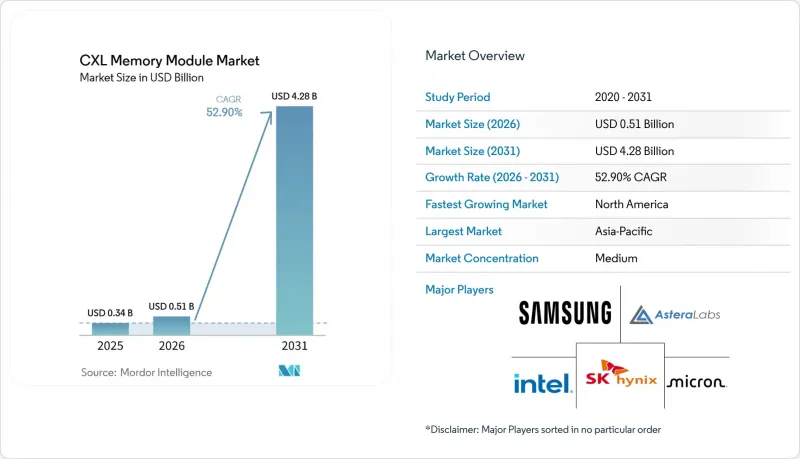
Mordor Intelligence에 의하면, CXL 메모리 모듈 시장 규모는 2025년에 3억 4,000만 달러로 평가되었고, 2026년 5억 1,000만 달러에서 2031년까지 42억 8,000만 달러에 이를 것으로 예측되며, 2026-2031년 CAGR 52.90%로 성장할 전망입니다.
본 보고서는 제품 유형별(CXL 2.0 메모리 모듈, CXL 3.0 메모리 모듈), 메모리 기술별(DRAM 기반 CXL 메모리 모듈 등), 폼 팩터별(E3.S 모듈, 애드인 카드(AIC) 모듈 등), 용도별(인공지능 및 머신러닝 등), 최종 사용자별(클라우드 서비스 제공업체 등), 그리고 지역별로 분류되어 있습니다. 시장 전망은 금액(달러) 기준으로 제시되어 있습니다.
세계의 CXL 메모리 모듈 시장 동향 및 인사이트
AI 서버의 메모리 밀도 요구 사항 증가
CXL 메모리 모듈 시장은 인공지능 서버, 특히 대규모 언어 모델의 추론 및 검색 부하가 높은 워크로드에서 메모리 수요가 급격히 증가함에 따라 성장하고 있습니다. 현대적인 추론 환경에서는 활성화 스토리지 및 KV 캐시를 위해 대용량 및 저지연 메모리 풀이 필요하지만, 많은 듀얼 소켓 서버 설계에서는 DIMM 슬롯만으로는 이러한 요구 사항을 충족할 수 없습니다. 2026년에 발표된 조사에 따르면, SGLang 추론 클러스터에서 풀링된 CXL 메모리는 조건부 메모리 검색에서 로컬 DRAM에 가까운 성능을 발휘했으며, 추천 및 검색 증강 생성(RAG) 작업에서 중요한 희소 액세스 패턴에서 RDMA보다 우수한 성능을 보였습니다. 이로 인해 CXL 메모리 모듈 시장은 성능 확장뿐만 아니라 비용 관리 측면에서도 그 중요성이 커지고 있습니다. 이는 운영자가 노드당 가속기 수를 늘리지 않고도 메모리 여유를 추가할 수 있기 때문입니다. 따라서 CXL 메모리 모듈 시장은 GPU 시스템을 추가로 구매하기 전에 서버당 메모리 밀도를 높이고자 하는 클라우드 플랫폼 및 추론 제공업체들로부터 지지를 얻고 있습니다. 마이크로소프트의 Azure는 2025년 11월, 메모리 집약적인 엔터프라이즈 워크로드를 위해 Astera Labs의 컨트롤러를 채택한 CXL 지원 M 시리즈 가상 머신의 프리뷰를 공개하며 이러한 방향성을 뒷받침했습니다.
DDR만을 통한 용량 확장에서 CXL 풀링으로의 전환
또한, 워크로드가 멀티테라바이트 규모에 도달함에 따라 고밀도 DIMM이나 서버 증설만을 통한 기존의 메모리 확장 방식은 비용이 급증하기 때문에 CXL 메모리 모듈 시장은 확대되고 있습니다. 삼성은 자사의 CMM-D 2.0 설계가 128GB 및 256GB 용량에서 36GB/s의 대역폭을 실현하며, 운영 담당자가 기존 서버 플랫폼의 PCIe 슬롯을 통해 더 많은 메모리를 연결할 수 있는 수단을 제공한다고 밝혔습니다. 이 접근 방식이 중요한 이유는 CXL 메모리 모듈 시장이 ‘스트랜드드 캐파시티(미활용 용량)’라는 과제를 해결하기 때문입니다. 2026년 조사에서 지적된 바와 같이, 이는 데이터센터에서 설치된 메모리의 상당 부분이 항상 충분히 활용되지 못하고 있다는 뿌리 깊은 비효율성입니다. 메모리 풀링은 각 서버 내에 용량을 고정하는 대신, 관리자가 워크로드의 동작에 따라 ‘핫’ 및 ‘콜드’ 메모리의 배치를 더 밀접하게 조정할 수 있도록 함으로써 운영 모델을 혁신합니다. 이 모델은 활용도 향상, 과잉 프로비저닝 감소, 대규모 서버 클러스터 전반에 걸친 확장성 관리 최적화를 지원하므로 CXL 메모리 모듈 시장에 이점을 제공합니다. 서버 총 수보다 총 소유 비용(TCO)을 우선시하는 사업자가 늘어남에 따라, 보다 광범위한 인프라 갱신 주기의 일환으로 메모리 풀링 도입을 정당화하기가 점점 더 쉬워지고 있습니다.
온소켓 DDR5 메모리와의 레이턴시 차이
CXL 메모리 모듈 시장은 확장 메모리가 모든 워크로드에서 로컬 DDR5의 레이턴시에 미치지 못하기 때문에 여전히 저항에 직면해 있습니다. 2026년 조사에 따르면, Intel Xeon 6 플랫폼상의 CXL 2.0 확장 장치는 로컬 DDR5의 75ns에 비해 공칭 액세스 레이턴시가 100ns에서 160ns였으며, 그 결과, 최적화된 용도에서는 일반적으로 10%에서 18%의 성능 저하가 관찰되었으나, 레이턴시가 훨씬 높은 ‘포인터 체이싱’의 경우 45%에 달할 가능성도 있었습니다. 이 결과가 중요한 이유는 성능 저하가 CXL 메모리 모듈 시장 전체에서 일률적으로 발생하는 것이 아니라, 워크로드마다 다르게 나타난다는 점을 보여주기 때문입니다. 또한, 해당 조사에서는 CXL 상호 연결 자체가 지연의 주된 원인이 아니라는 사실도 밝혀졌습니다. 이는 CPU 측의 NUMA 중재 및 리프레시 동작이 관측된 오버헤드의 대부분을 차지했기 때문입니다. 즉, 도입의 성패는 모든 이용 사례에 단일 메모리 동작이 적용될 수 있다고 가정하는 것이 아니라, 용도를 면밀히 프로파일링한 후 핫 데이터와 콜드 데이터를 적절한 계층에 배치하는 데 달려 있습니다. Meta는 2026년, 공정한 멀티테넌트 CXL 메모리 계층화를 실현하는 ‘Equilibria’ 프레임워크를 통해 이러한 방향성에 부합하는 노력을 기울였습니다. 해당 프레임워크에서는 실제 운영 환경에 가까운 워크로드에서 엔드투엔드 성능이 최대 52% 향상된 것으로 보고되었습니다.
부문 분석
2025년, CXL 2.0 메모리 모듈은 제품 유형 부문의 88.79%를 차지했으며, 이에 따라 상용화 초기 단계에서 CXL 메모리 모듈 시장에서는 기존 도입 기반이 계속해서 중심적인 위치를 차지했습니다. 이러한 선두 위상은 2024년부터 2025년에 걸쳐 호환 가능한 CPU 플랫폼의 데이터센터 도입이 가속화된 것을 반영하며, 그 결과 인증 사이클에서는 현행 서버 세대에 적합한 제품이 우선시되었습니다. 따라서 CXL 메모리 모듈 시장은 CXL 2.0을 기반으로 한 상태를 유지했습니다. 이는 특히 대규모 클라우드 및 하이퍼스케일 환경이 이미 호환 가능한 인프라를 중심으로 구축되어 있었기 때문에 구매자들이 검증에서 양산까지의 기간을 단축하는 것을 우선시했기 때문입니다. CXL 3.0 모듈은 2031년까지 연평균 성장률(CAGR) 53.29%를 나타낼 것으로 예측되며, 공유 메모리에 대한 수요가 더욱 치열해짐에 따라 프로토콜의 차이가 상업적 차별화 요인으로 부상하고 있음을 보여줍니다. CXL 3.0은 지원 가능한 이용 사례를 단순한 메모리 확장에서 더 광범위한 랙 수준의 리소스 공유로 확대함에 따라, CXL 메모리 모듈 시장은 현재 전환기를 맞이하고 있습니다.
이러한 전환은 멀티호스트 캐시 일관성, 스위치 기반 풀링, 더 높은 유효 대역폭과 같은 기능과 밀접하게 연관되어 있으며, 도입이 단일 서버 업그레이드에서 메모리 패브릭 설계로 전환됨에 따라 이러한 기능의 가치는 더욱 높아지고 있습니다. 마벨(Marvell)이 2026년 3월에 스위치를 출시한 것은 CXL 3.x의 확장에 필요한 생태계가 점차 형성되고 있음을 보여주며, 이는 CXL 메모리 모듈 시장의 향후 성장 곡선이 새로운 프로토콜 세대일수록 더욱 강력할 것이라는 점을 설명하는 요인 중 하나입니다. 또한 구매자들은 상호 운용성에 더욱 주목하고 있습니다. 프로토콜의 기능이 충실하더라도 컨트롤러, 호스트, 패브릭 매니저가 벤더에 관계없이 일관된 동작을 하지 않으면 그 이점을 발휘할 수 없기 때문입니다. CXL 메모리 모듈 시장에서는 단기적인 도입 측면에서는 CXL 2.0이 계속해서 중요할 것으로 보이지만, 대규모 풀링 아키텍처에서는 CXL 3.x가 주류를 이룰 전망입니다. 이로 인해 급격한 전환이 아닌 단계적인 전환이 이루어지게 되며, 이는 예측 기간 동안 두 프로토콜 세대가 모두 상업적으로 중요한 위치를 계속 차지하게 될 이유입니다.
DRAM 기반 CXL 모듈은 2025년 메모리 기술 수요의 92.14%를 차지했으며, 현재 주기에서 CXL 메모리 모듈 시장의 중심을 이루고 있습니다. 이러한 집중 현상은 제조상의 현실을 반영한 것으로, 기존 메모리 제조업체들이 CXL을 고속 용량 확장 수단으로 활용하는 AI, HPC, 클라우드 환경에 필요한 생산 기반과 성능 프로파일을 이미 갖추고 있기 때문입니다. 또한, CXL 메모리 모듈 시장이 현재 DRAM을 우대하고 있는 배경에는 하이퍼스케일러와 주요 클라우드 사업자들이 1차 확장 계층에 예측 가능한 동작을 요구하고 있으며, DRAM이 여전히 그 요건에 가장 부합한다는 사정이 있습니다. 반면, SCM 및 퍼시스턴트 메모리 기반 CXL 모듈은 연평균 성장률(CAGR) 53.47%로 확대될 것으로 예측되며, 이는 CXL 메모리 모듈 시장이 휘발성 메모리의 확장 이용 사례를 넘어 확장되고 있음을 보여줍니다. 이 부문의 성장은 용량뿐만 아니라 재시작 속도, 체크포인트, 내결함성 및 데이터 보존을 중시하는 워크로드와 밀접한 관련이 있습니다.
Penguin Solutions는 2026년 1월, 자사의 'SMART Modular NV-CMM E3.S 2T' 모듈이 CXL 준수 테스트를 통과했다고 발표했습니다. 이 설계는 휘발성 DRAM, NAND 백업, 온보드 전원 모듈, 엔터프라이즈 데이터센터 용도를 위한 AES-256 암호화를 결합하고 있습니다. 또한 CXL 컨소시엄은 유형 3 디바이스가 호스트 메모리 맵 내에서 영구적인 용량을 직접 노출할 수 있으므로, 블록 스토리지 워크플로우의 오버헤드 없이 바이트 단위로 주소 지정 가능한 영구성을 실현할 수 있다고 지적하고 있습니다. 이를 통해 CXL 메모리 모듈 시장은 인메모리 데이터베이스, 재시작에 민감한 가상화 시스템, 그리고 모든 데이터를 프리미엄 DRAM 계층에 보관할 필요가 없는 분석 워크로드로 진출할 수 있는 길이 열립니다. 또한, NAND 및 플래시 기반 설계에서는 특히 이용 빈도가 낮은 분석 데이터의 경우, 피크 액세스 속도보다 기가바이트당 비용이 중시되는 중간 계층이 형성됩니다. 소프트웨어를 통한 계층화 메모리 정책의 처리 능력이 향상됨에 따라, CXL 메모리 모듈 시장에서는 영속화 옵션이 전용 제품에서 더 주목받는 전략적 계층으로 전환될 것으로 전망됩니다.
지역별 분석
북미는 2025년 수요의 45.37%를 차지했으며, 현재 사이클에서도 CXL 메모리 모듈 시장에 가장 크게 기여하는 지역으로 자리매김하고 있습니다. 이 지역이 주도적인 위치를 차지하고 있는 이유는 미국이 최대 규모의 하이퍼스케일 클라우드 사업자를 보유하고 있으며, 이들 기업이 초기 인증 작업, 서버 플랫폼 구축 및 프로덕션 환경 수준의 도입 계획에서 중심적인 역할을 수행했기 때문입니다. 북미의 CXL 메모리 모듈 시장은 강력한 컨트롤러 및 플랫폼 생태계의 혜택을 받고 있으며, 이를 통해 메모리 공급업체, 반도체 벤더, 클라우드 인프라 사업자 간의 상용 검증 과정이 용이해졌습니다. 2025년 11월 Microsoft Azure가 CXL을 지원하는 M 시리즈 가상 머신의 프리뷰를 공개한 것은 해당 지역이 이미 실험실 테스트 단계를 넘어 메모리 집약적인 엔터프라이즈 워크로드를 위한 고객 대상 배포 단계로 전환하고 있음을 보여줍니다. 캐나다는 미국 사업자와의 클라우드 인프라 국경 간 연계의 혜택을 받고 있는 반면, 멕시코는 현 단계에서 직접적인 수요보다는 물류 및 서버 조립 협력을 통해 더 중요한 역할을 수행하고 있습니다.
아시아태평양은 2031년까지 연평균 성장률(CAGR) 53.78%로 확대될 것으로 예측되며, CXL 메모리 모듈 시장에서 가장 빠르게 성장하는 지역 시장이 될 전망입니다. 한국은 이러한 성장 궤도를 주도하고 있으며, 삼성과 SK하이닉스가 CXL 지원 메모리 제품 공급에서 중심적인 역할을 계속하고 있어, 두 기업의 제품 활동을 통해 이 지역의 생태계는 상용화의 핵심에 가까운 위치를 유지하고 있습니다. 아시아태평양의 CXL 메모리 모듈 시장은 부품 제조, 시스템 통합 및 컨트롤러 개발 분야에서 이 지역이 수행하는 역할로부터도 혜택을 받고 있으며, 이를 통해 이 지역은 공급과 도입 준비 양면에서 영향력을 행사하고 있습니다. 일본에서는 상용 제품을 위한 명확한 유통 채널이 구축되어 있으며, 그 일례로 Tekwind사가 2025년 7월에 현지 시장을 대상으로 ‘SMART Modular CXL’ 애드인 카드 제품을 출시할 예정입니다. 인도의 CXL 메모리 모듈 시장은 여전히 초기 단계의 기회에 머물러 있지만, 대규모 하이퍼스케일 캠퍼스에 대한 투자가 향후 CXL을 보다 광범위하게 채택할 수 있는 차세대 서버의 기반을 마련하고 있습니다.
유럽은 현재 CXL 메모리 모듈 시장 점유율이 작지만, 기업의 전환 수요, 하이퍼스케일 데이터센터 확장, 그리고 대규모 클라우드 및 용도 환경에서 메모리 효율성 향상을 추구하는 움직임을 중심으로 수요가 형성되고 있습니다. 독일, 영국, 프랑스는 데이터센터 투자, 기업 소프트웨어의 규모, 그리고 높은 메모리 밀도에 대한 수요 증가가 맞물려 수요가 가장 집중될 가능성이 높은 국가들입니다. 유럽의 CXL 메모리 모듈 시장은 구매자들이 시범 평가 단계에서 조달 시 불확실성을 줄여주는 검증된 멀티 벤더 구성으로 전환함에 따라 더욱 확대될 것으로 전망됩니다. 남미, 중동 및 아프리카는 여전히 도입 초기 단계에 있으며, CXL 지원 인프라에 대한 단기적인 접근은 광범위한 On-Premise 구축보다는 클라우드 리전을 통해 이루어질 가능성이 높습니다. 클라우드 서비스 제공업체들이 CXL 기반 서비스를 확대함에 따라, 이들 지역에서는 대규모 로컬 하드웨어 환경이 구축되기 전에 서비스 이용을 통해 CXL 메모리 모듈 시장에 참여할 수 있게 될 것입니다.
기타 혜택 :
- 엑셀 형식 시장 예측(ME) 시트
- 3개월간의 애널리스트 지원
자주 묻는 질문
목차
제1장 서론
제2장 조사 방법
제3장 주요 요약
제4장 시장 구도
제5장 시장 규모 및 성장 예측
제6장 경쟁 구도
제7장 시장 기회 및 향후 전망
AJYAccording to Mordor Intelligence, the CXL memory module market size is projected to be USD 0.34 billion in 2025, USD 0.51 billion in 2026, and reach USD 4.28 billion by 2031, growing at a CAGR of 52.90% from 2026 to 2031.
This report is Segmented by Product Type (CXL 2. 0 Memory Modules, and CXL 3. 0 Memory Modules), Memory Technology (DRAM-Based CXL Memory Modules, and More), Form Factor (E3. S Modules, Add-In Card (AIC) Modules, and More), Application (Artificial Intelligence and Machine Learning, and More), End User (Cloud Service Providers, and More), and Geography. The Market Forecasts are Provided in Terms of Value (USD).
Global CXL Memory Module Market Trends and Insights
Rising AI Server Memory Density Requirements
The CXL memory module market is being driven by the rapid increase in memory demand from artificial intelligence servers, especially for large language model inference and retrieval-heavy workloads. Modern inference environments require large, low-latency memory pools for activation storage and KV cache, and many dual-socket server designs cannot meet those needs solely through DIMM slots. Research published in 2026 showed that pooled CXL memory in SGLang inference clusters delivered performance close to local DRAM for conditional memory retrieval and demonstrated stronger performance than RDMA on sparse access patterns that matter for recommendation and retrieval-augmented generation tasks. This makes the CXL memory module market relevant not only for performance expansion but also for cost control, as operators can add memory headroom without multiplying the accelerator count across every node. The CXL memory module market is therefore gaining support from cloud platforms and inference providers that want more memory density per server before they buy more GPU systems. Microsoft Azure validated that direction in November 2025 when it previewed CXL-backed M-series virtual machines using Astera Labs controllers for memory-intensive enterprise workloads.
Shift from DDR-Only Capacity Scaling to CXL Pooling
The CXL memory module market is also expanding because the older path of scaling memory only through denser DIMMs or more servers becomes increasingly expensive when workloads move into multi-terabyte territory. Samsung stated that its CMM-D 2.0 design delivered 36 GB/s of bandwidth across 128 GB and 256 GB capacities, giving operators a way to attach more memory via PCIe slots on existing server platforms. That path matters because the CXL memory module market addresses stranded capacity, a persistent inefficiency in data centers where a meaningful share of installed memory remains underused at any given time, as research in 2026 described. Memory pooling changes the operating model by letting administrators match hot and cold memory placement more closely to workload behavior, rather than locking capacity inside each server. The CXL memory module market benefits because that model supports higher utilization, lower overprovisioning, and better scaling discipline across larger fleets. As more operators prioritize total cost of ownership over raw server counts, pooled memory becomes easier to justify as part of a broader infrastructure refresh cycle.
Latency Gap Versus On-Socket DDR5 Memory
The CXL memory module market still faces resistance because expanded memory does not match the latency of local DDR5 across all workloads. Research in 2026 found that CXL 2.0 expansion devices on Intel Xeon 6 platforms delivered nominal access latencies of 100 ns to 160 ns, compared with 75 ns for local DDR5, and the resulting slowdown was usually 10% to 18% for tuned applications but could reach 45% in pointer chasing cases at much higher latency levels. That finding matters because it shows the penalty is workload-specific rather than uniform across the CXL memory module market. The same research also showed that the CXL interconnect itself was not the main source of delay, because CPU-side NUMA arbitration and refresh behavior contributed much of the observed overhead. This means deployment success depends on carefully profiling applications and then placing hot and cold data on the right tiers, rather than assuming one memory behavior fits every use case. Meta aligned with that direction in 2026 through its Equilibria framework for fair multi-tenant CXL memory tiering, which reported end-to-end performance gains of up to 52% in production-style workloads.
Other drivers and restraints analyzed in the detailed report include:
- Rapid Commercialization of CXL 2.0 and CXL 3.0 Ecosystems
- Hyperscale Data Center Demand for Composable Memory Architectures
- High Upfront Cost of CXL-Capable Servers and Modules
For complete list of drivers and restraints, kindly check the Table Of Contents.
Segment Analysis
CXL 2.0 memory modules held 88.79% of the product type segment in 2025, which kept the installed base at the center of the CXL memory module market during the early commercialization phase. That lead reflected the fact that data center deployment of compatible CPU platforms accelerated through 2024 and 2025, so qualification cycles favored products that fit active server generations. The CXL memory module market, therefore, remained anchored in CXL 2.0 because buyers preferred a shorter path from validation to production, especially when large cloud and hyperscale fleets were already building around compatible infrastructure. CXL 3.0 modules are projected to grow at a 53.29% CAGR through 2031, indicating that the protocol gap is becoming a commercial differentiator as shared memory needs become more demanding. The CXL memory module market is shifting here because CXL 3.0 expands the addressable use case set beyond simple memory expansion and into broader rack-level resource sharing.
That transition is tied to capabilities such as multi-host cache coherence, switch-based pooling, and higher effective bandwidth, which become more valuable as deployments move from single-server upgrades to memory fabric designs. Marvell's March 2026 switch launch showed that the ecosystem needed for CXL 3.x scaling is taking shape, which helps explain why the future growth curve in the CXL memory module market is stronger for the newer protocol generation. Buyers are also paying closer attention to interoperability because a richer protocol is only useful if controllers, hosts, and fabric managers behave consistently across vendors. The CXL memory module market is likely to see CXL 2.0 remain important for near-term deployments while CXL 3.x becomes the preferred path for larger-scale pooling architectures. This creates a phased transition rather than a sudden handoff, which is why both protocol generations remain commercially relevant across the forecast period.
DRAM-based CXL modules accounted for 92.14% of 2025 memory technology demand, making them the core of the CXL memory module market in the current cycle. That concentration reflects manufacturing reality, because established memory makers already have the production base and performance profile needed for AI, HPC, and cloud environments that treat CXL as a high-speed capacity extension. The CXL memory module market also favors DRAM today because hyperscalers and major cloud operators want predictable behavior from a primary expansion tier, and DRAM still aligns best with that requirement. At the same time, SCM and persistent memory-based CXL modules are projected to expand at a 53.47% CAGR, which shows that the CXL memory module market is broadening beyond volatile expansion use cases. Growth in this segment is tied to workloads that value restart speed, checkpointing, resilience, and data retention alongside capacity.
Penguin Solutions stated in January 2026 that its SMART Modular NV-CMM E3.S 2T module had passed CXL compliance testing, and the design combined volatile DRAM, NAND backup, an onboard energy source module, and AES-256 encryption for enterprise data center use. The CXL Consortium also noted that Type 3 devices can expose persistent capacity directly in the host memory map, enabling byte-addressable persistence without the overhead of a block storage workflow. That gives the CXL memory module market a path into in-memory databases, restart-sensitive virtualized systems, and analytical workloads that do not need all data on premium DRAM tiers. NAND and flash-based designs also create a middle layer where cost per gigabyte matters more than peak access speed, especially for colder analytics data. As software improves at handling tiered memory policies, the CXL memory module market should see persistent options shift from specialized products into a more visible strategic tier.
Complete Report Scope:
- By Product Type
- CXL 2.0 Memory Modules
- CXL 3.0 Memory Modules
- By Memory Technology
- DRAM-Based CXL Memory Modules
- NAND/Flash-Based CXL Memory Modules
- SCM/Persistent Memory-Based CXL Modules
- By Form Factor
- E3.S Modules
- Add-in Card (AIC) Modules
- U.2/U.3 and Other Form Factors
- By Application
- Artificial Intelligence and Machine Learning
- High Performance Computing
- Database and Analytics
- Virtualization and Cloud
- Enterprise Applications
- By End User
- Cloud Service Providers
- Hyperscale Data Centers
- Enterprise Data Centers
- OEM/ODM Server Manufacturers
- Research and Government Computing
- Other End Users
- By Geography
- North America
- United States
- Canada
- Mexico
- Europe
- Germany
- United Kingdom
- France
- Italy
- Rest of Europe
- Asia-Pacific
- China
- Japan
- South Korea
- Taiwan
- India
- Rest of Asia-Pacific
- South America
- Middle East and Africa
- North America
Geography Analysis
North America accounted for 45.37% of 2025 demand and remained the largest regional contributor to the CXL memory module market in the current cycle. The region leads because the United States hosts the largest hyperscale cloud operators, and those firms were central to early qualification work, server platform rollout, and production-style deployment planning. The CXL memory module market in North America also benefits from a strong controller and platform ecosystem, which makes commercial validation easier across memory suppliers, silicon vendors, and cloud infrastructure operators. Microsoft Azure's November 2025 preview of CXL-backed M-series virtual machines showed that the region had already moved beyond lab testing into customer-facing deployment for enterprise memory-intensive workloads. Canada benefits from cross-border alignment of cloud infrastructure with US operators, while Mexico remains more relevant through logistics and server assembly linkages than through direct demand at this stage.
Asia-Pacific is projected to expand at a 53.78% CAGR through 2031, making it the fastest-growing regional market for CXL memory modules. South Korea anchors that trajectory because Samsung and SK Hynix remain central to the supply of CXL-capable memory products, and their product activity keeps the regional ecosystem close to the core of commercialization. The CXL memory module market in Asia-Pacific also benefits from its role in component manufacturing, system integration, and controller development, which gives the region influence on both supply and deployment readiness. Japan is building a clear distribution channel for commercial products, including Tekwind's July 2025 rollout of SMART Modular CXL add-in card products for the local market. India remains an early-stage opportunity in the CXL memory module market, but large hyperscale campus investments lay the groundwork for future generations of servers that can adopt CXL more broadly over time.
Europe holds a smaller share of the CXL memory module market today, but demand is forming around enterprise migration needs, hyperscale data center buildouts, and the search for better memory efficiency in larger cloud and application environments. Germany, the United Kingdom, and France are the most likely demand centers because they combine data center investment, enterprise software scale, and a growing need for higher memory density. The CXL memory module market in Europe should strengthen as buyers move from pilot evaluations toward validated multi-vendor configurations that reduce procurement uncertainty. South America, the Middle East, and Africa remain earlier in the adoption curve, and most near-term access to CXL-enabled infrastructure is likely to come through cloud regions rather than broad on-premises deployments. As cloud service providers widen their CXL-based offerings, these regions can still participate in the CXL memory module market through service consumption before large local hardware fleets emerge.
- Samsung Electronics Co., Ltd.
- SK hynix Inc.
- Micron Technology, Inc.
- Intel Corporation
- Astera Labs, Inc.
- Marvell Technology, Inc.
- Rambus Inc.
- Microchip Technology Incorporated
- Montage Technology Co., Ltd.
- SMART Modular Technologies, Inc.
- Super Micro Computer, Inc.
- Dell Technologies Inc.
- Lenovo Group Limited
- Hewlett Packard Enterprise Company
- MemVerge, Inc.
- Advanced Micro Devices, Inc.
- Broadcom Inc.
- Synopsys, Inc.
- Cadence Design Systems, Inc.
- Teledyne LeCroy, Inc.
Additional Benefits:
- The market estimate (ME) sheet in Excel format
- 3 months of analyst support
TABLE OF CONTENTS
1 INTRODUCTION
- 1.1 Study Assumptions and Market Definition
- 1.2 Scope of the Study
2 RESEARCH METHODOLOGY
3 EXECUTIVE SUMMARY
4 MARKET LANDSCAPE
- 4.1 Market Overview
- 4.2 Market Drivers
- 4.2.1 Rising AI Server Memory Density Requirements
- 4.2.2 Shift From DDR-Only Capacity Scaling to CXL Pooling
- 4.2.3 Rapid Commercialization of CXL 2.0 and CXL 3.0 Ecosystems
- 4.2.4 Hyperscale Data Center Demand for Composable Memory Architectures
- 4.2.5 Power and Rack Footprint Pressure From Conventional Overprovisioning
- 4.2.6 Software-Defined Memory Tiering and Orchestration Readiness
- 4.3 Market Restraints
- 4.3.1 Latency Gap Versus On-Socket DDR5 Memory
- 4.3.2 High Upfront Cost of CXL-Capable Servers and Modules
- 4.3.3 Ecosystem Interoperability and Validation Complexity
- 4.3.4 Immature Software Stack for Memory Management and Tiering
- 4.4 Supply Chain Analysis
- 4.5 Impact of Macroeconomic Factors on the Market
- 4.6 Regulatory Landscape
- 4.7 Technological Outlook
- 4.8 Porter's Five Forces Analysis
- 4.8.1 Bargaining Power of Suppliers
- 4.8.2 Bargaining Power of Buyers
- 4.8.3 Threat of New Entrants
- 4.8.4 Threat of Substitutes
- 4.8.5 Intensity of Competitive Rivalry
5 MARKET SIZE AND GROWTH FORECASTS (VALUE)
- 5.1 By Product Type
- 5.1.1 CXL 2.0 Memory Modules
- 5.1.2 CXL 3.0 Memory Modules
- 5.2 By Memory Technology
- 5.2.1 DRAM-Based CXL Memory Modules
- 5.2.2 NAND/Flash-Based CXL Memory Modules
- 5.2.3 SCM/Persistent Memory-Based CXL Modules
- 5.3 By Form Factor
- 5.3.1 E3.S Modules
- 5.3.2 Add-in Card (AIC) Modules
- 5.3.3 U.2/U.3 and Other Form Factors
- 5.4 By Application
- 5.4.1 Artificial Intelligence and Machine Learning
- 5.4.2 High Performance Computing
- 5.4.3 Database and Analytics
- 5.4.4 Virtualization and Cloud
- 5.4.5 Enterprise Applications
- 5.5 By End User
- 5.5.1 Cloud Service Providers
- 5.5.2 Hyperscale Data Centers
- 5.5.3 Enterprise Data Centers
- 5.5.4 OEM/ODM Server Manufacturers
- 5.5.5 Research and Government Computing
- 5.5.6 Other End Users
- 5.6 By Geography
- 5.6.1 North America
- 5.6.1.1 United States
- 5.6.1.2 Canada
- 5.6.1.3 Mexico
- 5.6.2 Europe
- 5.6.2.1 Germany
- 5.6.2.2 United Kingdom
- 5.6.2.3 France
- 5.6.2.4 Italy
- 5.6.2.5 Rest of Europe
- 5.6.3 Asia-Pacific
- 5.6.3.1 China
- 5.6.3.2 Japan
- 5.6.3.3 South Korea
- 5.6.3.4 Taiwan
- 5.6.3.5 India
- 5.6.3.6 Rest of Asia-Pacific
- 5.6.4 South America
- 5.6.5 Middle East and Africa
- 5.6.1 North America
6 COMPETITIVE LANDSCAPE
- 6.1 Market Concentration
- 6.2 Strategic Moves
- 6.3 Market Share Analysis
- 6.4 Company Profiles (includes Global Level Overview, Market Level Overview, Core Segments, Financials as available, Strategic Information, Market Rank/Share, Products and Services, Recent Developments)
- 6.4.1 Samsung Electronics Co., Ltd.
- 6.4.2 SK hynix Inc.
- 6.4.3 Micron Technology, Inc.
- 6.4.4 Intel Corporation
- 6.4.5 Astera Labs, Inc.
- 6.4.6 Marvell Technology, Inc.
- 6.4.7 Rambus Inc.
- 6.4.8 Microchip Technology Incorporated
- 6.4.9 Montage Technology Co., Ltd.
- 6.4.10 SMART Modular Technologies, Inc.
- 6.4.11 Super Micro Computer, Inc.
- 6.4.12 Dell Technologies Inc.
- 6.4.13 Lenovo Group Limited
- 6.4.14 Hewlett Packard Enterprise Company
- 6.4.15 MemVerge, Inc.
- 6.4.16 Advanced Micro Devices, Inc.
- 6.4.17 Broadcom Inc.
- 6.4.18 Synopsys, Inc.
- 6.4.19 Cadence Design Systems, Inc.
- 6.4.20 Teledyne LeCroy, Inc.
7 MARKET OPPORTUNITIES AND FUTURE OUTLOOK
- 7.1 White-Space and Unmet-Need Assessment