

|
시장보고서
상품코드
2099867
CXL 신호 컨디셔너 및 리타이머 IC 시장 : 시장 점유율 분석, 업계 동향 및 통계, 성장 예측(2026-2031년)CXL Signal Conditioner and Retimer IC - Market Share Analysis, Industry Trends & Statistics, Growth Forecasts (2026 - 2031) |
||||||
 Mordor Intelligence
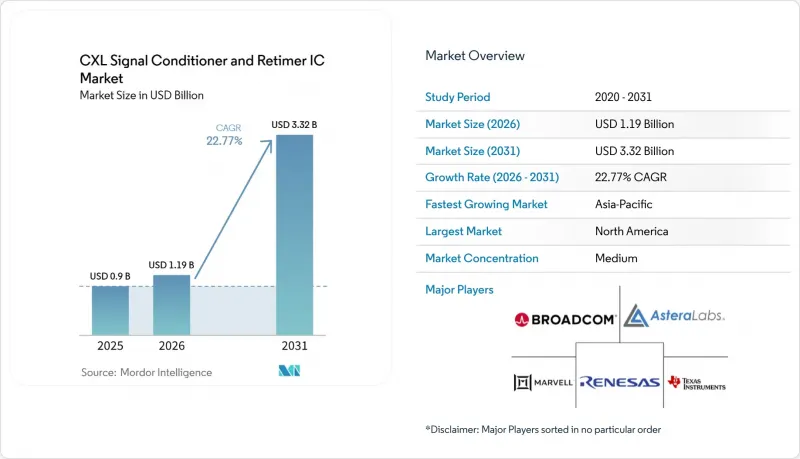
Mordor Intelligence에 의하면, CXL 신호 컨디셔너 및 리타이머 IC 시장 규모는 2025년에 9억 달러로 평가되었고, 2026년 11억 9,000만 달러에서 2031년까지 33억 2,000만 달러에 이를 것으로 예측되며, 2026-2031년 CAGR 22.77%로 성장할 전망입니다.
본 보고서는 제품 유형별(CXL 호환 리타이머 IC 등), PCIe/CXL 세대 호환성별(PCIe 6.0/CXL 3.X 호환 등), 도입 형태별(라이저 카드 및 애드인 보드 내장 IC 등), 용도별(AI 및 GPU 가속기 서버 등), 최종 사용자별(하이퍼스케일러 등), 그리고 지역별로 분류되어 있습니다. 시장 전망은 금액(달러) 기준으로 제시되어 있습니다.
세계의 CXL 신호 컨디셔너 및 리타이머 IC 시장 동향 및 인사이트
AI 서버 랙의 고밀도화로 인해 채널 손실 허용치가 상승하고 있습니다.
최신 AI 가속기 랙은 2025년까지 72개의 GPU 시스템에서 랙당 150kW를 이미 초과하고 있으며, 마이크로소프트 조사에 따르면 가속기 랙의 전력 소비량은 일반적인 연산용 및 스토리지용 랙보다 훨씬 빠른 속도로 증가하고 있는 것으로 나타났습니다. 이러한 전력 소비의 변화는 CXL 신호 컨디셔너 및 리타이머 IC 시장에 중요한 의미를 지닙니다. 고밀도화된 랙에서는 더 좁은 열적 및 물리적 레이아웃 내에 더 많은 고속 링크가 배치되기 때문입니다. PCIe 6.0의 속도에서는 표준 기판 재료의 도달 거리 한계가 심각해지고 있어, 많은 서버 경로에서 신호 복원은 더 이상 선택 사항으로 취급될 수 없게 되었습니다. 그 결과, 수요 대수가 증가할 뿐만 아니라, 첨단 AI 시스템 내의 GPU-CPU 간, GPU-메모리 간, 그리고 GPU-네트워크 간 링크에서 그 도입 범위가 더욱 확대될 것입니다. 향후 몇 년 동안 랙 아키텍처가 더 큰 전력 엔벨로프로 전환됨에 따라, 결정론적 링크 무결성에 대한 수요가 새로운 플랫폼 세대에 걸쳐 CXL 신호 컨디셔너 및 리타이머 IC 시장을 지속적으로 뒷받침할 것으로 예측됩니다.
PCIe 6.0 및 CXL 3.0의 채택으로 인해 프로토콜 기반 신호 복구가 요구되고 있습니다.
PCIe 5.0에서 PCIe 6.0으로의 전환에 따라 리타이머 요구 사항이 변경되었습니다. 이는 PAM4 신호 전송 및 FLIT 기반 작동이 링크 복구 장치에 대한 기술적 부담을 증가시키기 때문입니다. 이러한 변화는 CXL 신호 컨디셔너 및 리타이머 IC 시장을 견인하고 있습니다. 이는 각 벤더들이 현재 AI 및 메모리 패브릭 전반에 걸쳐 더욱 엄격한 지연 시간, 규정 준수, 상호 운용성 목표를 달성해야 하기 때문입니다. 마이크로칩 테크놀로지는 2026년 6월, 핀 간 지연 시간이 12ns 미만인 PCIe 6.0 및 CXL 3.1 지원 리타이머를 출시했습니다. 이는 저지연 준수가 첨단 도입에서 주요 구매 요인이 되고 있음을 보여줍니다. 또한, CXL 컨소시엄은 2025년 11월에 CXL 4.0 사양을 공개했습니다. 이는 CXL 3.x가 더욱 광범위하게 도입되고 있는 상황에서도 제품 주기가 단축되고 있음을 의미합니다. 이 규격의 제정 기간이 단축된 것은 설계부터 인증, 그리고 양산 출하로 신속하게 전환할 수 있는 공급업체에게 유리하게 작용합니다. 또한, 서버 플랫폼이 Gen 6로의 전환을 더욱 가속화하고 차세대 준비를 진행하는 가운데, 프로토콜 지원 신호 복원 기술이 CXL 신호 컨디셔너 및 리타이머 IC 시장의 중심적인 위치를 계속 차지하게 될 것입니다.
PCI-SIG 및 CXL 준수를 위한 높은 검증 부담이 설계 채택 지연을 초래하고 있습니다.
PCI-SIG 및 CXL 준수 요건으로 인해, 리타이머가 실리콘 공급 가능 상태에서 수익을 창출하는 플랫폼 승인으로 전환되기까지 여러 테스트 단계가 추가됩니다. CXL 컨소시엄의 준수 프레임워크에서는 구조화된 테스트 이벤트와 상호 운용성 단계가 채택되어 있어, 벤더는 생태계의 하드웨어 및 레퍼런스 시스템에 대해 검증을 수행해야 합니다. 이러한 일련의 프로세스로 인해 제품 완성부터 상용화까지의 기간이 연장되어, CXL 신호 컨디셔너 및 리타이머 IC 시장에서 각 세대별로 얻을 수 있는 수익 기회가 줄어들게 됩니다. 중소 벤더의 경우, 이러한 부담이 더욱 커집니다. 일반적으로 전담 규정 준수 팀의 인원이 적고, 반복 주기를 단축하기 위한 실험실용량도 제한적이기 때문입니다. 이러한 상황은 이미 여러 세대에 걸친 인증 경험과 고객의 신뢰를 확립한 공급업체의 입지를 더욱 강화하는 경향이 있습니다. 그 결과, 기술적 성능도 중요하지만, 누가 가장 먼저 양산에 도달할지는 많은 경우 인증 준비 상태에 따라 결정되는 시장이 되었습니다.
부문 분석
2025년, CXL 지원 리타이머 IC는 제품 유형별 부문의 84.12%를 차지했으며, CXL 신호 컨디셔너 및 리타이머 IC 시장 수요에서 확고한 중심 위치를 유지했습니다. 이러한 높은 점유율은 Gen 5 및 Gen 6 속도에서 완전한 프로토콜 호환 리제너레이션이 필요한 AI 서버의 베이스보드, 케이블 어셈블리, 메모리 확장 하드웨어에서 이러한 IC가 필수적인 역할을 수행하고 있음을 반영합니다. 또한, 하이퍼스케일러 기업들은 일반적으로 장기적인 주기로 리타이머 공급업체를 검증하기 때문에 플랫폼이 양산 단계에 접어들면 승인된 디바이스를 교체하기 어려워지므로 이 기반도 안정성을 유지했습니다. 실용적인 관점에서 볼 때, 2025년의 높은 시장 점유율은 CXL 신호 컨디셔너 및 리타이머 IC 업계가 더 단순한 컨디셔닝 기법이 아닌, 여전히 완전한 리타이밍을 최우선으로 중시하고 있음을 보여줍니다. 또한, 이 시장에서 제품의 리더십은 단순한 레인 성능뿐만 아니라 인증의 깊이와도 밀접한 관련이 있음을 보여줍니다.
신호 컨디셔너 및 리드라이버 IC는 라이저 카드, 스토리지 백플레인, 엔터프라이즈용 애드인 보드 등 완전한 리타이밍 기능이 반드시 필요하지 않은 단거리 용도에서 여전히 중요한 역할을 수행하고 있습니다. 액티브형 신호 컨디셔닝 IC는 2031년까지 연평균 성장률(CAGR) 23.37%를 나타낼 것으로 예측되며, 부문별 CXL 신호 컨디셔너 및 리타이머 IC 시장 규모에서 가장 두드러진 성장을 보이는 제품 유형입니다. 이러한 성장은 랙 간 구리선 링크를 통해 PCIe 6.0 신호를 전송하는 능동형 전기 케이블 어셈블리 및 스마트 케이블 모듈에의 채택에 기인합니다. 몽타주 테크놀로지(Montage Technology)는 2026년 1월, 중국 케이블 제조업체와 공동 개발하여 CPU, xPU, PCIe 스위치, NIC에서 검증된 PCIe 6.x 및 CXL 3.x 지원 능동형 전기 케이블 솔루션을 출시하며 이 제품 전략을 확대했습니다. 이러한 움직임이 중요한 이유는 비즈니스 기회의 일부가 기판 소켓에서 케이블 기반 상호 연결 계층으로 이동하기 때문입니다. 또한, 성능이 극히 중요한 링크에서 리타이머의 핵심적인 역할을 저해하지 않으면서, CXL 신호 컨디셔너 및 리타이머 IC 시장에서 대상 제품 라인업을 확대하는 결과로 이어집니다.
2025년 시점에서 PCIe 5.0 및 CXL 1.x-2.0 호환 IC는 이 부문의 66.83%를 차지했으며, 이는 레거시 플랫폼에서 현세대 플랫폼으로의 전환이 진행되고 있음에도 불구하고, 출하량의 대부분을 여전히 레거시 플랫폼이 차지하고 있었음을 의미합니다. 이러한 상황은 Hopper 세대 AI 서버의 생산이 지속되고 있다는 점, 그리고 하이퍼스케일 및 네오클라우드 데이터센터에 이미 존재하는 대규모 도입 기반을 반영한 것입니다. 따라서 CXL 신호 컨디셔너 및 리타이머 IC 시장은 새로운 플랫폼이 Gen 6로의 전환 준비를 진행하는 와중에도, 기존 서버 세대에서 비롯된 견조한 수요의 여파를 타고 2026년을 맞이했습니다. 이 기존 도입 기반이 중요한 이유는 대규모 클라우드 환경에서 업데이트 주기가 즉각적으로 이루어지지 않으며, 검증된 시스템이 수 분기 동안 계속해서 수요를 창출하기 때문입니다. 또한 이는 다음 사양이 이용 가능해지자마자 시장이 최신 호환성 수준으로 완전히 전환되지 않은 이유를 설명하는 요인 중 하나이기도 합니다.
PCIe 6.0 및 CXL 3.x 호환 IC는 2031년까지 연평균 성장률(CAGR) 23.54%를 나타낼 것으로 예측되며, CXL 신호 컨디셔너 및 리타이머 IC 시장에서 가장 두드러진 성장을 보이는 호환성 카테고리입니다. 이러한 성장은 2026년에 생산이 본격화될 새로운 AI 서버 플랫폼과 64GT/s에서 더욱 엄격해진 신호 복원 기술적 요구에 기인합니다. 또한, 인텔의 ‘PCIe 6.0 리타이머 보완 실적’는 세대를 초월한 핀 호환성 리타이머 전환을 가능하게 함으로써 업그레이드가 용이한 경로를 지원하며, 이를 통해 서버 개발자의 재설계에 따른 부담을 경감시킵니다. 브로드컴의 리타이머 제품 개요 ‘BCM85667’에서는 이 실적 준수가 강조되고 있으며, 각 벤더들이 성능과 마찬가지로 플랫폼의 지속성을 중시하여 제품을 포지셔닝하고 있음을 알 수 있습니다. 따라서 여러 제품 주기에 걸쳐 인증의 유효성을 확대하고자 하는 ODM 및 OEM에게, 여러 세대에 걸친 설계는 실용적인 조달 옵션이 되고 있습니다. 그 결과, 호환성 분야에서는 현재 출하량이 여전히 Gen 5에 편중되어 있지만, 향후 성장은 Gen 6의 채택과 보다 광범위한 하위 호환성을 갖춘 설계 전략에 의해 점점 더 결정되고 있습니다.
지역별 분석
2025년, 북미는 전 세계 수요의 49.07%를 차지하며 CXL 신호 컨디셔너 및 리타이머 IC 시장에서 가장 큰 점유율을 기록했습니다. 이 지역은 하이퍼스케일 AI 데이터센터 구축의 주요 거점으로 계속 자리매김하고 있으며, 이로 인해 현재 리타이머 소비량에서 이 지역이 1위 자리를 유지하고 있습니다. 또한, 미국에 기반을 둔 하이퍼스케일러가 종종 플랫폼 요구 사항을 설정하고, 이것이 이후 아시아 전역의 OEM 및 ODM 공급망으로 파급되기 때문에 이 지역은 아키텍처 측면에서도 매우 큰 영향력을 행사했습니다. 이는 북미 수요가 현지 출하뿐만 아니라 전 세계 공급업체의 인증 절차 및 제품 우선순위에도 영향을 미칩니다는 것을 의미합니다.
유럽은 독일, 영국, 프랑스를 통해 중요한 역할을 수행하고 있으며, 이들 국가에서는 슈퍼컴퓨팅 센터, 대규모 프라이빗 클라우드 환경, 그리고 서버 설계 업무가 첨단 상호 연결 하드웨어에 대한 수요를 뒷받침하고 있었습니다. 이 지역은 절대적인 규모 면에서는 북미에 미치지 못했지만, 엔터프라이즈 및 연구 분야에서의 도입에 있어 컴포저블 인프라와 메모리 효율성이 점점 더 중요시됨에 따라 여전히 중요한 위치를 차지하고 있었습니다. 이로 인해 CXL 신호 컨디셔너 및 리타이머 IC 시장에는 단순한 클라우드 구축 규모보다는 아키텍처 채택과 밀접하게 연계된 안정적인 유럽 수요 기반이 형성되고 있습니다. 또한, 유럽은 인증 및 플랫폼 엔지니어링 측면에서도 중요하며, 설계 센터와 인프라 운영자가 성능과 효율성을 고려한 서버 플랫폼 구성에 큰 영향을 미치고 있습니다.
아시아태평양은 2031년까지 23.77%라는 가장 높은 연평균 성장률(CAGR)을 보일 것으로 예측되며, 지역별 CXL 신호 컨디셔너 및 리타이머 IC 시장 규모에서 가장 빠르게 성장하는 지역이 될 것입니다. 중국에서는 현지 기업들의 리타이머 시장 진출이 활발해지고 있으며, Montage Technology사는 이미 PCIe 6.x 및 CXL 3.x 지원 리타이머의 샘플 제공을 시작했고, 차세대 데이터센터 상호 연결을 위한 능동형 전기 케이블 솔루션을 출시했습니다. 대만은 ODM 및 IC 설계 생태계를 통해 여전히 중심적인 역할을 수행하고 있는 반면, 한국은 자국의 메모리 및 모듈 생태계가 하류 CXL 도입을 뒷받침하고 있다는 점에서 중요합니다. 일본 또한 보다 광범위한 서버 연결 체인 내 신호 조정 및 타이밍 부품에 대한 기술력을 통해 기여하고 있습니다. 남미, 중동 및 아프리카는 현재 규모는 작지만, 해당 지역의 클라우드 및 국가 주도의 AI 인프라 도입이 고속 서버 하드웨어에 대한 수요를 더욱 촉진할 것이므로, 예측 기간 동안 구조적으로 중요한 위치를 계속 차지할 것입니다. 플랫폼 비용이 정상화되고 인증 역량이 확산됨에 따라, 이들 지역은 CXL 서버 및 메모리 패브릭 도입의 후반 단계에서 더 큰 역할을 수행할 것으로 예측됩니다.
기타 혜택 :
- 엑셀 형식 시장 예측(ME) 시트
- 3개월간의 애널리스트 지원
자주 묻는 질문
목차
제1장 서론
제2장 조사 방법
제3장 주요 요약
제4장 시장 구도
제5장 시장 규모 및 성장 예측
제6장 경쟁 구도
제7장 시장 기회 및 향후 전망
AJY 26.08.11According to Mordor Intelligence, the CXL signal conditioner and retimer IC market size is projected to be USD 0.90 billion in 2025, USD 1.19 billion in 2026, and reach USD 3.32 billion by 2031, growing at a CAGR of 22.77% from 2026 to 2031.
This report is Segmented by Product Type (CXL-Compatible Retimer ICs and More), PCIe/CXL Generation Compatibility (PCIe 6. 0 / CXL 3. X Compatible, and More), Deployment Form (Riser-Card and Add-In-Board Embedded ICs, and More), Application (AI and GPU Accelerator Servers, and More), End User (Hyperscalers, and More), and Geography. The Market Forecasts are Provided in Terms of Value (USD).
Global CXL Signal Conditioner and Retimer IC Market Trends and Insights
AI Server Rack Densification Is Raising Channel Loss Budgets
Modern AI accelerator racks had already moved past 150 kW per rack for 72-GPU systems by 2025, and Microsoft Research showed that accelerator rack power was rising much faster than general compute and storage racks. That power shift matters for the CXL signal conditioner and retimer IC market because denser racks place more high-speed links in tighter thermal and physical layouts. At PCIe 6.0 speeds, reach limits on standard board materials become severe enough that signal recovery can no longer be treated as optional in many server paths. The result is not only higher unit demand, but also broader placement across GPU-to-CPU, GPU-to-memory, and GPU-to-network links inside advanced AI systems. As rack architectures move toward larger power envelopes over the next several years, the need for deterministic link integrity is expected to keep supporting the CXL signal conditioner and retimer IC market across new platform generations.
PCIe 6.0 and CXL 3.0 Adoption Is Forcing Protocol-Aware Signal Recovery
The move from PCIe 5.0 to PCIe 6.0 changed retimer requirements because PAM4 signaling and FLIT-based operation raise the technical burden on link recovery devices. That change supports the CXL signal conditioner and retimer IC market because vendors now have to meet stricter latency, compliance, and interoperability targets across AI and memory fabrics. Microchip Technology launched PCIe 6.0 and CXL 3.1 retimers in June 2026 with sub-12 ns pin-to-pin latency, which shows how low-latency compliance has become a central buying factor for advanced deployments. The CXL Consortium also released the CXL 4.0 specification in November 2025, which means product cycles are tightening even as CXL 3.x enters broader deployment. That shorter standards window favors suppliers that can move quickly from design to certification and then to volume shipment. It also keeps protocol-aware signal recovery at the center of the CXL signal conditioner and retimer IC market as server platforms move deeper into Gen 6 and prepare for later generations.
High Validation Burden for PCI-SIG and CXL Compliance Delays Design Wins
PCI-SIG and CXL compliance requirements add multiple layers of testing before a retimer can convert from silicon availability into revenue-bearing platform approval. The CXL Consortium's compliance framework uses structured test events and interoperability phases that require vendors to validate against ecosystem hardware and reference systems. That sequence extends the time between product completion and commercial deployment, which narrows the revenue window available for each generation in the CXL signal conditioner and retimer IC market. The burden is heavier for smaller vendors because they usually have fewer dedicated compliance teams and less lab capacity to shorten iteration cycles. This tends to reinforce the position of suppliers that already hold multi-generation certification experience and customer trust. The outcome is a market where technical performance matters, but qualification readiness often determines who reaches volume deployment first.
Other drivers and restraints analyzed in the detailed report include:
- Hyperscale Memory Pooling Needs are Expanding Demand for Low-Latency CXL Connectivity
- Gen 6-Capable Retimers are Becoming Design-Standard in New AI Platforms
- Rapid Standard Revisions Increase Product Obsolescence Risk
For complete list of drivers and restraints, kindly check the Table Of Contents.
Segment Analysis
CXL-compatible retimer ICs held 84.12% of the product type segment in 2025, which kept them firmly at the center of CXL signal conditioner and retimer IC market demand. That large share reflected their required role on AI server baseboards, cable assemblies, and memory expansion hardware wherever full protocol-aware regeneration was needed at Gen 5 and Gen 6 speeds. The base also remained stable because hyperscalers generally validate retimer suppliers over long cycles, which makes approved devices harder to replace once a platform enters production. In practical terms, the high 2025 share shows that the CXL signal conditioner and retimer IC industry still depended first on full retiming rather than simpler conditioning approaches. It also shows that product leadership in this market is tied closely to qualification depth, not only to raw lane performance.
Signal conditioner and redriver ICs remained relevant in shorter-reach applications such as riser cards, storage backplanes, and enterprise add-in boards where full retimer capability is not always required. Active signal-conditioning ICs are projected to grow at a 23.37% CAGR through 2031, which makes them the fastest-growing product type in the CXL signal conditioner and retimer IC market size by segment. That growth comes from their use in active electrical cable assemblies and smart cable modules that extend PCIe 6.0 signals across inter-rack copper links. Montage Technology expanded that product direction in January 2026 when it launched a PCIe 6.x and CXL 3.x active electrical cable solution developed with cable manufacturers in China and validated with CPUs, xPUs, PCIe switches, and NICs. The move matters because it shifts part of the opportunity from board sockets to cable-based interconnect layers. It also broadens the addressable product mix inside the CXL signal conditioner and retimer IC market without reducing the central role of retimers on performance-critical links.
PCIe 5.0 and CXL 1.x-2.0 compatible ICs held 66.83% of this segment in 2025, which meant legacy-to-current generation platforms still accounted for most shipment volume. That position reflected continuing production of Hopper-generation AI servers and the large installed base already present in hyperscale and neocloud data centers. The CXL signal conditioner and retimer IC market therefore entered 2026 with a strong demand tail from existing server generations even as new platforms prepared for Gen 6 transition. That installed base matters because replacement cycles in large cloud environments do not happen instantly, and validated systems keep generating demand over several quarters. It also helps explain why the market did not shift fully to the newest compatibility tier as soon as the next specification became available.
PCIe 6.0 and CXL 3.x compatible ICs are projected to grow at a 23.54% CAGR through 2031, which makes them the fastest-moving compatibility category in the CXL signal conditioner and retimer IC market. Their growth is tied to the 2026 production ramp of newer AI server platforms and to the technical need for stricter signal recovery at 64 GT/s. Intel's PCIe 6.0 Retimer Supplemental Footprint also supports a more upgrade-friendly path by enabling pin-compatible retimer transitions across generations, which lowers redesign friction for server developers. Broadcom's BCM85667 retimer product brief highlighted compliance with that footprint, which shows how vendors are positioning around platform continuity as much as performance. Multi-generation designs have therefore become a practical procurement option for ODMs and OEMs that want to extend qualification value across multiple product cycles. The result is a compatibility segment where current volume still leans toward Gen 5, but future growth is increasingly defined by Gen 6 adoption and broader backward-compatible design strategies.
Complete Report Scope:
- By Product Type
- CXL-Compatible Retimer ICs
- CXL-Compatible Signal Conditioner / Redriver ICs
- CXL-Compatible Active Signal-Conditioning ICs
- By PCIe/CXL Generation Compatibility
- PCIe 5.0 / CXL 1.x-2.0 Compatible
- PCIe 6.0 / CXL 3.x Compatible
- PCIe 7.0 / CXL 4.0 Compatible
- Multi-Generation Backward-Compatible ICs
- By Deployment Form
- Discrete Board-Level Retimer / Signal Conditioner ICs
- Riser-Card and Add-In-Board Embedded ICs
- Active Electrical Cable and Smart Cable Module Embedded ICs
- Connector-, Backplane-, and Chassis-Embedded ICs
- By Application
- AI and GPU Accelerator Servers
- High-Performance Computing and Supercomputing Systems
- Hyperscale and Cloud Compute Servers
- CXL Memory Expansion and Memory Pooling Platforms
- Enterprise and Private Cloud Servers
- CXL Fabric Switches and Composable Infrastructure
- Storage, JBOF, and CXL-Enabled Storage Appliances
- Active Electrical Cable and Rack-Scale Interconnect Platforms
- By End User
- Hyperscalers
- Cloud Service Providers and Neocloud Providers
- Server, Storage, and Networking OEMs
- ODMs and System Platform Manufacturers
- HPC Centers, Research Institutions, and Supercomputing Facilities
- Large Enterprises and Private Cloud Operators
- Telecom, Edge Cloud, and Colocation Operators
- By Geography
- North America
- United States
- Canada
- Mexico
- Europe
- Germany
- United Kingdom
- France
- Italy
- Rest of Europe
- Asia-Pacific
- China
- Japan
- South Korea
- India
- Southeast Asia
- Rest of Asia-Pacific
- South America
- Middle East and Africa
- North America
Geography Analysis
North America accounted for 49.07% of global demand in 2025, which gave the region the largest position in the CXL signal conditioner and retimer IC market share. The region remained the main center for hyperscale AI data center build-outs, and that kept it at the front of current retimer consumption. It also carried outsized architectural influence because U.S.-based hyperscalers often set platform requirements that later flow into OEM and ODM supply chains across Asia. This means North American demand affects not only local shipments, but also the qualification paths and product priorities of global suppliers.
Europe held a meaningful role through Germany, the United Kingdom, and France, where supercomputing centers, large private cloud environments, and server design operations supported demand for advanced interconnect hardware. The region did not match North America on absolute scale, but it remained relevant because composable infrastructure and memory efficiency are increasingly important in enterprise and research deployments. That gives the CXL signal conditioner and retimer IC market a stable European demand base tied more to architecture adoption than to sheer cloud build volume. Europe also matters in qualification and platform engineering because design centers and infrastructure operators influence how server platforms are configured for performance and efficiency.
Asia-Pacific is projected to post the fastest CAGR at 23.77% through 2031, which makes it the fastest-growing geography in the CXL signal conditioner and retimer IC market size by region. China is strengthening local retimer participation, and Montage Technology has already sampled PCIe 6.x and CXL 3.x retimers and launched an active electrical cable solution aimed at next-generation data center interconnects. Taiwan remains central through its ODM and IC design ecosystem, while South Korea is important because memory and module ecosystems there support downstream CXL deployment. Japan also contributes through signal-conditioning and timing component capabilities within the wider server connectivity chain. South America and Middle East and Africa remain smaller today, but both are structurally relevant over the forecast period as regional cloud and sovereign AI infrastructure deployments create additional pull for high-speed server hardware. As platform costs normalize and qualification capabilities spread, these regions are expected to take a larger role in later-stage CXL server and memory-fabric deployments.
- Astera Labs, Inc.
- Broadcom Inc.
- Texas Instruments Incorporated
- Marvell Technology, Inc.
- Renesas Electronics Corporation
- Montage Technology Co., Ltd.
- Intel Corporation
- Microchip Technology Incorporated
- Diodes Incorporated
- Semtech Corporation
- Rambus Incorporated
- NXP Semiconductors N.V.
- Analog Devices, Inc.
- MaxLinear, Inc.
- Cadence Design Systems, Inc.
- Synopsys, Inc.
- Parade Technologies, Ltd.
- Phison Electronics Corporation
- Kandou Bus S.A.
- THine Electronics, Inc.
- MACOM Technology Solutions Holdings, Inc.
Additional Benefits:
- The market estimate (ME) sheet in Excel format
- 3 months of analyst support
TABLE OF CONTENTS
1 INTRODUCTION
- 1.1 Study Assumptions and Market Definition
- 1.2 Scope of the Study
2 RESEARCH METHODOLOGY
3 EXECUTIVE SUMMARY
4 MARKET LANDSCAPE
- 4.1 Market Overview
- 4.2 Market Drivers
- 4.2.1 AI Server Rack Densification Is Raising Channel Loss Budgets
- 4.2.2 PCIe 6.0 and CXL 3.0 Adoption Is Forcing Protocol-Aware Signal Recovery
- 4.2.3 Hyperscale Memory Pooling Needs Are Expanding Demand for Low-Latency CXL Connectivity
- 4.2.4 Gen6-Capable Retimers Are Becoming Design-Standard in New AI Platforms
- 4.2.5 Chiplet-Based System Architectures Are Increasing Board-to-Board Interconnect Count
- 4.2.6 Interoperability Testing Costs Are Raising Switching Costs for Qualified Suppliers
- 4.3 Market Restraints
- 4.3.1 High Validation Burden for PCI-SIG and CXL Compliance Delays Design Wins
- 4.3.2 Rapid Standard Revisions Increase Product Obsolescence Risk
- 4.3.3 Power Dissipation and Thermal Constraints Limit Deployment in Dense Server Boards
- 4.3.4 On-Die PHY Improvement and Integrated CPU Support Can Reduce Standalone Retimer Demand
- 4.4 Supply Chain Analysis
- 4.5 Regulatory Landscape
- 4.6 Technological Outlook
- 4.7 Porter's Five Forces Analysis
- 4.7.1 Threat of New Entrants
- 4.7.2 Bargaining Power of Suppliers
- 4.7.3 Bargaining Power of Buyers
- 4.7.4 Threat of Substitutes
- 4.7.5 Competitive Rivalry
5 MARKET SIZE AND GROWTH FORECASTS (VALUE)
- 5.1 By Product Type
- 5.1.1 CXL-Compatible Retimer ICs
- 5.1.2 CXL-Compatible Signal Conditioner / Redriver ICs
- 5.1.3 CXL-Compatible Active Signal-Conditioning ICs
- 5.2 By PCIe/CXL Generation Compatibility
- 5.2.1 PCIe 5.0 / CXL 1.x-2.0 Compatible
- 5.2.2 PCIe 6.0 / CXL 3.x Compatible
- 5.2.3 PCIe 7.0 / CXL 4.0 Compatible
- 5.2.4 Multi-Generation Backward-Compatible ICs
- 5.3 By Deployment Form
- 5.3.1 Discrete Board-Level Retimer / Signal Conditioner ICs
- 5.3.2 Riser-Card and Add-In-Board Embedded ICs
- 5.3.3 Active Electrical Cable and Smart Cable Module Embedded ICs
- 5.3.4 Connector-, Backplane-, and Chassis-Embedded ICs
- 5.4 By Application
- 5.4.1 AI and GPU Accelerator Servers
- 5.4.2 High-Performance Computing and Supercomputing Systems
- 5.4.3 Hyperscale and Cloud Compute Servers
- 5.4.4 CXL Memory Expansion and Memory Pooling Platforms
- 5.4.5 Enterprise and Private Cloud Servers
- 5.4.6 CXL Fabric Switches and Composable Infrastructure
- 5.4.7 Storage, JBOF, and CXL-Enabled Storage Appliances
- 5.4.8 Active Electrical Cable and Rack-Scale Interconnect Platforms
- 5.5 By End User
- 5.5.1 Hyperscalers
- 5.5.2 Cloud Service Providers and Neocloud Providers
- 5.5.3 Server, Storage, and Networking OEMs
- 5.5.4 ODMs and System Platform Manufacturers
- 5.5.5 HPC Centers, Research Institutions, and Supercomputing Facilities
- 5.5.6 Large Enterprises and Private Cloud Operators
- 5.5.7 Telecom, Edge Cloud, and Colocation Operators
- 5.6 By Geography
- 5.6.1 North America
- 5.6.1.1 United States
- 5.6.1.2 Canada
- 5.6.1.3 Mexico
- 5.6.2 Europe
- 5.6.2.1 Germany
- 5.6.2.2 United Kingdom
- 5.6.2.3 France
- 5.6.2.4 Italy
- 5.6.2.5 Rest of Europe
- 5.6.3 Asia-Pacific
- 5.6.3.1 China
- 5.6.3.2 Japan
- 5.6.3.3 South Korea
- 5.6.3.4 India
- 5.6.3.5 Southeast Asia
- 5.6.3.6 Rest of Asia-Pacific
- 5.6.4 South America
- 5.6.5 Middle East and Africa
- 5.6.1 North America
6 COMPETITIVE LANDSCAPE
- 6.1 Market Concentration
- 6.2 Strategic Moves
- 6.3 Vendor Positioning Analysis
- 6.4 Company Profiles (includes Global Level Overview, Market Level Overview, Core Segments, Financials as available, Strategic Information, Market Rank/Share, Products and Services, Recent Developments)
- 6.4.1 Astera Labs, Inc.
- 6.4.2 Broadcom Inc.
- 6.4.3 Texas Instruments Incorporated
- 6.4.4 Marvell Technology, Inc.
- 6.4.5 Renesas Electronics Corporation
- 6.4.6 Montage Technology Co., Ltd.
- 6.4.7 Intel Corporation
- 6.4.8 Microchip Technology Incorporated
- 6.4.9 Diodes Incorporated
- 6.4.10 Semtech Corporation
- 6.4.11 Rambus Incorporated
- 6.4.12 NXP Semiconductors N.V.
- 6.4.13 Analog Devices, Inc.
- 6.4.14 MaxLinear, Inc.
- 6.4.15 Cadence Design Systems, Inc.
- 6.4.16 Synopsys, Inc.
- 6.4.17 Parade Technologies, Ltd.
- 6.4.18 Phison Electronics Corporation
- 6.4.19 Kandou Bus S.A.
- 6.4.20 THine Electronics, Inc.
- 6.4.21 MACOM Technology Solutions Holdings, Inc.
7 Market Opportunities and Future Outlook
- 7.1 White-Space and Unmet-Need Assessment


