

|
시장보고서
상품코드
2099874
CXL 패브릭 스위치 IC 시장 : 시장 점유율 분석, 업계 동향 및 통계, 성장 예측(2026-2031년)CXL Fabric Switch IC - Market Share Analysis, Industry Trends & Statistics, Growth Forecasts (2026 - 2031) |
||||||
 Mordor Intelligence
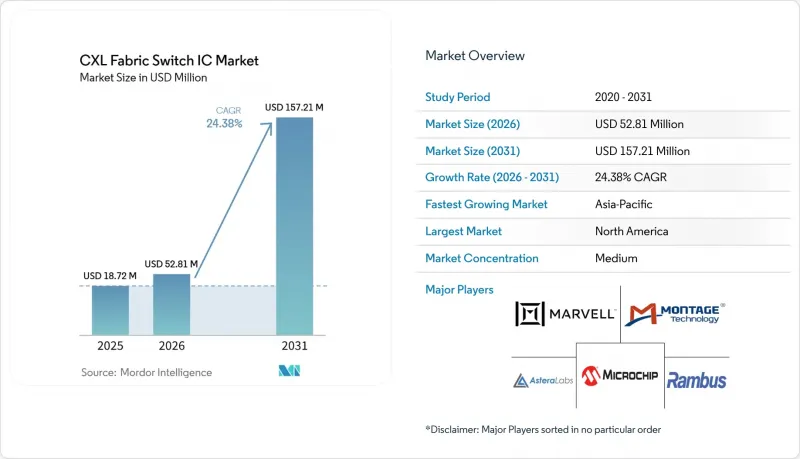
Mordor Intelligence에 의하면, CXL 패브릭 스위치 IC 시장 규모는 2025년에 1,872만 달러로 평가되었고, 2026년 5,281만 달러에서 2031년까지 1억 5,721만 달러에 이를 것으로 예측되며, 2026-2031년 CAGR 24.38%로 성장할 전망입니다.
본 보고서는 스위치 아키텍처별(CXL 2.0 메모리 풀링 스위치 IC 등), 레인 수별(최대 32레인, 33-64레인, 65-128레인 등), CXL 사양별(CXL 2.0 등), 용도별(메모리 풀링 및 메모리 테어링 등), 고객 유형별(하이퍼스케일러 및 클라우드 서비스 제공업체 등), 지역별로 분류되어 있습니다. 시장 전망은 금액(달러) 기준으로 제시되어 있습니다.
세계의 CXL 패브릭 스위치 IC 시장 동향 및 인사이트
AI 및 LLM에서 ‘메모리 장벽’으로 인한 압박이 수요의 주요 촉진요인으로 작용하고 있습니다.
LLM 추론의 디코딩 단계에서 GPU 활용률은 시스템이 연산 리소스가 아닌 고대역폭 메모리 전송을 대기하고 있는 경우 30%-40% 수준에서 정체될 수 있습니다. 이러한 병목 현상으로 인해 구매자들의 관심은 단순한 가속기 대수에서 랙 수준의 메모리 액세스 효율로 이동하고 있습니다. CXL 패브릭 스위치 IC 시장에서 이것이 중요한 이유는 스위치 실리콘을 통해 호스트의 액세스 패턴을 해치지 않으면서도 각 서버 외부에 코히런트 풀 메모리를 배치할 수 있기 때문입니다. 2026년 3월 코넬 대학교의 연구에 따르면, SGLang 추론 프레임워크에서 DRAM에 필적하는 성능을 가진 KV 캐시가 CXL 메모리 풀을 통해 제공되고 있는 것으로 보고되었습니다. 이 결과로 인해 CXL 패브릭 스위치 IC의 잠재 시장은 훈련 클러스터에서 실제 추론 환경으로 확대되고 있습니다. AI 플릿의 규모가 확대됨에 따라, 사업자가 고가의 GPU 자산 활용도 향상을 추구하는 모든 상황에서 CXL 패브릭 스위치 IC 시장의 중요성은 더욱 커지고 있습니다.
분산형이자 조합 가능한 데이터센터의 도입이 패브릭 계층의 모습을 변화시키고 있습니다.
분산된 인프라는 연산, 메모리, 스토리지 자원을 분리하기 때문에 패브릭 계층은 단순한 선택적 부가 기능이 아닌 시스템의 핵심 요소로 변화하고 있습니다. 마블(Marvel)사는 2026년 3월, CPU, GPU, 가속기를 아우르는 랙 수준의 메모리 풀링을 실현하는 'Structera S 30260'을 발표하며, 범용 반도체 공급업체들이 조합형 시스템 설계에 맞추어 로드맵을 조정하고 있음을 보여주었습니다. Astera Labs는 자사의 'Scorpio X 시리즈' 스마트 패브릭 스위치가 개방형 메모리 세미언틱스를 기반으로 한 스케일업 네트워킹을 위해 설계되었으며, 2026년 5월부터 주요 하이퍼스케일러에 대한 출하를 시작했다고 발표했습니다. SK hynix는 2025년 4월 CXL 2.0 기반 CMM-DDR5 모듈에 대한 고객 검증을 완료했으며, 도입 가능한 풀형 메모리 시스템으로의 광범위한 전환을 촉진하고 있습니다. 따라서 데이터센터 구매자들이 공유·재할당·확장이 가능하고 유휴 용량이 적은 메모리 리소스를 요구하게 되면, CXL 패브릭 스위치 IC 시장은 그 혜택을 누리게 될 것입니다. 또한, 이를 통해 CXL 패브릭 스위치 집적회로(IC) 시장의 상업적 전개 경로도 하이퍼스케일러를 위한 구축에서 OEM 주도 및 가속기 주도 시스템 아키텍처로 확대될 것입니다.
플랫폼과 생태계의 성숙도 부족이 단기적인 대규모 도입 제약
CXL 패브릭 스위치 IC 시장은 여전히 CPU, 메모리 모듈, 스위치용 실리콘 등 각 요소가 유기적으로 연계되어 준비가 완료되는 것에 의존하고 있으며, 설령 한 계층이 기술적으로 준비되어 있다 하더라도 광범위한 도입을 지연시키고 있습니다. 마벨(Marvell)은 2025년 9월, 주요 메모리 및 CPU 플랫폼 간의 상호 운용성을 강조하며, 광범위한 생태계 검증이 단순한 일상적인 체크리스트 항목이 아니라 여전히 중요한 상업적 이정표임을 보여주었습니다. SK하이닉스도 2025년 4월, CXL 2.0 기반 CMM-DDR5 모듈에 대한 고객 검증을 완료했다고 발표하며, 메모리 측의 인증이 여전히 도입 시기를 좌우하고 있음을 뒷받침했습니다. 각 인증 단계는 특히 하이퍼스케일러가 워크로드 고유의 조건 하에서 풀 스택을 테스트할 경우, 샘플 제공부터 양산 수주에 이르기까지의 과정을 길어지게 할 가능성이 있습니다. 소규모 벤더는 자사에서 통제할 수 없는 외부 플랫폼 로드맵에 의존하고 있기 때문에 더 큰 압박에 직면해 있습니다. 더 많은 서버, 메모리 모듈, 소프트웨어 스택이 동시에 성숙기에 도달하기 전까지는 CXL 패브릭 스위치 IC 시장이 직선적인 보급 곡선을 그리기보다는 불균일한 파도 모양의 확장을 이어갈 가능성이 높습니다.
부문 분석
2025년 시점에서 CXL 2.0 메모리 풀링 스위치 IC는 CXL 패브릭 스위치 IC 시장 규모의 48.32%를 차지했으나, CXL 3.x 패브릭 스위치 IC는 2031년까지 연평균 성장률(CAGR) 25.37%로 확대될 것으로 예측됩니다. 이러한 2025년의 선두 위상은 이미 CXL 2.0 호스트 인터페이스를 공개한 인텔의 Sapphire Rapids 및 AMD의 Genoa, Bergamo 서버 플랫폼의 도입 실적을 반영한 것입니다. 메모리 확장에서 보다 본격적인 패브릭 구축으로의 전환 기간 동안, 많은 구매자들이 유연성을 요구하고 있기 때문에 PCIe와 CXL 하이브리드 디바이스는 여전히 전략적 가치를 지니고 있습니다. 마블(Marvel)이 2026년 3월에 발표한 제품은 260레인의 CXL 3.0 스위치와 핀 호환이 가능한 260레인의 PCIe 6.0 스위치를 결합한 것으로, 단일 하드웨어 실적 내에서 이러한 과도기적 설계 논리를 지원합니다. AI 스케일업을 위한 메모리 시맨틱 설계와 커스텀/세미커스텀 스위치 IC는 여전히 초기 단계의 카테고리이지만, 일부 주요 사업자들이 메모리 서브시스템의 효율성을 보다 엄격하게 제어하고자 하기 때문에 중요한 위치를 차지하고 있습니다.
이러한 아키텍처의 전환은 단순한 버전 업그레이드가 아닙니다. 토폴로지가 단일 레벨 스위칭에서 멀티홉 패브릭의 동작으로 변화하기 때문입니다. Panmnesia사는 자사의 패브릭 스위치용 실리콘이 포트 기반 라우팅을 지원하는 CXL 3.2를 완벽하게 구현하고 있으며, 대규모 패브릭의 라우팅 요구 사항을 직접 충족한다고 밝혔습니다. 이는 CXL 패브릭 스위치 IC 시장에 중요한 의미를 지닙니다. 현재 양산 중인 CXL 2.0 디바이스는 소프트웨어 변경만으로는 완전한 CXL 3.x 멀티홉 패브릭으로 전환할 수 없기 때문입니다. 그 결과, 1세대 CXL을 조기에 도입한 기업들은 2차 조달 주기에서도 다시 시장에 진입할 가능성이 높을 것으로 보입니다. 또한, 장기적인 관점에서 보면 하이퍼스케일러가 스위치의 수뿐만 아니라 메모리 동작 면에서도 차별화를 꾀할 수 있는 맞춤형 프로그램의 여지도 남아 있습니다.
2025년에는 65-128 레인 구성이 매출의 51.64%를 차지할 것으로 예상되며, 한편 129-256 레인 부문은 2031년까지 연평균 성장률(CAGR) 25.28%로 성장할 것으로 전망됩니다. 65-128 레인 범위는 단일 스위치 계층을 통해 8-16개의 가속기 노드를 연결하는 현재 하이퍼스케일러의 랙 설계와 일치합니다. 최대 32레인 및 33-64레인 제품은 여전히 비용과 전력 소비가 주요 구매 요인인 엔터프라이즈 데이터센터, 엣지 배포 및 파일럿 프로그램에서 활용되고 있습니다. 하이엔드 분야에서는 Astera Labs에 따르면, 이 회사의 ‘Scorpio X 시리즈’ 스마트 패브릭 스위치가 320레인으로 출하되고 있으며, AI 스케일업 클러스터 성능의 최첨단에서 256레인 이상의 제품을 능가하고 있습니다. 따라서 CXL 패브릭 스위치 IC 시장의 상업적 방향성은 더 고밀도인 패브릭을 선호하는 경향을 보이고 있으며, 사업자 측은 홉 수를 줄이고 노드 도달 범위를 확대하기를 원하고 있습니다.
레인 수 구성이 변화하고 있는 것은 대규모 AI 클러스터에서 훈련 트래픽의 지연을 줄여주는 고라딕스 토폴로지의 이점을 얻을 수 있기 때문입니다. Astera Labs에 따르면, 자사의 'Scorpio P 시리즈' PCIe 스위치는 2025년에 기업 매출의 10%를 차지하고 있으며, 이는 X 시리즈의 양산 시작 이전부터 이미 고성능 스위칭이 상업적으로 중요한 비중을 차지하고 있었음을 보여줍니다. 이러한 매출 동향은 벤더들이 고레인 수 디바이스를 틈새 제품으로 취급하기보다는 밀도 확대를 지속하도록 뒷받침하고 있습니다. 또한 Neocloud나 GPU 클라우드 제공업체들도 더 고밀도인 연결 계층을 기반으로 한 랙 레퍼런스 디자인의 표준화를 추진하고 있어, 이에 따라 129-256 레인 대역에 대한 수요가 더욱 높아질 것으로 예측됩니다. 한편, 최대 규모의 패브릭 구축이라는 목표보다는 실용적인 도입 비용이 중시되는 상황에서는 낮은 레인 수의 디바이스도 계속해서 중요한 역할을 수행할 것입니다.
지역별 분석
2025년, 북미는 전 세계 매출의 59.28%를 차지했으며, CXL 패브릭 스위치 IC의 최대 지역 시장이 되었습니다. 이러한 우위는 주요 하이퍼스케일러와 상업적으로 가장 활발한 스위치용 실리콘 공급업체 중 일부가 해당 지역에 집중되어 있음을 반영합니다. Astera Labs는 2026년 1분기 매출이 전년 동기 대비 93% 증가한 3억 840만 달러에 달했다고 보고했으며, 이 회사의 Scorpio 스위치 제품군이 주요 성장 동력으로 작용하고 있습니다. 이러한 상업적 모멘텀은 북미의 인증 활동이 이미 상당한 출하량 증가로 이어지고 있음을 보여줍니다. 캐나다와 멕시코는 지역 데이터센터용량이 확대됨에 따라 규모는 작지만 중요한 인프라 채널로 부상하고 있습니다.
아시아태평양은 2031년까지 연평균 성장률(CAGR) 25.36%로 확대될 것으로 예측되며, CXL 패브릭 스위치 IC 시장에서 가장 빠르게 성장하는 지역 부문이 될 전망입니다. 한국은 메모리 생태계 개발과 CXL 지원 인프라에 대한 직접적인 수요라는 이중적인 역할을 수행하고 있습니다. SK하이닉스는 2025년 4월 CXL 2.0 기반 CMM-DDR5 모듈 검증을 완료했으며, 판메네시아는 2026년 4월 얼리 액세스 파트너에게 프리 릴리스 버전의 CXL 3.2 스위치용 실리콘을 공급했다고 발표했습니다. 메모리와 스위치의 개발이 이처럼 밀접하게 연계됨으로써 생태계의 학습 주기를 단축하고, 상용화를 위한 준비를 가속화할 수 있습니다. 중국, 일본, 동남아시아에서는 AI 인프라 구축 및 공공 기술 프로그램을 통해 추가적인 수요가 발생하고 있습니다.
유럽, 남미, 중동 및 아프리카는 2026년 시점에서 점유율이 낮았으나, CXL 패브릭 스위치 IC 시장에서 각각 다른 도입 경로를 따랐습니다. 유럽은 엔터프라이즈 AI 업그레이드 및 공공 HPC 프로그램과 더 밀접하게 연관되어 있습니다. 남미는 단기적으로는 하이퍼스케일 조달의 영향보다는 엔터프라이즈 서버의 교체 주기를 따를 가능성이 높을 것으로 보입니다. 중동 및 아프리카에서는 생태계 구축이 예정대로 진행된다면, 신규 AI 시설이 차세대 CXL 설계로 직접 전환되는 그린필드 기회가 생길 것입니다.
기타 혜택 :
- 엑셀 형식 시장 예측(ME) 시트
- 3개월간의 애널리스트 지원
자주 묻는 질문
목차
제1장 서론
제2장 조사 방법
제3장 주요 요약
제4장 시장 구도
제5장 시장 규모 및 성장 예측
제6장 경쟁 구도
제7장 시장 기회 및 향후 전망
AJY 26.08.07According to Mordor Intelligence, the CXL fabric switch IC market size is projected to be USD 18.72 million in 2025, USD 52.81 million in 2026, and reach USD 157.21 million by 2031, growing at a CAGR of 24.38% from 2026 to 2031.
This report is Segmented by Switch Architecture (CXL 2. 0 Memory Pooling Switch ICs, and More), Lane Count (Up To 32 Lanes, 33-64 Lanes, 65-128 Lanes, and More), CXL Specification (CXL 2. 0, and More), Application (Memory Pooling and Memory Tiering, and More), Customer Type (Hyperscalers and Cloud Service Providers, and More), and Geography. The Market Forecasts are Provided in Terms of Value (USD).
Global CXL Fabric Switch IC Market Trends and Insights
AI and LLM Memory Wall Pressure is the Primary Demand Catalyst
GPU utilization during LLM inference decode phases can stall at 30%-40% when systems wait on high-bandwidth memory transfers rather than on compute resources. That bottleneck shifts buyer focus from raw accelerator counts toward memory access efficiency at the rack level. In the CXL fabric switch IC market, this matters because switch silicon allows coherent pooled memory to sit outside each server without breaking host access patterns. A March 2026 Cornell study reported that a near-DRAM-performance KV cache is served via CXL memory pools in the SGLang inference framework. That result broadens the addressable market for the CXL fabric switch IC beyond training clusters into production inference environments. As AI fleets scale, the CXL fabric switch IC market becomes more relevant wherever operators want higher utilization from expensive GPU assets.
Disaggregated and Composable Data Center Adoption Reshapes the Fabric Layer
Disaggregated infrastructure separates compute, memory, and storage resources, which turns the fabric layer into a core system choice rather than an optional attachment. Marvell introduced the Structera S 30260 in March 2026 for rack-level memory pooling across CPUs, GPUs, and accelerators, showing that merchant silicon suppliers are aligning their roadmaps with composable system design. Astera Labs said its Scorpio X-Series smart fabric switch was built for open memory-semantic scale-up networking and began shipping to leading hyperscalers in May 2026. SK hynix completed customer validation of its CXL 2.0-based CMM-DDR5 module in April 2025, supporting the broader move toward deployable, pooled-memory systems. The CXL fabric switch IC market, therefore, benefits when data center buyers seek memory resources that can be shared, reassigned, and expanded with less stranded capacity. That also widens the commercial path for the CXL fabric switch integrated circuit (IC) market from hyperscaler builds toward OEM-led and accelerator-led system architectures.
Limited Platform and Ecosystem Maturity Constrain Near-Term Scale Deployment
The CXL fabric switch IC market still depends on the coordinated readiness of CPUs, memory modules, and switch silicon, which slows broad deployment even when one layer is technically ready. Marvell highlighted interoperability across major memory and CPU platforms in September 2025, showing that broad ecosystem validation remained a central commercial milestone rather than a routine checklist item. SK hynix also announced customer validation of its CXL 2.0-based CMM-DDR5 module in April 2025, reinforcing that memory-side qualification continued to shape deployment timing. Each qualification step can lengthen the path from sampling to volume orders, especially when hyperscalers test the full stack under workload-specific conditions. Smaller vendors face greater pressure because they depend on external platform roadmaps that they do not control. Until more servers, memory modules, and software stacks mature together, the CXL fabric switch IC market is likely to expand in uneven waves rather than along a straight adoption curve.
Other drivers and restraints analyzed in the detailed report include:
- Migration to CXL 3.x and Fabric-Scale Memory Pooling Opens the Multi-Rack Tier
- Rack-Scale GPU and Accelerator Utilization Optimization Raises Strategic Priority
- High Silicon, Packaging, and Validation Costs Limit New Entrants
For complete list of drivers and restraints, kindly check the Table Of Contents.
Segment Analysis
CXL 2.0 memory pooling switch ICs held 48.32% of the CXL fabric switch IC market size in 2025, while CXL 3.x fabric switch ICs are projected to expand at 25.37% CAGR through 2031. That 2025 lead reflected the installed base of Intel Sapphire Rapids and AMD Genoa and Bergamo server platforms that already exposed CXL 2.0 host interfaces. Hybrid PCIe and CXL devices still carry strategic value because many buyers want flexibility during the transition from memory expansion toward fuller fabric deployment. Marvell's March 2026 launch paired a 260-lane CXL 3.0 switch with a pin-compatible 260-lane PCIe 6.0 switch, which supports that transitional design logic in a single hardware footprint. AI scale-up memory-semantic designs and custom or semi-custom switch ICs remain early-stage categories, but they matter because a few large operators want tighter control over memory subsystem efficiency.
The architecture shift is not simply a version update, because it changes the topology from single-level switching toward multi-hop fabric behavior. Panmnesia said its fabric-switch silicon fully implements CXL 3.2 with port-based routing support, directly addressing the routing demands of larger fabrics. That matters for the CXL fabric switch IC market because current CXL 2.0 devices in production cannot be turned into full CXL 3.x multi-hop fabrics solely through software changes. As a result, early adopters of first-generation CXL are still likely to return to the market for a second procurement cycle. The long-term path also leaves room for custom programs that allow hyperscalers to differentiate on memory behavior rather than on switch count alone.
The 65-128-lane configuration accounted for 51.64% of revenue in 2025, while the 129-256-lane segment is projected to grow at a 25.28% CAGR through 2031. The 65-128-lane range aligns with current hyperscaler rack designs that connect 8-16 accelerator nodes via a single switch tier. Up-to-32-lane and 33-64-lane products still serve enterprise data centers, edge deployments, and pilot programs where cost and power remain central buying factors. At the upper end, Astera Labs said its Scorpio X-Series smart fabric switch shipped with 320 lanes, placing it above-256-lane products at the performance frontier of AI scale-up clusters. The commercial direction of the CXL fabric switch IC market, therefore, favors denser fabrics, where operators want fewer hops and broader node reach.
The lane-count mix is shifting because larger AI clusters benefit from higher-radix topologies that reduce latency for training traffic. Astera Labs said its Scorpio P-Series PCIe switches accounted for 10% of total company revenue in 2025, demonstrating that high-performance switching already carried meaningful commercial weight before the X-Series ramp. That revenue signal encourages switch vendors to keep expanding density rather than treating high-lane-count devices as niche products. Neocloud and GPU cloud providers are also standardizing rack reference designs around denser connectivity layers, which should pull more demand into the 129-256-lane range. Lower-lane devices should still keep volume relevance where practical deployment economics matter more than the largest fabric ambition.
Complete Report Scope:
- By Switch Architecture
- CXL 2.0 Memory Pooling Switch ICs
- CXL 3.x Fabric Switch ICs
- Hybrid PCIe/CXL Switch ICs
- AI Scale-Up Memory-Semantic Fabric Switch ICs
- Custom or Semi-Custom CXL Fabric Switch ICs
- By Lane Count
- Up to 32 Lanes
- 33-64 Lanes
- 65-128 Lanes
- 129-256 Lanes
- Above 256 Lanes
- By CXL Specification
- CXL 2.0
- CXL 3.0
- CXL 3.1 and CXL 3.2
- CXL 4.0
- By Application
- Memory Pooling and Memory Tiering
- Memory Sharing and Dynamic Capacity Allocation
- Composable and Disaggregated Infrastructure
- AI Training and Inference Clusters
- HPC and Scientific Computing
- Database, Analytics, and In-Memory Computing
- Other Data-Center Workloads
- By Customer Type
- Hyperscalers and Cloud Service Providers
- Neocloud and GPU Cloud Providers
- Server OEMs and ODMs
- AI Server and Accelerator System Vendors
- Enterprise Data-Center Operators
- HPC, Research, and Government Organizations
- Telecom Operators and Edge Infrastructure Providers
- By Geography
- North America
- United States
- Canada
- Mexico
- Europe
- Germany
- United Kingdom
- France
- Italy
- Rest of Europe
- Asia-Pacific
- China
- Japan
- South Korea
- India
- Southeast Asia
- Rest of Asia-Pacific
- South America
- Middle East and Africa
- North America
Geography Analysis
North America accounted for 59.28% of global revenue in 2025, making it the largest regional market for CXL fabric switch ICs. That lead reflected the concentration of major hyperscalers and several of the most commercially active switch silicon suppliers in the same region. Astera Labs reported Q1 2026 revenue of USD 308.4 million, up 93% year over year, with its Scorpio switch families acting as the primary growth engine. That commercial momentum shows that North American qualification activity is already converting into meaningful shipment growth. Canada and Mexico add smaller but relevant infrastructure channels as regional data center capacity broadens.
Asia-Pacific is projected to expand at a 25.36% CAGR through 2031, making it the fastest-growing regional segment of the CXL fabric switch IC market. South Korea plays a dual role, combining memory ecosystem development with direct demand for CXL-enabled infrastructure. SK hynix validated its CXL 2.0-based CMM-DDR5 module in April 2025, and Panmnesia said in April 2026 that it had supplied pre-release CXL 3.2 switch silicon to early access partners. That proximity between memory and switch development can shorten ecosystem learning cycles and speed practical deployment readiness. China, Japan, and Southeast Asia add further demand through AI infrastructure buildouts and public technology programs.
Europe, South America, and the Middle East and Africa held smaller positions in 2026, but each followed a different adoption path inside the CXL fabric switch IC market. Europe is tied more closely to enterprise AI upgrades and public HPC programs. South America is likely to track enterprise server refresh cycles more than hyperscale procurement in the near term. The Middle East and Africa offer greenfield opportunities for new AI facilities to move directly toward later-generation CXL designs if ecosystem readiness improves on schedule.
- Marvell Technology, Inc.
- Panmnesia Co., Ltd.
- Broadcom Inc.
- Intel Corporation
- Astera Labs, Inc.
- Micron Technology, Inc.
- MemVerge, Inc.
- Rambus Inc.
- Montage Technology Co., Ltd.
- GigaIO, Inc.
- Enfabrica Corporation
- Microchip Technology Incorporated
- Renesas Electronics Corporation
- Arm Holdings Plc
- Cadence Design Systems, Inc.
- HiSilicon (Shanghai) Technologies CO., LTD (Huawei Technologies Co., Ltd.)
- SiPearl SAS
Additional Benefits:
- The market estimate (ME) sheet in Excel format
- 3 months of analyst support
TABLE OF CONTENTS
1 INTRODUCTION
- 1.1 Study Assumptions and Market Definition
- 1.2 Scope of the Study
2 RESEARCH METHODOLOGY
3 EXECUTIVE SUMMARY
4 MARKET LANDSCAPE
- 4.1 Market Overview
- 4.2 Market Drivers
- 4.2.1 AI and LLM Memory Wall Pressure
- 4.2.2 Disaggregated and Composable Data Center Adoption
- 4.2.3 Migration to CXL 3.x and Fabric-Scale Memory Pooling
- 4.2.4 Rack-Scale GPU and Accelerator Utilization Optimization
- 4.2.5 Port Density and Latency Advantages Over Proprietary Scaling Approaches
- 4.2.6 Early Hyperscaler Qualification of CXL Switch Silicon
- 4.3 Market Restraints
- 4.3.1 Limited Platform and Ecosystem Maturity at Scale
- 4.3.2 High Silicon, Packaging, and Validation Cost
- 4.3.3 Interoperability and Qualification Complexity Across Vendors
- 4.3.4 Competitive Pressure From Proprietary Interconnect Architectures
- 4.4 Supply Chain Analysis
- 4.5 Technological Outlook
- 4.6 Regulatory Landscape
- 4.7 Porter's Five Forces Analysis
- 4.7.1 Bargaining Power of Suppliers
- 4.7.2 Bargaining Power of Buyers
- 4.7.3 Threat of New Entrants
- 4.7.4 Threat of Substitutes
- 4.7.5 Intensity of Competitive Rivalry
5 MARKET SIZE AND GROWTH FORECASTS (VALUE)
- 5.1 By Switch Architecture
- 5.1.1 CXL 2.0 Memory Pooling Switch ICs
- 5.1.2 CXL 3.x Fabric Switch ICs
- 5.1.3 Hybrid PCIe/CXL Switch ICs
- 5.1.4 AI Scale-Up Memory-Semantic Fabric Switch ICs
- 5.1.5 Custom or Semi-Custom CXL Fabric Switch ICs
- 5.2 By Lane Count
- 5.2.1 Up to 32 Lanes
- 5.2.2 33-64 Lanes
- 5.2.3 65-128 Lanes
- 5.2.4 129-256 Lanes
- 5.2.5 Above 256 Lanes
- 5.3 By CXL Specification
- 5.3.1 CXL 2.0
- 5.3.2 CXL 3.0
- 5.3.3 CXL 3.1 and CXL 3.2
- 5.3.4 CXL 4.0
- 5.4 By Application
- 5.4.1 Memory Pooling and Memory Tiering
- 5.4.2 Memory Sharing and Dynamic Capacity Allocation
- 5.4.3 Composable and Disaggregated Infrastructure
- 5.4.4 AI Training and Inference Clusters
- 5.4.5 HPC and Scientific Computing
- 5.4.6 Database, Analytics, and In-Memory Computing
- 5.4.7 Other Data-Center Workloads
- 5.5 By Customer Type
- 5.5.1 Hyperscalers and Cloud Service Providers
- 5.5.2 Neocloud and GPU Cloud Providers
- 5.5.3 Server OEMs and ODMs
- 5.5.4 AI Server and Accelerator System Vendors
- 5.5.5 Enterprise Data-Center Operators
- 5.5.6 HPC, Research, and Government Organizations
- 5.5.7 Telecom Operators and Edge Infrastructure Providers
- 5.6 By Geography
- 5.6.1 North America
- 5.6.1.1 United States
- 5.6.1.2 Canada
- 5.6.1.3 Mexico
- 5.6.2 Europe
- 5.6.2.1 Germany
- 5.6.2.2 United Kingdom
- 5.6.2.3 France
- 5.6.2.4 Italy
- 5.6.2.5 Rest of Europe
- 5.6.3 Asia-Pacific
- 5.6.3.1 China
- 5.6.3.2 Japan
- 5.6.3.3 South Korea
- 5.6.3.4 India
- 5.6.3.5 Southeast Asia
- 5.6.3.6 Rest of Asia-Pacific
- 5.6.4 South America
- 5.6.5 Middle East and Africa
- 5.6.1 North America
6 COMPETITIVE LANDSCAPE
- 6.1 Market Concentration
- 6.2 Strategic Moves
- 6.3 Vendor Positioning Analysis
- 6.4 Company Profiles (includes Global Level Overview, Market Level Overview, Core Segments, Financials as available, Strategic Information, Market Rank/Share, Products and Services, Recent Developments)
- 6.4.1 Marvell Technology, Inc.
- 6.4.2 Panmnesia Co., Ltd.
- 6.4.3 Broadcom Inc.
- 6.4.4 Intel Corporation
- 6.4.5 Astera Labs, Inc.
- 6.4.6 Micron Technology, Inc.
- 6.4.7 MemVerge, Inc.
- 6.4.8 Rambus Inc.
- 6.4.9 Montage Technology Co., Ltd.
- 6.4.10 GigaIO, Inc.
- 6.4.11 Enfabrica Corporation
- 6.4.12 Microchip Technology Incorporated
- 6.4.13 Renesas Electronics Corporation
- 6.4.14 Arm Holdings Plc
- 6.4.15 Cadence Design Systems, Inc.
- 6.4.16 HiSilicon (Shanghai) Technologies CO., LTD (Huawei Technologies Co., Ltd.)
- 6.4.17 SiPearl SAS
7 MARKET OPPORTUNITIES AND FUTURE OUTLOOK
- 7.1 White-Space and Unmet-Need Assessment

(주말 및 공휴일 제외)


