

|
시장보고서
상품코드
2099875
CXL PCIe 6.0 PHY IP 시장 : 시장 점유율 분석, 업계 동향 및 통계, 성장 예측(2026-2031년)CXL PCIe 6.0 PHY IP - Market Share Analysis, Industry Trends & Statistics, Growth Forecasts (2026 - 2031) |
||||||
 Mordor Intelligence
Mordor Intelligence에 의하면, CXL PCIe 6.0 PHY IP 시장 규모는 2025년에 1억 1,260만 달러로 평가되었고, 2026년 1억 4,630만 달러에서 2031년까지 5억 2,480만 달러에 이를 것으로 전망되고 있으며, 2026-2031년 CAGR 29.11%를 나타낼 것으로 예측됩니다.
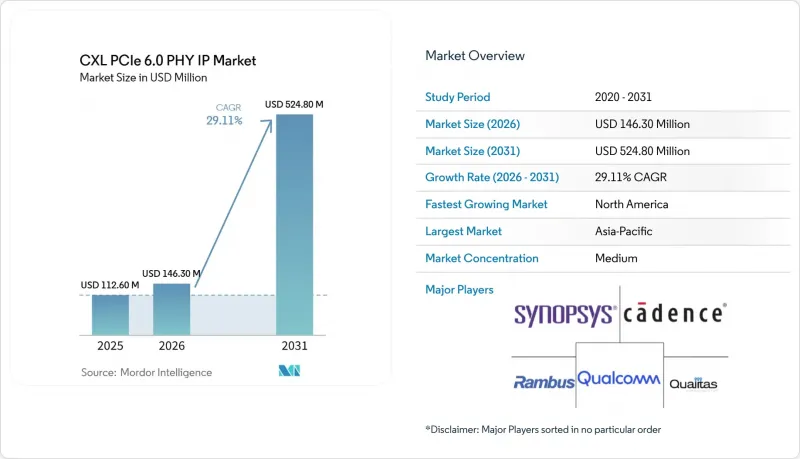
본 보고서는 제품별(독립형 PCIe 6.0/CXL 3. X PHY IP, 통합형 PHY 서브시스템 IP 등), 프로토콜별(PCIe 6.0 PHY IP-PCIe 전용 등), 공정 노드별(3nm 이하 등), IP 구성별(싱글 레인 PHY IP 등), 최종 용도별(범용 데이터센터 및 클라우드 서버 등), 지역별로 분류되어 있습니다. 시장 전망은 금액(달러) 기준으로 제시되어 있습니다.
세계의 CXL PCIe 6.0 PHY IP 시장 동향 및 인사이트
AI 가속기 및 하이퍼스케일 코히런트 메모리 수요의 급증
AI 가속기 SoC 프로그램은 CXL PCIe 6.0 PHY IP 시장의 주요 구매 동인으로 작용하고 있으며, 현재는 일반적인 서버 교체 주기보다 더 큰 비중을 차지하고 있습니다. 하이퍼스케일 사업자들은 64GT/s의 레인 성능을 필요로 합니다. 이는 대규모 AI 클러스터가 기존 클라우드 워크로드에 비해 메모리 이동, 캐시 코히어런스 및 랙 스케일 대역폭에 훨씬 더 큰 부하를 주기 때문입니다. CXL 3.0은 PCIe 6.0 물리 계층 전반에 걸쳐 코히런트 메모리 동작을 확장함으로써 이러한 추세를 더욱 강화했습니다. 이로 인해 새로운 가속기 설계에서 공유 PHY의 중요성이 더욱 높아졌습니다. 2025년에 발표된 조사에 따르면, 전이중 채널을 갖춘 CXL 연결 DRAM은 읽기 및 쓰기 비율이 균형을 이룰 경우, 기존의 DDR5 구성에 비해 55-61% 더 높은 대역폭을 실현하는 것으로 나타났습니다. 이로써 시스템 아키텍트는 CXL 지원 인터페이스를 지정해야 할 보다 직접적인 성능상의 근거를 얻게 되었습니다. CXL PCIe 6.0 PHY IP 시장이 활기를 띠고 있는 이유는 이 아키텍처를 기반으로 구축되는 모든 가속기, 스위치, 메모리 컨트롤러가 여전히 라이선싱 가능한 고속 물리 인터페이스를 필요로 하기 때문입니다. AI 시스템 설계가 단순한 연산 능력의 확장에서 메모리를 고려한 확장으로 전환됨에 따라, CXL PCIe 6.0 PHY IP 시장에서는 단일 IP 선택으로 대역폭과 코히어런스를 모두 추구하는 프로젝트 수요가 더욱 높아지고 있습니다.
차세대 SoC에서의 PCIe 6.0과 CXL의 융합
PCIe 6.0과 CXL 3.x의 융합으로 인해, 기존에는 별도로 존재하던 두 가지 조달 경로가 하나로 통합되었으며, 그 결과 PHY 계층에서 CXL PCIe 6.0 PHY IP 시장의 가치가 높아지고 있습니다. 단일 SoC에서 두 표준을 모두 지원하는 설계자는 면적과 전력 소비의 중복을 줄일 수 있게 되었으며, 이로 인해 개별 구현보다 통합된 PHY 블록이 더 매력적인 선택지가 되고 있습니다. 캐드런스는 2025년 6월, 삼성 파운드리와의 제휴 관계를 확대하고, 삼성의 첨단 노드에서 PCIe 6.0 및 CXL 3.2의 PHY 및 컨트롤러 IP를 제공함으로써 이러한 방향성을 더욱 강화했습니다. 또한 알파웨이브 세미(AlphaWave Semi)도 PCIe 6.0, CXL 3.1 및 800G 이더넷을 혼합 모드로 지원하는 멀티프로토콜 연결 치플렛의 테이프아웃을 완료하며, 통합형 I/O에 대한 상업적 수요를 보여주었습니다. 그 후, 2025년 6월, 시노프시스는 브로드컴의 PEX90000 스위치와 함께 64GT/s에서 PCIe 6.x의 상호 운용성을 입증했습니다. 이를 통해 관련 규정 준수 및 상호 운용성 스택이 실제 설계 채택을 위한 보다 실용적인 단계에 접어들었음을 보여주었습니다. 따라서 CXL PCIe 6.0 PHY IP 시장은 프로토콜에 대한 수요뿐만 아니라, 통합 위험을 줄여주는 통일된 물리적 인터페이스에 대한 광범위한 설계 선호에 힘입어 성장하고 있습니다.
PCIe 6.0 PAM4 PHY 규격 준수 검증의 높은 비용
검증은 여전히 CXL PCIe 6.0 PHY IP 시장의 가장 뚜렷한 장벽 중 하나입니다. 이는 64GT/s PAM4 테스트에 이전 PCIe 세대보다 더 비싼 도구와 많은 엔지니어링 시간이 필요하기 때문입니다. PCIe 6.0 규격 준수를 위해서는 서로 다른 측정 방법과 프로토콜 고유의 패턴이 필요하며, 이로 인해 송신기, 지터 및 스트레스드 아이(stressed eye) 검증의 복잡성이 더욱 가중됩니다. 시노프시스는 FYI 이전의 적합성 테스트를 위해 공식 PCIe 6.x 골드 시스템을 제공했으나, 이 환경의 가치를 최대한 활용할 수 있는 것은 이미 최고 수준의 IP 생태계를 활용하고 있는 고객으로 제한됩니다. 소규모 설계 팀의 경우, 첫 PAM4 테이프아웃에 수반되는 툴 비용, 실험실 사용 시간, 그리고 반복되는 특성 평가 작업 비용을 정당화하기 어려울 수 있습니다. 따라서 CXL 및 PCIe 6.0 PHY IP 시장은 이러한 부담을 더 쉽게 감당할 수 있는 대규모 하이퍼스케일 및 AI 관련 프로젝트에 편중된 상태가 지속되고 있습니다. 호스트의 보급 범위가 확대되고 테스트 성숙도가 향상될 때까지는 검증 비용이 장벽이 되어, 2차 고객 그룹으로의 확산은 계속해서 지연될 것입니다.
부문 분석
2025년, 독립형 PCIe 6.0 및 CXL 3.x PHY IP는 매출의 44.13%를 차지했으며, CXL PCIe 6.0 PHY IP 시장의 주요 제품이 되었습니다. 이러한 위상은 선진적인 SoC 팀들이 자사의 컨트롤러나 선정한 타사 로직과 연결 가능한 모듈형 PHY 블록을 선호하는 경향을 반영합니다. 많은 대규모 칩 프로그램에서는 시스템 아키텍처, 보안, 워크로드 튜닝 및 파운드리 전환에 대한 통제력을 높이기 위해 여전히 컨트롤러 계층에서의 유연성을 추구하고 있습니다. 또한, 독립형 모델은 단일 서브시스템 스택에 대한 과도한 의존을 피하려는 하이퍼스케일러의 설계 전략에도 적합합니다. CXL PCIe 6.0 PHY IP 시장에서 이러한 추세로 인해, 특성 평가 데이터, 규정 준수 지원 및 공정 이식에 대한 노하우로 뒷받침되는 라이선스 가능한 코어에 대한 수요는 계속해서 높은 수준을 유지하고 있습니다. 또한, PAM4 검증은 도입까지의 기간을 대폭 연장할 가능성이 있으므로, 독립형 카테고리에서도 검증, 규정 준수 및 특성 평가 관련 자료의 중요성이 더욱 높아지고 있습니다. 시노프시스는 상용 호스트가 널리 이용 가능해지기 전에 고객에게 조기 규정 준수 달성 경로를 제공하는 ‘PCIe 6.x Gold System’ 접근 방식을 통해 이러한 필요성을 강조했습니다. 이러한 자료는 회로 블록 자체를 넘어서는 불확실성을 줄여주므로, 독립형 라이선싱의 가치를 높입니다. 또한, 모듈형 라이선싱이 이론적으로는 더 단순해 보일지라도, 프리미엄 PHY 벤더가 가격을 유지할 수 있는 이유를 설명하는 데에도 도움이 됩니다. 실제로 주요 독립형 제품은 더 이상 단순한 PHY 매크로가 아니라, 고속 제품 개발을 위한 위험이 관리된 진입점이 되고 있습니다.
통합형 PHY 서브시스템 IP는 2031년까지 연평균 성장률(CAGR) 29.89%를 나타낼 것으로 예측되며, CXL PCIe 6.0 PHY IP 시장에서 가장 빠르게 성장하는 제품입니다. 이러한 변화는 특히 사내 PAM4 관련 전문 지식이 제한적인, 1세대 PCIe 6.0 및 CXL 프로그램을 담당하는 팀 등 다양한 구매자층을 반영하고 있습니다. 컨트롤러와 PHY를 번들로 제공함으로써 통합 주기가 단축되고, 공급업체 간의 디버깅 작업 중복이 줄어들며, 시스템에 대한 책임의 상당 부분이 IP 라이선서 측으로 이전됩니다. 이 모델은 스택이 파편화되어 일정상 리스크가 높은 CXL 메모리 컨트롤러 ASIC, 리타이머, DPU 프로그램에서 점점 더 매력적인 선택지로 부상하고 있습니다. Cadence가 삼성 파운드리용으로 공정별 PCIe 6.0 및 CXL PHY와 컨트롤러에 대한 지원을 지속적으로 확대하고 있다는 점은 통합형 솔루션이 특정 제조 공정에 점점 더 최적화되고 있음을 보여줍니다. CXL PCIe 6.0 PHY IP 업계에서 이로 인해 포팅, 통합 및 맞춤화 서비스는 단순한 부가 기능이 아닌, 더욱 강력한 수익원으로 자리 잡고 있습니다. 또한 설계 팀 입장에서도 별도의 PHY 및 컨트롤러 벤더별로 검증을 수행하는 것보다, 하나의 조정되고 인증된 패키지를 받는 데 더 큰 가치를 두고 있습니다. 5nm에서 3nm 이하로 노드 전환이 가속화되는 가운데, 이 서브시스템 모델은 아키텍처의 유연성 극대화보다 속도와 리스크 관리를 중시하는 구매자들 사이에서 계속해서 중요성이 커질 것입니다. 그 결과, CXL PCIe 6.0 PHY IP 시장에서 현재 가장 큰 수익원은 모듈형 코어이지만, 향후 가장 빠른 성장이 예상되는 분야는 긴밀하게 번들된 솔루션입니다. 이러한 균형이 예측 기간 동안 공급업체의 패키징 전략을 결정짓게 될 것입니다.
CXL 3.0 및 CXL 3.1을 지원하는 PCIe 6.0 PHY IP는 2025년 매출의 48.86%를 차지하며, CXL PCIe 6.0 PHY IP 시장에서 가장 큰 프로토콜 기능 점유율을 기록했습니다. 이 결과는 현재 최첨단 데이터센터용 SoC의 상당수가 동일한 인터페이스를 통해 표준 PCIe 연결성과 일관성 있는 CXL 메모리 동작을 모두 필요로 한다는 사실과 밀접한 관련이 있습니다. 메모리 풀링이나 일관성 기능을 필요로 하는 많은 서버, 액셀러레이터, 패브릭 설계에서는 PCIe만으로 구현하는 것만으로는 더 이상 충분하지 않게 되었습니다. CXL 3.0 사양 자체가 이러한 연동을 구조적인 것으로 만들고 있습니다. 왜냐하면 이 프로토콜은 PCIe 6.0 물리 인터페이스의 ‘옆’이 아니라 ‘위’에 위치하고 있기 때문입니다. 이로 인해 듀얼 모드 PHY 지원은 CXL PCIe 6.0 PHY IP 시장에서 특히 장기적인 로드맵의 관련성을 고려하여 설계되는 서버 프로세서 및 가속기 플랫폼에서 지속적인 우위를 가져다줍니다. 또한 구매자의 입장에서 듀얼 모드 지원은 표준 I/O 확장과 코히런트 메모리 도입 사이의 선택권을 유지할 수 있게 해주기 때문에 아키텍처의 변화에 대한 헤지 수단으로도 간주됩니다. 즉, 최대 시장 점유율은 단순히 현재 수요를 반영할 뿐만 아니라, 향후 플랫폼이 CXL을 대규모로 어떻게 활용할지에 대한 불확실성에 대한 대응이기도 합니다. 많은 프로젝트에서 듀얼 모드 PHY는 단순한 프리미엄 업그레이드가 아니라 기본 출발점이 되고 있습니다. 이것이 바로 CXL PCIe 6.0 PHY IP 시장에서 광범위한 프로토콜 로드맵과 성숙한 상호 운용성 지원을 갖춘 공급업체가 계속해서 우위를 점하고 있는 이유 중 하나입니다. 또한, PCIe와 CXL 모두에 대한 대응 준비가 되어 있음을 입증할 수 있는 벤더가 라이선싱 계약 결정 과정에서 더 유리한 입지를 차지하는 이유도 이를 통해 뒷받침됩니다.
멀티프로토콜 64GT/s PHY IP 시장은 2031년까지 연평균 성장률(CAGR) 29.67%를 나타낼 것으로 예측되며, 이는 여러 표준에 걸쳐 공유 SerDes의 활용이 확대되고 있음을 반영합니다. 칩렛 기반 설계, SmartNIC 및 DPU에서는 다이 면적과 전력 소모를 줄이기 위해 통합된 고속 인프라를 통한 PCIe, CXL 및 이더넷 지원이 점점 더 필요해지고 있습니다. Alphawave Semi의 'AlphaCHIP1600-IO' 칩렛은 PCIe 6.0, CXL 3.1 및 800G 이더넷 지원을 하나의 혼합 모드 설계에 통합함으로써 이러한 방향성을 명확히 보여주었습니다. CXL 및 PCIe 6.0 PHY IP 시장은 이러한 추세로부터 혜택을 받고 있습니다. 재사용 가능한 각 고속 레인이 더 많은 제품군과 시스템 내 역할을 수행할 수 있기 때문입니다. 이러한 재사용을 지원하는 벤더는 대역폭이 중요한 반면, 실리콘 면적이나 열적 제약이 엄격한 설계 프로젝트를 수주하는 데 있어 더 유리한 입장에 있습니다. PCIe 전용 PHY IP는 CXL 지원이 필수적이지 않은 스토리지 컨트롤러나 일부 자동차용 컴퓨팅 설계 분야에서 여전히 확고한 입지를 유지하고 있습니다. 하지만 CXL PCIe 6.0 PHY IP 시장의 향후 수요 동향은 아날로그 리소스를 중복하지 않고 여러 프로토콜을 지원하는 유연한 레인 인프라로 향하고 있습니다. 이러한 추세는 단일 표준에 특화된 제품이 아닌, 포트폴리오 폭이 넓고 규정 준수 범위가 광범위한 벤더에게 유리하게 작용합니다. 향후 많은 구매 결정에서 프로토콜의 유연성이 순수한 신호 성능만큼 중요하게 여겨질 것입니다. 따라서 이 부문의 성장은 상호 연결 표준과 마찬가지로 시스템 아키텍처의 경제성에 대해서도 많은 것을 시사합니다.
지역별 분석
2025년, 북미는 CXL PCIe 6.0 PHY IP 시장 점유율의 43.27%를 차지하며 지역별 1위를 유지했습니다. 이 지역은 하이퍼스케일 클라우드 사업자, 가속기 개발 기업, EDA 벤더, 독립 IP 공급업체가 밀집해 있다는 이점이 있으며, 그 대부분은 여전히 미국에 집중되어 있습니다. 이러한 조합 덕분에 CXL PCIe 6.0 PHY IP 시장에서 아키텍처 선정부터 라이선싱, 검증, 테이프아웃에 이르는 과정이 단축되고 있습니다. 시노프시스(Synopsys)는 2025년까지 7세대에 걸친 PCIe에서 100건 이상의 구현과 3,800건 이상의 고객사 테이프아웃을 달성했다고 보고하고 있으며, 이는 해당 지역의 설계 기반의 성숙도를 반영하고 있습니다. 유럽은 확고한 입지를 갖춘 IP 벤더와 자동차용 컴퓨팅 분야의 호황에 힘입어, 개발 지역으로서도 최종 사용자 지역으로서도 여전히 중요한 위치를 차지하고 있습니다. 한편, 램버스(Lambas)는 데이터센터 및 AI SoC를 위해 CXL 3.0을 지원하는 완전한 PCIe 6.0 인터페이스 서브시스템을 포지셔닝하고 있습니다.
아시아태평양은 2031년까지 연평균 성장률(CAGR) 30.06%를 나타낼 것으로 예측되며, CXL PCIe 6.0 PHY IP 시장 규모 측면에서 가장 두드러진 성장을 보일 지역 블록이 될 전망입니다. 이러한 성장은 선진적인 파운드리 생산 능력, 각국의 AI 인프라 계획, 그리고 메모리, 스위칭, 검증 툴을 중심으로 한 지역 생태계의 강화에 힘입은 것입니다. 키오크시아가 2025년 8월에 발표한 용량 5TB, 대역폭 64GB/s의 PCIe 6.0 플래시 메모리 모듈 프로토타입은 이 지역 수요가 가속기용 반도체에 그치지 않고 스토리지 클래스 메모리 용도로까지 확대되고 있음을 보여줍니다. 또한, 안리쓰가 2026년 6월에 64GT/s PAM4 링크용 CXL 2.0 및 3.x 평가 솔루션을 출시한 것도, 일본 내 규정 준수 인프라가 디바이스 개발과 병행하여 진화하고 있음을 보여줍니다. 따라서 아시아태평양의 CXL PCIe 6.0 PHY IP 시장은 제조의 깊이와 보다 광범위한 지원 툴체인의 이점을 모두 누리고 있습니다. 이는 중요한 점입니다. 구매자들은 PHY 설계, 패키징, 메모리 혁신 및 검증 리소스가 동일한 지역 공급망 내에서 이용 가능한 생태계를 선호하는 경향이 있기 때문입니다. 또한, 이 지역은 반도체, 스토리지, 서버 하드웨어 분야에서 확고한 입지를 바탕으로 향후 메모리 풀링 도입의 혜택을 누리기에 유리한 위치에 있습니다. 그 결과, 예측 기간 동안 북미를 추월하지는 않더라도 아시아태평양은 북미와의 격차를 좁힐 가능성이 높을 것으로 보입니다.
남미 및 중동 및 아프리카는 CXL PCIe 6.0 PHY IP 시장에서 여전히 점유율이 작지만, 두 지역 모두 장기적인 데이터센터 및 주권 클라우드 확장과 밀접하게 연관되어 있습니다. 이 지역들의 현재 역할은 AI나 메모리 인프라에 대한 최종 수요라기보다는 현지 반도체 설계 역량의 깊이에 의해 제한받고 있습니다. 중동의 투자 프로그램은 가속기 조달, 설계 파트너십, 그리고 대규모 AI 인프라 프로젝트와 관련된 서비스를 통해 간접적인 성장을 뒷받침할 여지가 있습니다. 남미는 여전히 사이클의 초기 단계에 있지만, 하이퍼스케일 기업의 진출 확대와 국내 반도체 역량에 대한 관심 증가로 인해 향후 더 의미 있는 파이프라인이 형성될 가능성이 있습니다. CXL PCIe 6.0 PHY IP 시장에서 이러한 지역들은 단기적인 수익의 주축이라기보다는 미래의 다각화 기회로 보는 것이 더 적절합니다.
기타 혜택 :
- 엑셀 형식 시장 예측(ME) 시트
- 3개월간의 애널리스트 지원
자주 묻는 질문
목차
제1장 서론
제2장 조사 방법
제3장 주요 요약
제4장 시장 구도
제5장 시장 규모 및 성장 예측
제6장 경쟁 구도
제7장 시장 기회 및 향후 전망
AJY 26.08.07According to Mordor Intelligence, the CXL pCIe 6.0 PHY IP market size is projected to be USD 112.60 million in 2025, USD 146.30 million in 2026, and reach USD 524.80 million by 2031, growing at a CAGR of 29.11% from 2026 to 2031.
This report is Segmented by Offering (Standalone PCIe 6. 0 / CXL 3. X PHY IP, Integrated PHY Subsystem IP, and More), Protocol (PCIe 6. 0 PHY IP - PCIe-Only, and More), Process Node (3 Nm and Below, and More), IP Configuration (Single-Lane PHY IP, and More), End Use (General-Purpose Data Center and Cloud Servers, and More), and Geography. The Market Forecasts are Provided in Terms of Value (USD).
Global CXL PCIe 6.0 PHY IP Market Trends and Insights
Rapid AI Accelerator and Hyperscale Coherent Memory Demand
AI accelerator SoC programs have become the main buying trigger for the CXL PCIe 6.0 PHY IP market, and they now carry more weight than a normal server refresh cycle. Hyperscale operators need 64 GT/s lane performance because larger AI clusters place much heavier pressure on memory movement, cache coherence, and rack-scale bandwidth than earlier cloud workloads. CXL 3.0 strengthened that case by extending coherent memory behavior over the PCIe 6.0 physical layer, which made the shared PHY more important in new accelerator designs. Published 2025 research also showed that CXL-attached DRAM with full-duplex channels delivered 55-61% higher bandwidth at balanced read and write ratios than flat DDR5 setups, which gave system architects a more direct performance reason to specify CXL-enabled interfaces. The CXL PCIe 6.0 PHY IP market is benefiting because every accelerator, switch, or memory controller built around that architecture still needs a licensable high-speed physical interface. As AI system design shifts from simple compute scaling to memory-aware scaling, the CXL PCIe 6.0 PHY IP market is seeing stronger pull from programs that want both bandwidth and coherency in a single IP decision.
PCIe 6.0 And CXL Convergence in Next-Generation SoCs
The convergence of PCIe 6.0 and CXL 3.x has turned two earlier procurement paths into one, and that has made the CXL PCIe 6.0 PHY IP market more valuable at the PHY layer. Designers that support both standards in one SoC can now reduce duplication in area and power, which makes a combined PHY block more attractive than separate implementations. Cadence reinforced that direction in June 2025 when it extended its Samsung Foundry relationship to include PCIe 6.0 and CXL 3.2 PHY and controller IP on advanced Samsung nodes. Alphawave Semi also showed commercial demand for converged I/O when it taped out a multi-protocol connectivity chiplet that supports PCIe 6.0, CXL 3.1, and 800G Ethernet in mixed modes. Synopsys then demonstrated PCIe 6.x interoperability with Broadcom's PEX90000 switch at 64 GT/s in June 2025, which showed that the surrounding compliance and interoperability stack was becoming more practical for real design wins. The CXL PCIe 6.0 PHY IP market is therefore being pushed not just by protocol demand, but by a broader design preference for unified physical interfaces that reduce integration risk.
High Validation Cost for PCIe 6.0 PAM4 PHY Compliance
Validation remains one of the clearest brakes on the CXL PCIe 6.0 PHY IP market because 64 GT/s PAM4 testing needs more expensive tools and more engineering time than earlier PCIe generations. PCIe 6.0 compliance requires different measurement methods and protocol-specific patterns, which adds complexity for transmitter, jitter, and stressed-eye validation. Synopsys responded with an official PCIe 6.x Gold System for pre-FYI compliance testing, but the value of that environment is highest for customers already working with top-tier IP ecosystems. Smaller design teams can struggle to justify the tool cost, lab time, and repeated characterization work that accompany a first PAM4 tapeout. The CXL PCIe 6.0 PHY IP market therefore remains skewed toward large hyperscale and AI-related programs that can absorb that burden more easily. Until broader host availability and test maturity improve, validation cost will continue to slow expansion into second-tier customer groups.
Other drivers and restraints analyzed in the detailed report include:
- Shift To PAM4 and Advanced SerDes IP Outsourcing
- Need For Lower-Latency Memory Disaggregation in Data Centers
- Limited Design Wins Outside Tier 1 Hyperscale and AI Programs
For complete list of drivers and restraints, kindly check the Table Of Contents.
Segment Analysis
Standalone PCIe 6.0 and CXL 3.x PHY IP held 44.13% of revenue in 2025, which made it the leading offering in the CXL PCIe 6.0 PHY IP market. That position reflects the preference of advanced SoC teams for modular PHY blocks that can connect with their own controllers or selected third-party logic. Many large chip programs still want freedom at the controller layer because that gives them more control over system architecture, security, workload tuning, and foundry migration. The standalone model also fits well with hyperscaler design strategies that avoid overdependence on a single subsystem stack. In the CXL PCIe 6.0 PHY IP market, that keeps demand high for licensable cores backed by characterization data, compliance support, and process-porting experience. Verification, compliance, and characterization collateral have also become more important inside the standalone category because PAM4 validation can materially lengthen time to deployment. Synopsys highlighted that need with its PCIe 6.x Gold System approach, which gave customers an earlier compliance path before broad commercial host availability. That kind of collateral raises the value of a standalone license because it reduces uncertainty beyond the circuit block itself. It also helps explain why premium PHY vendors can defend pricing even when modular licensing seems simpler on paper. In practice, the leading standalone offer is no longer just a PHY macro, but a risk-managed entry point into high-speed product execution.
Integrated PHY subsystem IP is projected to grow at a 29.89% CAGR through 2031, which makes it the fastest-growing offering in the CXL PCIe 6.0 PHY IP market. This shift reflects a different buyer profile, especially teams handling first-generation PCIe 6.0 or CXL programs with limited internal PAM4 expertise. A bundled controller and PHY shortens integration cycles, reduces debugging overlap across suppliers, and moves more system responsibility to the IP licensor. That model is increasingly attractive for CXL memory controller ASICs, retimers, and DPU programs where the schedule risk of a fragmented stack is high. Cadence's continued expansion of process-specific PCIe 6.0 and CXL PHY and controller support for Samsung Foundry shows how integrated offerings are becoming more tailored to specific manufacturing paths. In the CXL PCIe 6.0 PHY IP industry, that makes porting, integration, and customization services a stronger revenue layer instead of a secondary add-on. Design teams also see value in receiving one coordinated qualification package rather than building proof across separate PHY and controller vendors. As node transitions accelerate from 5 nm toward 3 nm and below, this subsystem model should keep gaining relevance among buyers that value speed and risk control over maximum architecture flexibility. The result is a CXL PCIe 6.0 PHY IP market where the biggest current revenue sits with modular cores, but the fastest future expansion comes from tightly bundled solutions. That balance is likely to define vendor packaging strategy through the forecast period.
PCIe 6.0 PHY IP with CXL 3.0 and CXL 3.1 support accounted for 48.86% of revenue in 2025, the largest protocol capability share in the CXL PCIe 6.0 PHY IP market. This result is tied to the fact that most advanced data center SoCs now need both standard PCIe connectivity and coherent CXL memory behavior from the same interface. A PCIe-only implementation is no longer sufficient for many server, accelerator, and fabric designs that need memory pooling or coherency features. The CXL 3.0 specification itself makes that linkage structural because the protocol sits on top of the PCIe 6.0 physical interface rather than beside it. That gives dual-mode PHY support a durable advantage in the CXL PCIe 6.0 PHY IP market, especially where server processors and accelerator platforms are being designed for longer roadmap relevance. Buyers also view dual-mode support as a hedge against architecture shifts because it preserves optionality between standard I/O expansion and coherent memory deployment. That means the largest share is not simply a reflection of current demand, but a response to uncertainty in how future platforms will use CXL at scale. In many programs, a dual-mode PHY has become the default starting point rather than a premium upgrade. This is one reason the CXL PCIe 6.0 PHY IP market continues to favor suppliers with broad protocol roadmaps and mature interoperability support. It also reinforces why vendors that can prove both PCIe and CXL readiness hold a stronger position during licensing decisions.
Multi-protocol 64 GT/s PHY IP is projected to grow at a 29.67% CAGR through 2031, and this reflects the widening use of shared SerDes across several standards. Chiplet-based designs, SmartNICs, and DPUs increasingly need PCIe, CXL, and Ethernet support from a unified high-speed infrastructure to limit die area and power. Alphawave Semi's AlphaCHIP1600-IO chiplet showed that direction clearly by combining PCIe 6.0, CXL 3.1, and 800G Ethernet support in one mixed-mode design. The CXL PCIe 6.0 PHY IP market gains from this pattern because each reusable high-speed lane can serve more product classes and more system roles. Vendors that support such reuse are better placed to win designs where bandwidth is critical but silicon area and thermal limits are tight. PCIe-only PHY IP still holds a steady place in storage controllers and selected automotive compute designs where CXL support is not essential. Even so, the forward demand pattern in the CXL PCIe 6.0 PHY IP market is moving toward flexible lane infrastructure that supports multiple protocols without duplicating analog resources. That trend favors vendors with stronger portfolio breadth and broader compliance coverage instead of narrow single-standard products. Over time, protocol flexibility is likely to matter as much as raw signal performance in many buying decisions. The growth of this segment therefore says as much about system architecture economics as it does about interconnect standards.
Complete Report Scope:
- By Offering
- Standalone PCIe 6.0 / CXL 3.x PHY IP
- Integrated PHY Subsystem IP
- PHY Verification, Compliance, and Characterization Collateral
- PHY Porting, Integration, and Customization Services
- By Protocol Capability
- PCIe 6.0 PHY IP - PCIe-Only
- PCIe 6.0 PHY IP with CXL 3.0 / CXL 3.1 Support
- Multi-Protocol 64 GT/s PHY IP
- By Process Node
- 3 Nm and Below
- 4 Nm to 5 Nm
- 6 Nm to 7 Nm
- 8 Nm to 16 Nm
- Above 16 Nm
- By IP Configuration
- Single-Lane PHY IP
- x4 PHY IP Subsystem
- x8 PHY IP Subsystem
- x16 and Above PHY IP Subsystem
- By End Use
- General-Purpose Data Center and Cloud Servers
- AI Accelerators and HPC Systems
- CXL Memory Expansion and Memory Pooling Infrastructure
- Networking, Switching, DPUs, and Storage Infrastructure
- Telecom and Edge Compute
- Automotive and Industrial Compute
- Aerospace, Defense, and Other Specialized Compute
- By Geography
- North America
- United States
- Canada
- Mexico
- Europe
- Germany
- United Kingdom
- France
- Italy
- Rest of Europe
- Asia-Pacific
- China
- Japan
- South Korea
- India
- Southeast Asia
- Rest of Asia-Pacific
- South America
- Middle East and Africa
- North America
Geography Analysis
North America held 43.27% of the CXL PCIe 6.0 PHY IP market share in 2025, which kept it in the leading regional position. The region benefits from a dense concentration of hyperscale cloud operators, accelerator developers, EDA vendors, and independent IP suppliers, most of which remain centered in the United States. That combination shortens the path from architecture selection to licensing, validation, and tapeout in the CXL PCIe 6.0 PHY IP market. Synopsys reported more than 100 PCIe 6.x implementations and more than 3,800 customer tapeouts across seven PCIe generations by 2025, which reflects the maturity of the regional design base. Europe remains important as both a development and end-use region, supported by established IP vendors and automotive compute activity, while Rambus has positioned a complete PCIe 6.0 interface subsystem with CXL 3.0 support for data center and AI SoCs.
Asia-Pacific is projected to grow at a 30.06% CAGR through 2031, which makes it the fastest-growing regional block in the CXL PCIe 6.0 PHY IP market size. Growth is supported by advanced foundry capacity, national AI infrastructure plans, and a stronger regional ecosystem around memory, switching, and validation tools. KIOXIA's August 2025 prototype of a PCIe 6.0 flash memory module with 5 TB capacity and 64 GB/s bandwidth showed that regional demand extends beyond accelerator silicon into storage-class memory applications. Anritsu's June 2026 launch of CXL 2.0 and 3.x evaluation solutions for 64 GT/s PAM4 links also showed that compliance infrastructure in Japan is evolving alongside device development. The CXL PCIe 6.0 PHY IP market in Asia-Pacific therefore benefits from both manufacturing depth and a broader supporting tool chain. This matters because buyers often prefer ecosystems where PHY design, packaging, memory innovation, and validation resources are available within the same regional supply network. The region is also well placed to benefit from future memory pooling deployments because of its strong position in semiconductors, storage, and server hardware. As a result, Asia-Pacific is likely to narrow the gap with North America even if it does not overtake it during the forecast period.
South America and Middle East and Africa still represent smaller shares of the CXL PCIe 6.0 PHY IP market, but both regions are linked to longer-term data center and sovereign cloud build-outs. Their current role is limited more by local semiconductor design depth than by end demand for AI and memory infrastructure. Middle East investment programs can still support indirect growth through accelerator procurement, design partnerships, and services linked to large AI infrastructure projects. South America remains earlier in the cycle, though expanding hyperscale presence and interest in domestic semiconductor capability could create a more meaningful pipeline over time. For the CXL PCIe 6.0 PHY IP market, these regions are better viewed as future diversification opportunities than as near-term revenue anchors.
- Synopsys Incorporated
- Cadence Design Systems, Inc.
- Qualcomm Incorporated
- Rambus Inc.
- Qualitas Semiconductor Co Ltd
- PLDA
- SignatureIP, Inc.
- Logic Fruit Technologies Private Limited
- Credo Technology Group Holding Ltd
- SmartDV Technologies, Inc.
- EXTOLL GmbH
- Chip Interfaces B.V.
- Faraday Technology Corporation
- Global Unichip Corporation
- M31 Technology Corporation
- Silicon Creations, LLC
- VeriSilicon Microelectronics (Shanghai) Co., Ltd.
- Teledyne LeCroy, Inc.
- Keysight Technologies, Inc.
- Broadcom Inc.
Additional Benefits:
- The market estimate (ME) sheet in Excel format
- 3 months of analyst support
TABLE OF CONTENTS
1 INTRODUCTION
- 1.1 Study Assumptions and Market Definition
- 1.2 Scope of the Study
2 RESEARCH METHODOLOGY
3 EXECUTIVE SUMMARY
4 MARKET LANDSCAPE
- 4.1 Market Overview
- 4.2 Market Drivers
- 4.2.1 Rapid AI Accelerator and Hyperscale Coherent Memory Demand
- 4.2.2 PCIe 6.0 and CXL Convergence in Next-Generation SoCs
- 4.2.3 Shift to PAM4 and Advanced SerDes IP Outsourcing
- 4.2.4 Need for Lower-Latency Memory Disaggregation in Data Centers
- 4.2.5 Multi-Protocol PHY Reuse Across PCIe, CXL, and Ethernet
- 4.2.6 Advanced Node Tapeout Pressure Favours Proven IP Blocks
- 4.3 Market Restraints
- 4.3.1 High Validation Cost for PCIe 6.0 PAM4 PHY Compliance
- 4.3.2 Limited Design Wins Outside Tier 1 Hyperscale and AI Programs
- 4.3.3 Signal Integrity Challenges at 64 GT/s Raise Integration Risk
- 4.3.4 Long Tapeout Cycles and Ecosystem Readiness Constraints
- 4.4 Supply Chain Analysis
- 4.5 Regulatory Landscape
- 4.6 Technological Outlook
- 4.7 Porter's Five Forces Analysis
- 4.7.1 Threat of New Entrants
- 4.7.2 Bargaining Power of Suppliers
- 4.7.3 Bargaining Power of Buyers
- 4.7.4 Threat of Substitutes
- 4.7.5 Competitive Rivalry
5 MARKET SIZE AND GROWTH FORECASTS (VALUE)
- 5.1 By Offering
- 5.1.1 Standalone PCIe 6.0 / CXL 3.x PHY IP
- 5.1.2 Integrated PHY Subsystem IP
- 5.1.3 PHY Verification, Compliance, and Characterization Collateral
- 5.1.4 PHY Porting, Integration, and Customization Services
- 5.2 By Protocol Capability
- 5.2.1 PCIe 6.0 PHY IP - PCIe-Only
- 5.2.2 PCIe 6.0 PHY IP with CXL 3.0 / CXL 3.1 Support
- 5.2.3 Multi-Protocol 64 GT/s PHY IP
- 5.3 By Process Node
- 5.3.1 3 Nm and Below
- 5.3.2 4 Nm to 5 Nm
- 5.3.3 6 Nm to 7 Nm
- 5.3.4 8 Nm to 16 Nm
- 5.3.5 Above 16 Nm
- 5.4 By IP Configuration
- 5.4.1 Single-Lane PHY IP
- 5.4.2 x4 PHY IP Subsystem
- 5.4.3 x8 PHY IP Subsystem
- 5.4.4 x16 and Above PHY IP Subsystem
- 5.5 By End Use
- 5.5.1 General-Purpose Data Center and Cloud Servers
- 5.5.2 AI Accelerators and HPC Systems
- 5.5.3 CXL Memory Expansion and Memory Pooling Infrastructure
- 5.5.4 Networking, Switching, DPUs, and Storage Infrastructure
- 5.5.5 Telecom and Edge Compute
- 5.5.6 Automotive and Industrial Compute
- 5.5.7 Aerospace, Defense, and Other Specialized Compute
- 5.6 By Geography
- 5.6.1 North America
- 5.6.1.1 United States
- 5.6.1.2 Canada
- 5.6.1.3 Mexico
- 5.6.2 Europe
- 5.6.2.1 Germany
- 5.6.2.2 United Kingdom
- 5.6.2.3 France
- 5.6.2.4 Italy
- 5.6.2.5 Rest of Europe
- 5.6.3 Asia-Pacific
- 5.6.3.1 China
- 5.6.3.2 Japan
- 5.6.3.3 South Korea
- 5.6.3.4 India
- 5.6.3.5 Southeast Asia
- 5.6.3.6 Rest of Asia-Pacific
- 5.6.4 South America
- 5.6.5 Middle East and Africa
- 5.6.1 North America
6 COMPETITIVE LANDSCAPE
- 6.1 Market Concentration
- 6.2 Strategic Moves
- 6.3 Vendor Positioning Analysis
- 6.4 Company Profiles (includes Global Level Overview, Market Level Overview, Core Segments, Financials as available, Strategic Information, Market Rank/Share, Products and Services, Recent Developments)
- 6.4.1 Synopsys Incorporated
- 6.4.2 Cadence Design Systems, Inc.
- 6.4.3 Qualcomm Incorporated
- 6.4.4 Rambus Inc.
- 6.4.5 Qualitas Semiconductor Co Ltd
- 6.4.6 PLDA
- 6.4.7 SignatureIP, Inc.
- 6.4.8 Logic Fruit Technologies Private Limited
- 6.4.9 Credo Technology Group Holding Ltd
- 6.4.10 SmartDV Technologies, Inc.
- 6.4.11 EXTOLL GmbH
- 6.4.12 Chip Interfaces B.V.
- 6.4.13 Faraday Technology Corporation
- 6.4.14 Global Unichip Corporation
- 6.4.15 M31 Technology Corporation
- 6.4.16 Silicon Creations, LLC
- 6.4.17 VeriSilicon Microelectronics (Shanghai) Co., Ltd.
- 6.4.18 Teledyne LeCroy, Inc.
- 6.4.19 Keysight Technologies, Inc.
- 6.4.20 Broadcom Inc.
7 MARKET OPPORTUNITIES AND FUTURE OUTLOOK
- 7.1 White-Space and Unmet-Need Assessment


