
|
시장보고서
상품코드
2099886
알포트 증후군 시장 : 시장 점유율 분석, 업계 동향 및 통계, 성장 예측(2026-2031년)Alport Syndrome - Market Share Analysis, Industry Trends & Statistics, Growth Forecasts (2026 - 2031) |
||||||
 Mordor Intelligence
Mordor Intelligence에 의하면, 알포트 증후군 시장 규모는 2025년 5,265만 달러로 평가되었고, 2026년에는 7,731만 달러로 확대될 것으로 추정되고, 2031년까지 5억 3,023만 달러에 이를 것으로 예상되며, 2026-2031년 CAGR 46.95%로 성장할 전망입니다.
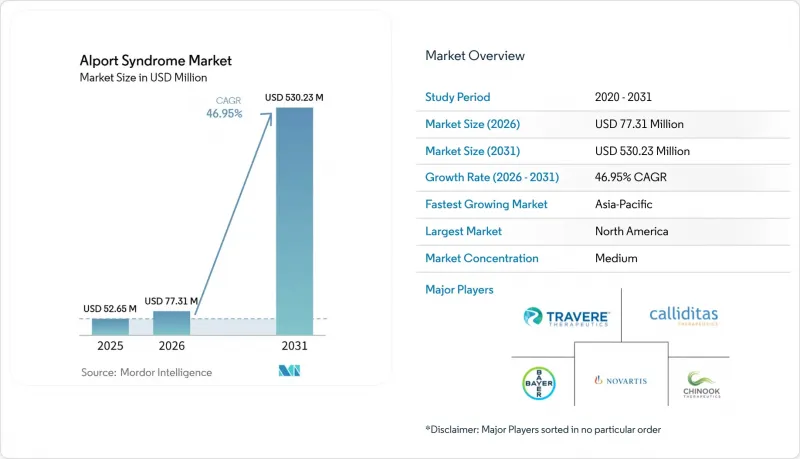
본 보고서는 유전자 변이별(X-연관 알포트 증후군, 상염색체 우성 알포트 증후군 등), 치료법별(지지적 약물 요법, 신장 대체 요법 등), 유통 채널별(병원 약국, 소매 약국 등), 지역별(북미, 유럽 등)로 분류되어 있습니다. 시장 전망은 금액(달러) 기준으로 제시되어 있습니다.
세계의 알포트 증후군 시장 동향 및 인사이트
변이가 확인된 환자 하위 그룹을 대상으로 한 임상시험 활동 활성화
알포트 증후군 시장에서는 2026년 시점에서 과거 어느 때보다 활발한 임상 파이프라인이 전개되고 있으며, 변이에 따라 정의된 환자 그룹을 대상으로 한 새로운 프로그램이 설계되고 있습니다. 바이엘(Bayer)은 2025년 12월, BAY 3401016의 ASSESS 2a상 임상시험을 시작했으며, 이 프로그램은 이미 FDA의 패스트트랙(Fast Track) 지정 및 희귀질환 치료제 지정을 받았습니다. Eloxx는 2026년 5월, COL4A3, COL4A4 및 COL4A5 유전자에서 논센스 돌연변이가 확인된 환자를 대상으로 한 EXACT 2b상 임상시험의 피험자 모집을 시작했습니다. 이러한 바이오마커 기반 선별 모델을 통해 임상시험 기관은 유전적으로 더 균일한 코호트를 연구할 수 있게 되며, 환자 수가 적은 질환 집단에서도 임상적으로 유의미한 효과 크기를 보일 가능성이 높아집니다. 그 결과, 알포트 증후군 시장에서는 현재 여러 승인 절차가 병행하여 진행되고 있으며, 이로 인해 최초의 승인 치료법이 실현될 가능성이 크게 높아지고 있습니다.
희귀질환 치료제의 경제적 이점이 희귀 신장 질환 치료제 개발 가속화를 뒷받침
희귀질환 치료제의 경제적 이점은 비용을 절감하고 규제 당국과의 가시성을 높이기 때문에 알포트 증후군 시장에서 실질적인 개발의 촉매제 역할을 하고 있습니다. 칼리디타스 테라퓨틱스(Caliditas Therapeutics)는 세타낙시브(Setanaxib)에 대해 FDA의 희귀질환 치료제 지정을 획득했습니다. 이를 통해 개발상의 장벽이 낮아졌으며, 해당 프로그램에 관한 규제 당국과의 긴밀한 협력이 촉진되었습니다. 바이엘(Bayer)사의 BAY 3401016 프로그램 역시 패스트트랙(Fast Track) 지정과 희귀질환 치료제 지정을 모두 획득하여, 신청 준비가 완료되는 대로 신속한 심사 절차가 기대됩니다. 이러한 제도의 경제적 이점은 BAY 3401016을 둘러싼 바이엘과 에보텍의 제휴가 보여주듯이, 상업적 이익의 가능성을 유지하면서도 신약 개발 위험을 분산시키는 파트너십 구조를 이끌어낼 만큼 충분히 견고합니다. 이러한 변화로 인해 알포트 증후군 시장은 불과 몇년전과 비교해 투자 대상으로 더욱 매력적으로 보입니다.
질환 수정 치료제의 접근성 제한
승인된 질환 수정 치료제가 존재하지 않는다는 점은 여전히 알포트 증후군 시장의 단기 수익에 대한 가장 큰 구조적 제약으로 남아 있습니다. ENYO Pharma는 2026년 1월, Alpestria-1 2상 임상시험 결과를 발표했습니다. 그 결과에 따르면, 보나펙솔은 24주 동안 eGFR의 추이를 기존의 평균 감소폭인 -6.4 mL/min/1.73 m²/년에서 평균 증가폭 +4.8 mL/min/1.73 m²/년으로 전환시켰으며, 또한, 피험자의 73%가 치료 종료 후 3개월이 경과한 시점에서도 UACR을 기준치 이하로 유지하고 있었습니다. 이러한 결과에도 불구하고, 3상 임상시험은 여전히 2026년 하반기로 예정되어 있으며, 규제 당국의 승인은 빠르더라도 2028년 이전에는 얻기 어려울 전망입니다. 현재 시점에서는 환자들이 제네릭 의약품을 통한 대증 요법에 의존할 수밖에 없으며, 의료비는 투석이나 이식에 편중된 상태를 유지할 것입니다. 질환 수정 요법이 시장에 등장할 때까지 알포트 증후군 시장에서는 질환 부담과 치료 접근성 간의 불균형이 지속될 것으로 예측됩니다.
부문 분석
2025년 기준, X-연관 알포트 증후군은 알포트 증후군 시장 점유율의 75.94%를 차지하고 있으며, 이는 임상적 부담이 크고 임상 현장에서의 진단 가시성이 높다는 점을 모두 반영합니다. COL4A5 변이를 가진 미치료 남성의 경우 40세 이전에 신부전에 이르는 사례가 많기 때문에 XLAS는 신장내과적 경과 관찰, 신장 중재술 및 질환 모니터링 비용에서 계속해서 중심적인 위치를 차지하고 있습니다. 이러한 심각한 질병 부담의 집중으로 인해, 알포트 증후군 시장 전체의 현재 수익 분배에서 XLAS는 불균형할 정도로 큰 역할을 담당하고 있습니다. XLAS 내에서는 유전자형에 기반한 RAAS(레닌-안지오텐신-알도스테론계) 조절이, 표준 치료에 대한 반응이 가장 기대하기 어려운 환자의 치료 강도나 치료법 전환 시기에 영향을 미치기 시작하고 있습니다.
상염색체 우성 알포트 증후군은 2026년부터 2031년까지 연평균 성장률(CAGR) 52.87%를 나타낼 것으로 예측되며, 가장 빠르게 성장하는 변이 부문이 될 전망입니다. 집단 유전체 데이터셋에 따르면, ADAS는 기존의 임상 사례 시리즈가 시사했던 것보다 훨씬 더 흔한 것으로 나타났으며, 이는 증상의 발현 양상이 더 경미하고 다양하기 때문에 지금까지 많은 환자가 간과되어 왔음을 의미합니다. ERKNet 프레임워크에 기반한 캐스케이드 스크리닝을 통해 현재 이형접합체의 친족도 진단 대상에 포함되고 있으며, 이로 인해 발병률에 변화가 없음에도 불구하고 알포트 증후군 시장의 잠재 고객 기반이 확대되고 있습니다. 상염색체 열성 및 이유전자성 질환의 사례 수는 여전히 적지만, 그 심각한 증상이나 새롭게 인식된 증상으로 인해 검사 수요가 증가하고 있으며, 또한 좁은 범위의 검사에서 다유전자 패널로의 전환에 따라 분류의 안정성도 향상되고 있습니다.
the
지역별 분석
2025년, 북미는 알포트 증후군 시장의 43.98%를 차지했으며, 지역별 최대 점유율을 기록했습니다. 이 지역은 신장 전문의의 밀집된 네트워크, 학술적인 희귀 신장 질환 센터, 그리고 후원사의 개발 위험을 줄여주는 희귀질환 의약품 제도의 혜택을 받고 있습니다. 또한, 알포트 증후군 재단은 2025년 12월, 임상시험의 평가 지표 및 환자 중심의 의약품 개발 우선순위에 대해 FDA와 직접 대화를 나누었으며, 이를 통해 알포트 증후군 시장에서의 연구 설계 명확화가 촉진되고 있습니다. 미국은 여전히 주요 수익원이며, 캐나다에서는 소아 의료 분야에서 유전성 신장병 패널을 보험 적용 범위에 포함시키는 움직임이 확대되고 있는 주(州)의 보험 제도를 통해 시장을 뒷받침하고 있습니다.
유럽은 독일, 프랑스, 네덜란드, 스페인, 이탈리아에 걸쳐 있는 ERKNet 레퍼런스 네트워크의 지원을 받아 알포트 증후군 시장의 두 번째 주요 지역 거점으로 자리매김하고 있습니다. 이 국가들은 이미 보나펙솔 및 세타낙시브의 주요 임상시험 실시지로 기능하고 있으며, 이 지역에는 희귀 신장 질환 임상시험 수행에 관한 실무 경험이 축적되어 있습니다. 독일에서 진행 중인 알포트 증후군 3상 임상시험 ‘DOUBLE PRO-TECT’에서는 다파글리플로진의 평가를 목적으로 청소년 및 젊은 성인을 대상으로 피험자를 모집 중입니다. 이러한 독립적인 증거의 축적은 향후 지침 개정 및 해당 지역 전체의 보험사 승인에 영향을 미칠 가능성이 있습니다. 따라서 유럽에서는 알포트 증후군 시장에 대한 강력한 임상적 관여와 보험 급여를 위한 보다 엄격한 증거 요건이 공존하고 있습니다.
아시아태평양은 2026-2031년 연평균 성장률(CAGR) 57.12%를 나타낼 것으로 예측되며, 알포트 증후군 시장에서 가장 빠르게 확대될 지역이 될 전망입니다. 일본의 소변 검사 의무화 프로그램은 소아 사례의 조기 발견 경로가 되고 있으며, JP-ALPS 레지스트리는 이 지역에 보다 견고한 분자 및 임상적 참조 기반을 제공합니다. 중국도 3차 의료기관의 검사 역량을 확대하고 있으며, 중국 남서부에서의 연구에서는 COL4A3, COL4A4 및 COL4A5의 새로운 변이가 확인되었을 뿐만 아니라, 두 유전자성 유전 패턴도 확인되어, 이는 진단 지도가 여전히 불완전함을 시사합니다.
기타 혜택 :
- 엑셀 형식 시장 예측(ME) 시트
- 3개월간의 애널리스트 지원
자주 묻는 질문
목차
제1장 서론
제2장 조사 방법
제3장 주요 요약
제4장 시장 구도
제5장 시장 규모 및 성장 예측
제6장 경쟁 구도
제7장 시장 기회 및 향후 전망
AJY 26.08.07According to Mordor Intelligence, the alport syndrome market size is expected to increase from USD 52.65 million in 2025 to USD 77.31 million in 2026 and reach USD 530.23 million by 2031, growing at a CAGR of 46.95% over 2026-2031.
This report is Segmented by Genetic Mutation (X-Linked Alport Syndrome, Autosomal Dominant Alport Syndrome, and More), by Treatment Type (Supportive Pharmacological Therapy, Renal Replacement Therapy, and More), by Distribution Channel (Hospital Pharmacies, Retail Pharmacies, and More), and Geography (North America, Europe, and More). The Market Forecasts are Provided in Terms of Value (USD).
Global Alport Syndrome Market Trends and Insights
Rising Trial Activity in Mutation-Defined Patient Subsets
The Alport syndrome market has a more active clinical pipeline in 2026 than at any earlier point, and new programs are being designed around mutation-defined patient groups. Bayer initiated the ASSESS Phase IIa trial of BAY 3401016 in December 2025, and the program already carries FDA Fast Track and Orphan Drug Designations. Eloxx opened the EXACT Phase 2b study for enrollment in May 2026 for patients with confirmed nonsense mutations across COL4A3, COL4A4, and COL4A5. This biomarker-gated model allows sponsors to study more genetically uniform cohorts and improves the chance of showing clinically meaningful effect sizes in a small disease population. As a result, the Alport syndrome market now has parallel approval paths moving at the same time, which materially improves the chance of a first approved therapy.
Orphan-Drug Economics Support Faster Development for Rare Renal Therapies
Orphan-drug economics have become a practical development catalyst for the Alport syndrome market because they reduce cost and improve regulatory visibility. Calliditas Therapeutics received FDA Orphan Drug Designation for setanaxib, which lowered development friction and supported closer regulatory engagement around the program. Bayer's BAY 3401016 program also carries both Fast Track and Orphan Drug Designations, which support a faster review path once a submission is ready. The economics behind these frameworks are now strong enough to attract partner structures that spread discovery risk while preserving commercial upside, as shown by the Bayer and Evotec collaboration around BAY 3401016. That shift makes the Alport syndrome market look more investable than it did only a few years ago.
Limited Disease-Modifying Treatment Availability
The absence of an approved disease-modifying therapy is still the largest structural cap on near-term revenue in the Alport syndrome market. ENYO Pharma reported Phase 2 Alpestria-1 data in January 2026 showing that vonafexor shifted eGFR trajectory from a historical mean decline of -6.4 mL/min/1.73 m2/yr to a mean gain of +4.8 mL/min/1.73 m2/yr over 24 weeks, and 73% of participants kept UACR below baseline 3 months after treatment stopped. Even with those results, Phase 3 was still planned for the second half of 2026, and regulatory approval was unlikely before 2028 at the earliest. That timing leaves patients dependent on generic supportive care and keeps healthcare spending tilted toward dialysis and transplantation. Until a disease-modifying option reaches the market, the Alport syndrome market will continue to carry a mismatch between disease burden and therapeutic access.
Other drivers and restraints analyzed in the detailed report include:
- Expanded Genetic Testing Adoption in Suspected Hereditary Kidney Disease
- Broader Use of Early RAAS Blockade to Delay Progression
- Reimbursement Friction for High-Cost Rare Disease Testing and Therapy
For complete list of drivers and restraints, kindly check the Table Of Contents.
Segment Analysis
X-linked Alport syndrome held 75.94% of Alport syndrome market share in 2025, reflecting both its higher clinical burden and its stronger diagnostic visibility in practice. Untreated males with COL4A5 mutations often reach kidney failure by age 40, which keeps XLAS at the center of nephrology follow-up, renal intervention, and disease monitoring costs. That concentration of severe disease burden gave XLAS a disproportionate role in present revenue allocation across the Alport syndrome market. Within XLAS, genotype-informed RAAS titration is starting to influence treatment intensity and the timing of transition for patients least likely to respond to standard care.
Autosomal dominant Alport syndrome is projected to grow at 52.87% CAGR from 2026 to 2031, making it the fastest-growing mutation segment. Population genomic datasets indicate that ADAS is far more common than older clinical case series suggested, which means many affected individuals were previously missed because presentation is milder and more variable. Cascade screening under the ERKNet framework is now bringing heterozygous relatives into the diagnosed pool, which expands the addressable base of the Alport syndrome market without any change in incidence. Autosomal recessive and digenic diseases remain smaller in count, but their severe or newly recognized presentations support more testing and more stable classification as multi-gene panels replace narrower workups.
the
Complete Report Scope:
- By Genetic Mutation
- X-Linked Alport Syndrome
- Autosomal Dominant Alport Syndrome
- Autosomal Recessive Alport Syndrome
- Digenic Alport Syndrome
- By Treatment Type
- Supportive Pharmacological Therapy
- Renal Replacement Therapy
- Emerging Disease-Modifying Therapies
- By Distribution Channel
- Hospital Pharmacies
- Retail Pharmacies
- Specialty Pharmacies
- Online Pharmacies
- By Geography
- North America
- United States
- Canada
- Mexico
- Europe
- Germany
- United Kingdom
- France
- Italy
- Spain
- Rest of Europe
- Asia-Pacific
- China
- Japan
- India
- Australia
- South Korea
- Rest of Asia-Pacific
- Rest of the World
- North America
Geography Analysis
North America held 43.98% of the Alport syndrome market share in 2025, making it the largest regional contributor. The region benefits from dense nephrology specialist networks, academic rare renal centers, and an orphan drug framework that lowers development risk for sponsors. The Alport Syndrome Foundation also maintained direct dialogue with the FDA in December 2025 on trial endpoints and patient-focused drug development priorities, which supports a clearer study design for the Alport syndrome market. The United States remains the main revenue center, while Canada adds support through provincial coverage that is increasingly including hereditary nephropathy panels in pediatric care.
Europe remained the second major regional base for the Alport syndrome market, supported by the ERKNet reference network across Germany, France, the Netherlands, Spain, and Italy. Those countries have already served as leading trial locations for vonafexor and setanaxib, which gives the region practical experience in rare renal study execution. Germany's DOUBLE PRO-TECT Alport Phase 3 trial is recruiting adolescents and young adults for dapagliflozin evaluation, and that independent evidence stream could influence future guideline updates and payer acceptance across the region. Europe, therefore, combines strong clinical participation in the Alport syndrome market with tighter evidence expectations for reimbursement.
Asia-Pacific is projected to grow at 57.12% CAGR from 2026 to 2031, which makes it the fastest-expanding geography in the Alport syndrome market. Japan's mandatory urinalysis program has become an early detection pathway for pediatric cases, and the JP-ALPS registry gives the region a stronger molecular and clinical reference base. China is also expanding tertiary hospital testing capacity, and work from southwestern China identified novel COL4A3, COL4A4, and COL4A5 variants together with digenic inheritance patterns that point to a still incomplete diagnostic map.
- AstraZeneca
- Bayer
- Biogen
- Boehringer Ingelheim
- Calliditas Therapeutics AB
- CENTOGENE N.V.
- Chinook Therapeutics, Inc.
- Eli Lilly and Company
- Eloxx Pharmaceuticals, Inc.
- Enyo Pharma
- Eurofins
- Roche
- Invitae
- Merck
- Myriad Women's Health, Inc.
- Natera, Inc.
- Novartis
- Regeneron Pharmaceuticals
- River 3 Renal Corp.
- Travere Therapeutics, Inc.
Additional Benefits:
- The market estimate (ME) sheet in Excel format
- 3 months of analyst support
TABLE OF CONTENTS
1 INTRODUCTION
- 1.1 Study Assumptions and Market Definition
- 1.2 Scope of the Study
2 RESEARCH METHODOLOGY
3 EXECUTIVE SUMMARY
4 MARKET LANDSCAPE
- 4.1 Market Overview
- 4.2 Market Drivers
- 4.2.1 Expanded Genetic Testing Adoption in Suspected Hereditary Kidney Disease
- 4.2.2 Broader Use of Early RAAS Blockade to Delay Progression
- 4.2.3 Rising Trial Activity in Mutation-Defined Patient Subsets
- 4.2.4 Orphan-Drug Economics Support Faster Development for Rare Renal Therapies
- 4.2.5 NGS Panel Integration in Nephrology and Transplant Workups
- 4.2.6 Expanded Family Cascade Screening Reveals Previously Hidden Prevalent Cases
- 4.3 Market Restraints
- 4.3.1 Limited Disease-Modifying Treatment Availability
- 4.3.2 Variable Phenotype Slows Diagnosis and Referral
- 4.3.3 Reimbursement Friction for High-Cost Rare Disease Testing and Therapy
- 4.3.4 AAV and Advanced Genetic Therapy Manufacturing Constraints
- 4.4 Supply Chain Analysis
- 4.5 Regulatory Landscape
- 4.6 Technological Outlook
- 4.7 Porter's Five Forces Analysis
- 4.7.1 Bargaining Power of Suppliers
- 4.7.2 Bargaining Power of Buyers
- 4.7.3 Threat of New Entrants
- 4.7.4 Threat of Substitutes
- 4.7.5 Intensity of Competitive Rivalry
5 MARKET SIZE AND GROWTH FORECASTS
- 5.1 By Genetic Mutation
- 5.1.1 X-Linked Alport Syndrome
- 5.1.2 Autosomal Dominant Alport Syndrome
- 5.1.3 Autosomal Recessive Alport Syndrome
- 5.1.4 Digenic Alport Syndrome
- 5.2 By Treatment Type
- 5.2.1 Supportive Pharmacological Therapy
- 5.2.2 Renal Replacement Therapy
- 5.2.3 Emerging Disease-Modifying Therapies
- 5.3 By Distribution Channel
- 5.3.1 Hospital Pharmacies
- 5.3.2 Retail Pharmacies
- 5.3.3 Specialty Pharmacies
- 5.3.4 Online Pharmacies
- 5.4 By Geography
- 5.4.1 North America
- 5.4.1.1 United States
- 5.4.1.2 Canada
- 5.4.1.3 Mexico
- 5.4.2 Europe
- 5.4.2.1 Germany
- 5.4.2.2 United Kingdom
- 5.4.2.3 France
- 5.4.2.4 Italy
- 5.4.2.5 Spain
- 5.4.2.6 Rest of Europe
- 5.4.3 Asia-Pacific
- 5.4.3.1 China
- 5.4.3.2 Japan
- 5.4.3.3 India
- 5.4.3.4 Australia
- 5.4.3.5 South Korea
- 5.4.3.6 Rest of Asia-Pacific
- 5.4.4 Rest of the World
- 5.4.1 North America
6 COMPETITIVE LANDSCAPE
- 6.1 Market Concentration
- 6.2 Market Share Analysis
- 6.3 Company Profiles (includes Global Level Overview, Market Level Overview, Core Segments, Financials as available, Strategic Information, Market Rank/Share, Products and Services, Recent Developments)
- 6.3.1 AstraZeneca PLC
- 6.3.2 Bayer AG
- 6.3.3 Biogen Inc.
- 6.3.4 Boehringer Ingelheim International GmbH
- 6.3.5 Calliditas Therapeutics AB
- 6.3.6 CENTOGENE N.V.
- 6.3.7 Chinook Therapeutics, Inc.
- 6.3.8 Eli Lilly and Company
- 6.3.9 Eloxx Pharmaceuticals, Inc.
- 6.3.10 Enyo Pharma
- 6.3.11 Eurofins Scientific SE
- 6.3.12 F. Hoffmann-La Roche Ltd.
- 6.3.13 Invitae Corporation
- 6.3.14 Merck KGaA
- 6.3.15 Myriad Women's Health, Inc.
- 6.3.16 Natera, Inc.
- 6.3.17 Novartis AG
- 6.3.18 Regeneron Pharmaceuticals, Inc.
- 6.3.19 River 3 Renal Corp.
- 6.3.20 Travere Therapeutics, Inc.
7 MARKET OPPORTUNITIES AND FUTURE OUTLOOK
- 7.1 White-Space and Unmet-Need Assessment