
|
시장보고서
상품코드
2099911
GDDR7 그래픽 메모리 시장 : 점유율 분석, 업계 동향 및 통계, 성장 예측(2026-2031년)GDDR7 Graphics Memory - Market Share Analysis, Industry Trends & Statistics, Growth Forecasts (2026 - 2031) |
||||||
 Mordor Intelligence
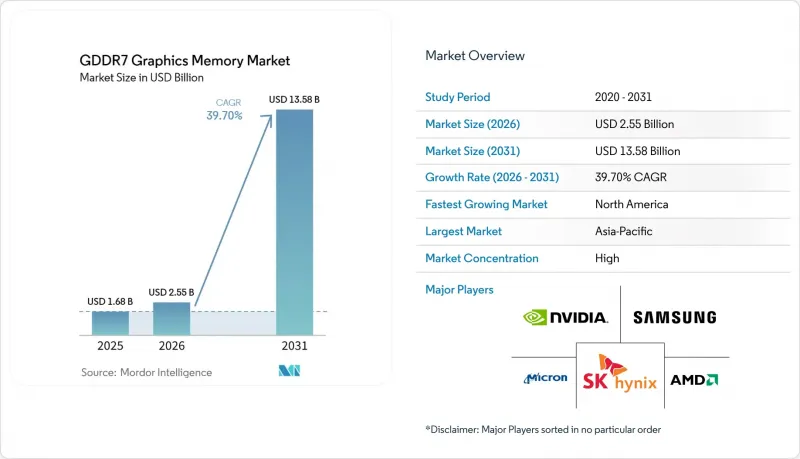
Mordor Intelligence에 의하면, GDDR7 그래픽 메모리 시장 규모는 2025년 17억 달러에서 2026년에는 26억 달러로 확대되어 2031년까지 136억 달러에 이를 것으로 예상되고 있어 2026년부터 2031년까지 CAGR 39.7%로 성장할 전망입니다.
본 보고서는 핀당 대역폭(최대 32 Gbps, 33-40 Gbps, 40 Gbps 이상), 메모리 용량(16GB, 24GB, 24GB 이상), 패키지 유형(스탠드얼론형 GDDR7 패키지, 멀티칩 패키지(MCP) 등), 용도(게이밍 GPU, AR/VR 시스템 등), 최종 사용자(소비자용 전자기기, 자동차 등), 지역별로 분류되어 있습니다. 시장 전망은 금액(달러) 기준으로 제시되어 있습니다.
전 세계 GDDR7 그래픽 메모리 시장 동향 및 인사이트
AI 및 게임 분야의 대역폭 요구 사항 증가
GDDR7 그래픽 메모리 시장은 게임 분야의 리프레시 수요와 AI 추론 메모리 수요 증가라는 보기 드문 시너지 효과에 힘입어 성장하고 있습니다. JEDEC은 핀당 32 Gbps에서 시작하여 48 Gbps 로드맵으로 확장되는 규격을 제정함으로써 이러한 변화의 기반을 마련했습니다. 한편, PAM3 신호 방식은 GDDR6에 비해 전송 효율을 향상시켰습니다. 이러한 기술적 진보가 중요한 이유는 롱 컨텍스트 추론 워크로드가 메모리를 통해 대량의 데이터를 이동시키며 처리량과 응답성에 끊임없는 부하를 주기 때문입니다. 128GB GDDR7을 탑재한 NVIDIA의 Rubin CPX 설계는 이 메모리 유형이 더 이상 단순한 게임용 업그레이드 경로가 아니라, AI 추론 플랫폼 계획의 일부가 되었음을 보여줍니다. 그 결과, GDDR7 그래픽 메모리 시장은 같은 기간 내에 고속 메모리 채택을 촉진하는 두 가지 최종 시장의 혜택을 받고 있습니다.
플래그십 GPU의 GDDR6에서 GDDR7로의 전환
2025년 1월에 출시된 NVIDIA의 GeForce RTX 50 시리즈는 대량 생산되는 소비자용 그래픽 카드에서 GDDR6에서 GDDR7로의 첫 번째 광범위한 플랫폼 전환을 알리는 것이었습니다. Rambus사는 GDDR7이 PAM3 신호 전송, 칩당 4개의 독립 채널, 그리고 더 세분화된 액세스 단위를 추가했으며, 이러한 요소들이 결합되어 컨트롤러의 병렬성을 높이고 보드 수준의 대역폭 활용 효율을 향상시킨다고 지적합니다. 이러한 조합을 통해 플래그십 제품은 단순한 주파수 향상만으로는 얻을 수 없는 명확한 성능 향상을 실현하며, GDDR7 그래픽 메모리 시장에서 조기 프리미엄 입지를 공고히 하고 있습니다. 또한, 플래그십 설계가 인증되면 더 광범위한 생태계가 안정적인 메모리 아키텍처에 맞추어 적응할 수 있으므로, 보드 파트너 및 OEM 제조업체에게는 직접적인 검증 경로가 됩니다. 그 결과, GDDR7 그래픽 메모리 시장에서는 제품 라인업의 최상위 모델부터 시작하여 인접한 GPU 등급으로 파급되는 첫 번째 대규모 채택 물결이 나타나고 있습니다.
차세대 DRAM 제조 비용 상승
GDDR7 그래픽 메모리 시장은 여전히 비용 장벽에 직면해 있습니다. 이는 최첨단 디바이스가 고도의 DRAM 공정 노드와 더욱 까다로운 인터페이스 설계에 의존하기 때문입니다. 삼성의 24GB GDDR7은 5세대 10nm급 공정을 채택하여 이전 세대 제품에 비해 셀 밀도가 50% 향상되었으며, 이는 현재 제품에 얼마나 많은 공정 발전이 반영되어 있는지를 보여줍니다. 이러한 기술적 진보로 인해 하이엔드 그래픽 카드의 메모리 비용이 상승하면서, 저가형 플랫폼이 동일한 속도로 전환하기 어려워지고 있습니다. 또한, GDDR7 그래픽 메모리 시장은 다른 고성능 메모리 카테고리와 첨단 제조 자원을 놓고 경쟁하고 있어, 수요가 급증할 경우 공급이 부족해질 가능성이 있습니다. 수율이 향상되고 생산 능력이 확대되기 전까지는 이러한 비용 구조로 인해 GDDR7 그래픽 메모리 시장 내에서도 가격에 민감한 분야의 보급이 계속해서 지연될 것으로 보입니다.
부문 분석
2025년에는 최대 32 Gbps 제품이 GDDR7 그래픽 메모리 시장 점유율의 75.2%를 차지했습니다. 이는 소비자용 그래픽 카드에서 GDDR7의 첫 번째 대규모 양산 확대를 반영한 것입니다. 초기 게이밍 제품의 대부분은 최고 속도 등급보다 안정적인 작동점을 우선시했기 때문에 이 등급이 GDDR7 그래픽 메모리 시장으로의 자연스러운 진입점이 되었습니다. 이러한 접근 방식을 통해 보드 파트너사들은 GDDR6 시대의 메모리 성능 대비 명확한 향상을 실현하는 동시에, 열 설계, 전원 공급 및 검증 리스크를 관리할 여지를 확보할 수 있었습니다. 또한 이는 절대적인 대역폭과 마찬가지로, 플랫폼의 신뢰성과 소매 시장에서의 구입 용이성이 중시되던 출시 초기 단계의 요구 사항에도 부합했습니다. 실용적인 관점에서 볼 때, 최대 32 Gbps 부문은 더 높은 등급의 디바이스가 시장에서 입지를 넓히기 전에 GDDR7 그래픽 메모리 시장공급량을 확대하기 위한 기반 역할을 수행했습니다.
40 Gbps를 초과하는 부문은 2031년까지 연평균 성장률(CAGR) 41.2%를 나타낼 것으로 예측되며, GDDR7 그래픽 메모리 시장에서 매출을 견인하는 최전선이 될 전망입니다. Samsung Electronics는 40 Gbps를 초과하는 속도가 검증된 업계 최초의 24Gb GDDR7 디바이스를 발표했습니다. 한편, JEDEC 규격에서는 이미 핀당 48 Gbps로의 로드맵이 제시되어 있어, 더 고속의 제품이 시장에 등장하기 전에 새로운 표준화 주기가 필요할 가능성은 낮아졌습니다. 그 후, SK하이닉스는 ISSCC 2026에서 48 Gbps의 24Gb GDDR7을 발표했으며, 이를 통해 상용 제품의 최고 성능 수준이 한층 더 높아지면서 프리미엄 속도 등급의 장기적인 성장 여지가 확고해졌습니다. 33-40 Gbps 범위는 이 두 극단 사이의 중간에 위치하며, 최고 수준의 검증 기준으로 전환하지 않고도 추가적인 여유를 추구하는 프리미엄 게이밍 카드 및 전문가용 시스템용 벤더에게 중간 단계가 될 것입니다. 향후 이 구성을 통해 GDDR7 그래픽 메모리 시장은 광범위한 엔트리 레벨과 규모는 작지만 수익성이 높은 고속 계층 사이에서 균형을 유지할 것으로 보입니다.
2025년, 16GB 등급은 GDDR7 그래픽 메모리 시장의 68.4%를 차지하며, 플랫폼에 대한 광범위한 채택이 시작된 첫 해에 핵심적인 볼륨 구성이 되었습니다. 이 등급은 용량 목표를 엄격한 기판 비용 제한 내에서 충족해야 하는 게이밍용 그래픽 카드와 일부 전문가용 GPU 설계에서 주류 출하 구성과 일치했습니다. 또한 가장 성숙한 다이 및 버스 구성의 이점을 누려 기판 파트너의 통합 위험을 줄였습니다. 비용, 용량, 인증 용이성 간의 균형이 잘 잡혀 있었기 때문에 16GB는 GDDR7 그래픽 메모리 시장의 초기 확장 단계에서 핵심 축이 되었습니다. 24GB 부문도 이와 병행하여 성장했으며, 더 복잡한 메모리 아키텍처로 전환하지 않고도 더 많은 VRAM을 필요로 하는 하이엔드 시스템에 대한 수요에 힘입었습니다.
24GB를 초과하는 구성은 2031년까지 연평균 성장률(CAGR) 42.4%를 나타낼 것으로 예측되며, GDDR7 그래픽 메모리 시장에서 가장 빠르게 성장하는 용량 부문이 될 전망입니다. 삼성의 24GB GDDR7 발표는 셀 밀도를 획기적으로 높여 기존 GPU 보드 상에서 더 대규모의 메모리 풀을 구축할 수 있는 명확한 길을 열었기 때문에 이러한 성장을 가능하게 하는 중요한 한 걸음이 되었습니다. 마이크론은 자사의 24GB GDDR7이 최대 96GB의 GPU 메모리 구성을 지원한다고 밝혔으며, 이는 더 큰 컨텍스트 윈도우나 부하가 높은 비주얼 워크로드를 필요로 하는 워크스테이션 및 추론 설계에 중요한 요소입니다. SK하이닉스는 ISSCC 2026에서 대칭 2채널 동작에 최적화된 24GB 디바이스를 발표하며, 이러한 고밀도화 추세를 더욱 확대했습니다. 이는 밀도 경쟁이 현재 AI 지향 이용 사례와도 밀접하게 연결되어 있음을 보여줍니다. 그 결과, GDDR7 그래픽 메모리 시장은 게임 중심의 VRAM 시장에서 전문적인 AI 도입 수요를 포함한 더 광범위한 메모리 용량 시장으로 전환되고 있습니다.
지역별 분석
2025년, 아시아태평양은 GDDR7 그래픽 메모리 시장 점유율의 64.7%를 차지하며, 다른 모든 지역에 비해 뚜렷한 선두를 유지했습니다. 이 지역의 우위는 메모리 제조와 GPU 기판 제조가 집중되어 있기 때문이며, 한국은 GDDR7 다이 생산의 중심지이고, 대만은 기판 조립의 중심지입니다. Samsung Electronics와 SK하이닉스가 첨단 그래픽 DRAM 분야에서 확고한 입지를 구축하고 있어, 아시아태평양은 GDDR7 그래픽 메모리 시장공급 측면에서 확고한 지배력을 보유하고 있습니다. 또한, 이 지역은 기판, 패키징, 테스트 및 하류 보드 통합을 뒷받침하는 긴밀한 공급망의 혜택도 누리고 있습니다. 이러한 산업의 깊이 덕분에 전 세계적으로 수요가 확대되는 상황에서도 아시아태평양은 계속해서 GDDR7 그래픽 메모리 시장의 운영 중심지 역할을 하고 있습니다.
북미는 2031년까지 41.6%라는 가장 높은 연평균 성장률(CAGR)을 보일 것으로 예상되며, GDDR7 그래픽 메모리 시장 수요 측면에서 주요 성장 동력이 될 전망입니다. 이러한 성장은 소매용 게임 시장뿐만 아니라, 하이퍼스케일러 및 AI 인프라에 대한 투자에 의해 더욱 강력하게 견인되고 있습니다. NVIDIA의 Rubin CPX 프로그램은 GDDR7이 기업용 대규모 컨텍스트 추론 하드웨어와 어떻게 연계되어 있는지를 보여주는 점에서 이 지역 정세에서 중요합니다. 또한, 이 지역은 새로운 메모리 규격을 신속하게 수용할 수 있는 GPU 플랫폼 설계, 클라우드 도입, 워크스테이션 조달과 같은 강력한 생태계의 혜택을 받고 있습니다. 그 결과, 북미는 조기 AI 도입 패턴과 하이엔드 시스템에 대한 수요를 통해 GDDR7 그래픽 메모리 시장의 다음 단계를 형성할 가능성이 높다고 볼 수 있습니다.
2025년 GDDR7 그래픽 메모리 시장의 나머지 점유율은 유럽 및 기타 지역이 차지했습니다. 유럽 수요는 순수한 소비자 시장보다는 전문가용 워크스테이션, 자동차 설계, 과학 계산 및 특수 산업용 워크로드에 중점을 두고 있습니다. 이러한 이용 사례는 비록 해당 지역이 아시아태평양처럼 공급망을 주도파관는 않더라도, GDDR7 그래픽 메모리 시장에 있어 꾸준한 중요성을 뒷받침하고 있습니다. 전 세계 기타 지역 시장은 현재 규모가 작고 여전히 수입된 완제품 GPU 시스템에 크게 의존하고 있지만, 데이터센터 확장 및 기업 IT 업그레이드에 힘입어 예측 기간 동안 수요가 점차 확대될 것으로 전망됩니다.
기타 혜택:
- 엑셀 형식 시장 예측(ME) 시트
- 3개월간의 애널리스트 지원
자주 묻는 질문
목차
제1장 서론
제2장 조사 방법
제3장 주요 요약
제4장 시장 구도
제5장 시장 규모와 성장 예측
제6장 경쟁 구도
제7장 시장 기회와 향후 전망
JHS 26.08.11According to Mordor Intelligence, the GDDR7 graphics memory market size is expected to increase from USD 1.7 billion in 2025 to USD 2.6 billion in 2026 and reach USD 13.6 billion by 2031, growing at a CAGR of 39.7% over 2026-2031.
This report is Segmented by Bandwidth Per Pin (Up To 32 Gbps, 33-40 Gbps, and Above 40 Gbps), Memory Capacity (16 GB, 24 GB, and Above 24 GB), Packaging Type (Standalone GDDR7 Packages, Multi-Chip Package (MCP), and More), Application (Gaming GPUs, AR/VR Systems, and More), End-User (Consumer Electronics, Automotive, and More), and Geography. The Market Forecasts are Provided in Terms of Value (USD).
Global GDDR7 Graphics Memory Market Trends and Insights
Rising AI And Gaming Bandwidth Requirements
The GDDR7 graphics memory market is being pushed by a rare overlap between gaming refresh demand and rising AI inference memory needs. JEDEC set the base for this shift with a standard that starts at 32 Gbps per pin and extends to a 48 Gbps roadmap, while PAM3 signaling improves transfer efficiency over GDDR6. That technical step matters because long-context inference workloads move large amounts of data through memory and place steady pressure on throughput and responsiveness. NVIDIA's Rubin CPX design, which carries 128 GB of GDDR7, shows that the memory type is now part of AI inference platform planning rather than only a gaming upgrade path. As a result, the GDDR7 graphics memory market is benefiting from two end markets that are both rewarding faster memory adoption in the same window.
Transition From GDDR6 To GDDR7 In Flagship GPUs
The January 2025 launch of NVIDIA's GeForce RTX 50 series marked the first broad platform migration from GDDR6 to GDDR7 in high-volume consumer graphics cards. Rambus noted that GDDR7 adds PAM3 signaling, four independent channels per chip, and finer access granularity, which together raise controller parallelism and improve how bandwidth is used at the board level. That combination gives flagship products a clearer performance step than a simple frequency increase would provide, which supports early premium positioning in the GDDR7 graphics memory market. It also gives board partners and OEMs a direct validation path, because once flagship designs are qualified, the broader ecosystem can adapt around a stable memory architecture. The result is that the GDDR7 graphics memory market is seeing its first major wave of adoption start at the top of the product stack and then spread outward into adjacent GPU classes.
Higher Cost Of Next-Generation DRAM Manufacturing
The GDDR7 graphics memory market still faces a cost barrier because leading devices rely on advanced DRAM nodes and a more demanding interface design. Samsung's 24 GB GDDR7 used a 5th-generation 10 nm-class process and 50% higher cell density than its predecessor, which shows how much process advancement is being built into current products. Those technical gains raise the cost of memory content in premium graphics cards and make it harder for lower-priced platforms to migrate at the same speed. The GDDR7 graphics memory market also competes for advanced manufacturing attention with other high-performance memory categories, which can tighten supply when demand rises quickly. Until yields improve and capacity broadens, this cost structure will continue to slow adoption in more price-sensitive parts of the GDDR7 graphics memory market.
Other drivers and restraints analyzed in the detailed report include:
- Faster Adoption In AI Workstation And Inference Cards
- Higher Energy Efficiency At 1.2V Operation
- HBM Substitution Pressure In Premium AI Accelerators
For complete list of drivers and restraints, kindly check the Table Of Contents.
Segment Analysis
Up to 32 Gbps held 75.2% of the GDDR7 graphics memory market share in 2025, which reflected the first large production ramp of GDDR7 in consumer graphics cards. Most early gaming products prioritized stable operating points rather than maximum speed grades, which made this tier the natural entry point for the GDDR7 graphics memory market. That approach gave board partners room to manage thermals, power delivery, and validation risk while still delivering a clear step up from GDDR6-era memory behavior. It also aligned with a launch phase in which platform reliability and retail availability mattered as much as absolute bandwidth. In practical terms, the up to 32 Gbps segment acted as the base that allowed the GDDR7 graphics memory market to scale in volume before higher-grade devices widened their presence.
The above 40 Gbps segment is projected to grow at 41.2% CAGR through 2031, which makes it the revenue-driving frontier inside the GDDR7 graphics memory market. Samsung announced the industry's first 24 Gb GDDR7 device with validated speeds above 40 Gbps, while JEDEC's standard already provides a path to 48 Gbps per pin, reducing the need for another standardization cycle before faster products move forward. SK hynix then presented a 48 Gbps 24 Gb GDDR7 at ISSCC 2026, which pushed the top commercial performance tier even further and reinforced the long runway for premium speed grades. The 33-40 Gbps range sits between these two ends and gives vendors an intermediate step for premium gaming cards and professional systems that want more headroom without moving to the highest validation threshold. Over time, this mix should keep the GDDR7 graphics memory market balanced between broad entry volume and a smaller but more lucrative high-speed layer.
The 16 GB tier captured 68.4% of the GDDR7 graphics memory market in 2025, which made it the core volume configuration during the first year of wider platform adoption. This tier aligned with the dominant shipping mix in gaming cards and several professional GPU designs, where capacity targets had to stay within strict board cost limits. It also benefited from the most mature die and bus configurations, which reduced integration risk for board partners. Because of that balance between cost, capacity, and qualification ease, 16 GB became the anchor point for the GDDR7 graphics memory market in its early expansion phase. The 24 GB layer grew alongside it, supported by demand for higher-end systems that needed more VRAM without moving to more complex memory architectures.
Above 24 GB configurations are forecast to grow at a 42.4% CAGR through 2031, making this the fastest-growing capacity segment in the GDDR7 graphics memory market. Samsung's 24 GB GDDR7 announcement was the enabling step because it raised cell density sharply and opened a clearer path to larger memory pools on conventional GPU boards. Micron stated that its 24 GB GDDR7 supports GPU memory configurations of up to 96 GB, which is material for workstation and inference designs that need larger context windows and heavier visual workloads. SK hynix extended that high-density case at ISSCC 2026 with a 24 GB device optimized for symmetric 2-channel operation, which shows that the density race is now tied closely to AI-oriented use cases as well. As a result, the GDDR7 graphics memory market is shifting from a gaming-led VRAM story toward a broader memory-capacity story that includes professional AI deployment needs.
Complete Report Scope:
- By Bandwidth Per Pin
- Up to 32 Gbps
- 33-40 Gbps
- Above 40 Gbps
- By Memory Capacity
- 16 GB
- 24 GB
- Above 24 Gb
- By Packaging Type
- Standalone GDDR7 Packages
- Multi-Chip Package (MCP)
- Advanced Package Integration (2.5D / Chiplet-based)
- By Application
- Gaming GPUs
- AI Accelerators and Data Center GPUs
- High-Performance Computing
- Professional Visualization
- AR/VR Systems
- Automotive AI and Infotainment
- By End-User
- Consumer Electronics
- Data Centers and Cloud
- Automotive
- Industrial and Embedded
- Other End-Users
- By Geography
- North America
- Europe
- Asia Pacific
- China
- Japan
- South Korea
- Taiwan
- Rest of Asia Pacific
- Rest of the World
Geography Analysis
Asia-Pacific accounted for 64.7% of the GDDR7 graphics memory market share in 2025, maintaining the region's clear lead over all other geographies. The region's lead rests on its concentration of memory fabrication and GPU board manufacturing, with South Korea central to GDDR7 die production and Taiwan central to board assembly. Samsung's and SK Hynix's positions in advanced graphics DRAM give the Asia-Pacific region a strong hold over the supply side of the GDDR7 graphics memory market. The region also benefits from a dense supplier network that supports substrates, packaging, testing, and downstream board integration. Because of that industrial depth, Asia-Pacific remains the operational center of the GDDR7 graphics memory market even as demand grows globally.
North America is forecast to record the fastest CAGR of 41.6% through 2031, making it the key demand-side growth engine in the GDDR7 graphics memory market. This growth is being driven more by hyperscaler and AI infrastructure spending than by retail gaming alone. NVIDIA's Rubin CPX program is important in this regional picture because it shows how GDDR7 is being tied to large-context inference hardware with enterprise relevance. The region also benefits from a strong ecosystem of GPU platform design, cloud deployment, and workstation procurement that can absorb new memory standards quickly. As a result, North America is likely to shape the next phase of the GDDR7 graphics memory market through early AI deployment patterns and premium system demand.
Europe and the rest of the world accounted for the remaining share of the GDDR7 graphics memory market in 2025. Europe's demand is centered more on professional workstation use, automotive design, scientific computing, and specialized industrial workloads than on raw consumer scale. Those use cases support steady relevance for the GDDR7 graphics memory market, even if the region does not control the supply chain in the same way as Asia-Pacific. Rest of the world markets remain smaller today and are still driven largely by imported finished GPU systems, though data center build-outs and enterprise IT upgrades should gradually widen demand over the forecast period.
- Micron Technology, Inc.
- Samsung Electronics Co., Ltd.
- SK hynix Inc.
- NVIDIA Corporation
- Advanced Micro Devices, Inc.
- ASUSTeK Computer Inc.
- Micro-Star International Co., Ltd.
- GIGA-BYTE Technology Co., Ltd.
- ZOTAC Technology Limited
- PNY Technologies, Inc.
- Palit Microsystems Ltd.
- Sapphire Technology Limited
- Kingston Technology Company, Inc.
- Corsair Gaming, Inc.
- G.SKILL International Enterprise Co., Ltd.
- ADATA Technology Co., Ltd.
- Team Group Inc.
- Transcend Information, Inc.
- Colorful Technology Company Limited
- Galax Microsystems Ltd.
Additional Benefits:
- The market estimate (ME) sheet in Excel format
- 3 months of analyst support
TABLE OF CONTENTS
1 INTRODUCTION
- 1.1 Study Assumptions and Market Definition
- 1.2 Scope of the Study
2 RESEARCH METHODOLOGY
3 EXECUTIVE SUMMARY
4 MARKET LANDSCAPE
- 4.1 Market Overview
- 4.2 Market Drivers
- 4.2.1 Rising AI and Gaming Bandwidth Requirements
- 4.2.2 Transition From GDDR6 to GDDR7 in Flagship GPUs
- 4.2.3 Higher Energy Efficiency at 1.2V Operation
- 4.2.4 Faster Adoption in AI Workstation and Inference Cards
- 4.2.5 Advanced Packaging and Signal Integrity Improvements
- 4.2.6 Strategic OEM and Memory Vendor Qualification Cycles
- 4.3 Market Restraints
- 4.3.1 Higher Cost of Next-Generation DRAM Manufacturing
- 4.3.2 Supply Chain Concentration in Advanced Memory Fabrication
- 4.3.3 HBM Substitution Pressure in Premium AI Accelerators
- 4.3.4 Board-Level Thermal and Power Delivery Complexity
- 4.4 Industry Value Chain Analysis
- 4.5 Impact of Macroeconomic Factors on the Market
- 4.6 Regulatory Landscape
- 4.7 Technological Outlook
- 4.8 Porter's Five Forces Analysis
- 4.8.1 Bargaining Power of Suppliers
- 4.8.2 Bargaining Power of Buyers
- 4.8.3 Threat of New Entrants
- 4.8.4 Threat of Substitutes
- 4.8.5 Intensity of Competitive Rivalry
5 MARKET SIZE AND GROWTH FORECASTS (VALUE)
- 5.1 By Bandwidth Per Pin
- 5.1.1 Up to 32 Gbps
- 5.1.2 33-40 Gbps
- 5.1.3 Above 40 Gbps
- 5.2 By Memory Capacity
- 5.2.1 16 GB
- 5.2.2 24 GB
- 5.2.3 Above 24 Gb
- 5.3 By Packaging Type
- 5.3.1 Standalone GDDR7 Packages
- 5.3.2 Multi-Chip Package (MCP)
- 5.3.3 Advanced Package Integration (2.5D / Chiplet-based)
- 5.4 By Application
- 5.4.1 Gaming GPUs
- 5.4.2 AI Accelerators and Data Center GPUs
- 5.4.3 High-Performance Computing
- 5.4.4 Professional Visualization
- 5.4.5 AR/VR Systems
- 5.4.6 Automotive AI and Infotainment
- 5.5 By End-User
- 5.5.1 Consumer Electronics
- 5.5.2 Data Centers and Cloud
- 5.5.3 Automotive
- 5.5.4 Industrial and Embedded
- 5.5.5 Other End-Users
- 5.6 By Geography
- 5.6.1 North America
- 5.6.2 Europe
- 5.6.3 Asia Pacific
- 5.6.3.1 China
- 5.6.3.2 Japan
- 5.6.3.3 South Korea
- 5.6.3.4 Taiwan
- 5.6.3.5 Rest of Asia Pacific
- 5.6.4 Rest of the World
6 COMPETITIVE LANDSCAPE
- 6.1 Market Concentration
- 6.2 Strategic Moves
- 6.3 Market Share Analysis
- 6.4 Company Profiles (includes Global Level Overview, Market Level Overview, Core Segments, Financials as available, Strategic Information, Market Rank/Share, Products and Services, Recent Developments)
- 6.4.1 Micron Technology, Inc.
- 6.4.2 Samsung Electronics Co., Ltd.
- 6.4.3 SK hynix Inc.
- 6.4.4 NVIDIA Corporation
- 6.4.5 Advanced Micro Devices, Inc.
- 6.4.6 ASUSTeK Computer Inc.
- 6.4.7 Micro-Star International Co., Ltd.
- 6.4.8 GIGA-BYTE Technology Co., Ltd.
- 6.4.9 ZOTAC Technology Limited
- 6.4.10 PNY Technologies, Inc.
- 6.4.11 Palit Microsystems Ltd.
- 6.4.12 Sapphire Technology Limited
- 6.4.13 Kingston Technology Company, Inc.
- 6.4.14 Corsair Gaming, Inc.
- 6.4.15 G.SKILL International Enterprise Co., Ltd.
- 6.4.16 ADATA Technology Co., Ltd.
- 6.4.17 Team Group Inc.
- 6.4.18 Transcend Information, Inc.
- 6.4.19 Colorful Technology Company Limited
- 6.4.20 Galax Microsystems Ltd.
7 MARKET OPPORTUNITIES AND FUTURE OUTLOOK
- 7.1 White-Space and Unmet-Need Assessment

(주말 및 공휴일 제외)


