

|
시장보고서
상품코드
2099917
RNAi 약물전달 시장 : 점유율 분석, 업계 동향 및 통계, 성장 예측(2026-2031년)RNAi Drug Delivery - Market Share Analysis, Industry Trends & Statistics, Growth Forecasts (2026 - 2031) |
||||||
 Mordor Intelligence
Mordor Intelligence에 의하면, RNAi 약물전달 시장 규모는 2025년에 12억 1,000만 달러, 2026년에 14억 3,000만 달러가 되어, 2031년까지 33억 4,000만 달러에 이를 것으로 예측되며, 2026년부터 2031년까지 CAGR 18.41%로 성장할 전망입니다.
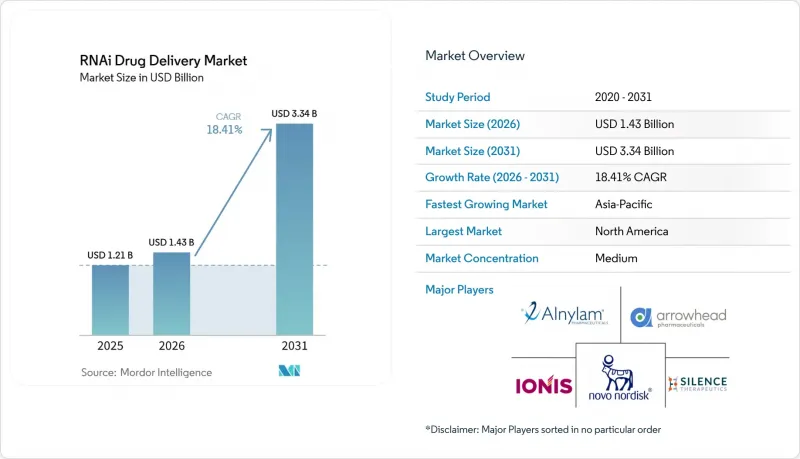
본 보고서는 기술별(siRNA, miRNA 등), 전달 시스템별(지질 나노입자, 고분자 나노입자 등), 투여 경로별(정맥 내 투여 등), 대상 질환별(암, 유전성 질환 등), 대상 조직별(간, 폐 등), 최종 사용자별(제약 회사 등), 지역별(북미 등)로 분류되어 있습니다. 예측치는 금액(달러) 기준으로 제시되어 있습니다.
세계 RNAi 약물전달 시장 동향 및 인사이트
승인된 siRNA 요법에 의한 임상적 견인력
RNAi 약물전달 시장은 승인된 siRNA 제품 덕분에 과거 플랫폼 채택을 제한했던 불확실성이 완화됨에 따라, 보다 견고한 규제 기반의 혜택을 받고 있습니다. 2025년 AMVUTTRA가 심근증을 동반한 ATTR 아밀로이드증에 대해 승인됨에 따라, 병원을 중심으로 한 정맥 주입 모델보다 상업적으로 규모를 확대하기 쉬운 분기별 피하 투여 모델이 입증되었습니다. 또한, 이 승인으로 인해 대형 제약사가 전달 위험을 평가하는 방식도 변화했습니다. 이는 이미 실증된 시판 제품이 초기 연구실 단계에서의 유망성만으로는 제공할 수 없는 더 우수한 기준점을 제시하게 되었기 때문입니다. Alnylam사가 발표한 2026년 매출 전망은 승인된 제품이 일회성 출시 시의 매출 급증에 그치지 않고 지속적인 성장을 뒷받침할 수 있음을 시사하며, 이러한 관점을 더욱 강화하고 있습니다. 이로 인해 거래 상대방들은 보다 명확한 상업적 실적을 갖춘 약물전달 플랫폼에 대한 대규모 라이선싱 계약을 체결하려는 의욕을 높이고 있습니다. 그 결과, RNAi 약물전달 시장에서는 새로운 승인이 나올 때마다 다음 물결이 될 자산과 이를 전달하는 시스템에 대한 신뢰가 높아지는 선순환이 형성되고 있습니다.
차세대 지질 나노입자 설계
RNAi 약물전달 시장이 발전하고 있는 또 다른 이유는 지질 나노입자(LNP)의 설계가 기존의 제제 개발에 비해 더 예측 가능하고 계획적으로 이루어질 수 있게 되었다는 점에 있습니다. LANCE 데이터셋을 활용해 학습된 COMET 모델은 비표준 LNP 구조를 훨씬 더 빠르게 평가할 수 있음을 보여주며, 이를 통해 유망한 약물전달 조성물의 스크리닝에 필요한 시간이 단축됩니다. 이는 지질의 꼬리 길이, 링커의 화학 구조, 그리고 머리기(head group)의 pKa를 변경함으로써 투여 후 LNP의 분포가 실질적으로 변화할 가능성이 있기 때문에 매우 중요한 의미를 지닙니다. BASE-Lipid나 NanoGen과 같은 독일의 중개 연구 프로그램 또한, 제형 연구가 단순한 학술적 개념 증명 단계에 머무르지 않고 규제 및 제조 현장에 점점 더 가까워지고 있음을 보여줍니다. 이러한 변화로 인해 실험실에서 유망한 것으로 평가된 후보 물질이 재현성이 보장되고 규제를 준수하는 제조 공정으로 전환될 가능성이 높아집니다. 이러한 기법이 성숙해짐에 따라, RNAi 약물전달 시장은 간에 편중된 성능에서 벗어나 보다 다양한 조직으로 전달되는 프로파일로 확대될 것으로 예측됩니다.
간 외 전달 효율의 한계
RNAi 약물전달 시장의 가장 큰 기술적 한계는 여전히 지속적인 치료 효과를 가져오기에 충분한 양의 유효 성분을 비간 조직에 전달하기 어렵다는 점에 있습니다. 혈액-뇌 장벽, 치밀한 심장 조직 구조, 그리고 엔도좀에 의한 포획은 모두 유효한 형태로 세포질에 도달하는 전달 물질의 비율을 저하시킵니다. 2025년에 발표된 총설에서도, 뇌를 표적으로 하는 많은 나노 캐리어는 중추 신경계 표적에 유용한 양으로 도달하기 전에 여전히 간에서 대사 및 배설된다는 점이 지적되었습니다. 초기 동물 실험 데이터가 유망해 보일지라도, 반복 투여나 단백질 코로나 효과로 인해 생체 내 분포가 변화하여 후속 단계에서는 예측이 어려워질 수 있습니다. 이는 과학적 과제일 뿐만 아니라 자금 조달의 문제도 야기합니다. 임상 적용으로의 전환이 불확실하기 때문에 비용이 많이 드는 간외 프로그램의 실패 위험이 높아지기 때문입니다. 이는 RNAi 약물전달 시장에서 가장 빠르게 발전하고 있는 분야 중 하나인 뇌 표적 프로그램에 있어 특히 중요한 문제이지만, 여전히 광범위한 인간 대상에서의 유효성은 입증되지 않았습니다.
부문 분석
2025년 시점에서 siRNA는 RNAi 약물전달 시장 규모의 65.31%를 차지하고 있으며, 승인된 제품 및 파트너들의 관심 측면에서 명실상부한 상업적 축을 형성하고 있습니다. 이러한 우위는 다른 RNA 간섭 방식에 비해 훨씬 더 긴 임상 실적, 더 깊이 이해된 접합체 및 LNP를 통한 전달 경로, 그리고 더 확고한 규제상의 선례에서 비롯됩니다. 대규모 라이선싱 거래도 이러한 추세를 따르고 있습니다. 이는 플랫폼 인수자들이 여전히 임상적 및 상업적 실적이 명확한 분자 군을 선호하기 때문입니다. RNAi 약물전달 업계에서 이러한 추세로 인해 siRNA는 시판 제품의 매출 및 플랫폼 가치 평가와 관련된 논의 모두에서 중심적인 위치를 계속 차지하고 있습니다. miRNA는 현재 규모는 작지만, 2026년 Thalia Therapeutics가 급성 골수성 백혈병을 대상으로 한 임상 단계의 항-miRNA-126 프로그램을 확보하기 위해 Sanmirna Therapeutics를 인수하면서 투자자들의 관심이 높아졌습니다.
shRNA는 2026년부터 2031년까지 연평균 성장률(CAGR) 22.38%를 나타낼 것으로 예측되며, 이에 따라 RNAi 약물전달 시장에서 가장 빠르게 확장되는 기술 부문이 될 것입니다. 이러한 성장은 바이러스 벡터를 활용한 중추신경계 프로그램과 관련이 있으며, 이 분야에서 장기적인 유전자 침묵화는 신경퇴행성 질환에 대한 치료 전략을 뒷받침할 수 있습니다. 헌팅턴병을 대상으로 한 알닐람의 ALN-HTT02에 대해서는 2026년 하반기에 1상 임상시험 결과가 발표될 전망이며, 그 결과는 향후 몇 년간 투자자들의 shRNA 기반 전달 기술에 대한 관점을 좌우할 가능성이 있습니다. 그러나 현재 유전자 치료에 대한 기대 속에서 바이러스 벡터의 제조, 탑재량 제한, 면역원성 등이 여전히 심사상 중요한 쟁점으로 남아 있기 때문에 shRNA는 규정 준수 측면에서 더 큰 압박을 받고 있습니다. 아프타머를 통한 전달 등 다른 기술도 존재하지만, 현재 입수 가능한 증거에 따르면, 이러한 기술들은 RNAi 약물전달 업계에서 단기적인 판매량 견인 역할이라기보다는 틈새 시장에서의 위치를 유지할 것으로 보입니다.
2025년에는 지질 나노입자(LNP)가 60.24%의 점유율을 차지하며, RNAi 약물전달 시장에서 가장 큰 전달 플랫폼이 되었습니다. 이러한 지위는 검증된 제조 인프라, 확립된 지적 재산권, 그리고 전 세계 RNA 백신 생산 시스템을 통해 구축된 신뢰성에 기반을 두고 있습니다. 이러한 우위의 상업적 중요성은 분명합니다. 왜냐하면 파티실란이 LNP를 이용한 간 내 트랜스사이레틴 노크다운에 대한 초기 임상 벤치마크를 확립하고, 이후의 개발 기준을 형성했기 때문입니다. 또한, 품질 관리 및 임상적 거동에 관한 근거 기반이 더욱 성숙해짐에 따라, LNP는 많은 개발자들에게 규제 당국이나 파트너에게 설명하기 쉬운 플랫폼으로 남아 있습니다. 엑소좀과 바이러스 벡터는 특히 생물학적 장벽을 통과하거나, 표준화된 수준보다 낮은 수준의 자연 면역원성이 중요한 특수한 상황에서 여전히 유용한 역할을 수행하고 있습니다.
고분자 나노입자는 2026년부터 2031년까지 연평균 성장률(CAGR) 20.52%를 나타낼 것으로 예측되며, 이는 RNAi 약물전달 시장의 전달 시스템 중 가장 높은 성장 속도입니다. 그 매력은 조절 가능한 분해성, 능동적 표적화를 위한 표면 기능화의 용이성, 그리고 siRNA를 다른 치료용 페이로드와 결합할 때의 높은 유연성에 있습니다. 독일의 연구 프로그램에서는 이미 폐 종양 모델을 이용한 흡입형 siRNA 전달을 위한 티로신 변형 폴리아민 계열이 검토되고 있으며, 이는 폴리머 계열이 표준 LNP로는 대응하기 어려운 투여 경로나 조직을 대상으로 자리매김하고 있음을 보여줍니다. 이러한 소재들은 여전히 더 강력한 후기 단계의 검증이 필요하지만, 그 설계의 폭이 넓기 때문에 RNAi 약물전달 시장의 다음 확장 단계에서 명확한 역할을 수행할 것으로 기대됩니다. RNA에 특화된 CMC(화학·제조·관리) 체계가 성숙해짐에 따라 생분해성 부형제 및 생체적합성에 관한 규제 요건을 충족하기가 점점 쉬워지고 있으며, 이를 통해 향후 도입을 가로막는 장벽 중 하나가 낮아지고 있습니다.
지역별 분석
2025년, 북미는 RNAi 약물전달 시장의 44.61% 점유율을 차지하며, 상업적 수익 및 임상 시행 측면에서 최대 지역 거점으로서의 지위를 유지했습니다. 미국은 승인된 siRNA 제품의 수익, 확립된 FDA 심사 선례, 그리고 차세대 전달 접근법을 연구하는 플랫폼 개발자들의 긴밀한 네트워크를 모두 갖추고 있어 여전히 이 지위의 중심에 있습니다. 알닐람(Alnylam)사가 매사추세츠주의 siRNA 전용 제조 역량에 2억 5,000만 달러를 투자할 계획은 이러한 지역적 우위에 산업적 측면을 더하고, 현지 공급 기반을 강화하는 것입니다. 캐나다 역시 활성 엔도좀 탈출과 관련된 지질 나노입자 연구에 대한 집중적인 공공 지원을 통해 기여하고 있으며, 이는 북미의 역량 구축이 제품 상용화를 넘어 플랫폼 설계로 확대되고 있음을 시사합니다. 이러한 조합 덕분에 다른 지역에서 연구 및 규제 관련 활동이 가속화되고 있음에도 불구하고, 북미는 RNAi 약물전달 시장의 중심지로 계속 자리 잡고 있습니다.
유럽은 2025년에도 여전히 2위 지역을 유지하며, 강력한 중개 연구 기반, 활발한 공동 연구 네트워크, 그리고 첨단 치료 제품을 위한 체계적인 규제 환경에 힘입고 있습니다. BASE-Lipid 및 NanoGen과 같은 프로그램은 유럽이 전임상적 근거와 확장 가능한 제조 방법을 모두 기반으로 전달 과학을 구축하고 있음을 보여줍니다. 아시아태평양은 가장 빠르게 성장하는 지역 부문이며, 이 지역의 RNAi 약물전달 시장 규모는 2031년까지 연평균 성장률(CAGR) 20.65%로 확대될 것으로 예측됩니다. 중국은 주요 견인차 역할을 하고 있는데, 이는 올리고뉴클레오티드 의약품의 승인 절차가 개선되고 있을 뿐만 아니라, 국내 개발 기업들이 간 표적형 및 간외 siRNA 프로그램에 대한 노력을 더욱 강화하고 있기 때문입니다. 일본과 한국도 플랫폼 혁신을 통해 이 지역의 동향을 뒷받침하고 있습니다. 그 예로, PeptiDream사가 Alnylam사와 공동으로 진행 중인 간외 전달에 관한 연구나, OliX사가 Vect-Horus사와 중추신경계 전달에 관해 수행 중인 공동 연구를 들 수 있습니다.
중동 및 아프리카 및 남미는 2025년 RNAi 약물전달 시장 매출에서 차지하는 비중이 극히 미미했습니다. 이 지역들의 현재 역할은 아직 초기 단계이지만, 각국 정부가 자국의 바이오의약품 개발 역량과 첨단 치료법에 대한 대응 체제에 더 많은 관심을 기울이면서 이 지역에 대한 관심이 높아지고 있습니다. 걸프 국가들은 바이오의약품 제조와 관련하여 보다 광범위한 계획을 수립하고 있는 반면, 남아프리카공화국은 임상시험 실시 및 연구 제휴 측면에서 사하라 이남 아프리카에서 가장 강력한 거점으로 자리매김하고 있습니다. 남미에서는 첨단 치료 제품에 대한 규제 당국의 관심이 높아지고 있으며, 고도로 전문화된 RNA 치료제의 가격 책정 모델이 더욱 실용적으로 변함에 따라 시장의 점진적인 확대가 촉진될 것으로 예측됩니다.
기타 혜택:
- 엑셀 형식 시장 예측(ME) 시트
- 3개월간의 애널리스트 지원
자주 묻는 질문
목차
제1장 서론
제2장 조사 방법
제3장 주요 요약
제4장 시장 구도
제5장 시장 규모와 성장 예측
제6장 경쟁 구도
제7장 시장 기회와 향후 전망
JHS 26.08.11According to Mordor Intelligence, the rNAi drug delivery market size is projected to be USD 1.21 billion in 2025, USD 1.43 billion in 2026, and reach USD 3.34 billion by 2031, growing at a CAGR of 18.41% from 2026 to 2031.
This report is Segmented by Technology (siRNA, Mirna, and More), Delivery System (Lipid Nanoparticles, Polymeric Nanoparticles, and More), Route of Administration (Intravenous and More), Target Disease (Cancer, Genetic Disorders, and More), Target Tissue (Liver, Lungs, and More), End-User (Pharmaceutical Companies and More), and Geography (North America and More). Forecasts are Provided in Terms of Value (USD).
Global RNAi Drug Delivery Market Trends and Insights
Clinical Pull From Approved siRNA Therapies
The RNAi drug delivery market is benefiting from a stronger regulatory base because approved siRNA products have reduced the uncertainty that once limited platform adoption. AMVUTTRA's 2025 approval in ATTR amyloidosis with cardiomyopathy validated a quarterly subcutaneous dosing model that is easier to scale commercially than hospital-centered infusion models. That approval also changed how large drug makers evaluate delivery risk, because proven commercial products now offer a better reference point than early laboratory promise alone. Revenue guidance from Alnylam for 2026 further strengthens that view, since it suggests that approved products can support sustained expansion rather than a one-time launch spike. This is making counterparties more willing to sign large licensing agreements around delivery platforms with clearer commercial precedent. The result is a reinforcing cycle in the RNAi drug delivery market where every new approval improves confidence in the next wave of assets and the systems that carry them.
Next-Generation Lipid Nanoparticle Engineering
The RNAi drug delivery market is also advancing because lipid nanoparticle design is becoming more predictable and more deliberate than earlier formulation work. The COMET model, trained on the LANCE dataset, showed that non-canonical LNP configurations can be evaluated with much greater speed, which reduces the time needed to screen potential delivery compositions. This matters because changing lipid tail length, linker chemistry, and head-group pKa can materially shift where an LNP distributes after administration. German translational programs such as BASE-Lipid and NanoGen also show that formulation research is moving closer to regulatory and manufacturing settings instead of remaining only in academic proof-of-concept work. That shift improves the likelihood that successful laboratory candidates can move into reproducible, compliant production processes. As these methods mature, the RNAi drug delivery market is likely to broaden from liver-biased performance toward a more diverse tissue delivery profile.
Extrahepatic Delivery Efficiency Limits
The biggest technical ceiling in the RNAi drug delivery market is still the difficulty of reaching non-hepatic tissues with enough active material to create durable therapeutic benefit. The blood-brain barrier, dense cardiac tissue structure, and endosomal trapping all reduce the fraction of delivered material that reaches the cytosol in a productive form. Reviews published in 2025 also noted that many nanocarriers intended for the brain are still cleared by the liver before they can reach central nervous system targets in useful quantities. Even when early animal data looks promising, repeat dosing and protein corona effects can alter biodistribution in ways that are hard to predict at later stages. This creates a scientific problem and a financing problem at the same time because uncertain translation raises the attrition risk of expensive extrahepatic programs. That is especially relevant for brain-directed programs, which represent one of the fastest-moving parts of the RNAi drug delivery market but still lack broad human validation.
Other drivers and restraints analyzed in the detailed report include:
- Expanding Hepatic Delivery Validation
- Under-Served Extrahepatic Targets
- High Formulation and CMC Complexity
For complete list of drivers and restraints, kindly check the Table Of Contents.
Segment Analysis
siRNA held 65.31% of the RNAi drug delivery market size in 2025, making it the clear commercial anchor across approved products and partner interest. Its lead comes from a much deeper clinical history, better understood conjugate and LNP delivery routes, and a stronger set of regulatory precedents than other RNA interference formats. Large licensing transactions have followed that pattern because platform buyers still prefer molecule classes with visible clinical and commercial proof. In the RNAi drug delivery industry, that preference keeps siRNA at the center of both marketed revenue and platform valuation discussions. miRNA remains smaller today, but investor interest increased in 2026 when Thalia Therapeutics acquired Sanmirna Therapeutics for its clinical-stage anti-miRNA-126 program in acute myeloid leukemia.
shRNA is forecast to grow at a 22.38% CAGR from 2026 to 2031, which makes it the fastest-moving technology segment in the RNAi drug delivery market. That expansion is linked to viral vector-based central nervous system programs where long-duration gene silencing can support neurodegenerative disease strategies. Alnylam's ALN-HTT02 for Huntington's disease is expected to deliver Phase 1 data in the second half of 2026, and that readout could shape how investors view shRNA-based delivery over the next few years. Even so, shRNA carries more compliance pressure because viral vector manufacturing, cargo limits, and immunogenicity remain active review points under current gene therapy expectations. Other technologies such as aptamer-mediated delivery are present, but the available evidence suggests they will remain niche positions rather than near-term volume drivers in the RNAi drug delivery industry.
Lipid nanoparticles accounted for 60.24% share in 2025 and therefore represented the largest delivery platform in the RNAi drug delivery market. Their position rests on validated manufacturing infrastructure, established intellectual property, and the credibility built through global RNA vaccine production systems. The commercial importance of that lead is clear because patisiran established an early clinical benchmark for LNP-enabled hepatic transthyretin knockdown and shaped later development standards. LNPs also remain the easiest platform for many developers to explain to regulators and partners because there is a more mature evidence base around quality control and clinical behavior. Exosomes and viral vectors still play useful roles in specialized settings, especially where biological barrier crossing or lower innate immunogenicity matters more than standardized scale.
Polymeric nanoparticles are projected to grow at a 20.52% CAGR from 2026 to 2031, which gives them the highest growth pace among delivery systems in the RNAi drug delivery market. Their appeal comes from tunable degradability, easier surface functionalization for active targeting, and better flexibility for pairing siRNA with other therapeutic payloads. German research programs are already exploring tyrosine-modified polyamine systems for inhaled siRNA delivery in lung tumor models, which shows that polymeric systems are being positioned for routes and tissues that are harder for standard LNPs to serve. These materials still need stronger late-stage validation, but their design range gives them a clear role in the next expansion phase of the RNAi drug delivery market. Regulatory expectations around biodegradable excipients and biocompatibility are becoming easier to manage as RNA-focused CMC frameworks mature, which lowers one barrier to future adoption.
Complete Report Scope:
- By Technology
- siRNA
- miRNA
- shRNA
- Other Technologies
- By Delivery System
- Lipid Nanoparticles
- Polymeric Nanoparticles
- Exosomes
- Viral Vectors
- Other Delivery Systems
- By Route of Administration
- Intravenous
- Subcutaneous
- Intranasal
- Other Routes of Administration
- By Target Disease
- Cancer
- Genetic Disorders
- Viral Infections
- Metabolic Diseases
- Other Target Diseases
- By Target Tissue
- Liver
- Lungs
- Brain
- Heart
- Other Target Tissues
- By End-User
- Pharmaceutical Companies
- Biotechnology Companies
- Academic and Research Institutions
- Hospitals and Clinics
- Other End-Users
- By Geography
- North America
- United States
- Canada
- Mexico
- Europe
- Germany
- United Kingdom
- France
- Italy
- Spain
- Rest of Europe
- Asia-Pacific
- China
- Japan
- India
- Australia
- South Korea
- Rest of Asia-Pacific
- Middle East and Africa
- GCC
- South Africa
- Rest of Middle East and Africa
- South America
- Brazil
- Argentina
- Rest of South America
- North America
Geography Analysis
North America held 44.61% of the RNAi drug delivery market share in 2025, which kept it as the largest regional base for commercial revenue and clinical execution. The United States remains the center of this position because it combines approved siRNA product revenue, established FDA review precedent, and a dense network of platform developers working on next-generation delivery approaches. Alnylam's plan to invest USD 250 million in dedicated siRNA manufacturing capacity in Massachusetts adds an industrial layer to that regional advantage and reinforces local supply depth. Canada is also contributing through targeted public support for lipid nanoparticle work tied to active endosomal escape, which signals that North American capacity building is extending beyond product commercialization into platform design. This combination keeps North America at the center of the RNAi drug delivery market even as other regions accelerate research and regulatory activity.
Europe remained the second-largest region in 2025, supported by a strong translational research base, active collaboration networks, and a structured regulatory setting for advanced therapeutic products. Programs such as BASE-Lipid and NanoGen show that Europe is building delivery science around both preclinical evidence and scalable manufacturing methods. Asia-Pacific is the fastest-growing regional segment, with the RNAi drug delivery market size in that region projected to advance at a 20.65% CAGR through 2031. China is a major driver because approval pathways for oligonucleotide drugs have been improving, while domestic developers are moving further into liver-targeted and extrahepatic siRNA programs. Japan and South Korea also support the regional story through platform innovation, as shown by PeptiDream's extrahepatic delivery work with Alnylam and the OliX collaboration with Vect-Horus on central nervous system delivery.
Middle East and Africa, together with South America, accounted for a minor share of 2025 revenue in the RNAi drug delivery market. Their current role is still early stage, but interest is increasing as governments place more attention on local biopharmaceutical capability and advanced therapeutics readiness. Gulf countries are building broader biopharma manufacturing agendas, while South Africa remains the strongest Sub-Saharan base for clinical trial execution and research partnerships. In South America, regulatory attention to advanced therapy products is improving, which should support gradual expansion as pricing models become more workable for highly specialized RNA therapies.
- Alnylam Pharmaceuticals
- Arbutus Biopharma Corporation
- Arcturus Therapeutics Holdings Inc.
- Arrowhead Pharmaceuticals
- AstraZeneca
- Genentech
- Ionis Pharmaceuticals
- Merck
- Novartis
- Novo Nordisk
- Pfizer
- Roche
- Sanofi
- Silence Therapeutics plc
- Sirnaomics Ltd.
- Takeda Pharmaceuticals
Additional Benefits:
- The market estimate (ME) sheet in Excel format
- 3 months of analyst support
TABLE OF CONTENTS
1 Introduction
- 1.1 Study Assumptions & Market Definition
- 1.2 Scope of the Study
2 Research Methodology
3 Executive Summary
4 Market Landscape
- 4.1 Market Overview
- 4.2 Market Drivers
- 4.2.1 Expanding Hepatic Delivery Validation
- 4.2.2 Clinical Pull From Approved siRNA Therapies
- 4.2.3 Next-Generation Lipid Nanoparticle Engineering
- 4.2.4 Rising Need for Precision Gene Silencing
- 4.2.5 Under-Served Extrahepatic Targets
- 4.2.6 Platform Convergence With Oligonucleotide and Gene Editing Pipelines
- 4.3 Market Restraints
- 4.3.1 Extrahepatic Delivery Efficiency Limits
- 4.3.2 High Formulation and CMC Complexity
- 4.3.3 Immunogenicity and Off-Target Risk
- 4.3.4 Limited Reimbursement for Ultra-Specialty Therapies
- 4.4 Regulatory Landscape
- 4.5 Technological Outlook
- 4.6 Porter's Five Forces Analysis
- 4.6.1 Bargaining Power of Suppliers
- 4.6.2 Bargaining Power of Buyers
- 4.6.3 Threat of New Entrants
- 4.6.4 Threat of Substitutes
- 4.6.5 Intensity of Competitive Rivalry
5 Market Size & Growth Forecasts (Value, USD)
- 5.1 By Technology
- 5.1.1 siRNA
- 5.1.2 miRNA
- 5.1.3 shRNA
- 5.1.4 Other Technologies
- 5.2 By Delivery System
- 5.2.1 Lipid Nanoparticles
- 5.2.2 Polymeric Nanoparticles
- 5.2.3 Exosomes
- 5.2.4 Viral Vectors
- 5.2.5 Other Delivery Systems
- 5.3 By Route of Administration
- 5.3.1 Intravenous
- 5.3.2 Subcutaneous
- 5.3.3 Intranasal
- 5.3.4 Other Routes of Administration
- 5.4 By Target Disease
- 5.4.1 Cancer
- 5.4.2 Genetic Disorders
- 5.4.3 Viral Infections
- 5.4.4 Metabolic Diseases
- 5.4.5 Other Target Diseases
- 5.5 By Target Tissue
- 5.5.1 Liver
- 5.5.2 Lungs
- 5.5.3 Brain
- 5.5.4 Heart
- 5.5.5 Other Target Tissues
- 5.6 By End-User
- 5.6.1 Pharmaceutical Companies
- 5.6.2 Biotechnology Companies
- 5.6.3 Academic and Research Institutions
- 5.6.4 Hospitals and Clinics
- 5.6.5 Other End-Users
- 5.7 By Geography
- 5.7.1 North America
- 5.7.1.1 United States
- 5.7.1.2 Canada
- 5.7.1.3 Mexico
- 5.7.2 Europe
- 5.7.2.1 Germany
- 5.7.2.2 United Kingdom
- 5.7.2.3 France
- 5.7.2.4 Italy
- 5.7.2.5 Spain
- 5.7.2.6 Rest of Europe
- 5.7.3 Asia-Pacific
- 5.7.3.1 China
- 5.7.3.2 Japan
- 5.7.3.3 India
- 5.7.3.4 Australia
- 5.7.3.5 South Korea
- 5.7.3.6 Rest of Asia-Pacific
- 5.7.4 Middle East and Africa
- 5.7.4.1 GCC
- 5.7.4.2 South Africa
- 5.7.4.3 Rest of Middle East and Africa
- 5.7.5 South America
- 5.7.5.1 Brazil
- 5.7.5.2 Argentina
- 5.7.5.3 Rest of South America
- 5.7.1 North America
6 Competitive Landscape
- 6.1 Market Concentration
- 6.2 Market Share Analysis
- 6.3 Company Profiles (includes Global Level Overview, Market Level Overview, Core Segments, Financials as available, Strategic Information, Market Rank/Share, Products and Services, Recent Developments)
- 6.3.1 Alnylam Pharmaceuticals, Inc.
- 6.3.2 Arbutus Biopharma Corporation
- 6.3.3 Arcturus Therapeutics Holdings Inc.
- 6.3.4 Arrowhead Pharmaceuticals, Inc.
- 6.3.5 AstraZeneca plc
- 6.3.6 Genentech, Inc.
- 6.3.7 Ionis Pharmaceuticals, Inc.
- 6.3.8 Merck KGaA
- 6.3.9 Novartis AG
- 6.3.10 Novo Nordisk A/S
- 6.3.11 Pfizer Inc.
- 6.3.12 Roche Holding AG
- 6.3.13 Sanofi
- 6.3.14 Silence Therapeutics plc
- 6.3.15 Sirnaomics Ltd.
- 6.3.16 Takeda Pharmaceutical Company Limited
7 Market Opportunities and Future Outlook
- 7.1 White-Space and Unmet-Need Assessment


