|
시장보고서
상품코드
2099927
렛 증후군 시장 : 시장 점유율 분석, 업계 동향 및 통계, 성장 예측(2026-2031년)Rett Syndrome - Market Share Analysis, Industry Trends & Statistics, Growth Forecasts (2026 - 2031) |
||||||
 Mordor Intelligence
Mordor Intelligence에 의하면, 렛 증후군 시장 규모는 2025년 4억 7,900만 달러로 평가되었고, 2026년 5억 2,101만 달러에서 2031년까지 7억 9,321만 달러로 확대될 것으로 예측되며, 2026-2031년 연평균 복합 성장률(CAGR)은 8.77%를 나타낼 전망입니다.
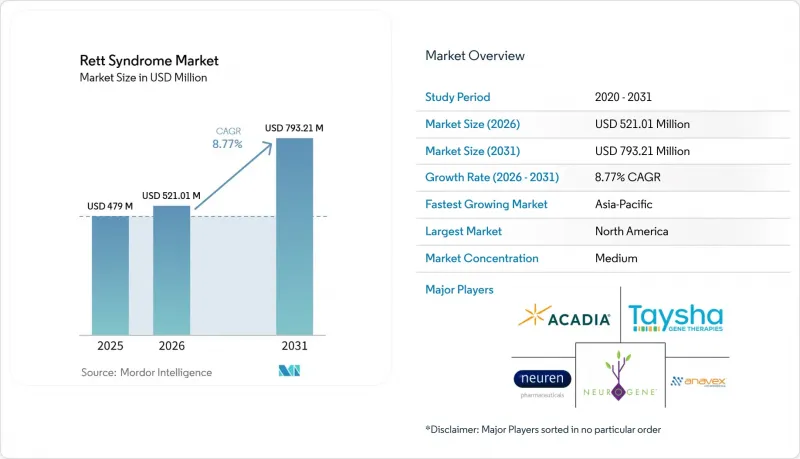
본 보고서는 유형별(치료, 진단), 질환 유형별(고전형, 비고전형), 병기별(I : 조기 발병, II : 급속 진행형, III : 안정기, IV : 후기 운동 기능 악화), 최종 사용자별(병원, 전문 클리닉, 재택 간호, 기타), 지역별(북미, 유럽, 아시아태평양, 중동 및 아프리카, 남미)로 분류되어 있습니다. 시장 전망은 금액(달러) 기준으로 제시되어 있습니다.
세계의 렛 증후군 시장 동향 및 인사이트
트로피네티드의 채택 확대에 따라 각 시장에서 상업적 성장 여지가 확대되고 있습니다.
DAYBUE의 순매출액은 2024년 3억 4,800만 달러에서 증가하여 2025년에는 3억 9,100만 달러에 달했습니다. 또한 아카디아(Acadia)사는 2026년 매출을 4억 6,000만-4억 9,000만 달러로 전망하고 있습니다. 이러한 전망은 단순한 가격 지원이 아닌, 렛 증후군 시장에서의 판매량 지속적 확대를 시사합니다. 실제 임상에서 치료 지속률은 계속해서 견조한 양상을 보였으며, 소아 환자의 87.5% 이상이 3개월 이상 치료를 지속했고, 65% 이상이 추적 조사 기간이 끝날 때까지 치료를 지속했습니다. 렛 증후군 시장에서는 해당 질환을 대상으로 한 약물 요법에 의한 수익의 대부분이 여전히 단 하나의 시판 제품에 의존하고 있기 때문에 이러한 높은 치료 지속률은 중요합니다. 캐나다에서는 2024년 10월 DAYBUE가 승인되어, 렛 증후군 시장에서 두 번째로 완전 승인을 받은 제품이 국내에 출시되었습니다. 이러한 판매 범위 확대로 인해 제품 시장 수명이 연장되고, 유전자 치료가 개발 단계에 있는 동안에도 렛 증후군 시장에 더욱 견고한 기반이 마련될 것입니다.
MECP2 유전자 검사 확대가 치료 대상 환자층을 넓히다.
MECP2 검사는 렛 증후군 시장에서 확정 진단 절차에서 조기 진단 도구로 전환되고 있습니다. GeneDx사는 2025년 엑솜 및 유전체 검사 건수가 전년 대비 30.5% 증가했다고 보고했으며, 2026년에는 33-35%의 건수 증가를 예상하고, 매출액은 5억 4,000만-5억 5,500만 달러에 달할 것으로 전망하고 있습니다. 또한 이 회사는 신경발달장애에 대한 엑솜 또는 유전체 검사를 실시함으로써 아동 1인당 최대 8만 달러의 의료비를 절감할 수 있다고 강조하고 있으며, 이는 조기 검사에 대한 보험사의 수용을 촉진하는 요인이 됩니다. GeneDx는 2026년에 성인 신경학 분야로 사업을 확장했습니다. 이를 통해 지금까지 공식적으로 렛 증후군으로 진단받은 적이 없는 성인 환자를 위한 새로운 진료 경로가 열리게 됩니다. 시판 중인 치료법의 사용이나 중요한 유전자 치료 참여 여부는 모두 문서화된 변이 상태를 바탕으로 결정되므로, 조기에 분자 수준에서 확정 진단을 내리는 것이 중요합니다. 검사가 더욱 일상화됨에 따라, 렛 증후군 시장에서는 개입 옵션이 더 다양해지는 시기에 진단과 치료를 앞당길 수 있게 될 것입니다.
임상적 수요가 있음에도 불구하고, 비용 구조가 시장 침투를 제약하고 있습니다.
고액의 치료비가 여전히 렛 증후군 시장의 확산을 제한하고 있습니다. 미국 50개 주를 대상으로 한 조사에 따르면, 2025년 시점에서 DAYBUE는 미국 전역의 메디케이드 프로그램에서 엄격한 사전 승인 기준에 직면해 있었습니다. 많은 소아 환자가 메디케이드에 의존하고 있기 때문에 이 점은 중요하며, 행정 심사가 실질적인 접근 장벽이 되고 있습니다. 이 문제는 현재의 치료법에만 국한되지 않습니다. 유전자 치료 후보 약물은 만성 경구 치료보다 훨씬 더 높은 가격으로 책정될 것으로 예상되기 때문입니다. 희귀질환 의약품에 대한 보험 지급 체계가 마련되지 않은 국가에서는 이러한 비용 구조로 인해 임상적 수요가 존재하더라도 상업적 기회의 일부를 확보하기 어려워집니다.
부문 분석
2025년, 렛 증후군 시장에서 치료의 점유율은 75.31%를 차지했으며, 수익은 치료 서비스와 의약품 지출에 집중되었습니다. 2025년 DAYBUE의 순제품 매출액 3억 9,100만 달러는 약물 요법 하위 부문의 규모를 보여주는 가장 명확한 지표로 남아 있습니다. 보조 요법, 보조 기구, 외과적 개입은 전체 치료 과정에서 매출을 끌어올렸으나, 모두 약물 요법에 비해 규모가 작고 분산된 상태를 유지했습니다. 진단 부문은 연평균 성장률(CAGR) 11.38%를 나타낼 것으로 예측되며, 치료가 여전히 큰 비중을 차지하는 한편, 렛 증후군 시장이 조기 분자진단을 통한 확정 진단으로 전환되고 있음을 보여줍니다.
GeneDx사는 2025년에 엑솜 및 유전체 검사 건수를 30.5% 증가시키고, 2026년에는 상업적 확장을 통해 검사 공급 역량을 강화했습니다. 유전자 검사는 변이 상태를 확인하고, 유전자형 검증을 지원하며, 유전자 치료 연구에 대한 적격성을 판단할 수 있기 때문에 혈액 검사나 기타 기법보다 빠른 속도로 확대되고 있습니다. 성인 신경학 분야로의 확장을 통해, 지금까지 확정 진단을 받지 못했던 환자, 특히 광범위한 신경학적 진단명으로 분류되었던 고령의 사례가 렛 증후군 시장에 임베디드될 것으로 기대됩니다. 이를 통해 렛 증후군 업계는 진단 대상층을 확대함과 동시에, 조기에 확정 진단이 이루어지게 되면 치료 기반도 지속적으로 확대해 나갈 수 있게 될 것입니다.
2025년에는 전형적인 렛 증후군이 74.24%의 점유율을 차지했으나, 비전형적인 렛 증후군은 2031년까지 연평균 성장률(CAGR) 10.52%를 나타낼 것으로 예측됩니다. 이러한 구성은 현재의 수익이 여전히 승인된 치료법의 중요한 근거 기반으로 사용되는 표현형에 기반을 두고 있음을 보여줍니다. 동시에, 각 후원사는 임상적 관심을 전형적인 증상의 범위를 넘어 확대하고 있으며, 이는 규모가 작은 비전형적 환자 집단에서의 향후 성장을 뒷받침할 것입니다. 필라델피아 소아병원 프로그램에서는 비정형형 및 남성 환자를 포함한 렛 증후군 및 관련 MECP2 관련 질환 환자 55명을 대상으로 12개월에 걸쳐 DAYBUE의 평가가 진행되었습니다.
FDA 승인을 뒷받침한 LAVENDER 임상시험에서는 확정 진단을 받은 고전적 렛 증후군(RTT) 환자 5-20세가 등록되었으며, 이를 통해 고전적 사례군의 상업적 비중이 더욱 강화되었습니다. 비정형 사례는 분자 프로파일 및 임상 증상의 균일성이 낮아, 기존에는 확정 진단이 어려웠습니다. MECP2에 더해 CDKL5 및 FOXG1까지 포괄하는 보다 광범위한 차세대 염기서열 분석 패널을 통해, 이러한 사례의 검출률은 향후 향상될 것으로 예측됩니다. 이러한 진단 범위의 확대로 인해 대상이 될 수 있는 비정형 사례군이 확대되며, 예측 기간 동안 그 성장률은 렛 증후군 시장 전체를 상회하는 수준을 유지할 것으로 전망됩니다.
지역별 분석
2025년, 북미는 렛 증후군 시장의 44.61% 점유율을 차지했으며, 이 지역은 다른 모든 지역을 확실히 앞서 나갔습니다. 미국이 트로피네티드의 상업적 출시를 최초로 실현했고, IRSF 센터 오브 엑설런스의 집중도가 가장 높았기 때문에 이러한 선두 위치를 이끌었습니다. 캐나다는 2024년 10월 트로피네티드의 완전 승인을 받은 두 번째 시장이 되어, 이를 통해 미국 이외의 지역 기반이 확대되었습니다. 다만, 해당 지역의 일부에서는 메디케이드의 사전 승인 제도로 인해 수요가 치료 건수에 어느 정도 반영될지가 여전히 제한되고 있습니다. GeneDx사는 2026년에 신경학에 특화된 대규모 영업팀을 확충하고 있으며, 이를 통해 처방 의사에게 더 폭넓게 접근할 수 있게 되어 미국 의료 현장에서의 확정 진단 건수 증가가 예상됩니다.
유럽에서는 렛 증후군 시장에서 접근성 확대 단계가 진행 중이며, 독일에서는 이미 전문의의 감독 하에 ‘컴패셔네이트 유스(특별 사용)’를 통해 조기 접근 경로가 제공되고 있습니다. 2025년 9월 BfArM(독일 의약품 및 의료제품청)의 결정에 따라, 보다 광범위한 지역적 상용화의 기반이 마련되기 전에 트로피네티드에 대한 접근이 승인되었습니다. 또한, Neurogene사는 NGN-401에 대해 EMA의 PRIME 지정 및 ATMP 지정을 획득했으며, 이를 통해 유럽은 차세대 첨단 치료법 개발에서도 중요한 위치를 계속 차지하게 될 것입니다. 이러한 조기 접근과 첨단 치료법에 대한 준비가 결합됨에 따라, 유럽은 단기적인 치료 활용과 향후 시장 출시 순서 양면에서 더욱 강력한 역할을 수행하게 될 것입니다. 이 지역에서는 보다 광범위한 승인이 시장에 도입된 후, 각국의 보험 환급 제도가 희귀질환 치료제의 비용을 어떻게 처리하느냐에 따라 향후 전개가 좌우될 것입니다.
아시아태평양은 2031년까지 렛 증후군 시장 규모가 연평균 성장률(CAGR) 11.65%로 확대될 것으로 예측되며, 가장 성장세가 두드러지는 지역 부문이 될 것입니다. 일본이 단기적인 주요 성장 요인이 될 전망입니다. 이는 아카디아(Acadia)사가 2025년 6월 일본에서 트로피네티드의 무작위 배정 3상 임상시험을 시작했으며, 주요 결과가 2026년 4분기부터 2027년 1분기 사이에 발표될 전망이기 때문입니다. 중국에서는 희귀질환 등록 시스템과 유전체 검사 기반이 확대되고 있어, 이에 따라 향후 확정 진단을 받은 환자 수가 증가할 것으로 전망됩니다. 한편, 한국과 호주는 계속해서 중기적인 성장의 버팀목이 될 것입니다. 남미, 중동 및 아프리카는 시장 규모가 비교적 작고 정책에 대한 의존도가 높은 상황이 지속되겠지만, GCC(걸프협력회의) 국가들의 투자와 브라질의 희귀질환 프로그램이 이들 지역에서 가장 명확한 접근 경로를 제공합니다.
기타 혜택 :
- 엑셀 형식 시장 예측(ME) 시트
- 3개월간의 애널리스트 지원
자주 묻는 질문
목차
제1장 서론
제2장 조사 방법
제3장 주요 요약
제4장 시장 구도
제5장 시장 규모 및 성장 예측
제6장 경쟁 구도
제7장 시장 기회 및 향후 전망
AJYAccording to Mordor Intelligence, the rett syndrome market size is projected to expand from USD 479 million in 2025 and USD 521.01 million in 2026 to USD 793.21 million by 2031, registering a CAGR of 8.77% between 2026 to 2031.
This report is Segmented by Type (Treatment, Diagnosis), Disease Type (Classic, Atypical), Stage (I: Early Onset, II: Rapid Destructive, III: Plateau, IV: Late Motor Deterioration), End User (Hospitals, Specialty Clinics, Homecare Settings, Other), and Geography (North America, Europe, Asia-Pacific, Middle East and Africa, South America). The Market Forecasts are Provided in Terms of Value (USD).
Global Rett Syndrome Market Trends and Insights
Trofinetide Adoption Extending Its Commercial Runway Across Markets
DAYBUE net sales reached USD 391 million in 2025, up from USD 348 million in 2024, and Acadia guided to USD 460-490 million for 2026. That outlook points to continued volume expansion in the Rett syndrome market rather than price support alone. Real world persistence remained strong, with more than 87.5% of pediatric patients staying on treatment beyond 3 months and more than 65% remaining through the end of available follow up. Strong persistence matters because the Rett syndrome market still depends on one commercial product for most disease-targeted pharmacological revenue. Canada approved DAYBUE in October 2024, which gave the Rett syndrome market its second fully authorized national launch. That wider footprint extends the product runway and gives the Rett syndrome market a firmer base while gene therapies remain in development.
MECP2 Genetic Testing Expanding The Treatable Population
MECP2 testing is moving from a confirmatory step to an earlier diagnostic tool in the Rett syndrome market. GeneDx reported 30.5% year over year growth in exome and genome test volumes in 2025 and projected 33-35% volume growth for 2026 with revenue guidance of USD 540-555 million. The same company also highlighted healthcare cost savings of up to USD 80,000 per child after exome or genome testing in neurodevelopmental disorders, which supports payer acceptance of earlier testing. GeneDx expanded into adult neurology in 2026, which opens a new funnel for adults whose conditions were never formally confirmed as Rett syndrome. Early molecular confirmation matters because both marketed therapy use and pivotal gene therapy enrollment depend on documented mutation status. As testing becomes more routine, the Rett syndrome market can pull forward diagnosis and treatment into a period when intervention options are broader.
Cost Architecture Constraining Market Penetration Despite Clinical Demand
High therapy costs still limit penetration in the Rett syndrome market. A 50-state audit showed that DAYBUE faced restrictive prior authorization criteria across U.S. Medicaid programs in 2025. That matters because many pediatric patients depend on Medicaid, so administrative review becomes the practical gatekeeper to access. The problem will not end with current therapy, because gene therapy candidates are expected to carry much higher prices than chronic oral treatment. In countries without mature orphan drug reimbursement frameworks, that cost profile keeps part of the commercial opportunity out of reach even when clinical demand exists.
Other drivers and restraints analyzed in the detailed report include:
- Gene And RNA-Based Therapy Pipeline Reaching Pivotal Data Inflection
- Multidisciplinary Care Networks Creating Durable Clinical Infrastructure
- Delayed Diagnosis Limiting The Addressable Patient Population In Emerging Markets
For complete list of drivers and restraints, kindly check the Table Of Contents.
Segment Analysis
Treatment accounted for 75.31% of the Rett syndrome market share in 2025, which kept revenue centered on therapy services and drug spending. DAYBUE net product sales of USD 391 million in 2025 remain the clearest proxy for the scale of the drug therapy sub segment. Supportive therapies, assistive devices, and surgical interventions added revenue across care pathways, but each remained smaller and more diffuse than drug therapy. The diagnosis segment is forecast to grow at 11.38% CAGR, which shows that the Rett syndrome market is shifting toward earlier molecular confirmation even while treatment stays the larger base.
GeneDx expanded the test supply side by lifting exome and genome volumes 30.5% in 2025 and extending its commercial push in 2026. Genetic testing is outpacing blood tests and other methods because it confirms mutation status, supports genotype review, and determines eligibility for gene therapy studies. Adult neurology outreach should also bring previously unconfirmed patients into the Rett syndrome market, especially among older cases that were coded under broader neurological labels. This leaves the Rett syndrome industry with a larger diagnostic funnel and a treatment base that can keep expanding once confirmation happens earlier.
Classic Rett syndrome held 74.24% share in 2025, while atypical Rett syndrome is projected to grow at 10.52% CAGR through 2031. That split shows that current revenue still follows the phenotype used in the pivotal evidence base for approved therapy. At the same time, sponsors are widening clinical attention beyond the classic presentation, which supports future growth in the smaller atypical pool. The Children's Hospital of Philadelphia program assessed DAYBUE in 55 people with Rett syndrome and related MECP2 associated disorders over 12 months, including atypical and male presentations.
The LAVENDER study that supported FDA approval enrolled patients aged 5-20 years with documented classic RTT, which reinforced the commercial weight of the classic segment. Atypical cases have historically been harder to confirm because their molecular profiles and clinical presentation are less uniform. Broader next generation sequencing panels that capture CDKL5 and FOXG1 alongside MECP2 should improve detection of these cases over time. That diagnostic broadening can expand the atypical addressable pool and keep its growth rate above the wider Rett syndrome market through the forecast period.
Complete Report Scope:
- By Type
- Treatment
- Drug Therapy
- Supportive Therapy
- Surgical Interventions
- Assistive Devices
- Diagnosis
- Genetic Testing
- Blood Test
- Other Diagnosis Methods
- Treatment
- By Disease Type
- Classic Rett Syndrome
- Atypical Rett Syndrome
- By Stage
- Stage I: Early Onset Phase
- Stage II: Rapid Destructive Phase
- Stage III: Plateau Phase
- Stage IV: Late Motor Deterioration Phase
- By End User
- Hospitals
- Specialty Clinics
- Homecare Settings
- Other End Users
- By Geography
- North America
- United States
- Canada
- Mexico
- Europe
- Germany
- United Kingdom
- France
- Italy
- Spain
- Rest of Europe
- Asia-Pacific
- China
- Japan
- India
- Australia
- South Korea
- Rest of Asia-Pacific
- Middle East and Africa
- GCC
- South Africa
- Rest of Middle East and Africa
- South America
- Brazil
- Argentina
- Rest of South America
- North America
Geography Analysis
North America held 44.61% of the Rett syndrome market share in 2025, which kept the region clearly ahead of all others. The United States drove that lead because it had the first commercial launch of trofinetide and the highest concentration of IRSF Centers of Excellence. Canada became the second fully authorized trofinetide market in October 2024, which widened the regional base beyond the United States. Even so, Medicaid prior authorization still limits how fully demand converts into treated volume in parts of the region. GeneDx added a larger neurology focused commercial team in 2026, and that should improve confirmed diagnosis flow in U.S. care settings with broader prescriber reach.
Europe is moving through an access building phase in the Rett syndrome market, with Germany already providing an early specialist supervised route through compassionate use. The BfArM decision in September 2025 allowed trofinetide access before any broader regional commercialization path was completed. Neurogene also secured EMA PRIME and ATMP designations for NGN-401, which keeps Europe relevant in the next wave of advanced therapy development. That combination of early access and advanced therapy preparation gives Europe a stronger role in both near term treatment use and future launch sequencing. The region still depends on how national reimbursement systems handle orphan therapy costs once wider approvals reach the market.
Asia-Pacific is forecast to advance at 11.65% CAGR within the Rett syndrome market size through 2031, which makes it the fastest growing regional segment. Japan is the main near term catalyst because Acadia started a randomized Phase 3 trofinetide study there in June 2025, with top line results expected between Q4 2026 and Q1 2027. China is expanding its rare disease registry and genomic testing base, which should enlarge the confirmed patient pool over time, while South Korea and Australia remain medium term growth supports. South America and the Middle East and Africa stay smaller and more policy dependent, although GCC investment and Brazil's rare disease program offer the clearest access paths in those regions.
- Acadia Pharmaceuticals Inc.
- AMO Pharma Limited
- Anavex Life Sciences Corp.
- Axonis Therapeutics, Inc.
- Biohaven Ltd.
- Edison Pharmaceuticals, Inc.
- GeneDx Holdings Corp.
- Illumina
- Jazz Pharmaceuticals plc
- LabCorp
- Neuren Pharmaceuticals Limited
- Neurogene Inc.
- Novartis
- Prilenia Therapeutics B.V.
- Quest Diagnostics
- Roche
- StrideBio, Inc.
- Taysha Gene Therapies, Inc.
- Thermo Fisher Scientific
- Unravel Biosciences, Inc.
- Wave Life Sciences Ltd.
Additional Benefits:
- The market estimate (ME) sheet in Excel format
- 3 months of analyst support
TABLE OF CONTENTS
1 Introduction
- 1.1 Study Assumptions & Market Definition
- 1.2 Scope of the Study
2 Research Methodology
3 Executive Summary
4 Market Landscape
- 4.1 Market Overview
- 4.2 Market Drivers
- 4.2.1 Increasing Adoption of Trofinetide as the First Approved Disease-Targeted Therapy
- 4.2.2 Expanding MECP2 Genetic Testing and Earlier Molecular Confirmation
- 4.2.3 Rising Clinical Trial Activity in Gene and RNA-Based Therapies
- 4.2.4 Multidisciplinary Care Adoption Across Neurology, Rehab, Nutrition, and Communication Support
- 4.2.5 Expansion of Rare Disease Centers of Excellence and Referral Networks
- 4.2.6 Caregiver-Generated Real-World Evidence and Remote Monitoring for Rare Neurodevelopmental Disorders
- 4.3 Market Restraints
- 4.3.1 High Treatment and Genetic Testing Costs Relative to Covered Patient Populations
- 4.3.2 Limited Curative Options Outside Symptom Management
- 4.3.3 Narrow Diagnosable Population and Delayed Diagnosis in Lower Awareness Markets
- 4.3.4 Clinical Trial Recruitment Friction and Small, Heterogeneous Patient Cohorts
- 4.4 Regulatory Landscape
- 4.5 Technological Outlook
- 4.6 Porter's Five Forces Analysis
- 4.6.1 Threat of New Entrants
- 4.6.2 Bargaining Power of Suppliers
- 4.6.3 Bargaining Power of Buyers
- 4.6.4 Threat of Substitutes
- 4.6.5 Industry Rivalry
5 Market Size & Growth Forecasts (Value, USD)
- 5.1 By Type
- 5.1.1 Treatment
- 5.1.1.1 Drug Therapy
- 5.1.1.2 Supportive Therapy
- 5.1.1.3 Surgical Interventions
- 5.1.1.4 Assistive Devices
- 5.1.2 Diagnosis
- 5.1.2.1 Genetic Testing
- 5.1.2.2 Blood Test
- 5.1.2.3 Other Diagnosis Methods
- 5.1.1 Treatment
- 5.2 By Disease Type
- 5.2.1 Classic Rett Syndrome
- 5.2.2 Atypical Rett Syndrome
- 5.3 By Stage
- 5.3.1 Stage I: Early Onset Phase
- 5.3.2 Stage II: Rapid Destructive Phase
- 5.3.3 Stage III: Plateau Phase
- 5.3.4 Stage IV: Late Motor Deterioration Phase
- 5.4 By End User
- 5.4.1 Hospitals
- 5.4.2 Specialty Clinics
- 5.4.3 Homecare Settings
- 5.4.4 Other End Users
- 5.5 By Geography
- 5.5.1 North America
- 5.5.1.1 United States
- 5.5.1.2 Canada
- 5.5.1.3 Mexico
- 5.5.2 Europe
- 5.5.2.1 Germany
- 5.5.2.2 United Kingdom
- 5.5.2.3 France
- 5.5.2.4 Italy
- 5.5.2.5 Spain
- 5.5.2.6 Rest of Europe
- 5.5.3 Asia-Pacific
- 5.5.3.1 China
- 5.5.3.2 Japan
- 5.5.3.3 India
- 5.5.3.4 Australia
- 5.5.3.5 South Korea
- 5.5.3.6 Rest of Asia-Pacific
- 5.5.4 Middle East and Africa
- 5.5.4.1 GCC
- 5.5.4.2 South Africa
- 5.5.4.3 Rest of Middle East and Africa
- 5.5.5 South America
- 5.5.5.1 Brazil
- 5.5.5.2 Argentina
- 5.5.5.3 Rest of South America
- 5.5.1 North America
6 Competitive Landscape
- 6.1 Market Concentration
- 6.2 Market Share Analysis
- 6.3 Company Profiles (includes Global Level Overview, Market Level Overview, Core Segments, Financials as available, Strategic Information, Market Rank/Share, Products and Services, Recent Developments)
- 6.3.1 Acadia Pharmaceuticals Inc.
- 6.3.2 AMO Pharma Limited
- 6.3.3 Anavex Life Sciences Corp.
- 6.3.4 Axonis Therapeutics, Inc.
- 6.3.5 Biohaven Ltd.
- 6.3.6 Edison Pharmaceuticals, Inc.
- 6.3.7 GeneDx Holdings Corp.
- 6.3.8 Illumina, Inc.
- 6.3.9 Jazz Pharmaceuticals plc
- 6.3.10 Laboratory Corporation of America Holdings
- 6.3.11 Neuren Pharmaceuticals Limited
- 6.3.12 Neurogene Inc.
- 6.3.13 Novartis AG
- 6.3.14 Prilenia Therapeutics B.V.
- 6.3.15 Quest Diagnostics Incorporated
- 6.3.16 Roche Holding AG
- 6.3.17 StrideBio, Inc.
- 6.3.18 Taysha Gene Therapies, Inc.
- 6.3.19 Thermo Fisher Scientific Inc.
- 6.3.20 Unravel Biosciences, Inc.
- 6.3.21 Wave Life Sciences Ltd.
7 Market Opportunities and Future Outlook
- 7.1 White-Space and Unmet-Need Assessment