

|
시장보고서
상품코드
2099928
레오나르다이트 시장 : 점유율 분석, 업계 동향 및 통계, 성장 예측(2026-2031년)Leonardite - Market Share Analysis, Industry Trends & Statistics, Growth Forecasts (2026 - 2031) |
||||||
 Mordor Intelligence
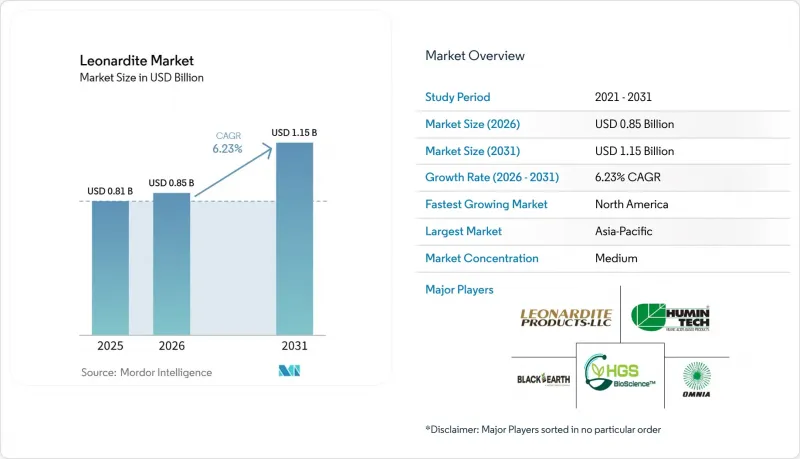
Mordor Intelligence에 의하면, 레오나르다이트 시장 규모는 2025년 8억 1,000만 달러, 2026년 8억 5,000만 달러에서 2031년까지 11억 5,000만 달러에 이를 것으로 예측되며, 2026년부터 2031년까지 CAGR 6.23%로 성장할 전망입니다.
본 보고서는 제품 형태(고체 레오나르다이트 및 액체 레오나르다이트), 용도(토양 개량제, 비료 첨가제 등), 최종 용도(밭작물, 원예 등), 지역(북미, 남미 등)별로 분류되어 있습니다. 시장 전망은 금액(달러) 기준으로 제시되어 있습니다.
전 세계 레오나르다이트 시장 동향 및 인사이트
지속 가능한 농업에서 레오나르다이트계 토양 개량제의 채택 확대
레오나르다이트 시장은 단기적인 영양분 공급에 그치지 않고, 농지의 물리적 및 생물학적 상태를 개선하는 토양 개량제로의 광범위한 전환의 혜택을 받고 있습니다. 생산자들은 뿌리 발달, 보습성 및 토양의 응집화에 더욱 주목하고 있습니다. 이는 반복되는 재배 주기를 통해 수확량의 안정성을 좌우하는 요인이기 때문입니다. 레오나르다이트는 그 부식질 함량이 양이온 교환을 촉진하여 뿌리권 내의 양분을 유지함으로써 장기적으로 이용할 수 있게 해주기 때문에 이러한 요건에 최적입니다. 이로 인해 구매 결정이 한 시즌의 반응이 아닌, 반복되는 실적이 좌우하는 경향이 있는 밭작물 재배 시스템에서 본 제품의 도입을 정당화하기 쉬워집니다. 이와 유사한 추세로 인해, 토양 품질 문제가 작물의 생육에 즉각적으로 나타나는 원예나 온실 재배 분야에서도 수요가 더욱 증가하고 있습니다. 또한, 토양 건강 제품은 토양 시스템 자체를 뒷받침하므로, 시비 계획이 변경되더라도 그 중요성을 유지할 수 있다는 점도 시장에 긍정적인 요인으로 작용하고 있습니다. 이로 인해 레오나르다이트는 기존의 비료 프로그램에 전적으로 의존하기보다는 그와 병행하여 기능하는 역할을 맡게 됩니다. 그 결과, 레오나르다이트 시장에서는 토양 구조나 양분 보유 능력을 직접적인 경영상의 우선 과제로 중시하는 생산자들의 지속적인 수요가 나타나고 있습니다.
유기농업 및 재생농업 프로그램의 확대
레오나르다이트 시장은 주요 생산 지역 전반에 걸쳐 유기농업 및 재생농업 프로그램이 꾸준히 확대되고 있는 점에 힘입고 있습니다. 유기농업연구소(FiBL)에 따르면, 2024년 전 세계 유기농 경지 면적은 9,890만 헥타르에 달했으며, 약 190개국에서 인증을 받은 유기농 생산자는 총 480만 명에 이르렀습니다. 이는 승인된 토양 개량제가 이전보다 훨씬 더 많은 사용자층에 의해 활용되고 있음을 보여줍니다. 이는 중요한 점입니다. 많은 인증 제도에서 허용되는 토양 개량제의 범위가 제한되어 있기 때문에 유기농 또는 저잔류물 조달 기준을 충족하는 레오나르다이트 제품의 입지가 강화되기 때문입니다. 아프리카에서 인증받은 유기농 경작지가 대폭 증가한 것도, 토양 복원과 투입 자재의 효율화 모두를 중요시하는 지역에서 새로운 수요가 발생하고 있음을 보여줍니다. 미국 농무부 천연자원보전국(NRCC)은 2025년 12월에 ‘재생 농업 시범 프로그램’을 시작하고, 2026 회계연도에 7억 달러를 배정하여 토양 보전에 기여하는 농법을 지원 대상 농업 프로그램에 포함시켰습니다. 이러한 변화는 시장에 긍정적인 영향을 미칠 것입니다. 보조금을 통한 보전 대책 도입은 순전히 자발적인 구매에 비해 보다 안정적인 구매 행동을 이끌어내는 경향이 있기 때문입니다. 또한, 지금까지는 토양 개량제의 지속적인 사용에 대한 동기가 부족했던 중소규모 생산자들도 대상 고객층에 포함되게 될 것입니다. 장기적으로는 이를 통해 시장이 틈새 시장인 유기농업 채널에 대한 의존도를 낮추고, 주류인 보전 관련 지출과의 연계성을 강화하게 될 것입니다.
레오나르다이트 광상 간 원료 품질의 편차
레오나르다이트 시장의 주요 제약 요인 중 하나는 광상이나 채굴 지역에 따라 원료 품질에 큰 편차가 있다는 점입니다. 구매자는 산지만을 기준으로 레오나르다이트를 구매하는 것이 아니라, 부식질 함량, 산화도, 균일성, 그리고 다운스트림 공정에서의 배합 성능도 판단 기준으로 삼고 있습니다. 생산자가 원료 공급처를 변경하거나 서로 다른 광산에서 나온 원료를 혼합할 경우, 로트별로 완제품의 성능을 예측하기 어려워질 가능성이 있습니다. 이로 인해 특히 액상 제제나 프리미엄 농업 프로그램에서 농지에서 재현 가능한 반응을 기대하는 판매업자나 생산자에게 어려움이 발생합니다. 옴니아 그룹이 고산화도의 호주산 원료를 전면에 내세우고 있다는 사실은 광상의 특성이 단순한 배경적 세부 사항이 아니라 상업적 차별화 요소가 될 수 있음을 보여줍니다. 2025년에 시행될 중국의 GB/T 34765-2024 규격 또한 비료 및 토양 개량제에서 풀빅산의 보다 명확한 측정의 필요성을 강조하고 있으며, 이는 품질 편차가 부식산계 제품 시장 전체에 어떤 영향을 미치는지를 반영하고 있습니다. 수입 감시 체계에 편차가 있고 구매자가 독립적인 시험 지원을 받을 수 없는 상황에서는 시장의 위험이 더욱 커집니다. 이러한 상황에서는 품질의 불확실성이 조달 결정의 지연을 초래하고, 제품에 대한 주장의 설득력을 약화시키며, 안정적인 원료 품질을 입증할 수 없는 공급업체에 대한 신뢰를 훼손할 가능성이 있습니다.
부문 분석
2025년 기준, 고체 레오나르다이트는 레오나르다이트 시장 규모의 58.2%를 차지하고 있으며, 이는 밭작물에서의 전면 살포 및 조시용 프로그램에서 오랫동안 사용되어 온 데 기인합니다. 과립 및 분말은 보존성이 뛰어나고, 벌크 운송이 효율적이며, 확립된 판매 채널에 적합하기 때문에 여전히 판매량의 주축을 이루고 있습니다. 이로 인해 레오나르다이트 시장은 광대한 면적의 곡물 및 유지종자 재배 시스템에서 확고한 기반을 구축하고 있습니다. 액상 제품은 규모는 작지만, 보다 깨끗한 살포와 밭에서의 신속한 혼합이 가장 중요시되는 상황에서 지지를 얻고 있습니다. 부문 구성은 여전히 물류 효율, 제형과의 적합성, 그리고 농장 내 시용 관행 간의 균형을 반영하고 있습니다.
액상 레오나르다이트는 2031년까지 연평균 성장률(CAGR) 8.1%로 성장할 것으로 추정되며, 시장에서 가장 빠르게 성장하는 제품 형태입니다. 성장이 가장 두드러지는 분야는 과수원, 보호재배 채소, 온실 재배 시스템 및 제어 환경 농업이며, 이러한 분야에서는 생산자가 반응을 신속하게 측정하고 고부가가치 배합의 도입을 정당화할 수 있습니다. Humintech GmbH는 이러한 변화에 대응하여 ‘Liqhumus Liquid 18’과 같은 비료 관개용 제품 라인을 전개하고 있습니다. 이 제품들은 토양에 대량 살포하는 것이 아니라 관개를 통한 공급을 목적으로 설계되었습니다. Omnia Group사 또한 침전 품질과 배합의 일관성을 무기로, 수출 지향적인 액상 후민산염 시장에서 경쟁력을 발휘하고 있습니다. 레오나르다이트 업계 전체에서 이러한 경향은 단순한 대량 공급에서 부가가치가 높은 용도 특화형 배합으로의 단계적인 전환을 나타내고 있습니다.
지역별 분석
2025년, 북미는 레오나르다이트 시장의 52.5%를 차지하며 여전히 최대 지역 시장으로서의 지위를 유지했습니다. 이 지역은 뉴멕시코주, 와이오밍주, 앨버타주에 고품질 광상을 보유하고 있을 뿐만 아니라, 농업 분야의 성숙한 유통망과 기술적 활용 패턴을 겸비하고 있습니다. 2025년 12월에 시작되어 2026 회계연도에 7억 달러의 예산이 배정된 미국 농무부 천연자원보전국(NRCC)의 ‘재생 농업 시범 프로그램’은 토양에 초점을 맞춘 농업 관행에 대한 자금 수요 신호를 더욱 강화하고 있습니다. 캐나다는 앨버타주에서의 후마라이트 생산을 통해 지역 공급을 뒷받침하고 있으며, 이는 국내 농업 및 수출 시장 모두에 공급되고 있습니다. 남미, 특히 브라질과 아르헨티나에서는 대규모 줄 재배 농업 시스템과 토양 황폐화가 토양 복원을 위한 반복적인 투입의 필요성을 입증하는 구체적인 사례가 되고 있어 그 중요성이 커지고 있습니다.
유럽은 질서 있는 제품 접근을 지원하는 규제 및 지속가능성 정책 덕분에 레오나르다이트 시장에서 여전히 비교적 체계화된 지역 중 하나입니다. 유럽연합(EU) 규정 2019/1009는 생산자들에게 토양 개량제 및 비미생물성 식물 생장 촉진제에 관한 공통된 틀을 제공하며, 승인된 제품이 회원국 간에 보다 효율적으로 유통되도록 뒷받침하고 있습니다. 중동은 후민산을 이용한 토양 안정화를 위한 농업용 시장으로서 여전히 활발하지만, 아프리카는 여전히 소규모 기반에서 출발하고 있음에도 불구하고 인증 유기농지의 확대를 통해 장기적인 지지를 얻고 있습니다.
아시아태평양은 2031년까지 레오나르다이트 시장에서 7.8%라는 지역별 최고 연평균 성장률(CAGR)을 보일 것으로 예측됩니다. 중국은 주요 견인차 역할을 하고 있는데, 이는 비료 감축 프로그램과 국내 부식질 제품 공급을 통해 효율성을 중시하는 투입 자재로 전환하는 움직임이 단순한 상징적 차원을 넘어 보다 실질적인 단계로 접어들었기 때문입니다. 지역별 성장은 토양 상태와 비료 효율성이 여전히 뿌리 깊은 우려 사항으로 남아 있는 집약형 농업 시스템에서 나타나는 강력한 농업학적 수요를 반영하고 있습니다. 일본, 한국, 호주는 보호 재배 및 특산 작물을 위한 정밀하게 배합된 투입 자재를 더욱 중시하고 있어, 지역 수요에 성숙한 층을 더하고 있습니다.
기타 혜택:
- 엑셀 형식 시장 예측(ME) 시트
- 3개월간의 애널리스트 지원
자주 묻는 질문
목차
제1장 서론
제2장 조사 방법
제3장 주요 요약
제4장 시장 구도
제5장 시장 규모와 성장 예측
제6장 경쟁 구도
제7장 시장 기회와 향후 전망
JHS 26.08.11According to Mordor Intelligence, the leonardite market size is anticipated to increase from USD 0.81 billion in 2025 and USD 0.85 billion in 2026, to reach USD 1.15 billion by 2031, growing at a CAGR of 6.23% over 2026-2031.
This report is Segmented by Product Form (Solid Leonardite and Liquid Leonardite), by Application (Soil Conditioner, Fertilizer Additive, and More), by End-Use (Field Crops, Horticulture, and More), and Geography (North America, South America, and More). Market Forecasts are Provided in Terms of Value (USD).
Global Leonardite Market Trends and Insights
Rising Adoption of Leonardite-Based Soil Conditioners in Sustainable Agriculture
The leonardite market is benefiting from a wider move toward soil conditioners that improve the physical and biological condition of farmland, not only short-term nutrient supply. Growers are paying closer attention to root development, water retention, and soil aggregation because those factors shape yield stability across repeated crop cycles. Leonardite fits this requirement well because its humic content supports cation exchange and helps retain nutrients in the root zone for longer use. This makes the product easier to justify in field crop systems where purchase decisions are often tied to repeat performance rather than one-season response. The same pattern supports stronger demand in horticulture and greenhouse production, where soil quality issues show up quickly in crop performance. The market also gains from the fact that soil health products can stay relevant even when fertilizer plans change, since they support the soil system itself. This gives leonardite a role that is adjacent to standard fertilizer programs rather than fully dependent on them. As a result, the leonardite market is seeing repeat demand from growers who now measure soil structure and nutrient retention as direct operating priorities.
Expansion of Organic and Regenerative Farming Programs
The leonardite market is also supported by the steady expansion of organic and regenerative farming programs across major producing regions. According to the Research Institute of Organic Agriculture (FiBL), global organic farmland reached 98.9 million hectares in 2024, while certified organic producers totaled 4.8 million across nearly 190 countries, which shows that approved soil inputs now serve a much larger user base than before. This matters because many certified systems narrow the range of acceptable soil amendments, which strengthens the position of leonardite products that meet organic or low-residue procurement rules. Africa's significant increase in certified organic farmland also points to the emergence of new demand in regions where soil restoration and input efficiency are both important. The United States Department of Agriculture Natural Resources Conservation Service launched the Regenerative Pilot Program in December 2025, allocating USD 700 million for fiscal year 2026 to bring soil-supportive practices into funded farm programs. The market benefits from this shift because funded conservation adoption usually creates more stable buying behavior than purely discretionary purchases. It also broadens the addressable base to small and mid-sized growers who previously had less reason to commit to repeated soil amendment use. Over time, this makes the market less dependent on niche organic channels and more connected to mainstream conservation spending.
Feedstock Variability Across Leonardite Deposits
A major restraint for the leonardite market is the wide variation in raw material quality across deposits and mining regions. Buyers do not purchase leonardite only by origin, they also judge it by humic content, oxidation level, consistency, and downstream formulation performance. When producers switch sources or blend material from different mines, finished product performance can become less predictable from batch to batch. That creates difficulty for distributors and growers who expect repeatable field response, especially in liquid formulations and premium agricultural programs. Omnia Group's positioning around high-oxidation Australian feedstock shows that the deposit profile can be a commercial differentiator rather than a background detail. China's GB/T 34765-2024 standard, implemented in 2025, also underscores the need for clearer measurement of fulvic acid in fertilizers and soil conditioners, reflecting how quality dispersion affects the wider humic products space. The market is more exposed, with uneven import oversight and buyers lacking independent testing support. In those settings, quality uncertainty can delay procurement decisions, weaken product claims, and reduce trust in suppliers that cannot prove stable source quality.
Other drivers and restraints analyzed in the detailed report include:
- Precision Fertigation and Liquid Humate Compatibility Gains
- Demand for Higher Nutrient Use Efficiency Under Input Cost Pressure
- Product Efficacy Sensitivity to Soil Type, pH, and Application Practice
For complete list of drivers and restraints, kindly check the Table Of Contents.
Segment Analysis
Solid leonardite held 58.2% of the leonardite market size in 2025, supported by its long-standing use in broadcast and in-furrow programs across field crops. Granules and powders remain the volume base because they store well, move efficiently in bulk, and fit established dealer channels. This gives the leonardite market a dependable foundation in large-acre cereal and oilseed systems. Liquid material remained smaller, but it gained favor where cleaner delivery and faster field integration mattered most. The segment mix still reflects a balance between logistics efficiency, formulation fit, and farm application practice.
Liquid leonardite is estimated to grow at an 8.1% CAGR through 2031, making it the fastest-moving product form in the market. Growth is strongest in orchards, protected vegetables, greenhouse systems, and controlled environment agriculture, where growers can quickly measure responses and justify premium formulations. Humintech GmbH has aligned with this shift through fertigation-ready lines such as Liqhumus Liquid 18, which are designed for irrigation-based delivery rather than bulk soil spreading. Omnia Group also uses deposit quality and formulation consistency to compete in the export-oriented liquid humate market. Across the leonardite industry, this pattern shows a gradual move from simple bulk supply toward higher-value application-specific formulations.
Complete Report Scope:
- By Product Form
- Solid Leonardite
- Liquid Leonardite
- By Application
- Soil Conditioner
- Fertilizer Additive
- Seed Treatment
- Fertigation
- Other Agricultural Applications
- By End-Use
- Field Crops
- Horticulture
- Turf and Ornamentals
- Greenhouse and Controlled Environment Agriculture
- By Geography
- North America
- United States
- Canada
- Mexico
- Rest of North America
- South America
- Brazil
- Argentina
- Rest of South America
- Europe
- Germany
- France
- United Kingdom
- Spain
- Italy
- Russia
- Rest of Europe
- Asia-Pacific
- China
- India
- Japan
- South Korea
- Australia
- Rest of Asia-Pacific
- Middle East
- Saudi Arabia
- United Arab Emirates
- Rest of Middle East
- Africa
- South Africa
- Egypt
- Rest of Africa
- North America
Geography Analysis
North America accounted for 52.5% of the leonardite market in 2025 and remained the largest regional contributor. The region combines high-quality deposits in New Mexico, Wyoming, and Alberta with mature agricultural distribution and technical usage patterns. The United States Department of Agriculture Natural Resources Conservation Service Regenerative Pilot Program, launched in December 2025 with USD 700 million for fiscal year 2026, adds a funded demand signal for soil-focused agricultural practices. Canada supports regional supply through Alberta humalite production, which serves both domestic agriculture and export markets. South America is becoming more relevant, especially in Brazil and Argentina, where large row-crop systems and degraded soils provide a practical case for repeated soil-restoration inputs.
Europe remained one of the more structured regions in the leonardite market, thanks to regulatory and sustainability policies that support orderly product access. Regulation (European Union) 2019/1009 provides producers with a common framework for soil improvers and non-microbial plant biostimulants, helping approved products move across member states more efficiently. The Middle East remains an active agricultural use market for humic soil stabilization, while Africa still starts from a smaller base but gains long-term support from expanding certified organic area.
Asia-Pacific is anticipated to record the fastest regional CAGR at 7.8% through 2031 in the leonardite market. China is a central driver because fertilizer reduction programs and domestic humic product supply have made the shift toward efficiency-oriented inputs more operational than symbolic. Regional growth also reflects strong agronomic need in intensive farming systems where soil condition and fertilizer efficiency remain persistent concerns. Japan, South Korea, and Australia add a more mature layer to regional demand, with stronger emphasis on precision-formulated inputs for protected horticulture and specialty crops.
- HGS BioScience
- Leonardite Products LLC
- Leonardita del Ebro
- Black Earth Humic (WestMET)
- Humintech GmbH
- Huma, Inc.
- Biorex LLC
- Shandong Chuangxin Humic Acid Technology Co., Ltd
- Omnia Specialities Australia Pty Ltd (Omnia Group)
- Canadian Humalite International Inc.
- Humate International
- Daymsa (Samca Group)
Additional Benefits:
- The market estimate (ME) sheet in Excel format
- 3 months of analyst support
TABLE OF CONTENTS
1 INTRODUCTION
- 1.1 Study Assumptions and Market Definition
- 1.2 Scope of the Study
2 RESEARCH METHODOLOGY
3 EXECUTIVE SUMMARY
4 MARKET LANDSCAPE
- 4.1 Market Overview
- 4.2 Market Drivers
- 4.2.1 Rising adoption of leonardite-based soil conditioners in sustainable agriculture
- 4.2.2 Expansion of organic and regenerative farming programs
- 4.2.3 Precision fertigation and liquid humate compatibility gains
- 4.2.4 Demand for higher nutrient use efficiency under input cost pressure
- 4.2.5 Soil carbon restoration and resilience farming adoption
- 4.2.6 Certification-driven demand from organic and residue-constrained crop systems
- 4.3 Market Restraints
- 4.3.1 Feedstock variability across leonardite deposits
- 4.3.2 Product efficacy depends on soil type, pH, and application practice
- 4.3.3 Farmer awareness of humic acid performance remains limited
- 4.3.4 Alternative humates, biostimulants, and compost inputs create substitution pressure
- 4.4 Regulatory Landscape
- 4.5 Technological Outlook
- 4.6 Porter's Five Forces Analysis
- 4.6.1 Bargaining Power of Suppliers
- 4.6.2 Bargaining Power of Buyers
- 4.6.3 Threat of New Entrants
- 4.6.4 Threat of Substitutes
- 4.6.5 Intensity of Competitive Rivalry
5 MARKET SIZE AND GROWTH FORECASTS (VALUE)
- 5.1 By Product Form
- 5.1.1 Solid Leonardite
- 5.1.2 Liquid Leonardite
- 5.2 By Application
- 5.2.1 Soil Conditioner
- 5.2.2 Fertilizer Additive
- 5.2.3 Seed Treatment
- 5.2.4 Fertigation
- 5.2.5 Other Agricultural Applications
- 5.3 By End-Use
- 5.3.1 Field Crops
- 5.3.2 Horticulture
- 5.3.3 Turf and Ornamentals
- 5.3.4 Greenhouse and Controlled Environment Agriculture
- 5.4 By Geography
- 5.4.1 North America
- 5.4.1.1 United States
- 5.4.1.2 Canada
- 5.4.1.3 Mexico
- 5.4.1.4 Rest of North America
- 5.4.2 South America
- 5.4.2.1 Brazil
- 5.4.2.2 Argentina
- 5.4.2.3 Rest of South America
- 5.4.3 Europe
- 5.4.3.1 Germany
- 5.4.3.2 France
- 5.4.3.3 United Kingdom
- 5.4.3.4 Spain
- 5.4.3.5 Italy
- 5.4.3.6 Russia
- 5.4.3.7 Rest of Europe
- 5.4.4 Asia-Pacific
- 5.4.4.1 China
- 5.4.4.2 India
- 5.4.4.3 Japan
- 5.4.4.4 South Korea
- 5.4.4.5 Australia
- 5.4.4.6 Rest of Asia-Pacific
- 5.4.5 Middle East
- 5.4.5.1 Saudi Arabia
- 5.4.5.2 United Arab Emirates
- 5.4.5.3 Rest of Middle East
- 5.4.6 Africa
- 5.4.6.1 South Africa
- 5.4.6.2 Egypt
- 5.4.6.3 Rest of Africa
- 5.4.1 North America
6 COMPETITIVE LANDSCAPE
- 6.1 Market Concentration
- 6.2 Strategic Moves
- 6.3 Market Share Analysis
- 6.4 Company Profiles (Includes Global Level Overview, Market Level Overview, Core Segments, Financials as Available, Strategic Information, Market Rank/Share, Products and Services, Recent Developments)
- 6.4.1 HGS BioScience
- 6.4.2 Leonardite Products LLC
- 6.4.3 Leonardita del Ebro
- 6.4.4 Black Earth Humic (WestMET)
- 6.4.5 Humintech GmbH
- 6.4.6 Huma, Inc.
- 6.4.7 Biorex LLC
- 6.4.8 Shandong Chuangxin Humic Acid Technology Co., Ltd
- 6.4.9 Omnia Specialities Australia Pty Ltd (Omnia Group)
- 6.4.10 Canadian Humalite International Inc.
- 6.4.11 Humate International
- 6.4.12 Daymsa (Samca Group)


