
|
시장보고서
상품코드
2099935
의료 바이오센서 시장 : 점유율 분석, 업계 동향 및 통계, 성장 예측(2026-2031년)Healthcare Biosensors - Market Share Analysis, Industry Trends & Statistics, Growth Forecasts (2026 - 2031) |
||||||
 Mordor Intelligence
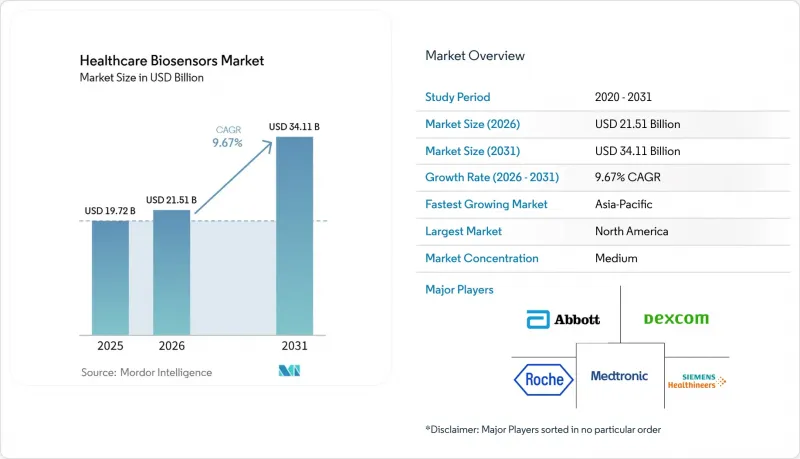
Mordor Intelligence에 의하면, 의료 바이오센서 시장은 2025년 197억 2,000만 달러에서 2026년에는 215억 1,000만 달러로 확대되어 2031년까지 341억 1,000만 달러에 이를 것으로 예상되고 있어 2026년부터 2031년까지 CAGR 9.67%로 성장할 전망입니다.
본 보고서는 제품 유형(웨어러블 바이오센서, 이식형 바이오센서, 기타), 기술(전기화학식 바이오센서, 기타), 용도(임상 진단, 건강·웰니스 모니터링, 기타), 최종 사용자(병원 및 진료소, 기타), 지역(북미, 유럽, 아시아태평양, 기타)별로 분류되어 있습니다. 시장 전망은 금액(달러) 기준으로 제시되어 있습니다.
세계 의료 바이오센서 시장 동향 및 인사이트
현장 진단 및 가정용 검사 수요 증가
의료 바이오센서 시장은 중앙 검사실에서 약국, 진료소, 그리고 환자의 자택으로 이동하는 지속적인 흐름에 의해 형성되고 있습니다. 북미 및 서유럽의 의료 시스템은 계속해서 인력과 수용 능력 부족에 직면하고 있으며, 이는 보다 신속한 진단 도구를 환자 가까이 배치하는 검사 모델을 촉진하고 있습니다. 2025년 12월에 시작된 FDA의 TEMPO 시범 프로그램은 실제 환경에서의 성능 데이터가 수집되는 동안, 만성 질환을 위한 적격 디지털 헬스 기술을 집행상의 재량에 따라 시장에 진입시킴으로써 이러한 전환을 지원하고 있습니다. 이 프레임워크를 통해 중증도가 낮은 심혈관 대사 질환 이용 사례를 목표로 하는 바이오센서 개발자들에게 실질적인 진입 장벽이 낮아집니다. 그 결과, 의료 바이오센서 시장에서는 가장 길고 비용이 많이 드는 승인 절차에 필요한 자원을 갖추지 못한 중견 제조업체들에게 더 넓은 활동 무대가 열리고 있습니다.
당뇨병 및 심혈관·대사 질환의 부담 증가
의료 바이오센서 시장은 당뇨병 및 심혈관·대사 질환이 장기간에 걸친 정기적인 모니터링을 필요로 하기 때문에 견고한 수요 기반을 갖추고 있습니다. 『IDF 당뇨병 아틀라스 2025』에 따르면, 2024년에는 5억 8,900만 명의 성인이 당뇨병을 앓고 있었으며, 그중 10명 중 4명 이상이 자신의 병세를 인지하지 못하고 있었습니다. 이러한 대규모 미진단 환자층의 존재는 특히 혈당 모니터링 및 원격 진료 분야에서 선별 검사 및 지속적인 관리 도구에 대한 수요를 뒷받침하고 있습니다. 또한, WHO의 2025년판 모니터링 보고서에 따르면 심혈관 질환이 비감염성 질환으로 인한 사망 원인의 중심에 위치하고 있으며, 이는 응급 의료 및 일상 진료에서 심장 바이오마커용 바이오센서의 지속적인 활용을 뒷받침하는 것입니다. 따라서 의료 바이오센서 시장에서는 당뇨병 유병률이 높고 모니터링 인프라가 여전히 확대되고 있는 지역에서 장기적인 판매량 증가의 상당 부분이 발생할 가능성이 높다고 볼 수 있습니다.
임상 검증 및 사이버 보안 규정 준수에 따른 높은 비용
치료상의 의사 결정이나 자동화된 치료 경로와 관련된 의료기기에 대한 검증 기준이 엄격해짐에 따라, 의료 바이오센서 시장은 더 큰 비용 압박에 직면하고 있습니다. AI가 탑재된 의료기기의 소프트웨어 기능에 관한 FDA의 2025년 지침에서는 AI 구성 요소에 대한 수명 주기 문서화 요건이 추가되어, 이로 인해 최초 승인 후에도 업무 범위가 확대될 것입니다. 이식형 제품은 대개 긴 시험 기간이 필요하며, 적응증이나 지역별로 개별적인 증거 패키지가 요구되기 때문에 더욱 큰 부담에 직면하고 있습니다. 이러한 추가 비용으로 인해 다각화된 의료 기술 그룹이나 자금력이 풍부한 스타트업에 비해 중견 기업이 따라가기 어려워지고 있습니다. 그 결과, 의료 바이오센서 시장에서는 검증, 사이버 보안 및 소프트웨어 유지 관리 비용이 잇달아 상승하는 가운데, 업계 재편 압력이 높아질 것으로 예측됩니다.
부문 분석
2025년, 웨어러블 생체 센서는 헬스케어용 생체 센서 시장의 58.40%를 차지하며, 매출 기준 최대 제품 카테고리가 되었습니다. 이러한 우위는 연속 혈당 모니터링, 심박 리듬 감시, 산소 포화도 추적에서의 높은 보급률에 더해, 매일 반복적으로 사용할 때의 높은 착용 편의성에 기인합니다. 의료 바이오센서 시장에서 이러한 형태가 선호되는 배경에는 임상의와 환자 모두가 정기적인 단발성 검사보다 지속적이고 비침습적인 데이터를 더 중요하게 여기기 때문입니다. 이러한 추세로 인해 급성기 및 만성기 의료 현장을 불문하고 손목 착용형, 패치형, 기타 신체 착용형 모니터링 형태에 대한 안정적인 수요가 뒷받침되고 있습니다.
포인트 오브 케어용 바이오센서는 2031년까지 연평균 성장률(CAGR) 11.80%를 나타낼 것으로 예측되며, 의료 바이오센서 시장에서 가장 빠르게 성장하는 제품 부문이 될 전망입니다. 이러한 성장은 1차 진료의 확대, 약국 내 진단, 그리고 대규모 병원 검사실 이외의 장소에서 신속 검사의 지속적인 활용과 밀접한 관련이 있습니다. 또한, CMS가 2025년에 365일간 이식 가능한 간질성 포도당 센서를 위해 HCPCS 코드 G0564 및 G0565를 추가함에 따라 이식형 바이오센서의 중요성도 높아지고 있습니다. 탁상형 및 실험실용 바이오센서의 성장은 완만하지만, 가정용 기기는 보험 적용 범위 및 간편한 모니터링 워크플로우의 이용 가능성과 밀접한 관련이 있습니다.
2025년, 전기화학식 바이오센서는 61.70%의 점유율을 유지하며, 의료 바이오센서 산업 및 더 광범위한 의료 바이오센서 시장의 핵심으로서의 지위를 지켰습니다. 이러한 지위는 성숙한 제조 기술, 폭넓은 임상적 근거, 그리고 혈당 검사, 심근 트로포닌 측정, 감염증 진단 분야에서 확립된 활용 실적을 바탕으로 하고 있습니다. 2025년에 발표된 조사에 따르면, AI를 통합한 전기화학식 바이오센서는 다중 항목 동시 측정 기능을 갖춘 휴대용 자율 진단 장치로 진화하고 있습니다. 이에 따라 그 적용 범위는 기존의 분석 대상 물질을 넘어 확장되었으며, 의료 기관에서의 검사 및 분산형 검사 모두에서 지속적인 판매량 호조를 뒷받침하고 있습니다.
압전식 바이오센서는 2031년까지 연평균 성장률(CAGR) 12.40%를 나타낼 것으로 예측되며, 의료 바이오센서 시장에서 가장 빠르게 성장하는 기술로 자리매김하고 있습니다. 이 기술의 매력은 라벨 프리(label-free) 질량 기반 검출에 있으며, 이를 통해 전기 활성 시약을 필요로 하지 않고도 병원체 검출이나 암 바이오마커 스크리닝이 가능해집니다. 2025년 조사 보고서에 따르면, 압전식 케모센서 및 바이오센서의 의료 진단 용도가 암 및 감염병 검사 분야에서 확대되고 있는 것으로 밝혀졌습니다. 광학식, 열식 및 나노기계식 플랫폼은 여전히 규모가 작은 반면, 가정용 의료기기에 대한 규정 준수 요건이 의료 바이오센서 업계 전체의 설계 선택을 계속해서 좌우하고 있습니다.
지역별 분석
2025년, 북미는 42.50%의 점유율을 차지하며 의료 바이오센서 시장에서 가장 큰 기여를 한 지역이 되었습니다. 이 지역은 CGM(연속 혈당 모니터링)의 높은 이용률, 잘 갖춰진 원격 환자 모니터링 체계, 그리고 지속 모니터링 기기에 대한 민간 보험의 강력한 지원이라는 혜택을 누리고 있습니다. 또한, 의료 바이오센서 시장은 미국의 주요 혁신 센터에 연구 개발 활동이 집중되어 있는 점도 호재로 작용하고 있습니다. 캐나다와 멕시코는 여전히 규모는 작지만, 보험 적용 범위 확대와 의료 프로그램을 통한 지원 강화로 인해 해당 지역의 기반은 점차 확대되고 있습니다.
유럽은 의료 바이오센서 시장에서 2위 지역 블록이었으나, 보다 복잡한 규제 환경 속에서 사업을 전개하고 있습니다. 독일과 영국이 여전히 주요 수익원인 한편, 유럽은 애보트의 ‘Libre Duo’나 로슈의 ‘Elecsys pTau217’과 같은 차별화된 제품의 조기 출시 시장으로도 기능하고 있습니다. 이는 유럽 의료 바이오센서 시장이 강력한 임상 수요와, 준비가 더 잘 된 제조업체에 유리하게 작용할 수 있는 높은 규제 장벽을 동시에 가지고 있음을 의미합니다.
아시아태평양은 2031년까지 연평균 성장률(CAGR) 12.30%를 나타낼 것으로 예측되며, 의료 바이오센서 시장에서 가장 빠르게 성장하는 지역이 될 것입니다. 중국은 계속해서 아시아태평양에서 가장 큰 국가별 시장을 차지하고 있으며, 애보트의 'FreeStyle Libre'는 중국의 CGM 부문에서 35%의 점유율을 차지하고 있습니다. 한편, Sinocare는 15개 성급 보험 플랜에 채택되었습니다. 아시아태평양의 의료 바이오센서 시장은 중국의 거대한 당뇨병 관리 기반과 인도의 확대되는 의료기기 제조 역량에 힘입어 성장하고 있습니다. 또한, 일본은 강력한 의료 기술 기반을 통해 시장의 성장세를 뒷받침하고 있습니다. 중동 및 아프리카 및 남미는 여전히 시장 규모가 작지만, 인프라 투자의 확대에 따라 합리적인 가격의 현장 진단(Point-of-Care) 제품 및 지역 선별 검사 제품의 도입이 촉진되고 있습니다.
기타 혜택:
- 엑셀 형식 시장 예측(ME) 시트
- 3개월간의 애널리스트 지원
자주 묻는 질문
목차
제1장 서론
제2장 조사 방법
제3장 주요 요약
제4장 시장 구도
제5장 시장 규모와 성장 예측
제6장 경쟁 구도
제7장 시장 기회와 향후 전망
JHS 26.08.11According to Mordor Intelligence, the healthcare biosensors market is expected to increase from USD 19.72 billion in 2025 to USD 21.51 billion in 2026 and reach USD 34.11 billion by 2031, growing at a CAGR of 9.67% over 2026-2031.
This report is Segmented by Product Type (Wearable Biosensors, Implantable Biosensors, and Others), Technology (Electrochemical Biosensors, and Others), Application (Clinical Diagnostics, Health and Wellness Monitoring, and Others), End-User (Hospitals and Clinics, and Others), and Geography (North America, Europe, Asia-Pacific, and Others). The Market Forecasts are Provided in Terms of Value (USD).
Global Healthcare Biosensors Market Trends and Insights
Rising Point-of-Care and At-Home Testing Demand
The healthcare biosensors market is being shaped by a lasting move away from central laboratories and toward pharmacies, clinics, and patient homes. Health systems in North America and Western Europe continue to face staffing and capacity pressure, which supports testing models that place faster diagnostic tools closer to the patient. The FDA's TEMPO pilot, launched in December 2025, supports this shift by allowing eligible digital health technologies for chronic conditions to enter the market under enforcement discretion while real-world performance data is collected.That framework lowers practical entry barriers for biosensor developers that target lower acuity cardio-metabolic use cases. As a result, the healthcare biosensors market is seeing broader room for mid-tier manufacturers that may not have the resources required for the longest and most expensive approval routes.
Growing Diabetes and Cardiometabolic Burden
The healthcare biosensors market has a strong demand base because diabetes and cardiometabolic conditions require regular monitoring over long periods. The IDF Diabetes Atlas 2025 reported that 589 million adults were living with diabetes in 2024, and more than 4 in 10 remained unaware of their condition.That large undiagnosed population supports demand for both screening and continuous management tools, especially across glucose monitoring and remote care. The WHO's 2025 monitor also kept cardiovascular disease at the center of noncommunicable disease mortality, which supports continued use of cardiac biomarker biosensors in emergency and routine care. The healthcare biosensors market is therefore likely to see a larger share of long-term volume growth come from regions where diabetes prevalence is high and monitoring infrastructure is still expanding.
High Cost of Clinical Validation and Cybersecurity Compliance
The healthcare biosensors market faces higher cost pressure as validation standards become more demanding for devices tied to therapeutic decisions and automated care pathways. The FDA's 2025 guidance on AI-enabled device software functions added lifecycle documentation expectations for AI components, which extends work beyond first approval. Implantable products face an even steeper burden because they often require long trial periods and separate evidence packages across indications and geographies. These added costs are making it harder for mid-sized companies to keep up when compared with diversified medtech groups and well-funded startups. As a result, the healthcare biosensors market is likely to see more consolidation pressure where validation, cybersecurity, and software upkeep costs keep rising together.
Other drivers and restraints analyzed in the detailed report include:
- Miniaturization, AI, And Multi-Analyte Sensing Integration
- Reimbursement Expansion for Remote Monitoring Use Cases
- Fragmented Regulatory Classification Across Device and Digital Health Pathways
For complete list of drivers and restraints, kindly check the Table Of Contents.
Segment Analysis
Wearable biosensors held 58.40% of the healthcare biosensors market in 2025, which made them the largest product category by revenue. Their lead reflects strong adoption in continuous glucose monitoring, cardiac rhythm surveillance, and oxygen saturation tracking, along with higher comfort for repeated daily use. The healthcare biosensors market has favored these formats because clinicians and patients both value continuous and non-intrusive data over periodic spot testing. That preference has supported steady demand for wrist-based, patch-based, and other body-worn monitoring formats across acute and chronic care settings.
Point-of-care biosensors are projected to grow at an 11.80% CAGR through 2031, making them the fastest-moving product segment in the healthcare biosensors market. Their growth is tied to primary care expansion, pharmacy diagnostics, and the continued use of rapid testing outside large hospital laboratories. Implantable biosensors are also gaining relevance as CMS added HCPCS codes G0564 and G0565 in 2025 for 365-day implantable interstitial glucose sensors. Benchtop and laboratory biosensors are growing more slowly, while home-use devices remain closely linked to payer coverage and the availability of simple monitoring workflows.
Electrochemical biosensors retained 61.70% share in 2025, which kept them at the core of the healthcare biosensors industry and the broader healthcare biosensors market. Their position rests on mature manufacturing, broad clinical evidence, and established use in glucose testing, cardiac troponin assays, and infectious disease diagnostics. Research published in 2025 showed that AI-integrated electrochemical biosensors are moving toward portable autonomous diagnostics with multiplexed capability. This extends their relevance beyond traditional analytes and supports continued volume strength across institutional and decentralized testing.
Piezoelectric biosensors are forecasted to grow at a 12.40% CAGR through 2031, making them the fastest-growing technology in the healthcare biosensors market. Their appeal comes from label-free mass-based detection, which supports pathogen detection and cancer biomarker screening without the same need for electroactive reagents. A 2025 review documented expanding medical diagnostic applications for piezoelectric chemosensors and biosensors across cancer and infectious disease testing. Optical, thermal, and nanomechanical platforms remain smaller, while compliance requirements for homecare devices continue to shape design choices across the healthcare biosensors industry.
Complete Report Scope:
- By Product Type
- Wearable Biosensors
- Implantable Biosensors
- Point-of-Care Biosensors
- Benchtop/Laboratory Biosensors
- Home-Use Biosensors
- By Technology
- Electrochemical Biosensors
- Optical Biosensors
- Piezoelectric Biosensors
- Thermal Biosensors
- Nanomechanical Biosensors
- By Application
- Clinical Diagnostics
- Glucose Monitoring
- Infectious Disease Testing
- Cardiac Marker Testing
- Pregnancy and Fertility Testing
- Other Clinical Diagnostics
- Health and Wellness Monitoring
- Chronic Disease Management / Therapeutic Monitoring
- Other Applications
- Clinical Diagnostics
- By End-User
- Hospitals and Clinics
- Homecare Settings
- Diagnostic Laboratories
- Other End-Users
- By Geography
- North America
- United States
- Canada
- Mexico
- Europe
- Germany
- United Kingdom
- France
- Italy
- Spain
- Rest of Europe
- Asia-Pacific
- China
- Japan
- India
- Australia
- South Korea
- Rest of Asia-Pacific
- Middle East and Africa
- GCC
- South Africa
- Rest of Middle East and Africa
- South America
- Brazil
- Argentina
- Rest of South America
- North America
Geography Analysis
North America held 42.50% share in 2025, which made it the largest regional contributor to the healthcare biosensors market. The region benefits from high CGM use, a developed remote patient monitoring framework, and strong private insurance support for continuous monitoring devices. The healthcare biosensors market also gains from North America's concentration of research and product development activity in major U.S. innovation centers. Canada and Mexico remain smaller, but coverage expansion and stronger health program support are widening the regional base.
Europe was the second-largest regional block in the healthcare biosensors market, but it is operating under a more complex regulatory setting. Germany and the United Kingdom remain the main revenue hubs, while Europe is also serving as an early launch market for differentiated products such as Abbott's Libre Duo and Roche's Elecsys pTau217. This means the healthcare biosensors market in Europe combines strong clinical demand with higher regulatory barriers that can favor better-prepared manufacturers.
Asia-Pacific is projected to grow at a 12.30% CAGR through 2031, which makes it the fastest-growing region in the healthcare biosensors market. China remains the largest APAC country market, and Abbott's FreeStyle Libre holds a 35% share of China's CGM segment, while Sinocare has listings in 15 provincial insurance plans. The healthcare biosensors market in Asia-Pacific is being supported by China's large diabetes management base and by India's expanding device manufacturing capacity. Japan also adds momentum through its strong healthcare technology base. The Middle East and Africa and South America remain smaller, but infrastructure spending is improving the case for affordable point-of-care and community screening products.
- Abbott Laboratories
- Agilent Technologies
- Beckton Dickinson
- Biolinq Inc.
- Bio-Rad Laboratories
- Biosensors International Group, Ltd.
- Dexcom
- Roche
- GE HealthCare Technologies Inc.
- Koninklijke Philips
- LifeScan IP Holdings, LLC
- Masimo
- Medtronic
- Nova Biomedical
- Profusa Inc.
- Mindray
- Siemens Healthineers
- Thermo Fisher Scientific
- Universal Biosensors, Inc.
- VitalConnect, Inc.
- Wearable Devices Ltd.
Additional Benefits:
- The market estimate (ME) sheet in Excel format
- 3 months of analyst support
TABLE OF CONTENTS
1 Introduction
- 1.1 Study Assumptions and Market Definition
- 1.2 Scope of the Study
2 Research Methodology
3 Executive Summary
4 Market Landscape
- 4.1 Market Overview
- 4.2 Market Drivers
- 4.2.1 Rising Point-of-Care and at-Home Testing Demand
- 4.2.2 Growing Diabetes and Cardiometabolic Burden
- 4.2.3 Miniaturization, AI, and Multi-Analyte Sensing Integration
- 4.2.4 Reimbursement Expansion for Remote Monitoring Use Cases
- 4.2.5 Data-Linked Service Models, Not Just Device Sales
- 4.2.6 Clinical Validation Advantage for Non-Invasive Biosensing
- 4.3 Market Restraints
- 4.3.1 High Cost of Clinical Validation and Cybersecurity Compliance
- 4.3.2 Fragmented Regulatory Classification Across Device and Digital Health Pathways
- 4.3.3 Sensor Drift, Bioreceptor Stability, and Calibration Burden
- 4.3.4 Interoperability Gaps Between Sensors, Apps, and Payer Workflows
- 4.4 Supply/Value Chain Analysis
- 4.5 Regulatory Landscape
- 4.6 Technological Outlook
- 4.7 Porter's Five Forces Analysis
- 4.7.1 Threat of New Entrants
- 4.7.2 Bargaining Power of Suppliers
- 4.7.3 Bargaining Power of Buyers
- 4.7.4 Threat of Substitutes
- 4.7.5 Competitive Rivalry
5 Market Size & Growth Forecasts (Value, USD)
- 5.1 By Product Type
- 5.1.1 Wearable Biosensors
- 5.1.2 Implantable Biosensors
- 5.1.3 Point-of-Care Biosensors
- 5.1.4 Benchtop/Laboratory Biosensors
- 5.1.5 Home-Use Biosensors
- 5.2 By Technology
- 5.2.1 Electrochemical Biosensors
- 5.2.2 Optical Biosensors
- 5.2.3 Piezoelectric Biosensors
- 5.2.4 Thermal Biosensors
- 5.2.5 Nanomechanical Biosensors
- 5.3 By Application
- 5.3.1 Clinical Diagnostics
- 5.3.1.1 Glucose Monitoring
- 5.3.1.2 Infectious Disease Testing
- 5.3.1.3 Cardiac Marker Testing
- 5.3.1.4 Pregnancy and Fertility Testing
- 5.3.1.5 Other Clinical Diagnostics
- 5.3.2 Health and Wellness Monitoring
- 5.3.3 Chronic Disease Management / Therapeutic Monitoring
- 5.3.4 Other Applications
- 5.3.1 Clinical Diagnostics
- 5.4 By End-User
- 5.4.1 Hospitals and Clinics
- 5.4.2 Homecare Settings
- 5.4.3 Diagnostic Laboratories
- 5.4.4 Other End-Users
- 5.5 By Geography
- 5.5.1 North America
- 5.5.1.1 United States
- 5.5.1.2 Canada
- 5.5.1.3 Mexico
- 5.5.2 Europe
- 5.5.2.1 Germany
- 5.5.2.2 United Kingdom
- 5.5.2.3 France
- 5.5.2.4 Italy
- 5.5.2.5 Spain
- 5.5.2.6 Rest of Europe
- 5.5.3 Asia-Pacific
- 5.5.3.1 China
- 5.5.3.2 Japan
- 5.5.3.3 India
- 5.5.3.4 Australia
- 5.5.3.5 South Korea
- 5.5.3.6 Rest of Asia-Pacific
- 5.5.4 Middle East and Africa
- 5.5.4.1 GCC
- 5.5.4.2 South Africa
- 5.5.4.3 Rest of Middle East and Africa
- 5.5.5 South America
- 5.5.5.1 Brazil
- 5.5.5.2 Argentina
- 5.5.5.3 Rest of South America
- 5.5.1 North America
6 Competitive Landscape
- 6.1 Market Concentration
- 6.2 Market Share Analysis
- 6.3 Company Profiles (includes Global level Overview, Market level overview, Core Segments, Financials as available, Strategic Information, Market Rank/Share for key companies, Products & Services, Recent Developments)
- 6.3.1 Abbott Laboratories
- 6.3.2 Agilent Technologies, Inc.
- 6.3.3 Becton, Dickinson and Company
- 6.3.4 Biolinq Inc.
- 6.3.5 Bio-Rad Laboratories, Inc.
- 6.3.6 Biosensors International Group, Ltd.
- 6.3.7 DexCom, Inc.
- 6.3.8 F. Hoffmann-La Roche Ltd
- 6.3.9 GE HealthCare Technologies Inc.
- 6.3.10 Koninklijke Philips N.V.
- 6.3.11 LifeScan IP Holdings, LLC
- 6.3.12 Masimo Corporation
- 6.3.13 Medtronic plc
- 6.3.14 Nova Biomedical Corporation
- 6.3.15 Profusa Inc.
- 6.3.16 Shenzhen Mindray Bio-Medical Electronics Co., Ltd.
- 6.3.17 Siemens Healthineers AG
- 6.3.18 Thermo Fisher Scientific Inc.
- 6.3.19 Universal Biosensors, Inc.
- 6.3.20 VitalConnect, Inc.
- 6.3.21 Wearable Devices Ltd.
7 Market Opportunities & Future Outlook
- 7.1 White-space & Unmet-need Assessment

(주말 및 공휴일 제외)


