

|
시장보고서
상품코드
2099936
의료기기 사이버 보안 시장 : 시장 점유율 분석, 업계 동향 및 통계, 성장 예측(2026-2031년)Medical Device Cybersecurity - Market Share Analysis, Industry Trends & Statistics, Growth Forecasts (2026 - 2031) |
||||||
 Mordor Intelligence
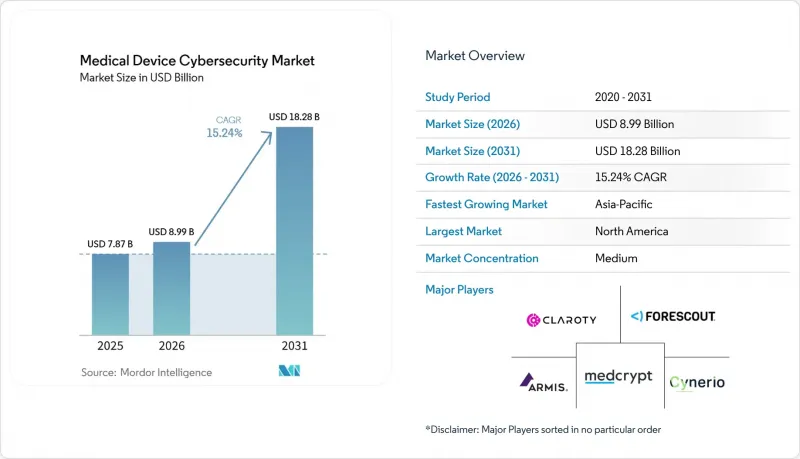
Mordor Intelligence에 의하면, 의료기기 사이버 보안 시장은 2025년 78억 7,000만 달러로 평가되었고, 2026년 89억 9,000만 달러에서 2031년까지 182억 8,000만 달러로 확대될 것으로 전망되며, 2026-2031년 연평균 복합 성장률(CAGR)은 15.24%를 나타낼 것으로 예측됩니다.
본 보고서는 컴포넌트별(솔루션, 서비스), 도입 형태별(온프레미스, 클라우드 기반, 하이브리드), 보안 유형별(네트워크 및 IoMT, 엔드포인트 보안, 기타), 기기 유형별(병원용 의료기기, 기타), 최종 사용자별(병원 및 의료 시스템, 기타), 지역별(북미, 유럽, 기타)로 분류되어 있습니다. 시장 전망은 금액(달러) 기준으로 제시되어 있습니다.
세계의 의료기기 사이버 보안 시장 동향 및 인사이트
연결 기기의 공격 표면 확대
FBI 사이버 부서의 조사에 따르면, 네트워크에 연결된 의료기기의 53%에 적어도 하나의 중대한 알려진 취약점이 존재하는 것으로 밝혀졌으며, 이로 인해 의료기기의 위험은 일반적인 병원 IT 시스템이 노출되는 위험과는 별개의 범주로 분류되게 되어, 의료기기 사이버 보안 시장에 대한 수요가 증가하고 있습니다. RunSafe Security는 2025년 보고서에서 의료 기관의 22%가 의료기기에 직접적인 영향을 미치는 사이버 공격을 겪었으며, 해당 사고의 75%가 환자 치료에 차질을 빚었고, 24%의 경우 환자 이원이 필요했다고 보고했습니다. 이를 통해 기기 침해는 단순한 데이터 유출에 그치지 않고 치료의 연속성에도 영향을 미칩니다는 사실이 밝혀졌습니다. 유사한 증거에 따르면, 2025년에는 영향을 받은 기관의 51%에서 악성코드 감염이 발생했으며, 3분의 1 이상의 기관에서 랜섬웨어가 의료기기의 운영을 표적으로 삼았음이 드러나, 공격자들이 의료기기 수준의 기능 방해로 더욱 깊이 침투하고 있음을 뒷받침했습니다. 이러한 추세에 따라 의료기기 사이버 보안 시장은 이상 행동 감지, 펌웨어 인증 및 세분화 오케스트레이션 방향으로 나아가고 있습니다. 이는 의료 분야의 구매자들이 의료기기에 신속하게 패치를 적용할 수 없는 상황에서도 효과를 유지할 수 있는 제어 수단을 필요로 하기 때문입니다.
FDA 524B 및 시판 전 사이버 보안 준비에 대한 압박
의료기기 사이버 보안 시장은 2026년 2월 FDA가 발표한 최종 지침을 통해 규제 측면에서 직접적인 뒷받침을 받고 있습니다. 이 지침에서는 사이버 보안 관련 요건이 품질 관리 시스템 규정에 통합되었으며, 제조업체에게 SBOM, 위협 모델, 보안 개발 증거 및 시판 후 취약점 관리 계획의 제출을 의무화하고 있습니다. 이 변경 사항이 중요한 이유는 사이버 보안에 관한 증거가 더 이상 특정 제품에 대한 보충 문서로 취급되지 않고, 의료기기의 전체 수명 주기 및 제조업체가 출시 전후에 소프트웨어 구성 요소를 관리하는 방식과 밀접하게 연계되게 되었기 때문입니다. 또한, 일본 및 EU 프레임워크에서 IEC 81001-5-1을 준수함에 따라 524B 유형의 요건이 미국 이외의 지역으로 확대되고 있어, 제조업체가 사이버 보안을 국가별 문제로만 다룰 수 있는 기간이 단축되고 있으며, 이에 따른 압박은 더욱 커지고 있습니다. 이러한 요인들이 복합적으로 작용하여 의료기기 사이버 보안 시장은 지속적인 규정 준수 지원 및 관리형 자문 업무로 전환되고 있으며, 이것이 서비스 분야에서 나타나는 급속한 성장률을 뒷받침하고 있습니다.
구형 기기의 교체 주기
의료기기 사이버 보안 시장은 여전히 구조적인 둔화에 직면해 있습니다. 그 이유는 기기의 하드웨어가 10년에서 30년 동안 계속 사용되는 반면, 임베디드 소프트웨어는 훨씬 더 빨리 지원 종료(EOL)에 도달하여, 병원에는 실질적으로 패치 적용을 받을 수 없게 된 지원 대상 외 시스템이 남게 되기 때문입니다. 이러한 격차는 단순히 금전적인 문제에 그치지 않습니다. MRI나 CT 장비와 같은 고가 시스템은 일일 환자 처리 능력과 밀접하게 연결되어 있어, 임상 일정이나 진단 접근성에 영향을 주지 않고는 운영에서 제외할 수 없기 때문입니다. 지방 및 주요 접근 병원들은 가장 큰 제약에 직면해 있습니다. 레거시 장비의 위험을 안전하게 관리하는 데 필요한 사이버 보안과 생체의공학 전문 지식의 조합은 보완적 조치의 필요성이 충분히 이해되고 있는 경우에도 여전히 제한적이기 때문입니다. 그 결과, 의료기기 사이버 보안 시장은 하드웨어의 직접적인 교체가 여전히 너무 많은 시간이 소요되고 업무에 과도한 지장을 초래하는 환경에서 네트워크 격리, 모니터링 및 가상 패치 적용에 계속 의존하고 있습니다.
부문 분석
2025년, 의료기기 사이버 보안 시장 규모의 67.83%를 솔루션이 차지했습니다. 이는 연결된 모든 기기에 기본적인 제어 계층을 구축하는 데 필요한 자산 감지, 네트워크 세분화, 엔드포인트 보호 및 가시화 도구에 대한 병원 측의 강력한 수요를 반영한 것입니다. 많은 의료 시스템이 시급한 규정 준수 및 모니터링 격차를 해결하기 위해 이미 개별 제품을 구매하고 있었기 때문에 이 부문이 주도적인 위치를 차지했습니다. 이에 따라 핵심 임상 워크플로우를 변경하지 않고 가시성을 향상시키는 가장 직접적인 수단으로 소프트웨어 플랫폼이 선택되었습니다. 그 결과, 2025년 의료기기 사이버 보안 시장에서는 특히 이러한 기능을 보다 광범위한 보안 운영에 통합하기 전에 우선 감지, 스캔, 세분화에 중점을 두었던 병원들을 중심으로 포인트 툴의 도입 기반이 견조한 추세를 보였습니다. 이러한 추세야말로 구매자의 관심이 라이프사이클 전반에 걸친 책임성 및 지속적인 프로그램 지원으로 이동하고 있음에도 불구하고, 현재도 해당 솔루션이 매출액 기준 1위를 유지하고 있는 이유를 설명해 줍니다.
의료기기 사이버 보안 시장에서 서비스 부문은 2031년까지 연평균 성장률(CAGR) 15.64%로 확대될 것으로 예측됩니다. 이는 많은 구매자가 사이버 보안을 일회성 도입 작업으로 취급하기보다는 지속적인 지원을 요구하고 있음을 보여줍니다. 따라서 의료기기 사이버 보안 시장은 독립형 제품 도입에서 벗어나, 장기적인 고객 관계의 일환으로 소프트웨어, 사고 대응 서비스, 자문 업무, 감사 지원을 통합하여 구매하는 운영 모델로 전환되고 있습니다.
2025년 시점에서 클라우드 기반 도입은 의료기기 사이버 보안 시장의 56.47%를 차지했으며, 이러한 우위는 여러 거점에 걸쳐 있는 대규모 의료기기 자산을 관리하는 의료 시스템에 대해 SaaS 모델이 제공하는 비용 효율성, 확장성 및 통합 관리의 이점을 반영한 것입니다. 이 부문은 정책 업데이트가 용이하고, 위협 인텔리전스 공유가 가능하며, 온사이트 인프라 요구 사항이 감소한다는 이점을 누리고 있으며, 이로 인해 분산된 캠퍼스 전체에 걸쳐 신속한 배포와 일관된 가시성이 필요한 의료 서비스 제공업체에게 클라우드 도입이 사실상 표준 선택지가 되었습니다. 운영상의 복잡성 감소와 광범위한 원격 모니터링이라는 이점이 결합되어, 2025년에는 클라우드 도입이 의료기기 사이버 보안 시장에서 가장 큰 도입 기반을 확보했습니다. 또한, 이로 인해 많은 중규모 병원과 대규모 하드웨어 투자 없이 즉각적인 가시성이 필요한 비용 중심의 환경에 있는 의료 기관에게 클라우드 플랫폼이 도입의 출발점이 되었습니다.
하이브리드 도입은 2031년까지 연평균 성장률(CAGR) 16.28%를 나타낼 것으로 예측되며, 이는 구매자들이 현재 클라우드의 효율성과 로컬 환경에서의 내결함성, 기밀성이 높은 원격 측정 데이터에 대한 보다 엄격한 관리라는 임상적 요구 사항 간의 균형을 맞추고 있음을 보여줍니다. 온프레미스 모델은 정부 기관 시스템, 연구 병원 및 더 엄격한 데이터 상주 요건이 적용되는 시장에서 여전히 중요한 위치를 차지하고 있지만, 의료기기 사이버 보안 시장에서는 하이브리드 모델이 가장 실용적인 기업 표준으로 자리 잡아가고 있습니다. 이는 의료 서비스 제공업체가 통합된 거버넌스, 온프레미스 환경에서의 비즈니스 연속성, 그리고 규제 당국과 임상 팀 양측의 요구 사항을 모두 충족할 수 있는 충분한 아키텍처 유연성을 필요로 하는 경우, 앞으로도 선호되는 선택지로 남을 것입니다.
지역별 분석
2025년, 북미는 의료기기 사이버 보안 시장 규모의 42.63%를 차지했으며, 같은 해 지역별 매출에서 1위를 기록했습니다. 이 지역의 우위는 연결형 의료기기의 고밀도 보급, 전문 벤더의 강력한 입지, 그리고 FDA 섹션 524B, HIPAA, HHS의 사이버 보안 요건을 중심으로 한 엄격한 규제 구조에 기인합니다. 지역 내 지출의 대부분은 미국이 차지하고 있지만, 국경을 초월한 의료 네트워크가 미국 기준의 보안 요건을 더 많이 도입함에 따라 캐나다와 멕시코도 진전을 보이고 있습니다. 또한, 북미 의료기기 사이버 보안 시장은 보안 계획을 ‘선택적 현대화’에서 보다 체계적인 다년간의 운영 우선순위로 전환하는 ‘제로 트러스트(Zero Trust)’ 로드맵에 의해서도 뒷받침되고 있습니다.
유럽은 의료기기 사이버 보안 시장에서 2위의 규모를 자랑하며, 그 수요 동향은 MDR의 사이버 보안 요건과 EU 사이버 복원력 법(CRA)의 복합적인 압력에 의해 형성되고 있습니다. 독일은 MDR 준수 및 CRA 대응이라는 두 가지 요구 사항에 직면한 의료기기 제조업체가 집중되어 있어, 이 지역의 주요 시장으로 자리매김하고 있습니다. 영국도 2026년에 NHS Secure Boundary 프로그램을 통해 신속하게 움직이기 시작했으나, 해당 계약은 아래에서 사용하는 가장 신뢰할 수 있는 인용 데이터 세트의 범위를 벗어납니다.
아시아태평양은 2031년까지 연평균 성장률(CAGR) 18.38%를 나타낼 것으로 예측되며, 의료기기 사이버 보안 시장에서 가장 높은 지역별 성장률을 보이고 있습니다. 이러한 성장 속도는 의료의 디지털화, IoMT 도입 확대, 그리고 주요 의료 시스템 전반에 걸친 국가 차원의 사이버 보안 요건 확산에 힘입고 있습니다. 2024년 4월, 일본이 IEC 81001-5-1에 부합하는 개정안에 따라 소프트웨어의 지속적인 보안 개선을 의무화함에 따라, 이 지역에는 규정 준수에 대한 구체적인 지침이 확립되었으며, 현재는 보다 광범위한 도입을 뒷받침하는 기반이 되고 있습니다. 중국, 인도, 호주에서는 병원 네트워크 확장 및 공공 디지털 헬스 이니셔티브를 통해 시장 규모가 확대되고 있습니다. 한편, 중동 및 아프리카 및 남미는 여전히 규모는 작지만 구조적으로 성장하고 있는 시장이며, ‘클라우드 퍼스트’ 모델이 예산 제약 속에서도 공급업체의 보안 대책 도입을 뒷받침하고 있습니다.
기타 혜택 :
- 엑셀 형식 시장 예측(ME) 시트
- 3개월간의 애널리스트 지원
자주 묻는 질문
목차
제1장 서론
제2장 조사 방법
제3장 주요 요약
제4장 시장 구도
제5장 시장 규모 및 성장 예측
제6장 경쟁 구도
제7장 시장 기회 및 향후 전망
AJY 26.08.07According to Mordor Intelligence, the medical device cybersecurity market is projected to expand from USD 7.87 billion in 2025 and USD 8.99 billion in 2026 to USD 18.28 billion by 2031, registering a CAGR of 15.24% between 2026 to 2031.
This report is Segmented by Component (Solutions, Services), Deployment Mode (On-Premises, Cloud-Based, Hybrid), Security Type (Network and IoMT, Endpoint Security, and Others), Device Type (Hospital Medical Devices, and Others), End-User (Hospitals and Health Systems, and Others), and Geography (North America, Europe, and Others). The Market Forecasts are Provided in Terms of Value (USD).
Global Medical Device Cybersecurity Market Trends and Insights
Rising Connected Device Attack Surface
The medical device cybersecurity market is drawing stronger demand because the FBI Cyber Division found that 53% of networked medical devices contain at least 1 critical known vulnerability, which places device risk in a separate category from general hospital IT exposure. RunSafe Security reported in 2025 that 22% of healthcare organizations faced cyberattacks that directly affected medical devices, and 75% of those incidents disrupted patient care, with 24% requiring patient transfers, which linked device compromise to care continuity rather than only data loss. The same body of evidence showed that malware infections affected 51% of impacted organizations and that ransomware targeted device operations in more than 1/3 of organizations in 2025, which confirmed that attackers were moving deeper into device-layer disruption. This pattern is pushing the medical device cybersecurity market toward behavioral anomaly detection, firmware attestation, and segmentation orchestration, because healthcare buyers now need controls that stay effective even when devices cannot be patched quickly.
FDA 524B and Premarket Cybersecurity Readiness Pressure
The medical device cybersecurity market is receiving a direct regulatory lift from the FDA's February 2026 final guidance, which integrates cybersecurity expectations into the Quality Management System Regulation and requires manufacturers to submit SBOMs, threat models, secure development evidence, and postmarket vulnerability management plans. This change matters because cybersecurity evidence is no longer treated as a supporting document for selected products and is instead tied to the full device lifecycle and to the way manufacturers govern software components before and after launch. The pressure grows further because IEC 81001-5-1 alignment in Japan and under the EU framework is extending 524B-style expectations beyond the United States, which shortens the period during which manufacturers could treat cybersecurity as a country-specific issue. That combination is helping the medical device cybersecurity market shift toward recurring compliance support and managed advisory work, which supports the faster expansion rate seen in services.
Legacy Device Replacement Cycles
The medical device cybersecurity market still faces a structural slowdown because device hardware often stays in service for 10 to 30 years, while embedded software reaches end-of-life much earlier and leaves hospitals with unsupported systems that no longer receive practical patch coverage. This gap is not only financial, because high-capital systems such as MRI and CT equipment are deeply tied to daily patient throughput and cannot be removed from service without affecting clinical schedules and diagnostic access. Rural and critical-access hospitals face the strongest constraint because the combination of cybersecurity and biomedical engineering expertise needed to manage legacy device risk safely remains limited even when the need for compensating controls is well understood. As a result, the medical device cybersecurity market continues to rely on network isolation, monitoring, and virtual patching in environments where direct hardware replacement remains too slow and too disruptive.
Other drivers and restraints analyzed in the detailed report include:
- Hospital Zero Trust Modernization Programs
- AI-Enabled Threat Detection Demand in Clinical Environments
- Limited Cybersecurity Budgets in Mid-Tier Care Settings
For complete list of drivers and restraints, kindly check the Table Of Contents.
Segment Analysis
Solutions accounted for 67.83% share of the medical device cybersecurity market size in 2025, which reflected strong hospital demand for asset discovery, network segmentation, endpoint protection, and visibility tools needed to establish a basic control layer across connected devices. The segment led because many health systems had already been buying discrete products to address immediate compliance and monitoring gaps, which made software platforms the most direct way to improve visibility without changing core clinical workflows. The medical device cybersecurity market therefore showed a strong installed base of point tools in 2025, especially in hospitals that first focused on discovery, scanning, and segmentation before trying to integrate those functions into broader security operations. That pattern explains why solutions still lead revenue today, even as buyer attention shifts toward lifecycle accountability and continuous program support.
Services are forecasted to expand at a 15.64% CAGR through 2031 in the medical device cybersecurity market, which shows that many buyers now want ongoing support instead of treating cybersecurity as a one-time implementation exercise. The medical device cybersecurity market is therefore shifting from stand-alone product deployment toward operating models where software, response services, advisory work, and audit support are purchased together as part of a longer customer relationship.
Cloud-based deployment held 56.47% of the medical device cybersecurity market in 2025, and this lead reflected the cost, scalability, and centralized management advantages that SaaS models offer to health systems overseeing large device estates across multiple sites. The segment benefited from easier policy updates, shared threat intelligence, and lower onsite infrastructure needs, which made cloud deployment the practical default for providers that needed faster rollout and consistent visibility across distributed campuses. That mix of lower operating complexity and broader remote oversight helped cloud deployments secure the largest installed base in the medical device cybersecurity market during 2025. It also made cloud platforms the starting point for many mid-tier hospitals and for providers in cost-sensitive environments that needed immediate visibility without major hardware investment.
Hybrid deployment is projected to grow at a 16.28% CAGR through 2031, which shows that buyers are now balancing cloud efficiency with the clinical need for local resilience and tighter control over sensitive telemetry. On-premises models still hold a meaningful place in government systems, research hospitals, and markets with stricter data residency rules, but the medical device cybersecurity market is increasingly settling around hybrid as the most workable enterprise standard. This is likely to remain the preferred path where providers need centralized governance, local continuity, and enough architectural flexibility to satisfy both regulators and clinical teams.
Complete Report Scope:
- By Component
- Solutions
- Services
- By Deployment Mode
- On-Premises
- Cloud-Based
- Hybrid
- By Security Type
- Network and IoMT Security
- Endpoint Security
- Application Security
- Cloud Security
- Firmware and Device Integrity Security
- By Device Type
- Hospital Medical Devices
- Internally Embedded Medical Devices
- Wearable and External Medical Devices
- By End-User
- Hospitals and Health Systems
- Ambulatory Surgery Centers
- Diagnostic and Imaging Centers
- Other End-Users
- By Geography
- North America
- United States
- Canada
- Mexico
- Europe
- Germany
- United Kingdom
- France
- Italy
- Spain
- Rest of Europe
- Asia-Pacific
- China
- Japan
- India
- Australia
- South Korea
- Rest of Asia-Pacific
- Middle East and Africa
- GCC
- South Africa
- Rest of Middle East and Africa
- South America
- Brazil
- Argentina
- Rest of South America
- North America
Geography Analysis
North America held 42.63% share of the medical device cybersecurity market size in 2025, which made it the leading regional revenue base during the year. The region's lead came from the high density of connected medical devices, strong specialist vendor presence, and demanding regulatory structure built around FDA Section 524B, HIPAA, and HHS cybersecurity expectations. The United States accounts for most regional spending, while Canada and Mexico are moving forward as cross-border healthcare networks absorb more U.S.-aligned security expectations. The medical device cybersecurity market in North America is also being supported by zero trust roadmaps that move security planning from optional modernization into a more structured multi-year operating priority.
Europe ranked as the second-largest region in the medical device cybersecurity market, and its demand profile is being shaped by the combined pressure of MDR cybersecurity requirements and the EU Cyber Resilience Act. Germany remains the leading market in the region because of its concentration of device manufacturers facing both MDR compliance and CRA readiness demands. The United Kingdom also moved faster in 2026 through the NHS Secure Boundary program, although that contract sits outside the most authentic citation set used below.
Asia-Pacific is forecasted to grow at a 18.38% CAGR through 2031, giving it the fastest regional expansion rate in the medical device cybersecurity market. This pace is being supported by healthcare digitization, rising IoMT deployment, and the spread of country-level cybersecurity expectations across major healthcare systems. Japan's move from April 2024 to require continuous software security improvement under amendments aligned with IEC 81001-5-1 gave the region a concrete compliance anchor that now supports wider adoption. China, India, and Australia add volume through hospital network expansion and public digital health efforts, while the Middle East and Africa and South America remain smaller but structurally growing markets where cloud-first models help providers adopt security controls despite budget pressure.
- Armis
- Asimily
- Axonius
- Broadcom Inc. (Symantec Enterprise Security)
- Check Point Software Technologies Ltd.
- Cisco Systems
- Claroty
- Cynerio
- Forescout Technologies
- Fortinet, Inc.
- IBM
- Imprivata, Inc.
- MedCrypt
- Medigate (Claroty)
- Microsoft
- Nozomi Networks Inc.
- Ordr, Inc.
- Palo Alto Networks
- Trend Micro Incorporated
Additional Benefits:
- The market estimate (ME) sheet in Excel format
- 3 months of analyst support
TABLE OF CONTENTS
1 Introduction
- 1.1 Study Assumptions and Market Definition
- 1.2 Scope of the Study
2 Research Methodology
3 Executive Summary
4 Market Landscape
- 4.1 Market Overview
- 4.2 Market Drivers
- 4.2.1 Rising Connected Device Attack Surface
- 4.2.2 FDA 524B and Premarket Cybersecurity Readiness Pressure
- 4.2.3 Hospital Zero Trust Modernization Programs
- 4.2.4 Postmarket Vulnerability Disclosure and Patch Governance Burden
- 4.2.5 Cloud-Connected Remote Monitoring Expansion
- 4.2.6 AI-Enabled Threat Detection Demand in Clinical Environments
- 4.3 Market Restraints
- 4.3.1 Legacy Device Replacement Cycles
- 4.3.2 Safety Validation Delays for Security Updates
- 4.3.3 Fragmented Vendor Accountability Across OEMs, Providers, and IT Teams
- 4.3.4 Limited Cybersecurity Budgets in Mid-Tier Care Settings
- 4.4 Supply/Value Chain Analysis
- 4.5 Regulatory Landscape
- 4.6 Technological Outlook
- 4.7 Porter's Five Forces Analysis
- 4.7.1 Threat of New Entrants
- 4.7.2 Bargaining Power of Suppliers
- 4.7.3 Bargaining Power of Buyers
- 4.7.4 Threat of Substitutes
- 4.7.5 Competitive Rivalry
5 Market Size & Growth Forecasts (Value, USD)
- 5.1 By Component
- 5.1.1 Solutions
- 5.1.2 Services
- 5.2 By Deployment Mode
- 5.2.1 On-Premises
- 5.2.2 Cloud-Based
- 5.2.3 Hybrid
- 5.3 By Security Type
- 5.3.1 Network and IoMT Security
- 5.3.2 Endpoint Security
- 5.3.3 Application Security
- 5.3.4 Cloud Security
- 5.3.5 Firmware and Device Integrity Security
- 5.4 By Device Type
- 5.4.1 Hospital Medical Devices
- 5.4.2 Internally Embedded Medical Devices
- 5.4.3 Wearable and External Medical Devices
- 5.5 By End-User
- 5.5.1 Hospitals and Health Systems
- 5.5.2 Ambulatory Surgery Centers
- 5.5.3 Diagnostic and Imaging Centers
- 5.5.4 Other End-Users
- 5.6 By Geography
- 5.6.1 North America
- 5.6.1.1 United States
- 5.6.1.2 Canada
- 5.6.1.3 Mexico
- 5.6.2 Europe
- 5.6.2.1 Germany
- 5.6.2.2 United Kingdom
- 5.6.2.3 France
- 5.6.2.4 Italy
- 5.6.2.5 Spain
- 5.6.2.6 Rest of Europe
- 5.6.3 Asia-Pacific
- 5.6.3.1 China
- 5.6.3.2 Japan
- 5.6.3.3 India
- 5.6.3.4 Australia
- 5.6.3.5 South Korea
- 5.6.3.6 Rest of Asia-Pacific
- 5.6.4 Middle East and Africa
- 5.6.4.1 GCC
- 5.6.4.2 South Africa
- 5.6.4.3 Rest of Middle East and Africa
- 5.6.5 South America
- 5.6.5.1 Brazil
- 5.6.5.2 Argentina
- 5.6.5.3 Rest of South America
- 5.6.1 North America
6 Competitive Landscape
- 6.1 Market Concentration
- 6.2 Market Share Analysis
- 6.3 Company Profiles (includes Global level Overview, Market level overview, Core Segments, Financials as available, Strategic Information, Market Rank/Share for key companies, Products & Services, Recent Developments)
- 6.3.1 Armis
- 6.3.2 Asimily
- 6.3.3 Axonius
- 6.3.4 Broadcom Inc. (Symantec Enterprise Security)
- 6.3.5 Check Point Software Technologies Ltd.
- 6.3.6 Cisco Systems, Inc.
- 6.3.7 Claroty
- 6.3.8 Cynerio
- 6.3.9 Forescout Technologies
- 6.3.10 Fortinet, Inc.
- 6.3.11 IBM
- 6.3.12 Imprivata, Inc.
- 6.3.13 MedCrypt
- 6.3.14 Medigate (Claroty)
- 6.3.15 Microsoft Corporation
- 6.3.16 Nozomi Networks Inc.
- 6.3.17 Ordr, Inc.
- 6.3.18 Palo Alto Networks
- 6.3.19 Trend Micro Incorporated
7 Market Opportunities & Future Outlook
- 7.1 White-space & Unmet-need Assessment


