

|
시장보고서
상품코드
2099937
제약용 전자기기 제조 서비스(EMS) 시장 : 점유율 분석, 업계 동향 및 통계, 성장 예측(2026-2031년)Pharmaceutical Electronic Manufacturing Services (EMS) - Market Share Analysis, Industry Trends & Statistics, Growth Forecasts (2026 - 2031) |
||||||
 Mordor Intelligence
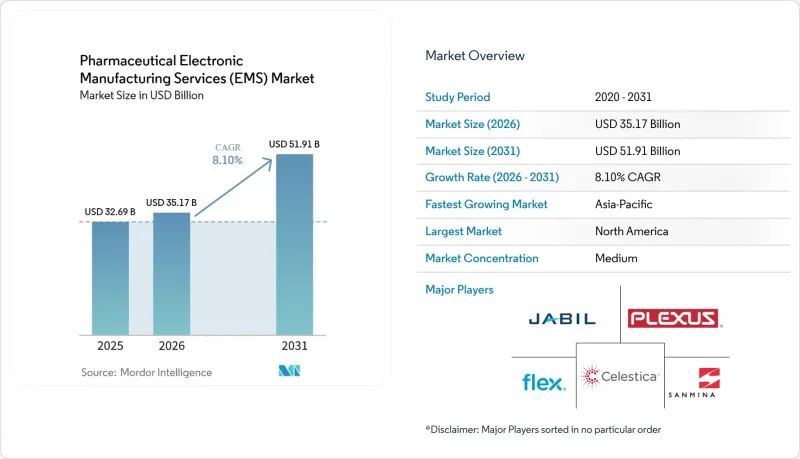
Mordor Intelligence에 의하면, 제약용 전자기기 제조 서비스(EMS) 시장은 2025년 326억 9,000만 달러, 2026년 351억 7,000만 달러에서 2031년까지 519억 1,000만 달러로 확대되어 2026년부터 2031년까지 CAGR 8.10%를 나타낼 것으로 예측됩니다.
본 보고서는 서비스 유형(PCB 조립 및 통합, 기타), 제품 유형(실험실 자동화용 전자기기, 기타), 용도(바이오의약품 제조, 기타), 최종 사용자(제약·바이오기술 기업, 기타), 지역(북미, 유럽, 기타)별로 분류되어 있습니다. 금액(달러). 시장 전망은 금액(달러)으로 제시되어 있습니다.
세계 제약용 전자기기 제조 서비스(EMS) 시장 동향 및 인사이트
제약용 전자기기 제조 분야의 아웃소싱 증가
제약용 전자기기 제조 서비스 시장은 연구 개발 및 제품 개발에 더 많은 자본을 집중하고자 하는 제약 기업들의 꾸준한 아웃소싱 증가로 인해 혜택을 보고 있습니다. Jabil사는 2025년 헬스케어 부문에서 14%의 성장을 보고했으며, 신규 계약의 60%가 제조를 위한 설계와 공급망 지원을 결합한 것이었습니다. 이는 고객들이 단일 파트너에게 더 폭넓은 서비스를 요구하기 시작했음을 보여줍니다. 이러한 변화로 인해 제조업체의 역할도 변화하고 있습니다. 이전에는 기판이나 조립 제조만 요구되었지만, 현재는 문서 관리, 품질 관리 절차, 자재 관리까지 담당할 것이 기대되고 있기 때문입니다. 따라서 제약용 전자기기 제조 서비스 시장에서는 이미 여러 규제 대상 거점에서 사업을 전개하고 있으며, 공정을 처음부터 재구축하지 않고도 프로그램을 이전할 수 있는 공급업체가 유리한 입지를 점하고 있습니다. 또한, 검증 완료된 제조 체계를 전환하는 것은 엔지니어링, 품질, 조달 각 팀에 불필요한 업무를 발생시키기 때문에 구매자는 인증된 공급업체와의 거래를 장기간 지속하는 경향이 있습니다.
약물 전달용 전자 기기의 복잡화
제약용 전자기기 제조 서비스 시장은 약물 전달 시스템, 웨어러블 주사기 및 커넥티드 복합 제품에 포함된 전자 부품의 양이 증가하고 있는 점도 호재로 작용하고 있습니다. 이러한 제품에서는 전자 부품, 패키징, 조립 및 문서화 간의 보다 긴밀한 통합이 요구됩니다. 이는 어느 한 단계에서라도 결함이 발생하면 기기의 성능과 제품 출시 모두에 영향을 미칠 수 있기 때문입니다. 2025년 2월 Jabil이 Pharmaceutics International을 인수함에 따라 무균 충전, 동결 건조 및 경구 고형 제제 제조 역량이 추가되었습니다. 이는 주요 공급업체들이 단일 운영 체제 하에서 의약품 기기 워크플로우의 더 넓은 범위를 포괄하려 하고 있음을 보여줍니다. 고객은 설계 단계에서 규제 대상 생산 단계로 전환할 때 인수인계 횟수를 줄이는 것을 선호하기 때문에 이러한 사업 확장은 제약용 전자기기 제조 서비스 시장을 뒷받침하는 요인이 됩니다. 설계, 검증 완료된 조립 및 포장 관련 지원을 통합할 수 있는 공급업체는 장기 계약을 확보하고 가격을 유지하는 데 있어 더 유리한 입장에 있습니다.
클린룸 및 자동 조립 라인의 높은 자본 집약도
제약용 전자기기 제조 서비스 시장은 규제 대상 전자기기 생산 능력 구축 및 유지에 드는 비용이라는 큰 장벽에 여전히 직면해 있습니다. 클린룸 라인, 시험 시스템, 환경 제어 및 검증 지원에는 일반적인 산업용 조립 업무보다 막대한 초기 투자가 필요합니다. 이러한 부담은 자금 조달의 폭, 숙련된 인력 확보, 지원 공급업체 체계가 그리 탄탄하지 않은 소규모 지역 시장에서 더욱 무겁게 다가옵니다. 따라서 제약용 전자기기 제조 서비스 시장은 규정 준수 및 시설 비용을 더 큰 생산량으로 분산할 수 있는 대기업에 유리한 상황이 지속되고 있습니다. 소규모 공급업체도 틈새 프로젝트를 수주하는 것은 가능하지만, 자본 재투자가 제한된 상황에서는 그러한 프로젝트를 폭넓고 다각적인 거래 관계로 확대하는 것이 훨씬 더 어렵습니다.
부문 분석
2025년, PCB(인쇄 회로 기판) 조립 및 통합은 제약용 전자기기 제조 서비스 시장 점유율의 40.13%를 차지하며, 전체 서비스 제공에 걸쳐 핵심 수익 기반으로서의 지위를 유지했습니다. 이러한 우위는 바이오리액터 제어, 라인 자동화, 직렬화 시스템, 모니터링 장치, 그리고 실험실용 기기에 사용되는 회로 기판의 수가 많기 때문입니다. 또한, 제약 현장에서 사용되는 전자 기기는 검증된 운영 환경에 투입되기 전에 문서화된 성능 검사가 필요하기 때문에 시험 및 품질 보증도 여전히 중심적인 역할을 하고 있습니다. 실제로 생산, 포장 및 실험실의 역량 확대 시마다 신뢰성 높은 조립 및 검증 작업이 필요하기 때문에 주요 서비스 카테고리는 지속적인 수요의 혜택을 받고 있습니다.
전자 설계 및 엔지니어링은 2031년까지 연평균 성장률(CAGR) 10.84%를 나타낼 것으로 예측되며, 제약용 전자기기 제조 서비스 시장에서 가장 빠르게 성장하는 서비스 범주로 자리매김하고 있습니다. 이러한 성장은 설계상의 선택 사항이 규제 대상 워크플로우에 확정되기 전에 전문 파트너의 참여를 요구하는 OEM 업체들의 조기 아웃소싱과 밀접한 관련이 있습니다. 애프터마켓 서비스 또한 구형 제약 장비의 경우, 긴 가동 기간 동안 기판 교체, 펌웨어 지원 및 관리형 업데이트가 여전히 필요하기 때문에 안정적인 수익원을 형성하고 있습니다. 제약용 전자기기 제조 서비스 업계 전체에서 이 비중은 단순한 조립에서 보다 광범위한 설계, 수명 주기 지원 및 규정 준수 관련 서비스로 명확하게 전환되고 있음을 보여줍니다.
제약 제조 장비용 전자기기는 2025년 매출의 42.27%를 차지하며, 이 부문은 제약용 전자기기 제조 서비스 시장에서 가장 큰 점유율을 차지하고 있습니다. 이 부문이 선두를 유지할 수 있었던 이유는 새로운 충전 및 마무리 라인, 무균 시설, 경구용 고형 제형 플랜트 등 모든 분야에서 전자 기기를 광범위하게 활용한 계측 및 제어 하드웨어가 필요하기 때문입니다. 또한, 포장 라인용 전자 기기도 시리얼화, 코딩 및 검증 기능으로 인해 기존 생산 라인 전반에 걸쳐 업그레이드 작업이 지속적으로 발생하고 있어 견조한 성장세를 보였습니다. 이러한 제품 카테고리는 제약 전자기기 제조 서비스 시장에 대규모 도입 기반을 마련해 주었으며, 신규 건설과 개보수 모두에서 지속적인 수요를 창출하고 있습니다.
실험실 자동화용 전자 기기는 2031년까지 연평균 성장률(CAGR) 10.96%를 나타낼 것으로 예측되며, 가장 빠르게 성장하는 제품 유형이 될 것입니다. 다이이치 산쿄는 2025년 1월, 미국에 24시간 가동되는 자동화 신약 개발 시스템을 구축했는데, 이는 대규모 연구소가 로봇 연동형이자 클라우드 연결형 실험실 환경을 채택하고 있음을 보여줍니다. 이는 제약용 전자기기 제조 서비스 시장을 견인하는 요인이 될 것입니다. 연구 자동화가 진행될수록 검증된 기판, 센서, 컨트롤러 및 통합 어셈블리에 대한 수요가 높아지기 때문입니다. 스마트 약물 전달 시스템이나 웨어러블 전자 기기는 현재로서는 시장 규모가 아직 작지만, 기기 1대당 전자 부품 함량을 고려할 때 기존 기기 제조보다 장기적인 가치 상승 가능성이 더 높다고 볼 수 있습니다.
지역별 분석
2025년, 북미는 제약용 전자기기 제조 서비스 시장의 46.36%를 차지하며 계속해서 최대 지역 기여자로서의 지위를 유지했습니다. 이 지역은 규제 대상 전자기기 제조업체가 가장 집중되어 있고, 성숙한 제약 업계의 고객 기반을 보유하고 있다는 점에서 혜택을 받고 있습니다. 아스트라제네카, 일라이 릴리, 머크, 존슨앤드존슨, 화이자의 대규모 투자가 전자기기를 많이 사용하는 제조 인프라에 대한 현지 수요를 지속적으로 뒷받침하고 있습니다. 캐나다는 중견 시장에서 안정적인 수요를 창출하고 있는 반면, 멕시코는 미국용 프로그램에서 물류상의 이점을 지닌 니어쇼어 조립 거점으로 주목받고 있습니다.
아시아태평양은 2031년까지 연평균 성장률(CAGR) 11.24%를 기록하며, 제약용 전자기기 제조 서비스 시장에서 가장 빠르게 성장하는 지역 블록이 될 것으로 예측됩니다. 이러한 성장은 인도의 정책적 지원, 공급망 다각화의 진전, 그리고 일본과 한국이 구축해 온 정밀 전자 분야의 강점에 힘입은 것입니다. 이러한 요소들이 결합되어 해당 지역은 새로운 생산 능력 확보에 있어 유리한 입지에 있으며, 특히 고객이 단일 국가에서의 조달을 대체할 대안을 모색하는 분야에서 그 강점이 발휘될 것입니다. 중국은 여전히 대량 생산에서 중요한 위치를 차지하고 있지만, 고부가가치의 검증 완료 업무는 지역 전체에 걸쳐 보다 선택적으로 재분배되고 있습니다. 이러한 변화로 인해 예측 기간 동안 인도, 한국 및 동남아시아 일부 지역이 새로운 공급업체 인증 주기에서 중요한 역할을 계속할 것으로 예측됩니다.
유럽은 견고한 의약품 생산 기반과 제조 시스템의 적극적인 현대화에 힘입어 지역별 매출 규모에서 2위를 차지하고 있습니다. 독일, 프랑스, 영국, 이탈리아, 스페인이 계속해서 주요 수요 거점이며, 특히 독일은 제어 시스템 및 공정 엔지니어링 분야에서 중요한 역할을 하고 있습니다. 중동 및 아프리카는 여전히 발전의 초기 단계에 있지만, 걸프 국가들에서는 현지 의약품 생산 능력이 구축되고 있어, 이것이 향후 전자기기 수요를 끌어올릴 것으로 예측됩니다. 남미는 브라질과 아르헨티나가 주도하고 있으나, 의약품 등급 EMS 공급업체의 수가 제한적이고 인증 비용이 높다는 점 등으로 인해 단기적인 확대에는 여전히 제약이 있습니다.
기타 혜택:
- 엑셀 형식 시장 예측(ME) 시트
- 3개월간의 애널리스트 지원
자주 묻는 질문
목차
제1장 서론
제2장 조사 방법
제3장 주요 요약
제4장 시장 구도
제5장 시장 규모와 성장 예측
제6장 경쟁 구도
제7장 시장 기회와 향후 전망
JHS 26.08.11According to Mordor Intelligence, the pharmaceutical electronic manufacturing services (EMS) market is projected to expand from USD 32.69 billion in 2025 and USD 35.17 billion in 2026 to USD 51.91 billion by 2031, registering a CAGR of 8.10% between 2026 and 2031.
This report is Segmented by Service Type (PCB Assembly and Integration, and Others), Product Type (Laboratory Automation Electronics, and Others), Application (Biopharmaceutical Manufacturing, and Others), End-User (Pharmaceutical and Biotechnological Companies, and Others), and Geography (North America, Europe, and Others). Value (USD). Market Forecasts Provided in Value (USD).
Global Pharmaceutical Electronic Manufacturing Services (EMS) Market Trends and Insights
Increasing Outsourcing of Pharma Device Manufacturing
The pharmaceutical electronic manufacturing services market is gaining from a steady rise in outsourcing by drug makers that want to keep more capital focused on research programs and product development. Jabil reported 14% growth in its healthcare segment in 2025, and 60% of its new contracts bundled design for manufacturing with supply chain support, which shows that customers are asking for broader services from one partner. This shift changes the role of contract manufacturers because they are now expected to manage documentation, quality routines, and material control instead of only producing boards and assemblies. The pharmaceutical electronic manufacturing services market therefore rewards providers that already operate across more than one regulated site and can move programs without rebuilding every process from the start. Buyers also tend to stay with qualified suppliers longer because switching a validated manufacturing setup creates extra work across engineering, quality, and procurement teams.
Rising Complexity of Drug Delivery Electronics
The pharmaceutical electronic manufacturing services market is also being pushed higher by the growing electronic content inside drug delivery systems, wearable injectors, and connected combination products. These products need tighter integration between electronics, packaging, assembly, and documentation because failure at any point can affect both device performance and product release. Jabil's February 2025 acquisition of Pharmaceutics International added aseptic filling, lyophilization, and oral solid dose capabilities, which shows how leading suppliers are trying to cover more of the drug device workflow under one operating structure. This kind of expansion supports the pharmaceutical electronic manufacturing services market because customers prefer fewer handoffs when they move from design work into regulated production. Providers that can combine design, validated assembly, and packaging related support are in a stronger position to win longer contracts and protect pricing.
High Capital Intensity for Cleanroom and Automated Assembly Lines
The pharmaceutical electronic manufacturing services market still faces a hard barrier in the cost of building and maintaining regulated electronics capacity. Cleanroom lines, testing systems, environmental controls, and validation support demand more upfront spending than ordinary industrial assembly operations. This burden is heavier in smaller regional markets where financing depth, skilled labor availability, and supporting suppliers are not as strong. The pharmaceutical electronic manufacturing services market therefore remains tilted toward larger firms that can spread compliance and facility costs over bigger production volumes. Smaller providers can still win niche work, but scaling those accounts into broad multi-program relationships is much harder when capital reinvestment stays limited.
Other drivers and restraints analyzed in the detailed report include:
- Tightening Compliance Burden Across ISO, FDA, and EU MDR
- Validation-Ready Digital Traceability and Data Integrity Requirements
- Component Allocation Risk for Miniaturized Medical Electronics
For complete list of drivers and restraints, kindly check the Table Of Contents.
Segment Analysis
PCB assembly and integration held 40.13% of the pharmaceutical electronic manufacturing services market share in 2025, which kept it as the core revenue base across service offerings. This lead comes from the large number of circuit boards used in bioreactor controls, line automation, serialization systems, monitoring devices, and laboratory instruments. Testing and Quality Assurance also remained central because electronics used in pharmaceutical settings need documented performance checks before release into validated operations. In practice, the leading service categories benefit from repeat demand because every expansion in production, packaging, and lab capacity needs dependable assembly and verification work.
Electronic design and engineering is projected to grow at a 10.84% CAGR through 2031, which makes it the fastest-moving service category in the pharmaceutical electronic manufacturing services market. Growth is tied to earlier outsourcing by OEMs that want specialist partners involved before design choices are locked into regulated workflows. Aftermarket Services also form a durable revenue stream because older pharmaceutical equipment still needs board replacement, firmware support, and controlled updates over long operating lives. Across the pharmaceutical electronic manufacturing services industry, this mix shows a clear shift from pure assembly toward broader design, lifecycle support, and compliance-linked services.
Pharmaceutical manufacturing equipment electronics captured 42.27% of 2025 revenue, giving this category the largest position within the pharmaceutical electronic manufacturing services market. The segment stayed ahead because new fill-finish lines, sterile facilities, and oral solid dose plants all require electronics-heavy instrumentation and control hardware. Packaging Line Electronics also showed resilience because serialization, coding, and verification functions keep creating upgrade work across established production lines. These product categories give the pharmaceutical electronic manufacturing services market a large installed base that continues to generate both new build and retrofit demand.
Laboratory automation electronics is forecasted to grow at a 10.96% CAGR through 2031, which makes it the fastest-rising product type. Daiichi Sankyo established a 24-hour automated drug discovery setup in the United States in January 2025, which showed how large research organizations are adopting robot-linked and cloud-connected laboratory environments. This supports the pharmaceutical electronic manufacturing services market because more research automation means more demand for validated boards, sensors, controllers, and integrated assemblies. Smart drug delivery and wearable electronics remain a smaller base today, but their electronics content per device suggests stronger long-run value potential than conventional instrument builds.
Complete Report Scope:
- By Service Type
- Electronic Design and Engineering Services
- PCB Assembly and Integration
- Box Build Assembly
- Testing and Quality Assurance Services
- Packaging and Labeling Electronics Integration
- Aftermarket Services and Maintenance
- By Product Type
- Control Systems and Automation Electronics
- Pharmaceutical Manufacturing Equipment Electronics
- Laboratory Automation Electronics
- Packaging Line Electronics Systems
- Other Product Types
- By Application
- Drug Manufacturing and Production Lines
- Biopharmaceutical Manufacturing
- Clinical Research and Laboratory Automation
- Packaging and Serialization Systems
- Other Applications
- By End-User
- Pharmaceutical and Biotechnological Companies
- Contract Manufacturing Organizations
- Other End-Users
- By Geography
- North America
- United States
- Canada
- Mexico
- Europe
- Germany
- United Kingdom
- France
- Italy
- Spain
- Rest of Europe
- Asia-Pacific
- China
- Japan
- India
- Australia
- South Korea
- Rest of Asia-Pacific
- Middle East and Africa
- GCC
- South Africa
- Rest of Middle East and Africa
- South America
- Brazil
- Argentina
- Rest of South America
- North America
Geography Analysis
North America accounted for 46.36% of the pharmaceutical electronic manufacturing services market share in 2025, which kept it as the largest regional contributor. The region benefits from the highest concentration of regulated electronics contract manufacturers and a mature pharmaceutical customer base. Major investment commitments from AstraZeneca, Eli Lilly, Merck, Johnson & Johnson, and Pfizer continue to support local demand for electronics-intensive manufacturing infrastructure. Canada adds stable mid-market demand, while Mexico is gaining attention as a nearshore assembly base with logistical advantages for U.S.-bound programs.
Asia-Pacific is projected to be the fastest-growing regional block in the pharmaceutical electronic manufacturing services market with 11.24% CAGR through 2031. Growth is being supported by India's policy push, broader supply chain diversification, and the established precision electronics strengths of Japan and South Korea. This mix gives the region a good position for new capacity, especially where customers want an alternative to single-country sourcing. China remains important for large-volume manufacturing, but higher-value validated work is being redistributed more selectively across the region. That shift should keep India, South Korea, and parts of Southeast Asia relevant to new supplier qualification cycles during the forecast period.
Europe forms the second-largest regional revenue cluster, supported by a strong pharmaceutical production base and active modernization of manufacturing systems. Germany, France, the United Kingdom, Italy, and Spain remain the core demand centers, with Germany especially relevant for control systems and process engineering applications. The Middle East and Africa are still early in development, though Gulf countries are building local pharmaceutical capacity that should lift future electronics demand. South America is led by Brazil and Argentina, but near-term expansion remains constrained by a limited pool of pharma-grade EMS providers and higher qualification costs.
- Benchmark Electronics, Inc.
- Celestica
- Creation Technologies LP
- Ensera
- Flex
- Foxconn Technology Group
- Gerresheimer
- Integer Holdings
- Jabil
- Kimball Electronics, Inc.
- MGS Mfg. Group
- Nortech Systems
- Phillips Medisize
- Plexus Corp.
- Sanmina Corporation
- SMC Ltd.
- TE Connectivity Ltd.
- Venture Corporation Limited
- Vexos Inc.
- Zollner Elektronik AG
Additional Benefits:
- The market estimate (ME) sheet in Excel format
- 3 months of analyst support
TABLE OF CONTENTS
1 Introduction
- 1.1 Study Assumptions and Market Definition
- 1.2 Scope of the Study
2 Research Methodology
3 Executive Summary
4 Market Landscape
- 4.1 Market Overview
- 4.2 Market Drivers
- 4.2.1 Increasing Outsourcing of Pharma Device Manufacturing
- 4.2.2 Rising Complexity of Drug Delivery Electronics
- 4.2.3 Tightening Compliance Burden Across ISO, FDA, and EU MDR
- 4.2.4 Nearshoring of Regulated Production for Supply Chain Control
- 4.2.5 Validation-Ready Digital Traceability and Data Integrity Requirements
- 4.2.6 Requalification Delays Created by Serialized Component Obsolescence
- 4.3 Market Restraints
- 4.3.1 High Capital Intensity for Cleanroom and Automated Assembly Lines
- 4.3.2 Component Allocation Risk for Miniaturized Medical Electronics
- 4.3.3 Extended Validation Cycles and Change-Control Overhead
- 4.3.4 Limited Pool of Pharma-Grade EMS Suppliers With Regulated Manufacturing Capability
- 4.4 Supply/Value Chain Analysis
- 4.5 Regulatory Landscape
- 4.6 Technological Outlook
- 4.7 Porter's Five Forces Analysis
- 4.7.1 Threat of New Entrants
- 4.7.2 Bargaining Power of Suppliers
- 4.7.3 Bargaining Power of Buyers
- 4.7.4 Threat of Substitutes
- 4.7.5 Competitive Rivalry
5 Market Size & Growth Forecasts (Value, USD)
- 5.1 By Service Type
- 5.1.1 Electronic Design and Engineering Services
- 5.1.2 PCB Assembly and Integration
- 5.1.3 Box Build Assembly
- 5.1.4 Testing and Quality Assurance Services
- 5.1.5 Packaging and Labeling Electronics Integration
- 5.1.6 Aftermarket Services and Maintenance
- 5.2 By Product Type
- 5.2.1 Control Systems and Automation Electronics
- 5.2.2 Pharmaceutical Manufacturing Equipment Electronics
- 5.2.3 Laboratory Automation Electronics
- 5.2.4 Packaging Line Electronics Systems
- 5.2.5 Other Product Types
- 5.3 By Application
- 5.3.1 Drug Manufacturing and Production Lines
- 5.3.2 Biopharmaceutical Manufacturing
- 5.3.3 Clinical Research and Laboratory Automation
- 5.3.4 Packaging and Serialization Systems
- 5.3.5 Other Applications
- 5.4 By End-User
- 5.4.1 Pharmaceutical and Biotechnological Companies
- 5.4.2 Contract Manufacturing Organizations
- 5.4.3 Other End-Users
- 5.5 By Geography
- 5.5.1 North America
- 5.5.1.1 United States
- 5.5.1.2 Canada
- 5.5.1.3 Mexico
- 5.5.2 Europe
- 5.5.2.1 Germany
- 5.5.2.2 United Kingdom
- 5.5.2.3 France
- 5.5.2.4 Italy
- 5.5.2.5 Spain
- 5.5.2.6 Rest of Europe
- 5.5.3 Asia-Pacific
- 5.5.3.1 China
- 5.5.3.2 Japan
- 5.5.3.3 India
- 5.5.3.4 Australia
- 5.5.3.5 South Korea
- 5.5.3.6 Rest of Asia-Pacific
- 5.5.4 Middle East and Africa
- 5.5.4.1 GCC
- 5.5.4.2 South Africa
- 5.5.4.3 Rest of Middle East and Africa
- 5.5.5 South America
- 5.5.5.1 Brazil
- 5.5.5.2 Argentina
- 5.5.5.3 Rest of South America
- 5.5.1 North America
6 Competitive Landscape
- 6.1 Market Concentration
- 6.2 Market Share Analysis
- 6.3 Company Profiles (includes Global level Overview, Market level overview, Core Segments, Financials as available, Strategic Information, Market Rank/Share for key companies, Products & Services, Recent Developments)
- 6.3.1 Benchmark Electronics, Inc.
- 6.3.2 Celestica Inc.
- 6.3.3 Creation Technologies LP
- 6.3.4 Ensera
- 6.3.5 Flex Ltd.
- 6.3.6 Foxconn Technology Group
- 6.3.7 Gerresheimer AG
- 6.3.8 Integer Holdings Corporation
- 6.3.9 Jabil Inc.
- 6.3.10 Kimball Electronics, Inc.
- 6.3.11 MGS Mfg. Group
- 6.3.12 Nortech Systems, Inc.
- 6.3.13 Phillips Medisize
- 6.3.14 Plexus Corp.
- 6.3.15 Sanmina Corporation
- 6.3.16 SMC Ltd.
- 6.3.17 TE Connectivity Ltd.
- 6.3.18 Venture Corporation Limited
- 6.3.19 Vexos Inc.
- 6.3.20 Zollner Elektronik AG
7 Market Opportunities & Future Outlook
- 7.1 White-space & Unmet-need Assessment


