
|
시장보고서
상품코드
2099940
의료 및 제약용 실링 솔루션 시장 : 점유율 분석, 업계 동향 및 통계, 성장 예측(2026-2031년)Medical and Pharmaceutical Sealing Solutions - Market Share Analysis, Industry Trends & Statistics, Growth Forecasts (2026 - 2031) |
||||||
 Mordor Intelligence
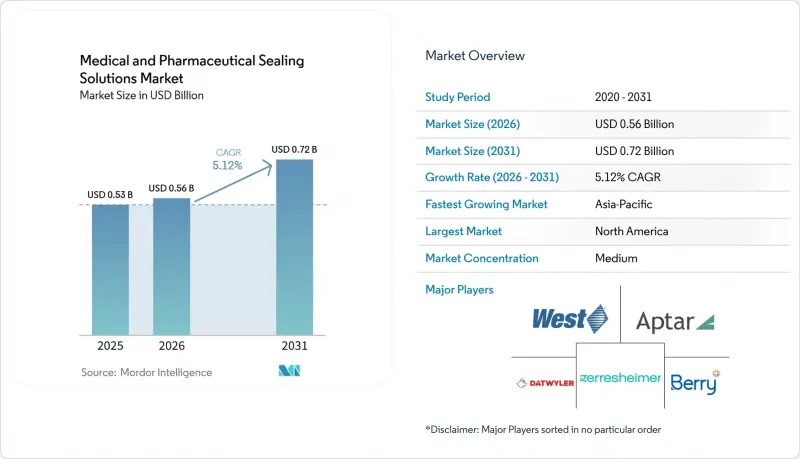
Mordor Intelligence에 의하면, 의료 및 제약용 실링 솔루션 시장은 2025년 5억 3,000만 달러, 2026년 5억 6,000만 달러에서 2031년까지 7억 2,000만 달러로 확대되어 2026년부터 2031년까지 CAGR 5.12%를 나타낼 것으로 예측됩니다.
본 보고서는 제품 유형(캡, 클로저, 기타 제품 유형), 소재 유형(플라스틱, 엘라스토머 및 고무, 기타), 용도(무균 주사제, 생물학적 제제 및 바이오시밀러, 기타 용도), 지역(북미, 유럽, 아시아태평양, 중동 및 아프리카, 남미)별로 분류되어 있습니다. 시장 전망은 금액(달러) 기준으로 제시되어 있습니다.
세계 의료 및 제약용 실링 솔루션 시장 동향 및 인사이트
바이오의약품 및 무균 주사제 수요 증가
의료 및 제약용 실링 솔루션 시장은 확대되는 바이오의약품 파이프라인에 힘입어 성장하고 있습니다. 이는 이러한 치료법이 표준 주사제 제품보다 밀폐 시스템에 대해 더 엄격한 요건을 부과하기 때문입니다. 미국 FDA는 2024년에 승인된 55건의 신규 의약품 중 28건을 고분자 치료제로 승인했습니다. 이에 따라 안정적인 엘라스토머 조성, 불소 수지 코팅 및 저온 성능을 갖춘 검증된 밀폐 시스템에 대한 필요성이 더욱 높아졌습니다. 고농도 단일클론 항체나 고점도 GLP-1 제제의 경우, 기존의 주사제 형태에 비해 단백질과의 상호작용, 인발력, 미끄러짐, 그리고 입자 위험에 대한 보다 엄격한 관리가 요구됩니다. 아프터 파마(Aptar Pharma)의 GLP-1용 캡 제품군은 각 공급업체가 표준 부품에 의존하기보다는 경질 니들 쉴드, 프리필드 주사기의 플런저, 카트리지용 캡을 중심으로 보다 전문성이 높은 제품 포트폴리오를 구축하고 있음을 보여줍니다. 오리지널 바이오의약품 및 바이오시밀러가 확대됨에 따라, 수요는 하나의 검증된 구성품 패키지로 여러 규제 시스템에서의 신청을 지원할 수 있는 공급업체로 이동하고 있으며, 이에 따라 의료 및 제약용 실링 솔루션 시장은 고사양 공급에 중점을 둔 상태가 지속되고 있습니다.
EU GMP 부록 1에 따른 용기 및 밀봉부의 무결성 향상
의료 및 제약용 실링 솔루션 시장은 개정된 EU GMP 부록 1에 기반한 더욱 엄격한 무균 제조 요건에 의해서도 형성되고 있습니다. Datwyler사의 규정 준수 지침에 따르면, 이 규정은 오염 관리 전략, 멸균 기록 및 검증된 공정 관리를 중시함으로써 1차 포장 공급업체를 문서화된 품질 파트너로 자리매김하고 있습니다. 캡, 스토퍼, 플런저의 경우 세척, 멸균, 내독소 저감 및 압착·충전 작업과 관련된 클린룸 조건에 대해 더욱 강력한 입증 자료가 요구되고 있습니다. 이러한 영향은 유럽에 그치지 않고, 인도, 중국 및 기타 수출 지향형 시장의 제조업체들도 EU 및 영국에 대한 신청 요건을 충족할 수 있는 밀봉 시스템을 필요로 하기 때문입니다. 이러한 변화로 인해 비즈니스는 적절한 문서를 갖춘 대형 공급업체로 이동하고 있으며, 여전히 주로 표준 부품으로 경쟁하고 있는 중견 기업들로부터 멀어지고 있습니다. 그 결과, 의료 및 제약용 실링 솔루션 시장 전체에서 가격 책정 능력 및 인증 획득 능력이 강화되고 있습니다.
추출물 및 용출물에 대한 검증 부담
의료 및 제약용 실링 솔루션 시장은 추출물 및 용출물에 대한 검증으로 인한 지속적인 제약에 직면해 있습니다. 이는 부품 변경이 장기적이고 비용이 많이 드는 시험을 초래할 가능성이 있기 때문입니다. EMA는 2025년 8월에 ICH Q3E 가이드라인을 과학적 지침으로 공표했으며, FDA도 2025년 12월에 지침 초안을 발표했습니다. 이에 따라 이 분야는 용기·밀폐 시스템 평가에 있어 더욱 조화롭고 엄격한 요건을 부과하는 프레임워크로 전환하게 되었습니다. USP 또한 이 분야에서 시스템 적합성에 관한 요건이 완전히 조화되지 않은 점을 지적하고 있으며, 공급업체나 시험 프로그램 간에 실무상 차이가 발생할 여지가 남아 있습니다. 이 프레임워크는 표준 주사제뿐만 아니라 세포 및 유전자 치료 및 의약품 및 의료기기 복합 제품에도 적용되므로, 부담은 더욱 광범위하게 미치고 있습니다. 일단 폐쇄 시스템이 제품 자료에 확정되면, 추출물 및 용출물 시험을 반복하는 데 시간과 비용이 소요되기 때문에 전환이 어려워집니다. 그 결과, 공급업체 변경이 지연되고, 의료 및 제약용 실링 솔루션 시장의 확대는 광범위하지 않고 보다 선택적인 수준에 그치고 있습니다.
부문 분석
2025년, 제품 유형별로 본 의료 및 제약용 실링 솔루션 시장에서 캡은 41.23%의 점유율을 차지하며, 바이알 기반 의약품 포장 전체에서 최대 제품 카테고리로서의 지위를 유지했습니다. 이러한 위상은 무균 및 클린 공정 환경의 클린핑 과정에서 사용되는 바이알 밀봉 시스템에서 캡이 수행하는 기본적이면서도 필수적인 역할을 반영합니다. West Pharmaceutical Services사는 Annex 1을 준수하는 제조 과정에서 멸균된 씰의 사용을 지원하기 위해 ‘Flip Off CCS’ 씰을 개발했습니다. 이 제품은 ISO 8 등급 클린룸에서 조립되며, 감마선 조사를 통해 멸균됩니다. 이 사례는 캡 제품의 차별화가 형태보다는 멸균 대응 준비, 문서화 품질, 그리고 규제된 클린핑 조건에 대한 적합성에 크게 좌우된다는 점을 보여줍니다. 의료 및 제약용 실링 솔루션 시장에서 이는 캡이 무균 규정 준수 및 즉시 사용 가능한 부품 공급과 같은 더 광범위한 동향과 밀접하게 연결되어 있음을 보여줍니다.
바이알, 주사기, 카트리지에서 마개와 스토퍼는 여전히 주요 엘라스토머 장벽으로서의 역할을 담당하고 있으며, 특히 코팅된 제품이 선호되는 고부가가치 생물학적 제제 용도에서 두드러집니다. 플런저는 프리필드 주사기나 오토인젝터 형태에서 여전히 필수적이며, 최근 제품 출시 동향을 보면 이 하위 부문이 이전보다 기기별 사양으로 전환되고 있음을 알 수 있습니다. 씰은 첨단 치료 분야의 초저온 보관 수요와 특정 의약품 패키지에서 유도 씰 형식의 보급에 힘입어, 2031년까지 연평균 성장률(CAGR) 5.49%를 기록하며 가장 빠르게 성장하는 제품 유형이 될 것으로 예측됩니다. 제품 유형에 관계없이 표준 구성 요소와 검증 완료되어 즉시 사용 가능한 등급의 제품 간 격차가 확대되고 있으며, 이로 인해 더 엄격한 인증 요건을 충족할 수 있는 공급업체는 프리미엄 가격을 책정할 수 있게 되었습니다.
지역별 분석
2025년, 북미는 의료 및 제약용 실링 솔루션 시장 점유율의 41.38%를 차지하며, 이 지역은 계속해서 1위를 유지했습니다. 이 지역은 미국 북동부의 제약 회랑 전역에 바이오의약품 제조업체, CDMO, 충전 및 마무리(FF) 사업자가 밀집해 있다는 이점을 누리고 있습니다. 미국의 검증 기준은 용기 및 밀봉 시스템의 무결성에 대한 기대와 ICH Q3E 관련 요건의 발전이 예상에 따라 계속해서 엄격해지고 있으며, 이에 따라 사전 검증이 완료되고 문서화가 잘 갖춰진 구성 요소에 대한 수요가 증가하고 있습니다. 캐나다와 멕시코는 제네릭 의약품 제조 및 위탁 포장을 통해 이 지역 시장 규모를 확대되고 있습니다. 하지만 의료 및 제약용 실링 솔루션 시장에서 고부가가치 수요의 주요 원천은 여전히 미국입니다.
유럽은 의료 및 제약용 실링 솔루션 시장에서 여전히 2위 지역 블록이며, 독일, 프랑스, 이탈리아가 주요 수요 거점을 형성하고 있습니다. 게레스하이머(Geresheimer)는 2025년 9월, 벨트하임 공장에 충전 준비가 완료된 바이알용 신규 생산 시설을 증설했으며, 스테바나트 그룹(Stevanat Group)도 2025년 10월 독일 내 제조 능력을 확대했습니다. 이는 바이오의약품 관련 포장 수요를 둘러싼 투자가 지속되고 있음을 시사합니다. 또한, 유럽 내 캡 설계 결정에 있어서도, 특히 재활용이 가능하고 폐기물이 적은 구조를 쉽게 채택할 수 있는 형태를 중심으로 지속가능성에 대한 압박이 더욱 두드러지고 있습니다.
아시아태평양은 의료 및 제약용 실링 솔루션 시장에서 가장 빠르게 성장하는 지역이 될 것으로 예측되며, 2031년까지 연평균 성장률(CAGR)은 7.26%를 나타낼 것으로 전망됩니다. 이러한 성장은 인도의 CDMO 거점 확대, 중국의 바이오시밀러 생산 체계 구축, 그리고 검증된 캡 부품공급· 수요 거점으로서 동남아시아의 부상에 의해 주도되고 있습니다. 새로운 무균 충전 능력의 확대와 수출 지향적인 의약품 제조 증가로 인해, 해당 지역 전체에서 씰, 스토퍼, 플런저 및 관련 포장 자재에 대한 사양 수준이 높아지고 있습니다. 남미, 중동 및 아프리카는 여전히 규모가 작은 편이지만, 브라질, 남아프리카공화국 및 일부 GCC 국가에서는 현지 의약품 생산이 꾸준히 증가하고 있으며, 이는 의료 및 제약용 씰링 솔루션 시장 전체 수요가 완만하게 증가하는 데 기여하고 있습니다.
기타 혜택:
- 엑셀 형식 시장 예측(ME) 시트
- 3개월간의 애널리스트 지원
자주 묻는 질문
목차
제1장 서론
제2장 조사 방법
제3장 주요 요약
제4장 시장 구도
제5장 시장 규모와 성장 예측
제6장 경쟁 구도
제7장 시장 기회와 향후 전망
JHS 26.08.11According to Mordor Intelligence, the medical & pharmaceutical sealing solutions market is projected to expand from USD 0.53 billion in 2025 and USD 0.56 billion in 2026 to USD 0.72 billion by 2031, registering a CAGR of 5.12% between 2026 and 2031.
This report is Segmented by Product Type (Caps, Closures, and Other Product Types), Material Type (Plastics, Elastomers and Rubber, and Others), Application (Sterile Injectables, Biologics and Biosimilars, and Other Applications), and Geography (North America, Europe, Asia-Pacific, Middle East and Africa, South America). The Market Forecasts are Provided in Terms of Value (USD).
Global Medical and Pharmaceutical Sealing Solutions Market Trends and Insights
Rising Biologics and Sterile Injectable Demand
The medical & pharmaceutical sealing solutions market is gaining support from the expanding biologics pipeline, because these therapies place more demanding requirements on closures than standard injectable products. The U.S. FDA approved 28 large molecule therapies out of 55 novel drug approvals in 2024, which reinforced the need for validated closure systems with stable elastomer composition, fluoropolymer coatings, and low temperature performance. High concentration monoclonal antibodies and viscous GLP 1 formulations need tighter control over protein interaction, break loose force, glide force, and particulate risk than older injectable formats. Aptar Pharma's GLP 1 closure offering shows how suppliers are building more specialized portfolios around rigid needle shields, prefilled syringe plungers, and cartridge closures rather than relying on standard components. As originator biologics and biosimilars scale, demand is moving toward suppliers that can support filings in multiple regulatory systems with one validated component package, which keeps the medical & pharmaceutical sealing solutions market tilted toward high specification supply.
EU GMP Annex 1 Driven Container Closure Integrity Upgrades
The medical & pharmaceutical sealing solutions market is also being shaped by stricter aseptic manufacturing expectations under revised EU GMP Annex 1. Datwyler's compliance guidance shows that the rule has elevated primary packaging suppliers into documented quality partners through its emphasis on contamination control strategy, sterilization records, and validated process controls. Caps, stoppers, and plungers now need stronger support files around washing, sterilization, endotoxin reduction, and the cleanroom conditions tied to crimping and filling operations. The effect extends beyond Europe because manufacturers in India, China, and other export-oriented markets also need closure systems that can support EU and UK submissions. That shift has been pushing business toward larger suppliers with ready documentation and away from mid tier companies that still compete mainly on standard components, which strengthens pricing and qualification power across the medical & pharmaceutical sealing solutions market.
Extractables and Leachables Validation Burden
The medical & pharmaceutical sealing solutions market faces a persistent restraint from extractables and leachables validation, because component changes can trigger long and costly studies. The EMA published the ICH Q3E guideline as a scientific guideline in August 2025, and the FDA followed with draft guidance in December 2025, which pushed the sector toward a more harmonized but more demanding framework for container closure evaluation. USP has also noted the lack of fully harmonized system suitability expectations in this area, which leaves room for uneven practice across suppliers and testing programs. The burden is wider now because the framework reaches into cell and gene therapies and drug device combination products, not only standard injectables. Once a closure system is locked into a product dossier, the time and cost of repeating extractables and leachables work makes switching difficult, which slows supplier changes and keeps expansion in the medical & pharmaceutical sealing solutions market more selective than broad based.
Other drivers and restraints analyzed in the detailed report include:
- Growth in Ready-to-Use Sterile Closure Formats
- Self-Administration and Home Care Packaging Requirements
- Raw Material and Aluminum Price Volatility
For complete list of drivers and restraints, kindly check the Table Of Contents.
Segment Analysis
Caps held 41.23% of the medical & pharmaceutical sealing solutions market share by product type in 2025, which kept them as the largest product category across vial-based pharmaceutical packaging. Their position reflects a basic but unavoidable role in vial closure systems used in aseptic and clean process crimping environments. West Pharmaceutical Services developed its Flip Off CCS seal to support sterilized seal use in Annex 1-aligned manufacturing, and the product is assembled in an ISO 8 cleanroom and sterilized by gamma irradiation. That example shows how product differentiation in caps is tied less to shape and more to sterility readiness, documentation quality, and fit with regulated crimping conditions. In the medical & pharmaceutical sealing solutions market, this keeps caps firmly linked to broader trends in aseptic compliance and ready-to-use component supply.
Closures and stoppers continue to carry the main elastomeric barrier role in vials, syringes, and cartridges, especially in higher-value biologic applications where coated variants are preferred. Plungers remain essential in prefilled syringe and autoinjector formats, and recent launches show that this subsegment is becoming more device-specific than before. Seals are expected to be the fastest-growing product type at a 5.49% CAGR through 2031, supported by deep freeze storage needs in advanced therapies and wider use of induction seal formats in selected pharmaceutical packs. The divide between standard components and validated, ready-to-use grade products is widening across product types, which supports premium pricing for suppliers that can meet more demanding qualification needs.
Complete Report Scope:
- By Product Type
- Caps
- Closures
- Stoppers
- Seals
- Plungers
- Other Product Types
- By Material Type
- Plastics
- Elastomers and Rubber
- Metals
- Glass Components
- By Application
- Sterile Injectables
- Biologics and Biosimilars
- Vaccines
- Ophthalmic and Otic Products
- Oral Solid and Liquid Drugs
- Other Applications
- By Geography
- North America
- United States
- Canada
- Mexico
- Europe
- Germany
- United Kingdom
- France
- Italy
- Spain
- Rest of Europe
- Asia-Pacific
- China
- Japan
- India
- Australia
- South Korea
- Rest of Asia-Pacific
- Middle East and Africa
- GCC
- South Africa
- Rest of Middle East and Africa
- South America
- Brazil
- Argentina
- Rest of South America
- North America
Geography Analysis
North America held 41.38% of the medical & pharmaceutical sealing solutions market share in 2025, which kept the region in the leading position. The region benefits from a dense concentration of biologics manufacturers, CDMOs, and fill finish operations across the Northeast U.S. pharmaceutical corridor. U.S. validation standards continue to tighten through container closure integrity expectations and the expected progression of ICH Q3E-related requirements, which reinforces demand for pre-validated and documentation-ready components. Canada and Mexico add regional volume through generic manufacturing and contract packaging. Still, the United States remains the main source of high-value demand in the medical & pharmaceutical sealing solutions market.
Europe remains the second-largest regional block in the medical & pharmaceutical sealing solutions market, with Germany, France, and Italy forming the core demand centers. Gerresheimer expanded its Wertheim site with a new production facility for ready-to-fill vials in September 2025, while Stevanato Group expanded manufacturing capacity in Germany in October 2025, which points to continued investment around biologics-related packaging demand. Sustainability pressure is also becoming more visible in European closure design decisions, especially in formats where recyclable and lower waste structures can be adopted more easily.
Asia-Pacific is projected to be the fastest-growing region in the medical & pharmaceutical sealing solutions market, with a projected CAGR of 7.26% through 2031. Growth is being driven by India's scaling CDMO base, China's biosimilar production buildout, and Southeast Asia's rise as both a supply and demand center for validated closure components. New sterile filling capacity and more export-oriented pharmaceutical manufacturing are raising the specification level for seals, stoppers, plungers, and related packaging inputs across the region. South America, the Middle East, and Africa remain smaller in scale. Still, Brazil, South Africa, and several GCC countries are steadily increasing local pharmaceutical production, which supports a gradual rise in demand across the medical & pharmaceutical sealing solutions market.
- Adelphi Healthcare Packaging
- AptarGroup, Inc.
- Berry Global Group, Inc.
- Bormioli Pharma S.p.A.
- Comar, LLC
- Datwyler Holding Inc.
- DWK Life Sciences GmbH
- Gerresheimer
- Lonstroff AG
- MRP Solutions
- Nemera Development S.A.
- Nipro
- Sanner GmbH
- SCHOTT Pharma AG & Co. KGaA
- SGD S.A.
- Stevanato Group
- TekniPlex, Inc.
- West Pharmaceutical Services
Additional Benefits:
- The market estimate (ME) sheet in Excel format
- 3 months of analyst support
TABLE OF CONTENTS
1 Introduction
- 1.1 Study Assumptions and Market Definition
- 1.2 Scope of the Study
2 Research Methodology
3 Executive Summary
4 Market Landscape
- 4.1 Market Overview
- 4.2 Market Drivers
- 4.2.1 Rising Biologics and Sterile Injectable Demand
- 4.2.2 EU GMP Annex 1 Driven Container Closure Integrity Upgrades
- 4.2.3 Growth in Ready-to-Use Sterile Closure Formats
- 4.2.4 Self-Administration and Home-Care Packaging Requirements
- 4.2.5 Ultra-Cold and Cryogenic Compatibility for Advanced Therapies
- 4.2.6 Sustainability Pressure Shifting Demand Toward Recyclable and Low-Waste Closure Designs
- 4.3 Market Restraints
- 4.3.1 Extractables and Leachables Validation Burden
- 4.3.2 Raw Material and Aluminum Price Volatility
- 4.3.3 Blow-Fill-Seal Substitution in Select Sterile Formats
- 4.3.4 Long Qualification Cycles and Supplier Switching Costs
- 4.4 Supply/Value Chain Analysis
- 4.5 Regulatory Landscape
- 4.6 Technological Outlook
- 4.7 Porter's Five Forces Analysis
- 4.7.1 Threat of New Entrants
- 4.7.2 Bargaining Power of Suppliers
- 4.7.3 Bargaining Power of Buyers
- 4.7.4 Threat of Substitutes
- 4.7.5 Competitive Rivalry
5 Market Size & Growth Forecasts (Value, USD)
- 5.1 By Product Type
- 5.1.1 Caps
- 5.1.2 Closures
- 5.1.3 Stoppers
- 5.1.4 Seals
- 5.1.5 Plungers
- 5.1.6 Other Product Types
- 5.2 By Material Type
- 5.2.1 Plastics
- 5.2.2 Elastomers and Rubber
- 5.2.3 Metals
- 5.2.4 Glass Components
- 5.3 By Application
- 5.3.1 Sterile Injectables
- 5.3.2 Biologics and Biosimilars
- 5.3.3 Vaccines
- 5.3.4 Ophthalmic and Otic Products
- 5.3.5 Oral Solid and Liquid Drugs
- 5.3.6 Other Applications
- 5.4 By Geography
- 5.4.1 North America
- 5.4.1.1 United States
- 5.4.1.2 Canada
- 5.4.1.3 Mexico
- 5.4.2 Europe
- 5.4.2.1 Germany
- 5.4.2.2 United Kingdom
- 5.4.2.3 France
- 5.4.2.4 Italy
- 5.4.2.5 Spain
- 5.4.2.6 Rest of Europe
- 5.4.3 Asia-Pacific
- 5.4.3.1 China
- 5.4.3.2 Japan
- 5.4.3.3 India
- 5.4.3.4 Australia
- 5.4.3.5 South Korea
- 5.4.3.6 Rest of Asia-Pacific
- 5.4.4 Middle East and Africa
- 5.4.4.1 GCC
- 5.4.4.2 South Africa
- 5.4.4.3 Rest of Middle East and Africa
- 5.4.5 South America
- 5.4.5.1 Brazil
- 5.4.5.2 Argentina
- 5.4.5.3 Rest of South America
- 5.4.1 North America
6 Competitive Landscape
- 6.1 Market Concentration
- 6.2 Market Share Analysis
- 6.3 Company Profiles (includes Global level Overview, Market level overview, Core Segments, Financials as available, Strategic Information, Market Rank/Share for key companies, Products & Services, Recent Developments)
- 6.3.1 Adelphi Healthcare Packaging
- 6.3.2 AptarGroup, Inc.
- 6.3.3 Berry Global Group, Inc.
- 6.3.4 Bormioli Pharma S.p.A.
- 6.3.5 Comar, LLC
- 6.3.6 Datwyler Holding Inc.
- 6.3.7 DWK Life Sciences GmbH
- 6.3.8 Gerresheimer AG
- 6.3.9 Lonstroff AG
- 6.3.10 MRP Solutions
- 6.3.11 Nemera Development S.A.
- 6.3.12 Nipro Corporation
- 6.3.13 Sanner GmbH
- 6.3.14 SCHOTT Pharma AG & Co. KGaA
- 6.3.15 SGD S.A.
- 6.3.16 Stevanato Group S.p.A.
- 6.3.17 TekniPlex, Inc.
- 6.3.18 West Pharmaceutical Services, Inc.
7 Market Opportunities & Future Outlook
- 7.1 White-space & Unmet-need Assessment