

|
시장보고서
상품코드
2099948
판금 시장 : 시장 점유율 분석, 업계 동향 및 통계, 성장 예측(2026-2031년)Sheet Metal - Market Share Analysis, Industry Trends & Statistics, Growth Forecasts (2026 - 2031) |
||||||
 Mordor Intelligence
Mordor Intelligence에 의하면, 판금 시장 규모는 2025년 1,914억 2,000만 달러로 평가되었고, 2026년에는 2,048억 5,000만 달러로 확대될 것으로 추정되고, 2026-2031년 CAGR 7.02%로 성장을 지속할 전망이며, 2031년에는 2,875억 5,000만 달러에 이를 것으로 예측됩니다.
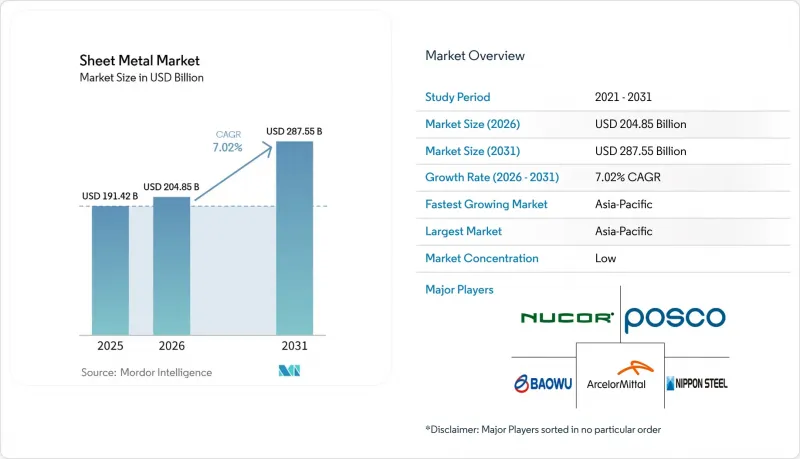
본 보고서는 소재 유형별(철강, 알루미늄 등), 가공 방법별(절단, 굽힘 가공 등), 최종 사용자 산업별(자동차, 산업기계 등) 및 지역별(아시아태평양, 북미, 유럽, 남미, 중동 및 아프리카)로 분류되어 있습니다. 시장 전망은 금액(달러) 기준으로 제시되어 있습니다.
세계의 판금 시장 동향 및 인사이트
경량 소재에 대한 수요 증가가 소재 구성을 변화시키고 있습니다.
자동차 제조업체와 에너지 장비 공급업체가 강도나 성형성을 희생하지 않으면서 경량 구조를 추구하는 가운데, 판금 시장에서는 소재 선택에 뚜렷한 변화가 나타나고 있습니다. EV의 차체 구조, 도어·펜더 등의 외판, 그리고 배터리 플로어 어셈블리에는 경량화와 우수한 내식성이 요구되기 때문에 알루미늄은 이러한 변화의 수혜를 받고 있습니다. 첨단 고장력강은 많은 양산 차종이 여전히 필요로 하는 ‘비용과 강도의 균형’을 제공하기 때문에 여전히 중요한 위치를 차지하고 있습니다. 자동차 제조업체(OEM)는 기존의 내연기관 설계에서 일부를 대체하는 것이 아니라, 전기차 전용 플랫폼을 위해 차체 전체의 아키텍처를 재설계하고 있기 때문에 이러한 변화는 일시적인 것이 아니라 구조적인 변화로 자리 잡고 있습니다. 이에 따라 판금 시장은 판매 대수 증가뿐만 아니라, 배터리 인클로저, 언더바디 시스템, 보호 케이싱에서의 강재 사용량 증가로도 견인되고 있습니다. 또한, 이러한 동향은 경량 판금 제품을 대규모로 공급할 수 있는 재활용, 압연, 마감 설비에 대한 투자 확대도 뒷받침하고 있습니다.
건축 및 건설 분야의 성장이 강판 수요를 뒷받침
건설 업계는 지붕 시스템, 외장재, 덕트, 구조용 프레임, 산업용 건물 등이 모두 평판 강재 제품에 크게 의존하고 있어, 계속해서 강판 시장의 수량 측면을 지탱하는 주축이 되고 있습니다. 아시아태평양에서는 인프라 회랑, 산업단지 확장, 재생에너지 발전 설비 설치로 인해 성형 및 코팅 처리된 강판이 대량으로 필요하며, 수요는 견조한 추세를 보이고 있습니다. 이러한 기반은 특정 제조 부문의 성장세가 둔화되더라도 제철소나 가공업체가 지속적인 수요를 확보할 수 있다는 점에서 중요합니다. 건설 분야 내 구성도 변화하고 있으며, 고객들은 기본적인 대량 공급보다는 에너지 절약형 건축, 모듈식 구조, 개보수 공사를 위해 더 고품질의 강판을 요구하는 경향이 강해지고 있습니다. 이러한 변화로 인해 더 엄격한 품질 및 코팅 요건을 충족할 수 있는 생산자의 수익성이 향상됩니다. 또한, 건설 수요가 단일 부동산 사이클에 의존하는 것이 아니라 물류 시설, 산업용 부지, 유틸리티 관련 시설 등으로 확대되고 있어 판금 시장의 회복력도 뒷받침되고 있습니다.
철강 및 알루미늄 가격 변동이 가공업체의 이익률을 압박
많은 가공업체가 철강이나 알루미늄 원가 급변동을 완전히 전가할 수 없는 고객 계약 하에서 사업을 영위하고 있기 때문에 판금 시장은 여전히 원자재 가격 변동의 영향을 받기 쉬운 상황에 놓여 있습니다. 관세, 공급 차질, 지역 간 불균형은 제철소의 가격과 하류 계약 조건 간의 격차를 확대시킬 가능성이 있습니다. 이는 조달 주기가 짧고, 헤지나 조달에 있어 협상력이 제한적인 중소 가공업체에게 특히 큰 과제가 되고 있습니다. 비용 관리는 전략적 우선 과제가 되었으며, 사업자들은 위험을 완화하기 위해 공급업체 다각화, 스크랩을 원료로 하는 조달 경로, 장기 계약 도입에 주력하고 있습니다. 이러한 압박은 무역 조치와 에너지 비용으로 인해 가격 환경이 불투명한 상태가 지속되고 있는 북미 및 유럽에서 가장 시급한 문제로 대두되고 있습니다. 이러한 동향은 건실한 사업자의 수익성을 뒷받침하는 한편, 현물 구매에 크게 의존하는 기업에게는 실행 위험을 높이고 있습니다.
부문 분석
2025년, 강판 시장에서 강재의 점유율은 74.82%를 차지했으며, 수요의 대부분이 강도, 가격, 그리고 확립된 가공 경로가 가장 중요시되는 용도에서 발생하고 있음이 확인되었습니다. 건설 시스템, 산업기계 및 자동차용 대형 부품은 대량 사용 시 강재의 대체 경제성이 여전히 유리하기 때문에 계속해서 강재에 의존하고 있습니다. 이에 따라 판금 업계는 대부분의 지역에서 강판 생산량, 서비스 센터 네트워크, 그리고 확립된 성형 기법에 의해 지속적으로 뒷받침되고 있습니다. 알루미늄은 2031년까지 연평균 성장률(CAGR) 8.33%로 확대될 것으로 예측되며, 이 시장에서 가장 빠르게 성장하는 소재 유형이 될 것입니다. 그 성장이 가장 두드러지는 분야는 전기차(EV)의 도어, 보닛, 배터리 플로어 구조, 그리고 경량화가 에너지 효율과 주행 거리 향상에 기여하는 기타 부품들입니다. 그 결과, 철강 수요가 감소하는 것이 아니라, 더 가볍고 전문성이 높은 판재 제품으로 구성 비율이 이동하게 됩니다.
이러한 변화가 중요한 이유는 판금 시장이 더 이상 단순히 톤수만으로 정의되는 것이 아니라, 각 소재가 최종 용도에서 수행하는 기술적 역할에 의해서도 정의되게 되었기 때문입니다. 완성 부품에 표준 강재로는 쉽게 충족할 수 없는 경량화, 내식성 또는 열적 성능이 요구되는 경우, 알루미늄은 더 높은 재료 비용을 정당화할 수 있습니다. 티타늄 및 기타 특수 소재는 여전히 생산량이 적지만, 인증, 정밀도, 성능이 광범위한 비용 비교보다 우선시되는 항공우주 및 의료 분야 제조에서는 계속해서 중요한 역할을 수행하고 있습니다. 각 생산 업체들은 상품화된 강판 공급에 그치지 않고, 특수 평강 제품으로의 전환을 추진함으로써 이에 대응하고 있습니다. 2025년 전 세계 조강 생산량은 18억 4,940만 톤에 달할 것으로 예상되며, 제품 구성이 고부가가치 평강 제품으로 전환되고 있음에도 불구하고 그 규모는 여전히 상당한 수준임을 보여줍니다. 판금 업계에서 가장 확고한 입지를 차지하는 것은 대량 수요가 있는 강재와 급성장하고 있는 경량화 용도 모두를 지원할 수 있는 공급업체일 것으로 보입니다.
지역별 분석
아시아태평양은 2025년에 전 세계 매출의 48.63%를 차지한 것으로 평가되었으며, 2031년까지 연평균 성장률(CAGR) 7.84%로 성장할 것으로 전망되어, 판금 시장에서 가장 크고 가장 빠르게 성장하는 지역이 되고 있습니다. 중국은 강판 생산량과 하류 가공의 폭이 넓다는 점에서 여전히 중심적인 위치를 차지하고 있지만, 국내 경쟁으로 인해 생산자들은 더 높은 품질과 전문성을 갖춘 등급으로의 전환을 강요받고 있습니다. 인도는 주요 성장 시장으로, 새로운 철강 생산 능력, 자동차 생산, 전자기기 제조, 인프라 투자가 모두 동시에 확대되고 있습니다. 이러한 폭넓은 성장 덕분에 아시아태평양의 판금 시장은 특정 단일 국가에 대한 의존도가 낮아지고 있습니다. 한국과 일본은 자동차용 강재, 도금 강판, 전자철판 등 고부가가치 판금 제품에 특화되어 있어 여전히 중요한 위치를 차지하고 있으며, 단순히 저비용뿐만 아니라 일관된 성능이 요구되는 용도를 위한 수출 지향적 공급을 뒷받침하고 있습니다.
북미의 상황은 다르며, 무역 보호 조치가 국내 제철소를 뒷받침하고 있는 반면, 일부 가공업체에게는 투입 비용 부담이 여전히 과제로 남아 있습니다. 이로 인해 강판 시장 내에서 양극화가 발생하고 있으며, 업스트림 생산 능력은 가격 지원의 혜택을 받고 있는 반면, 하류 기업들은 계약의 경직성이나 원자재 조달 시기에 민감한 상태가 지속되고 있습니다. 유럽에서는 탄소 규제, 탈탄소화 투자, 에너지 가격 등이 철강 및 가공 강판 공급의 경제성을 재편하고 있어 구조적인 과제에 직면해 있습니다. 보다 청정한 생산을 위한 노력은 막대한 자본 수요 및 정책의 불확실성과 맞물려 있습니다. 아르셀로미탈, 티센크루프 스틸, 포에스타알파인 등 각사는 2026년 배출권 거래 제도(ETS) 개혁을 공개적으로 요구하고 있으며, 이는 정책 설계가 지역 철강 업계에 있어 직접적인 경쟁 요인이 되고 있음을 여실히 보여주고 있습니다. 두 지역 모두에서 판재 시장은 최종 수요와 마찬가지로 규제 및 비용 구조의 문제에 의해 크게 형성되고 있습니다.
남미, 중동 및 아프리카는 절대적인 규모로는 여전히 작지만, 자동차, 건설, 산업 프로젝트 및 수출 지향적인 철강 흐름과 연계된 지역 수요를 창출하고 있어, 강판 시장에서 여전히 중요한 위치를 차지하고 있습니다. 남미에서는 브라질과 아르헨티나가 자동차 및 건설 분야 수요를 뒷받침하고 있으며, 브라질은 반제품 강재 공급에서도 중요한 역할을 하고 있습니다. 중동에서는 산업단지 및 인프라 정비 계획에 따라 성형 강판 및 특수 강판 제품에 대한 수요가 발생하고 있어 그 중요성이 높아지고 있습니다. 이러한 지역들은 규모 면에서는 아직 아시아태평양에 미치지 못하지만, 성숙한 국내 시장을 넘어 사업 확장을 모색하는 생산자들에게 다각화의 기회를 제공합니다. 향후 이는 강판 시장의 지리적 구조가 보다 균형 잡힌 형태로 발전하는 데 기여할 것입니다.
기타 혜택 :
- 엑셀 형식 시장 예측(ME) 시트
- 3개월간의 애널리스트 지원
자주 묻는 질문
목차
제1장 서론
제2장 조사 방법
제3장 주요 요약
제4장 시장 구도
제5장 시장 규모 및 성장 예측
제6장 경쟁 구도
제7장 시장 기회 및 향후 전망
AJY 26.08.07According to Mordor Intelligence, the sheet metal market size is expected to grow from USD 191.42 billion in 2025 to USD 204.85 billion in 2026 and is forecast to reach USD 287.55 billion by 2031 at 7.02% CAGR over 2026-2031.
This report is Segmented by Material Type (Steel, Aluminum and More), Process (Cutting, Bending, and More), End-User Industry (Automotive, Industrial Machinery, and More), and Geography (Asia-Pacific, North America, Europe, South America, and Middle-East and Africa). The Market Forecasts are Provided in Terms of Value (USD).
Global Sheet Metal Market Trends and Insights
Rising Demand for Lightweight Materials Reshaping the Material Mix
The sheet metal market is seeing a clear shift in material choice as vehicle manufacturers and energy equipment suppliers push for lighter structures without sacrificing strength or formability. Aluminum is benefiting from this shift because EV body structures, closures, and battery floor assemblies require lower mass and better corrosion performance. Advanced high-strength steel remains relevant because it offers a cost-to-strength balance that many high-volume vehicle programs continue to need. The change is becoming structural rather than temporary, as Original Equipment Manufacturers (OEMs) are redesigning full-body architectures for EV-native platforms rather than making minor substitutions within older internal combustion designs. This keeps the sheet metal market tied not only to more units sold, but also to higher content requirements in battery enclosures, underbody systems, and protective casings. This trend also supports greater investment in recycling, rolling, and finishing assets that can deliver lighter sheet products at scale.
Growth in Building and Construction Sustaining Steel Sheet Demand
Construction continues to anchor the volume side of the sheet metal market because roofing systems, cladding, ducting, structural frames, and industrial buildings all rely heavily on flat steel products. Demand remains firm in Asia-Pacific, where infrastructure corridors, industrial park expansion, and renewable power installations require large volumes of formed and coated steel sheet. This base is significant because it keeps mills and fabricators exposed to recurring demand even when one manufacturing segment slows. The mix within construction is also changing, as customers increasingly require higher-grade sheets for energy-efficient buildings, modular structures, and refurbishment work rather than basic volume supply. This shift improves the value profile for producers that can meet tighter quality and coating requirements. It also supports resilience in the sheet metal market because construction demand is spreading across logistics facilities, industrial sites, and utility-linked installations, rather than depending on a single property cycle.
Volatility in Steel and Aluminum Prices Compressing Fabricator Margins
The sheet metal market remains exposed to raw material price swings because many fabricators operate under customer contracts that do not fully pass through rapid changes in steel or aluminum costs. Tariffs, supply disruptions, and regional imbalances can widen the gap between mill pricing and downstream contract economics. This is particularly challenging for smaller fabricators that purchase in shorter cycles and have limited hedging or procurement leverage. Cost management has become a strategic priority as operators turn to supplier diversification, scrap-based routes, and longer-term agreements to reduce exposure. The pressure is most immediate in North America and Europe, where trade measures and energy costs have kept the pricing environment uncertain. This dynamic supports profitability for disciplined operators but raises execution risk for companies that rely heavily on spot purchases.
Other drivers and restraints analyzed in the detailed report include:
- Increasing Demand from Electric Vehicle (EV) and Electronics Manufacturing
- Expansion of Precision Manufacturing Creating Differentiated Demand
- High Energy Intensity Limiting Cost Competitiveness in Transition Markets
For complete list of drivers and restraints, kindly check the Table Of Contents.
Segment Analysis
Steel accounted for 74.82% of the sheet metal market in 2025, confirming that the largest share of demand came from applications where strength, price, and established processing routes matter most. Construction systems, industrial machinery, and heavy automotive components continue to rely on steel because its substitution economics remain favorable in high-volume use. This keeps the sheet metal industry anchored to flat steel output, service center networks, and well-established forming practices across most regions. Aluminum is forecast to expand at an 8.33% CAGR through 2031, making it the fastest-growing material type in this market. Its growth is strongest in EV doors, hoods, battery floor structures, and other parts where mass reduction supports energy efficiency and range. The result is not a decline in steel demand, but a shift in the mix toward lighter, more specialized flat products.
This change is significant because the sheet metal market is no longer defined only by tonnage, but also by the technical role each material plays in end use. Aluminum can justify a higher material cost when the finished component requires weight reduction, corrosion resistance, or thermal performance that standard steel cannot meet as readily. Titanium and other specialty materials remain small in volume, but they continue to matter in aerospace and medical fabrication, where certification, precision, and performance outweigh broad cost comparisons. Producers are responding by moving toward specialty flat products rather than remaining in commoditized sheet supply. World crude steel production reached 1,849.4 million tons in 2025, indicating that scale remains substantial even as the product mix shifts toward higher-value flat-rolled applications. Within the sheet metal industry, the strongest positions will likely belong to suppliers that can support both large-volume steel demand and fast-growing lightweight applications.
Complete Report Scope:
- By Material Type
- Steel
- Aluminum
- Titanium
- Other Materials
- By Process
- Cutting
- Bending
- Stamping
- Roll Forming
- Other Process
- By End-User Industry
- Automotive
- Aerospace & Defense
- Industrial Machinery
- Buildings and Construction
- Electrical & Electronics
- Consumer Goods
- Other End Users
- By Geography
- Asia-Pacific
- China
- India
- Japan
- South Korea
- Rest of Asia-Pacific
- North America
- United States
- Canada
- Mexico
- Europe
- Germany
- United Kingdom
- France
- Italy
- Russia
- Rest of Europe
- South America
- Brazil
- Argentina
- Rest of South America
- Middle-East and Africa
- Saudi Arabia
- South Africa
- Rest of Middle-East and Africa
- Asia-Pacific
Geography Analysis
Asia-Pacific accounted for 48.63% of global revenue in 2025 and is projected to grow at a 7.84% CAGR through 2031, making it the largest and fastest-growing region in the sheet metal market. China remains central due to its flat-steel output and breadth of downstream fabrication, even as local competition pushes producers toward higher quality and more specialized grades. India is a key growth market, with new steel capacity, automotive production, electronics manufacturing, and infrastructure investment all expanding simultaneously. This broad-based growth makes the Asia-Pacific sheet metal market less dependent on any single country. South Korea and Japan remain relevant due to their specialization in high-value sheet products such as automotive-grade steel, coated flats, and electrical steel, supporting export-oriented supply for applications that require consistent performance rather than low cost alone.
North America operates under different conditions, where trade protection has supported domestic mills while also keeping input costs challenging for some fabricators. This creates a divide within the sheet metal market, where upstream capacity benefits from price support while downstream companies remain sensitive to contract rigidity and raw material timing. Europe faces structural challenges, as carbon regulations, decarbonization spending, and energy prices are reshaping the economics of steel and fabricated sheet supply. The push for cleaner production coincides with high capital requirements and policy uncertainty. ArcelorMittal, Thyssenkrupp Steel, and voestalpine publicly pressed for Emissions Trading System (ETS) reform in 2026, highlighting how policy design has become a direct competitive factor for the regional steel industry. In both regions, the sheet metal market is being shaped as much by regulatory and cost structure issues as by end demand.
South America, the Middle East, and Africa remain smaller in absolute terms but are still relevant to the sheet metal market, providing regional demand tied to vehicles, construction, industrial projects, and export-oriented steel flows. Brazil and Argentina support automotive and construction demand in South America, while Brazil also plays an important role in supplying semi-finished steel. The Middle East is growing in significance as industrial zones and infrastructure programs generate demand for formed and specialty sheet products. While these regions do not yet match Asia-Pacific in scale, they offer diversification opportunities for producers looking beyond mature home markets. Over time, this should support a more balanced geographic structure in the sheet metal market.
- Aleris International, Inc.
- ARCELORMITTAL
- BlueScope Steel Limited
- China Baowu Steel Group
- Constellium SE
- Hindalco Industries Limited
- JFE Holdings, Inc.
- JSW Steel Limited
- Kaiser Aluminum Corporation
- NIPPON STEEL CORPORATION
- Norsk Hydro ASA
- Nucor Corporation
- POSCO
- Steel Authority of India Limited
- Steel Dynamics, Inc.
- Tata Steel Limited
- Thyssenkrupp AG
- United States Steel Corporation
Additional Benefits:
- The market estimate (ME) sheet in Excel format
- 3 months of analyst support
TABLE OF CONTENTS
1 Introduction
- 1.1 Study Assumptions and Market Definition
- 1.2 Scope of the Study
2 Research Methodology
3 Executive Summary
4 Market Landscape
- 4.1 Market Overview
- 4.2 Market Drivers
- 4.2.1 Rising Demand for Lightweight Materials in Automotive and Transportation
- 4.2.2 Growth in Building and Infrastructure Development
- 4.2.3 Expansion of Precision Fabrication for EV, HVAC, and Electronics Assemblies
- 4.2.4 Increasing Demand from Renewable Energy and Electrical Infrastructure
- 4.2.5 Adoption of Advanced Manufacturing and Automation Technologies
- 4.3 Market Restraints
- 4.3.1 Volatility in Steel, Aluminum, and Raw Material Prices
- 4.3.2 High Energy Intensity of Forming and Finishing Operations
- 4.3.3 High Capital Investment and Skilled Labor Requirements
- 4.4 Value Chain Analysis
- 4.5 Porter's Five Forces Analysis
- 4.5.1 Threat of New Entrants
- 4.5.2 Bargaining Power of Suppliers
- 4.5.3 Bargaining Power of Buyers
- 4.5.4 Threat of Substitutes
- 4.5.5 Competitive Rivalry
5 Market Size and Growth Forecasts (Value)
- 5.1 By Material Type
- 5.1.1 Steel
- 5.1.2 Aluminum
- 5.1.3 Titanium
- 5.1.4 Other Materials
- 5.2 By Process
- 5.2.1 Cutting
- 5.2.2 Bending
- 5.2.3 Stamping
- 5.2.4 Roll Forming
- 5.2.5 Other Process
- 5.3 By End-User Industry
- 5.3.1 Automotive
- 5.3.2 Aerospace & Defense
- 5.3.3 Industrial Machinery
- 5.3.4 Buildings and Construction
- 5.3.5 Electrical & Electronics
- 5.3.6 Consumer Goods
- 5.3.7 Other End Users
- 5.4 By Geography
- 5.4.1 Asia-Pacific
- 5.4.1.1 China
- 5.4.1.2 India
- 5.4.1.3 Japan
- 5.4.1.4 South Korea
- 5.4.1.5 Rest of Asia-Pacific
- 5.4.2 North America
- 5.4.2.1 United States
- 5.4.2.2 Canada
- 5.4.2.3 Mexico
- 5.4.3 Europe
- 5.4.3.1 Germany
- 5.4.3.2 United Kingdom
- 5.4.3.3 France
- 5.4.3.4 Italy
- 5.4.3.5 Russia
- 5.4.3.6 Rest of Europe
- 5.4.4 South America
- 5.4.4.1 Brazil
- 5.4.4.2 Argentina
- 5.4.4.3 Rest of South America
- 5.4.5 Middle-East and Africa
- 5.4.5.1 Saudi Arabia
- 5.4.5.2 South Africa
- 5.4.5.3 Rest of Middle-East and Africa
- 5.4.1 Asia-Pacific
6 Competitive Landscape
- 6.1 Market Concentration
- 6.2 Strategic Moves
- 6.3 Market Share (%)/Ranking Analysis
- 6.4 Company Profiles (includes Global Overview, Market Overview, Core Segments, Financials as available, Strategic Information, Products and Services, and Recent Developments)
- 6.4.1 Aleris International, Inc.
- 6.4.2 ARCELORMITTAL
- 6.4.3 BlueScope Steel Limited
- 6.4.4 China Baowu Steel Group
- 6.4.5 Constellium SE
- 6.4.6 Hindalco Industries Limited
- 6.4.7 JFE Holdings, Inc.
- 6.4.8 JSW Steel Limited
- 6.4.9 Kaiser Aluminum Corporation
- 6.4.10 NIPPON STEEL CORPORATION
- 6.4.11 Norsk Hydro ASA
- 6.4.12 Nucor Corporation
- 6.4.13 POSCO
- 6.4.14 Steel Authority of India Limited
- 6.4.15 Steel Dynamics, Inc.
- 6.4.16 Tata Steel Limited
- 6.4.17 Thyssenkrupp AG
- 6.4.18 United States Steel Corporation
7 Market Opportunities and Future Outlook
- 7.1 White-Space and Unmet-Need Assessment


