|
시장보고서
상품코드
2099949
유리 매트 시장 : 시장 점유율 분석, 업계 동향 및 통계, 성장 예측(2026-2031년)Glass Mat - Market Share Analysis, Industry Trends & Statistics, Growth Forecasts (2026 - 2031) |
||||||
 Mordor Intelligence
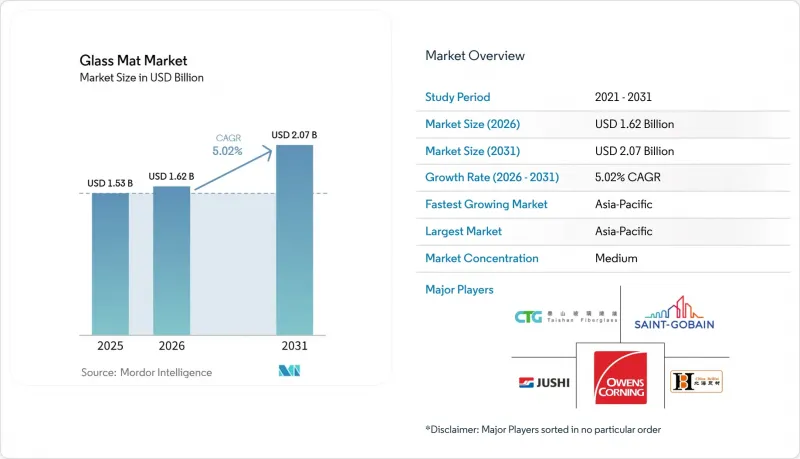
Mordor Intelligence에 의하면, 유리 매트 시장 규모는 2025년 15억 3,000만 달러로 평가되었고, 2026년에는 16억 2,000만 달러로 확대될 것으로 추정되고, 2031년까지 20억 7,000만 달러에 이를 것으로 전망되며, 2026-2031년 CAGR 5.02%를 나타낼 것으로 예측됩니다.
본 보고서는 매트 유형별(촙드 스트랜드 매트 및 연속 필라멘트 매트), 바인더 유형별(분말 결합 유리 매트 등), 제조 공정별(습식 적층법 등), 최종 사용자 산업별(풍력 발전 등), 지역별(아시아태평양, 북미, 유럽, 남미, 중동 및 아프리카)로 분류되어 있습니다. 시장 전망은 금액(달러) 기준으로 제시되어 있습니다.
세계의 유리 매트 시장 동향 및 인사이트
건설 및 인프라 확대
건설 분야는 유리 매트 시장에서 여전히 최대 수요 부문으로 자리 잡고 있습니다. 이 소재는 석고보드 보강, 지붕용 필름의 기판, 그리고 유리섬유 강화 콘크리트 패널에 사용됩니다. 미국에서는 인프라 투자가 가혹한 사용 조건에서도 높은 내구성을 갖춘 경량 보강 패널이 필요한 용도를 지속적으로 뒷받침하고 있습니다. 이러한 수요 동향은 중요한 의미를 지닙니다. 왜냐하면 유리 매트 시장은 주목도가 높은 구조용 복합재료에만 의존하는 것이 아니라, 보다 안정적이고 광범위한 경향을 보이는 건축자재에 대한 지속적인 수요로부터도 혜택을 받고 있기 때문입니다. 건축 및 패널 용도의 구매자들은 표면 마감, 단위 면적당 중량 감소, 그리고 섬유의 균일성 향상을 더욱 중요시하게 되었으며, 이로 인해 수요 기반의 일부가 관리가 철저한 제품 등급으로 이동하고 있습니다. 유리 매트 시장에 있어 건설 분야의 판매량 증가는 저부가가치의 범용 제품 판매에만 의존하는 것이 아니라, 제품 구성 개선을 더욱 촉진하는 요인이 됩니다. 이는 또한 지속성, 품질의 일관성, 그리고 지역에 뿌리를 둔 공급의 신뢰성을 중시하는 건축자재 제조업체와 매트 생산량을 조정할 수 있는 공급업체의 입지를 강화하는 결과로 이어집니다.
풍력 발전 설비의 확대
풍력 발전은 유리 매트 시장에서 가장 빠르게 성장하고 있는 최종 용도 부문이며, 설치되는 터빈 1기당 더 많은 보강재가 필요한 대형 블레이드의 보급이 직접적인 원동력이 되고 있습니다. 블레이드 용도에서는 치수 안정성, 구조적 일관성 및 재현성 있는 적층 성능이 요구되므로, 연속 필라멘트 형태가 가장 큰 혜택을 보고 있습니다. 이에 따라 블레이드 제조업체는 더욱 엄격한 승인 요건 및 공정 요건을 충족하는 제품을 필요로 하고 있어, 단순한 명목상의 생산 능력뿐만 아니라 장기적인 생산 품질의 중요성이 더욱 높아지고 있습니다. 유리 매트 시장에서는 특수한 제조 능력, 확실한 인증 실적, 그리고 신뢰성 높은 생산 라인 관리를 갖춘 제조업체를 우대하는 공급 계약으로 수요 전환이 나타나고 있습니다. 유럽에서는 풍력 발전 도입 확대를 위한 정책 지원이 블레이드 제조에 있어 복합재료의 지속적인 소비를 뒷받침하고 있습니다. 각 지역에서 유리 매트 시장은 터빈 설치 대수 증가뿐만 아니라, 블레이드의 대형화와 더 엄격한 요건이 요구되는 해상 풍력 발전 설계를 동반한 자재 사용량 증가로부터도 혜택을 받고 있습니다.
유리 섬유 원료 가격 변동
원료 가격 변동은 유리 매트 시장에 여전히 시급한 압박 요인으로 작용하고 있습니다. 이는 생산자가 업스트림 단계의 섬유 생산 능력을 관리하지 않을 경우, 가공 마진이 영향을 받기 쉽기 때문입니다. 이 문제는 고객이 원자재 가격을 예상하는 반면, 섬유 투입 비용이 계약 갱신 주기보다 빠르게 변동하는 부문에서 특히 두드러집니다. 그 영향은 공급업체에 따라 균일하지 않으며, 수직 통합형 제조업체는 독립 가공업체보다 변동을 더 효과적으로 흡수하고 관리할 수 있습니다. 실무적으로는 구매 조건이 엄격해지거나 높은 비용으로 재고를 늘려야 하는 경우, 소규모 사업자나 비통합형 사업자에게는 시장 환경이 더욱 어려워집니다. 이로 인해 고객에 대한 가격 책정 유연성이 좁아지고, 판매량 확대에 대한 의욕이 저하되어, 생산 시설과의 연계가 강력한 공급업체나 장기 공급 계약을 체결한 공급업체가 유리해질 가능성이 있습니다. 하류 수요 상황이 호조를 보이더라도, 원자재 조달을 전략적으로 관리하는 것은 유리 매트 시장에서 여전히 핵심적인 경쟁 요인으로 남아 있습니다.
부문 분석
2025년, 촙드 스트랜드 매트는 매트형 수요의 62.70%를 차지했으며, 건설, 선박 및 일반 산업 용도에 걸친 유리 매트 시장의 양적 기반을 형성하고 있습니다. 이러한 확고한 입지는 일반적인 폴리에스테르 및 비닐 에스테르 수지 시스템과의 호환성은 물론, 다양한 제품 사양을 충족하는 광범위한 생산을 뒷받침하는 생산 경제성에서 비롯됩니다. 가공업체들은 정밀한 구조적 성능보다는 오픈 몰드 가공, 비용 관리, 그리고 소재에 대한 익숙함이 중시되는 상황에서 계속해서 촙드 스트랜드 제품에 의존하고 있습니다. 이로 인해 이 부문은 지붕 패널, 파이프 부재, 보트 부품 및 범용 강화 플라스틱 부품에 깊이 뿌리내리고 있습니다. 유리 매트 시장에서 이러한 대규모 도입 실적은 견고성을 제공하며, 성장률이 높은 용도가 주목을 받는 가운데에서도 교체 주기 및 지속적인 가공 수요는 여전히 존재하고 있습니다.
연속 필라멘트 매트는 2031년까지 연평균 성장률(CAGR) 8.33%를 나타낼 것으로 예측되며, 구조용 및 기계 구동형 성형 공정에서 유리 매트 업계에서 가장 빠르게 성장하는 제품 형태가 될 전망입니다. 그 성장이 가장 두드러지는 분야는 풍력 발전용 블레이드와 자동차용 구조 패널이며, 이러한 분야에서는 섬유의 연속성과 치수 제어가 적층재의 거동 및 공정의 신뢰성에 직접적인 영향을 미칩니다. 이 부문 수요는 일일 현물 가격 변동의 영향을 덜 받는 경향이 있습니다. 이는 고객의 인증 요건 및 인증 기준, 그리고 장기적인 공정 안정성으로 인해 승인된 공급업체가 고객과의 거래 관계를 견고하게 유지하고 있기 때문입니다. 또한, 이러한 제품은 범용 대체품에 비해 더 엄격한 공정 범위, 더 뛰어난 성형 일관성, 그리고 더 엄격한 품질 관리가 필요하기 때문에 공급업체의 선택지도 제한적입니다. 유리 매트 시장이 자동화 및 구조용 복합재료로의 활용으로 계속 전환됨에 따라, 예측 기간 동안 잘게 자른 스트랜드 매트가 여전히 가장 큰 수익 기반을 차지할 것으로 보이지만, 연속 필라멘트 형태의 중요성은 더욱 높아질 것으로 예측됩니다.
2025년에는 에멀젼 결합형 유리 매트가 바인더 부문에서 58.72%의 점유율을 차지하며 1위를 기록했습니다. 이는 선박, 건설, 패널 용도에서 수년간 핸드 레이업 공정에 사용되어 온 사실을 반영합니다. 이러한 확고한 입지는 제품의 부드러움과 드레이프성에서 비롯되며, 이러한 특성 덕분에 제조업체는 공기 혼입 위험을 높이지 않으면서도 복잡한 형상에 재료를 맞출 수 있습니다. 따라서 에멀젼 결합 제품은 보트 선체나 곡면 패널 등, 여전히 수작업 처리가 공정 선택의 결정적 요인이 되는 형상에 실용적으로 적합합니다. 또한, 많은 유서 깊은 제조 공장에서는 이미 이 방식에 최적화된 수지 시스템과 워크플로우를 도입하고 있어, 고객의 친숙함이 이 부문의 성장 동력이 되고 있습니다. 유리 매트 시장에서 이러한 기존 가공 기반은 새로운 제조 공정이 확대되는 상황 속에서도 에멀젼 결합 제품 수요를 지탱하는 역할을 하고 있습니다.
분말 결합형 유리 매트는 밀폐형 금형 및 연속 생산 시스템과의 호환성이 높아, 2031년까지 연평균 성장률(CAGR) 7.84%를 나타낼 것으로 예측됩니다. 이 방식은 더 빠른 아웃과 높은 수지 투과성이 사이클 타임 준수를 뒷받침하는 경우, 특히 수지 이송 성형, 압축 성형 및 연속 패널 생산에서 선호됩니다. 또한, 분말 바인더의 화학적 특성은 가수분해 안정성도 뛰어나며, 습기로 인한 열화에 대한 내성이 요구되는 화학 물질 저장 및 수중 사용 용도에서 유용합니다. 배출량 감축 및 성형 조건의 보다 엄격한 관리를 향한 광범위한 움직임도 추가적인 견인력이 되고 있습니다. 이러한 우선순위들은 기존의 오픈 몰드 방식보다 분말 바인더 제품의 특성과 더 밀접하게 부합하기 때문입니다. 그 결과, 유리 매트 시장에서 바인더의 배합은 모든 용도에서 기존 제품을 단순히 대체하는 형태가 아니라, 제조 방법에 맞추어 진화해 나갈 것으로 보입니다.
지역별 분석
아시아태평양은 2025년에 세계 수요의 46.94%를 차지했으며, 2031년까지 연평균 성장률(CAGR) 8.22%를 나타낼 것으로 예측되어, 유리 매트 시장에서 가장 크고 가장 빠르게 성장하는 지역 시장이 되고 있습니다. 이 지역은 정교한 복합재료 제조 생태계, 견고한 풍력 발전 설비 기반, 그리고 유리섬유 공급과 하류 가공 간의 긴밀한 연계라는 장점을 가지고 있습니다. 중국은 통합된 공급망과 대규모 보강재 제조 거점을 통해 비용 효율성과 지역 내 공급 안정성을 모두 뒷받침하고 있어, 이 지위의 핵심으로 자리매김하고 있습니다. 중국 유리섬유 제조업체들의 생산 능력 확충과 투자 활동은 하류 매트 공급의 안정성과 제품 개발 측면에서 이 지역의 중요성을 더욱 강화하고 있습니다. 일본과 한국은 보다 기술 집약적인 생산과 특수 소재 제조 능력을 통해 기여하고 있으며, 지역 수요 중에서도 고성능 분야를 뒷받침하고 있습니다.
북미는 석고보드, 지붕용 싱글, 보강 건축 패널 등을 통해 건축자재가 유리 매트 출하량의 상당 부분을 계속 차지하고 있어, 안정적이고 전략적으로 중요한 지역 시장으로 자리매김하고 있습니다. 또한, 이 지역 시장은 중요한 보강재 조달에 있어 장거리 의존도를 낮추기 위한 현지 공급 확보 노력의 혜택을 받고 있습니다. 2026년 4월 오웬스 코닝(Owens Corning)사의 유리 보강재 사업이 플라아나 그룹(Plaana Group)에 양도됨에 따라 사업 환경이 변화했습니다. 해당 사업은 현재 ‘오리지널 컴포지트 앤 파이버스(Original Composites and Fibers)’로 운영되고 있으며, 북미에 자산을 보유한 새로운 독립 경쟁사가 탄생했습니다. 이러한 변화는 고객이 지역 전체공급 지속성, 제품 포트폴리오의 방향성, 그리고 향후 투자를 어떻게 평가할지에 영향을 미칠 가능성이 있습니다. 풍력 발전은 여전히 규모는 작지만 지속적으로 성장하고 있는 지역 시장이며, 국내 공급업체들은 향후 블레이드 및 해상 풍력 발전 프로젝트 요건과 관련된 고성능 복합재료에 대한 수요를 대비해 체제를 정비하고 있습니다.
유럽은 풍력 블레이드 제조, 건설용 복합재료, 그리고 공정 관리와 지속가능성을 점점 더 중시하는 규제 환경을 통해 유리 매트 시장에서 중요한 위치를 차지하고 있습니다. 특히 풍력 관련 복합재료의 경우, 재활용성 및 사용 후 처리가 산업적 의사결정에서 중요하게 고려됨에 따라 해당 지역의 조달 구조는 더욱 선택적으로 변하고 있습니다. 남미, 중동 및 아프리카는 여전히 소규모 시장이지만, 이 세 지역 모두 인프라 구축, 산업 다각화, 재생에너지 프로젝트로 인해 복합재료 사용이 증가하고 있어 성장 여지가 있습니다. 따라서 유리 매트 시장의 지리적 구성은 지배적인 아시아태평양을 핵심으로, 북미의 안정적인 수요, 그리고 지속가능성 요건 및 기술적 자격 기준에 따라 점점 더 형성되고 있는 유럽 주도의 특수 용도 시장이 결합된 형태를 띠고 있습니다.
기타 혜택 :
- 엑셀 형식 시장 예측(ME) 시트
- 3개월간의 애널리스트 지원
자주 묻는 질문
목차
제1장 서론
제2장 조사 방법
제3장 주요 요약
제4장 시장 구도
제5장 시장 규모 및 성장 예측
제6장 경쟁 구도
제7장 시장 기회 및 향후 전망
AJY 26.08.07According to Mordor Intelligence, the glass mat market size is expected to increase from USD 1.53 billion in 2025 to USD 1.62 billion in 2026 and reach USD 2.07 billion by 2031, and is expected to grow at a CAGR of 5.02% over 2026-2031.
This report is Segmented by Mat Type (Chopped Strand Mat and Continuous Filament Mat), Binder Type (Powder Bonded Glass Mat and More), Manufacturing Process (Wet-Laid Process and More), End-User Industry (Wind Energy and More), and Geography (Asia-Pacific, North America, Europe, South America, and Middle-East and Africa). The Market Forecasts are Provided in Terms of Value (USD).
Global Glass Mat Market Trends and Insights
Construction and Infrastructure Expansion
Construction remains the largest demand segment for the glass mat market. The material is used in gypsum board reinforcement, roofing membrane substrates, and glass fiber-reinforced concrete panels. In the United States, infrastructure spending has continued to support applications that require lighter reinforced panels with strong durability in demanding service conditions. This demand profile is significant because the glass mat market does not rely solely on high-visibility structural composites; it also benefits from recurring building product demand that tends to be more stable and widely distributed. Buyers in architectural and panel applications are placing greater emphasis on surface finish, lower areal weight, and tighter fiber uniformity, which shifts part of the demand base toward better-controlled product grades. For the glass mat market, volume growth in construction can increasingly support product mix improvement rather than relying solely on low-value commodity sales. This also strengthens the position of suppliers that can align mat output with building product manufacturers that value continuity, quality consistency, and localized supply reliability.
Expansion of Wind Energy Installations
Wind energy is the fastest-growing end-use segment in the glass mat market, driven directly by larger blade formats that require more reinforcement material per installed turbine. Continuous filament formats benefit the most, as blade applications require dimensional stability, structural consistency, and repeatable laminate performance. This raises the importance of long-run production quality, not just nominal capacity, because blade manufacturers require products that meet tighter approval and process requirements. The glass mat market is seeing demand shift toward supply agreements that favor producers with specialty capability, established qualification history, and reliable line control. In Europe, policy support for expanded wind deployment continues to reinforce sustained composite consumption in blade manufacturing. Across regions, the glass mat market benefits not only from higher turbine installation volumes, but also from the greater material intensity associated with blade scaling and more demanding offshore designs.
Volatility in Glass Fiber Feedstock Prices
Feedstock price movements remain an immediate pressure point for the glass mat market, as conversion margins are exposed when producers do not control upstream fiber capacity. This issue is particularly relevant in segments where customers expect commodity pricing, but fiber input costs move faster than contract reset cycles. The effect is not uniform across suppliers, as integrated manufacturers can absorb or manage volatility more effectively than independent converters. In practical terms, market conditions become more challenging for smaller and non-integrated participants when buying conditions tighten or when inventory must be built at elevated cost. This can narrow flexibility in customer pricing, reduce willingness to pursue volume, and favor suppliers with stronger furnace linkages or long-term supply arrangements. Strategic control of raw material access remains a central competitive factor in the glass mat market, even when downstream demand conditions are supportive.
Other drivers and restraints analyzed in the detailed report include:
- Rising Adoption of Lightweighting in Automotive and Transportation
- Shift Toward Continuous Filament Production and Automation-Compatible Mat Formats
- Substitution by Alternative Composite Materials
For complete list of drivers and restraints, kindly check the Table Of Contents.
Segment Analysis
Chopped strand mat retained 62.70% of mat-type demand in 2025, making it the volume foundation of the glass mat market across construction, marine, and general industrial uses. Its established position stems from compatibility with common polyester and vinyl ester resin systems, as well as production economics that support broad output across many product specifications. Fabricators continue to rely on chopped strand products where open-mold processing, cost control, and material familiarity matter more than precision structural performance. This keeps the segment deeply embedded in roofing panels, pipe sections, boat components, and general-purpose reinforced plastic parts. Within the glass mat market, this large installed base provides resilience, as replacement cycles and recurring fabrication needs persist even as higher-growth applications receive more attention.
Continuous filament mat is projected to grow at an 8.33% CAGR through 2031, making it the fastest-growing product format in the glass mat industry for structural and machine-driven fabrication routes. Its gains are strongest in wind blades and automotive structural panels, where fiber continuity and dimensional control directly affect laminate behavior and process reliability. Demand in this segment is less exposed to daily spot pricing because customer qualification, certification requirements, and long-run process stability give approved suppliers a stronger hold on accounts. The supplier pool is also narrower, since these products require tighter process windows, better forming consistency, and more disciplined quality control than commodity alternatives. As the glass mat market continues to shift toward automation and structural composite use, continuous filament formats are expected to gain further importance, even if chopped strand mat remains the larger revenue base over the forecast period.
Emulsion-bonded glass mat led the binder segment with 58.72% share in 2025, reflecting its long-standing use in hand lay-up processes across marine, construction, and panel applications. Its established position stems from its softness and drapeability, which help fabricators conform the material to complex shapes without increasing the risk of air entrapment. This makes emulsion-bonded products a practical fit for boat hulls, curved panels, and other geometries where manual handling still drives process choice. The segment also benefits from customer familiarity, as many established fabrication shops already run resin systems and workflows optimized for this format. In the glass mat market, the installed processing base helps protect emulsion-bonded demand even as newer process routes expand.
Powder-bonded glass mat is projected to grow at a 7.84% CAGR through 2031, supported by a better fit with closed-mold and continuous production systems. The format is favored where faster wet-out and higher resin permeability support cycle-time discipline, particularly in resin transfer molding, compression molding, and continuous panel production. Powder binder chemistry also offers greater hydrolytic stability, which is beneficial in chemical storage and submerged-service applications that require resistance to moisture-related degradation. The broader shift toward lower emissions and more controlled molding conditions provides additional support, as those priorities align more closely with the characteristics of powder-bonded products than with traditional open-mold methods. As a result, the binder mix in the glass mat market is likely to evolve in line with manufacturing methods rather than through a straightforward replacement of older products across all applications.
Complete Report Scope:
- By Mat Type
- Chopped Strand Mat
- Continuous Filament Mat
- By Binder Type
- Powder Bonded Glass Mat
- Emulsion Bonded Glass Mat
- By Manufacturing Process
- Wet-Laid Process
- Continuous Filament Process
- Chopped Strand Process
- By End-User Industry
- Construction and Infrastructure
- Automotive and Transportation
- Wind Energy
- Marine
- Sports and Leisure Goods
- Industrial
- Other End-Use
- By Geography
- Asia-Pacific
- China
- India
- Japan
- South Korea
- Rest of Asia-Pacific
- North America
- United States
- Canada
- Mexico
- Europe
- Germany
- United Kingdom
- France
- Italy
- Russia
- Rest of Europe
- South America
- Brazil
- Argentina
- Rest of South America
- Middle-East and Africa
- Saudi Arabia
- South Africa
- Rest of Middle-East and Africa
- Asia-Pacific
Geography Analysis
Asia-Pacific accounted for 46.94% of global demand in 2025 and is projected to grow at an 8.22% CAGR through 2031, making it the largest and fastest-growing regional market for glass mats. The region benefits from a dense composite manufacturing ecosystem, a strong wind equipment base, and close linkages between glass fiber supply and downstream fabrication. China remains central to this position, as its integrated supply chain and large-scale reinforcement manufacturing footprint support both cost efficiency and regional availability. Capacity additions and investment activity by Chinese glass fiber producers reinforce the region's importance for downstream mat availability and product development. Japan and South Korea contribute through more technology-intensive production and specialty-material capabilities, supporting the higher-performance end of regional demand.
North America remains a stable and strategically important regional market, as building products continue to absorb a meaningful share of glass mat volumes through gypsum board, shingles, and reinforced construction panels. The regional market also benefits from efforts to secure local supply, reducing reliance on long-distance sourcing for critical reinforcement inputs. The April 2026 transfer of Owens Corning's glass reinforcements business to Praana Group has changed the operating landscape; the business now operates as Original Composites and Fibers, creating a new standalone competitor with North American assets. This change may influence how customers evaluate supply continuity, portfolio direction, and future investment across the region. Wind energy remains a smaller but expanding regional outlet, and domestic suppliers are positioning for higher-performance composite demand tied to future blade and offshore project requirements.
Europe holds a meaningful position in the glass mat market through wind blade manufacturing, construction composites, and a regulatory environment that increasingly values process control and sustainability. The region's procurement mix is becoming more selective as recyclability and end-of-life handling gain visibility in industrial decision-making, particularly for wind-related composites. South America, the Middle East, and Africa remain smaller markets, but all three regions offer room for expansion where infrastructure activity, industrial diversification, and renewable energy projects are increasing composite use. The geographic profile of the glass mat market therefore combines a dominant Asia-Pacific core with steady North American demand and a Europe-led specialty base that is increasingly shaped by sustainability requirements and technical qualification standards.
- 3B - the fibreglass company
- Ahlstrom
- China Beihai Fiberglass Co., Ltd.
- China Jushi Co., Ltd.
- Chongqing Polycomp International Corporation
- Fibretech Industries
- Jiangsu Changhai Composite Materials Co., Ltd.
- Johns Manville
- Nippon Electric Glass Co., Ltd.
- Nittobo
- Owens Corning
- Saint-Gobain
- Superior Huntingdon Composites Co., LLC
- Taishan Fiberglass Inc.(CTG)
- Taiwan Glass Ind Corp.
Additional Benefits:
- The market estimate (ME) sheet in Excel format
- 3 months of analyst support
TABLE OF CONTENTS
1 Introduction
- 1.1 Study Assumptions and Market Definition
- 1.2 Scope of the Study
2 Research Methodology
3 Executive Summary
4 Market Landscape
- 4.1 Market Overview
- 4.2 Market Drivers
- 4.2.1 Construction and Infrastructure Reinforcement Demand
- 4.2.2 Rising Adoption of Lightweight Composites in Automotive and Transportation
- 4.2.3 Expansion of Wind Energy and Renewable Energy Installations
- 4.2.4 Shift Toward Continuous Filament Mat in High-Performance Uses
- 4.2.5 Growing Demand for Cost-Effective Composite Reinforcement Materials
- 4.3 Market Restraints
- 4.3.1 Volatility in Glass Fiber and Binder Raw Material Prices
- 4.3.2 Substitution by Alternative Reinforcement Materials in Price-Sensitive Applications
- 4.3.3 Limited Recycling and End-of-Life Management of Composite Materials
- 4.4 Value Chain Analysis
- 4.5 Porter's Five Forces Analysis
- 4.5.1 Threat of New Entrants
- 4.5.2 Bargaining Power of Suppliers
- 4.5.3 Bargaining Power of Buyers
- 4.5.4 Threat of Substitutes
- 4.5.5 Competitive Rivalry
5 Market Size and Growth Forecasts (Value)
- 5.1 By Mat Type
- 5.1.1 Chopped Strand Mat
- 5.1.2 Continuous Filament Mat
- 5.2 By Binder Type
- 5.2.1 Powder Bonded Glass Mat
- 5.2.2 Emulsion Bonded Glass Mat
- 5.3 By Manufacturing Process
- 5.3.1 Wet-Laid Process
- 5.3.2 Continuous Filament Process
- 5.3.3 Chopped Strand Process
- 5.4 By End-User Industry
- 5.4.1 Construction and Infrastructure
- 5.4.2 Automotive and Transportation
- 5.4.3 Wind Energy
- 5.4.4 Marine
- 5.4.5 Sports and Leisure Goods
- 5.4.6 Industrial
- 5.4.7 Other End-Use
- 5.5 By Geography
- 5.5.1 Asia-Pacific
- 5.5.1.1 China
- 5.5.1.2 India
- 5.5.1.3 Japan
- 5.5.1.4 South Korea
- 5.5.1.5 Rest of Asia-Pacific
- 5.5.2 North America
- 5.5.2.1 United States
- 5.5.2.2 Canada
- 5.5.2.3 Mexico
- 5.5.3 Europe
- 5.5.3.1 Germany
- 5.5.3.2 United Kingdom
- 5.5.3.3 France
- 5.5.3.4 Italy
- 5.5.3.5 Russia
- 5.5.3.6 Rest of Europe
- 5.5.4 South America
- 5.5.4.1 Brazil
- 5.5.4.2 Argentina
- 5.5.4.3 Rest of South America
- 5.5.5 Middle-East and Africa
- 5.5.5.1 Saudi Arabia
- 5.5.5.2 South Africa
- 5.5.5.3 Rest of Middle-East and Africa
- 5.5.1 Asia-Pacific
6 Competitive Landscape
- 6.1 Market Concentration
- 6.2 Strategic Moves
- 6.3 Market Share (%)/Ranking Analysis
- 6.4 Company Profiles (includes Global Overview, Market Overview, Core Segments, Financials as available, Strategic Information, Products and Services, and Recent Developments)
- 6.4.1 3B - the fibreglass company
- 6.4.2 Ahlstrom
- 6.4.3 China Beihai Fiberglass Co., Ltd.
- 6.4.4 China Jushi Co., Ltd.
- 6.4.5 Chongqing Polycomp International Corporation
- 6.4.6 Fibretech Industries
- 6.4.7 Jiangsu Changhai Composite Materials Co., Ltd.
- 6.4.8 Johns Manville
- 6.4.9 Nippon Electric Glass Co., Ltd.
- 6.4.10 Nittobo
- 6.4.11 Owens Corning
- 6.4.12 Saint-Gobain
- 6.4.13 Superior Huntingdon Composites Co., LLC
- 6.4.14 Taishan Fiberglass Inc.(CTG)
- 6.4.15 Taiwan Glass Ind Corp.
7 Market Opportunities and Future Outlook
- 7.1 White-Space and Unmet-Need Assessment