

|
시장보고서
상품코드
2099950
의료용 자외선 소독 장비 시장 : 시장 점유율 분석, 업계 동향 및 통계, 성장 예측(2026-2031년)Healthcare UV Disinfection Equipment - Market Share Analysis, Industry Trends & Statistics, Growth Forecasts (2026 - 2031) |
||||||
 Mordor Intelligence
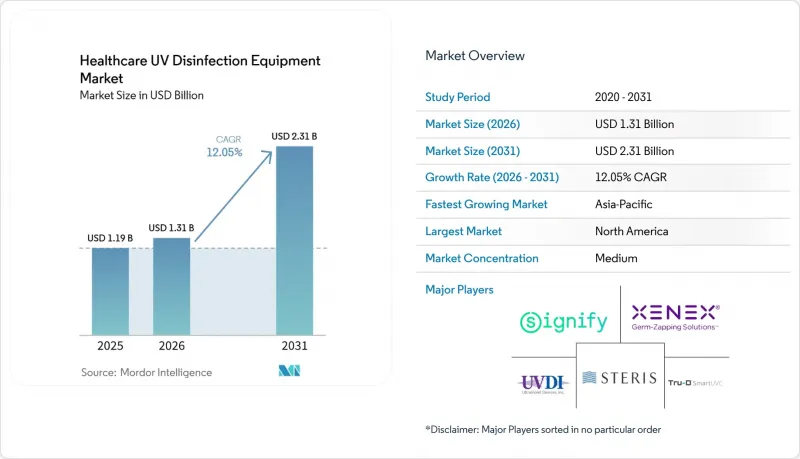
의료용 자외선 소독 장비 시장은 2025년 11억 9,000만 달러로 평가되었고, 2026년에는 13억 1,000만 달러로 확대될 것으로 추정되고, 2031년까지 23억 1,000만 달러에 이를 것으로 예상되며, 2026-2031년 CAGR 12.05%로 성장할 전망입니다.
본 보고서는 제품 유형별(UV-C 로봇, 고정식 UV-C 시스템 등), 기술별(저압 수은 램프 방식, 펄스식 크세논 등), 용도별(환자실 소독 등), 최종 사용자별(병원, 외래수술센터(ASC) 등), 지역별(북미, 유럽, 아시아태평양 등)로 분류되어 있습니다. 시장 전망은 금액(달러) 기준으로 제시되어 있습니다.
세계의 의료용 자외선 소독 장비 시장 동향 및 인사이트
고도 급성기 의료 분야에서 의료 관련 감염에 대한 압박 증가
의료용 자외선 소독 장비 시장은 병원 환경 내 병원 내 감염의 뿌리 깊은 존재로 인해 계속해서 가장 큰 성장 동력을 얻고 있습니다. 2026년 1월에 발표된 CDC의 2024년 전국 보고서에 따르면, 2023년과 비교하여 병원 내에서 발병한 C. 디피실 감염증은 11% 감소했고, MRSA 균혈증은 7% 감소한 것으로 나타나, 감염 관리가 의료 제공업체에게 여전히 운영상의 최우선 과제임을 뒷받침하고 있습니다. 또한, 같은 보고서에서는 2024년에 복식 자궁 적출술 후 수술 부위 감염이 8% 증가한 것으로 나타나, 다른 감염 범주에서는 광범위한 진전이 보이는 반면, 여전히 중요한 과제가 남아 있음을 시사하고 있습니다. 업계 단체의 데이터에 따르면, WHO 추산으로 입원 환자의 10%가 의료 관련 감염에 걸려 있으며, 항생제 내성은 매년 1억 3,600만 건의 관련 사례와 연관되어 있어 전 세계적인 감염 위험은 여전히 크다고 할 수 있습니다. 이러한 상황에서 의료용 자외선 소독 장비 시장은 혜택을 보고 있습니다. 이는 UV-C 시스템이 화학 잔류물이나 항생제 내성 위험을 증가시키지 않으면서 병원체를 처리할 수 있기 때문입니다. 따라서 조달 담당 팀은 이러한 장비를 단순한 선택적 추가 기능이 아닌, 기본적인 감염 관리 역량의 일부로 인식하기 시작했습니다.
사람이 머무는 공간에서 화학 물질을 사용하지 않는 지속적인 소독으로의 전환
의료용 자외선 소독 장비 시장은 정기적인 병실 폐쇄에서 사람이 머무는 공간에서의 지속적인 병원체 관리로 전환되는 추세로 인해 혜택을 보고 있습니다. 『Infection Control &Hospital Epidemiology』지에 게재된 2025년 연구에 따르면, 천장에 설치된 원자외선(far-UVC) 조명 기구는 직원과 환자가 일상적으로 활동하는 동안에도 사람이 머무르는 임상 구역 표면의 생물 부하를 감소시키는 것으로 밝혀졌습니다. 따라서 의료용 자외선 소독 장비 시장은 사람이 상주하고 있어 수동 소독을 필요한 빈도로 반복하기 어려운 병동, 검사실, 간호 구역에서 성장 여지가 있습니다. 2025년 스웨덴의 완화의료 병동에서 진행된 도입 사례에 따르면, 직원의 병가율이 0.4%였던 반면 지역 평균은 약 6%였던 것으로 보고되었으며, 이를 통해 원자외선(far-UVC)은 중환자실 이외의 현장에서도 운영상의 논의에 적극적으로 반영되고 있습니다.
어수선한 진료실에서의 유효성을 저하시키는 ‘시야 범위’의 제한
의료용 자외선 소독 장비 시장은 기기가 밀집되어 있고 불규칙한 형태의 표면을 가진 공간에서 여전히 기본적인 성능상의 과제에 직면해 있습니다. 중환자실, 수술실, 약품 관리 공간 등에서는 노출된 표면에 비해 조사량이 약해지는 그림자 영역이 발생하는 경우가 많습니다. 따라서 의료용 자외선 소독 장비 시장은 조사량 공급과 실제 방의 형태 사이의 격차를 메우기 위해 다중 위치 조사 사이클, 에미터 추가, 혹은 더 정밀한 실내 매핑에 여전히 의존하고 있습니다. 이러한 기능들이 제품 간에 보다 일관되게 구현될 때까지, 병원 측은 ‘실 전체에 대한 유효성’에 대한 주장을 엄격하게 검토할 것입니다.
부문 분석
2025년, UV-C 로봇은 제품 유형별 부문의 46.38%를 차지했으며, 의료용 자외선 소독 장비 시장에서 가장 큰 카테고리가 되었습니다. 이러한 위상은 수작업에 대한 의존을 최소화하면서, 자율적이고 조사량이 검증된 실내 소독을 추구하는 중증 환자 치료 시설에서의 도입이 활발함을 반영합니다. 또한, 환자 유입이 빈번하고 감염 예방 팀이 재현 가능한 워크플로우를 필요로 하는 병원에서도 이러한 시스템이 선호되고 있습니다. 따라서 의료용 자외선 소독 장비 업계에서는 대규모 시설의 조달에 있어 로봇 플랫폼이 핵심 기준 카테고리로 간주되고 있습니다.
휴대용 UV-C 장치는 2031년까지 연평균 성장률(CAGR) 12.62%를 나타낼 것으로 예측되며, 의료용 자외선 소독 장비 시장에서 가장 빠르게 성장하는 제품 형태가 될 것입니다. 2025년 유전체 분석에 따르면, 원자외선(far-UVC) 휴대용 기기를 사용함으로써 안락의자, 키보드, 작업실 표면에서 평균 53%에서 83%의 콜로니 형성 단위(CFU) 감소가 보고되었습니다. 이러한 유연성이 중요한 이유는 직원이 실내용 로봇으로는 완전히 처리할 수 없는 그림자가 드리워진 곳이나 불규칙한 표면을 집중적으로 처리할 수 있기 때문입니다. 따라서 휴대용 기기는 단순한 저비용 대체품이 아니라 로봇을 보완하는 존재가 되고 있습니다.
저압 수은 램프 방식의 시스템은 2025년 기준 기술 부문의 49.72%를 차지하고 있으며, 이는 의료용 자외선 소독 장비 시장에서 여전히 가장 많은 도입 실적을 보유하고 있음을 의미합니다. 이러한 위상은 병원 내 UV-C 도입에 대한 오랜 사용 실적과 254 nm 파장에서 입증된 살균 성능을 반영한 것입니다. 많은 시설이 이미 그 운영 특성과 교체 필요성을 이해하고 있기 때문에 이러한 시스템은 계속해서 조달 주기에 포함되고 있습니다. 따라서 의료용 UV 살균 장치 시장에서는 여전히 큰 기존 도입 기반 효과가 존재하며, 단기적으로는 기존의 수은 플랫폼에 유리하게 작용하고 있습니다.
UV-C LED 시스템은 2031년까지 연평균 성장률(CAGR) 14.18%를 나타낼 것으로 예측되며, 의료용 UV 살균 장치 시장에서 가장 빠르게 성장하는 기술이 될 것입니다. 222 nm 원자외선(Far-UVC) 시스템은 현재 보다 광범위하게 시험이 진행되고 있는 임상 조건 하에서 사람이 머무는 공간에서도 사용할 수 있기 때문에 추가적인 변화를 가져오고 있습니다. 그 결과, 기술 전환은 부품의 발전과 시설이 UV 살균을 어떻게 적용하고자 하는지에 대한 사고방식의 광범위한 변화 모두에 의해 추진되고 있습니다.
지역별 분석
2025년, 북미는 전 세계 매출의 42.19%를 차지했으며, 지역별 의료용 UV 소독 장비 시장 점유율에서 1위를 기록했습니다. 이 지역은 의료 관련 감염에 대한 높은 인식과 감염 관리 성과, 조달 기준 및 병원 운영 우선순위 간의 일관성이 강화되고 있다는 이점을 가지고 있습니다. 미국 전역의 병원들은 의료 관련 감염(HAI) 보고와 관련해 여전히 상당한 압박에 직면해 있으며, 이는 검증된 환경 소독 도구에 대한 수요를 유지하는 데 기여하고 있습니다. 또한, 2026년 1월 Xenex사가 ‘LightStrike6’에 대해 캐나다 보건부(Health Canada)의 등록을 획득함에 따라, 캐나다 역시 해당 지역 내 조달에서 중요성이 커지고 있습니다. 미국이 여전히 주요 수익원이기는 하지만, 멕시코와 캐나다에는 추가적인 성장 여지가 있습니다.
유럽은 감염 관리에 대한 인식이 높고 도입 대수도 많아, 의료용 자외선 소독 장비 시장의 주요 축 중 하나로 자리 잡고 있습니다. 독일, 영국, 프랑스, 이탈리아, 스페인은 광범위한 병원 인프라와 교체 주기를 통해 지속적으로 수요를 뒷받침하고 있습니다. UV 스펙트럼 수은 램프에 대한 RoHS 규제 면제 재검토로 인해 구매자들은 장기적인 자본 계획에서 수은이 포함되지 않은 대체품에 대해 더 조기에 검토해야 하는 상황에 놓여 있습니다. 조달 기준도 중요하며, IEC 62471 및 UL 8802는 살균용 UV 기기 및 시스템의 안전성에 관한 기술적 요건을 규정하고 있습니다.
아시아태평양은 의료용 UV 소독 장비 시장에서 가장 빠르게 성장하는 지역 블록이 될 것으로 예상되며, 2031년까지 연평균 성장률(CAGR)은 15.31%로 성장이 전망됩니다. 이러한 성장은 중국, 인도, 일본, 한국, 호주의 병원 확장, 감염 관리의 현대화, 그리고 LED 기반 시스템에 대한 관심 증가와 밀접한 관련이 있습니다. 일본과 한국은 로봇 도입에서 앞서가고 있지만, 인도와 동남아시아는 도입 초기 단계에 있으며 자본 집약도가 낮은 시스템을 선호하는 경향이 강합니다. 중동 및 아프리카는 여전히 초기 단계 시장이지만, GCC(걸프협력회의) 국가들의 병원 확장 계획으로 인해 통합형 UV-C 설비에 대한 수요가 발생하고 있습니다. 또한 사하라 이남 아프리카에서는 남아프리카공화국이 도입 측면에서 가장 선진적인 기반을 갖추고 있습니다. 남미는 여전히 발전 단계에 있지만, 브라질과 아르헨티나가 지역 수요를 주도하고 있으며, 민간 병원에 대한 투자로 인해 이러한 기술에 대한 접근성이 점차 개선되고 있습니다.
기타 혜택 :
- 엑셀 형식 시장 예측(ME) 시트
- 3개월간의 애널리스트 지원
자주 묻는 질문
목차
제1장 서론
제2장 조사 방법
제3장 주요 요약
제4장 시장 구도
제5장 시장 규모 및 성장 예측
제6장 경쟁 구도
제7장 시장 기회 및 향후 전망
AJY 26.08.11According to Mordor Intelligence, the healthcare UV disinfection equipment market is expected to increase from USD 1.19 billion in 2025 to USD 1.31 billion in 2026 and reach USD 2.31 billion by 2031, growing at a CAGR of 12.05% over 2026-2031.
This report is Segmented by Product Type (UV-C Robots, Fixed UV-C Systems, and More), Technology (Low-Pressure Mercury Lamp-Based Systems, Pulsed Xenon, and More), Application (Patient Room Disinfection, and More), End-User (Hospitals, Ambulatory Surgical Centers, and More), and Geography (North America, Europe, Asia-Pacific, and More). The Market Forecasts are Provided in Terms of Value (USD).
Global Healthcare UV Disinfection Equipment Market Trends and Insights
Rising Healthcare-Associated Infection Pressure in High-Acuity Care
The healthcare UV disinfection equipment market continues to draw its strongest support from the persistence of healthcare-associated infections in hospital settings. The CDC's 2024 national report, published in January 2026, showed a 11% decline in hospital-onset C. difficile and a 7% decline in MRSA bacteremia versus 2023, which confirms that infection control remains a central operating priority for providers. The same report also showed that abdominal hysterectomy surgical site infections increased 8% in 2024, which suggests that important gaps remain despite broader progress in other infection categories. Global infection pressure remains large as industry association data cited a WHO estimate that 10% of hospitalized patients acquire a healthcare-associated infection, while antimicrobial resistance is linked to 136 million related cases each year. In this setting, the healthcare UV disinfection equipment market benefits because UV-C systems address pathogens without adding chemical residue or antimicrobial resistance pressure. That is why purchasing teams increasingly view these devices as part of baseline infection control capacity rather than as an optional add-on.
Shift Toward Continuous, Chemical-Free Disinfection in Occupied Spaces
The healthcare UV disinfection equipment market is also gaining from the move away from periodic room shutdowns toward continuous germ control in occupied spaces. A 2025 study in Infection Control & Hospital Epidemiology found that ceiling-mounted far-UVC fixtures reduced surface bioburden in occupied clinical areas even during routine staff and patient activity. The healthcare UV disinfection equipment market therefore has room to grow in wards, laboratories, and care areas where steady occupancy makes manual disinfection harder to repeat at the needed frequency. A 2025 installation in a Swedish palliative care ward also reported staff sick leave of 0.4% compared with a regional average near 6%, which is helping far-UVC enter more operational conversations beyond intensive care settings.
Line-of-Sight Limitations that Reduce Efficacy in Cluttered Clinical Rooms
The healthcare UV disinfection equipment market still faces a basic performance challenge in rooms with dense equipment and irregular surfaces. Intensive care units, operating rooms, and medication spaces often create shadowed areas that receive a weaker dose than exposed surfaces. The healthcare UV disinfection equipment market therefore still depends on multi-position cycles, added emitters, or better room mapping to close the gap between dose delivery and real-world room geometry. Until those features become more consistent across products, hospitals will continue to scrutinize claims around whole-room effectiveness.
Other drivers and restraints analyzed in the detailed report include:
- Expansion of UV-C Use Beyond Terminal Cleaning into Air, Surfaces, and Devices
- Declining UV-C LED Costs and Improved Energy Efficiency
- High Capex and Service Burden for Hospital-Grade Systems
For complete list of drivers and restraints, kindly check the Table Of Contents.
Segment Analysis
UV-C robots held 46.38% of the product type segment in 2025, which made them the largest category in the healthcare UV disinfection equipment market. Their position reflects strong adoption in high-acuity facilities that want autonomous, dose-verified room disinfection with limited dependence on manual technique. Hospitals also favor these systems where patient turnover is high and infection prevention teams need repeatable workflows. The healthcare UV disinfection equipment industry therefore treats robotic platforms as the core reference category for large-site procurement.
Handheld UV-C devices are forecasted to grow at 12.62% CAGR through 2031, which makes them the fastest-rising product format in the healthcare UV disinfection equipment market. A 2025 genomic analysis also reported mean colony-forming unit reductions of 53% to 83% across armchairs, keyboards, and workroom surfaces with a far-UVC handheld device. Their flexibility matters because staff can target shadowed or irregular surfaces that room robots may not fully address. That makes handheld tools a complement to robots instead of a simple low-cost substitute.
Low-pressure mercury lamp-based systems retained 49.72% of the technology segment in 2025, which means they still represented the largest installed technology base in the healthcare UV disinfection equipment market. Their position reflects long-standing use in hospital UV-C deployments and familiar germicidal performance at 254 nm. These systems remain embedded in procurement cycles because many facilities already understand their operating profile and replacement needs. The healthcare UV disinfection equipment market therefore still carries a large installed-base effect that favors existing mercury platforms in the near term.
UV-C LED systems are projected to grow at 14.18% CAGR through 2031, which makes them the fastest-growing technology in the healthcare UV disinfection equipment market. Far-UVC systems at 222 nm add another layer of change because they can be used in occupied spaces under clinical conditions now being tested more widely. As a result, the technology shift is being driven by both component progress and a broader change in how facilities want to apply UV disinfection.
Complete Report Scope:
- By Product Type
- UV-C Robots
- Fixed UV-C Systems
- Handheld UV-C Devices
- UV-C Cabinets and Chambers
- By Technology
- Low-Pressure Mercury Lamp-Based Systems
- Pulsed Xenon Systems
- UV-C LED Systems
- Far-UVC Systems
- By Application
- Patient Room Disinfection
- Air Disinfection in Clinical Areas
- Operating Room Sterilization
- Medical Equipment Disinfection
- By End-User
- Hospitals
- Ambulatory Surgical Centers
- Diagnostic Laboratories
- Long-Term Care Facilities
- By Geography
- North America
- United States
- Canada
- Mexico
- Europe
- Germany
- United Kingdom
- France
- Italy
- Spain
- Rest of Europe
- Asia-Pacific
- China
- Japan
- India
- Australia
- South Korea
- Rest of Asia-Pacific
- Middle East and Africa
- GCC
- South Africa
- Rest of Middle East and Africa
- South America
- Brazil
- Argentina
- Rest of South America
- North America
Geography Analysis
North America held 42.19% of global revenue in 2025, which gave it the largest position in the healthcare UV disinfection equipment market share by region. The region benefits from high awareness of healthcare-associated infections and stronger alignment between infection outcomes, procurement standards, and hospital operating priorities. Hospitals across the United States continue to face visible HAI reporting pressure, which helps sustain demand for validated environmental disinfection tools. Canada is also becoming more relevant in regional procurement, with Xenex receiving Health Canada registration for LightStrike6 in January 2026. Mexico and Canada offer additional room for expansion, though the U.S. remains the main revenue anchor.
Europe remains one of the core pillars of the healthcare UV disinfection equipment market because infection control awareness is high and the installed base is large. Germany, the United Kingdom, France, Italy, and Spain continue to anchor demand through broad hospital infrastructure and replacement cycles. The review of the RoHS exemption for UV-spectrum mercury lamps is pushing buyers to think earlier about mercury-free alternatives in long-term capital plans. Procurement standards also matter, with IEC 62471 and UL 8802 shaping the technical expectations around germicidal UV equipment and system safety.
Asia-Pacific is expected to be the fastest-growing regional block in the healthcare UV disinfection equipment market, with a projected CAGR of 15.31% through 2031. Growth is tied to hospital expansion, infection-control modernization, and rising interest in LED-based systems across China, India, Japan, South Korea, and Australia. Japan and South Korea are ahead in robotic adoption, while India and Southeast Asia are earlier in the uptake curve and are more likely to favor systems with lower capital intensity. The Middle East and Africa remain earlier-stage markets, although GCC hospital expansion programs are creating demand for integrated UV-C installations, and South Africa has the most advanced sub-Saharan base for adoption. South America is still developing, with Brazil and Argentina leading regional demand as private hospital investment gradually improves access to these technologies.
- Aereus Technologies Inc.
- American Ultraviolet
- Aqua Ultraviolet
- Aquionics
- Atlantic Ultraviolet
- Bioquell Group
- Crystal IS, Inc.
- Ecolab
- Finsen Technologies
- Halma
- Lumalier Corporation
- Signify N.V.
- Skytron
- Steriliz LLC
- STERIS
- Trojan Technologies
- Tru-D SmartUVC
- UltraViolet Devices
- UVD Robots
- Xenex Disinfection Services, Inc.
Additional Benefits:
- The market estimate (ME) sheet in Excel format
- 3 months of analyst support
TABLE OF CONTENTS
1 Introduction
- 1.1 Study Assumptions and Market Definition
- 1.2 Scope of the Study
2 Research Methodology
3 Executive Summary
4 Market Landscape
- 4.1 Market Overview
- 4.2 Market Drivers
- 4.2.1 Rising Healthcare-Associated Infection Pressure in High-Acuity Care
- 4.2.2 Shift Toward Continuous, Chemical-Free Disinfection in Occupied Spaces
- 4.2.3 Expansion of UV-C Use Beyond Terminal Cleaning into Air, Surfaces, and Devices
- 4.2.4 Retrofit Demand from HVAC and Upper-Air Infection-Control Upgrades
- 4.2.5 Declining UV-C LED Costs and Improved Energy Efficiency
- 4.2.6 Need for Audit-Ready Disinfection Traceability in Regulated Facilities
- 4.3 Market Restraints
- 4.3.1 Line-of-Sight Limitations that Reduce Efficacy in Cluttered Clinical Rooms
- 4.3.2 Safety, Certification, and Operator Exposure Constraints
- 4.3.3 High Capex and Service Burden for Hospital-Grade Systems
- 4.3.4 Supply Concentration in Deep-UV Components and Replacement Parts
- 4.4 Supply/Value Chain Analysis
- 4.5 Regulatory Landscape
- 4.6 Technological Outlook
- 4.7 Porter's Five Forces Analysis
- 4.7.1 Threat of New Entrants
- 4.7.2 Bargaining Power of Suppliers
- 4.7.3 Bargaining Power of Buyers
- 4.7.4 Threat of Substitutes
- 4.7.5 Competitive Rivalry
5 Market Size & Growth Forecasts (Value, USD)
- 5.1 By Product Type
- 5.1.1 UV-C Robots
- 5.1.2 Fixed UV-C Systems
- 5.1.3 Handheld UV-C Devices
- 5.1.4 UV-C Cabinets and Chambers
- 5.2 By Technology
- 5.2.1 Low-Pressure Mercury Lamp-Based Systems
- 5.2.2 Pulsed Xenon Systems
- 5.2.3 UV-C LED Systems
- 5.2.4 Far-UVC Systems
- 5.3 By Application
- 5.3.1 Patient Room Disinfection
- 5.3.2 Air Disinfection in Clinical Areas
- 5.3.3 Operating Room Sterilization
- 5.3.4 Medical Equipment Disinfection
- 5.4 By End-User
- 5.4.1 Hospitals
- 5.4.2 Ambulatory Surgical Centers
- 5.4.3 Diagnostic Laboratories
- 5.4.4 Long-Term Care Facilities
- 5.5 By Geography
- 5.5.1 North America
- 5.5.1.1 United States
- 5.5.1.2 Canada
- 5.5.1.3 Mexico
- 5.5.2 Europe
- 5.5.2.1 Germany
- 5.5.2.2 United Kingdom
- 5.5.2.3 France
- 5.5.2.4 Italy
- 5.5.2.5 Spain
- 5.5.2.6 Rest of Europe
- 5.5.3 Asia-Pacific
- 5.5.3.1 China
- 5.5.3.2 Japan
- 5.5.3.3 India
- 5.5.3.4 Australia
- 5.5.3.5 South Korea
- 5.5.3.6 Rest of Asia-Pacific
- 5.5.4 Middle East and Africa
- 5.5.4.1 GCC
- 5.5.4.2 South Africa
- 5.5.4.3 Rest of Middle East and Africa
- 5.5.5 South America
- 5.5.5.1 Brazil
- 5.5.5.2 Argentina
- 5.5.5.3 Rest of South America
- 5.5.1 North America
6 Competitive Landscape
- 6.1 Market Concentration
- 6.2 Market Share Analysis
- 6.3 Company Profiles (includes Global level Overview, Market level overview, Core Segments, Financials as available, Strategic Information, Market Rank/Share for key companies, Products & Services, Recent Developments)
- 6.3.1 Aereus Technologies Inc.
- 6.3.2 American Ultraviolet
- 6.3.3 Aqua Ultraviolet
- 6.3.4 Aquionics
- 6.3.5 Atlantic Ultraviolet Corporation
- 6.3.6 Bioquell Group
- 6.3.7 Crystal IS, Inc.
- 6.3.8 Ecolab Inc.
- 6.3.9 Finsen Technologies
- 6.3.10 Halma plc
- 6.3.11 Lumalier Corporation
- 6.3.12 Signify N.V.
- 6.3.13 Skytron, LLC
- 6.3.14 Steriliz LLC
- 6.3.15 STERIS plc
- 6.3.16 Trojan Technologies
- 6.3.17 Tru-D SmartUVC
- 6.3.18 UltraViolet Devices, Inc.
- 6.3.19 UVD Robots
- 6.3.20 Xenex Disinfection Services, Inc.
7 Market Opportunities & Future Outlook
- 7.1 White-space & Unmet-need Assessment


