|
시장보고서
상품코드
2099957
연부조직 육종 시장 : 시장 점유율 분석, 업계 동향 및 통계, 성장 예측(2026-2031년)Soft Tissue Sarcoma - Market Share Analysis, Industry Trends & Statistics, Growth Forecasts (2026 - 2031) |
||||||
 Mordor Intelligence
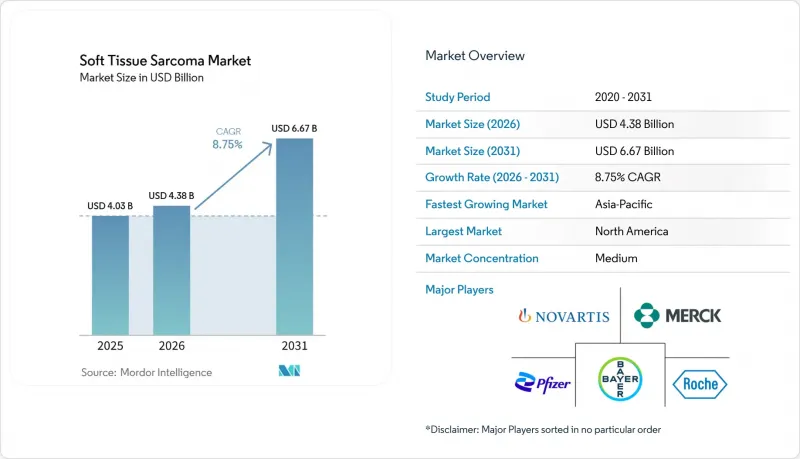
Mordor Intelligence에 의하면, 연부조직 육종 시장 규모는 2025년 40억 3,000만 달러로 평가되었고, 2026년에는 43억 8,000만 달러로 확대될 것으로 추정되고, 2031년까지 66억 7,000만 달러에 이를 것으로 예상되며, 2026-2031년 CAGR 8.75%로 성장할 전망입니다.
본 보고서는 제공 서비스별(진단, 치료), 육종 유형별(지방육종, 평활근육종, 활막육종, 횡문근육종, MPNST, 기타), 최종 사용자별(병원, 암 연구센터, 진단실험실, 외래수술센터(ASC), 기타), 지역별(북미, 유럽, 아시아태평양, 기타)로 분류되어 있습니다. 시장 전망은 금액(달러) 기준으로 제시되어 있습니다.
세계의 연부조직 육종 시장 동향 및 인사이트
연부조직 육종 발병률 증가 및 전문 의료 센터로의 조기 의뢰
Cancer Research UK의 보고에 따르면, 잉글랜드의 연부조직 육종 발생률은 지난 10년간 7% 증가했으며, 이러한 증가는 새로운 노출 패턴에 기인한 것이 아니라 감시 체계 강화 및 인구 고령화와 관련이 있는 것으로 나타났습니다. 연부조직 육종 시장에 더 중요한 영향은 조기 의뢰를 통해 치료 지연이나 단편화가 발생하기 전에 더 많은 환자가 전문 의료 경로로 유도된다는 점입니다. 2025년 GEIS 지침에서는 MRI를 1차 영상 진단법으로 지정하고, 의뢰 의료기관에서의 3-4코어 코어 바늘 생검을 시술 표준으로 정함으로써, 이를 통해 고도의 진단 및 치료로 이어지는 경로가 공식적으로 확립되었습니다. 또한 독일, 프랑스, 영국의 지역 육종 센터에서 운영되는 다학제 종양 위원회는 의뢰 기준을 더욱 일관성 있게 만들고, 의심 증상이 발생한 후 전문의 진찰을 받기까지의 기간을 단축하고 있습니다. 이는 연부 조직 육종 시장이 환자 수 증가뿐만 아니라 영상 진단, 생검, 병리 검사, 분자 검사에 이르는 환자 1인당 검사 및 시술 빈도 증가로부터도 혜택을 받을 것임을 의미합니다.
표적 치료 및 면역 치료 파이프라인의 확대
2024년 8월, FDA는 절제 불가능하거나 전이성 활막육종에 대한 아파미트레스젠 오토로이셀의 신속 승인을 승인했으며, 이를 통해 고형암 전반에 대해 승인된 최초의 유전자 변형 T세포 수용체 치료법이 확립되었습니다. 또한, 44명의 환자를 대상으로 한 SPEARHEAD-1 코호트 1 임상시험에서는 43.2%의 전체 반응률이 보고되었습니다. 2026년 6월의 완전 승인을 통해 적응증이 12세 이상 환자로 확대되었으며, 137명의 환자를 대상으로 한 확인된 전체 반응률은 43.8%로 보고되었고, 반응자의 31.9%가 24개월 시점에서 지속적인 반응을 유지하고 있었습니다. 연부조직 육종 시장에서 이러한 변화는 중요한 의미를 지닙니다. 왜냐하면 매출 성장은 진단 건수의 광범위한 증가에만 기인한 것이 아니라, 바이오마커를 통해 선별된 환자를 대상으로 한 프리미엄 치료법에 의해 주도되고 있기 때문입니다. 또한 연부조직 육종 시장에서는 PD-1 및 PD-L1 프로그램, CDK4 표적 치료법, 항체-약물 복합체(ADC), 차세대 TCR 플랫폼 등에 대한 투자가 더욱 심화되고 있어, 이를 통해 향후 더 폭넓은 정밀 치료 조합이 실현될 것으로 기대됩니다. 아형에 특화된 프로그램이 성숙해짐에 따라, 연부육종 시장의 상업적 리더십은 암 치료 전반의 규모보다는 바이오마커 접근성, 환자 유입 확보, 그리고 적격 치료 시설에서의 시행 능력에 더 크게 좌우될 것입니다.
각 아형별 환자 수의 부족 및 임상시험 피험자 모집의 병목 현상
연부육종에는 70개 이상의 조직학적 아형이 존재하며, 이러한 세분화로 인해 개별 후기 임상시험에서 달성할 수 있는 통계적 검정력의 한계가 발생하고 있습니다. 악성 말초 신경초종이나 폐포성 연부육종과 같은 희귀 아형의 경우, 소규모 임상시험이라 하더라도 피험자 등록에 수년이 소요될 수 있으며, 이는 승인까지의 기간을 지연시키고 경쟁사 시장 진입을 제한하고 있습니다. 연부육종 시장에서 이는 보다 전통적인 개발 경로를 뒷받침할 만큼 충분한 규모를 가진 아형, 특히 지방육종이나 평활근육종에서 여전히 가장 강력한 상업적 모멘텀이 나타나고 있음을 의미합니다. 임상시험 기관들은 바스켓형 접근법을 통해 조직형을 조합하거나, 장기 생존 데이터가 나올 때까지 기다리지 않고 반응 평가 지표에 기반한 승인 경로를 모색함으로써 이러한 제약을 완화하려고 노력하고 있습니다. 아형 레지스트리나 바이오마커를 통한 사전 선별 코호트가 더 광범위하고 일관성을 갖추게 될 때까지는 연부조직육종 시장은 더 대규모의 종양학 카테고리에 비해 신약 출시 속도가 느린 상황이 지속될 것으로 예측됩니다.
부문 분석
2025년 시점에서 치료법은 제공 범주 내 연부육종 시장의 68.31% 점유율을 차지했으며, 2031년까지 연평균 성장률(CAGR)이 9.38%로 가장 빠르게 성장하는 하위 부문이기도 합니다. 연부육종 시장의 치료 분야가 최대의 수익 기반을 담당하고 있는 이유는 전신 요법, 수술 및 병용 요법이 일반적인 병기 및 진행 병기를 불문하고 여전히 대부분의 치료 경로의 기반을 이루고 있기 때문입니다. 새로운 바이오마커 기반 치료법은 특정 아형에서 지속적인 치료 효과가 프리미엄 가격 책정 및 전문의 주도 제공 모델을 뒷받침하고 있어, 이 부문의 성장 상한선을 높이고 있습니다. 이러한 변화에도 불구하고, 화학요법은 평활근육종 및 기타 환자 수가 많은 연부육종 사례에서 여전히 핵심을 차지하고 있어 널리 사용되고 있습니다.
진단은 시장 구조의 균형을 유지하는 역할을 담당하고 있으며, 치료 접근성이 바이오마커 확인에 점점 더 의존하게 됨에 따라 연부육종 시장에서 그 역할은 더욱 전략적인 것으로 변모하고 있습니다. 종합적인 유전체 프로파일링, 융합 유전자 검출 및 MAGE-A4 관련 검사는 치료 승인 과정의 초기 단계에서 이루어지기 때문에 병리 및 검사 서비스의 가치를 높이고 있습니다. MRI 또한 지침에 따른 1차 검사법이라는 점에 더해, 전문 의료기관이 육종 환자의 전원 환자를 위해 보다 체계적인 영상 진단 체계를 구축하고 있기 때문에 여전히 중심적인 위치를 차지하고 있습니다. 액체 생검에 기반한 모니터링을 포함한 기타 진단법은 여전히 주로 학술적 용도로 제한되어 있지만, 검증 정확도가 향상됨에 따라 연부육종 시장에서 지속적인 검사 수요의 기반을 마련하고 있습니다.
지역별 분석
2025년, 북미는 연부육종 시장의 41.61% 점유율을 차지했으며, 매출 측면에서 가장 큰 기여를 한 지역이 되었습니다. 이 지역은 전문 의료 센터의 밀집된 네트워크, 희귀암 승인을 신속화하는 희귀질환 치료제(오펀 드럭) 제도, 그리고 다른 많은 지역보다 비용이 높은 치료법을 쉽게 수용할 수 있는 보험 급여 제도의 혜택을 받고 있습니다. 이 가치의 대부분을 견인하고 있는 것은 미국으로, 이는 다른 국가에서는 유례를 찾기 힘들 정도로 풍부한 의뢰 환자층, 시판 의약품의 보급률, 그리고 적격 치료 시설 인프라가 결합되어 있기 때문입니다. 캐나다도 수요를 뒷받침하고 있지만, 공공 자금 지원 체계로 인해 고가 치료법에 대한 접근 시기가 달라질 수 있습니다. 유럽은 연부육종 시장에서 2위를 차지하고 있으며, 프랑스, 독일, 이탈리아, 스페인, 영국에 전문 지식과 임상시험 활동이 집중된 레퍼런스 네트워크에 의해 뒷받침되고 있습니다.
아시아태평양은 가장 빠르게 성장하는 지역으로, 연부육종 시장에서 2031년까지 연평균 성장률(CAGR) 9.65%로 확대될 것으로 예측됩니다. 이러한 성장은 분자진단 능력 향상, 암 치료 분야에 대한 투자 확대, 그리고 특정 국가에서 접근성 향상을 촉진하는 희귀암 관련 규제 조치에 힘입은 것입니다. 일본이 두드러지는 이유는 후생노동성이 2025년 2월 절제 불가능한 폐포성 연부육종에 대한 아테졸리주맙의 승인을 결정하여, 이 극히 희귀한 적응증에서 최초로 승인된 면역관문억제제가 되었기 때문입니다. 중국은 연부육종 시장에서 여전히 장기적인 큰 기회를 내포하고 있지만, 주요 대도시권 이외의 지역에서는 표준화된 수술 후 관리 및 분자 프로파일링의 시행 현황에 여전히 편차가 나타나고 있습니다.
한국과 인도는 아시아태평양의 다음 중요한 성장 동력으로 부상하고 있습니다. 이는 두 나라가 연부육종 시장의 확대 과정에서 각각 다른 측면을 뒷받침하고 있기 때문입니다. 한국은 탄탄한 진단 환경을 통해 기여하고 있는 반면, 인도는 암 연구에 대한 투자 증가와 임상시험 참여 확대를 통해 그 중요성을 높이고 있습니다. 남미, 중동 및 아프리카는 주요 도시를 제외한 지역에서는 전문 의료 센터, 보험 급여 범위, 분자 병리학에 대한 접근성이 여전히 제한적이기 때문에 연부육종 시장에서는 여전히 초기 단계에 머물러 있습니다. 남미에서는 브라질과 아르헨티나가 가장 큰 환자 기반을 보유하고 있는 반면, GCC 국가들에서는 암 센터의 수용 능력이 확대되고 있어, 이에 따라 향후 해당 수요가 점차 확대될 것으로 전망됩니다.
기타 혜택 :
- 엑셀 형식 시장 예측(ME) 시트
- 3개월간의 애널리스트 지원
자주 묻는 질문
목차
제1장 서론
제2장 조사 방법
제3장 주요 요약
제4장 시장 구도
제5장 시장 규모 및 성장 예측
제6장 경쟁 구도
제7장 시장 기회 및 향후 전망
AJY 26.08.07According to Mordor Intelligence, the soft tissue sarcoma market size is expected to increase from USD 4.03 billion in 2025 to USD 4.38 billion in 2026 and reach USD 6.67 billion by 2031, growing at a CAGR of 8.75% over 2026-2031.
This report is Segmented by Offering (Diagnosis, Treatment), Type of Sarcoma (Liposarcoma, Leiomyosarcoma, Synovial Sarcoma, Rhabdomyosarcoma, MPNST, Others), End User (Hospitals, Cancer Research Centers, Diagnostic Laboratories, Ambulatory Surgical Centers, Others), and Geography (North America, Europe, Asia-Pacific, and More). Market Forecasts are Provided in Terms of Value (USD).
Global Soft Tissue Sarcoma Market Trends and Insights
Rising Incidence of Soft Tissue Sarcoma and Earlier Referral to Specialty Centers
Cancer Research UK reported that soft tissue sarcoma incidence rates in England increased by 7% over the past decade, and the rise was tied to stronger surveillance and demographic aging rather than to a new exposure pattern. For the soft tissue sarcoma market, the more important effect is that earlier referral brings more patients into specialist pathways before care becomes delayed or fragmented. The 2025 GEIS guidelines set MRI as the first-line imaging modality and core needle biopsy with 3-4 cores at referral centers as the procedural standard, which formalizes the route into advanced diagnosis and treatment. Multidisciplinary tumor boards at regional sarcoma centers in Germany, France, and the United Kingdom are also making referral thresholds more consistent and shortening the path from suspicion to specialist consultation. This means the soft tissue sarcoma market gains not only from case capture, but also from higher procedure intensity per patient across imaging, biopsy, pathology review, and molecular testing.
Expansion of Targeted Therapy and Immunotherapy Pipelines
The August 2024 FDA accelerated approval of afamitresgene autoleucel for unresectable or metastatic synovial sarcoma established the first engineered T-cell receptor therapy approved for any solid tumor and reported a 43.2% overall response rate in the SPEARHEAD-1 Cohort 1 trial of 44 patients. The June 2026 full approval expanded the label to patients 12 years of age and older and reported a confirmed overall response rate of 43.8% across 137 patients, with 31.9% of responders maintaining durable response at 24 months. In the soft tissue sarcoma market, that change matters because revenue growth is being driven by premium therapies in biomarker-selected patients rather than by a broad increase in diagnosis alone. The soft tissue sarcoma market is also seeing deeper investment across PD-1 and PD-L1 programs, CDK4-directed approaches, antibody-drug conjugates, and next-generation TCR platforms, which supports a wider precision treatment mix over time. As more subtype-specific programs mature, commercial leadership in the soft tissue sarcoma market is likely to depend less on broad oncology scale and more on biomarker access, referral depth, and execution at qualified treatment sites.
Small Patient Pools and Trial Recruitment Bottlenecks Across Subtypes
Soft tissue sarcoma includes more than 70 histologic subtypes, and that fragmentation limits how much statistical power can be achieved in any single late-stage trial. In rare subtypes such as malignant peripheral nerve sheath tumor and alveolar soft part sarcoma, even modest studies can take years to enroll, which slows approval timing and keeps competitive entry narrow. For the soft tissue sarcoma market, that means the strongest commercial momentum still sits in subtypes large enough to support more conventional development paths, especially liposarcoma and leiomyosarcoma. Sponsors are trying to reduce this constraint by combining histologies in basket-style approaches and by seeking approval routes based on response endpoints rather than waiting for long survival readouts. Until subtype registries and biomarker-preselected cohorts become broader and more consistent, the soft tissue sarcoma market will continue to face slower launch cadence than larger oncology categories.
Other drivers and restraints analyzed in the detailed report include:
- Greater Use of MRI, Core Needle Biopsy, and Molecular Profiling in Diagnostic Workups
- Liquid Biopsy and ctDNA Adoption for Response Monitoring and Minimal Residual Disease Detection
- High Cost of Multimodal Treatment and Advanced Diagnostics
For complete list of drivers and restraints, kindly check the Table Of Contents.
Segment Analysis
Treatment held 68.31% of the soft tissue sarcoma market share in the by offering category in 2025, and it is also the fastest-growing sub-segment with a 9.38% CAGR through 2031. The treatment side of the soft tissue sarcoma market is carrying the largest revenue base because systemic therapy, surgery, and combination regimens still anchor most care pathways across common and advanced disease settings. New biomarker-selected therapies are raising the ceiling of this segment because durable responses in specific subtypes support premium pricing and specialist delivery models. Even with this shift, chemotherapy still retains broad use because it remains the backbone for leiomyosarcoma and several other higher-volume soft tissue sarcoma settings.
Diagnosis represents the balance of the by offering structure, and its role in the soft tissue sarcoma market is becoming more strategic as therapy access increasingly depends on biomarker confirmation. Comprehensive genomic profiling, fusion detection, and MAGE-A4-linked testing are raising the value of pathology and laboratory services because they sit earlier in the treatment authorization path. MRI also remains central because it is the guideline-based first-line modality and because specialist centers are building more structured imaging capacity around sarcoma referrals. Other diagnostic methods, including liquid biopsy-based monitoring, are still mostly concentrated in academic use, but they are laying the groundwork for a recurring testing stream inside the soft tissue sarcoma market as validation improves.
Complete Report Scope:
- By Offering
- Diagnosis
- Biopsy
- Imaging
- Molecular Diagnostics
- Other Diagnostic Methods
- Treatment
- Surgery
- Radiation Therapy
- Chemotherapy
- Targeted Therapy
- Immunotherapy
- Other Treatments
- Diagnosis
- By Type of Sarcoma
- Liposarcoma
- Leiomyosarcoma
- Synovial Sarcoma
- Rhabdomyosarcoma
- Malignant Peripheral Nerve Sheath Tumor (MPNST)
- Other Types of Sarcoma
- By End User
- Hospitals
- Cancer Research Centers
- Diagnostic Laboratories
- Ambulatory Surgical Centers
- Other End Users
- By Geography
- North America
- United States
- Canada
- Mexico
- Europe
- Germany
- United Kingdom
- France
- Italy
- Spain
- Rest of Europe
- Asia-Pacific
- China
- Japan
- India
- Australia
- South Korea
- Rest of Asia-Pacific
- Middle East and Africa
- GCC
- South Africa
- Rest of Middle East and Africa
- South America
- Brazil
- Argentina
- Rest of South America
- North America
Geography Analysis
North America held 41.61% of the soft tissue sarcoma market share in 2025, which made it the largest regional contributor by revenue. The region benefits from dense specialist center coverage, orphan drug frameworks that support faster rare cancer approvals, and reimbursement structures that can absorb higher-cost therapies more readily than many other regions. The United States drives most of that value because it combines referral depth, commercial drug uptake, and qualified treatment site infrastructure in a way that few other countries can match. Canada adds demand, but its public funding structure can produce a different access timeline for premium therapies. Europe held the second-largest position in the soft tissue sarcoma market, supported by reference networks that concentrate expertise and trial activity across France, Germany, Italy, Spain, and the United Kingdom.
Asia-Pacific is the fastest-growing region and is projected to expand at a 9.65% CAGR through 2031 in the soft tissue sarcoma market. Growth is being supported by rising molecular diagnostics capacity, stronger oncology investment, and rare cancer regulatory actions that can accelerate access in selected countries. Japan stands out because the Ministry of Health, Labour and Welfare approved atezolizumab for unresectable alveolar soft part sarcoma in February 2025, making it the first approved immune checkpoint inhibitor for that ultra-rare indication. China remains a large long-term opportunity in the soft tissue sarcoma market, but standardized post-operative management and molecular profiling are still more uneven outside major urban centers.
South Korea and India are emerging as the next important growth engines in Asia-Pacific because each supports a different part of the expansion path for the soft tissue sarcoma market. South Korea contributes through a strong diagnostics environment, while India is building relevance through rising oncology research investment and broader trial participation. South America and the Middle East and Africa remain earlier-stage parts of the soft tissue sarcoma market because specialist centers, reimbursement depth, and molecular pathology access are still limited outside major cities. Brazil and Argentina have the largest patient pools in South America, while GCC countries are adding cancer center capacity that should gradually widen addressable demand over time.
- Adaptimmune Therapeutics plc
- AstraZeneca
- Bayer
- Bristol-Myers Squibb
- Daiichi Sankyo
- Eisai
- Eli Lilly and Company
- Roche
- GlaxoSmithKline
- Illumina
- Merck
- Nanobiotix S.A.
- Novartis
- Pfizer
- QIAGEN
- Sanofi
- Sun Pharmaceuticals Industries
- Teva Pharmaceutical Industries
- Thermo Fisher Scientific
- Viatris
Additional Benefits:
- The market estimate (ME) sheet in Excel format
- 3 months of analyst support
TABLE OF CONTENTS
1 Introduction
- 1.1 Study Assumptions & Market Definition
- 1.2 Scope of the Study
2 Research Methodology
3 Executive Summary
4 Market Landscape
- 4.1 Market Overview
- 4.2 Market Drivers
- 4.2.1 Rising Incidence of Soft Tissue Sarcoma and Earlier Referral to Specialty Centers
- 4.2.2 Expansion of Targeted Therapy and Immunotherapy Pipelines
- 4.2.3 Greater Use of MRI, Core Needle Biopsy, and Molecular Profiling in Diagnostic Workups
- 4.2.4 Liquid Biopsy and ctDNA Adoption for Response Monitoring and Minimal Residual Disease Detection
- 4.2.5 Biomarker-Linked Treatment Selection in Rare Sarcoma Subtypes
- 4.3 Market Restraints
- 4.3.1 Small Patient Pools and Trial Recruitment Bottlenecks Across Subtypes
- 4.3.2 High Cost of Multimodal Treatment and Advanced Diagnostics
- 4.3.3 Limited Pathology and Sarcoma-Center Access in Emerging Markets
- 4.4 Regulatory Landscape
- 4.5 Technological Outlook
- 4.6 Porter's Five Forces Analysis
- 4.6.1 Threat of New Entrants
- 4.6.2 Bargaining Power of Suppliers
- 4.6.3 Bargaining Power of Buyers
- 4.6.4 Threat of Substitutes
- 4.6.5 Intensity of Competitive Rivalry
5 Market Size & Growth Forecasts (Value, USD)
- 5.1 By Offering
- 5.1.1 Diagnosis
- 5.1.1.1 Biopsy
- 5.1.1.2 Imaging
- 5.1.1.3 Molecular Diagnostics
- 5.1.1.4 Other Diagnostic Methods
- 5.1.2 Treatment
- 5.1.2.1 Surgery
- 5.1.2.2 Radiation Therapy
- 5.1.2.3 Chemotherapy
- 5.1.2.4 Targeted Therapy
- 5.1.2.5 Immunotherapy
- 5.1.2.6 Other Treatments
- 5.1.1 Diagnosis
- 5.2 By Type of Sarcoma
- 5.2.1 Liposarcoma
- 5.2.2 Leiomyosarcoma
- 5.2.3 Synovial Sarcoma
- 5.2.4 Rhabdomyosarcoma
- 5.2.5 Malignant Peripheral Nerve Sheath Tumor (MPNST)
- 5.2.6 Other Types of Sarcoma
- 5.3 By End User
- 5.3.1 Hospitals
- 5.3.2 Cancer Research Centers
- 5.3.3 Diagnostic Laboratories
- 5.3.4 Ambulatory Surgical Centers
- 5.3.5 Other End Users
- 5.4 By Geography
- 5.4.1 North America
- 5.4.1.1 United States
- 5.4.1.2 Canada
- 5.4.1.3 Mexico
- 5.4.2 Europe
- 5.4.2.1 Germany
- 5.4.2.2 United Kingdom
- 5.4.2.3 France
- 5.4.2.4 Italy
- 5.4.2.5 Spain
- 5.4.2.6 Rest of Europe
- 5.4.3 Asia-Pacific
- 5.4.3.1 China
- 5.4.3.2 Japan
- 5.4.3.3 India
- 5.4.3.4 Australia
- 5.4.3.5 South Korea
- 5.4.3.6 Rest of Asia-Pacific
- 5.4.4 Middle East and Africa
- 5.4.4.1 GCC
- 5.4.4.2 South Africa
- 5.4.4.3 Rest of Middle East and Africa
- 5.4.5 South America
- 5.4.5.1 Brazil
- 5.4.5.2 Argentina
- 5.4.5.3 Rest of South America
- 5.4.1 North America
6 Competitive Landscape
- 6.1 Market Concentration
- 6.2 Market Share Analysis
- 6.3 Company Profiles (includes Global Level Overview, Market Level Overview, Core Segments, Financials as available, Strategic Information, Market Rank/Share, Products and Services, Recent Developments)
- 6.3.1 Adaptimmune Therapeutics plc
- 6.3.2 AstraZeneca plc
- 6.3.3 Bayer AG
- 6.3.4 Bristol Myers Squibb Company
- 6.3.5 Daiichi Sankyo Company, Limited
- 6.3.6 Eisai Co., Ltd.
- 6.3.7 Eli Lilly and Company
- 6.3.8 F. Hoffmann-La Roche Ltd.
- 6.3.9 GSK plc
- 6.3.10 Illumina, Inc.
- 6.3.11 Merck & Co., Inc.
- 6.3.12 Nanobiotix S.A.
- 6.3.13 Novartis AG
- 6.3.14 Pfizer Inc.
- 6.3.15 QIAGEN N.V.
- 6.3.16 Sanofi
- 6.3.17 Sun Pharmaceutical Industries Ltd.
- 6.3.18 Teva Pharmaceutical Industries Ltd.
- 6.3.19 Thermo Fisher Scientific Inc.
- 6.3.20 Viatris Inc.
7 Market Opportunities and Future Outlook
- 7.1 White-Space and Unmet-Need Assessment