

|
시장보고서
상품코드
2099959
초정밀 머시닝 센터 시장 : 시장 점유율 분석, 업계 동향 및 통계, 성장 예측(2026-2031년)Ultra-Precision Machining Centers - Market Share Analysis, Industry Trends & Statistics, Growth Forecasts (2026 - 2031) |
||||||
 Mordor Intelligence
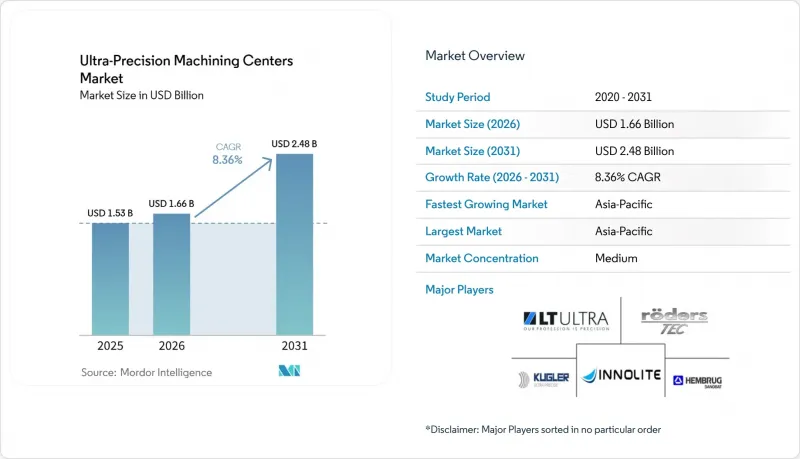
초정밀 머시닝 센터 시장 규모는 2025년 15억 3,000만 달러로 평가되었고, 2026년에는 16억 6,000만 달러로 확대될 것으로 추정되고, 2026-2031년 CAGR 8.36%로 성장을 지속할 전망이며, 2031년에는 24억 8,000만 달러에 이를 것으로 예측됩니다.
본 보고서는 구성별(수직형, 수평형 등), 기계 유형별(3축, 4축 등), 기술별(다이아몬드 선삭, 초정밀 연삭 등), 최종 사용자별(반도체 및 전자기기 제조업체 등), 지역별(아시아태평양, 유럽 등)로 분류되어 있습니다. 본 보고서에서는 상기 모든 부문에 대해 시장 규모 및 예측치(달러)를 제시하고 있습니다.
세계의 초정밀 머시닝 센터 시장 동향 및 인사이트
서브미크론급 공차를 요구하는 반도체 팹의 확장
2026년 초정밀 머시닝 센터 시장을 견인할 주요 상업적 요인은 반도체 분야의 사상 최고 수준의 투자입니다. 2025년 전 세계 반도체 제조 장비 매출액은 전년 대비 15% 증가한 1351억 달러에 달한 것으로 평가되었으며, 2026년에는 300mm 팹용 장비에 대한 지출이 18% 증가해 1330억 달러에 이를 것으로 전망됩니다. TSMC 역시 애리조나주 팹 건설 및 향후 2nm 미만 생산 계획을 추진하는 한편, 2026년 설비 투자액을 사상 최대인 400억-560억 달러로 상향 조정하고 있습니다. 초정밀 머시닝 센터 시장에서 첨단 팹 건설에는 초미세 표면 품질과 재현성이 요구되는 웨이퍼 척, 광학 마운트, 진공 챔버 부품, 포토마스크 관련 부품이 더 많이 필요하게 됩니다. 2026년 조사에 따르면, 최신 초정밀 다이아몬드 선삭 및 마이크로 연삭 시스템은 금속, 세라믹, 반도체 웨이퍼에서 50nm 미만의 형상 정밀도와 1nm Ra 미만의 표면 거칠기를 달성할 수 있는 것으로 확인되었습니다. 이러한 변화는 초정밀 머시닝 센터 시장이 팹의 수량 증가뿐만 아니라, 각 신공정 세대에서 공급업체에 요구되는 더 높은 최소 가공 기준으로부터도 혜택을 받고 있음을 보여줍니다.
항공우주용 티타늄 및 초합금 부품의 복잡성
티타늄 합금이나 니켈 기반 초합금은 극도로 엄격한 공차로 가공하기 어렵기 때문에 항공우주 분야 수요가 초정밀 머시닝 센터 시장을 견인하고 있습니다. 2025년 항공우주 분야 관련 조사에서는 티타늄 가공이 낮은 열전도율, 화학적 반응성 및 스프링백의 영향을 받는다는 점이 지적되었으며, 공정을 엄격하게 관리하지 않으면 치수 오차가 발생할 가능성이 있습니다. 2025년의 또 다른 조사에 따르면, 생산성이 높은 티타늄 가공, 특히 기체 구조 부품에 사용되는 A+B계 티타늄 합금의 경우, 고도의 공구 설계, 제어된 냉각제 공급, 그리고 극도로 정밀한 절삭 동작이 필수적인 것으로 밝혀졌습니다. 터빈 블레이드의 경우, 내부 냉각 통로와 앞가장자리의 마감 품질을 높은 작동 온도에서 극히 엄격한 허용 범위 내로 유지해야 하기 때문에 복잡성이 더욱 커집니다. 초정밀 머시닝 센터 시장은 이러한 상황에서 혜택을 보고 있습니다. 항공기 제조업체들이 가공 데이터를 디지털 추적성 시스템에 통합하고 있기 때문에 재현 가능한 서브마이크론 수준의 가공 결과를 제공하지 못하는 플랫폼은 인증된 공급망에서 배제될 위험이 있기 때문입니다. 인증 프로그램이 금세기 말까지 진전됨에 따라, 완전히 새로운 항공기 프로그램이 급증하지 않더라도 초정밀 머시닝 센터 시장에서는 항공우주 분야 수요가 지속적으로 유지될 것으로 전망됩니다.
높은 자본 집약도와 인증 부담
기계 가격의 높음은 초정밀 머시닝 센터 시장 진입 장벽의 일부에 불과합니다. ISO 230-3:2020에서는 공작기계의 정밀도가 검증되는 열적 조건이 정의되어 있으며, 여기에는 20°C의 기준 환경이 포함됩니다. 즉, 극히 엄격한 온도 관리가 불가능한 시설에서는 생산을 시작하기도 전에 큰 인증상의 제약에 직면하게 됩니다. 또한, ISO 14644-1은 오염에 민감한 정밀 작업과 관련된 클린룸의 공기 청정도 분류를 규정하고 있어, 공작기계 자체의 설치에 앞서 시설 비용이 고려됩니다. 항공우주 및 의료기기 등 규제 대상 분야에서는 양산이 승인되기 전에 공정 개발, 초기 제품 검사, 통계적 공정 관리를 확립해야 하므로 승인 주기가 수개월에 달할 가능성이 있습니다. 따라서 초정밀 머시닝 센터 시장은 인프라 투자와 장기적인 인증 절차를 모두 감당할 수 있는 대형 제조업체에 집중된 상태가 지속되고 있습니다. 이러한 장벽은 수요가 존재함에도 불구하고, 온도 관리, 계측, 클린룸과 같은 지원 체계가 아직 제한적인 새로운 제조 거점에서 시장 진입을 지연시키는 요인이 되고 있습니다.
부문 분석
2025년에는 수직형 초정밀 머시닝 센터가 34.50%의 점유율을 차지했으나, 갠트리형 및 브리지형 시스템은 2031년까지 연평균 성장률(CAGR) 9.60%로 가장 빠르게 확대될 것으로 예측됩니다. 이러한 시스템이 주도하고 있는 배경에는 안정적이고 컴팩트한 가공 범위에 적합한 반도체 공구, 광학 부품, 의료기기 부품과 같은 분야에서 오랫동안 확립된 기반이 있다는 점을 들 수 있습니다. 또한, 수직 배치는 중력을 이용한 절삭 부스러기 배출을 가능하게 하여, 대량 생산의 정밀 가공에서 여전히 일반적인 디스크, 링, 웨이퍼 형태의 기판에 대한 공작물 고정 과정을 간소화합니다. 이러한 실용적인 구성 덕분에 초정밀 머시닝 센터 시장에서는 넓은 이동 범위보다 재현성이나 부품 핸들링이 중시되는 용도에서 수직 시스템에 대한 견조한 수요가 유지되고 있습니다. 마키노의 ‘iQ500’은 이 분야가 어떻게 지속적으로 진화하고 있는지를 보여주는 한 예로, 0.005μm의 분해능을 가진 스케일 피드백과 45,000 rpm의 스핀들 회전 속도를 갖추어, LED용 공구 및 광학 관련 가공에서 초미세 밀링 가공을 실현하고 있습니다.
그러나 갠트리형 및 브리지형 시스템이 초정밀 머시닝 센터 시장에서 또 다른 구조적 과제를 해결함에 따라 성장 추세는 변화하고 있습니다. 대형 항공우주 부품, 방위용 하우징, 광학 미러 블랭크에는 전체 공정에 걸쳐 서브마이크론 수준의 체적 정밀도를 저해하지 않으면서 긴 이동 범위가 요구됩니다. 갠트리 프레임은 다른 많은 레이아웃에 비해 넓은 가공 영역 전체에 걸쳐 더 높은 강성, 더 안정적인 힘 전달, 그리고 뛰어난 기하학적 제어를 제공합니다. 2026년 3월에 출시될 GROB사의 GP1350은 이러한 추세를 여실히 보여주는 제품으로, 1,400 mm×1,950 mm×1,100 mm의 이동 범위를 갖추고 있으며, 대형 부품에 대한 완전한 자동화 대응이 가능한 포털형 밀링 센터입니다. 이에 따라 초정밀 머시닝 센터 시장은 이용 사례에 따라 양극화가 진행되고 있으며, 수직형 시스템이 여전히 주류를 이루는 반면, 구조적 크기나 강성이 구매 결정의 주요 요인이 되는 분야에서는 갠트리형이 우위를 점하고 있습니다. 수평형 시스템이나 전용 로터리 셀, 밀턴 셀도 여전히 중요하지만, 그 역할은 보다 제한적이며 특정 이용 사례에 특화된 형태입니다.
5축 시스템은 초정밀 머시닝 센터 시장에서 가장 규모가 크고 가장 빠르게 성장하고 있는 기계 유형으로, 2025년에는 39.45%의 시장 점유율을 차지했으며, 2031년까지의 연평균 성장률(CAGR)은 10.00%로 예측됩니다. 이러한 우위는 복잡한 항공우주용 표면이나 고도의 정밀 전자 부품을 스택업 오차를 최소화하면서 단 한 번의 셋업으로 가공해야 할 필요성에서 비롯됩니다. 터빈 블레이드나 이와 유사한 복잡한 부품의 경우, 5축 동시 보정을 통해 반복적으로 클램핑을 다시 할 필요 없이 여러 표면에 걸쳐 연속적인 마무리 가공이 가능해집니다. 이를 통해 형상 정밀도와 처리량 모두 향상되므로, 초정밀 머시닝 센터 시장에서는 최상위 용도에서 5축 가공 기능이 점점 더 기본 요건으로 간주되고 있습니다. 『International Journal of Advanced Manufacturing Technology』지에 게재된 2026년 연구에 따르면, 5축 CNC 밀링 가공에서 딥러닝과 다목적 최적화를 폐루프 제어 하에 결합함으로써 가공 정밀도, 에너지 소비 및 공구 마모를 동시에 개선할 수 있는 것으로 밝혀졌습니다. 이는 5축 아키텍처가 초정밀 머시닝 센터 시장에서 기계적인 이점일 뿐만 아니라, 첨단 제어 소프트웨어에 가장 적합한 형태라는 생각을 뒷받침하는 것입니다.
다른 기계 유형도 여전히 중요한 위치를 차지했지만, 그 역할은 보다 제한적입니다. 3축의 도입 실적은 광학 제조나 계측용 지그에서 평면 부품 및 회전 대칭 부품에 있어 여전히 중요하며, 이러한 분야에서는 보다 단순한 운동학을 통해 열 오차의 누적을 억제할 수 있습니다. 4축 카테고리는 인덱스 가공에서 항공우주 및 의료용 원통형 부품의 보다 연속적인 정밀 가공으로 전환하는 제조업체에게 종종 과도기적인 단계로 기능합니다. 멀티태스크형 초정밀 시스템은 선삭, 밀링, 경우에 따라 연삭까지 단일 섀시 내에서 완료할 수 있어 공정 간 이관 시간을 단축할 수 있으므로, 수탁 제조업체로부터 주목을 받고 있습니다. AS9100 Rev D 및 ISO 13485와 같은 규제 프레임워크에서는 단일 인증 주기 내에서 더 많은 공정을 완료할 수 있는 플랫폼을 권장하고 있으며, 이는 초정밀 머시닝 센터 시장에서 멀티태스크 시스템에 대한 수요를 뒷받침하고 있습니다. DMG MORI사의 ‘DM 20 linear’ 및 ‘ULTRASONIC 20 linear’ 3세대 모델은 이 부문에서 최첨단 성능을 구현하고 있으며, 동시 5축 동작, 리니어 구동 및 직접 측정 기능을 갖추고 있어 유리, 세라믹, 기타 가공이 어려운 정밀 소재의 가공을 목적으로 합니다.
지역별 분석
아시아태평양은 2025년에 지역별 최대 점유율을 차지했으며, 2031년까지 초정밀 머시닝 센터 시장에서 가장 빠른 성장세를 이어갈 것으로 예측됩니다. 이 지역은 세계 최대 규모의 반도체 제조 거점을 보유하고 있을 뿐만 아니라, 일본, 대만, 한국, 중국에 걸쳐 있는 강력한 공작기계 공급망을 갖추고 있습니다. SEMI 보고서에 따르면, 2025년 전 세계 반도체 제조 장비 지출 중 중국, 대만, 한국이 합계 79%를 차지했으며, 대만의 지출은 90% 증가한 315억 달러, 한국의 지출은 26% 증가한 258억 달러를 기록했습니다. 일본은 첨단 공작기계 생산 능력과 차세대 포토닉스 분야에 대한 직접적인 지원을 겸비하고 있어 독자적인 성장층을 형성하고 있습니다. 경제산업성(METI)의 지원을 받은 타워 세미컨덕터(Tower Semiconductor)사의 2026년 7월 일본 내 확장 계획은 실리콘 포토닉스가 주류인 로직 및 메모리 생산을 넘어 초정밀 머시닝 센터 시장의 실질적인 수요 원천으로 자리 잡고 있음을 보여줍니다.
북미와 유럽은 서로 다르지만 상호 보완적인 형태로 초정밀 머시닝 센터 시장을 뒷받침하고 있습니다. 북미에서는 생산의 국내 복귀(리쇼어링) 및 방위 산업 제조 확대로 인해, 항공우주 및 반도체 프로그램 거점과 가까운 지역에서의 고정밀 가공 능력에 대한 수요가 증가하고 있습니다. 2026년 상반기에는 국내 항공우주 및 방위 산업을 위한 신규 투자로 147억 달러 이상이 발표되면서, 해당 지역의 정밀 인프라 확충 필요성이 더욱 커지고 있습니다. TSMC가 계획하고 있는 애리조나주에서의 확장도 최첨단 반도체 생산을 뒷받침하는 공구, 구조 부품 및 공정 부품에 대한 수요를 창출하는 지역 거점이 될 것입니다. 유럽은 오랜 기간에 걸쳐 확립된 정밀 공학 클러스터, 특히 독일에 그 기반을 두고 있습니다. 독일에서는 GF Machining Solutions, DMG MORI Ultrasonic Lasertec GmbH, DANOBAT과 같은 기업들이 세계적으로 중요한 개발 및 생산 능력을 유지하고 있습니다. 따라서 유럽은 초정밀 머시닝 센터 시장에서 수요의 중심지일 뿐만 아니라, 용도 특화형 기계 설계, 공정 노하우 및 전문적인 생산공급원으로서도 중요한 역할을 수행하고 있습니다.
남미, 중동 및 아프리카는 초정밀 머시닝 센터 시장에서 여전히 규모는 작지만, 이 세 지역 모두에서 선택적인 수요 형성이 나타나고 있습니다. 남미에서는 자동차 생산 및 전기차(EV) 관련 금형이 고정밀 기계 조달을 위한 가장 명확한 단기적 경로가 되고 있어, 브라질이 두드러지고 있습니다. 중동 및 아프리카에서는 산업 다각화 계획과 정밀 공학 역량에 대한 투자가 뒷받침되어 사우디아라비아와 UAE가 주요 시장으로 부상하고 있습니다. 튀르키예에서도 방위용 전자기기, 드론, 미사일 유도 시스템공급망에서 부품 정밀도의 추가적인 향상이 요구되는 등, 지역 특유 수요가 나타나고 있습니다. 이러한 지역에서는 열 안정성, 오염 관리, 계측 지원 측면에서 여전히 인프라 제약이 존재하여 도입에 걸림돌이 되고 있습니다. 그럼에도 불구하고, 정밀 제조 역량이 단순한 개별 설비 투자가 아닌 보다 광범위한 산업 정책의 일환으로 점차 자리 잡고 있기 때문에 해당 지역의 초정밀 머시닝 센터 시장은 장기적으로 밝은 전망을 가지고 있습니다.
기타 혜택 :
- 엑셀 형식 시장 예측(ME) 시트
- 3개월간의 애널리스트 지원
자주 묻는 질문
목차
제1장 서론
제2장 조사 방법
제3장 주요 요약
제4장 시장 구도
제5장 시장 규모 및 성장 예측
제6장 경쟁 구도
제7장 시장 기회 및 향후 전망
AJY 26.08.11According to Mordor Intelligence, the ultra-Precision machining centers market size is expected to grow from USD 1.53 billion in 2025 to USD 1.66 billion in 2026 and is forecast to reach USD 2.48 billion by 2031 at 8.36% CAGR over 2026-2031.
This report is Segmented by Configuration (Vertical, Horizontal, and More), by Machine Type (3-Axis, 4-Axis, and More), by Technology (Diamond Turning, Ultra-Precision Grinding, and More), by End-User (Semiconductor & Electronics Manufacturers, and More), and by Geography (Asia-Pacific, Europe, and More). The Report Offers Market Size and Forecasts in Value (USD) for all the Above Segments.
Global Ultra-Precision Machining Centers Market Trends and Insights
Semiconductor Fab Expansion Requiring Sub-Micron Tolerances
Record semiconductor investment is the main commercial force lifting the ultra-precision machining centers market in 2026. Global semiconductor equipment billings reached USD 135.1 billion in 2025, up 15% year on year, and 300mm fab equipment spending is projected to rise 18% to USD 133 billion in 2026. TSMC is also raising capital expenditure to a record range of USD 40 billion to USD 56 billion in 2026, while advancing its Arizona fabrication buildout and future sub-2nm production plans. In the ultra-precision machining centers market, every advanced fab build requires more wafer chucks, optical mounts, vacuum chamber parts, and photomask-related components that depend on ultra-fine surface quality and repeatability. A 2026 review confirmed that modern ultra-precision diamond turning and micro-grinding systems can achieve form accuracy below 50 nm and surface finishes below 1 nm Ra on metals, ceramics, and semiconductor wafers. This shift indicates that the ultra-precision machining centers market benefits not only from volume growth in fabs but also from the higher minimum machining standards that each new process generation requires suppliers to meet.
Aerospace Titanium and Superalloy Part Complexity
Aerospace demand is strengthening the ultra-precision machining centers market, as titanium alloys and nickel-based superalloys are difficult to machine to very tight tolerances. A 2025 aerospace review noted that titanium machining is affected by its low thermal conductivity, chemical reactivity, and springback, which can cause dimensional errors unless the process is tightly controlled. A second 2025 review found that productive titanium machining depends on advanced tool design, controlled coolant delivery, and very accurate cutting motion, especially for a+B titanium alloys used in structural airframe parts. Turbine blades add another layer of complexity because internal cooling passages and leading-edge finish quality must be maintained within extremely tight limits at high operating temperatures. The ultra-precision machining centers market benefits from this because aircraft manufacturers are embedding machining data into digital traceability systems, and platforms that cannot deliver repeatable sub-micron output risk exclusion from qualified supply chains. As certification programs progress toward the end of the decade, the ultra-precision machining centers market should continue to see sustained aerospace demand even without a surge in entirely new aircraft programs.
High Capital Intensity and Qualification Burden
High machine prices are only one part of the entry barrier in the ultra-precision machining centers market. ISO 230-3:2020 defines the thermal conditions under which machine tool accuracy is validated, including a 20°C reference environment, which means facilities without very tight temperature control face major qualification limits before production even starts. ISO 14644-1 also establishes cleanroom air cleanliness classifications relevant to contamination-sensitive precision work, factoring in facility costs before the machine itself is installed. In regulated sectors such as aerospace and medical devices, approval cycles can stretch for months because process development, first-article inspection, and statistical process control must be established before serial output is accepted. The ultra-precision machining centers market, therefore, remains concentrated among larger manufacturers that can absorb both infrastructure spending and long qualification timelines. This barrier also slows market entry in newer manufacturing locations where demand exists, but the supporting thermal, metrology, and cleanroom ecosystem is still limited.
Other drivers and restraints analyzed in the detailed report include:
- AI-Enabled Closed-Loop Compensation in Machine Controls
- Optical And Photonics Manufacturing Scale-Up
- Export Controls, Tariffs, and Customs Compliance Friction
For complete list of drivers and restraints, kindly check the Table Of Contents.
Segment Analysis
Vertical ultra-precision machining centers held a 34.50% share in 2025, while gantry and bridge-type systems are expected to expand the fastest at at 9.60% CAGR through 2031. Their lead reflects a long-established base across semiconductor tooling, optical components, and medical device parts that fit stable, compact work envelopes. The vertical arrangement also supports gravity-assisted chip removal and simpler workholding for disc, ring, and wafer-like substrates, which remain common in high-volume precision production. That practical setup has helped the ultra-precision machining centers market maintain strong demand for vertical systems in applications where repeatability and part handling matter more than large travel range. Makino's iQ500 is an example of how the category continues to advance, with 0.005 µm-resolution scale feedback and 45,000 rpm spindle speeds for ultra-fine milling in LED tooling and optics-related work.
The growth profile is shifting, however, because gantry and bridge-type systems solve a different structural problem in the ultra-precision machining centers market. Large aerospace parts, defense housings, and optical mirror blanks require long travel ranges without sacrificing sub-micron volumetric accuracy along the entire path. Gantry frames provide stronger stiffness, more stable force flow, and better geometric control across wide working envelopes than many alternative layouts. GROB's GP1350 launch in March 2026 to show this trend, with a portal milling center offering 1,400 mm by 1,950 mm by 1,100 mm travel and full automation compatibility for large parts. That makes the ultra-precision machining centers market more polarized by use case, with vertical systems remaining the volume choice and gantry formats pulling ahead where structural size and rigidity dominate buying decisions. Horizontal systems and dedicated rotary or mill-turn cells remain relevant, but their roles stay narrower and more application-specific.
5-axis systems were both the largest and the fastest-growing machine type in the ultra-precision machining centers market, with a 39.45% market share in 2025 and an expected 10.00% CAGR through 2031. Their lead comes from the need to machine complex aerospace surfaces and advanced precision electronics parts in a single setup with minimal stack-up error. For turbine blades and similarly complex components, simultaneous 5-axis interpolation allows continuous finishing across multiple surfaces without repeated re-clamping. That improves both geometric control and throughput, which is why the ultra-precision machining centers market increasingly treats 5-axis capability as a baseline requirement in top-end applications. A 2026 study in the International Journal of Advanced Manufacturing Technology found that deep learning and multi-objective optimization in 5-axis CNC milling can improve machining accuracy, energy use, and tool wear together under closed-loop control. This reinforces the idea that 5-axis architecture is not only a mechanical advantage in the ultra-precision machining centers market, but also the format best suited to advanced control software.
Other machine types still hold important positions, although their roles are narrower. The 3-axis installed base remains relevant for flat and rotationally symmetric parts in optical fabrication and metrology tooling, where simpler kinematics can limit thermal error accumulation. The 4-axis category often serves as a transition step for manufacturers moving from indexed work into more continuous precision machining on cylindrical aerospace and medical parts. Multi-tasking ultra-precision systems are attracting interest from contract manufacturers because turning, milling, and sometimes grinding can be completed in a single enclosure, reducing handoff time across operations. Regulated frameworks such as AS9100 Rev D and ISO 13485 favor platforms that can complete more operations within a single qualification cycle, which supports the demand for multitasking systems in the ultra-precision machining centers market. DMG MORI's DM 20 linear and ULTRASONIC 20 linear 3rd generation reflect the premium edge of this category, where simultaneous 5-axis motion, linear drives, and direct measurement are aimed at glass, ceramic, and other difficult precision materials.
Complete Report Scope:
- By Configuration
- Vertical Ultra-Precision Machining Centers
- Horizontal Ultra-Precision Machining Centers
- Gantry/Bridge-Type Ultra-Precision Machining Centers
- Other Configurations
- By Machine Type
- 3-Axis Ultra-Precision Machining Centers
- 4-Axis Ultra-Precision Machining Centers
- 5-Axis Ultra-Precision Machining Centers
- Multi-Tasking Ultra-Precision Machining Centers
- Other Ultra-Precision Machining Centers
- By Technology
- Diamond Turning
- Ultra-Precision Grinding
- Ultra-Precision Milling
- Ultra-Precision Electrical Discharge Machining (Micro-EDM)
- Laser-Based Ultra-Precision Machining
- Hybrid & Other Ultra-Precision Technologies
- By End User
- Semiconductor & Electronics Manufacturers
- Medical Device Manufacturers
- Aerospace & Defense Manufacturers
- Automotive Manufacturers
- Precision Engineering & Mold Manufacturers
- Others - Research Institutes & Laboratories, etc.
- By Geography
- North America
- United States
- Canada
- Mexico
- South America
- Brazil
- Rest of South America
- Europe
- United Kingdom
- Germany
- France
- Italy
- Spain
- Netherlands
- Sweden
- Rest of Europe
- Asia-Pacific
- China
- India
- Japan
- Australia
- South Korea
- Rest of Asia-Pacific
- Middle East and Africa
- Saudi Arabia
- United Arab Emirates
- Turkey
- Rest of Middle East and Africa
- North America
Geography Analysis
Asia-Pacific held the largest regional position in 2025 and is expected to remain the fastest-growing geography in the ultra-precision machining centers market through 2031. The region combines the world's deepest semiconductor fabrication base with a strong machine-tool supply chain across Japan, Taiwan, South Korea, and China. SEMI reported that China, Taiwan, and South Korea together accounted for 79% of global semiconductor equipment spending in 2025, while Taiwan's spending rose 90% to USD 31.5 billion and South Korea's increased 26% to USD 25.8 billion. Japan adds a separate growth layer because it combines advanced machine production capability with direct support for next-generation photonics capacity. Tower Semiconductor's July 2026 expansion plan in Japan, backed by METI, shows how silicon photonics is becoming a practical demand source for the ultra-precision machining centers market beyond mainstream logic and memory output.
North America and Europe support the ultra-precision machining centers market in different but complementary ways. In North America, reshoring and defense manufacturing expansion are increasing the need for high-accuracy machining capacity close to aerospace and semiconductor programs. More than USD 14.7 billion in new domestic aerospace and defense manufacturing investment was announced in the first half of 2026, strengthening the case for more local precision infrastructure. TSMC's planned Arizona expansion also creates a regional node for tooling, structural components, and demand for process parts supporting leading-edge semiconductor production. Europe remains anchored in long-established precision engineering clusters, especially in Germany, where companies such as GF Machining Solutions, DMG MORI Ultrasonic Lasertec GmbH, and DANOBAT maintain globally relevant development and production capabilities. This makes Europe important to the ultra-precision machining centers market not only as a demand center, but also as a source of application-specific machine design, process know-how, and specialized production.
South America, the Middle East, and Africa remain smaller in the ultra-precision machining centers market, but all three regions show selective demand formation. In South America, Brazil stands out because automotive production and EV-related tooling are the clearest short-term route for higher-precision machine procurement. In the Middle East and Africa, Saudi Arabia and the UAE are the main markets, supported by industrial diversification plans and investment in precision engineering capability. Turkey also shows localized demand where defense electronics, drones, and missile guidance supply chains require tighter component accuracy. These regions still face infrastructure limits in thermal stability, contamination control, and metrology support, which slow deployment. Even so, the ultra-precision machining centers market has a positive long-term outlook there because precision manufacturing capability is gradually becoming part of broader industrial policy rather than an isolated capital purchase.
- Kugler GmbH
- LT Ultra-Precision Technology GmbH
- Innolite GmbH
- Hembrug Machine Tools B.V.
- Roeders GmbH
- AMETEK, Inc.
- Moore Nanotechnology Systems, LLC
- Fives
- Hardinge Inc.
- Schneider Optical Machines, Inc.
- Kern Microtechnik GmbH
- Shibaura Machine Co., Ltd.
- DANOBAT Group
- Mikrotools Pte Ltd
- Makino Milling Machine Co., Ltd.
- DMG MORI Co., Ltd.
- Okuma Corporation
- Yamazaki Mazak Corporation
- GF Machining Solutions Management SA
- Mitsui Seiki Kogyo Co., Ltd.
Additional Benefits:
- The market estimate (ME) sheet in Excel format
- 3 months of analyst support
TABLE OF CONTENTS
1 INTRODUCTION
- 1.1 Study Assumptions and Market Definition
- 1.2 Scope of the Study
2 RESEARCH METHODOLOGY
3 EXECUTIVE SUMMARY
4 MARKET LANDSCAPE
- 4.1 Market Overview
- 4.2 Market Drivers
- 4.2.1 Semiconductor Fab Expansion Requiring Sub-Micron Tolerances
- 4.2.2 Aerospace Titanium and Superalloy Part Complexity
- 4.2.3 AI-Enabled Closed-Loop Compensation in Machine Controls
- 4.2.4 Optical and Photonics Manufacturing Scale-Up
- 4.2.5 Defense Reshoring and Localized Precision Capacity Buildout
- 4.2.6 Retrofit-Driven Replacement Cycle in Installed Precision Assets
- 4.3 Market Restraints
- 4.3.1 High Capital Intensity and Qualification Burden
- 4.3.2 Export Controls, Tariffs, and Customs Compliance Friction
- 4.3.3 Skilled Operator and Metrology Talent Shortage
- 4.3.4 Thermal Stability and Facility Infrastructure Constraints
- 4.4 Value / Supply-Chain Analysis
- 4.5 Regulatory Landscape
- 4.6 Technological Outlook
- 4.7 Impact Assessment of Geoplotical Events on the Ultra-Precision Center Market
5 MARKET SIZE AND GROWTH FORECASTS (Values, In USD Billion)
- 5.1 By Configuration
- 5.1.1 Vertical Ultra-Precision Machining Centers
- 5.1.2 Horizontal Ultra-Precision Machining Centers
- 5.1.3 Gantry/Bridge-Type Ultra-Precision Machining Centers
- 5.1.4 Other Configurations
- 5.2 By Machine Type
- 5.2.1 3-Axis Ultra-Precision Machining Centers
- 5.2.2 4-Axis Ultra-Precision Machining Centers
- 5.2.3 5-Axis Ultra-Precision Machining Centers
- 5.2.4 Multi-Tasking Ultra-Precision Machining Centers
- 5.2.5 Other Ultra-Precision Machining Centers
- 5.3 By Technology
- 5.3.1 Diamond Turning
- 5.3.2 Ultra-Precision Grinding
- 5.3.3 Ultra-Precision Milling
- 5.3.4 Ultra-Precision Electrical Discharge Machining (Micro-EDM)
- 5.3.5 Laser-Based Ultra-Precision Machining
- 5.3.6 Hybrid & Other Ultra-Precision Technologies
- 5.4 By End User
- 5.4.1 Semiconductor & Electronics Manufacturers
- 5.4.2 Medical Device Manufacturers
- 5.4.3 Aerospace & Defense Manufacturers
- 5.4.4 Automotive Manufacturers
- 5.4.5 Precision Engineering & Mold Manufacturers
- 5.4.6 Others - Research Institutes & Laboratories, etc.
- 5.5 By Geography
- 5.5.1 North America
- 5.5.1.1 United States
- 5.5.1.2 Canada
- 5.5.1.3 Mexico
- 5.5.2 South America
- 5.5.2.1 Brazil
- 5.5.2.2 Rest of South America
- 5.5.3 Europe
- 5.5.3.1 United Kingdom
- 5.5.3.2 Germany
- 5.5.3.3 France
- 5.5.3.4 Italy
- 5.5.3.5 Spain
- 5.5.3.6 Netherlands
- 5.5.3.7 Sweden
- 5.5.3.8 Rest of Europe
- 5.5.4 Asia-Pacific
- 5.5.4.1 China
- 5.5.4.2 India
- 5.5.4.3 Japan
- 5.5.4.4 Australia
- 5.5.4.5 South Korea
- 5.5.4.6 Rest of Asia-Pacific
- 5.5.5 Middle East and Africa
- 5.5.5.1 Saudi Arabia
- 5.5.5.2 United Arab Emirates
- 5.5.5.3 Turkey
- 5.5.5.4 Rest of Middle East and Africa
- 5.5.1 North America
6 COMPETITIVE LANDSCAPE
- 6.1 Market Concentration
- 6.2 Strategic Moves
- 6.3 Market Share Analysis
- 6.4 Company Profiles (includes Global Level Overview, Market Level Overview, Core Segments, Financials as available, Strategic Information, Products and Services, Recent Developments)
- 6.4.1 Kugler GmbH
- 6.4.2 LT Ultra-Precision Technology GmbH
- 6.4.3 Innolite GmbH
- 6.4.4 Hembrug Machine Tools B.V.
- 6.4.5 Roeders GmbH
- 6.4.6 AMETEK, Inc.
- 6.4.7 Moore Nanotechnology Systems, LLC
- 6.4.8 Fives
- 6.4.9 Hardinge Inc.
- 6.4.10 Schneider Optical Machines, Inc.
- 6.4.11 Kern Microtechnik GmbH
- 6.4.12 Shibaura Machine Co., Ltd.
- 6.4.13 DANOBAT Group
- 6.4.14 Mikrotools Pte Ltd
- 6.4.15 Makino Milling Machine Co., Ltd.
- 6.4.16 DMG MORI Co., Ltd.
- 6.4.17 Okuma Corporation
- 6.4.18 Yamazaki Mazak Corporation
- 6.4.19 GF Machining Solutions Management SA
- 6.4.20 Mitsui Seiki Kogyo Co., Ltd.
7 MARKET OPPORTUNITIES AND FUTURE OUTLOOK
- 7.1 White-Space and Unmet-Need Assessment


