|
시장보고서
상품코드
2099965
양자 기계학습(QML) 소프트웨어 시장 : 시장 점유율 분석, 업계 동향 및 통계, 성장 예측(2026-2031년)Quantum Machine Learning (QML) Software - Market Share Analysis, Industry Trends & Statistics, Growth Forecasts (2026 - 2031) |
||||||
 Mordor Intelligence
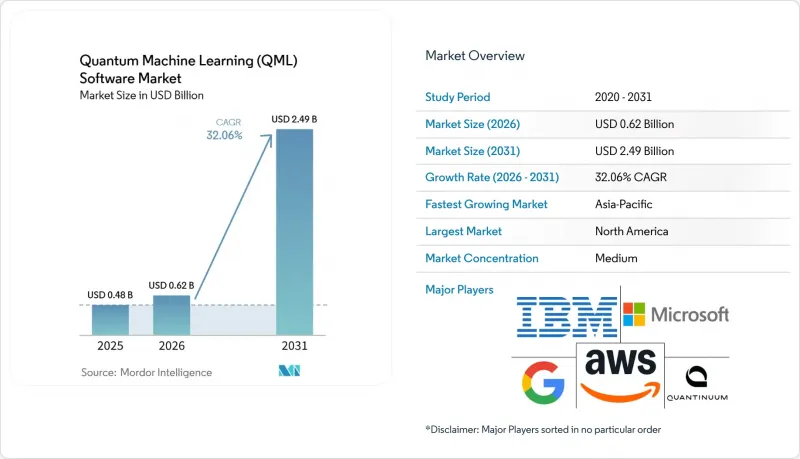
양자 기계학습(QML) 소프트웨어 시장 규모는 2025년에 4억 8,000만 달러로 평가되었고, 2026년 6억 2,000만 달러에서 2031년까지 24억 9,000만 달러에 이를 것으로 예측되며, 2026-2031년 예측 기간 CAGR은 32.06%를 나타낼 전망입니다.
본 보고서는 솔루션별(소프트웨어 플랫폼 및 서비스), 도입 형태별(클라우드 기반, 하이브리드형, 온프레미스형), 조직 규모별(대기업 및 중소기업), 용도별(최적화 등), 최종 사용자 산업별(은행, 금융서비스 및 보험(BFSI), 교육 및 연구 기관 등) 및 지역별로 분류되어 있습니다. 시장 전망은 금액(달러) 기준으로 제시되어 있습니다.
세계의 양자 기계학습(QML) 소프트웨어 시장 동향 및 인사이트
하이브리드 양자·고전 워크플로우에 대한 기업 수요
양자 기계학습(QML) 소프트웨어 시장은 하이브리드 워크플로우에 대한 기업 수요 증가로 인해 혜택을 보고 있습니다. 이는 소프트웨어를 통한 오케스트레이션이 양자 작업을 실제 생산 환경에서 활용할 수 있는지 여부를 결정하기 때문입니다. 단기적인 머신러닝 및 최적화 이용 사례의 대부분은 양자 처리 전후에 반복적인 고전적 처리를 필요로 하며, 현 단계에서는 워크플로우 설계가 단순한 양자 비트 수보다 더 중요해졌습니다. 2025년 11월 Quantinuum사가 'Helios'를 상용 출시한 것은 이 점을 명확히 보여줍니다. 이 시스템은 Python 기반 프로그래밍 언어 ‘Guppy’ 및 하이브리드 컴퓨팅용 클라우드 플랫폼 ‘Nexus’와 함께 도입되었으며, 신약 개발, 재료 연구, 금융 분석 등의 분야에서 초기 활용 사례가 확인되고 있습니다. 이러한 추세에 따라, 엔터프라이즈 시스템의 전면적인 재설계를 강요하지 않으면서도 기존 데이터 구조, 모델 로직, 프로세스 흐름을 양자 호환 형식으로 변환할 수 있는 벤더의 역할이 확대되고 있습니다. 그 결과, 양자 기계학습(QML) 소프트웨어 시장은 양자 컴퓨팅을 독립된 환경으로 다루기보다는 양자 실험과 표준적인 인공지능, 분석, 연구 업무를 연결하는 제품으로 전환되고 있습니다. 구매자가 일회성 시연이 아닌 재현 가능한 가치를 추구하게 됨에 따라, 이러한 연동을 용이하게 하는 벤더는 계속해서 유리한 입지를 유지할 수 있을 것입니다.
고도로 복잡한 이용 사례에서 양자 안전 최적화에 대한 수요 증가
양자 기계학습(QML) 소프트웨어 시장은 기존 방법만으로는 실용적인 비즈니스 기간 내에 대규모 최적화 문제를 해결하기가 점점 더 어려워지고 있는 분야 수요에 의해서도 뒷받침되고 있습니다. 물류 계획, 금융 포트폴리오 설계, 파생상품 가격 책정, 의약품 스크리닝 등은 모두 변수, 제약 조건 및 가능한 결과의 수가 증가함에 따라 의사결정 구조가 더욱 복잡해지는 것을 필요로 합니다. D-Wave사는 2026년 1분기 실적 발표에서 자사의 하이브리드 솔버 ‘Stride’가 대리 머신러닝 통합을 지원하게 되었다고 밝혔습니다. 이는 고객들이 이미 더 적응성이 높은 산업용 최적화 워크플로로 전환하고 있음을 시사합니다. 두 번째 요인은 수학적으로 구조화된 최적화 프로세스가 블랙박스형 예측 모델보다 검증 및 설명이 용이하다는 점입니다. 이는 은행업, 의료 및 기타 규제가 엄격한 분야에서 중요한 의미를 지닙니다. 양자 지원 최적화는 단순한 성능 향상 도구로서뿐만 아니라, 추적 가능성과 의사 결정에 대한 설명 책임을 향상시키는 수단으로도 평가받고 있어, 이것이 양자 기계학습(QML) 소프트웨어 시장의 성장에 기여하고 있습니다. 이러한 폭넓은 가치 제안을 통해, 계산 성능과 감독 요건의 균형을 맞추어야 하는 업계에서 소프트웨어 도입이 더욱 중요시되고 있습니다.
내결함성 양자 하드웨어의 상용 규모 한계
양자 기계학습(QML) 소프트웨어 시장은 여전히 큰 제약에 직면해 있습니다. 그 이유는 기업에서 광범위하게 활용하기 위해 필요한 규모로, 상업적으로 의미 있는 내결함성 양자 하드웨어를 아직 확보하지 못했기 때문입니다. 그 결과, 벤더들은 노이즈가 많은 중규모 시스템에 얽매여 있으며, 제품은 오류 정정 계산의 이론적 이점을 최대한 활용하는 대신 오류율, 제한된 코히어런스 윈도우, 그리고 좁은 성능 조건에 맞추어 설계할 수밖에 없는 상황에 처해 있습니다. IBM은 2026년 말까지 양자 우위를, 2029년까지는 내결함성을 달성할 것으로 전망하는 반면, 마이크로소프트는 ‘Majorana 2’ 프로젝트를 통해 2029년을 확장 가능한 시스템으로 가는 이정표로 제시하고 있습니다. 이러한 지연으로 인해 양자 기계학습(QML) 소프트웨어 시장 경쟁 구도가 변화하고 있으며, 노이즈, 컴파일 및 하드웨어를 고려한 실행을 관리하는 벤더가 알고리즘 이론에만 초점을 맞추는 벤더보다 중요성이 커지고 있습니다. 또한, 많은 조직은 지원하는 하드웨어가 더 성숙하고 안정적인 단계에 도달하기 전에 소프트웨어가 가치를 창출할 수 있다는 증거를 요구하고 있기 때문에 이러한 지연은 구매자의 신뢰를 저해하게 됩니다. 그 격차가 좁혀질 때까지는 소프트웨어 부문이 성장을 이어가겠지만, 완전히 성숙한 하드웨어 환경에서 가능할 때보다 더 많은 테스트와 벤치마킹, 그리고 신중한 접근을 동반하는 형태로 진행될 것입니다.
부문 분석
2025년, 소프트웨어 플랫폼은 양자 기계학습(QML) 소프트웨어 시장 점유율의 72.41%를 차지했습니다. 이는 기업들이 제한적인 단일 기능 제품보다 통합된 개발 툴킷, 시뮬레이션 환경 및 알고리즘 설계 소프트웨어를 선호하는 경향을 반영한 것입니다. 구매자들이 이러한 플랫폼을 선호한 이유는 단일 환경 내에서 코드 개발, 워크플로우 테스트, 벤치마크 및 백엔드 접근을 관리할 수 있어, 개념 증명(PoC) 단계부터 제한적인 실제 운영으로의 전환 초기 단계에서 발생하는 마찰을 줄일 수 있기 때문입니다. IBM은 2026년 7월, 다중 표현 컴파일러 프레임워크와 전용 내결함성 컴파일 파이프라인을 갖춘 ‘Qiskit v2.5’를 출시하며 이 플랫폼의 추세를 더욱 강화했습니다. 이를 통해 개발자는 동일한 코드 기반으로 단기 아키텍처와 미래 아키텍처 모두에 걸쳐 작업하기가 더 쉬워졌습니다. 또한 기업 팀이 예산을 확대하기 전에 양자 및 고전적 성능을 병행하여 비교하기를 점점 더 요구하게 되면서, 시뮬레이션 소프트웨어의 전략적 가치도 높아졌습니다. 알고리즘 설계 환경은 사용자가 양자 물리학이나 저수준 회로 설계에 대한 깊은 전문 지식 없이도 문제 정형화를 검토할 수 있도록 함으로써 추가적인 수요를 창출했습니다.
서비스는 가장 빠르게 성장하는 솔루션 분야이며, 양자 기계학습(QML) 소프트웨어 시장의 서비스 규모는 2026-2031년 연평균 성장률(CAGR) 35.82%로 확대될 것으로 예측됩니다. 이러한 성장은 많은 구매 기업이 여전히 모델 설계, 워크플로우 통합, 벤치마킹 및 사내 배포 지원을 담당할 수 있는 내부 인력을 충분히 확보하지 못하고 있음을 보여줍니다. 조직이 초기 실험 단계에서 비즈니스 성과나 과학적 목표로 이어지는 프로젝트로 전환함에 따라, 자문, 구현 및 관리형 배포 업무의 가치가 높아지고 있습니다. 특히 제약 및 금융 서비스 업계에서는 서비스 수요가 매우 높으며, 이러한 분야의 계약은 목적 없는 테스트라기보다는 분자 시뮬레이션, 포트폴리오 구축, 부정 감지 또는 최적화의 품질 향상으로 이어지는 경우가 많습니다. 이와 관련된 변화로 성과 기반 계약으로의 전환을 들 수 있습니다. 이는 구매자가 단순히 소요된 시간만 청구하는 것이 아니라, 최적화나 모델링에서 측정 가능한 개선을 제공업체가 보장해 줄 것을 점점 더 요구하고 있기 때문입니다. 이러한 변화로 인해 더 깊은 전문 지식을 갖춘 기업이 우위를 점하고 있습니다. 양자 기계학습(QML) 소프트웨어 시장에서는 기술적 제공 능력과 업계 고유의 응용 지식을 결합할 수 있는 서비스 제공업체가 높이 평가되기 때문입니다.
2025년에는 클라우드 기반 도입이 68.24%의 점유율을 차지했으며, 이는 양자 기계학습(QML) 소프트웨어 시장이 여전히 대규모 클라우드 환경을 통해 사용자가 양자 백엔드에 접근할 수 있는 원격 접근 모델에 주로 의존하고 있음을 보여줍니다. 이 모델은 전용 시스템에 대한 설비 투자의 필요성을 없애고, 기업이 대규모 투자를 진행하기 전에 도구, 제공업체, 하드웨어 유형을 쉽게 비교할 수 있는 수단을 제공했기 때문에 계속해서 매력적인 선택지로 지지받았습니다. 2025년 8월에 시작된 Amazon Braket 프로그램은 호환 가능한 워크로드의 실행 시간을 단축함으로써 이러한 입지를 강화했으며, 훈련 및 최적화 워크플로우에서 빈번하게 요구되는 회로 반복 실행 처리를 개선했습니다. 또한, 클라우드 기반 제공 방식은 벤더에게 업데이트 배포, 벤치마크 기능, 그리고 여러 프로세서에 대한 관리된 액세스를 제공하는 보다 실용적인 수단이 되었습니다. 이러한 조합 덕분에 클라우드 제공 방식이 우위를 유지했습니다. 대부분의 구매자에게는 직접적인 로컬 제어보다 즉각적인 가용성과 낮은 진입 장벽이 더 중요하게 여겨졌기 때문입니다.
하이브리드 배포는 2031년까지 연평균 성장률(CAGR) 34.19%를 나타낼 것으로 예측되며, 양자 기계학습(QML) 소프트웨어 시장에서 가장 빠르게 성장하는 배포 모드가 될 전망입니다. 이러한 변화는 기업이 지연 시간 허용 범위, 데이터 기밀성, 비용 효율성을 바탕으로 기존 CPU, GPU, 양자 프로세서 간에 서로 다른 워크플로우 단계를 할당하는 보다 신중한 아키텍처를 반영하고 있습니다. PASQAL이 2026년 3월에 발표한 CUDA-Q와의 통합은 양자 처리가 기존 계산 처리의 외부에 위치하는 것이 아니라, 표준 고성능 계산 스케줄링 패턴에 통합될 수 있음을 입증했습니다. 실용적인 이용 사례의 대부분은 작업의 양자 처리 부분을 중심으로, 고전적인 최적화, 매개변수 업데이트, 데이터 준비를 반복적으로 수행하는 데 여전히 의존하고 있기 때문에 하이브리드 설계의 중요성은 더욱 커지고 있습니다. 온프레미스 도입 규모는 여전히 작지만, 보안 규정, 주권상의 우려, 혹은 네트워크 제한으로 인해 클라우드 사용이 제한되는 정부 기관이나 규제 대상인 금융 분야에서는 여전히 중요한 역할을 수행하고 있습니다. 향후 양자 기계학습(QML) 소프트웨어 시장에서 하이브리드 아키텍처는 일시적인 과도기가 아닌 표준 운영 모델로 자리 잡을 것입니다.
지역별 분석
2025년, 북미는 양자 기계학습(QML) 소프트웨어 시장의 38.62% 점유율을 차지했으며, 소프트웨어 도입, 플랫폼 개발 및 기업 조달 측면에서 가장 규모가 큰 지역 거점이 되었습니다. 이 지역은 하이퍼스케일러의 클라우드 인프라, 전문 벤더, 벤처 활동, 그리고 첨단 컴퓨팅 도구의 시범 도입에 이미 준비가 되어 있던 기업 사용자들이 밀접하게 공존하고 있다는 이점을 누렸습니다. 또한 2026년에는 미국 상무부의 인센티브 패키지와 양자 기술의 상용화 및 성능 평가에 관한 백악관 대통령령을 통해 공공 자금 지원이 이 우위를 더욱 공고히 했습니다. 이러한 정책은 하드웨어, 소프트웨어, 벤치마크 및 조달 체계를 동시에 지원하는 것이므로 매우 중요합니다. 캐나다에서는 Xanadu Quantum Technologies나 1QBit와 같은 기업을 통해 의미 있는 활동이 전개되었으나, 멕시코는 기업 도입의 초기 단계에 머물렀습니다. 이러한 요인들이 복합적으로 작용하여 2025-2026년 북미는 양자 기계학습(QML) 소프트웨어 시장에서 가장 탄탄한 상업적 환경을 구축했습니다.
유럽은 독일, 영국, 프랑스가 체계적인 생태계 개발 및 공공 협력 프로그램을 통해 지원함으로써, 양자 기계학습(QML) 소프트웨어 시장에서 지역별 2위 자리를 차지했습니다. 이 지역의 강점은 단일 지배 기업에 의한 것이 아니라, 표준화, 상호 운용성, 그리고 연구에서 상용화로 이어지는 로드맵에 대한 협력적인 노력에서 비롯됩니다. EU의 ‘Quantum Flagship’ 프레임워크와 EuroHPC 컨소시엄의 ‘QEC4QEA’ 이니셔티브는 국경을 초월한 양자 강화 용도를 위한 공유 인프라 구축과 보다 명확한 소프트웨어 개발 경로 확립에 기여하고 있습니다. 독일의 ‘FullStaQD’ 이니셔티브는 양자 컴퓨팅 스택을 위한 참조 소프트웨어 아키텍처를 개발함으로써 국내 생태계 전반에 걸친 구성 요소의 상호 운용성을 지원하며, 이를 한 단계 더 발전시켰습니다. 또한 스페인도 이 지역에서 상업적으로 가장 활발한 최적화 전문 소프트웨어 벤더 중 하나인 ‘Multiverse Computing’을 통해 계속해서 중요한 존재감을 유지하고 있습니다. 이러한 구조 덕분에, 북미에서 볼 수 있는 하이퍼스케일러의 집중도에는 미치지 못하지만, 유럽은 양자 기계학습(QML) 소프트웨어 시장에서 안정적인 지역적 역할을 수행할 수 있었습니다.
아시아태평양은 2031년까지 연평균 성장률(CAGR) 35.28%를 나타낼 것으로 예측되며, 양자 기계학습(QML) 소프트웨어 시장에서 가장 빠르게 성장하는 지역 블록이 되고 있습니다. 이 지역의 성장은 각국의 상용화 프로그램, 클라우드 접근성 확대, 그리고 생명과학 및 연구 용도에 대한 관심 증가를 반영하고 있습니다. 2026년 5월, 일본에서는 리켄(RIKEN), 클리블랜드 클리닉, IBM의 공동 연구가 주목을 받으며, 12,635개 원자로 구성된 단백질 시뮬레이션이라는 획기적인 성과를 달성했습니다. 이는 해당 지역에서 가장 뚜렷한 응용 사례 중 하나가 되었습니다. 남미는 2025년 매출 점유율이 다소 낮았으나, 브라질은 여전히 이 지역에서 초기 연구개발 및 기업 주도 파일럿 프로젝트가 가장 활발한 거점으로 자리 잡고 있습니다. 한편, 중동 및 아프리카는 직접적인 하드웨어 투자보다는 인재 양성 및 클라우드 접근성에 힘입어 여전히 신흥 단계에 머물러 있습니다. 이는 최대 규모 시장을 제외한 지역적 확장이 성숙한 상용화보다는 생태계 구축을 통해 형성되고 있음을 의미합니다.
기타 혜택 :
- 엑셀 형식 시장 예측(ME) 시트
- 3개월간의 애널리스트 지원
자주 묻는 질문
목차
제1장 서론
제2장 조사 방법
제3장 주요 요약
제4장 시장 구도
제5장 시장 규모 및 성장 예측
제6장 경쟁 구도
제7장 시장 기회 및 향후 전망
AJY 26.08.11According to Mordor Intelligence, the quantum machine learning (QML) software market size was valued at USD 0.48 billion in 2025 and estimated to grow from USD 0.62 billion in 2026 to reach USD 2.49 billion by 2031, at a CAGR of 32.06% during the forecast period 2026-2031.
This report is Segmented by Solution (Software Platforms, and Services), Deployment (Cloud-Based, Hybrid, and On-Premises), Organization Size (Large Enterprises, and Small and Medium Enterprises), Application (Optimization, and More), End-User Industry (BFSI, Education and Research Institutions, and More), and Geography. The Market Forecasts are Provided in Terms of Value (USD).
Global Quantum Machine Learning (QML) Software Market Trends and Insights
Enterprise Demand for Hybrid Quantum-Classical Workflows
The Quantum Machine Learning (QML) Software Market is benefiting from stronger enterprise demand for hybrid workflows, as software orchestration determines whether a quantum task can be used in a real production environment. Most near-term machine learning and optimization use cases still need repeated classical processing before and after the quantum step, which makes workflow design more important than raw qubit counts at this stage. Quantinuum's commercial launch of Helios in November 2025 clearly demonstrated this, as the system was introduced alongside Guppy, a Python-based programming language, and the Nexus cloud platform for hybrid computing, with early customer use cases in drug discovery, materials research, and financial analytics. This pattern is creating a larger role for middleware vendors that can translate existing data structures, model logic, and process flows into quantum-compatible formats without forcing a full redesign of enterprise systems. As a result, the Quantum Machine Learning (QML) Software Market is moving toward products that connect quantum experimentation with standard artificial intelligence, analytics, and research operations, rather than treating quantum computing as a stand-alone environment. Vendors that make this connection easier are likely to stay better positioned as buyers look for repeatable value rather than isolated demonstrations.
Rising Need for Quantum-Safe Optimization in High-Complexity Use Cases
The Quantum Machine Learning (QML) Software Market is also supported by demand from sectors where large-scale optimization problems are becoming harder to solve within practical business time frames using only classical methods. Logistics planning, financial portfolio design, derivative pricing, and pharmaceutical screening all require decision structures that become more difficult as the number of variables, constraints, and possible outcomes increases. D-Wave stated in its first-quarter 2026 results that its Stride hybrid solver now supports surrogate machine learning integration, indicating that customers are already moving toward more adaptive industrial optimization workflows. A second factor is that mathematically structured optimization pathways are easier to review and explain than black-box prediction models, which matters in banking, healthcare, and other regulated settings. This is helping the Quantum Machine Learning (QML) Software Market because quantum-assisted optimization is being evaluated not only as a performance tool, but also as a way to improve traceability and decision accountability. That broader value proposition is making software adoption more relevant in sectors that must balance computational performance with oversight requirements.
Limited Commercial Scale of Fault-Tolerant Quantum Hardware
The Quantum Machine Learning (QML) Software Market still faces a major restraint because commercially meaningful fault-tolerant quantum hardware is not yet available at the scale needed for broad enterprise use. That keeps software vendors tied to noisy intermediate-scale systems, where products must be designed around error rates, limited coherence windows, and narrow performance conditions rather than around the full theoretical benefits of error-corrected computing. IBM stated that it expects quantum advantage by the end of 2026 and fault tolerance by 2029, while Microsoft has pointed to 2029 as a path toward scalable systems through its Majorana 2 work. This delay shifts competition in the Quantum Machine Learning (QML) Software Market, as vendors that manage noise, compilation, and hardware-aware execution gain greater relevance than those that focus solely on algorithmic theory. It also erodes buyer confidence because many organizations still want proof that software can generate value before the supporting hardware reaches a more mature, stable phase. Until that gap narrows, the software layer will continue growing, but it will do so with more testing, benchmarking, and caution than a fully mature hardware environment would allow.
Other drivers and restraints analyzed in the detailed report include:
- Rapid Expansion of Cloud Access to Quantum Development Environments
- Regulatory and Public Funding Support for Quantum Software Ecosystems
- High Integration Cost With Legacy Enterprise Data and MLOps Stacks
For complete list of drivers and restraints, kindly check the Table Of Contents.
Segment Analysis
Software platforms commanded 72.41% of the Quantum Machine Learning (QML) Software Market share in 2025, which reflected enterprise preference for integrated development toolkits, simulation environments, and algorithm design software over narrower point products. Buyers favored these platforms because they could manage code development, workflow testing, benchmarking, and backend access in a single environment, reducing friction during the early shift from proof-of-concept work to limited production use. IBM strengthened this platform pattern in July 2026 when it released Qiskit v2.5 with a multi-representation compiler framework and dedicated fault-tolerant compilation pipelines, which made it easier for developers to work across near-term and future architectures in the same codebase. Simulation software also gained strategic value as enterprise teams increasingly sought side-by-side comparisons of quantum and classical performance before expanding budgets. Algorithm design environments added another layer of demand by enabling users to explore problem formulation without requiring deep expertise in quantum physics or low-level circuit design.
Services is the fastest-growing solution segment, with the Quantum Machine Learning (QML) Software Market size for services projected to expand at a 35.82% CAGR between 2026 and 2031. This growth shows that many buyers still lack the internal talent to handle model design, workflow integration, benchmarking, and in-house deployment support. Advisory, implementation, and managed deployment work is becoming more valuable as organizations move from initial experimentation to projects tied to business outcomes or scientific targets. Service demand is especially strong in pharmaceuticals and financial services, where engagements are often linked to molecular simulation, portfolio construction, fraud detection, or optimization quality rather than open-ended testing. A related shift is the move toward outcome-based contracts, as buyers increasingly want providers to stand behind measurable improvements in optimization or modeling gains rather than billing only by time spent. That change gives an edge to firms with greater domain depth, because the Quantum Machine Learning (QML) Software Market rewards service providers that can combine technical delivery with industry-specific application knowledge.
Cloud-based deployment held a 68.24% share in 2025, indicating that the Quantum Machine Learning (QML) Software Market still relied mainly on remote access models that allow users to reach quantum backends via large cloud environments. This model stayed attractive because it removed the need for capital spending on specialized systems and gave enterprises an easier way to compare tools, providers, and hardware types before making larger commitments. Amazon Braket's August 2025 program, which supported this position by reducing execution time on compatible workloads, improved the handling of repeated circuit runs, often required in training and optimization workflows. Cloud-based delivery also gave vendors a more practical way to distribute updates, benchmarking features, and managed access to multiple processors. That combination kept cloud delivery ahead because immediate availability and lower entry barriers mattered more to most buyers than direct local control.
Hybrid deployment is projected to grow at a 34.19% CAGR through 2031, making it the fastest-growing deployment mode in the Quantum Machine Learning (QML) Software Market. This shift reflects a more deliberate architecture in which enterprises route different workflow steps across classical central processing units, graphics processing units, and quantum processors based on latency tolerance, data sensitivity, and cost efficiency. PASQAL's March 2026 CUDA-Q integration demonstrated that quantum processing can fit within standard high-performance computing scheduling patterns rather than sitting outside existing compute operations. Hybrid design is gaining relevance because most practical use cases still rely on repeated classical optimization, parameter updates, and data preparation around the quantum portion of the task. On-premises deployment remains smaller, but it still has a role in government and regulated financial settings where security rules, sovereignty concerns, or network restrictions limit cloud usage. Over time, the Quantum Machine Learning (QML) Software Market is likely to treat hybrid architecture as a standard operating model rather than as a temporary transition stage.
Complete Report Scope:
- By Solution
- Software Platforms
- Development Tools And SDKs
- Simulation And Benchmarking Software
- Algorithm Design And Optimization Software
- Services
- Software Platforms
- By Deployment
- Cloud-Based
- Hybrid
- On-Premises
- By Organization Size
- Large Enterprises
- Small and Medium Enterprises
- By Application
- Optimization
- Drug Discovery and Life Sciences
- Materials Science and Quantum Chemistry
- Financial Analytics and Risk Modeling
- Cryptography and Cybersecurity
- Other Applications
- By End-User Industry
- IT and Telecommunication
- BFSI
- Healthcare and Life Sciences
- Industrial Manufacturing
- Education and Research Institutions
- Government and administration
- Energy and Utilities
- Other End-User Industries
- By Geography
- North America
- United States
- Canada
- Mexico
- South America
- Brazil
- Argentina
- Rest of South America
- Europe
- Germany
- United Kingdom
- France
- Russia
- Spain
- Rest of Europe
- Asia-Pacific
- China
- Japan
- India
- South Korea
- Southeast Asia
- Rest of Asia-Pacific
- Middle East and Africa
- Middle East
- Saudi Arabia
- United Arab Emirates
- Turkey
- Rest of Middle East
- Africa
- South Africa
- Nigeria
- Egypt
- Rest of Africa
- Middle East
- North America
Geography Analysis
North America held 38.62% of the Quantum Machine Learning (QML) Software Market share in 2025, making it the largest regional center for software adoption, platform development, and enterprise procurement. The region benefited from a dense mix of hyperscaler cloud infrastructure, specialist vendors, venture activity, and enterprise users that were already prepared to test advanced computational tools. Public funding also reinforced that lead in 2026 through the U.S. Department of Commerce incentive package and the White House executive order on quantum commercialization and performance assessment. These actions matter because they support hardware, software, benchmarking, and procurement structures simultaneously. Canada added meaningful activity through companies such as Xanadu Quantum Technologies and 1QBit, while Mexico remained at an earlier stage of enterprise adoption. Taken together, these factors gave North America the most complete commercial environment in the Quantum Machine Learning (QML) Software Market during 2025 and 2026.
Europe held the second-largest regional position in the Quantum Machine Learning (QML) Software Market, supported by Germany, the United Kingdom, and France through structured ecosystem development and public collaboration programs. The region's strength came less from a single dominant company and more from coordinated work on standards, interoperability, and research-to-commercialization pathways. The EU Quantum Flagship framework and the EuroHPC Joint Undertaking's QEC4QEA initiative are helping create shared infrastructure and a clearer software pathway for quantum-enhanced applications across borders. Germany's FullStaQD initiative added another layer by developing a reference software architecture for quantum computing stacks, which supports component interoperability across the domestic ecosystem. Spain also remained relevant through Multiverse Computing, one of the region's more commercially active optimization-focused software vendors. This structure gave Europe a stable regional role in the Quantum Machine Learning (QML) Software Market, even without the same level of hyperscaler concentration seen in North America.
Asia-Pacific is projected to grow at a 35.28% CAGR through 2031, which makes it the fastest-growing regional block in the Quantum Machine Learning (QML) Software Market. Growth in the region reflects national commercialization programs, broader cloud access, and rising interest in life sciences and research applications. Japan stood out in May 2026 with the collaboration among RIKEN, the Cleveland Clinic, and IBM on the 12,635-atom protein simulation milestone, which represented one of the clearest applications in the region. South America accounted for a modest revenue share in 2025, with Brazil remaining the region's most active base for early research and enterprise pilots, while the Middle East and Africa remained at an emerging stage driven more by talent development and cloud access than by direct hardware investment. This means regional expansion outside the largest markets is still being shaped by ecosystem building rather than by mature commercial deployment.
- Xanadu Quantum Technologies Inc.
- Zapata Computing Holdings Inc.
- Classiq Technologies Ltd.
- QC Ware Corp.
- 1QBit Canada Ltd.
- QunaSys Inc.
- Quantinuum Ltd.
- Riverlane Ltd.
- Terra Quantum AG
- Multiverse Computing S.L.
- PASQAL SAS
- SEEQC, Inc.
- Algorithmiq Oy
- ProteinQure Inc.
- Atos SE
- D-Wave Quantum Inc.
- Rigetti Computing, Inc.
- IBM Corporation
- Microsoft Corporation
- Amazon Web Services, Inc.
- Google LLC
- IonQ Inc.
- Intel Corporation
- Fujitsu Limited
- QuEra Computing Inc.
Additional Benefits:
- The market estimate (ME) sheet in Excel format
- 3 months of analyst support
TABLE OF CONTENTS
1 INTRODUCTION
- 1.1 Study Assumptions and Market Definition
- 1.2 Scope of the Study
2 RESEARCH METHODOLOGY
3 EXECUTIVE SUMMARY
4 MARKET LANDSCAPE
- 4.1 Market Overview
- 4.2 Market Drivers
- 4.2.1 Enterprise Demand for Hybrid Quantum Classical Workflows
- 4.2.2 Rising Need for Quantum Safe Optimization In High Complexity Use Cases
- 4.2.3 Rapid Expansion of Cloud Access to Quantum Development Environments
- 4.2.4 Regulatory and Public Funding Support For Quantum Software Ecosystems
- 4.2.5 Under-Reported Driver, Algorithm Portability Across Hardware Backends
- 4.2.6 Under-Reported Driver, Quantum Readiness Benchmarking In Procurement
- 4.3 Market Restraints
- 4.3.1 Limited Commercial Scale of Fault Tolerant Quantum Hardware
- 4.3.2 High Integration Cost With Legacy Enterprise Data and MLOps Stacks
- 4.3.3 Talent Shortage in Quantum Algorithms And Quantum DevOps
- 4.3.4 Under-Reported Restraint, Validation Gaps for Quantum Advantage Claims
- 4.4 Impact of Macroeconomic Factors on the Market
- 4.5 Industry Value Chain Analysis
- 4.6 Technology Outlook
- 4.7 Regulatory Landscape
- 4.8 Porter's Five Forces Analysis
- 4.8.1 Threat of New Entrants
- 4.8.2 Bargaining Power of Suppliers
- 4.8.3 Bargaining Power of Buyers
- 4.8.4 Threat of Substitutes
- 4.8.5 Intensity of Competitive Rivalry
5 MARKET SIZE AND GROWTH FORECASTS (VALUE)
- 5.1 By Solution
- 5.1.1 Software Platforms
- 5.1.1.1 Development Tools And SDKs
- 5.1.1.2 Simulation And Benchmarking Software
- 5.1.1.3 Algorithm Design And Optimization Software
- 5.1.2 Services
- 5.1.1 Software Platforms
- 5.2 By Deployment
- 5.2.1 Cloud-Based
- 5.2.2 Hybrid
- 5.2.3 On-Premises
- 5.3 By Organization Size
- 5.3.1 Large Enterprises
- 5.3.2 Small and Medium Enterprises
- 5.4 By Application
- 5.4.1 Optimization
- 5.4.2 Drug Discovery and Life Sciences
- 5.4.3 Materials Science and Quantum Chemistry
- 5.4.4 Financial Analytics and Risk Modeling
- 5.4.5 Cryptography and Cybersecurity
- 5.4.6 Other Applications
- 5.5 By End-User Industry
- 5.5.1 IT and Telecommunication
- 5.5.2 BFSI
- 5.5.3 Healthcare and Life Sciences
- 5.5.4 Industrial Manufacturing
- 5.5.5 Education and Research Institutions
- 5.5.6 Government and administration
- 5.5.7 Energy and Utilities
- 5.5.8 Other End-User Industries
- 5.6 By Geography
- 5.6.1 North America
- 5.6.1.1 United States
- 5.6.1.2 Canada
- 5.6.1.3 Mexico
- 5.6.2 South America
- 5.6.2.1 Brazil
- 5.6.2.2 Argentina
- 5.6.2.3 Rest of South America
- 5.6.3 Europe
- 5.6.3.1 Germany
- 5.6.3.2 United Kingdom
- 5.6.3.3 France
- 5.6.3.4 Russia
- 5.6.3.5 Spain
- 5.6.3.6 Rest of Europe
- 5.6.4 Asia-Pacific
- 5.6.4.1 China
- 5.6.4.2 Japan
- 5.6.4.3 India
- 5.6.4.4 South Korea
- 5.6.4.5 Southeast Asia
- 5.6.4.6 Rest of Asia-Pacific
- 5.6.5 Middle East and Africa
- 5.6.5.1 Middle East
- 5.6.5.1.1 Saudi Arabia
- 5.6.5.1.2 United Arab Emirates
- 5.6.5.1.3 Turkey
- 5.6.5.1.4 Rest of Middle East
- 5.6.5.2 Africa
- 5.6.5.2.1 South Africa
- 5.6.5.2.2 Nigeria
- 5.6.5.2.3 Egypt
- 5.6.5.2.4 Rest of Africa
- 5.6.5.1 Middle East
- 5.6.1 North America
6 COMPETITIVE LANDSCAPE
- 6.1 Market Concentration
- 6.2 Strategic Moves
- 6.3 Market Share Analysis
- 6.4 Company Profiles (includes Global Level Overview, Market Level Overview, Core Segments, Financials as available, Strategic Information, Market Rank/Share, Products and Services, Recent Developments)
- 6.4.1 Xanadu Quantum Technologies Inc.
- 6.4.2 Zapata Computing Holdings Inc.
- 6.4.3 Classiq Technologies Ltd.
- 6.4.4 QC Ware Corp.
- 6.4.5 1QBit Canada Ltd.
- 6.4.6 QunaSys Inc.
- 6.4.7 Quantinuum Ltd.
- 6.4.8 Riverlane Ltd.
- 6.4.9 Terra Quantum AG
- 6.4.10 Multiverse Computing S.L.
- 6.4.11 PASQAL SAS
- 6.4.12 SEEQC, Inc.
- 6.4.13 Algorithmiq Oy
- 6.4.14 ProteinQure Inc.
- 6.4.15 Atos SE
- 6.4.16 D-Wave Quantum Inc.
- 6.4.17 Rigetti Computing, Inc.
- 6.4.18 IBM Corporation
- 6.4.19 Microsoft Corporation
- 6.4.20 Amazon Web Services, Inc.
- 6.4.21 Google LLC
- 6.4.22 IonQ Inc.
- 6.4.23 Intel Corporation
- 6.4.24 Fujitsu Limited
- 6.4.25 QuEra Computing Inc.
7 MARKET OPPORTUNITIES AND FUTURE OUTLOOK
- 7.1 White-Space and Unmet-Need Assessment