|
시장보고서
상품코드
2099969
모바일 위협 방어(MTD) 소프트웨어 시장 : 시장 점유율 분석, 업계 동향 및 통계, 성장 예측(2026-2031년)Mobile Threat Defense (MTD) Software - Market Share Analysis, Industry Trends & Statistics, Growth Forecasts (2026 - 2031) |
||||||
 Mordor Intelligence
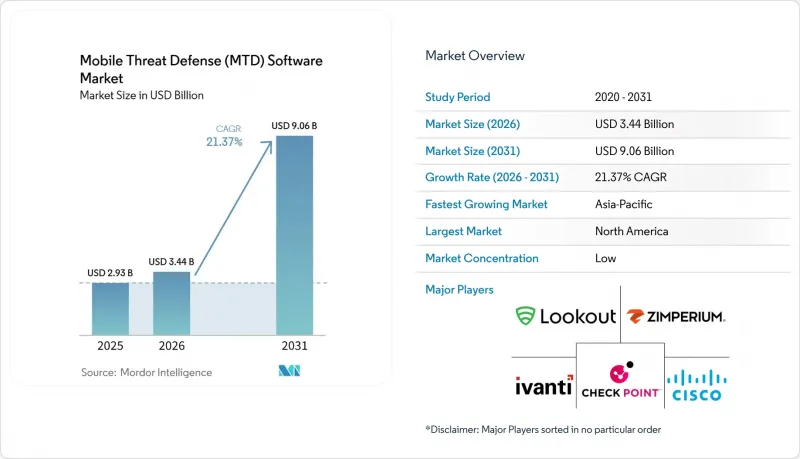
Mordor Intelligence에 의하면, 모바일 위협 방어(MTD) 소프트웨어 시장 규모는 2025년에 29억 3,000만 달러로 평가되었고, 2031년까지 90억 6,000만 달러에 이를 것으로 예측되며, 2026-2031년 CAGR 21.37%로 성장할 전망입니다.
본 보고서는 솔루션별(소프트웨어 및 서비스), 도입 형태별(클라우드 기반, 하이브리드형, 온프레미스형), 운영 체제별(Android, iOS, Windows, 기타), 기업 규모별(대기업 및 중소기업), 최종 사용자별(IT 및 통신, 은행, 금융서비스 및 보험(BFSI), 기타) 및 지역별로 분류되어 있습니다. 시장 전망은 금액(달러) 기준으로 제시되어 있습니다.
세계의 모바일 위협 방어(MTD) 소프트웨어 시장 동향 및 인사이트
기업용 기기 전반에서 확대되는 ‘모바일 퍼스트’ 공격 표적 영역
현재, 기업의 모바일 기기는 공격 체인에서 가장 공격의 발판이 되기 쉬운 요소 중 하나이며, 이러한 변화가 모바일 위협 방어(MTD) 소프트웨어 시장 전체 수요를 견인하고 있습니다. Digital.ai의 조사에 따르면, 2025년 1월에는 모니터링 대상 안드로이드 앱의 90.4%, iOS 앱의 88.1%에서 공격이 확인되었으며, 이는 2024년 2월에 보고된 전체 크로스 플랫폼 수준에 비해 급격한 상승을 보여줍니다. 그동안 많은 조직에서는 모바일 관련 지출을 위협 감지가 아닌 기기 관리에 중점을 두었기 때문에 통제와 위험 노출 사이에 뚜렷한 격차가 발생했습니다. 관리 도구만으로는 피싱이나 악성 컨텐츠, 기기 수준의 공격 위험을 제거할 수 없기 때문에 이러한 격차로 인해 지금까지의 모빌리티 투자는 불완전한 것으로 보였습니다. 룩아웃(Lookout)은 2025년 3분기에 120만 건 이상의 기업 대상 피싱 사이트를 보고하며, 모바일 단말기가 공격자에게 확실한 침입 경로라고 지적했습니다. 이는 구매 결정 속도가 가속화되어 경영진의 검토 단계에 이전보다 훨씬 이른 시점에 도달하고 있는 이유를 설명해 줍니다.
BYOD 및 COPE 도입 확대에 따라 관리 대상에서 벗어난 엔드포인트 증가
BYOD(개인 소유 기기의 업무용 사용)는 예외적인 존재에서 직장의 일반적인 관행으로 전환되고 있으며, 모바일 위협 방어(MTD) 소프트웨어 시장의 잠재적 고객 기반을 확대되고 있습니다. 버라이즌의 조사에 따르면, IT 담당자 4명 중 3명이 BYOD를 일상적인 현상으로 인식하고 있는 반면, 이를 명시적으로 허용하는 조직은 52%에 그쳤으며, 금지된 경우에도 이를 완전히 준수하는 직원은 22%에 불과했습니다. 이러한 불일치로 인해 전용 모바일 위협 방어 계층이 없는 상태에서 개인 기기에 기업의 인증 정보나 업무용 애플리케이션이 존재하는 경우가 늘고 있습니다. BYOD에 관한 NIST 지침에서는 기업 소유 기기를 위해 설계된 통제 조치만으로는 직원 소유 엔드포인트에 특유한 위험을 완전히 커버할 수 없습니다는 점이 명확히 밝혀졌습니다. 그 결과, 모바일 기기 관리(MDM)에 완전히 등록되었습니다는 사실만으로는 더 이상 모바일 보안을 신뢰할 수 있는 지표가 되지 못하므로, 구매자들은 MDM 등록 범위를 벗어나도 작동하는 도입 모델에 더 많은 관심을 기울이고 있습니다.
BYOD가 주류인 환경에서의 개인정보 보호에 대한 반발
BYOD 환경에서 직원의 개인정보 보호에 대한 우려는 여전히 현실적인 장애물로 남아 있습니다. 특히 데이터 보호 규정에 따라 고용주가 개인 단말기에 대해 요구할 수 있는 가시성이 제한되는 경우에는 더욱 그렇습니다. 버라이즌의 조사에 따르면, 보안 전문가의 29%가 BYOD 자체를 위험 증가 요인으로 간주하는 반면, 직원들의 개인 단말기 활용을 통한 우회 조치는 여전히 지속되고 있어, 위험 관리와 사용자 수용성 사이에서 어려운 균형을 찾아야 하는 상황입니다. 근본적인 문제는 모바일 위협 요인이 행동 데이터, 앱 활동 현황, 네트워크 정보, 또는 위치 정보와 관련된 신호를 수집할 가능성이 있어, 직원들이 이를 감시로 해석해 버린다는 점에 있습니다. 유럽의 일부 지역에서는 고용주 협의회나 지역의 개인정보 보호에 대한 기대에 따라, 이미 일부 도입 사례에서 기기 전체를 감시하는 대신 ‘기업용 컨테이너’로의 전환이 진행되고 있어, 기업이 더 강력한 보호를 원하더라도 가시성이 저하되고 있습니다. 이러한 긴장 관계로 인해 도입 범위 확대가 지연되거나 사내 승인 절차가 장기화되어, 개인 단말기 환경에서 보안 팀이 원하는 수준에 미치지 못하는 커버리지로 그칠 가능성이 있습니다.
부문 분석
2025년 모바일 위협 방어(MTD) 소프트웨어 시장에서 소프트웨어가 68.41%의 점유율을 차지했습니다. 이는 많은 구매자가 여전히 외부 위탁형 오버레이보다 자사에서 직접 관리하는 도구를 선호하고 있음을 보여줍니다. 모바일 위협 방어(MTD) 소프트웨어 시장에서 이러한 경향은 이미 보안 운영 체제를 갖추고 있으며, 정책, 커넥터, 텔레메트리 처리를 스스로 제어하고자 하는 조직의 요구를 반영한 것입니다. 이러한 구매자들은 감지 규칙을 보다 직접적으로 조정할 수 있고, 확립된 엔드포인트 및 ID 관리 워크플로우와의 연동이 더욱 긴밀해지기 때문에 소프트웨어를 선호하는 경향을 보였습니다. 이러한 경향은 모바일 보안이 단순한 모빌리티 기능에 그치지 않고, 이미 정식 보안 운영의 일환으로 자리 잡은 대기업에서 가장 두드러졌습니다.
서비스 부문은 2026-2031년 연평균 성장률(CAGR) 24.83%로 확대될 것으로 예측되며, 모바일 위협 방어(MTD) 소프트웨어 시장에서 가장 빠르게 성장하는 솔루션 부문이 될 전망입니다. 이러한 성장은 명백한 기술 격차에서 기인합니다. 많은 중견 기업의 팀에는 모바일 경보를 ID 이벤트, 애플리케이션 위험, 사용자 행동과 연관 지을 수 있는 분석가가 여전히 부족했습니다. Zimperium의 보고서에 따르면, 모바일을 표적으로 한 피싱은 확인된 위협의 약 3분의 1을 차지하여, 모바일에 대한 전문 지식이 없는 소규모 보안 팀의 부담을 더욱 가중시키고 있었습니다. 관리형 제공 모델은 24시간 모니터링, 미리 구축된 대응 플레이북, 그리고 보다 광범위한 보안 운영과의 간편한 통합을 통해 이러한 격차를 해소했습니다. 이로 인해 전문적인 사내 체계를 처음부터 구축할 필요 없이, 신뢰할 수 있는 모바일 보안 대책을 필요로 하는 직원 수 1,000명 미만의 조직에게 이 서비스는 특히 중요해졌습니다.
2025년 모바일 위협 방어(MTD) 소프트웨어 시장에서 클라우드 기반 도입이 74.18%를 차지했으며, 중앙 집중형 제공이 여전히 대다수의 구매자에게 표준 모델임이 확인되었습니다. 모바일 위협 방어(MTD) 소프트웨어 시장에서 클라우드 기반 제공은 손쉬운 확장성, 인프라 부담 경감, 그리고 벤더에 의한 시그니처 및 모델의 지속적인 업데이트가 가능하다는 점에서 계속해서 매력적인 선택지였습니다. 또한, 클라우드 기반 제공 방식은 위협 인텔리전스 공유도 지원하여, 이를 통해 벤더는 단일 기업이 일반적으로 단독으로 수행하는 것보다 더 신속하게 고객 환경 전반에 걸친 새로운 공격 패턴을 식별할 수 있었습니다. 이러한 강점 덕분에 클라우드 기반 도입은 속도, 도입 부담 경감, 그리고 고객 전반에 걸친 광범위한 가시성을 추구하는 조직의 요구와 계속해서 밀접하게 부합했습니다.
하이브리드 도입은 2026-2031년 연평균 성장률(CAGR) 23.69%를 나타낼 것으로 예측되며, 이는 모바일 위협 방어(MTD) 소프트웨어 시장에서 데이터 저장 위치에 대한 우려가 커지고 있음을 반영합니다. 의료, 금융 서비스, 정부 기관의 구매자들은 기밀성이 높은 텔레메트리 데이터의 저장 위치에 대한 엄격한 관리를 유지하면서도, 클라우드 수준의 속도로 분석을 수행할 수 있기를 점점 더 요구하게 되었습니다. NIST 지침은 모바일 보안 아키텍처의 선택을 해당 기기에서 액세스되는 데이터의 기밀성과 연계하도록 제시하고 있으며, 이는 규제 대상 환경에서 보다 선택적인 도입 접근 방식을 뒷받침했습니다. 따라서 온프레미스 도입은 에어 갭 환경이나 기밀 환경에서 여전히 중요했지만, 그 대상은 더 강력한 격리가 필요한 제한된 사용자층에 국한되었습니다. 하이브리드 모델은 중앙 집중식 감지 로직과 텔레메트리 및 정책 처리에 대한 보다 로컬한 제어를 결합함으로써 그 중간에 위치합니다.
지역별 분석
2025년, 북미는 모바일 위협 방어(MTD) 소프트웨어 시장의 36.42%를 차지하며 선두 자리를 유지했습니다. 이러한 위상은 기업 내 모바일 기기 사용 밀도가 높고, 보안 지출이 성숙한 수준이며, 모바일 위협 방어(MTD) 소프트웨어 시장에 진출한 다수의 주요 벤더가 존재함을 반영한 것입니다. 정부 정책 또한 중요한 요인으로, 공공 부문 단말기에 대한 모바일 위협 방어 및 앱 심사에 관한 공식적인 요건이 관련 규제 대상 부문 전반에 걸쳐 기업의 구매 결정을 촉진했습니다. 캐나다와 멕시코도 지역 수요를 끌어올렸으며, 특히 캐나다의 금융 기관들은 모바일 보안 대책에 대한 감독 당국의 관심이 높아짐에 따라 더욱 신속하게 대응을 추진하고 있습니다.
아시아태평양은 2026-2031년 연평균 성장률(CAGR) 26.81%로 확대될 것으로 예측되며, 모바일 위협 방어(MTD) 소프트웨어 시장에서 가장 빠르게 성장하는 지역이 될 전망입니다. 이 지역의 많은 국가에서는 기업의 컴퓨팅 모델이 보다 ‘모바일 우선’이기 때문에 PC 중심 환경에 비해 스마트폰이 비즈니스 데이터 및 사용자 활동에서 더 큰 비중을 차지하는 경우가 많습니다. Zimperium의 보고서에 따르면, 2025년 이 지역에서 모바일 금융 용도를 표적으로 한 뱅킹형 트로이 목마 활동이 전년 대비 67% 증가했으며, 이는 은행 업무 및 디지털 결제 분야에서의 도입 가속화를 뒷받침했습니다. 이 회사는 또한 한 회계연도 동안 아시아태평양의 12개 금융 기관과 계약을 체결했다고 밝혔으며, 이는 해당 지역의 구매 모멘텀을 보여주는 구체적인 신호로 해석됩니다. 중국은 현지 규정 준수 체계와 국내 공급업체의 입지 등으로 인해 국제적인 벤더 시장과는 완전히 일치하지 않는 독자적인 경쟁 환경이 형성되어 있었기 때문에 여전히 다른 지역과는 차별화된 모습을 보였습니다.
2025년, 유럽은 지역별 2위 자리를 차지했으며, 독일, 영국, 프랑스가 모바일 위협 방어(MTD) 소프트웨어 시장의 주요 핵심 시장으로 기능했습니다. NIS2로 인해 대상 조직 수가 대폭 확대됨에 따라, 더욱 엄격한 사이버 보안 의무 하에서 사업을 영위하는 조직에게 모바일 엔드포인트 제어의 실질적인 중요성이 더욱 높아졌습니다. 독일의 보안 프레임워크는 운영 체제 강화를 넘어선 보호를 중시하는 반면, 프랑스는 Pradeo 제품군에 CSPN 인증을 부여하여 규제 대상 구매자들에게 의미 있는 현지 규정 준수상의 이점을 제공했습니다. 남미, 중동 및 아프리카는 모바일 위협 방어(MTD) 소프트웨어 시장에서 여전히 초기 단계에 머물러 있었으나, 모바일 뱅킹 사기 및 디지털 정부 이용이 모두 증가하는 가운데, 브라질의 금융 부문과 걸프 국가들의 정부 프로그램이 뚜렷한 수요의 중심이 되어 가고 있었습니다.
기타 혜택 :
- 엑셀 형식 시장 예측(ME) 시트
- 3개월간의 애널리스트 지원
자주 묻는 질문
목차
제1장 서론
제2장 조사 방법
제3장 주요 요약
제4장 시장 구도
제5장 시장 규모 및 성장 예측
제6장 경쟁 구도
제7장 시장 기회 및 향후 전망
AJYAccording to Mordor Intelligence, the mobile threat defense (MTD) software market size stood at USD 2.93 billion in 2025 and is projected to reach USD 9.06 billion by 2031, expanding at a CAGR of 21.37% during 2026-2031.
This report is Segmented by Solution (Software and Services), Deployment (Cloud-Based, Hybrid, and On-Premises), Operating System (Android, IOS, Windows, and Others), Enterprise Size (Large Enterprises and Small and Medium Enterprises), End User (IT and Telecommunication, BFSI, and More), and Geography. The Market Forecasts are Provided in Terms of Value (USD).
Global Mobile Threat Defense (MTD) Software Market Trends and Insights
Rising Mobile-First Attack Surface Across Enterprise Devices
Enterprise mobile devices now sit at a point where they are one of the most likely starting points in an attack chain, and that shift is strengthening demand across the Mobile Threat Defense (MTD) Software Market. Digital.ai recorded attacks on 90.4% of monitored Android apps and 88.1% of monitored iOS apps in January 2025, which marked a sharp rise from the cross-platform level reported in February 2024. Many organizations had previously aligned mobile spending with device management rather than with threat detection, leaving a clear gap between control and exposure. That gap has made earlier mobility investments look incomplete because management tools do not remove phishing, malicious content, or device-level attack risk on their own. Lookout reported more than 1.2 million enterprise phishing sites in Q3 2025 and described mobile as a reliable entry point for attackers, which helps explain why buying decisions are now moving faster and reaching senior leadership review much earlier.
BYOD and COPE Adoption Expanding Unmanaged Endpoints
Bring-your-own-device use has moved from an exception to a regular workplace practice, widening the accessible base for the Mobile Threat Defense (MTD) Software Market. Verizon found that 3 in 4 IT workers saw BYOD as a regular occurrence, yet only 52% of organizations explicitly permitted it, and only 22% of employees fully complied where it was prohibited. That mismatch means corporate credentials and business applications are often present on personal devices without a dedicated mobile threat layer. NIST guidance on BYOD makes clear that controls designed for corporate devices do not fully address the distinct risks associated with employee-owned endpoints. As a result, buyers are paying more attention to deployment models that can work outside full mobile device management enrollment, because enrollment coverage alone no longer serves as a dependable proxy for mobile protection.
Privacy Pushback in BYOD-Heavy Deployments
Employee privacy concerns remain a real obstacle in BYOD settings, especially when data protection rules limit the visibility employers can demand into personal devices. Verizon found that 29% of security professionals viewed BYOD itself as a heightened risk, yet employee workarounds on personal devices persisted, creating a difficult balance between risk control and user acceptance. The core issue is that mobile threat agents may collect behavior data, app activity, network information, or location-linked signals that employees can interpret as surveillance. In parts of Europe, employer councils and local privacy expectations have already pushed some deployments toward corporate containers rather than full-device monitoring, reducing visibility even when companies want stronger protection. This tension can slow rollout scope, prolong internal approvals, and keep coverage below what security teams would prefer in personal-device environments.
Other drivers and restraints analyzed in the detailed report include:
- AI-Enhanced Smishing and QR Phishing Increasing Mobile Intrusion Risk
- Zero-Trust Rollouts Pulling Mobile Devices into Unified Policy Control
- Overlap With MDM, UEM, and EDR Budgets Slowing Standalone Purchases
For complete list of drivers and restraints, kindly check the Table Of Contents.
Segment Analysis
Software commanded 68.41% of the Mobile Threat Defense (MTD) Software market share in 2025, which showed that many buyers still preferred directly managed tools over outsourced overlays. In the Mobile Threat Defense (MTD) Software Market, that preference reflected the needs of organizations that already had security operations capacity and wanted control over policies, connectors, and telemetry handling. These buyers often favored software because it allowed more direct tuning of detection rules and tighter alignment with established endpoint and identity workflows. The pattern was strongest in larger enterprises, where mobile security had already moved into formal security operations rather than remaining a simple mobility function.
Services are projected to expand at a 24.83% CAGR during 2026-2031, making it the fastest-growing solution segment in the Mobile Threat Defense (MTD) Software Market. That growth stemmed from a clear skills gap: many mid-market teams still lacked analysts who could connect mobile alerts to identity events, application risk, and user behavior. Zimperium reported that mobile-targeted phishing accounted for roughly one-third of identified threats, reinforcing the burden on smaller security teams without dedicated mobile expertise. Managed delivery models answered that gap with round-the-clock monitoring, built response playbooks, and simpler integration into wider security operations. This made services especially relevant for organizations below 1,000 seats that wanted credible mobile coverage without building a specialized internal practice from the ground up
Cloud-based deployment accounted for 74.18% of the Mobile Threat Defense (MTD) Software market in 2025, confirming that centralized delivery remained the default model for most buyers. In the Mobile Threat Defense (MTD) Software Market, cloud delivery remained attractive because it scaled easily, reduced infrastructure burden, and enabled vendors to continuously update signatures and models. It also supported pooled threat intelligence, which helped suppliers identify emerging attack patterns across customer environments faster than a single enterprise usually could on its own. These strengths kept cloud deployment well aligned with organizations that wanted speed, lighter deployment effort, and broad cross-customer visibility.
Hybrid deployment is expected to grow at a 23.69% CAGR during 2026-2031, reflecting rising data residency concerns in the Mobile Threat Defense (MTD) Software Market. Healthcare, financial services, and government buyers increasingly wanted cloud-speed analytics while still retaining tighter control over where sensitive telemetry was stored. NIST guidance tied mobile security architecture choices to the sensitivity of the data accessed on those devices, which supported a more selective deployment approach in regulated settings. On-premises deployment, therefore, remained relevant for air-gapped or classified environments, but it served a narrower group of users with stronger isolation needs. Hybrid models sit in the middle by combining centralized detection logic with more local control over telemetry and policy handling.
Complete Report Scope:
- By Solution
- Software
- Services
- By Deployment
- Cloud-Based
- Hybrid
- On-Premises
- By Operating System
- Android
- iOS
- Windows
- Others
- By Enterprise Size
- Large Enterprises
- Small and Medium Enterprises
- By End-User Industry
- IT and Telecommunication
- BFSI
- Healthcare and Life Sciences
- Retail and E-Commerce
- Industrial Manufacturing
- Education and Research Institutions
- Media and Entertainment
- Government and administration
- Energy and Utilities
- Other End-User Industries
- By Geography
- North America
- United States
- Canada
- Mexico
- South America
- Brazil
- Argentina
- Rest of South America
- Europe
- Germany
- United Kingdom
- France
- Russia
- Spain
- Rest of Europe
- Asia-Pacific
- China
- Japan
- India
- South Korea
- Southeast Asia
- Rest of Asia-Pacific
- Middle East and Africa
- Middle East
- Saudi Arabia
- United Arab Emirates
- Turkey
- Rest of Middle East
- Africa
- South Africa
- Nigeria
- Egypt
- Rest of Africa
- Middle East
- North America
Geography Analysis
North America held 36.42% of the Mobile Threat Defense (MTD) Software market in 2025, maintaining its lead. That position reflected dense enterprise mobile usage, mature security spending, and the presence of many major vendors serving the Mobile Threat Defense (MTD) Software Market. Government direction also mattered, as formal expectations around mobile threat defense and app vetting on public-sector devices helped drive enterprise buying decisions across adjacent regulated sectors. Canada and Mexico added to regional demand, with Canadian financial institutions moving more quickly after updated supervisory attention to mobile security controls.
Asia-Pacific is projected to expand at a 26.81% CAGR during 2026-2031, making it the fastest-growing region in the Mobile Threat Defense (MTD) Software Market. The region's enterprise computing model is more mobile-first in many countries, so smartphones often carry a larger share of business data and user activity than in more PC-centric environments. Zimperium reported a 67% year-over-year increase in banking trojan activity targeting mobile financial applications in the region during 2025, which supported faster adoption in banking and digital payments. The company also stated that it signed 12 banking institutions in Asia-Pacific in one fiscal year, which gave a practical signal of regional buying momentum. China remained more distinct because local compliance structures and domestic supplier positioning created a parallel competitive path that did not fully mirror the international vendor field.
Europe held the second-largest regional position in 2025, with Germany, the United Kingdom, and France serving as the main anchor markets in the Mobile Threat Defense (MTD) Software Market. NIS2 sharply widened the number of covered organizations, thereby expanding the practical relevance of mobile endpoint controls for entities now operating under stricter cyber obligations. Germany's security framework emphasized protection beyond operating system hardening, while France granted Pradeo's suite CSPN certification, creating a meaningful local compliance advantage for regulated buyers. South America, the Middle East, and Africa remained earlier-stage parts of the Mobile Threat Defense (MTD) Software Market, but Brazil's financial sector and Gulf government programs were becoming clearer demand centers as mobile banking fraud and digital government use both increased.
- Lookout, Inc.
- Zimperium, Inc.
- Check Point Software Technologies Ltd.
- Cisco Systems, Inc.
- Broadcom Inc.
- IBM Corporation
- Palo Alto Networks, Inc.
- Jamf Holding Corp.
- Ivanti, Inc.
- Trend Micro Incorporated
- Sophos Limited
- BlackBerry Limited
- Microsoft Corporation
- VMware, Inc.
- OPSWAT, Inc.
- Pradeo Security Systems SAS
- Guardsquare NV
- Matrix42 AG
- Esper.io Inc.
- F-Secure Oyj
Additional Benefits:
- The market estimate (ME) sheet in Excel format
- 3 months of analyst support
TABLE OF CONTENTS
1 INTRODUCTION
- 1.1 Study Assumptions and Market Definition
- 1.2 Scope of the Study
2 RESEARCH METHODOLOGY
3 EXECUTIVE SUMMARY
4 MARKET LANDSCAPE
- 4.1 Market Overview
- 4.2 Market Drivers
- 4.2.1 Rising Mobile-First Attack Surface Across Enterprise Devices
- 4.2.2 BYOD and COPE Adoption Expanding Unmanaged Endpoints
- 4.2.3 AI-Enhanced Smishing and QR Phishing Increasing Mobile Intrusion Risk
- 4.2.4 Zero-Trust Rollouts Pulling Mobile Devices Into Unified Policy Control
- 4.2.5 5G and SASE Convergence Increasing Demand for Mobile-Specific Telemetry
- 4.2.6 Compliance-Driven Need for Mobile Data Loss Prevention in Regulated Verticals
- 4.3 Market Restraints
- 4.3.1 Privacy Pushback in BYOD-Heavy Deployments
- 4.3.2 Overlap With MDM, UEM, and EDR Budgets Slowing Standalone Purchases
- 4.3.3 Limited Security Telemetry on Consumer-Owned Devices
- 4.3.4 Integration Friction With Legacy Identity and Mobile Fleet Tooling
- 4.4 Impact of Macroeconomic Factors on the Market
- 4.5 Industry Value Chain Analysis
- 4.6 Technology Outlook
- 4.7 Regulatory Landscape
- 4.8 Porter's Five Forces Analysis
- 4.8.1 Threat of New Entrants
- 4.8.2 Bargaining Power of Suppliers
- 4.8.3 Bargaining Power of Buyers
- 4.8.4 Threat of Substitutes
- 4.8.5 Intensity of Competitive Rivalry
5 MARKET SIZE AND GROWTH FORECASTS (VALUE)
- 5.1 By Solution
- 5.1.1 Software
- 5.1.2 Services
- 5.2 By Deployment
- 5.2.1 Cloud-Based
- 5.2.2 Hybrid
- 5.2.3 On-Premises
- 5.3 By Operating System
- 5.3.1 Android
- 5.3.2 iOS
- 5.3.3 Windows
- 5.3.4 Others
- 5.4 By Enterprise Size
- 5.4.1 Large Enterprises
- 5.4.2 Small and Medium Enterprises
- 5.5 By End-User Industry
- 5.5.1 IT and Telecommunication
- 5.5.2 BFSI
- 5.5.3 Healthcare and Life Sciences
- 5.5.4 Retail and E-Commerce
- 5.5.5 Industrial Manufacturing
- 5.5.6 Education and Research Institutions
- 5.5.7 Media and Entertainment
- 5.5.8 Government and administration
- 5.5.9 Energy and Utilities
- 5.5.10 Other End-User Industries
- 5.6 By Geography
- 5.6.1 North America
- 5.6.1.1 United States
- 5.6.1.2 Canada
- 5.6.1.3 Mexico
- 5.6.2 South America
- 5.6.2.1 Brazil
- 5.6.2.2 Argentina
- 5.6.2.3 Rest of South America
- 5.6.3 Europe
- 5.6.3.1 Germany
- 5.6.3.2 United Kingdom
- 5.6.3.3 France
- 5.6.3.4 Russia
- 5.6.3.5 Spain
- 5.6.3.6 Rest of Europe
- 5.6.4 Asia-Pacific
- 5.6.4.1 China
- 5.6.4.2 Japan
- 5.6.4.3 India
- 5.6.4.4 South Korea
- 5.6.4.5 Southeast Asia
- 5.6.4.6 Rest of Asia-Pacific
- 5.6.5 Middle East and Africa
- 5.6.5.1 Middle East
- 5.6.5.1.1 Saudi Arabia
- 5.6.5.1.2 United Arab Emirates
- 5.6.5.1.3 Turkey
- 5.6.5.1.4 Rest of Middle East
- 5.6.5.2 Africa
- 5.6.5.2.1 South Africa
- 5.6.5.2.2 Nigeria
- 5.6.5.2.3 Egypt
- 5.6.5.2.4 Rest of Africa
- 5.6.5.1 Middle East
- 5.6.1 North America
6 COMPETITIVE LANDSCAPE
- 6.1 Market Concentration
- 6.2 Strategic Moves
- 6.3 Market Share Analysis
- 6.4 Company Profiles (includes Global Level Overview, Market Level Overview, Core Segments, Financials as available, Strategic Information, Market Rank/Share, Products and Services, Recent Developments)
- 6.4.1 Lookout, Inc.
- 6.4.2 Zimperium, Inc.
- 6.4.3 Check Point Software Technologies Ltd.
- 6.4.4 Cisco Systems, Inc.
- 6.4.5 Broadcom Inc.
- 6.4.6 IBM Corporation
- 6.4.7 Palo Alto Networks, Inc.
- 6.4.8 Jamf Holding Corp.
- 6.4.9 Ivanti, Inc.
- 6.4.10 Trend Micro Incorporated
- 6.4.11 Sophos Limited
- 6.4.12 BlackBerry Limited
- 6.4.13 Microsoft Corporation
- 6.4.14 VMware, Inc.
- 6.4.15 OPSWAT, Inc.
- 6.4.16 Pradeo Security Systems SAS
- 6.4.17 Guardsquare NV
- 6.4.18 Matrix42 AG
- 6.4.19 Esper.io Inc.
- 6.4.20 F-Secure Oyj
7 MARKET OPPORTUNITIES AND FUTURE OUTLOOK
- 7.1 White-Space and Unmet-Need Assessment