

|
시장보고서
상품코드
2099972
수생 잡초 수확기 시장 : 시장 점유율 분석, 업계 동향 및 통계, 성장 예측(2026-2031년)Aquatic Weed Harvesters - Market Share Analysis, Industry Trends & Statistics, Growth Forecasts (2026 - 2031) |
||||||
 Mordor Intelligence
수생 잡초 수확기 시장은 2025년 8억 5,000만 달러로 평가되었고, 2026년에는 9억 달러로 확대될 것으로 추정되고, 2026-2031년 CAGR 5.74%로 성장을 지속할 전망이며, 2031년까지 11억 9,000만 달러에 이를 것으로 예측됩니다.
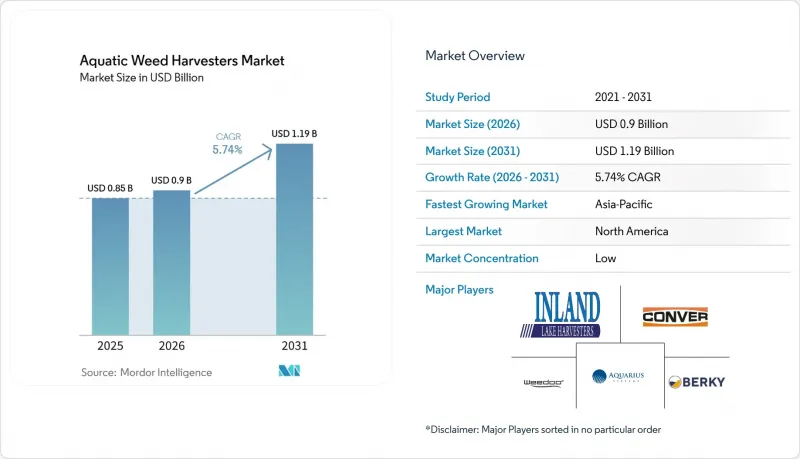
본 보고서는 제품 유형별(기계식 수확기, 유압식 수확기, 원격 조종식 수확기), 용도별(호수, 저수지, 하천·운하, 연못), 동력원별(디젤 엔진, 전기 모터, 하이브리드), 지역별(북미, 남미, 유럽, 아시아태평양, 중동 및 아프리카)로 분류되어 있습니다. 시장 전망은 금액(달러) 기준으로 제시되어 있습니다.
세계의 수생 잡초 수확기 시장 동향 및 인사이트
관리 수역에서 침입성 수생 잡초의 압박 증가
침입성 수생 잡초의 번식으로 인해, 많은 수자원 관리 기관에게 그 방제 비용은 상시적인 운영 필수 경비가 되고 있습니다. 미국 육군 공병대는 연방 수로 전역에서 매년 침입종 및 외래 식물을 관리하고 있으며, 내륙 및 연안 수로에서의 지속적인 수생 잡초 관리와 항행성 확보를 지원하고 있습니다. 텍사스주에서는 자이언트 살비니아와 물장미의 관리가 지속되고 있으며, 다양한 수역에서 수생 잡초 방제의 지속적인 필요성이 부각되고 있습니다. 이러한 추세는 수생 잡초 수확기 시장의 지속적인 수요를 뒷받침하는 요인이 되고 있습니다. 이는 각 기관이 단일 시즌에 국한된 대책이 아닌, 지속적인 수확 능력을 필요로 하기 때문입니다.
민감한 수역에서의 화학적 잡초 방제에 대한 규제 강화
수생 잡초 수확기 시장에서 가장 발전한 두 지역에서는 수생 제초제에 대한 규제 압력이 높아지고 있습니다. 미국 환경보호청(EPA)은 2024년 8월 ‘제초제 전략’을 최종 확정했습니다. 이에 따라 지정된 900종과 관련된 서식지 전반으로 규제가 확대되었으며, 화학적 방제 프로그램은 더욱 엄격한 심사 절차에 포함되었습니다. 또한 EPA는 디쿠왓·디브로마이드에 관한 2025년판 팩트 시트를 발표하고, 수생 부유 잡초에 대한 사용 허용량을 축소했습니다. 이는 제품 차원에서의 규제도 강화되고 있음을 보여줍니다. 유럽에서는 플루페나세트의 등록 갱신이 승인되지 않았고, 하천 및 호수에서 농약 기준치를 초과하는 현상이 지속되고 있어 수변 환경에서의 화학물질 사용에 대한 정치적·규제적 압력이 계속 가해지고 있습니다. 이러한 규제가 확대됨에 따라 비화학적 작업에 따른 허가 및 책임에 대한 우려가 완화되므로, 수생 잡초 수확기 시장에서 기계적 수확의 도입이 더욱 정당화되기 쉬워지고 있습니다.
전문 수확선단의 초기 설비 투자 비용 부담
수생 잡초 수확기 시장에서 초기 투자 비용은 소규모 사업자에게 여전히 큰 장벽으로 작용하고 있습니다. 호수나 저수지에서 본격적인 운용을 상정한 대형 수확기에는 막대한 설비 투자가 필요하며, 내륙이나 외진 지역의 구매자에게는 배송 물류 비용이 추가적인 부담이 됩니다. 오카나간 분지 수자원 위원회가 2024년 6월에 688,000 캐나다 달러(50만 5,000달러) 상당의 수륙양용형 Berky GmbH 제조 수확기를 구매한 사례는 확립된 공공 프로그램이라 하더라도 얼마나 정교한 공식 조달 절차와 예산 지원이 필요한지를 여실히 보여줍니다. Berky GmbH사의 상용 모델에는 렌탈 옵션이 포함되어 있어, 공급업체가 초기 비용이라는 장벽의 크기를 인식하고 있음을 엿볼 수 있습니다. 서비스 네트워크와 렌탈 차량이 더욱 확대되기 전까지는 이 문제가 시장 보급을 계속 제한할 것입니다.
부문 분석
2025년, 기계식 수확기는 수생 잡초 수확기 시장 점유율의 45.0%를 차지했으며, 여전히 최대 부문으로 자리 잡고 있습니다. 정부의 호수 및 저수지 정비 프로그램에서는 이러한 기종이 대량의 바이오매스를 처리할 수 있고 밀집된 생육 환경에 적합하다는 점에서 계속해서 선호되고 있습니다. 또한, 도입 대수가 많기 때문에 공공기관이 노후화된 장비를 교체할 때 지속적인 교체 수요도 뒷받침되고 있습니다. 유압식 수확기는 광범위한 처리 능력보다는 수확 깊이의 제어가 중시되는 관개 수로나 저수지에서의 용도에서 여전히 중요한 역할을 수행하고 있습니다.
원격 조종식 수확기는 2026-2031년 연평균 성장률(CAGR) 11.5%를 나타낼 것으로 예측되며, 수생 잡초 수확기 시장에서 가장 빠르게 성장하는 제품 유형이 될 전망입니다. 배터리 비용의 하락, 좁은 수로에서의 안전한 운용, 그리고 사유 수역에서의 도입 용이성이 이 카테고리에 대한 수요를 확대시키고 있습니다. 또한, 이러한 장비는 더 소형이며 필요한 노동력이나 유지보수 부담이 적은 시스템을 원하는 구매자에게도 매력적입니다. 수생 잡초 수확기 시장의 이 부문은 전기식이며 콤팩트하고 도입이 용이한 플랫폼으로 점차 전환되고 있습니다.
지역별 분석
북미는 2025년에 수생 잡초 수확기 시장의 36.5% 점유율을 차지했으며, 여전히 최대 지역 시장으로 자리 잡고 있습니다. 이 지역은 연방, 주, 지방 각 기관에 의한 외래종 관리에 대한 꾸준한 공공 자금 투입의 혜택을 받고 있습니다. 이 자금은 전문 장비와 훈련을 받은 운영자가 필요한 기계적 수확을 포함하여 광범위한 활동을 지원하고 있습니다. 플로리다주와 텍사스주는 모두 연간 처리 면적이 광범위하다는 보고가 있으며, 이는 조달 수요가 일회성 청소 수요가 아니라 지속적인 현장 작업량에 의해 주도되고 있음을 뒷받침합니다. 이 두 주 외에도 수자원이 풍부한 다른 주에서도 수생식물 관리 프로그램이 활발히 시행되고 있어, 해당 지역의 안정적인 수요를 더욱 공고히 하고 있습니다.
유럽은 수생식물 제초선에게 중요한 지역 시장으로, 정기적인 유지 관리가 필요하며 공공 부문의 차량 운용 수요를 뒷받침하는 운하, 하천, 호수 및 습지의 밀집된 네트워크에 의해 지탱되고 있습니다. 화학적 잡초 방제는 농약 규제 및 수질 기준에 따른 지속적인 압박에 직면해 있어, 규제가 엄격한 환경에서 기계적 제거의 필요성을 더욱 높이고 있습니다. 또한, 이 지역은 공급 측면에서도 중요하며, Berky GmbH 및 Conver B.V.와 같은 기업들이 시장에서 확고한 입지를 차지하고 있는 유럽의 제조 역량을 대표하고 있습니다.
아시아태평양은 2026-2031년 연평균 성장률(CAGR) 7.1%로 확대될 것으로 예측되며, 수생 잡초 제초선 시장에서 가장 빠르게 성장하는 지역 시장이 될 전망입니다. 이러한 성장은 인도, 중국, 동남아시아에서 증가하는 담수 관리 활동에 의해 주도되고 있으며, 이 지역들에서는 침입성 잡초가 관개 시스템, 저수지, 도시 수로에 영향을 미치고 있습니다. 2025년, 반건조 열대 지역 국제 작물 연구소(ICRISAT)가 라이선스를 부여한 태양광 발전식 물히야신스 수확기의 가격은 20만 루피(2,400달러) 미만으로, 가격에 민감한 사업자들에게 저비용의 현지 맞춤형 솔루션이 가진 매력을 반영했습니다. 또한, 2025년 『Nature』지의 『Scientific Reports』에 게재된 연구에서는 첸나이에서 물히야신스 감지 및 기계적 제거를 위한 자율형 쌍동선 시스템의 유효성이 입증되어, 해당 지역이 차세대 장비 설계에서 수행하는 역할이 뒷받침되었습니다. 남미, 아프리카, 중동에서도 수로에 대한 접근성, 관개 시설 보호, 도시 지역 운하의 유지 관리에 대한 관심이 높아짐에 따라 시장 성장에 기여할 것으로 전망됩니다.
기타 혜택 :
- 엑셀 형식 시장 예측(ME) 시트
- 3개월간의 애널리스트 지원
자주 묻는 질문
목차
제1장 서론
제2장 조사 방법
제3장 주요 요약
제4장 시장 구도
제5장 시장 규모 및 성장 예측
제6장 경쟁 구도
제7장 시장 기회 및 향후 전망
AJY 26.08.11According to Mordor Intelligence, the aquatic weed harvesters market is anticipated to grow from USD 0.85 billion in 2025 to USD 0.9 billion in 2026 and is forecast to reach USD 1.19 billion by 2031, at a CAGR of 5.74% over 2026-2031.
This report is Segmented by Product Type (Mechanical Harvesters, Hydraulic Harvesters, and Remote-Controlled Harvesters), Application (Lakes, Reservoirs, Rivers and Canals, and Ponds), Power Source (Diesel Engine, Electric Motor, and Hybrid), and Geography (North America, South America, Europe, Asia-Pacific, Middle East, and Africa). The Market Forecasts are Provided in Terms of Value (USD).
Global Aquatic Weed Harvesters Market Trends and Insights
Rising Invasive Aquatic Vegetation Pressure in Managed Waterways
Invasive aquatic plant growth has made control spending a recurring operational need for many water agencies. The United States Army Corps of Engineers manages invasive and exotic vegetation annually across federal navigation channels, supporting ongoing aquatic weed management and navigability in inland and coastal waterways. Texas continues to manage giant salvinia and water hyacinth, highlighting the persistent need for aquatic weed control across diverse water bodies. This pattern supports recurring equipment demand in the aquatic weed harvesters market, as agencies require ongoing harvesting capacity rather than single-season intervention.
Tighter Restrictions on Chemical Weed Control in Sensitive Water Bodies
Regulatory pressure on aquatic herbicides is rising in the two largest developed regions for the aquatic weed harvesters market. The United States Environmental Protection Agency finalized its Herbicide Strategy in August 2024, which widened restrictions across habitats tied to 900 listed species and pushed chemical programs into a tighter review process. The agency also published a 2025 fact sheet for diquat dibromide reducing the permitted application rates for aquatic surface weed uses, indicating that product-level controls are also tightening. In Europe, the non-renewal of flufenacet and continued pesticide exceedances in rivers and lakes maintain political and regulatory pressure on chemical options in water-adjacent settings. As these restrictions expand, mechanical harvesting becomes easier to justify in the aquatic weed harvesters market, as buyers face fewer permit and liability concerns from non-chemical operations.
High Upfront Capital Cost for Specialized Harvesting Fleets
Capital cost remains a significant barrier for smaller operators in the aquatic weed harvesters market. Large harvesters designed for full-scale lake or reservoir operations require substantial capital investment, and delivery logistics add further costs for inland or remote buyers. The Okanagan Basin Water Board's June 2024 purchase of a CAD 688,000 (USD 505,000) amphibious Berky GmbH harvester illustrates the level of formal procurement and budget support required even for well-established public programs. Berky GmbH's commercial model includes rental options, indicating that suppliers recognize the scale of the upfront cost barrier. Until service networks and rental fleets expand further, this issue will continue limiting market adoption.
Other drivers and restraints analyzed in the detailed report include:
- Labor-Saving Demand From Public Works and Lake Management Operators
- Growth of Integrated Weed and Debris Removal Missions
- Seasonal Utilization Limits in Temperate Climate Markets
For complete list of drivers and restraints, kindly check the Table Of Contents.
Segment Analysis
Mechanical harvesters held 45.0% of the aquatic weed harvesters market share in 2025, remaining the largest segment. Government lake and reservoir programs continue to favor these units because they handle large biomass volumes and are suited to dense growth conditions. Their installed base also supports recurring replacement demand as public agencies refresh older fleets. Hydraulic harvesters remained relevant in irrigation canals and reservoir applications where cutting depth control matters more than broad-area throughput.
Remote-controlled harvesters are projected to grow at an 11.5% CAGR between 2026 and 2031, making them the fastest-growing product type in the aquatic weed harvesters market. Declining battery costs, safer operation in confined waterways, and easier deployment in private water bodies are broadening demand for this category. These units also appeal to buyers seeking smaller systems with reduced labor requirements and reduced maintenance burdens. This segment of the aquatic weed harvesters market is gradually shifting toward electric, compact, and easily deployable platforms.
Complete Report Scope:
- By Product Type
- Mechanical Harvesters
- Hydraulic Harvesters
- Remote-Controlled Harvesters
- By Application
- Lakes
- Reservoirs
- Rivers and Canals
- Ponds
- By Power Source
- Diesel Engine
- Electric Motor
- Hybrid
- By Geography
- North America
- United States
- Canada
- Mexico
- Rest of North America
- South America
- Brazil
- Argentina
- Rest of South America
- Europe
- Germany
- France
- United Kingdom
- Spain
- Italy
- Russia
- Rest of Europe
- Asia-Pacific
- China
- India
- Japan
- Australia
- Rest of Asia-Pacific
- Middle East
- Saudi Arabia
- United Arab Emirates
- Rest of Middle East
- Africa
- South Africa
- Kenya
- Rest of Africa
- North America
Geography Analysis
North America held 36.5% of the aquatic weed harvesters market share in 2025 and remains the largest regional market. The region benefits from steady public funding for invasive species management across federal, state, and local agencies. This funding supports a broad range of activities, including mechanical harvesting, which requires specialized equipment and trained operators. Florida and Texas both reported large annual treatment footprints, confirming that procurement needs are driven by recurring field workloads rather than one-off cleanup demand. Beyond these two states, other water-rich states also maintain active aquatic vegetation management programs, further reinforcing consistent regional demand.
Europe represents a significant regional market for aquatic weed harvesters, supported by dense networks of canals, rivers, and lakes that require regular maintenance and sustain demand for public-sector fleet operations. Chemical weed control faces continued pressure from pesticide monitoring and water quality standards, which strengthens the case for mechanical removal in regulated settings. The region also holds significance on the supply side, with Berky GmbH and Conver B.V. representing established European manufacturing capacity within the market.
Asia-Pacific is forecast to expand at a 7.1% CAGR between 2026 and 2031, making it the fastest-growing regional market for aquatic weed harvesters. Growth is driven by rising freshwater management activity in India, China, and Southeast Asia, where invasive weeds affect irrigation systems, reservoirs, and urban waterways. In 2025, the International Crops Research Institute for the Semi-Arid Tropics' (ICRISAT) licensed solar-powered water hyacinth harvester, priced below INR 200,000 (USD 2,400), reflected the appeal of low-cost, local solutions for price-sensitive operators. A 2025 Scientific Reports study in nature journal also validated an autonomous catamaran system for water hyacinth detection and mechanical removal in Chennai, supporting the region's role in next-generation equipment design. South America, Africa, and the Middle East are also anticipated to contribute to market growth as waterway access, irrigation protection, and urban canal maintenance receive greater attention.
- Aquarius Systems (D and D Products, Inc.)
- Inland Lake Harvesters, Inc.
- Berky GmbH
- Weedoo Greenboat, Inc.
- Stonbury Limited
- Alamo Group, Inc. (Conver B.V.)
- Aquamarine Inc.
- Elastec, Inc.
- Eco-Harvesters LLC (Silver Mist Aquatics)
- Lake Weeders Digest LLC (Shoretech Industries)
- Relong Technology Co., Ltd.
Additional Benefits:
- The market estimate (ME) sheet in Excel format
- 3 months of analyst support
TABLE OF CONTENTS
1 INTRODUCTION
- 1.1 Study Assumptions and Market Definition
- 1.2 Scope of the Study
2 RESEARCH METHODOLOGY
3 EXECUTIVE SUMMARY
4 MARKET LANDSCAPE
- 4.1 Market Overview
- 4.2 Market Drivers
- 4.2.1 Rising invasive aquatic vegetation pressure in managed waterways
- 4.2.2 Tighter restrictions on chemical weed control in sensitive water bodies
- 4.2.3 Labor-saving demand from public works and lake management operators
- 4.2.4 Growth of integrated weed and debris removal missions
- 4.2.5 Underreported demand from stormwater retention and flood-bypass channels
- 4.2.6 Underreported adoption in asset protection for marina and canal operators
- 4.3 Market Restraints
- 4.3.1 High upfront capital cost for specialized harvesting fleets
- 4.3.2 Seasonal utilization limits in temperate climate markets
- 4.3.3 Permitting delays for mechanical operations in ecologically sensitive waters
- 4.3.4 Limited disposal capacity for biomass after harvesting
- 4.4 Regulatory Landscape
- 4.5 Technological Outlook
- 4.6 Porter's Five Forces Analysis
- 4.6.1 Bargaining Power of Buyers
- 4.6.2 Bargaining Power of Suppliers
- 4.6.3 Threat of New Entrants
- 4.6.4 Threat of Substitutes
- 4.6.5 Competitive Rivalry
5 MARKET SIZE AND GROWTH FORECASTS (VALUE)
- 5.1 By Product Type
- 5.1.1 Mechanical Harvesters
- 5.1.2 Hydraulic Harvesters
- 5.1.3 Remote-Controlled Harvesters
- 5.2 By Application
- 5.2.1 Lakes
- 5.2.2 Reservoirs
- 5.2.3 Rivers and Canals
- 5.2.4 Ponds
- 5.3 By Power Source
- 5.3.1 Diesel Engine
- 5.3.2 Electric Motor
- 5.3.3 Hybrid
- 5.4 By Geography
- 5.4.1 North America
- 5.4.1.1 United States
- 5.4.1.2 Canada
- 5.4.1.3 Mexico
- 5.4.1.4 Rest of North America
- 5.4.2 South America
- 5.4.2.1 Brazil
- 5.4.2.2 Argentina
- 5.4.2.3 Rest of South America
- 5.4.3 Europe
- 5.4.3.1 Germany
- 5.4.3.2 France
- 5.4.3.3 United Kingdom
- 5.4.3.4 Spain
- 5.4.3.5 Italy
- 5.4.3.6 Russia
- 5.4.3.7 Rest of Europe
- 5.4.4 Asia-Pacific
- 5.4.4.1 China
- 5.4.4.2 India
- 5.4.4.3 Japan
- 5.4.4.4 Australia
- 5.4.4.5 Rest of Asia-Pacific
- 5.4.5 Middle East
- 5.4.5.1 Saudi Arabia
- 5.4.5.2 United Arab Emirates
- 5.4.5.3 Rest of Middle East
- 5.4.6 Africa
- 5.4.6.1 South Africa
- 5.4.6.2 Kenya
- 5.4.6.3 Rest of Africa
- 5.4.1 North America
6 COMPETITIVE LANDSCAPE
- 6.1 Market Concentration
- 6.2 Strategic Moves
- 6.3 Market Share Analysis
- 6.4 Company Profiles (Includes Global Level Overview, Market Level Overview, Core Segments, Financials as Available, Strategic Information, Market Rank/Share, Products and Services, Recent Developments)
- 6.4.1 Aquarius Systems (D and D Products, Inc.)
- 6.4.2 Inland Lake Harvesters, Inc.
- 6.4.3 Berky GmbH
- 6.4.4 Weedoo Greenboat, Inc.
- 6.4.5 Stonbury Limited
- 6.4.6 Alamo Group, Inc. (Conver B.V.)
- 6.4.7 Aquamarine Inc.
- 6.4.8 Elastec, Inc.
- 6.4.9 Eco-Harvesters LLC (Silver Mist Aquatics)
- 6.4.10 Lake Weeders Digest LLC (Shoretech Industries)
- 6.4.11 Relong Technology Co., Ltd.
7 MARKET OPPORTUNITIES AND FUTURE OUTLOOK

(주말 및 공휴일 제외)


