
|
시장보고서
상품코드
2099985
멸균 파우치 시장 : 시장 점유율 분석, 업계 동향 및 통계, 성장 예측(2026-2031년)Sterilization Pouches - Market Share Analysis, Industry Trends & Statistics, Growth Forecasts (2026 - 2031) |
||||||
 Mordor Intelligence
멸균 파우치 시장 규모는 2025년에 394억 9,000만 달러로 평가되었고, 2026년 418억 4,000만 달러에서 2031년까지 560억 1,000만 달러에 이를 것으로 예측되며, 예측 기간(2026-2031년) CAGR은 6%를 나타낼 전망입니다.
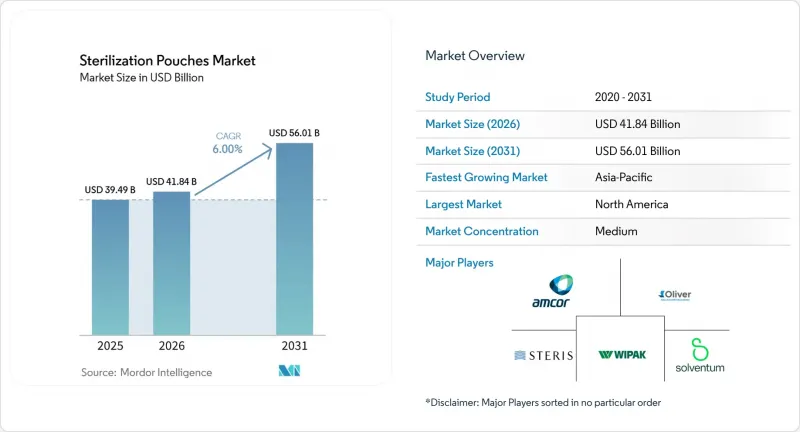
본 보고서는 제품 유형별(셀프 실링 파우치, 열 밀봉 파우치 등), 소재 유형별(종이 및 플라스틱, 타이벡, 부직포 등), 용도별(의료기기 포장 등), 최종 사용자별(병원 등), 지역별(북미, 유럽, 아시아태평양, 중동 및 아프리카, 남미)로 분류되어 있습니다. 시장 전망은 금액(달러) 기준으로 제시되어 있습니다.
세계의 멸균 파우치 시장 동향 및 인사이트
수술 건수 증가와 외래 수술 확대
멸균 파우치 시장은 모든 외과 수술에서 기구나 키트가 사용 현장에 도착하기 전에 무균 장벽이 필요하다는 기본적인 사실 덕분에 계속해서 혜택을 받고 있습니다. 세계보건기구(WHO)에 따르면, 전 세계 연간 수술 건수는 3억 건을 넘는 것으로 추정되며, 이는 멸균 파우치 시장에 대규모이자 지속적인 수술 건수라는 기반을 제공합니다. 또한, 외래 및 당일 진료 현장에서는 대규모 병원의 진료과에서 사용되는 부피가 큰 유형보다 소형이며 신속하게 처리할 수 있는 파우치 구성이 선호되는 경향이 있어 수요 형태도 변화하고 있습니다. 이러한 변화는 상업적으로 중요한 의미를 지닙니다. 외래 진료 센터에서는 일반적으로 시술마다 구매하는 경향이 있어, 이는 유통업체 주도의 유통 채널과 더 견고한 단위당 수익성을 뒷받침하고 있기 때문입니다. 또한 태국, 인도, 튀르키예 등의 국가에서 이루어지는 의료 관광은 멸균된 소모품에 대한 지리적으로 집중된 수요를 더욱 창출하고 있으며, 이로 인해 멸균 파우치 시장은 고성장을 이루고 있는 의료 거점에서 새로운 유통 기회를 얻고 있습니다.
멸균 장벽 검증에 대한 규제적 추진
멸균 파우치 시장은 단순한 기본 포장 자재 공급에 그치지 않고, 검증된 멸균 장벽 시스템에 대한 규제적 관심이 높아짐에 따라 형성되고 있습니다. ISO 11607-1에서는 포장 시스템 설계 시 위험 관리가 더욱 명확하게 강조됨에 따라, 의료기기 제조업체와 그 포장 파트너의 문서화 부담이 증가하고 있습니다.
유럽에서는 개정된 EN ISO 11607 규격이 EU MDR에 기반한 조화 프레임워크에 추가되었습니다. 이에 따라 해당 지역에서 제품을 판매하는 제조업체는 포장의 적합성 평가를 최신 버전에 부합하도록 해야 합니다. 이로 인해 전체 제품 포트폴리오에 걸쳐 검증 일정이 단축되고, 상업 계획 내 포장 심사가 앞당겨지고 있습니다. 따라서 멸균 파우치 시장에서는 재적격성 평가 주기에서 보다 신속한 시험 지원, 보다 충실한 기술 자료, 그리고 보다 적절한 지침을 제공할 수 있는 공급업체가 우위를 점하고 있습니다.
비용 제약이 있는 의료 조달에서의 가격 민감도
멸균 파우치 시장에서는 최저가 입찰에 의존하는 공공 의료 제도 하에서 여전히 가격 상한선에 직면해 있습니다. 이는 특히 남아시아, 동남아시아, 중동 및 아프리카 및 남미의 일부 지역에서 두드러지며, 이 지역 병원들은 규격에 부합하는 포장을 필요로 함에도 불구하고 여전히 주로 비용을 기준으로 계약을 결정하고 있습니다. 그 결과, 동일 국가 내에 이중 구조가 형성되어 고품질의 검증 완료 파우치는 사립 병원이나 다국적 의료기기 제조업체에 공급되는 반면, 저비용 제품은 공공 입찰에서 경쟁을 피할 수 없는 상황에 처해 있습니다.
그 결과, 시장의 양극단에 서비스를 제공하는 공급업체들은 이익률 압박에 직면해 있습니다. 공공 부문의 저렴한 가격 책정이 더 광범위한 협상에서 기준점이 되어버리기 때문입니다. 조달 평가에서 ISO 11607에 기반한 문서화 및 검증의 품질이 더욱 중시될 때까지, 멸균 파우치 시장은 신흥 의료 시스템 전반에 걸쳐 불균일한 가격 책정 문제에 계속 직면할 것입니다.
부문 분석
2025년, 셀프 씰 파우치는 매출의 39.11%를 차지했으며, 멸균 파우치 시장에서 가장 큰 제품 카테고리가 되었습니다. 이러한 위상은 별도의 열밀봉 장비가 필요하지 않아 병원, 진료소, 멸균 처리 부서에서 기구의 신속한 회전을 가능하게 한다는 명확한 워크플로우상의 이점에 힘입은 것이었습니다. 플랫 파우치는 일상적인 포장 수요의 폭넓은 기반을 지속적으로 충족시키며, 일반적인 기구나 키트의 표준 선택지로 자리매김했습니다. 거셋 파우치는 평평한 구조로는 적절하게 밀봉되지 않거나 외관이 나빠질 가능성이 있는 부피가 큰 세트나 다성분 팩을 처리함으로써 다른 역할을 수행했습니다.
열밀봉 파우치는 2031년까지 연평균 성장률(CAGR) 8.11%를 나타낼 것으로 예측되며, 제품 유형별 멸균 파우치 시장 규모에서 가장 빠르게 성장하는 포맷이 될 것입니다. 이러한 성장은 더 강력하고 재현성이 높은 밀봉 강도를 반영하며, 모니터링이 포함된 밀봉 워크플로우를 도입한 병원 시스템이나 자동 포장 라인에 의존하는 의료기기 제조업체에게 매력적입니다. 포일 파우치는 여전히 좁은 틈새 시장에 국한되어 있지만, 종이 기반 형식으로는 제공할 수 없는 투습 제로 배리어가 요구되는 습기에 민감한 제품의 경우 여전히 중요한 역할을 수행하고 있습니다. 릴 및 롤 유형은 기성 크기의 제품을 대량으로 재고로 보유하지 않으면서 파우치 길이에 유연성을 원하는 치과 및 소규모 의료시설로부터 안정적인 수요를 유지했습니다. 이러한 추세를 종합해 보면, 멸균 파우치 시장은 임상 현장의 편의성을 중시하는 수요와 대규모 의료 기관 및 OEM 환경에서의 검증을 바탕으로 한, 보다 관리된 밀봉 방식의 채택 사이에서 균형을 이루고 있음을 알 수 있습니다.
2025년에는 종이와 플라스틱 복합재가 매출의 54.30%를 차지했으며, 소재 수준에서 멸균 파우치 시장 점유율을 주도했습니다. 이러한 주도적 지위는 증기, 에틸렌옥사이드, 감마선 멸균과 같은 광범위한 멸균 방식에 대응할 수 있을 뿐만 아니라, 많은 국가의 공공 조달 예산에 여전히 부합하는 가격 책정 덕분입니다. 이 소재 조합은 사용자를 프리미엄 가격대로 몰아넣지 않으면서도 대량 이용 사례를 지원하기 때문에 멸균 파우치 시장의 주력 제품으로 자리매김하고 있습니다. 부직포 소재는 서로 다른 미생물 차단 특성이 요구되는 특정 용도에서 계속 사용되고 있는 반면, 호일 및 라미네이트 소재는 습기나 빛에 민감한 포장에서 전문적인 역할을 계속 수행하고 있습니다.
타이벡은 2031년까지 연평균 성장률(CAGR) 8.16%를 나타낼 것으로 예측되며, 소재 부문별 멸균 파우치 시장 규모에서 가장 빠르게 성장하는 소재가 될 것입니다. 그 주된 이유는 저온 멸균 공정과의 구조적 적합성이며, 특히 셀룰로오스계 종이가 과산화수소 증기 시스템에 적합하지 않은 상황에서 그 강점이 발휘됩니다. 듀폰사가 ‘타이벡 의료용 포장 전환 프로젝트’에 3,000만 달러 이상을 투자한 것은 이 회사가 이 기판에 대한 장기적인 수요에 자신감을 가지고 있음을 보여줍니다. 또한, 올림푸스(Olympus)도 2026년부터 일본 및 베트남 시설에서 100유형 이상의 의료기기 카테고리 멸균 포장에 듀폰사의 ‘재생 가능 원료’ 인증을 받은 타이벡을 채택하기 시작했으며, 조달 결정 시 차단 성능과 CO₂ 배출 강도 감소를 연계하고 있습니다. 이러한 움직임은 멸균 파우치 시장, 특히 OEM 의료기기 포장 프로그램에서 소재 선정이 ‘멸균 적합성’과 ‘지속가능성’이라는 두 가지 측면에서 평가되기 시작했음을 시사합니다.
지역별 분석
2025년, 북미는 전 세계 매출의 38.80%를 차지하며 멸균 파우치 시장에서 가장 규모가 큰 지역 점유율을 확보했습니다. 이 지역은 잘 갖춰진 외과 의료 인프라, 성숙한 규제 집행 체계, 그리고 검증된 포장 시스템을 중시하는 조달 관행의 혜택을 받고 있습니다. 그 수요의 대부분은 미국이 주도하고 있으며, 엄격한 의료기기 표시 규정과 확립된 감염 관리 기준에 힘입어 의료 기관의 조달 과정에서 검증 완료된 형식 이외의 것을 채택할 여지는 거의 없습니다. 캐나다는 주 정부 조달 시스템을 통해 규모는 작지만 꾸준한 기여를 이어가고 있으며, 멕시코는 의료기기 제조 거점으로서 시장을 뒷받침하고 있습니다. 또한 북미에서는 외래수술센터(ASC)의 기반이 지속적으로 확대되고 있으며, 처리량이 많은 환경에서 신뢰성 높은 멸균 포장이 필요한 새로운 시술 거점이 증가하고 있는 점도 시장 성장에 긍정적인 요인으로 작용하고 있습니다.
아시아태평양은 2031년까지 연평균 성장률(CAGR) 8.06%를 나타낼 것으로 예측되며, 멸균 파우치 시장에서 가장 두드러진 성장을 보일 지역 부문이 될 전망입니다. 이러한 성장은 중국, 인도, 일본, 한국, 동남아시아의 병원 투자와 더불어 해당 지역 전체의 의료기기 생산량 증가에 힘입고 있습니다. 또한 인도에서는 병원의 수용 능력이 확대되고, 현지 조달에 있어 멸균 의료기기 포장에 대한 요건이 엄격해짐에 따라 그 중요성이 높아지고 있습니다. 암콜(Amcor)사가 말레이시아 투자개발청의 지원을 받아 2026년 4월 말레이시아에 3,500만 달러를 투자해 의료용 포장 코팅 시설을 개설한 것과, 2026년 6월 인도에 투자한 사실은 공급업체들이 지역 의료기기 제조 클러스터 근처에 거점을 구축하고 있음을 보여줍니다.
유럽은 EU 의료기기 규정(MDR)이 멸균 의료기기 포장에 대해 개정된 EN ISO 11607 준수를 의무화하고 있기 때문에 멸균 파우치 시장에서 구조적으로 중요한 위치를 계속 차지하고 있습니다. 독일과 영국은 의료 시술 건수가 많고 의료기기 제조 활동이 집중되어 있어 주요 국내 시장으로 두각을 나타내고 있습니다. 또한, EU의 포장 및 포장 폐기물 규제는 의료 분야 특유의 사용 현실이 여전히 중요함에도 불구하고, 포장 설계를 재활용 가능성으로 이끌고 재료 심사를 엄격화함으로써 장기적인 재료 선택에 영향을 미치고 있습니다. 중동 및 아프리카 및 남미는 규모는 작지만 여전히 중요한 시장으로, GCC 국가들의 병원 투자가 프리미엄 제품에 대한 수요를 뒷받침하는 한편, 브라질과 아르헨티나에서는 조달 가격에 대한 가격 민감도가 여전히 높은 수준임에도 불구하고 성장을 이어가고 있습니다.
기타 혜택 :
- 엑셀 형식 시장 예측(ME) 시트
- 3개월간의 애널리스트 지원
자주 묻는 질문
목차
제1장 서론
제2장 조사 방법
제3장 주요 요약
제4장 시장 구도
제5장 시장 규모 및 성장 예측
제6장 경쟁 구도
제7장 시장 기회 및 향후 전망
AJY 26.08.11According to Mordor Intelligence, the sterilization pouches market size was valued at USD 39.49 billion in 2025 and is estimated to grow from USD 41.84 billion in 2026 to reach USD 56.01 billion by 2031, at a CAGR of 6% during the forecast period (2026-2031).
This report is Segmented by Product Type (Self-Seal Pouches, Heat-Seal Pouches, and More), Material Type (Paper and Plastic, Tyvek, Non-Woven Materials, and More), Application (Medical Device Packaging, and More), End-User (Hospitals, and More), and Geography (North America, Europe, Asia-Pacific, Middle East and Africa, South America). The Market Forecasts are Provided in Terms of Value (USD).
Global Sterilization Pouches Market Trends and Insights
Rising Surgical Volumes and Outpatient Procedure Growth
The sterilization pouches market continues to benefit from the basic fact that every surgical procedure needs a sterile barrier before an instrument or kit reaches the point of use. The World Health Organization places annual global surgical volume above 300 million procedures, which gives the sterilization pouches market a large and recurring procedural base. Demand is also shifting in format, because outpatient and ambulatory settings often prefer smaller and faster pouch configurations over bulkier options used in large hospital departments. That shift matters commercially because ambulatory centers tend to buy for per-procedure use, which supports distributor-led channels and stronger unit economics. Medical tourism in countries such as Thailand, India, and Turkey adds another layer of geographically concentrated demand for sterile consumables, which gives the sterilization pouches market new distribution opportunities in high-growth treatment corridors.
Regulatory Push for Sterile Barrier Validation
The sterilization pouches market is also being shaped by a stronger regulatory focus on validated sterile barrier systems rather than basic packaging supply alone. ISO 11607-1 now gives more explicit weight to risk management within packaging system design, which raises the documentation burden for device companies and their packaging partners.
In Europe, amended EN ISO 11607 standards were added to the harmonized framework under the EU MDR, which means manufacturers selling into the region must align packaging qualification with the updated versions. This is compressing validation timelines across product portfolios and bringing packaging review forward in commercial planning. The sterilization pouches market, therefore, favors suppliers that can provide faster test support, stronger technical files, and better guidance during requalification cycles.
Price Sensitivity in Cost-Constrained Healthcare Procurement
The sterilization pouches market still runs into price ceilings in public healthcare systems that rely on lowest-bid tendering. This is especially visible across South Asia, Southeast Asia, the Middle East, Africa, and parts of South America, where hospitals may need compliant packaging but still award contracts mainly on cost. That creates a two-tier structure inside the same country, with premium validated pouches serving private hospitals and multinational device manufacturers, while lower-cost products compete for public tenders.
The result is margin pressure for suppliers that serve both ends of the market, because cheap public-sector pricing becomes a reference point in wider negotiations. Until procurement scoring gives more weight to ISO 11607 documentation and validation quality, the sterilization pouches market will continue to face uneven pricing discipline across emerging healthcare systems.
Other drivers and restraints analyzed in the detailed report include:
- Expansion of Medical Device Manufacturing and Contract Sterilization
- Shift Toward Single-Use, Traceable Sterile Packaging
- Compliance Burden Across Multi-Jurisdiction Medical Packaging Standards
For complete list of drivers and restraints, kindly check the Table Of Contents.
Segment Analysis
Self-seal pouches held 39.11% of revenue in 2025, which made them the largest product category in the sterilization pouches market. Their position rested on clear workflow advantages because they do not require separate heat-sealing equipment, and they support fast instrument turnaround in hospitals, clinics, and sterile processing departments. Flat pouches continued to serve the broad base of routine packaging demand and remained the standard option for common instruments and kits. Gusseted pouches filled a different role by supporting bulkier sets and multi-component packs where flat structures may not seal or present well.
Heat-seal pouches are projected to grow at an 8.11% CAGR through 2031, which makes them the fastest-rising format in the sterilization pouches market size by product type. Their growth reflects stronger and more repeatable seal integrity, which appeals to hospital systems that are adopting monitored sealing workflows and to device manufacturers that rely on automated packaging lines. Foil pouches stayed limited to a narrower niche, but they remained important where moisture-sensitive products need a zero-permeability barrier that paper-based formats cannot provide. Reels and rolls kept steady demand from dental clinics and small healthcare facilities that need flexibility in pouch length without managing a large inventory of pre-made sizes. Together, these patterns show that the sterilization pouches market is balancing convenience-led demand in clinical settings with validation-led adoption of more controlled sealing formats in larger institutions and OEM environments.
Paper and plastic composites accounted for 54.30% of revenue in 2025 and led the sterilization pouches market share at the material level. Their leadership came from broad modality compatibility across steam, ethylene oxide, and gamma sterilization, along with pricing that still fits public procurement budgets in many countries. This material mix remains the workhorse of the sterilization pouches market because it supports high-volume use cases without pushing users into premium cost bands. Non-woven materials continued to serve selected applications where different microbial barrier properties are preferred, while foil and laminated materials kept a specialized role in moisture- and light-sensitive packaging.
Tyvek is forecast to grow at an 8.16% CAGR through 2031, which makes it the fastest-rising material in the sterilization pouches market size by material segment. The main reason is structural compatibility with low-temperature sterilization processes, especially where cellulosic paper is not suitable for vaporized hydrogen peroxide systems. DuPont's investment of more than USD 30 million in its Tyvek Medical Packaging Transition Project underlined the company's confidence in long-term demand for this substrate. Olympus also began incorporating DuPont Tyvek with Renewable Attribution into sterile packaging for more than 100 device categories at facilities in Japan and Vietnam in 2026, linking barrier performance with lower CO2 intensity in procurement decisions. That move suggests the sterilization pouches market is starting to judge material choice on both sterilization compatibility and sustainability credentials, especially in OEM device packaging programs.
Complete Report Scope:
- By Product Type
- Self-Seal Pouches
- Heat-Seal Pouches
- Flat Pouches
- Gusseted Pouches
- Foil Pouches
- Sterilization Reels and Rolls
- Other Product Types
- By Material Type
- Paper and Plastic
- Tyvek
- Non-Woven Materials
- Foil and Laminated Materials
- Other Material Types
- By Application
- Medical Device Packaging
- Surgical Instruments Packaging
- Dental Instruments Packaging
- Laboratory Supplies Packaging
- Pharmaceutical Packaging
- Veterinary Instruments Packaging
- Other Applications
- By End-User
- Hospitals
- Central Sterile Services Departments
- Ambulatory Surgical Centers
- Dental Clinics and Practices
- Medical Device Manufacturers
- Other End-Users
- By Geography
- North America
- United States
- Canada
- Mexico
- Europe
- Germany
- United Kingdom
- France
- Italy
- Spain
- Rest of Europe
- Asia-Pacific
- China
- Japan
- India
- Australia
- South Korea
- Rest of Asia-Pacific
- Middle East and Africa
- GCC
- South Africa
- Rest of Middle East and Africa
- South America
- Brazil
- Argentina
- Rest of South America
- North America
Geography Analysis
North America held 38.80% of global revenue in 2025, which gave it the largest regional position in the sterilization pouches market. The region benefits from dense surgical infrastructure, mature regulatory enforcement, and purchasing practices that place a high value on validated packaging systems. The United States drives most of that demand, supported by strict device labeling rules and established infection-control expectations that leave little room for non-validated formats in institutional purchasing. Canada remained a smaller but stable contributor through provincial procurement systems, while Mexico added support as a medical device manufacturing hub. North America also continues to benefit from an expanding ambulatory surgical center base, which adds new procedural sites that need reliable sterile packaging in high-throughput settings.
Asia-Pacific is forecast to grow at an 8.06% CAGR through 2031, making it the fastest-growing regional segment in the sterilization pouches market. Growth is being supported by hospital investment in China, India, Japan, South Korea, and Southeast Asia, along with rising medical device output across the region. India is also moving higher in importance as hospital capacity grows and sterile medical device packaging requirements tighten in local procurement. Amcor's April 2026 opening of a USD 35 million healthcare packaging coating facility in Malaysia, supported by the Malaysian Investment Development Authority, and its June 2026 investment in India both show how suppliers are building closer to regional device manufacturing clusters.
Europe remained a structurally important part of the sterilization pouches market because the EU MDR ties sterile device packaging to amended EN ISO 11607 compliance. Germany and the United Kingdom stood out as major national markets due to procedure volumes and concentrated medical device manufacturing activity. The EU Packaging and Packaging Waste Regulation is also shaping long-run material choices by pushing packaging design toward recyclability and closer material scrutiny, even though healthcare-specific application realities remain important. Middle East and Africa and South America remained smaller but meaningful, with GCC hospital investment supporting premium demand while Brazil and Argentina continued to grow despite persistent procurement price sensitivity.
- Amcor plc
- Anqing Yipak Packaging Material Co., Ltd.
- Bischof+Klein SE and Co. KG
- Cardinal Health
- DuPont
- Dynarex
- Euronda S.p.A.
- Getinge
- GuardDent
- Hubei Cfull Medical Technology Co., Ltd.
- Konkore Packaging Private Limited
- Oliver Healthcare Packaging
- PMS Healthcare Technologies
- Propper Manufacturing Company, Inc.
- Shanghai Jianzhong Medical Packaging Co., Ltd.
- Solventum Corporation
- Sterimed
- STERIS
- Technipaq Inc.
- V-Dent Enterprise
- Wipak Group
Additional Benefits:
- The market estimate (ME) sheet in Excel format
- 3 months of analyst support
TABLE OF CONTENTS
1 Introduction
- 1.1 Study Assumptions & Market Definition
- 1.2 Scope of the Study
2 Research Methodology
3 Executive Summary
4 Market Landscape
- 4.1 Market Overview
- 4.2 Market Drivers
- 4.2.1 Rising Surgical Volumes and Outpatient Procedure Growth
- 4.2.2 Regulatory Push for Sterile Barrier Validation
- 4.2.3 Expansion of Medical Device Manufacturing and Contract Sterilization
- 4.2.4 Shift Toward Single-Use, Traceable Sterile Packaging
- 4.2.5 Increased Adoption of Low-Temperature Sterilization Compatible Pouches
- 4.2.6 Digitized Lot Traceability and Recall Readiness Requirements
- 4.3 Market Restraints
- 4.3.1 Price Sensitivity in Cost-Constrained Healthcare Procurement
- 4.3.2 Compliance Burden Across Multi-Jurisdiction Medical Packaging Standards
- 4.3.3 Material Substitution Pressure From Recyclability and Waste-Reduction Mandates
- 4.3.4 Compatibility Constraints With Emerging Sterilization Modalities
- 4.4 Supply-Chain Analysis
- 4.5 Regulatory Landscape
- 4.6 Technological Outlook
- 4.7 Porter's Five Forces
- 4.7.1 Threat of New Entrants
- 4.7.2 Bargaining Power of Suppliers
- 4.7.3 Bargaining Power of Buyers
- 4.7.4 Threat of Substitutes
- 4.7.5 Competitive Rivalry
5 Market Size & Growth Forecasts (Value in USD)
- 5.1 By Product Type
- 5.1.1 Self-Seal Pouches
- 5.1.2 Heat-Seal Pouches
- 5.1.3 Flat Pouches
- 5.1.4 Gusseted Pouches
- 5.1.5 Foil Pouches
- 5.1.6 Sterilization Reels and Rolls
- 5.1.7 Other Product Types
- 5.2 By Material Type
- 5.2.1 Paper and Plastic
- 5.2.2 Tyvek
- 5.2.3 Non-Woven Materials
- 5.2.4 Foil and Laminated Materials
- 5.2.5 Other Material Types
- 5.3 By Application
- 5.3.1 Medical Device Packaging
- 5.3.2 Surgical Instruments Packaging
- 5.3.3 Dental Instruments Packaging
- 5.3.4 Laboratory Supplies Packaging
- 5.3.5 Pharmaceutical Packaging
- 5.3.6 Veterinary Instruments Packaging
- 5.3.7 Other Applications
- 5.4 By End-User
- 5.4.1 Hospitals
- 5.4.2 Central Sterile Services Departments
- 5.4.3 Ambulatory Surgical Centers
- 5.4.4 Dental Clinics and Practices
- 5.4.5 Medical Device Manufacturers
- 5.4.6 Other End-Users
- 5.5 By Geography
- 5.5.1 North America
- 5.5.1.1 United States
- 5.5.1.2 Canada
- 5.5.1.3 Mexico
- 5.5.2 Europe
- 5.5.2.1 Germany
- 5.5.2.2 United Kingdom
- 5.5.2.3 France
- 5.5.2.4 Italy
- 5.5.2.5 Spain
- 5.5.2.6 Rest of Europe
- 5.5.3 Asia-Pacific
- 5.5.3.1 China
- 5.5.3.2 Japan
- 5.5.3.3 India
- 5.5.3.4 Australia
- 5.5.3.5 South Korea
- 5.5.3.6 Rest of Asia-Pacific
- 5.5.4 Middle East and Africa
- 5.5.4.1 GCC
- 5.5.4.2 South Africa
- 5.5.4.3 Rest of Middle East and Africa
- 5.5.5 South America
- 5.5.5.1 Brazil
- 5.5.5.2 Argentina
- 5.5.5.3 Rest of South America
- 5.5.1 North America
6 Competitive Landscape
- 6.1 Market Concentration
- 6.2 Market Share Analysis
- 6.3 Company Profiles {(includes Global level Overview, Market level overview, Core Segments, Financials as available, Strategic Information, Market Rank/Share for key companies, Products & Services, and Recent Developments)}
- 6.3.1 Amcor plc
- 6.3.2 Anqing Yipak Packaging Material Co., Ltd.
- 6.3.3 Bischof+Klein SE and Co. KG
- 6.3.4 Cardinal Health, Inc.
- 6.3.5 DuPont de Nemours, Inc.
- 6.3.6 Dynarex Corporation
- 6.3.7 Euronda S.p.A.
- 6.3.8 Getinge AB
- 6.3.9 GuardDent
- 6.3.10 Hubei Cfull Medical Technology Co., Ltd.
- 6.3.11 Konkore Packaging Private Limited
- 6.3.12 Oliver Healthcare Packaging
- 6.3.13 PMS Healthcare Technologies
- 6.3.14 Propper Manufacturing Company, Inc.
- 6.3.15 Shanghai Jianzhong Medical Packaging Co., Ltd.
- 6.3.16 Solventum Corporation
- 6.3.17 Sterimed
- 6.3.18 STERIS plc
- 6.3.19 Technipaq Inc.
- 6.3.20 V-Dent Enterprise
- 6.3.21 Wipak Group
7 Market Opportunities & Future Outlook
- 7.1 White-space & unmet-need assessment