

|
시장보고서
상품코드
2099990
의료용 AI 가상 동반자 시장 : 점유율 분석, 업계 동향 및 통계, 성장 예측(2026-2031년)AI Virtual Companions In Healthcare - Market Share Analysis, Industry Trends & Statistics, Growth Forecasts (2026 - 2031) |
||||||
 Mordor Intelligence
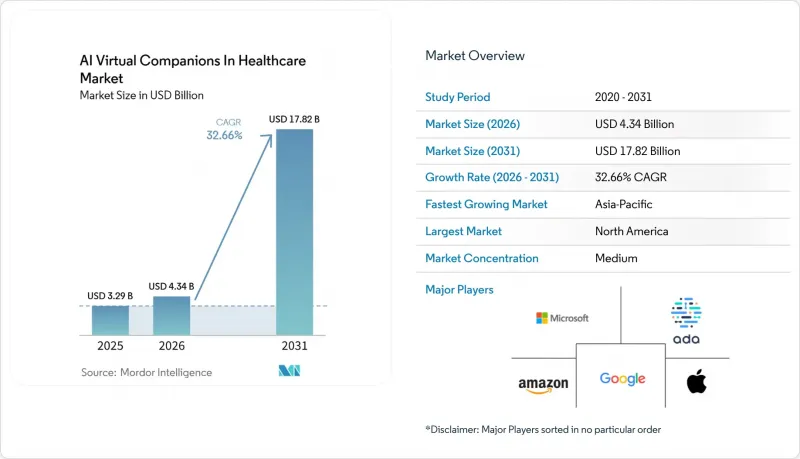
Mordor Intelligence에 의하면, 의료용 AI 가상 동반자 시장 규모는 2025년 32억 9,000만 달러에서 2026년에는 43억 4,000만 달러로 확대되어 2026년부터 2031년까지 CAGR 32.66%로 성장을 지속하여, 2031년에는 178억 2,000만 달러에 이를 것으로 예측됩니다.
본 보고서는 구성 요소(소프트웨어, 서비스), 배포 방식(클라우드 기반, On-Premise형), 컴패니언 유형(챗봇형, 음성 대응형, 멀티모달형), 용도(정신 건강, 만성 질환, 노인 돌봄, 복약 순응도), 최종 사용자(병원, 재택 간호, 요양 주택, 보험사, 소비자), 지역(북미, 유럽, 아시아태평양, 중동 및 아프리카, 남미)별로 분류되어 있습니다.
전 세계 의료용 AI 가상 동반자 시장 동향과 인사이트
개인 맞춤형 환자 지원에 대한 접근성 확대
의료용 AI 가상 동반자 시장은 환자가 진료 사이사이에 필요로 하는 것과 임상 팀이 현실적으로 대규모로 제공할 수 있는 것 사이의 오랜 격차를 해소함으로써 성장을 이루고 있습니다. 기존의 진료 모델에서는 의미 있는 상호작용이 여전히 진료 예약 시점에 집중되어 있어, 그 결과 많은 환자가 치료 준비, 회복 및 정기적인 후속 관리 기간 동안 체계적인 지원을 받지 못한 채 방치되고 있습니다. 대화형 시스템은 치료 전후에 의사의 일정에 직접적인 부담을 주지 않으면서도 시기적절하고 상황에 맞는 지침을 제공할 수 있기 때문에 이러한 격차를 해소하는 것이 점점 더 쉬워지고 있습니다. 마운트 시나이 헬스 시스템에서 2026년에 실시된 연구에서는 시술 전 준비를 지원하는 음성 어시스턴트의 유효성이 입증되었으며, 중재 실패율이 초기 단계의 6.0%에서 최적화 후 2.6%로 감소한 것으로 나타났습니다. 이는 이러한 도구가 실제 의료 현장에서 업무 성과를 향상시킬 수 있음을 시사합니다. 또한, 이러한 활용 사례를 통해 의료진은 환자와의 면담 전에 보다 상세한 사전 정보를 얻을 수 있으며, 이를 통해 진료 준비 시간을 단축하고 의사 결정의 근거가 되는 정보를 보강할 수 있습니다. 의료 시스템이 워크플로우 효율화와 환자 준비 태세를 더욱 중시하게 됨에 따라, 의료용 AI 가상 동반자 시장은 기본적인 채팅 지원에서 보다 구조화된 치료 경로 지원으로 전환되고 있습니다.
복약 순응도 및 만성 질환 관리에 대한 수요 증가
의료용 AI 가상 동반자 시장은 진료소 밖에서의 복약 순응도 및 일상적인 질환 관리 향상에 대한 꾸준한 수요에 의해서도 뒷받침되고 있습니다. 만성 질환의 경우, 일회성 교육보다는 반복적인 행동 강화가 필요한 경우가 많으며, 대화형 지원은 제공 비용을 크게 늘리지 않고도 반복적으로 실시할 수 있어 유용합니다. 2025년 『npj Digital Medicine』지에 발표된 무작위 임상시험에 따르면, 음성 알림, 실시간 복약 기록, 간병인용 앱과의 연동 기능을 갖춘 디지털 복약 관리 시스템이 중증 정신질환 환자를 대상으로 한 12개월간의 추적 조사에서 대조군에 비해 복약 순응도를 향상시킨 것으로 밝혀졌습니다. 또한 『Digital Health』지에 게재된 2026년 스코핑 리뷰에서는 당뇨병, 고혈압, 천식, 암 지원 분야의 챗봇 활용 사례 전반에 걸쳐 측정 가능한 개선이 확인되었습니다. 이는 일상적인 자가 관리에서 대화형 도구의 유효성을 뒷받침하는 것입니다. 이러한 연구 결과가 중요한 이유는 복약 순응도 지원이 많은 노력이 필요한 아웃리치 기능이 아니라 확장 가능한 서비스 계층이 될 수 있다는 생각을 뒷받침하기 때문입니다. 의료 기관이 다수의 환자를 관리하기 위한 부담 없는 방법을 모색하는 가운데, 의료용 AI 가상 동반자는 만성 질환 지원 프로그램에서 확고한 역할을 찾아가고 있습니다.
생성형 AI 응답의 임상적 신뢰성 격차
의료 시스템은 이러한 도구를 단순한 사용자 참여도나 언어의 질만으로 평가하지 않기 때문에 임상적 신뢰성은 여전히 주요 제약 요인으로 남아 있습니다. 또한, 복약 지도나 정신 건강 지원과 같은 민감한 상황에서 응답이 안전하고 안정적이며, 임상적으로 적절한지 여부도 평가 기준이 됩니다. 의료용 AI 가상 동반자 시장은 대규모 언어 모델이 중대한 오류를 포함하고 있음에도 신뢰할 수 있는 답변을 생성할 수 있기 때문에 여전히 신중한 시각으로 바라보고 있습니다. 2025년 11월 FDA 자문위원회에서는 환각 현상, 문맥 불일치, 인구통계학적 격차, 모델 드리프트가 유해 사건 보고나 보다 명확한 동의 기준을 필요로 하는 위험 요인으로 지적되었습니다. 미국 국립의학도서관이 2026년에 실시한 분석에서도 기존 규제 접근 방식으로는 광범위한 접근성과 다양한 임상적 위험 간의 균형이 충분히 잡히지 않았다는 결론이 제시되었으며, 지속적인 모니터링과 독립적인 감사를 결합한 하이브리드 모델의 도입이 권장되었습니다. 이는 상업적으로도 직접적인 영향을 미치고 있으며, 의료 제공업체와 보험사는 대규모 도입을 결정하기 전에 공개된 검증 결과, 감사 가능성 및 시판 후 감시를 더욱 중시하고 있습니다.
부문 분석
2025년 기준, 소프트웨어 부문은 의료용 AI 가상 동반자 시장의 62.2%를 차지하고 있으며, 2031년까지 연평균 성장률(CAGR) 33.8%를 나타낼 것으로 예측됩니다. 이러한 위상은 소프트웨어 플랫폼이 기기를 많이 사용하는 모델에 수반되는 제조, 유지보수, 도입 부담 없이 여러 의료 시스템의 워크플로우에 횡단적으로 확장될 수 있음을 반영합니다. 플랫폼이 분류, 진료 전 문진, 후속 조치 메시지, 지원 내비게이션에 통합되면, 공급업체는 개별 제품 카테고리를 통해서가 아니라 추가적인 이용 사례를 통해 고객 가치를 확대할 수 있습니다. 이를 통해 이용이 늘어날수록 상호작용 데이터가 증가하고, 그 데이터가 모델 성능 향상, 워크플로우 최적화, 제품 신뢰성 향상으로 이어지는 선순환이 만들어집니다. 그 결과, 확고한 입지를 갖춘 소프트웨어 벤더는 동등한 수준의 데이터 세트나 도입 실적을 아직 갖추지 못한 소규모 신규 진출기업에 비해 품질 및 조달 측면에서 우위를 점하는 경우가 많아집니다.
서비스 부문의 규모는 여전히 작지만, 엔터프라이즈 도입이 단순히 소프트웨어 접근 권한 제공으로만 끝나는 경우는 드물기 때문에 중요한 역할을 수행하고 있습니다. 의료 기관이 이러한 도구를 폭넓게 활용할 수 있게 되려면, 통합 지원, 워크플로우 맞춤화, 거버넌스 설계, 개인정보 보호 심사, 교육, 그리고 지속적인 모델 유지 관리가 필요한 경우가 많습니다. 『Frontiers in Artificial Intelligence』지에 게재된 2026년 연구에 따르면, 완전 오프라인 언어 모델과 가상 의사 아바타를 결합함으로써 클라우드 연결 없이도 개인정보를 보호한 채 임상 대화를 지원할 수 있음이 밝혀졌습니다. 이를 통해 소프트웨어 활용 기회는 대역폭에 제약이 있는 환경이나 데이터 저장 위치가 중요한 환경으로 확대됩니다. 이 발견은 과거 클라우드 의존형 대화형 도구에게는 어려웠던 환경에서도 소프트웨어 계층을 배포할 수 있음을 시사한다는 점에서 중요합니다. 따라서 의료용 AI 가상 동반자 시장에서는 소프트웨어가 주도권을 유지하고 있습니다. 그 이유는 배포가 용이할 뿐만 아니라, 새로운 도입 아키텍처 덕분에 활용 범위가 확대되고 있기 때문입니다. 시간이 지남에 따라 서비스 수익은 소프트웨어의 성장과 계속해서 연동될 것입니다. 도입이 깊어질수록 일반적으로 통합 노력도 깊어지기 때문입니다. 의료용 AI 가상 동반자 시장에서는 제품의 규모와 도입의 철저함, 그리고 개인정보 보호 대응 도입 모델을 모두 갖춘 벤더가 계속해서 우위를 점할 것입니다.
2025년에는 컴패니언 유형 부문의 54.3%를 챗봇 기반 솔루션이 차지하며, 이는 의료 커뮤니케이션 분야에서 텍스트 주도형 인터페이스의 지속성을 보여줍니다. 텍스트 채팅은 환자 포털, 보안 메시징 도구, 모바일 케어 패스웨이에 도입하기 가장 쉬운 형식이며, 기존 사용자 행동을 거의 바꾸지 않고도 도입할 수 있습니다. 또한 벤더는 트리아지, 교육, 내비게이션, 후속 조치와 같은 이용 사례에서 기본적인 지원 기능을 신속하게 확장할 수 있습니다. 이러한 선구자로서의 우위야말로, 보다 풍부한 대화 모델이 임상 현장에서 주목을 받고 있음에도 불구하고 챗봇 형식이 여전히 현재의 수익을 견인하고 있는 이유를 설명해 줍니다. 많은 의료 제공업체에게 있어 텍스트 기반의 출발점은 의료용 AI 가상 동반자 시장에 진입하는 데 있어 여전히 진입 장벽이 가장 낮은 경로입니다.
멀티모달 아바타의 성장 속도는 더욱 빨라질 것으로 예상되며, 2031년까지 연평균 성장률(CAGR)은 34.1%를 나타낼 것으로 전망됩니다. 이는 음성, 시각적 존재감, 그리고 감정을 읽을 수 있는 상호작용이 텍스트만으로는 반드시 실현할 수 없는 방식으로 이해도와 안정감을 향상시킬 수 있다는 관점을 반영한 것입니다. 2026년 6월 ChristianaCare의 연구에 따르면, 방사선 치료 수진 전에 AI 의사 아바타 동영상을 시청한 암 환자는 표준 교육용 동영상을 시청한 환자에 비해 불안감이 낮고, 치료 계획에 대한 이해도가 높으며, 만족도도 높은 것으로 나타났습니다. 또한, 2025년 『Frontiers in Public Health』지에 게재된 연구에서도 아바타의 맞춤 설정을 통해 사회적 존재감이 강화되어, 사용자가 가상 의료 시스템을 이용하려는 의향이 높아졌습니다고 보고되었습니다. 음성 지원 시스템은 고령자나 터치 조작을 많이 사용하는 용도를 편안하게 이용할 수 없는 사용자에게 인터페이스의 장벽을 낮추기 때문에 계속해서 전략적 가치를 지니고 있습니다. 따라서 의료용 AI 가상 동반자 시장은 채팅에서 멀어지고 있는 것이 아니라, 임상 경험이나 참여도의 성과를 보다 직접적으로 측정할 수 있는 더 풍부한 형태로 전환되고 있습니다. 다중 모드 제공을 통해 성과 향상이 입증된 벤더는 텍스트가 여전히 광범위한 도입 기반을 차지하고 있다 하더라도, 더 높은 가치의 계약을 확보할 가능성이 있습니다.
지역별 분석
2025년, 북미는 의료용 AI 가상 동반자 시장 점유율의 38.1%를 차지하며, 현재 매출액 기준으로 가장 규모가 큰 지역 시장이 되었습니다. 이 지역은 확립된 디지털 헬스 인프라, 광범위한 상호 운용성 채택, 그리고 다른 많은 지역에 비해 AI 워크플로우 통합에 대한 기업의 준비 태세가 갖춰져 있다는 이점을 가지고 있습니다. 미국의 구매자들은 이러한 도구가 고립된 채팅 인터페이스로 기능하는 것이 아니라, 기존 진료 시스템과 연동되기를 점점 더 기대하고 있습니다. 이러한 기대는 보다 광범위한 임상 워크플로우 내에서 문서 작성, 진료 전 선별 검사, 요약, 환자 참여를 지원할 수 있는 공급업체에 유리하게 작용합니다. 마이크로소프트는 2026년 6월, 메이요 클리닉과의 제휴를 발표하며, 해당 클리닉의 익명화된 종단적 임상 데이터와 마이크로소프트의 AI 및 클라우드 엔지니어링 역량을 결합한 최첨단 의료 AI 모델을 구축함으로써 이러한 기업용 방향성을 강화했습니다. 또한 마이크로소프트는 2026년 5월, 미국 내 Microsoft 365 구독자를 대상으로 ‘Copilot Health’의 프리뷰 버전을 출시했습니다. 이는 HIPAA를 준수하는 환경에서 AI를 활용한 진료 기록 해석 및 건강 관련 문의 대응을 표준화하려는 노력이 활발해지고 있음을 보여줍니다.
아시아태평양은 2031년까지 연평균 성장률(CAGR) 34.5%를 나타낼 것으로 예측되며, 의료용 AI 가상 동반자 시장에서 가장 두드러진 성장을 보이는 지역입니다. 이 지역의 성장은 고령화로 인한 압박, 간병 분야의 인력 부족, 그리고 가정이나 지역 사회에서 지속적으로 활용할 수 있는 확장성이 높은 지원 도구에 대한 대중의 관심에 의해 주도되고 있습니다. 한국은 2025년 말까지 초고령 사회에 진입함에 따라 가장 두드러진 사례 중 하나로 꼽히며, AI 동반자 로봇의 대중적 보급은 이미 개념적 논의 단계를 넘어섰습니다. 전라남도의 조사 결과에 따르면, 노인의 우울증 점수가 63% 감소한 것으로 나타났으며, 이는 이러한 도구가 노인층의 웰빙에 측정 가능한 성과를 가져올 수 있다는 실증적인 증거가 되고 있습니다. 일본과 중국도 고령화와 의료 접근성에 대한 압박이 커짐에 따라 지원형 및 저접촉형 케어 모델에 대한 수요를 뒷받침하고 있으며, 이는 해당 지역 시장 기회에 규모를 더하고 있습니다. 인도와 호주는 서로 다른 경로를 통해 기여하고 있는데, 인도는 디지털로 연결된 대규모 사용자 기반을 제공하는 반면, 호주는 기관 차원의 디지털 헬스 분야 조달 역량이 더 탄탄하다는 특징이 있습니다.
유럽은 여전히 성숙 단계에 있는 지역 시장으로, 순수한 신기술에 대한 수요보다는 정책 구조나 환급 경로가 더 중요하게 여겨집니다. EU의 디지털 헬스 프레임워크와 국가 차원의 환급 경로를 통해 벤더들은 초기 단계에 있는 일부 지역에 비해 공식적인 시장 진입을 위한 더 명확한 로드맵을 확보할 수 있습니다. 독일의 DiGA(디지털 헬스케어 용도) 제도는 환급 대상이 되는 디지털 헬스 용도를 위한 체계적인 경로를 제공하며, AI 컴패니언 벤더에게 구체적인 시장 진입 목표가 되기 때문에 특히 중요합니다. 영국 또한 NHS(국민보건서비스)와의 파트너십 및 디지털 서비스 시범 사업을 통해 임상 AI 도입에 적극적인 태도를 보이고 있으며, 도입 속도가 완만하더라도 이 지역은 상업적으로 중요한 위치를 계속 차지하고 있습니다. 중동 및 아프리카는 여전히 발전의 초기 단계에 있지만, GCC 국가들의 디지털 헬스 혁신에 대한 투자는 정신 건강 지원 및 만성 질환 관리와 같은 이용 사례와 잘 부합합니다. 남미는 현재 시장 규모가 작지만, 대도시권의 인구, 디지털 헬스 이용 확대, 그리고 의료 서비스가 미치지 못하는 농촌 지역 수요가 의료용 AI 가상 동반자 시장 전체의 장기적인 성장 여지를 뒷받침하고 있습니다.
기타 혜택:
- 엑셀 형식 시장 예측(ME) 시트
- 3개월간의 애널리스트 지원
자주 묻는 질문
목차
제1장 서론
제2장 조사 방법
제3장 주요 요약
제4장 시장 구도
제5장 시장 규모 및 성장 예측
제6장 경쟁 구도
제7장 시장 기회와 향후 전망
JHS 26.08.11According to Mordor Intelligence, the AI virtual companions in healthcare market size is expected to grow from USD 3.29 billion in 2025 to USD 4.34 billion in 2026 and is forecast to reach USD 17.82 billion by 2031 at 32.66% CAGR over 2026-2031.
This report is Segmented by Component (Software, Services), Deployment Mode (Cloud-Based, On-Premises), Companion Type (Chatbot-Based, Voice-Enabled, Multimodal), Application (Mental Health, Chronic Disease, Elder Care, Medication Adherence), End User (Hospitals, Home Care, Assisted Living, Payers, Consumers), and Geography (North America, Europe, Asia-Pacific, MEA, South America).
Global AI Virtual Companions In Healthcare Market Trends and Insights
Expanded Access to Personalized Patient Support
The AI virtual companions in the healthcare market is gaining from a long-standing gap between what patients need between visits and what clinical teams can realistically provide at scale. Traditional care models still concentrate meaningful interaction around appointments, which leaves many patients without structured support during preparation, recovery, and routine follow-up. That gap has become easier to address because conversational systems can deliver timely and context-aware guidance before and after treatment, often without adding direct pressure on physician schedules. A 2026 study at Mount Sinai Health System validated a voice-based assistant for pre-procedural preparation and showed that intervention failure rates fell from 6.0% in the initial phase to 2.6% after optimization, which suggests these tools can improve operational performance in real care settings. The same use case also gives providers richer intake data before the clinician encounter, which can shorten visit preparation time and improve context for decision-making. As health systems place more weight on workflow efficiency and patient readiness, the AI virtual companions in healthcare market is moving from basic chat support toward more structured care pathway support.
Rising Demand for Medication Adherence and Chronic Disease Management
The AI virtual companions in healthcare market is also being supported by the steady need for better medication adherence and day-to-day disease management outside the clinic. Chronic conditions often require repeated behavioral reinforcement rather than one-time education, and that makes conversational support useful because it can be repeated without a similar rise in delivery cost. A 2025 randomized clinical trialin npj Digital Medicine found that a digital medication system with audio reminders, real-time dose recording, and caregiver app connectivity improved adherence outcomes compared with controls over a 12-month period in patients with severe mental disorders. A 2026 scoping review in Digital Health also found measurable improvements across chatbot use cases in diabetes, hypertension, asthma, and cancer support, which strengthens the case for conversational tools in routine self-management. These findings matter because they support the idea that adherence support can become a scalable service layer rather than a labor-heavy outreach function. As care organizations look for low-friction ways to manage large patient panels, the AI virtual companions in healthcare market is finding a durable role in chronic disease support programs.
Clinical Trust Gaps in Generative AI Responses
Clinical trust remains a core restraint because health systems do not judge these tools only by user engagement or language quality. They also judge them by whether responses can remain safe, stable, and clinically appropriate in sensitive situations such as medication guidance and mental health support. The AI virtual companions in healthcare market still faces caution because large language models can produce answers that sound credible even when they contain serious errors. The FDA advisory discussion in November 2025 highlighted hallucinations, context failures, demographic disparities, and model drift as risks that require adverse event reporting and clearer consent standards. A 2026 analysis hosted by the National Library of Medicine also concluded that existing regulatory approaches do not fully balance broad access against the range of clinical risks, and it recommended a hybrid model with ongoing monitoring and independent auditing . This has a direct commercial effect because providers and payers now place greater weight on published validation, auditability, and post-market oversight before they commit to scaled deployment.
Other drivers and restraints analyzed in the detailed report include:
- Growing Adoption of AI-Based Behavioral Health Solutions
- Aging Population Requiring Continuous Low-Touch Care
- Reimbursement Uncertainty for Conversational AI
For complete list of drivers and restraints, kindly check the Table Of Contents.
Segment Analysis
The software segment held 62.2% of the AI virtual companions in healthcare market in 2025, and it was forecast to grow at a 33.8% CAGR through 2031. That position reflects how software platforms can scale across multiple health system workflows without the manufacturing, maintenance, and deployment burdens attached to device-heavy models. Once a platform is embedded in triage, pre-visit intake, follow-up messaging, and support navigation, the vendor can expand account value through additional use cases rather than through separate product categories. This creates a reinforcing cycle where more usage produces more interaction data, and more interaction data can improve model performance, workflow tuning, and product credibility. The result is that established software vendors often gain quality and procurement advantages over smaller entrants that do not yet have similar dataset depth or deployment history.
The services side remains smaller, but it still plays an important role because enterprise implementation rarely ends with software access alone. Health systems often need integration support, workflow customization, governance design, privacy review, training, and ongoing model maintenance before they can use these tools widely. A 2026 study in Frontiers in Artificial Intelligenceshowed that fully offline language models combined with virtual physician avatars could support privacy-preserving clinical interactions without cloud connectivity, which expands the software opportunity into bandwidth-constrained and data-residency-sensitive settings. That finding matters because it suggests the software layer can move into environments that were once seen as difficult for cloud-dependent conversational tools. The AI virtual companions in healthcare industry is therefore seeing software retain leadership not only because it is lighter to distribute, but also because new deployment architectures are widening its usable footprint. Over time, services revenue should remain attached to software growth because deeper adoption usually means deeper integration effort. The AI virtual companions in healthcare market should continue to favor vendors that can combine product scale with implementation discipline and privacy-ready deployment models.
Chatbot-based solutions held 54.3% of the companion type segment in 2025, which shows the staying power of text-led interfaces in healthcare communication. Text chat remains the easiest format to place into patient portals, secure messaging tools, and mobile care pathways, and it can be deployed with little change to existing user behavior. It also allows vendors to scale basic support functions quickly across triage, education, navigation, and follow-up use cases. That first-mover advantage explains why chatbot formats still lead current revenue even as richer interaction models attract more clinical attention. For many providers, a text-based starting point remains the lowest-friction path into the AI virtual companions in healthcare market.
The faster expansion is expected in multimodal avatars, which were forecast to grow at a 34.1% CAGR through 2031. This reflects the view that voice, visual presence, and emotionally legible interaction may improve comprehension and comfort in ways that pure text cannot always match. A June 2026 ChristianaCare study found that cancer patients who viewed AI physician avatar videos before radiation visits reported lower anxiety, stronger understanding of their treatment plan, and higher satisfaction than those who watched standard educational videos. A 2025 Frontiers in Public Health study also reported that avatar customization improved user intention to engage with virtual health systems by strengthening social presence. Voice-enabled systems continue to hold strategic value as well because they reduce interface barriers for older adults and for users who do not engage comfortably with touch-heavy applications. The AI virtual companions in healthcare market is therefore not shifting away from chat, but it is moving toward richer formats where clinical experience and engagement outcomes can be measured more directly. Vendors that prove outcome gains from multimodal delivery may win higher-value contracts even if text remains the broader installed base.
Complete Report Scope:
- By Component
- Software
- Hardware
- Services
- By Application
- In Vivo Diagnostics
- In Vitro Diagnostics
- By Deployment Mode
- Cloud Based
- Hybrid
- On Premises
- By Companion Type
- Chatbot-Based
- Voice-Enabled
- Multimodal
- By End User
- Hospitals
- Diagnostic Imaging Centers
- Diagnostic Laboratories
- Clinics and Other Healthcare Providers
- By Geography
- North America
- United States
- Canada
- Mexico
- Europe
- Germany
- United Kingdom
- France
- Italy
- Spain
- Asia-Pacific
- China
- India
- Japan
- South Korea
- Australia
- Rest of Asia-Pacific
- Middle East & Africa
- GCC
- South Africa
- Rest of Middle East and Africa
- South America
- Brazil
- Argentina
- Rest of South America
- North America
Geography Analysis
North America accounted for 38.1% of AI virtual companions in healthcare market share in 2025, which made it the largest regional market by current revenue. The region benefits from established digital health infrastructure, wider interoperability adoption, and stronger enterprise readiness for AI workflow integration than many other regions. Buyers in the United States increasingly expect these tools to connect with existing care systems rather than operate as isolated chat interfaces. That expectation favors vendors that can support documentation, pre-visit screening, summarization, and patient engagement within broader clinical workflows. Microsoft strengthened this enterprise-facing direction in June 2026 when it announced a collaboration with Mayo Clinic to build a frontier healthcare AI model that combines Mayo's de-identified longitudinal clinical data with Microsoft's AI and cloud engineering capabilities. Microsoft also launched Copilot Health in preview in May 2026 for U.S. Microsoft 365 subscribers, which signaled growing effort to normalize AI-supported health record interpretation and health query support in a HIPAA-compliant environment.
Asia Pacific was forecast to grow at a 34.5% CAGR through 2031, which made it the fastest-growing geography in the AI virtual companions in healthcare market. Growth in this region is being pulled by aging population pressure, labor shortages in caregiving, and public interest in scalable support tools that can remain active in homes and community settings. South Korea has become one of the clearest examples because it entered super-aged society status by the end of 2025, and public distribution of AI companion robots has already moved beyond concept discussion. The South Jeolla Province outcome data showing a 63% drop in geriatric depression scores adds practical evidence that these tools can contribute to measurable well-being outcomes in elderly populations. Japan and China also add scale to the regional opportunity because aging and healthcare access pressure there support demand for assistive and low-touch care models. India and Australia contribute through different routes, with India offering a large digitally connected user base and Australia showing stronger institutional digital health purchasing capacity.
Europe remains a maturing regional market where policy structure and reimbursement pathways carry more weight than pure novelty demand. EU digital health frameworks and country-level reimbursement routes give vendors a clearer route to formal market participation than in some earlier-stage regions. Germany's DiGA pathway is especially relevant because it offers a structured route for reimbursable digital health applications, and that gives AI companion vendors a concrete market entry target. The United Kingdom also remains open to clinical AI deployment through NHS-linked partnerships and digital service pilots, which keeps the region commercially relevant even when adoption moves at a measured pace. Middle East and Africa is still earlier in development, but GCC investment in digital health transformation aligns well with mental health support and chronic disease management use cases. South America remains a smaller base today, yet large urban populations, growing digital health use, and underserved rural care needs support long-run room for expansion across the AI virtual companions in healthcare market.
- Alphabet Inc. (Google Health / DeepMind)
- Microsoft
- NVIDIA
- Siemens Healthineers
- GE HealthCare Technologies Inc.
- Koninklijke Philips
- Roche
- Tempus AI, Inc.
- Aidoc Medical Ltd.
- Qure.AI Technologies Private Limited
- Heartflow
- PathAI, Inc.
- Paige.AI, Inc.
- Ada Health GmbH
- AliveCor
- Butterfly Network, Inc.
- Digital Diagnostics
- Lunit
- Ibex Medical Analytics Ltd.
Additional Benefits:
- The market estimate (ME) sheet in Excel format
- 3 months of analyst support
TABLE OF CONTENTS
1 Introduction
- 1.1 Study Assumptions & Market Definition
- 1.2 Scope of the Study
2 Research Methodology
3 Executive Summary
4 Market Landscape
- 4.1 Market Overview
- 4.2 Market Drivers
- 4.2.1 Rising Demand for Faster Triage and Early Disease Detection
- 4.2.2 Expansion of AI-Enabled Radiology and Pathology Workflows
- 4.2.3 Multi-Modal Clinical Data Convergence Improves Diagnostic Confidence
- 4.2.4 Provider Push Toward Workflow Automation in Overburdened Health Systems
- 4.2.5 Integration With Wearables and Remote Monitoring Expands Diagnostic Reach
- 4.2.6 Growing Investment in Clinical Validation and Interoperable AI Platforms
- 4.3 Market Restraints
- 4.3.1 Algorithm Explainability and Liability Concerns Slow Clinical Trust
- 4.3.2 High Integration Cost Across PACS, EHR, and Hospital IT Stacks
- 4.3.3 Data Privacy, Sovereignty, and Cross-Border Model Training Constraints
- 4.3.4 Regulatory Heterogeneity and Revalidation Burden for Model Updates
- 4.4 Value / Supply-Chain Analysis
- 4.5 Regulatory Landscape
- 4.6 Technological Outlook
- 4.7 Porters Five Forces
5 Market Size & Growth Forecasts (Value; volume for key analytes)
- 5.1 By Component
- 5.1.1 Software
- 5.1.2 Hardware
- 5.1.3 Services
- 5.2 By Application
- 5.2.1 In Vivo Diagnostics
- 5.2.2 In Vitro Diagnostics
- 5.3 By Deployment Mode
- 5.3.1 Cloud Based
- 5.3.2 Hybrid
- 5.3.3 On Premises
- 5.4 By Companion Type
- 5.4.1 Chatbot-Based
- 5.4.2 Voice-Enabled
- 5.4.3 Multimodal
- 5.5 By End User
- 5.5.1 Hospitals
- 5.5.2 Diagnostic Imaging Centers
- 5.5.3 Diagnostic Laboratories
- 5.5.4 Clinics and Other Healthcare Providers
- 5.6 By Geography
- 5.6.1 North America
- 5.6.1.1 United States
- 5.6.1.2 Canada
- 5.6.1.3 Mexico
- 5.6.2 Europe
- 5.6.2.1 Germany
- 5.6.2.2 United Kingdom
- 5.6.2.3 France
- 5.6.2.4 Italy
- 5.6.2.5 Spain
- 5.6.3 Asia-Pacific
- 5.6.3.1 China
- 5.6.3.2 India
- 5.6.3.3 Japan
- 5.6.3.4 South Korea
- 5.6.3.5 Australia
- 5.6.3.6 Rest of Asia-Pacific
- 5.6.4 Middle East & Africa
- 5.6.4.1 GCC
- 5.6.4.2 South Africa
- 5.6.4.3 Rest of Middle East and Africa
- 5.6.5 South America
- 5.6.5.1 Brazil
- 5.6.5.2 Argentina
- 5.6.5.3 Rest of South America
- 5.6.1 North America
6 Competitive Landscape
- 6.1 Market Concentration
- 6.2 Market Share Analysis
- 6.3 Company Profiles
- 6.3.1 Alphabet Inc. (Google Health / DeepMind)
- 6.3.2 Microsoft Corporation
- 6.3.3 NVIDIA Corporation
- 6.3.4 Siemens Healthineers AG
- 6.3.5 GE HealthCare Technologies Inc.
- 6.3.6 Koninklijke Philips N.V.
- 6.3.7 F. Hoffmann-La Roche Ltd
- 6.3.8 Tempus AI, Inc.
- 6.3.9 Aidoc Medical Ltd.
- 6.3.10 Qure.ai Technologies Private Limited
- 6.3.11 Heartflow, Inc.
- 6.3.12 PathAI, Inc.
- 6.3.13 Paige.AI, Inc.
- 6.3.14 Ada Health GmbH
- 6.3.15 AliveCor, Inc.
- 6.3.16 Butterfly Network, Inc.
- 6.3.17 Digital Diagnostics, Inc.
- 6.3.18 Lunit Inc.
- 6.3.19 Ibex Medical Analytics Ltd.
7 Market Opportunities & Future Outlook
- 7.1 White Space and Unmet Need Assessment


