

|
시장보고서
상품코드
2099992
커플링 시약 시장 : 시장 점유율 분석, 업계 동향 및 통계, 성장 예측(2026-2031년)Coupling Reagents - Market Share Analysis, Industry Trends & Statistics, Growth Forecasts (2026 - 2031) |
||||||
 Mordor Intelligence
Mordor Intelligence에 의하면, 커플링 시약 시장 규모는 2025년에 9억 3,000만 달러로 평가되었고, 2026년 9억 9,000만 달러에서 2031년까지 13억 6,000만 달러에 이를 것으로 예측되며, 2026-2031년 CAGR 6.58%로 성장할 전망입니다.
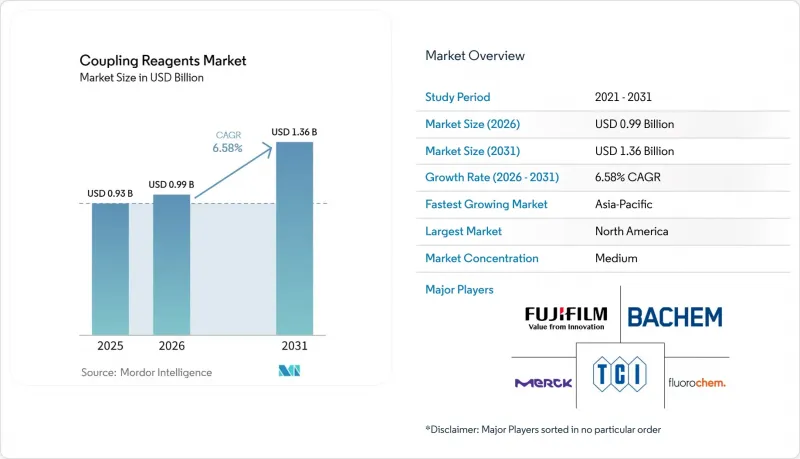
본 보고서는 제품 유형별(카르보디이미드계 시약, 우로늄계 시약, 포스포늄계 시약 등), 용도별(펩타이드 합성, 의약품 원료(API) 합성 등), 지역별(아시아태평양, 북미, 유럽, 기타 지역)로 분류되어 있습니다. 시장 전망은 금액(달러) 기준으로 제시되어 있습니다.
세계의 커플링 시약 시장 동향 및 인사이트
펩타이드계 치료제에 대한 수요 증가
치료용 펩타이드의 승인은 커플링 시약 시장의 주요 수요 요인으로 계속 작용하고 있습니다. 이는 승인되었거나 후기 임상 단계에 있는 각 펩타이드 개발 프로그램이 개발 및 제조의 전 단계에 걸쳐 시약 소비량을 증가시키기 때문입니다. 인용된 승인 사례에는 2025년 FDA의 합성 펩타이드 승인 및 2026년 2월 아센디스 파마(Ascendis Pharma)사의 ‘YUVIWEL’ 승인이 포함되어 있으며, 이는 펩타이드 제조 능력 및 시약 공급 체계에 대한 상업적 관심을 유지하는 요인이 되고 있습니다. 대용량 펩타이드 제품은 합성 경로에서 각 아미노산 부착 사이클마다 반복적인 커플링 공정이 필요하기 때문에 중요한 역할을 합니다. 2025년에 발표된 릴라글루티드 및 틸제파티드 합성에 관한 조사에 따르면, 카르보디이미드 및 관련 커플링 시스템은 여전히 확장 가능한 펩타이드 제조 경로에 통합되어 있는 것으로 나타났습니다. 그 결과, 커플링 시약 시장은 승인량과 상용화 및 후기 단계 공급망으로 전환되는 제조 규모 모두와 계속해서 연동되고 있습니다.
제약 및 생명공학 분야의 연구 개발 활동 확대
제약 및 생명공학 분야의 연구 개발 활동 확대 또한 커플링 시약 시장을 뒷받침하고 있습니다. 이는 치료제가 상업 생산 단계에 도달하기 훨씬 전부터 시약 소비가 시작되기 때문입니다. 신약 개발 화학자들은 병렬 합성 경로, 공정 최적화, 분석법 개발에 이러한 물질을 사용하고 있으며, 이는 파이프라인 전반에 걸쳐 지속적인 소량 수요를 창출하고 있습니다. 서모피셔 사이언티픽(Thermo Fisher Scientific)은 2025년 4월, 복잡한 바이오의약품 프로그램에서 고객의 제조 및 국내 혁신을 지원하기 위해 제조 설비 투자 15억 달러를 포함한 20억 달러 규모의 투자를 발표했습니다. 펩타이드 및 RNA 기반 치료제는 연구 개발 단계에서 엄격한 재료 적격성 요건이 적용되는 규제 대상 공정 개발 단계로 전환됨에 따라, 이러한 생산 능력 증강은 커플링 시약 시장에 중요한 의미를 지닙니다. 이러한 전환을 통해 신약 개발, 스케일업, 검증 및 GMP 이행의 전 단계에 걸쳐 더 광범위하고 안정적인 수요 기반이 형성될 것입니다.
고급 커플링 시약의 높은 비용
커플링 시약 시장은 고급 우로늄계 및 포스포늄계 시약의 가격이 범용 대체품보다 높기 때문에 계속해서 가격 측면의 제약에 직면해 있습니다. 이러한 비용 격차는 대량 조달을 통한 이점을 누리기 어려운 중규모의 위탁 개발·제조 기관(CDMO) 및 학술 연구소에게 특히 큰 문제로 대두되고 있습니다. 해당 초안에서는 HATU(1-(비스(디메틸아미노)메틸렌)-1H-1, 2,3-트리아졸로(4,5-b)피리디늄 3-옥사이드 헥사플루오로포스페이트)가 여전히 널리 사용되는 펩타이드 커플링 시약이라고 지적하고 있습니다. 그러나 다단계 합성, 제어된 불활성 분위기 요건, 그리고 특수한 정제 공정으로 인해 비용은 여전히 높은 수준을 유지하고 있습니다. 또한, 해당 초안에서는 벤조트리아졸 설폰산염이나 옥시마스설폰산염 시약과 같은 새로운 시스템에 대해서도, 우수 제조 기준(GMP) 수준의 순도에서 상업적 규모로 비용 경쟁력이 있는 대체품으로 아직 자리 잡지 못했다고 언급하고 있습니다. 그 결과, 커플링 시약 시장은 비용에 민감한 용도에서 구매에 대한 거부감을 겪으면서도 시장 규모를 확대할 가능성이 있습니다.
부문 분석
카르보디이미드계 시약은 2025년에 커플링 시약 시장 점유율의 37.19%를 차지한 것으로 평가되었으며, 원료의약품(API) 합성, 바이오접합 및 고분자 연구 각 분야에서 계속해서 주도적인 위치를 유지할 것으로 전망됩니다. 커플링 시약 시장에서의 이러한 위상은 널리 알려진 점, 응용 범위의 유연성, 그리고 연구 및 규제 대상 제조 분야 모두에서 확립된 사용 실적에서 비롯됩니다. N,N' 디이소프로파일카보디이미드(DIC)는 여과 가능한 요소 부산물 및 옥시마 공시약과의 호환성이 우수하며, 공정 처리가 용이하기 때문에 Fmoc 고상 펩타이드 합성에서 여전히 선호되는 카보디이미드입니다. 수용성 1-에틸-3-(3-디메틸아미노프로파일)카보디이미드(EDC) 염산염은 특히 링커 결합이나 생체 분자와의 적합성이 중요한 경우, 수계 바이오접합 워크플로우에서 여전히 중요한 역할을 하고 있습니다. 2025년 Springer가 발표할 예정인 연구에 따르면, 변형 카보디이미드인 TBEC를 사용함으로써 디메틸포름아미드(DMF)를 사용하지 않고도 우수 제조 기준(GMP)에 부합하는 릴라글루티드의 합성이 가능해지며, 이 제품군에서 용매 사용량을 줄인 개발 경로가 제공될 것으로 전망됩니다.
우로늄계 커플링 시약 시장 규모는 2026-2031년 연평균 성장률(CAGR) 7.36%로 확대될 것으로 예측되며, 가장 빠르게 성장하는 제품군이 될 전망입니다. 이러한 성장은 입체 장애가 있는 아미노산이나 복잡한 올리고뉴클레오티드의 결합 공정에서 더 높은 커플링 효율이 요구되고 있음을 반영합니다. 포스포늄 시약은 부반응의 양상이 우로늄 화학과 다른 특수 용도나 용액상 워크플로우에서 계속해서 활용되고 있습니다. N,N-카르보닐디이미다졸(CDI), 프로파일포스폰산 무수물(T3P), 옥사릴 클로라이드 등의 카르보닐 활성화 시약은 포스폰산 무수물과 함께 특정 농약, 폴리머 및 정밀 화학물질 제조 공정에서 여전히 중요한 역할을 수행하고 있습니다. 커플링 시약 업계 전반에 걸쳐, GMP 등급의 순도 및 국제조화회의(ICH) Q7에 부합하는 요건으로 인해, 가격만을 이유로 한 공급업체 변경은 여전히 제한되고 있습니다.
지역별 분석
2025년, 북미는 전 세계 매출의 38.74%를 차지했으며, 커플링 시약의 최대 지역 시장이 되었습니다. 제약 분야의 활발한 연구 개발(R&D), 펩타이드 및 올리고뉴클레오티드 제조 활동의 집중, 그리고 FDA의 GMP 요건이 이 지역을 뒷받침하며 고품질 조달을 촉진하고 있습니다. 이러한 상황으로 인해 구매자가 순도 및 재현성 입증, 그리고 감사 대응이 가능한 공급업체의 지원을 우선시하는 커플링 시약 시장이 형성되고 있습니다. 서모피셔(Thermo Fisher)와 같은 공급업체의 국내 사업 전개 또한 미국에 기반을 둔 고객을 대상으로 한 현지 공급 체계 및 규제 대응 서비스 역량을 강화하고 있습니다. 그 결과, 북미는 계속해서 커플링 시약 시장에서 확고한 수익원으로 자리 잡고 있습니다.
아시아태평양은 2031년까지 연평균 성장률(CAGR) 7.48%로 확대될 것으로 예측되며, 커플링 시약 시장에서 가장 두드러진 성장을 보일 지역 시장이 될 전망입니다. 펩타이드 원료의약품(API) 생산 확대, 중국 및 인도에서의 의약품 제조 활동 확대, 그리고 고상 및 액상 합성 모두에서 공정 역량의 향상이 이 지역의 성장을 뒷받침하고 있습니다. 이러한 요인들로 인해 아시아태평양의 커플링 시약 시장은 보다 성숙한 유럽 및 미국 시장에 비해 제조 주도형 성장 패턴을 보이고 있습니다. 한편, 이 지역의 성장은 인증 기준, 공급 안정성, 그리고 GMP 등급 인프라 구축의 진척 상황에 여전히 크게 좌우되는 상황입니다. 이러한 균형으로 인해 아시아태평양은 커플링 시약 시장의 향후 판매량 성장에서 중심적인 위치를 계속 차지하게 될 것입니다.
유럽은 계속해서 커플링 시약 시장의 중요한 한 축을 차지하고 있으며, 스위스, 독일, 영국에는 수많은 정평이 나 있는 공급업체와 합성 역량이 집중되어 있습니다. Bachem사는 2025 회계연도에 3억 3,260만 스위스 프랑(본 초안에 기재된 2025년 평균 환율 기준, 3억 6,300만 달러에 해당)을 투자하여, 부벤도르프의 K동 건물을 GMP 규모의 펩타이드 및 올리고뉴클레오티드 API 생산 거점으로 가동했습니다. 상업 생산 확대는 2026년 내내 지속될 전망입니다. 또한, 독일의 화학 산업 기반은 첨단 시약 개발을 위한 특수 합성 전문 지식과 탄탄한 공급망 구조를 뒷받침하고 있습니다. ‘세계 기타 지역’ 부문은 여전히 규모가 작지만, 남미, 중동 및 아프리카의 의약품 생산 능력 확대에 따라 해당 지역에서도 커플링 시약 시장이 서서히 발전하고 있습니다.
기타 혜택 :
- 엑셀 형식 시장 예측(ME) 시트
- 3개월간의 애널리스트 지원
자주 묻는 질문
목차
제1장 서론
제2장 조사 방법
제3장 주요 요약
제4장 시장 구도
제5장 시장 규모 및 성장 예측
제6장 경쟁 구도
제7장 시장 기회 및 향후 전망
AJY 26.08.07According to Mordor Intelligence, the coupling reagents market size is projected to be USD 0.93 billion in 2025, USD 0.99 billion in 2026, and reach USD 1.36 billion by 2031, and is expected to grow at a CAGR of 6.58% from 2026 to 2031.
This report is Segmented by Product Type (Carbodiimide-Based Reagents, Uronium-Based Reagents, Phosphonium-Based Reagents, and More), Application (Peptide Synthesis, Pharmaceutical API Synthesis, and More), and Geography (Asia-Pacific, North America, Europe, and Rest of the World). The Market Forecasts are Provided in Terms of Value (USD).
Global Coupling Reagents Market Trends and Insights
Rising Demand for Peptide-Based Therapeutics
Therapeutic peptide approvals remain a key demand driver for the coupling reagents market, as each approved or late-stage peptide program increases reagent consumption across development and manufacturing. The cited approval activity includes the FDA's approval of a synthetic peptide in 2025 and Ascendis Pharma's approval for YUVIWEL in February 2026, which sustained commercial focus on peptide manufacturing capacity and reagent readiness. Large-volume peptide products play an important role because their synthesis routes require repeated coupling steps during each amino acid addition cycle. Published 2025 research on liraglutide and tirzepatide synthesis showed that carbodiimide and related coupling systems remain embedded in scalable peptide manufacturing routes. As a result, the coupling reagents market remains linked to both approval volumes and the scale of manufacturing moving into commercial and late-stage supply chains.
Expansion of Pharma and Biotech R&D Activities
Broader pharmaceutical and biotech R&D activity also supports the coupling reagents market, as reagent consumption begins well before a therapy reaches commercial production. Discovery chemists use these materials across parallel synthesis routes, process optimization, and analytical method development, creating recurring small-batch demand throughout the pipeline. Thermo Fisher Scientific announced a USD 2 billion US investment in April 2025, including USD 1.5 billion in manufacturing capital expenditure, to support customer manufacturing and domestic innovation in complex biopharma programs. These capacity additions are relevant to the coupling reagents market because peptide- and RNA-based therapeutics move from research into regulated process development with strict material qualification requirements. This shift creates a broader and more stable demand base across discovery, scale-up, validation, and GMP execution.
High Cost of Advanced Coupling Reagents
The coupling reagents market continues to face pricing constraints, as advanced uronium and phosphonium reagents are priced higher than commodity alternatives. This cost gap is particularly significant for mid-sized Contract Development and Manufacturing Organizations (CDMOs) and academic laboratories, which often do not benefit from large procurement volumes. The source draft noted that HATU (1-[Bis(dimethylamino)methylene]-1H-1,2,3-triazolo[4,5-b]pyridinium 3-oxide hexafluorophosphate) remains a widely used peptide coupling reagent. However, its multi-step synthesis, controlled inert-atmosphere requirements, and specialized purification steps keep costs high. The same draft also stated that newer systems, such as benzotriazole-sulfonate and Oxyma-sulfonate reagents, have not yet become commercially scaled, cost-competitive substitutes at Good Manufacturing Practice (GMP) purity levels. As a result, the coupling reagents market can grow in value while facing purchasing resistance in cost-sensitive applications.
Other drivers and restraints analyzed in the detailed report include:
- Higher Use in Regulated Industries (Food, Agro)
- Growth in High-Purity Specialty Chemicals Demand
- Moisture Sensitivity, Storage, and Handling Challenges
For complete list of drivers and restraints, kindly check the Table Of Contents.
Segment Analysis
Carbodiimide-based reagents are expected to account for 37.19% of the coupling reagents market share in 2025, maintaining their leading position across pharmaceutical Active Pharmaceutical Ingredient (API) synthesis, bioconjugation, and polymer research. Their position in the coupling reagents market stems from broad familiarity, a flexible application range, and established use in both research and regulated manufacturing. N,N'-Diisopropylcarbodiimide (DIC) remains a preferred carbodiimide for Fmoc solid-phase peptide synthesis because its filterable urea byproduct and compatibility with Oxyma co-reagents support process handling. Water-soluble 1-Ethyl-3-(3-dimethylaminopropyl)carbodiimide (EDC) hydrochloride remains relevant in aqueous bioconjugation workflows, especially when linker attachment and biomolecule compatibility are critical. A 2025 Springer study is expected to show that TBEC, a modified carbodiimide, enables dimethylformamide (DMF)-free, Good Manufacturing Practice (GMP)-compatible liraglutide synthesis, providing a lower-solvent development path for this product class.
The coupling reagents market size for uronium-based reagents is projected to expand at a CAGR of 7.36% between 2026 and 2031, making it the fastest-growing product class. This growth reflects demand for higher coupling efficiency in sterically hindered amino acids and complex oligonucleotide conjugation steps. Phosphonium reagents continue to serve specialty and solution-phase workflows where side-reaction behavior differs from uronium chemistry. Carbonyl activation reagents, such as N,N'-Carbonyldiimidazole (CDI), propylphosphonic anhydride (T3P), and oxalyl chloride, along with phosphonic anhydrides, remain important in selected agrochemical, polymer, and fine chemical routes. Across the coupling reagents industry, GMP-grade purity and International Council for Harmonisation (ICH) Q7-aligned expectations continue to limit supplier switching based solely on price.
Complete Report Scope:
- By Product Type
- Carbodiimide-Based Reagents
- Uronium-Based Reagents
- Phosphonium-Based Reagents
- Phosphonic Anhydride Reagents
- Carbonyl Activation Reagents
- Other Coupling Reagents
- By Application
- Peptide Synthesis
- Pharmaceutical API Synthesis
- Oligonucleotide Synthesis
- Organic Synthesis
- Agrochemical Synthesis
- Specialty and Fine Chemical Synthesis
- Polymer and Materials Chemistry
- Other Applications
- By Geography
- Asia-Pacific
- China
- India
- Japan
- South Korea
- Rest of Asia-Pacific
- North America
- United States
- Canada
- Mexico
- Europe
- Germany
- United Kingdom
- France
- Italy
- Rest of Europe
- Rest of the World
- South America
- Middle-East and Africa
- Asia-Pacific
Geography Analysis
North America accounted for 38.74% of global revenue in 2025, making it the largest regional market for coupling reagents. High pharmaceutical R&D intensity, dense peptide and oligonucleotide manufacturing activity, and FDA GMP requirements support the region and favor high-grade sourcing. These conditions create a coupling reagents market in which buyers prioritize documentation of purity, reproducibility, and audit-ready supplier support. Domestic participation by suppliers such as Thermo Fisher also strengthens local availability and regulatory service capabilities for US-based customers. As a result, North America remains an established revenue center for the coupling reagents market.
Asia-Pacific is forecast to expand at a CAGR of 7.48% through 2031, making it the fastest-growing regional market for coupling reagents. Expanding peptide API production, broader pharmaceutical manufacturing activity in China and India, and increasing process capabilities in both solid-phase and liquid-phase synthesis support regional growth. These factors give the coupling reagents market in Asia-Pacific a manufacturing-led growth profile compared with more mature Western markets. At the same time, regional growth remains sensitive to qualification standards, supply consistency, and the pace of improvement in GMP-grade infrastructure. This balance keeps Asia-Pacific central to future volume growth in the coupling reagents market.
Europe remains a key part of the coupling reagents market, with Switzerland, Germany, and the United Kingdom hosting several established suppliers and synthesis capabilities. Bachem invested CHF 332.6 million in fiscal 2025, equal to USD 363 million at the source draft's stated average 2025 exchange rate, and commissioned Building K in Bubendorf for GMP-scale peptide and oligonucleotide API production, with commercial ramp-up continuing through 2026. Germany's chemical base also supports specialty synthesis expertise and supplier depth for advanced reagent development. The Rest of World segment remains smaller, but the coupling reagents market is gradually developing there as pharmaceutical manufacturing capacity expands in South America, the Middle East, and Africa.
- AAPPTec
- Avantor, Inc.
- Bachem AG
- Biosolve Chimie
- BLD Pharmatech Ltd.
- Carl Roth GmbH + Co. KG
- Chem-Impex
- Enamine Ltd.
- Fluorochem Limited
- FUJIFILM Wako Pure Chemical Corporation
- GL Biochem (Shanghai) Ltd.
- Iris Biotech GmbH
- J and K Scientific Ltd.
- Luxembourg Bio Technologies Ltd.
- Merck KGaA
- Suzhou Highfine Biotech Co., Ltd.
- Thermo Fisher Scientific Inc.
- Tokyo Chemical Industry Co., Ltd.
Additional Benefits:
- The market estimate (ME) sheet in Excel format
- 3 months of analyst support
TABLE OF CONTENTS
1 Introduction
- 1.1 Study Assumptions and Market Definition
- 1.2 Scope of the Study
2 Research Methodology
3 Executive Summary
4 Market Landscape
- 4.1 Market Overview
- 4.2 Market Drivers
- 4.2.1 Rising Demand for Peptide-Based Therapeutics
- 4.2.2 Expansion of Pharma and Biotech Outsourcing
- 4.2.3 Higher Use in Regulated API and CDMO Workflows
- 4.2.4 Growth in High-Purity and Low-Racemization Synthesis Demand
- 4.2.5 Shift Toward Greener Coupling Chemistries and Waste Reduction
- 4.2.6 Increasing Use in Oligonucleotide and Bioconjugation Workflows
- 4.3 Market Restraints
- 4.3.1 High Cost of Advanced Reagents and Purification Burden
- 4.3.2 Moisture Sensitivity, Safety, and Handling Complexity
- 4.3.3 Process Substitution by Enzymatic, Flow, and Alternative Ligation Routes
- 4.3.4 Supply Concentration in Specialty Inputs and Intermediates
- 4.4 Value Chain Analysis
- 4.5 Porter's Five Forces Analysis
- 4.5.1 Threat of New Entrants
- 4.5.2 Bargaining Power of Suppliers
- 4.5.3 Bargaining Power of Buyers
- 4.5.4 Threat of Substitutes
- 4.5.5 Competitive Rivalry
5 Market Size and Growth Forecasts (Value)
- 5.1 By Product Type
- 5.1.1 Carbodiimide-Based Reagents
- 5.1.2 Uronium-Based Reagents
- 5.1.3 Phosphonium-Based Reagents
- 5.1.4 Phosphonic Anhydride Reagents
- 5.1.5 Carbonyl Activation Reagents
- 5.1.6 Other Coupling Reagents
- 5.2 By Application
- 5.2.1 Peptide Synthesis
- 5.2.2 Pharmaceutical API Synthesis
- 5.2.3 Oligonucleotide Synthesis
- 5.2.4 Organic Synthesis
- 5.2.5 Agrochemical Synthesis
- 5.2.6 Specialty and Fine Chemical Synthesis
- 5.2.7 Polymer and Materials Chemistry
- 5.2.8 Other Applications
- 5.3 By Geography
- 5.3.1 Asia-Pacific
- 5.3.1.1 China
- 5.3.1.2 India
- 5.3.1.3 Japan
- 5.3.1.4 South Korea
- 5.3.1.5 Rest of Asia-Pacific
- 5.3.2 North America
- 5.3.2.1 United States
- 5.3.2.2 Canada
- 5.3.2.3 Mexico
- 5.3.3 Europe
- 5.3.3.1 Germany
- 5.3.3.2 United Kingdom
- 5.3.3.3 France
- 5.3.3.4 Italy
- 5.3.3.5 Rest of Europe
- 5.3.4 Rest of the World
- 5.3.4.1 South America
- 5.3.4.2 Middle-East and Africa
- 5.3.1 Asia-Pacific
6 Competitive Landscape
- 6.1 Market Concentration
- 6.2 Strategic Moves
- 6.3 Market Share (%)/Ranking Analysis
- 6.4 Company Profiles (includes Global Overview, Market Overview, Core Segments, Financials as available, Strategic Information, Products and Services, and Recent Developments)
- 6.4.1 AAPPTec
- 6.4.2 Avantor, Inc.
- 6.4.3 Bachem AG
- 6.4.4 Biosolve Chimie
- 6.4.5 BLD Pharmatech Ltd.
- 6.4.6 Carl Roth GmbH + Co. KG
- 6.4.7 Chem-Impex
- 6.4.8 Enamine Ltd.
- 6.4.9 Fluorochem Limited
- 6.4.10 FUJIFILM Wako Pure Chemical Corporation
- 6.4.11 GL Biochem (Shanghai) Ltd.
- 6.4.12 Iris Biotech GmbH
- 6.4.13 J and K Scientific Ltd.
- 6.4.14 Luxembourg Bio Technologies Ltd.
- 6.4.15 Merck KGaA
- 6.4.16 Suzhou Highfine Biotech Co., Ltd.
- 6.4.17 Thermo Fisher Scientific Inc.
- 6.4.18 Tokyo Chemical Industry Co., Ltd.
7 Market Opportunities and Future Outlook
- 7.1 White-Space and Unmet-Need Assessment


