
|
시장보고서
상품코드
2099995
소결강 시장 : 점유율 분석, 업계 동향 및 통계, 성장 예측(2026-2031년)Sintered Steel - Market Share Analysis, Industry Trends & Statistics, Growth Forecasts (2026 - 2031) |
||||||
 Mordor Intelligence
Mordor Intelligence에 의하면, 소결강 시장 규모는 2025년 291억 1,000만 달러에서 2026년에는 306억 5,000만 달러로 확대되어 2031년까지 408억 9,000만 달러에 이른다고 전망되고 있어 2026년부터 2031년까지 CAGR 5.93%를 나타낼 것으로 예측됩니다.
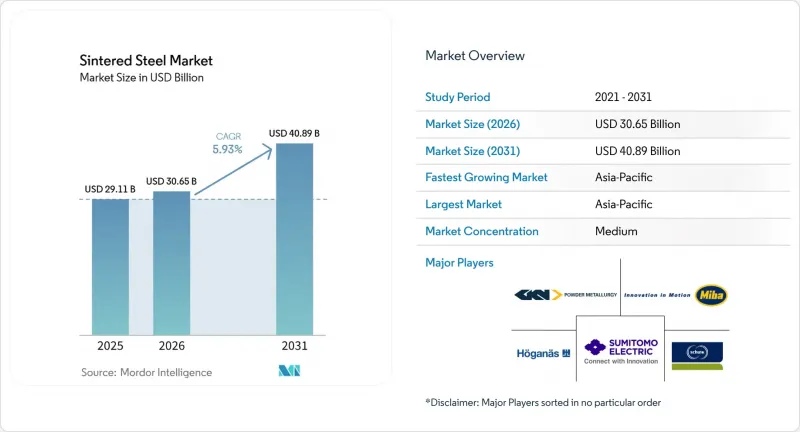
본 보고서는 유형(스테인리스 스틸 등), 공정(기존 분말 야금, 분말 단조 등), 용도(기어·변속기 부품, 베어링·부싱 등), 최종 사용자 산업(자동차 산업 등), 지역(아시아태평양, 북미, 유럽, 남미, 중동 및 아프리카)별로 분류되어 있습니다. 시장 전망은 금액(달러) 기준으로 제시되어 있습니다.
전 세계 소결강 시장 동향 및 인사이트
자동차 용도에서의 소결강 수요 증가
드라이브트레인 및 섀시 프로그램에서 여전히 대량의 분말 야금 부품이 채택되고 있기 때문에 자동차 제조는 소결강의 최대 최종 시장으로 자리매김하고 있습니다. 2024년 북미 철분 출하량의 70% 이상을 자동차 부문이 차지하고 있어, 자동차 생산 대수가 소결강 시장의 수주 동향에 얼마나 밀접한 영향을 미치는지가 여실히 드러나고 있습니다. 2024년 북미의 신차 판매 대수는 1,590만 대에 달했으며, 하이브리드차 판매 대수는 37% 가까이 증가했습니다. 이에 따라 OEM의 파워트레인 구성에 변화가 나타나기 시작했음에도 불구하고, 분말 금속 수요는 견조한 추세를 보였습니다. 기어, 커넥팅로드, 베어링 캡, 싱크로나이저 허브는 재현성이 높은 공차와 대규모 생산에서 뛰어난 처리 효율을 제공하기 때문에 여전히 주요 양산 제품으로 자리 잡고 있습니다. 2026년에 발표된 조사에 따르면, 2단 EV용 기어박스는 1단 하드웨어에 비해 고속 주행 사이클에서 모터 효율을 5%에서 7%까지 향상시킬 수 있어, 향후 차량 아키텍처에서 소결 유성 기어 캐리어 및 차동 기어 부품의 추가 채택을 촉진하고 있습니다. 이러한 변화로 인해 내연기관(ICE) 전용 부품에 대한 수요가 점차 감소하는 상황에서도 소결강 시장은 계속해서 중요한 위치를 차지하게 될 것입니다.
전기차에서 소결 부품 수요 증가
전기차(EV)의 보급으로 인해 소결강의 잠재 시장이 확대되고 있습니다. 이는 새로운 EV 플랫폼에서 콤팩트하고 고효율적인 설계를 뒷받침하는 모터, 기어박스, 스티어링 부품이 요구되고 있기 때문입니다. 2024년 전 세계 전기차 판매 대수는 1,700만 대를 넘어 2023년 대비 25% 증가했습니다. 이에 따라 연자성 복합재료(SMC)로 제작된 모터 코어, e-액슬용 유성 캐리어, 전동 파워 스티어링 펌프용 로터에 대한 수요가 높아지고 있습니다. 『Metals』지에 2024년에 게재된 연구에 따르면, 전기차 모터용 SMC 소재는 코어 손실을 20% 이상 저감할 수 있는 것으로 보고되어, 효율 향상이 극히 중요한 소형 모터 레이아웃에서 SMC 소재의 사용을 뒷받침하고 있습니다. 또한, 2024년의 또 다른 논문에서는 소결 SMC 모터 코어가 0.35mm 비배향 실리콘 강판 적층과 동등한 효율을 실현할 수 있을 뿐만 아니라, 적층 방식으로는 실현하기 어려운 3차원 자속 경로를 가능하게 한다는 사실이 밝혀졌습니다. 인도의 ‘생산 연계형 인센티브 제도(PLIS)’에서는 분말 야금 기술 도입과 관련된 기술을 포함하여 자동차 및 자동차 부품 제조에 10,000 카롤 루피(12억 달러)가 배정되었습니다. 이러한 동향에 따라 소결강 시장은 기존의 엔진 부품에 국한되지 않고, 자동차의 전환 과정에서 더 큰 역할을 담당하게 될 것입니다.
막대한 설비 투자 필요
고도의 소성로, 압축 시스템 및 금형의 경우, 안정적인 생산량이 확보되기 전에 막대한 초기 투자가 필요하기 때문에 높은 자본 요건이 계속해서 소결강 시장의 걸림돌이 되고 있습니다. 진공 소결로의 가격은 대당 5만 달러에서 20만 달러 이상으로 폭이 넓으며, 프레스·소결 일괄 라인을 구축하는 데는 종종 수백만 달러의 지출이 필요합니다. 부품 설계에 복잡한 다단 금형이 필요한 경우, 투자를 정당화하기 위해서는 대규모 생산 로트로 해당 금형의 비용을 상각해야 하므로 재정적 부담은 더욱 커집니다. 이러한 과제는 저비용 자금 조달, 숙련된 소결로 운영자, 그리고 안정적이고 장기적인 OEM(Original Equipment Manufacturer) 계약이 여전히 제한적인 분말 야금(PM) 신규 진입 지역에서 더욱 두드러집니다. 또한 제조업체가 산업용 바인더 제팅이나 파우더 베드 시스템을 도입하면 부담은 더욱 커집니다. 이러한 기술은 표준 소결 라인에 더해 추가적인 설비 투자가 필요하기 때문입니다. 그 결과, 신흥 지역의 소결강 시장은 독립적인 그린필드 공장이 아닌, 라이선싱 생산 능력이나 공급업체와의 제휴를 통해 지속적으로 확대되고 있습니다.
부문 분석
2025년, 탄소강은 소결강 시장 점유율의 46.82%를 차지하며, 재료 유형 중 1위를 유지했습니다. 이러한 위상은 낮은 투입 비용, 기존 금형과의 폭넓은 호환성, 그리고 대량 생산되는 자동차 및 산업용 분야에서 쌓아온 오랜 실적을 바탕으로 합니다. 합금강은 니켈, 몰리브덴, 구리의 첨가를 통해 가혹한 조건에서 사용되는 부품에 더 높은 인장 강도와 뛰어난 내피로성을 실현하기 때문에 밸류체인에서 탄소강보다 상위 위치에 있습니다. 공구강은 생산량이 여전히 적지만, 생산량보다 내마모성이 중시되는 정밀 인서트 용도나 특수 기계용으로 활용되고 있습니다. 스테인리스 스틸은 의료기기, 부식의 영향을 받기 쉬운 전기 어셈블리, 식품 가공 장비에서 탄소강으로는 제공할 수 없는 재료 특성이 요구되기 때문에 2031년까지 연평균 성장률(CAGR)이 6.84%로 가장 빠르게 성장하고 있는 유형입니다.
이러한 변화는 새로운 최종 용도 분야의 인증 기준이 구매자의 수용 기준을 변화시키고 있기 때문에 소결강 시장이 더 이상 최저 비용의 재료 경로만으로 형성되어 있지 않음을 보여줍니다. 또한, 스테인리스 스틸은 소형화나 표면 청정도가 우선시되는 경우, 금속 사출 성형(MIM) 생산에도 적합합니다. 이러한 조합을 통해 총 생산량이 탄소강보다 낮더라도 공급업체는 더 높은 부가가치를 창출하는 프로그램으로 진출할 여지가 생깁니다. 또한, OEM(주문자 상표 제조) 구매자들이 업스트림 공급망의 Scope 3 배출량에 더욱 주목하고 있기 때문에 소재 선정은 고객의 지속가능성 목표와 점점 더 밀접하게 연결되고 있습니다. 호가나스(Hoganas)사는 저탄소 분말 생산에 대한 지속적인 투자를 보고하는 한편, 2018년 대비 스코프 1 및 2 배출량을 55% 감축했다고 밝혔으며, 이는 소재 공급업체들이 기계적 성능에만 그치지 않는 차별화를 꾀하고 있음을 보여줍니다. 이러한 상황에서 소결강 시장에서는 신뢰할 수 있는 야금 기술과 더욱 강력한 지속가능성 실적을 동시에 갖춘 제조업체가 높은 평가를 받을 가능성이 높습니다.
2025년에는 기존 분말 야금법이 시장의 50.89%를 차지하며, 소결강 시장의 주요 제조 공정이 되었습니다. 이러한 위상은 대량 생산을 통해 고정 금형 비용을 분산할 수 있는 대규모 자동차 및 산업용 프로젝트에서의 높은 경제성을 반영합니다. 또한 이 공정은 완전 기계 가공품에 비해 수율이 훨씬 낮음에도 불구하고, 95%에 가까운 높은 재료 이용률이라는 장점도 갖추고 있습니다. 금속 사출 성형은 그 다음 순위를 차지하고 있으며, 의료, 방위, 전자 및 정밀 소비재 분야에서 표준 프레스 및 소결 공정이 일반적으로 제공하는 공차보다 더 엄격한 공차를 충족합니다. 분말 단조는 커넥팅로드나 싱크로나이저 링 등 거의 완벽한 밀도가 요구되는 고밀도 구조 부품 분야에서 여전히 중요한 역할을 하고 있습니다. 적층 가공는 가장 빠르게 성장하는 공정으로, 2031년까지 연평균 성장률(CAGR)이 7.36%를 나타낼 것으로 예측됩니다. 이는 소결강 시장에서 설계의 복잡성과 소량 생산에 대한 유연성이 점점 더 중요해지고 있음을 보여줍니다.
이는 대량 생산 프로그램에서 적층 가공가 기존의 분말 야금(PM)을 대체한다는 것을 의미하지는 않습니다. 생산량이 확대되면 비용 측면에서 여전히 기존의 금형 성형이 유리하기 때문입니다. 그러나 항공우주, 방위, 의료 분야의 구매자들이 시제품 단계에서 양산 인증 단계로 전환함에 따라, 소결강 시장에서 제조 공정의 조합이 다양해지고 있음을 보여줍니다. 금속 사출 성형(MIM)도 이러한 변화의 혜택을 받고 있습니다. MIM은 양산과 정밀 기계 가공의 중간에 위치하기 때문에 기존의 프레스 가공으로는 너무 복잡해 대응할 수 없고, 반면 순수한 기계 가공으로는 비용이 너무 많이 드는 부품에 대해 매력적인 선택지가 되고 있기 때문입니다. Indo-MIM사가 2025년 9월에, 생산 능력 확대 및 첨단 바인더 제팅 시스템에 대한 투자 자금으로 1,000카롤 루피(1억 1,300만 달러)의 자금 조달을 신청한 것은 각 제조업체들이 여전히 이러한 제조 공정에 대한 전략적 투자 여지를 발견하고 있음을 보여줍니다. 설계 검증, 첨단 분말, 재현성이 높은 소결 기술을 결합하는 공급업체가 늘어남에 따라, 소결강 시장은 기존 공정 체인으로는 도달할 수 없었던 새로운 용도를 개척해 나갈 것으로 예측됩니다.
지역별 분석
아시아태평양은 2025년 소결강 시장 점유율의 48.32%를 차지하며, 2031년까지 연평균 성장률(CAGR) 6.78%를 기록해 지역별 가장 높은 성장률을 보일 것으로 예측됩니다. 이러한 위상은 해당 지역의 자동차 조립 규모, 확대되는 전기차(EV) 공급망, 그리고 제조 비용의 경쟁력을 반영한 것입니다. 중국은 광범위한 자동차 산업 및 정밀 제조거점을 바탕으로, 이 지역에서 여전히 최대의 국가별 수요 거점으로 자리 잡고 있습니다. 인도는 정책 주도형의 활발한 성장 시장으로, 중공업부가 자동차 부품용 ‘생산 연계 인센티브(PLI)’ 제도에 따라 10,000 카롤 루피(12억 달러)를 배정함으로써 성장세가 가속화되고 있습니다. 이 제도에는 관련 분말 야금 기술도 포함되어 있습니다. 일본은 스미토모 전기공업 및 폴리테 주식회사 등의 기업을 통해 고정밀 금속 사출 성형(MIM) 및 첨단 소결 부품 분야에서 중요한 기술적 역할을 수행하고 있는 반면, 한국은 자동차 및 전자기기 제조거점을 통해 시장에 깊이를 더하고 있습니다. 아시아태평양의 소결강 시장은 현재의 규모와 향후 제품 다각화를 모두 갖추고 있습니다.
북미는 자동차 공급망과 확립된 분말 야금(PM) 공급업체 기반에 힘입어, 소결강 지역 시장으로서 여전히 2위의 규모를 유지하고 있습니다. 2024년에는 해당 지역의 철분말 출하량의 70% 이상이 자동차 부문에 공급되었으며, 지역 수요가 자동차 생산 동향과 밀접하게 연동되고 있음이 확인되었습니다. 2024년 신차 판매 대수가 1,590만 대에 달하고 하이브리드차 판매가 37% 가까이 증가한 것은 각 OEM 업체들이 내연기관(ICE), 하이브리드, 전기차(EV) 전략의 균형을 맞추려 노력하는 가운데 단기적인 수요 유지에 기여했습니다. 유럽은 3위 지역 시장이 되었으며, 독일과 스웨덴이 주도적인 역할을 했습니다. 이들 국가에서는 소재 공급업체와 자동차 OEM 간의 긴밀한 협력이 새로운 PM 사양의 공동 개발을 뒷받침하고 있습니다. 또한, 유럽의 조달 활동은 저탄소 원자재에 대한 기대에 따라 점점 더 형성되고 있으며, 호가나스(Hoganas)사는 저탄소 분말 전략을 추진한 결과, 2018년 대비 스코프 1 및 2 배출량을 55% 감축했다고 보고했습니다.
남미는 소결강 시장 규모가 작지만 지속적으로 확대되고 있는 지역으로, 자동차 조립 거점과 산업기계 수요를 배경으로 브라질이 이 지역의 주요 견인차 역할을 하고 있습니다. 아르헨티나 및 인근 국가들의 기여도는 낮으며, 현지 PM 생산보다는 수입 부품에 대한 의존도가 높은 상황이 지속되고 있습니다. 중동 및 아프리카는 규모가 가장 작은 지역 부문이며, 사우디아라비아는 하류 산업 수요와 연계되어 있고, 남아프리카공화국은 확립된 자동차 조립 활동에 힘입고 있습니다. 두 지역 모두 성장 가능성이 있지만, 이 지역의 소결강 시장은 여전히 아시아태평양 및 유럽에서의 수입에 의존하고 있으며, 국내 분말 야금(PM) 생산 능력은 제한적입니다.
기타 혜택:
- 엑셀 형식 시장 예측(ME) 시트
- 3개월간의 애널리스트 지원
자주 묻는 질문
목차
제1장 서론
제2장 조사 방법
제3장 주요 요약
제4장 시장 구도
제5장 시장 규모와 성장 예측
제6장 경쟁 구도
제7장 시장 기회와 향후 전망
JHS 26.08.11According to Mordor Intelligence, the sintered steel market size is expected to increase from USD 29.11 billion in 2025 to USD 30.65 billion in 2026 and reach USD 40.89 billion by 2031, and is expected to grow at a CAGR of 5.93% over 2026-2031.
This report is Segmented by Type (Stainless Steel and More), Process (Conventional Powder Metallurgy, Powder Forging, and More), Application (Gears & Transmission Components, Bearings & Bushings, and More), End-User Industry (Automotive Industry and More), and Geography (Asia-Pacific, North America, Europe, South America, and Middle-East and Africa). The Market Forecasts are Provided in Terms of Value (USD).
Global Sintered Steel Market Trends and Insights
Increasing Demand for Sintered Steel in Automotive Applications
Automotive manufacturing remains the largest end market for sintered steel, as drivetrain and chassis programs continue to absorb high volumes of powder metal parts. The automotive sector accounted for more than 70% of iron powder shipments in North America in 2024, highlighting how closely vehicle output shapes order flow in the sintered steel market. North American new-vehicle sales reached 15.9 million units in 2024, and hybrid sales rose by nearly 37%, keeping powder metal demand firm even as OEM powertrain mixes began to shift. Gears, connecting rods, bearing caps, and synchronizer hubs remain core volume products, as they offer repeatable tolerances and strong throughput economics at scale. Research published in 2026 found that two-speed EV gearboxes can improve highway-cycle motor efficiency by 5% to 7% compared to single-speed hardware, supporting further use of sintered planet carriers and differential components in future vehicle architectures. This shift helps the sintered steel market remain relevant even as demand for Internal Combustion Engine (ICE)-only parts eases over time.
Rising Demand for Sintered Components in Electric Vehicles
Electric vehicle (EV) adoption is expanding the addressable market for sintered steel, as new EV platforms require motor, gearbox, and steering components that support compact, efficient designs. Global electric car sales exceeded 17 million units in 2024, up 25% from 2023, lifting demand for soft magnetic composite (SMC) motor cores, e-axle planetary carriers, and electric power steering pump rotors. A 2024 study published in Metals reported that SMC materials for EV motors can reduce core losses by more than 20%, strengthening the case for their use in compact motor layouts where efficiency gains are critical. Another 2024 paper showed that sintered SMC motor cores can deliver efficiency comparable to 0.35 mm non-oriented silicon steel laminations while enabling three-dimensional flux paths that are difficult to achieve with stacked laminations. India's Production Linked Incentive Scheme allocated INR 10,000 crore (USD 1.2 billion) for automobile and auto component manufacturing, including technologies relevant to powder metallurgy adoption. These developments give the sintered steel market a larger role in the vehicle transition, rather than limiting it to legacy engine content.
High Capital Investment Requirements
High capital requirements continue to restrain the sintered steel market, as advanced furnaces, compaction systems, and tooling demand substantial upfront investment before stable program volumes are secured. Vacuum sintering furnaces range from USD 55,000 to more than USD 200,000 per unit, while complete press-and-sinter lines often require multi-million-dollar expenditure. The financial burden increases further when part designs require complex multi-level dies, as those tools must be amortized across large production runs to justify the investment. This challenge is more pronounced in newer Powder Metallurgy (PM) geographies, where low-cost financing, skilled furnace operators, and stable, long-term Original Equipment Manufacturer (OEM) contracts remain limited. The burden grows further when producers add industrial binder jetting or powder bed systems, as these technologies create a second capital layer on top of the standard sintering line. As a result, the sintered steel market in emerging regions continues to expand through licensed capacity or supplier partnerships rather than independent greenfield plants.
Other drivers and restraints analyzed in the detailed report include:
- Expansion of the Industrial Manufacturing Sector
- Growing Adoption of Metal Injection Molding
- Volatility In Raw Material Prices
For complete list of drivers and restraints, kindly check the Table Of Contents.
Segment Analysis
Carbon steel held 46.82% of the sintered steel market share in 2025, maintaining its lead among material types. Its position is based on low input costs, broad compatibility with conventional tooling, and a long track record of performance in high-volume automotive and industrial applications. Alloy steel sits above it in the value chain because nickel, molybdenum, and copper additions support higher tensile strength and better fatigue resistance in demanding components. Tool steel remains smaller in volume, but it serves precision insert applications and specialized machinery where wear performance matters more than tons. Stainless steel is the fastest-growing type, with a 6.84% CAGR through 2031, because medical devices, corrosion-sensitive electrical assemblies, and food processing equipment require material properties that carbon grades cannot provide.
This shift indicates that the sintered steel market is no longer shaped only by the lowest-cost material route, as qualification standards in newer end uses are changing what buyers accept. Stainless grades also lend themselves well to metal injection molding (MIM) production when miniaturization and clean-surface requirements are priorities. That combination gives suppliers room to move into higher-value programs even when total volume remains lower than carbon steel. Material decisions are also increasingly tied to customer sustainability goals, as original equipment manufacturer (OEM) buyers are paying closer attention to Scope 3 emissions in the upstream supply chain. Hoganas reported continued investment in lower-carbon powder production and disclosed a 55% reduction in Scope 1 and 2 emissions versus 2018, demonstrating how material suppliers are differentiating beyond mechanical performance alone. In this context, the sintered steel market is likely to reward producers that can pair reliable metallurgy with stronger sustainability credentials.
Conventional powder metallurgy accounted for 50.89% of the market in 2025, making it the leading process route in the sintered steel market. That position reflects strong economics in large automotive and industrial programs where fixed tooling costs can be spread over high production volumes. The process also benefits from high material utilization, estimated at near 95%, compared with much lower yields for fully machined equivalents. Metal injection molding is the next tier, serving medical, defense, electronics, and precision consumer goods applications with tighter tolerances than standard press-and-sinter operations typically provide. Powder forging remains important for high-density structural parts such as connecting rods and synchronizer rings, where near-full density is required. Additive manufacturing is the fastest-growing process, with a 7.36% CAGR through 2031, indicating that design complexity and low-volume flexibility are becoming increasingly important in the sintered steel market.
This does not mean additive routes will displace conventional powder metallurgy (PM) in bulk programs, as the cost logic still favors traditional tooling once volumes scale. It does mean that the process mix within the sintered steel market is broadening as aerospace, defense, and medical buyers move from prototyping toward production qualification. Metal injection molding (MIM) also benefits from this shift because it sits between scale manufacturing and precision machining, making it attractive for parts that are too intricate for conventional pressing but too costly for pure machining. Indo-MIM's September 2025 filing for INR 1,000 crore (USD 113 million) to fund capacity expansion and advanced binder jetting systems indicates that manufacturers still see room for strategic investment in these routes. As more suppliers combine design validation, advanced powders, and repeatable sintering, the sintered steel market is expected to add applications previously out of reach for older process chains.
Complete Report Scope:
- By Type
- Stainless Steel
- Carbon Steel
- Alloy Steel
- Tool Steel
- By Process
- Conventional Powder Metallurgy
- Metal Injection Molding (MIM)
- Powder Forging
- Additive Manufacturing
- By Application
- Gears & Transmission Components
- Bearings & Bushings
- Engine Components
- Structural Components
- Brake Components
- Electrical & Magnetic Components
- Sensors & Precision Components
- Other Applications
- By End-User Industry
- Automotive Industry
- Industrial
- Electrical and Electronics
- Healthcare
- Aerospace and Defense
- By Geography
- Asia-Pacific
- China
- India
- Japan
- South Korea
- Rest of Asia-Pacific
- North America
- United States
- Canada
- Mexico
- Europe
- Germany
- United Kingdom
- France
- Italy
- Russia
- Rest of Europe
- South America
- Brazil
- Argentina
- Rest of South America
- Middle-East and Africa
- Saudi Arabia
- South Africa
- Rest of Middle-East and Africa
- Asia-Pacific
Geography Analysis
Asia-Pacific held 48.32% of the sintered steel market share in 2025 and is projected to register the fastest regional CAGR of 6.78% through 2031. This position reflects the region's scale in vehicle assembly, growing EV supply chains, and manufacturing cost competitiveness. China remains the largest country-level demand center in the region due to its broad automotive and precision manufacturing base. India is an active policy-driven growth market, supported by the Ministry of Heavy Industries' allocation of INR 10,000 crore (USD 1.2 billion) under the Production Linked Incentive (PLI) scheme for auto components, which includes relevant powder metallurgy technologies. Japan holds an important technology role in high-precision Metal Injection Molding (MIM) and advanced sintered components through companies such as Sumitomo Electric Industries and Porite Corporation, while South Korea adds depth through its automotive and electronics manufacturing base. The Asia-Pacific sintered steel market combines present scale with future product diversification.
North America remained the second-largest regional market for sintered steel, supported by its automotive supply chain and an established powder metallurgy (PM) vendor base. More than 70% of regional iron powder shipments went to the automotive sector in 2024, confirming that regional demand closely follows vehicle production trends. New-vehicle sales of 15.9 million units in 2024 and hybrid sales growth of nearly 37% helped sustain near-term demand, even as OEMs balanced ICE, hybrid, and EV strategies. Europe ranked as the third-largest regional market, led by Germany and Sweden, where close ties between material suppliers and automotive OEMs support the co-development of newer PM specifications. European procurement is also being increasingly shaped by expectations for low-carbon inputs, and Hoganas reported a 55% reduction in Scope 1 and 2 emissions versus 2018 as it advanced its lower-carbon powder strategy.
South America remained a smaller but expanding part of the sintered steel market, with Brazil as the primary regional anchor due to its vehicle assembly base and industrial machinery demand. Argentina and neighboring countries contributed lower volumes and remained more dependent on imported components than on local PM production. The Middle East and Africa represented the smallest regional segment, with Saudi Arabia linked to downstream industrial demand and South Africa supported by established vehicle assembly activity. Growth potential exists in both areas, but the sintered steel market in these regions remains dependent on imports from Asia-Pacific and Europe, while domestic PM capacity remains limited.
- Allied Sinterings, Inc.
- AMES Group Sintering, S.A.
- ASCO Sintering Co.
- Atlas Pressed Metals
- Fine Sinter Co., Ltd.
- GKN Powder Metallurgy
- Hitachi Metals, Ltd.
- Hoganas AB
- Indo-MIM
- Keystone Powdered Metal Company
- Kobe Steel, Ltd.
- Miba AG
- PMG Holding GmbH
- Porite Corporation
- Schunk Group
- Sintercom India Ltd.
- Stackpole International
- Sumitomo Electric Industries, Ltd.
Additional Benefits:
- The market estimate (ME) sheet in Excel format
- 3 months of analyst support
TABLE OF CONTENTS
1 Introduction
- 1.1 Study Assumptions and Market Definition
- 1.2 Scope of the Study
2 Research Methodology
3 Executive Summary
4 Market Landscape
- 4.1 Market Overview
- 4.2 Market Drivers
- 4.2.1 Increasing Demand for Lightweight and High-Strength Components in the Automotive Industry
- 4.2.2 Rising Demand for Sintered Steel Components in Electric Vehicles and Advanced Powertrain Systems
- 4.2.3 Expansion of Industrial Automation and Precision Engineering Applications
- 4.2.4 Increasing Preference for Sustainable and Material-Efficient Powder Metallurgy Manufacturing Processes
- 4.2.5 Growing Adoption of Near-Net-Shape Manufacturing for Improved Material Utilization and Production Efficiency
- 4.3 Market Restraints
- 4.3.1 High Capital Investment Required for Powder Metallurgy Production Facilities
- 4.3.2 Volatility in Raw Material Prices and Supply of Specialty Metal Powders
- 4.3.3 Competition from Alternative Metal Forming and Manufacturing Technologies
- 4.4 Value Chain Analysis
- 4.5 Porter's Five Forces Analysis
- 4.5.1 Threat of New Entrants
- 4.5.2 Bargaining Power of Suppliers
- 4.5.3 Bargaining Power of Buyers
- 4.5.4 Threat of Substitutes
- 4.5.5 Competitive Rivalry
5 Market Size and Growth Forecasts (Value)
- 5.1 By Type
- 5.1.1 Stainless Steel
- 5.1.2 Carbon Steel
- 5.1.3 Alloy Steel
- 5.1.4 Tool Steel
- 5.2 By Process
- 5.2.1 Conventional Powder Metallurgy
- 5.2.2 Metal Injection Molding (MIM)
- 5.2.3 Powder Forging
- 5.2.4 Additive Manufacturing
- 5.3 By Application
- 5.3.1 Gears & Transmission Components
- 5.3.2 Bearings & Bushings
- 5.3.3 Engine Components
- 5.3.4 Structural Components
- 5.3.5 Brake Components
- 5.3.6 Electrical & Magnetic Components
- 5.3.7 Sensors & Precision Components
- 5.3.8 Other Applications
- 5.4 By End-User Industry
- 5.4.1 Automotive Industry
- 5.4.2 Industrial
- 5.4.3 Electrical and Electronics
- 5.4.4 Healthcare
- 5.4.5 Aerospace and Defense
- 5.5 By Geography
- 5.5.1 Asia-Pacific
- 5.5.1.1 China
- 5.5.1.2 India
- 5.5.1.3 Japan
- 5.5.1.4 South Korea
- 5.5.1.5 Rest of Asia-Pacific
- 5.5.2 North America
- 5.5.2.1 United States
- 5.5.2.2 Canada
- 5.5.2.3 Mexico
- 5.5.3 Europe
- 5.5.3.1 Germany
- 5.5.3.2 United Kingdom
- 5.5.3.3 France
- 5.5.3.4 Italy
- 5.5.3.5 Russia
- 5.5.3.6 Rest of Europe
- 5.5.4 South America
- 5.5.4.1 Brazil
- 5.5.4.2 Argentina
- 5.5.4.3 Rest of South America
- 5.5.5 Middle-East and Africa
- 5.5.5.1 Saudi Arabia
- 5.5.5.2 South Africa
- 5.5.5.3 Rest of Middle-East and Africa
- 5.5.1 Asia-Pacific
6 Competitive Landscape
- 6.1 Market Concentration
- 6.2 Strategic Moves
- 6.3 Market Share (%)/Ranking Analysis
- 6.4 Company Profiles (includes Global Overview, Market Overview, Core Segments, Financials as available, Strategic Information, Products and Services, and Recent Developments)
- 6.4.1 Allied Sinterings, Inc.
- 6.4.2 AMES Group Sintering, S.A.
- 6.4.3 ASCO Sintering Co.
- 6.4.4 Atlas Pressed Metals
- 6.4.5 Fine Sinter Co., Ltd.
- 6.4.6 GKN Powder Metallurgy
- 6.4.7 Hitachi Metals, Ltd.
- 6.4.8 Hoganas AB
- 6.4.9 Indo-MIM
- 6.4.10 Keystone Powdered Metal Company
- 6.4.11 Kobe Steel, Ltd.
- 6.4.12 Miba AG
- 6.4.13 PMG Holding GmbH
- 6.4.14 Porite Corporation
- 6.4.15 Schunk Group
- 6.4.16 Sintercom India Ltd.
- 6.4.17 Stackpole International
- 6.4.18 Sumitomo Electric Industries, Ltd.
7 Market Opportunities and Future Outlook
- 7.1 White-Space and Unmet-Need Assessment