

|
시장보고서
상품코드
2100015
C형 간염 시장 : 점유율 분석, 업계 동향 및 통계, 성장 예측(2026-2031년)Hepatitis C - Market Share Analysis, Industry Trends & Statistics, Growth Forecasts (2026 - 2031) |
||||||
 Mordor Intelligence
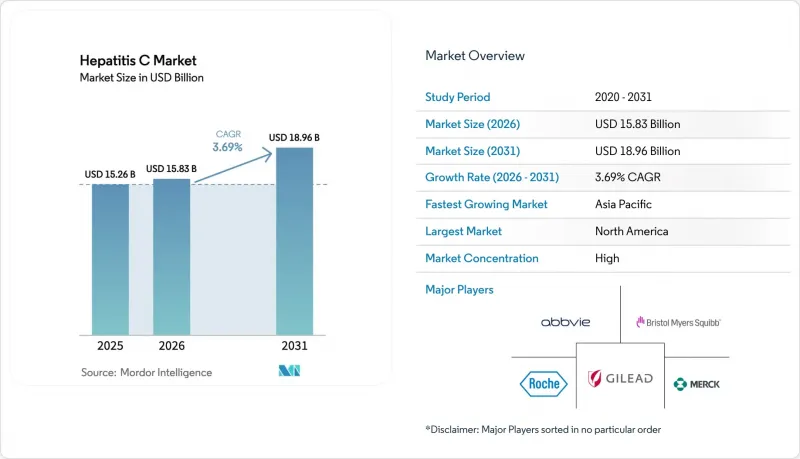
Mordor Intelligence에 의하면, C형 간염 시장 규모는 2025년 152억 6,000만 달러에서 2026년에는 158억 3,000만 달러로 확대되어 2026년부터 2031년까지 CAGR 3.69%로 성장을 지속하여, 2031년에는 189억 6,000만 달러에 이를 것으로 예측됩니다.
본 보고서는 구성 요소(진단(혈액 검사 등) 및 치료(DAA 등)), 연령대(18세 미만, 18-45세, 45세 이상), 판매 채널(병원 및 클리닉 등), 지역(북미, 유럽, 아시아태평양 등)별로 분류되어 있습니다. 시장 전망은 금액(달러) 기준으로 제시되어 있습니다.
전 세계 C형 간염 시장 동향 및 인사이트
C형 간염(HCV) 유병률 증가와 의무화된 보편적 선별 검사
위험 기반 접근 방식 대신 일회성 보편적 선별 검사 또는 출생 코호트별 선별 검사가 도입되면서, 지방 및 교외 인구 집단 내 잠재적 사례가 드러나고 있습니다. 미국 질병통제예방센터(CDC)의 모델 분석에 따르면, 2013년부터 2022년 사이에 진단을 받은 미국인 중 바이러스학적 치유를 달성한 비율은 고작 3분의 1에 그쳐, 치료 연계 과정을 효율화해야 할 잠재적 수요가 부각되고 있습니다. 유럽의 전체 인구를 대상으로 한 조사에서는 1965년부터 1985년 사이에 태어난 사람들 사이에서 유병률이 1% 이상의 지역이 확인되었으며, 이는 기존의 추정치를 크게 상회하는 수치입니다. 세계보건기구(WHO)가 제시한 ‘진단율 90%’라는 목표를 달성한 국가들에서는 인지율이 여전히 30% 미만에 그치고 있는 국가들에 비해 치료 도입 증가율이 현저히 가파른 양상을 보이고 있습니다. 더 많은 공중보건 기관이 1차 진료 및 응급 진료 부문에서의 선별 검사를 의무화함에 따라, 만성 유병률은 감소하고 있음에도 불구하고 진단 건수는 계속 증가하고 있습니다.
정부 자금 지원 전국 근절 이니셔티브
이집트의 국가 근절 프로그램에서는 400만 명 이상의 국민이 치료를 받았으며, 완치율은 87%에 달하고, 공공 자금 지원 대규모 모델의 유효성이 입증되었습니다. 호주, 캐나다, 스페인에서는 현재 지불자의 인센티브를 근절 목표와 연계하는 정액제 또는 지불 상한이 있는 계약을 통해 DAA에 대한 무제한 접근을 제공합니다. 미국에서는 110억 달러 규모의 연방 기금 설립이 제안되어 있으며, 이를 통해 무보험자를 대상으로 한 치료가 보장되고, 각 주의 메디케이드에 의한 치료 대상 확대가 지원될 전망입니다. 이로 인해 2027년까지 연간 40만 건의 치료 개시가 추가될 가능성이 있습니다. 이러한 제도를 통해 예측 가능한 치료 건수가 확보되므로, 제약사는 가격 면에서의 양보를 대가로 확실한 수요를 확보하는 동시에, 2030년 근절이라는 이정표 달성을 위한 진전을 가속화할 수 있습니다.
고가의 브랜드 치료제와 보험 급여 간의 격차
많은 고소득 국가 시장에서 범유전자형 대응 브랜드 DAA의 1코스당 가격은 여전히 2만 4,000달러 전후로 유지되고 있으며, 이는 섬유화 진행 단계나 금주 요건에 기반한 지불 주체의 엄격한 적격 기준으로 이어지고 있습니다. 본인 부담 비용의 위험으로 인해, 지역 의료 센터에서 저비용 선별 검사가 제공되고 있는 경우에도 무보험자나 보험 가입이 불충분한 계층의 치료 의지가 꺾이고 있습니다. 인도, 파키스탄, 이집트에서는 제네릭 소포스부비르/벨파타스비르를 100달러 미만으로 구입할 수 있지만, 기타 지역에서는 특허의 크로 조항이나 독점 조항으로 인해 정가가 높은 수준을 유지하고 있습니다. 확인용 RNA 검사, 섬유화 단계 판정, 전문의 진찰 등을 포함한 누적 비용은 1인당 3만 달러를 초과하기도 하여, 비용 대비 효과가 입증되었음에도 불구하고 치료의 보급을 저해하고 있습니다.
부문 분석
2025년 C형 간염 시장에서 치료제가 시장 점유율의 87.58%를 차지했습니다. 이는 많은 국가에서 고가로 판매되고 있는 직접작용형 항바이러스제(DAA)의 높은 단가를 반영한 것입니다. 소포스부비르 복합제를 중심으로 한 직접작용형 항바이러스제가 부문 매출의 대부분을 차지하고 있으며, 2024년에는 ‘하보니’와 ‘에프클라사’만으로도 전 세계 매출이 90억 달러를 넘어섰습니다. 페그화 인터페론/리바비린은 현재 인터페론 치료 적응증 환자를 대상으로 한 한 자릿수 수준에 머무르는 틈새 시장이지만, 비반응자에 대해서는 면역 조절 보조 요법이 연구되고 있습니다. 현재의 보험 급여 체계가 유지된다면, C형 간염 치료 시장 규모는 2031년까지 168억 5,000만 달러에 달할 가능성이 있습니다.
진단 분야는 규모는 작지만, 보편적 선별 검사, 산전 검사 및 교도소 내 프로그램으로 인해 검사 건수가 증가하고 있어 연평균 성장률(CAGR) 5.62%로 확대되고 있습니다. 아시아태평양 및 라틴아메리카에서는 현장(Point-of-Care) 항체 검사, 리플렉스(Reflex) RNA 카트리지, 그리고 고처리량 NAAT 플랫폼이 조달 입찰을 주도하고 있습니다. 분자 아형 분류 및 내성 염기서열 분석은 맞춤형 치료의 지침이 됨으로써 매출 증가를 이끌고 있습니다. 통합된 ‘검사부터 치료까지(test-to-treat)’ 워크플로는 환자 유지를 도모하고 두 구성 범주에 걸쳐 가치 창출을 확대함으로써, 유병률 감소로 인해 발생하는 치료 부문의 축소를 완화하고 있습니다.
지역별 분석
북미는 2025년, 종합적인 선별 검사 의무화, 프리미엄 브랜드 제품의 가격 책정, 그리고 메디케이드에 의한 광범위한 급여 지원에 힘입어 C형 간염 시장 점유율의 39.76%를 차지했습니다. 그러나 지금까지 치료를 받지 않았던 베이비붐 세대의 유병률이 감소함에 따라 성장률은 연평균 성장률(CAGR) 3.28%로 둔화되고 있습니다. 제안된 연방 근절 기금이 통과되면, 무보험자의 의료비를 보장함으로써 여전히 치료 건수를 대폭 증가시킬 가능성이 있습니다. 캐나다에서는 의약품 가격을 의료 기술 평가와 연계하여 정가에 상한선을 설정하고 있습니다. 한편, 멕시코의 ‘세구로 포풀라르(Seguro Popular)’ 프로그램에서는 현지에서 제조된 제네릭 의약품에 대한 보조금이 지급되기 시작했으며, 환자 1인당 지출은 감소하고 있지만 치료 건수 증가를 뒷받침하고 있습니다.
유럽은 큰 점유율을 차지하고 있으며, 2031년까지 연평균 성장률(CAGR) 3.01%를 기록할 전망입니다. '베넬룩사(Beneluxa)' 연합의 공동 조달 이니셔티브와 스페인 및 포르투갈의 국가 차원 정액제 계약에 힘입어, 2022년 이후 치료 과정의 가격은 45% 인하되었습니다. 영국에서는 전장 유전체 감시(Whole Genome Surveillance)와 지역사회에 대한 직접적인 아웃리치 활동을 통합한 결과, 만성 감염증 유병률이 51.6% 감소한 것으로 보고되었습니다. 동유럽 국가들은 세계보건기금(WHO)의 전환 보조금 지원을 받아 약물 주사 사용자를 대상으로 한 피해 감소, 검사, 치료 패키지를 확대하고 있으며, 이로 인해 진단 건수가 더욱 증가하고 있습니다.
아시아태평양은 연평균 성장률(CAGR) 4.83%로 확대되고 있으며, 가장 빠르게 성장하는 지역입니다. 중국의 물량 기반 조달로 인해 2024년 입찰 라운드에서 소포스부비르/벨파타스비르의 가격 상한선이 68% 인하되었으며, 각 성의 일괄 구매 주문이 촉진되었습니다. 인도의 ‘전국 바이러스성 간염 대책 프로그램’은 1코스당 100달러 미만으로 제네릭 의약품 비용을 충당하고 있으며, 2024년에는 55만 건 이상의 치료비를 상환했습니다. 말레이시아, 태국, 베트남에서는 ‘넷플릭스’형 가격 상한 모델이 도입되어, 감염 부담이 높은 집단을 대상으로 한 대규모 캠페인이 촉진되고 있습니다. 아시아태평양의 C형 간염 치료제 시장 점유율은 적극적인 근절 목표와 국내 생산 추진에 힘입어 2031년까지 28.64%를 넘어설 것으로 예측됩니다.
기타 혜택:
- 엑셀 형식 시장 예측(ME) 시트
- 3개월간의 애널리스트 지원
자주 묻는 질문
목차
제1장 서론
제2장 조사 방법
제3장 주요 요약
제4장 시장 구도
제5장 시장 규모와 성장 예측
제6장 경쟁 구도
제7장 시장 기회와 향후 전망
JHS 26.08.11According to Mordor Intelligence, the hepatitis c market size is expected to grow from USD 15.26 billion in 2025 to USD 15.83 billion in 2026 and is forecast to reach USD 18.96 billion by 2031 at 3.69% CAGR over 2026-2031.
This report is Segmented by Component (Diagnosis [Blood Tests and More] and Treatment [DAAs and More]), Age-Group (Below 18, 18 - 45, Above 45), Channel (Hospitals & Clinics, and More), and Geography (North America, Europe, Asia-Pacific, and More). The Market Forecasts are Provided in Terms of Value (USD).
Global Hepatitis C Market Trends and Insights
Rising HCV Prevalence & Mandatory Universal Screening
Universal one-time or birth-cohort screening replaces risk-based approaches and uncovers hidden cases in rural and suburban populations. US Centers for Disease Control modelling shows that only one-third of diagnosed Americans achieved virologic cure between 2013 and 2022, underscoring latent demand for streamlined linkage-to-care pathways. Whole-population surveys in Europe reveal prevalence pockets above 1% among individuals born between 1965 and 1985, far exceeding prior estimates. Countries meeting the World Health Organization's 90% diagnosis target demonstrate markedly steeper treatment adoption curves than nations still at sub-30% awareness levels. As more public health agencies set mandatory screening in primary-care and emergency-department settings, diagnostic volumes continue to rise even while the chronic prevalence rate falls.
Government-Funded National Elimination Initiatives
Egypt's national elimination programme treated over 4 million citizens and reached 87% cure, validating large-scale, publicly financed models. Australia, Canada, and Spain now provide unlimited DAA access through subscription or capped-payment contracts that align payer incentives with elimination targets. In the United States, a proposed USD 11 billion federal fund would cover the uninsured population and support state Medicaid treatment expansion, potentially adding 400,000 annual treatment starts by 2027. These schemes lock in predictable volumes, allowing manufacturers to exchange price concessions for certainty while accelerating progress toward the 2030 elimination milestone.
High Branded-Therapy Cost & Reimbursement Gaps
Course prices for branded pan-genotypic DAAs remain near USD 24,000 in many high-income markets, leading to restrictive payer criteria based on fibrosis stage or sobriety requirements. Out-of-pocket cost exposure discourages treatment among uninsured or under-insured populations, even where community health centres offer low-cost screening. Generic sofosbuvir/velpatasvir is available for under USD 100 in India, Pakistan, and Egypt, yet patent claws and exclusivity clauses keep list prices elevated elsewhere. The cumulative spend, including confirmatory RNA tests, fibrosis staging, and specialist visits, can exceed USD 30,000 per person, hampering uptake despite proven cost-effectiveness.
Other drivers and restraints analyzed in the detailed report include:
- Advances in Point-of-Care and Molecular Diagnostics
- Superior Cure Rates & Shorter Regimens of DAAs
- Large undiagnosed pool & social stigma
For complete list of drivers and restraints, kindly check the Table Of Contents.
Segment Analysis
Treatment accounted for 87.58% of the Hepatitis C market share in 2025, reflecting the high unit value of DAAs that sell at premium prices in many countries. Direct-acting antivirals anchored by sofosbuvir combinations generated the bulk of segment turnover, with Harvoni and Epclusa alone surpassing USD 9 billion in global sales in 2024. Pegylated-interferon/ribavirin now constitutes a single-digit niche for interferon-eligible patients, while immunomodulatory adjuncts are under investigation for non-responders. The Hepatitis C market size for treatment could reach USD 16.85 billion by 2031 if current reimbursement frameworks hold.
Diagnosis, although smaller, is rising at a 5.62% CAGR as universal screening, antenatal testing, and prison-based programmes increase test volumes. Point-of-care antibody assays, reflex RNA cartridges, and high-throughput NAAT platforms dominate procurement tenders in Asia-Pacific and Latin America. Molecular sub-typing and resistance sequencing deliver incremental revenue by guiding personalized therapy. An integrated "test-to-treat" workflow retains patients and extends value capture across both component categories, mitigating treatment-segment contraction caused by shrinking prevalence.
Complete Report Scope:
- By Component
- Diagnosis
- Blood Tests
- Rapid/POC Tests
- Molecular (PCR, NAAT)
- Sequencing-based Genotyping
- Others
- Treatment
- Direct-Acting Antivirals (DAAs)
- Pegylated Interferon + Ribavirin
- Adjunct Immunomodulators
- Diagnosis
- By Age Group
- Below 18
- 18 - 45
- Above 45
- By Channel
- Hospitals & Clinics
- Diagnostic Laboratories
- Community Pharmacies & Retail Clinics
- Others
- By Geography
- North America
- United States
- Canada
- Mexico
- Europe
- Germany
- United Kingdom
- France
- Italy
- Spain
- Rest of Europe
- Asia-Pacific
- China
- Japan
- India
- Australia
- South Korea
- Rest of Asia-Pacific
- Middle East and Africa
- GCC
- South Africa
- Rest of Middle East and Africa
- South America
- Brazil
- Argentina
- Rest of South America
- North America
Geography Analysis
North America commanded 39.76% of the Hepatitis C market share in 2025, powered by comprehensive screening mandates, premium branded pricing, and broad Medicaid coverage. However, growth moderates to a 3.28% CAGR as prevalence declines in previously untreated baby boomers. The proposed federal elimination fund, if enacted, could still add large treatment volumes by underwriting uninsured care. Canada aligns drug pricing with health-technology assessments, capping list prices, while Mexico's Seguro Popular programme is beginning to subsidise locally manufactured generics, anchoring volume growth despite lower per-patient spend.
Europe accounts for a sizeable share and shows a 3.01% CAGR through 2031. Joint procurement initiatives under the Beneluxa coalition and national subscription deals in Spain and Portugal have trimmed treatment course prices by 45% since 2022. The United Kingdom reports a 51.6% drop in chronic infection prevalence after integrating whole-genome surveillance with direct community outreach. Eastern European nations, backed by Global Fund transition grants, are scaling harm-reduction, testing, and treatment packages among people who inject drugs, unlocking additional diagnostic volumes.
Asia-Pacific is the fastest-growing territory, expanding at 4.83% CAGR. China's volume-based procurement brought down the sofosbuvir/velpatasvir price ceiling by 68% in the 2024 tender round, catalysing provincial bulk-buy orders. India's National Viral Hepatitis Control Programme finances generics at under USD 100 per course and reimbursed more than 550,000 treatments in 2024. Malaysia, Thailand, and Vietnam deploy the "Netflix" capped-price model, facilitating mass campaigns among high-burden populations. The Hepatitis C market share derived from Asia-Pacific is expected to climb above 28.64% by 2031, powered by aggressive elimination goals paired with domestic manufacturing.
- Abbott Laboratories
- Abbvie
- Alnylam Pharmaceuticals
- Arbutus Biopharma Corporation
- Assembly Biosciences, Inc.
- Atea Pharmaceuticals
- Bayer
- Bristol-Myers Squibb
- Cipla
- Dr. Reddy's Laboratories
- Enanta Pharmaceuticals, Inc.
- Roche
- Gilead Sciences
- Grifols
- GlaxoSmithKline
- Johnson & Johnson
- Merck
- Novartis
- Orasure Technologies
- QIAGEN
- Sun Pharmaceuticals Industries
- Thermo Fisher Scientific
- Viatris
- Vir Biotechnology, Inc.
- Zydus Lifesciences Ltd
Additional Benefits:
- The market estimate (ME) sheet in Excel format
- 3 months of analyst support
TABLE OF CONTENTS
1 Introduction
- 1.1 Study Assumptions & Market Definition
- 1.2 Scope of the Study
2 Research Methodology
3 Executive Summary
4 Market Landscape
- 4.1 Market Overview
- 4.2 Market Drivers
- 4.2.1 Rising HCV Prevalence & Mandatory Universal Screening
- 4.2.2 Government-Funded National Elimination Initiatives
- 4.2.3 Advances in Point-of-Care and Molecular Diagnostics
- 4.2.4 Superior Cure Rates & Shorter Regimens of DAAs
- 4.2.5 Pharmacy-Led Decentralized "Test-To-Treat" Models
- 4.2.6 AI-Guided Personalized DAA Regimen Optimization
- 4.3 Market Restraints
- 4.3.1 High Branded-Therapy Cost & Reimbursement Gaps
- 4.3.2 Large Undiagnosed Pool & Social Stigma
- 4.3.3 Specialist-Prescription & Retreatment Restrictions
- 4.3.4 Emerging Antiviral-Resistance Mutations
- 4.4 Value Chain Analysis
- 4.5 Regulatory Landscape
- 4.6 Technological Outlook
- 4.7 Porter's Five Forces Analysis
- 4.7.1 Threat of New Entrants
- 4.7.2 Bargaining Power of Buyers
- 4.7.3 Bargaining Power of Suppliers
- 4.7.4 Threat of Substitutes
- 4.7.5 Intensity of Competitive Rivalry
5 Market Size & Growth Forecasts (Value)
- 5.1 By Component
- 5.1.1 Diagnosis
- 5.1.1.1 Blood Tests
- 5.1.1.2 Rapid/POC Tests
- 5.1.1.3 Molecular (PCR, NAAT)
- 5.1.1.4 Sequencing-based Genotyping
- 5.1.1.5 Others
- 5.1.2 Treatment
- 5.1.2.1 Direct-Acting Antivirals (DAAs)
- 5.1.2.2 Pegylated Interferon + Ribavirin
- 5.1.2.3 Adjunct Immunomodulators
- 5.1.1 Diagnosis
- 5.2 By Age Group
- 5.2.1 Below 18
- 5.2.2 18 - 45
- 5.2.3 Above 45
- 5.3 By Channel
- 5.3.1 Hospitals & Clinics
- 5.3.2 Diagnostic Laboratories
- 5.3.3 Community Pharmacies & Retail Clinics
- 5.3.4 Others
- 5.4 By Geography
- 5.4.1 North America
- 5.4.1.1 United States
- 5.4.1.2 Canada
- 5.4.1.3 Mexico
- 5.4.2 Europe
- 5.4.2.1 Germany
- 5.4.2.2 United Kingdom
- 5.4.2.3 France
- 5.4.2.4 Italy
- 5.4.2.5 Spain
- 5.4.2.6 Rest of Europe
- 5.4.3 Asia-Pacific
- 5.4.3.1 China
- 5.4.3.2 Japan
- 5.4.3.3 India
- 5.4.3.4 Australia
- 5.4.3.5 South Korea
- 5.4.3.6 Rest of Asia-Pacific
- 5.4.4 Middle East and Africa
- 5.4.4.1 GCC
- 5.4.4.2 South Africa
- 5.4.4.3 Rest of Middle East and Africa
- 5.4.5 South America
- 5.4.5.1 Brazil
- 5.4.5.2 Argentina
- 5.4.5.3 Rest of South America
- 5.4.1 North America
6 Competitive Landscape
- 6.1 Market Concentration
- 6.2 Strategic Moves
- 6.3 Market Share Analysis
- 6.4 Company Profiles (includes Global level Overview, Market level overview, Core Segments, Financials as available, Strategic Information, Market Rank/Share for key companies, Products & Services, Recent Developments)
- 6.4.1 Abbott Laboratories Inc.
- 6.4.2 AbbVie Inc.
- 6.4.3 Alnylam Pharmaceuticals, Inc.
- 6.4.4 Arbutus Biopharma Corporation
- 6.4.5 Assembly Biosciences, Inc.
- 6.4.6 Atea Pharmaceuticals
- 6.4.7 Bayer AG
- 6.4.8 Bristol-Myers Squibb Co.
- 6.4.9 Cipla Ltd
- 6.4.10 Dr. Reddy's Laboratories
- 6.4.11 Enanta Pharmaceuticals, Inc.
- 6.4.12 F. Hoffmann-La Roche
- 6.4.13 Gilead Sciences Inc.
- 6.4.14 Grifols, S.A.
- 6.4.15 GSK plc
- 6.4.16 Johnson & Johnson Services, Inc.
- 6.4.17 Merck & Co., Inc.
- 6.4.18 Novartis AG
- 6.4.19 OraSure Technologies Inc.
- 6.4.20 QIAGEN N.V.
- 6.4.21 Sun Pharmaceutical Industries Limited
- 6.4.22 Thermo Fisher Scientific Inc.
- 6.4.23 Viatris Inc.
- 6.4.24 Vir Biotechnology, Inc.
- 6.4.25 Zydus Lifesciences Ltd
7 Market Opportunities & Future Outlook
- 7.1 White-space & Unmet-need Assessment


