

|
시장보고서
상품코드
2100026
AI 기반 정신건강 솔루션 시장 : 시장 점유율 분석, 업계 동향 및 통계, 성장 예측(2026-2031년)AI-powered Mental Health Solutions - Market Share Analysis, Industry Trends & Statistics, Growth Forecasts (2026 - 2031) |
||||||
 Mordor Intelligence
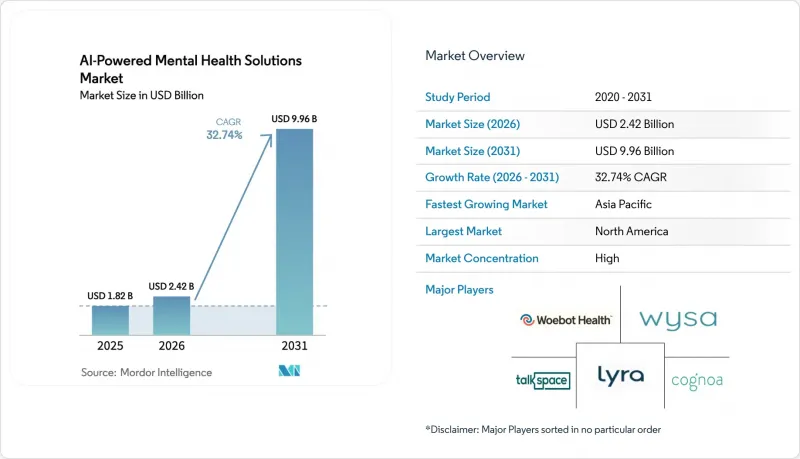
Mordor Intelligence에 의하면, AI 기반 정신건강 솔루션 시장 규모는 2025년 18억 2,000만 달러로 평가되었고, 2026년에는 24억 2,000만 달러로 확대될 것으로 추정되고, 2026-2031년 CAGR 32.74%로 성장을 지속할 전망이며, 2031년에는 99억 6,000만 달러에 이를 것으로 예측됩니다.
본 보고서는 기술별(머신러닝, 자연어 처리 등), 솔루션 유형별(진단 지원 등), 도입 형태별(클라우드 기반, On-Premise형), 최종 사용자별(개인 등), 정신 질환별(우울증 등), 지역별(북미 등)로 분류되어 있습니다. 시장 전망은 금액(달러) 기준으로 제시되어 있습니다.
세계의 AI 기반 정신 건강 솔루션 시장 동향 및 인사이트
AI를 활용한 정신 건강 모바일 앱의 급속한 확산
현재 1만 개가 넘는 정신건강 앱에 AI가 통합되어 있으나, 5년 전만 해도 1,000개 미만이었습니다. 무작위 대조 시험에 따르면, Therabot 및 유사한 도구는 주요 우울 장애, 일반화된 불안 장애, 섭식 장애에서 인간이 수행하는 치료와 동등한 증상 완화 효과를 달성하고 있습니다. 미국 성인의 24%가 이미 정서적 지원을 위해 LLM(대규모 언어 모델)을 이용하고 있으며, 지원을 꺼리는 경향이 있는 계층에서도 변화가 나타나고 있습니다. AI가 생성한 대처법 연습을 포함한 마음챙김 앱을 도입한 기업에서는 생산성이 12% 향상되고, 직원 이직률이 67% 개선된 것으로 보고되었습니다. Wysa사의 만성 통증 모듈 등 모바일 치료 앱에 대해 FDA가 ‘획기적인 의료기기(Breakthrough Device)’로 지정함에 따라, 임상 워크플로우에서 앱 기반 치료의 정당성이 인정되었습니다.
디지털 치료제에 대한 보험 급여 확대
메디케어의 2025년 요금표에는 디지털 정신건강 도구를 도입하는 의료 제공업체를 위해 3가지 새로운 청구 코드가 도입됩니다. 미국 식품의약국(FDA) 및 메디케어·메디케이드 서비스 센터(CMS)는 현재 성과 연계형 지불 모델의 시범 운영을 진행 중입니다. 보상은 기능 개선이라는 평가 지표에 연동되어 있어, 지속적인 수익원이 될 것임을 시사합니다. 독일, 프랑스, 영국, 벨기에에서는 DiGA형 프레임워크가 채택되어 있으며, 임상적 근거 기준을 충족할 경우 인공지능을 활용한 치료법에 대한 자금 지원이 이루어집니다. 이에 대응하여 각 벤더 기업들은 대규모 3상 임상시험을 시작하고 있습니다. Rejoyn사는 인지 조절 훈련 데이터의 유효성을 근거로 미국 내 승인을 획득했습니다. 보험사의 지원에 힘입어 서비스 대상 범위는 의료 서비스가 충분히 제공되지 않는 메디케이드 수급자나 농촌 지역 주민까지 확대되고 있습니다.
알고리즘 기반 권고 사항의 임상적 타당성 격차
AI를 활용한 정신건강 도구의 진단 정확도는 21-100%로 편차가 커 규제 당국을 불안하게 하고 있습니다. FDA는 현재 의약품 수준의 증거를 요구하고 있으며, 중소기업들은 임상시험 비용을 충당하기 위해 대학과 제휴하고 있습니다. 편향에 관한 연구에 따르면, 다양한 대상 집단에서 모델의 신뢰성이 떨어지는 것으로 나타나 개발자들은 데이터 세트를 확충할 수밖에 없는 상황입니다. 임상의들은 동료 심사를 거친 학술지에 재현 가능한 결과가 게재될 때까지 신중한 태도를 고수하고 있으며, 환자들의 열의에도 불구하고 병원 내 도입 속도는 더딥니다.
부문 분석
AI를 활용한 정신 건강 솔루션 시장에서 2025년 자연어 처리(NLP)가 매출의 44.02%를 차지한 반면, 머신러닝(ML)은 연평균 성장률(CAGR) 34.36%로 성장하고 있습니다. 다모달 뇌파(EEG) 및 음성 분류기는 우울증 진단에서 97.53%의 정확도를 달성했습니다. 벤더들의 로드맵에서는 감정 컴퓨팅, 예측 분석, LLM 채팅을 통합하여 풀스택 플랫폼을 구축하려는 움직임이 점점 더 강해지고 있습니다. 병원에서는 임상의의 확인에 앞서 AI 챗봇이 구조화된 환자 병력을 수집함으로써, 분류 시간이 단축되고 있는 것으로 확인되었습니다. 각 클라우드 하이퍼스케일러 기업들은 정신 건강 API를 기존 의료 데이터 생태계에 통합하고 있으며, 이를 통해 머신러닝 모듈과 연동된 AI 기반 정신 건강 솔루션 시장 규모가 확대되고 있습니다.
데이터 주권 요건을 충족하기 위해 새로운 트랜스포머 모델이 가상 사설 클라우드 내에서 가동되고 있습니다. 예측 분석 대시보드는 직원의 기분을 벤치마킹하여 선제적인 자원 배분을 가능하게 하고 있습니다. 현재 30건 이상의 자금 조달 라운드가 맞춤형 치료 LLM을 대상으로 진행되고 있으며, 알고리즘의 혁신성보다 데이터 자산의 중요성이 강조되고 있습니다. ISO/IEC 안전 기준에 따른 인증을 획득하고 대규모 보험사와의 보상 협상을 진행하는 벤더에게 경쟁 우위가 주어질 것입니다.
2025년에는 ‘치료의 개인화’가 매출의 39.02%를 차지했습니다. '진단 지원'은 34.78%라는 가장 높은 연평균 성장률(CAGR)을 나타낼 전망입니다. 음성 바이오마커 도구는 25초 이내에 중등도에서 중증의 우울증을 민감도 71.3%, 특이도 73.5%로 감지합니다. 조기 발견을 통해 후속 치료 비용이 절감되므로, 보험사 등의 관심을 끌고 있습니다. 모니터링 및 관리 솔루션은 웨어러블 기기에서 수집된 데이터와 채팅 기반 코칭을 결합하여 지속적인 피드백 루프를 구현합니다. 가상현실(VR)을 활용한 노출 요법 제품은 PTSD에 대해 뛰어난 치료 성과를 보여주고 있으며, AI를 활용한 정신 건강 솔루션 시장의 ‘기타 용도’ 확대에 기여하고 있습니다.
의료 제공업체들은 선별 검사, 개인 맞춤화, 재발 예방을 아우르는 통합 솔루션을 선호합니다. 각 벤더사는 편두통(CT-132)이나 조현병의 음성 증상(CT-155)과 같은 부담이 큰 질환에 파이프라인을 집중시키고, 명확한 규제 승인 경로를 바탕으로 프리미엄 가격 확보를 목표로 하고 있습니다.
지역별 분석
북미는 2025년 매출의 41.42%를 차지한 것으로 평가되었으며, FDA 승인(Rejoyn, SleepioRx) 및 메디케어 환급 로드맵이 이를 뒷받침했습니다. 벤처 캐피털 자금은 여전히 풍부하며, Slingshot AI는 치료 특화형 LLM 개발을 위해 3,000만 달러를 조달했습니다.
유럽은 EU AI법 및 GDPR(EU 개인정보보호규정)을 통해 세계적 기준을 확립하고 있습니다. 독일의 DiGA 카탈로그에서는 40종 이상의 디지털 치료제가 보험 적용 대상에 포함되어 있습니다. 이탈리아가 Replika사에 부과한 500만 유로의 벌금은 규제 집행의 엄격함을 여실히 보여주고 있습니다. Limbic사는 AI를 활용한 임상 의사결정 지원 기능을 전자의무기록(EMR)에 통합하기 위해 1,470만 달러를 조달했습니다.
아시아태평양은 연평균 성장률(CAGR) 34.41%로 성장을 주도하고 있습니다. 이 지역 전체에서 정신 질환은 장애 조정 생명 연수(DALY)의 5%를 차지하고 있습니다. 중국은 디지털 치료제 승인 건수에서 미국과 어깨를 나란히 하고 있으며, 한국에서는 GPT-4를 탑재한 챗봇이 높은 공감도 평가를 받고 있습니다. 언어 적응 및 문화적 배려를 반영한 프롬프트 설계와 같은 현지화 전략이 각 기업의 서비스를 차별화하고 있습니다.
남미에서는 정신 질환 및 비감염성 질환으로 인해 2020-2050년 7조 3,000억 달러의 GDP 손실이 예상됩니다. 브라질과 콜롬비아의 각 정부 부처는 저비용 모바일 플랫폼에서 AI 채팅 라인의 시범 운영을 진행하고 있습니다. 중동 및 아프리카에서는 SMS 기반 AI 선별 도구가 광대역 환경이 제한된 지역에도 보급되고 있습니다. 사하라 이남 아프리카의 우울증 유병률은 26.9%에 달하며, 충족되지 않은 의료 수요가 상당한 규모에 이르는 것으로 나타났습니다.
기타 혜택 :
- 엑셀 형식 시장 예측(ME) 시트
- 3개월간의 애널리스트 지원
자주 묻는 질문
목차
제1장 서론
제2장 조사 방법
제3장 주요 요약
제4장 시장 구도
제5장 시장 규모 및 성장 예측
제6장 경쟁 구도
제7장 시장 기회 및 향후 전망
AJY 26.08.07According to Mordor Intelligence, the AI-powered mental health solutions market size is expected to grow from USD 1.82 billion in 2025 to USD 2.42 billion in 2026 and is forecast to reach USD 9.96 billion by 2031 at 32.74% CAGR over 2026-2031.
This report is Segmented by Technology (Machine Learning, Natural-Language Processing, and More), Solution Type (Diagnostics Assistance, and More), Deployment Mode (Cloud-Based, On-Premise), End User (Individuals, and More), Mental-Health Condition (Depression, and More), and Geography (North America, and More). The Market Forecasts are Provided in Terms of Value (USD).
Global AI-powered Mental Health Solutions Market Trends and Insights
Rapid Proliferation of AI-Driven Mental-Health Mobile Apps
More than 10 000 mental-health apps now incorporate AI, compared with fewer than 1 000 five years ago. Randomized trials show Therabot and similar tools achieve symptom reductions comparable to human therapy across major depressive, generalized-anxiety, and feeding disorders. Twenty-four percent of U.S. adults already use LLMs for emotional support, marking a shift among help-averse demographics. Employers document 12% productivity gains and 67% retention improvements after deploying mindfulness apps that include AI-generated coping exercises. FDA breakthrough-device designations for mobile therapeutics such as Wysa's chronic-pain module legitimize app-based care inside clinical workflows.
Reimbursement Expansion for Digital Therapeutics
Medicare's 2025 fee schedule introduces three new billing codes for providers integrating digital mental-health tools. The U.S. Food and Drug Administration and the Centers for Medicare & Medicaid Services now pilot outcomes-based payment models: reimbursement is tied to functional-improvement endpoints, signaling durable revenue streams. Germany, France, the U.K., and Belgium use DiGA-style frameworks that fund artificial-intelligence-enabled therapeutics once clinical-evidence thresholds are met. Vendors respond by launching large phase-III trials; Rejoyn secured U.S. clearance on the strength of cognitive-control training data. Payer support expands service reach to underserved Medicaid and rural populations.
Clinical Validation Gap for Algorithmic Recommendations
Diagnostic accuracy for AI mental-health tools ranges 21-100%, unsettling regulators. The FDA now demands pharmaceutical-grade evidence; small firms partner with universities to manage trial costs. Bias studies show model reliability drops in diverse cohorts, compelling developers to expand datasets. Clinicians remain wary until reproducible outcomes appear in peer-reviewed journals, slowing hospital procurement cycles despite patient enthusiasm.
Other drivers and restraints analyzed in the detailed report include:
- Enterprise Demand for Workforce-Wellness AI Platforms
- Integration of Multimodal Emotional-AI Sensors in Wearables
- Fragmented Data-Privacy Regulations
For complete list of drivers and restraints, kindly check the Table Of Contents.
Segment Analysis
The AI powered mental health solutions market saw Natural Language Processing hold 44.02% revenue in 2025, yet Machine Learning is growing at 34.36% CAGR. A multimodal EEG-and-speech classifier achieved 97.53% depression-diagnosis accuracy. Vendor road maps increasingly converge affective computing, predictive analytics, and LLM chat to create full-stack platforms. Hospitals note shorter triage times when AI chatbots collect structured patient histories before clinician review. Cloud hyperscalers integrate mental-health APIs into existing health-data ecosystems, boosting the AI powered mental health solutions market size attached to Machine Learning modules.
Emergent transformer models run inside virtual private clouds to meet data-sovereignty demands. Predictive-analytics dashboards benchmark workforce mood, enabling proactive resource allocation. More than 30 funding rounds now target bespoke therapy LLMs, underscoring data-asset primacy over algorithm novelty. Competitive advantage will accrue to vendors that certify under ISO/IEC safety standards and negotiate payer reimbursement at scale.
Treatment Personalization held 39.02% revenue in 2025; Diagnostics Assistance is projected to register the highest 34.78% CAGR. A voice-biomarker tool flags moderate-to-severe depression within 25 seconds at 71.3% sensitivity and 73.5% specificity. Early identification lowers downstream costs, attracting payer interest. Monitoring and Management suites pair wearable data with chat-based coaching for continuous feedback loops. Virtual-reality exposure therapy products deliver compelling PTSD outcomes, expanding "Other Applications" within the AI powered mental health solutions market.
Providers prefer integrated solutions that span screening, personalization, and relapse prevention. Vendors focus pipelines on high-burden conditions such as migraine (CT-132) and schizophrenia negative symptoms (CT-155), banking on clear regulatory pathways to secure premium pricing.
Complete Report Scope:
- By Technology
- Machine Learning
- Natural-Language Processing (NLP)
- Emotion AI/ Affective Computing
- Predictive Analytics
- Others Software Solutions
- By Solution Type
- Diagnostics Assistance
- Treatment Personalization
- Monitoring and Management
- Other Applications
- Other Solutions
- By Deployment Mode
- Cloud-Based
- On-Premise
- By End User
- Individuals
- Employers & Corporate Wellness Programs
- Healthcare Providers
- Payers
- Government & Non-Profit Organizations
- By Mental-Health Condition
- Depression
- Anxiety Disorders
- Stress Management
- Post-Traumatic Stress Disorder (PTSD)
- Substance-Use Disorders
- Other Conditions
- By Geography
- North America
- United States
- Canada
- Mexico
- Europe
- Germany
- United Kingdom
- France
- Italy
- Spain
- Rest of Europe
- Asia-Pacific
- China
- India
- Japan
- South Korea
- Australia
- Rest of Asia-Pacific
- South America
- Brazil
- Argentina
- Rest of South America
- Middle East and Africa
- GCC
- South Africa
- Rest of Middle East and Africa
- North America
Geography Analysis
North America generated 41.42% revenue in 2025, fueled by FDA clearances (Rejoyn, SleepioRx) and Medicare's reimbursement roadmap. Venture capital remains abundant: Slingshot AI raised USD 30 million to develop therapy-specific LLMs.
Europe sets global standards through the EU AI Act and GDPR. Germany's DiGA catalog reimburses more than 40 digital therapeutics. Italy's EUR 5 million Replika fine highlights enforcement strength. Limbic secured USD 14.7 million to integrate AI clinical decision support into electronic health records.
Asia-Pacific leads growth at 34.41% CAGR. Mental disorders contribute 5% of disability-adjusted life years region-wide. China matches the U.S. in digital-therapeutics approvals; South Korean GPT-4-powered chatbots receive high empathy ratings. Localization strategies-language adaptation and culturally sensitive prompt engineering-differentiate offerings.
South America faces projected GDP losses of USD 7.3 trillion from 2020-2050 due to mental-health and non-communicable diseases. Ministries in Brazil and Colombia pilot AI chatlines on low-cost mobile platforms. In the Middle East and Africa, SMS-based AI screening tools reach areas with limited broadband; sub-Saharan prevalence rates of 26.9% depression indicate sizable unmet need.
- Headspace Health
- Woebot Health
- Wysa
- Quartet Health
- Spring Health
- Teladoc Health
- Talkspace
- Koa Health
- Babylon Health
- Mindstrong
- AbleTo
- BetterUp
- Ada Health
- Amaha
- Happify Health
- Calm Health
- BenevolentAI (mental-health pipeline)
- Unmind
- SilverCloud Health
Additional Benefits:
- The market estimate (ME) sheet in Excel format
- 3 months of analyst support
TABLE OF CONTENTS
1 Introduction
- 1.1 Study Assumptions & Market Definition
- 1.2 Scope of the Study
2 Research Methodology
3 Executive Summary
4 Market Landscape
- 4.1 Market Overview
- 4.2 Market Drivers
- 4.2.1 Rapid proliferation of AI-driven mental-health mobile apps
- 4.2.2 Reimbursement expansion for digital therapeutics
- 4.2.3 Enterprise demand for workforce-wellness AI platforms
- 4.2.4 Integration of multimodal emotional-AI sensors in wearables
- 4.2.5 Foundation-model fine-tuning for psychotherapy chatbots
- 4.3 Market Restraints
- 4.3.1 Clinical-validation gap for algorithmic recommendations
- 4.3.2 Fragmented data-privacy regulations
- 4.3.3 Bias risks in emotion-AI training datasets
- 4.4 Value / Supply-Chain Analysis
- 4.5 Regulatory Landscape
- 4.6 Technological Outlook
- 4.7 Porter's Five Forces
- 4.7.1 Threat of New Entrants
- 4.7.2 Bargaining Power of Suppliers
- 4.7.3 Bargaining Power of Buyers
- 4.7.4 Threat of Substitutes
- 4.7.5 Competitive Rivalry
5 Market Size & Growth Forecasts (Value)
- 5.1 By Technology
- 5.1.1 Machine Learning
- 5.1.2 Natural-Language Processing (NLP)
- 5.1.3 Emotion AI/ Affective Computing
- 5.1.4 Predictive Analytics
- 5.1.5 Others Software Solutions
- 5.2 By Solution Type
- 5.2.1 Diagnostics Assistance
- 5.2.2 Treatment Personalization
- 5.2.3 Monitoring and Management
- 5.2.4 Other Applications
- 5.2.5 Other Solutions
- 5.3 By Deployment Mode
- 5.3.1 Cloud-Based
- 5.3.2 On-Premise
- 5.4 By End User
- 5.4.1 Individuals
- 5.4.2 Employers & Corporate Wellness Programs
- 5.4.3 Healthcare Providers
- 5.4.4 Payers
- 5.4.5 Government & Non-Profit Organizations
- 5.5 By Mental-Health Condition
- 5.5.1 Depression
- 5.5.2 Anxiety Disorders
- 5.5.3 Stress Management
- 5.5.4 Post-Traumatic Stress Disorder (PTSD)
- 5.5.5 Substance-Use Disorders
- 5.5.6 Other Conditions
- 5.6 By Geography
- 5.6.1 North America
- 5.6.1.1 United States
- 5.6.1.2 Canada
- 5.6.1.3 Mexico
- 5.6.2 Europe
- 5.6.2.1 Germany
- 5.6.2.2 United Kingdom
- 5.6.2.3 France
- 5.6.2.4 Italy
- 5.6.2.5 Spain
- 5.6.2.6 Rest of Europe
- 5.6.3 Asia-Pacific
- 5.6.3.1 China
- 5.6.3.2 India
- 5.6.3.3 Japan
- 5.6.3.4 South Korea
- 5.6.3.5 Australia
- 5.6.3.6 Rest of Asia-Pacific
- 5.6.4 South America
- 5.6.4.1 Brazil
- 5.6.4.2 Argentina
- 5.6.4.3 Rest of South America
- 5.6.5 Middle East and Africa
- 5.6.5.1 GCC
- 5.6.5.2 South Africa
- 5.6.5.3 Rest of Middle East and Africa
- 5.6.1 North America
6 Competitive Landscape
- 6.1 Market Concentration
- 6.2 Market Share Analysis
- 6.3 Company Profiles (includes Global level Overview, Market level overview, Core Segments, Financials as available, Strategic Information, Market Rank/Share for key companies, Products & Services, and Recent Developments)
- 6.3.1 Headspace Health
- 6.3.2 Woebot Health
- 6.3.3 Wysa
- 6.3.4 Quartet Health
- 6.3.5 Spring Health
- 6.3.6 Teladoc Health
- 6.3.7 Talkspace
- 6.3.8 Koa Health
- 6.3.9 Babylon Health
- 6.3.10 Mindstrong
- 6.3.11 AbleTo
- 6.3.12 BetterUp
- 6.3.13 Ada Health
- 6.3.14 Amaha
- 6.3.15 Happify Health
- 6.3.16 Calm Health
- 6.3.17 BenevolentAI (mental-health pipeline)
- 6.3.18 Unmind
- 6.3.19 SilverCloud Health
7 Market Opportunities & Future Outlook
- 7.1 White-Space & Unmet-Need Assessment


