

|
시장보고서
상품코드
2100030
의약품 전자상거래 시장 : 점유율 분석, 업계 동향 및 통계, 성장 예측(2026-2031년)Pharmaceutical E-commerce - Market Share Analysis, Industry Trends & Statistics, Growth Forecasts (2026 - 2031) |
||||||
 Mordor Intelligence
Mordor Intelligence에 의하면, 2026년 의약품 전자상거래 시장 규모는 2,622억 5,000만 달러로 추정되고 있어 2025년 2,349억 5,000만 달러에서 확대해, 2031년에는 4,544억 3,000만 달러에 이를 것으로 예측됩니다.
2026년부터 2031년까지 연평균 성장률(CAGR) 11.62%로 성장할 것으로 전망됩니다.
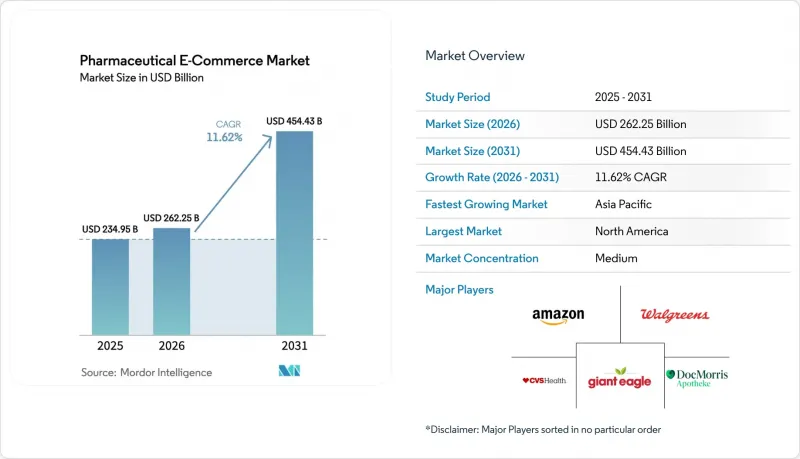
본 보고서는 유형(처방약 및 일반의약품), 제품 유형(백신 등), 치료 분야(당뇨병 등), 시장 유형(B2B, B2B2B, B2B2C, B2C), 플랫폼(제조업체 직영 디지털 커머스 등), 지역(북미, 유럽, 아시아태평양, 중동 및 아프리카, 남미)별로 분류되어 있습니다. 시장 전망은 금액(달러) 기준으로 제시되어 있습니다.
세계 의약품 전자상거래 시장 동향과 인사이트
디지털 헬스 인프라의 급속한 확대
디지털 헬스 인프라는 현재 전자 차트, 결제 게이트웨이, 클라우드 기반 재고 관리 시스템을 실시간으로 연동하여 처방전 검증과 조제를 원활하게 수행할 수 있도록 하고 있습니다. 아마존이 2025년에 20개의 매장 내 약국을 새로 개설할 계획은 미국 가구의 45%에게 당일 배송을 확대하는 것으로, 인프라 투자가 얼마나 신속하게 시장 접근성을 확대할 수 있는지를 보여줍니다. UPS 헬스케어와 같은 세계 물류 제공업체들은 220개국에 걸쳐 GDP/GMP 준수 콜드체인 역량을 확충하여, 온도 관리가 필요한 생물학적 제제의 국경 간 운송을 간소화하고 있습니다. 연결성 향상으로 조제 오류가 감소하고 리드타임이 단축되며, 이전에는 불규칙한 배송에 의존해야 했던 지방 지역으로의 전문 의약품 공급 범위가 확대되고 있습니다. 그 결과, 선도 기업이 공급망 효율성을 확립하고 후발 기업이 이를 재현하기 어려운 생태계가 형성되고 있습니다.
원격의료 및 전자처방 서비스의 보급 확대
원격의료 플랫폼은 전자처방전을 제휴 온라인 약국으로 직접 전송함으로써 진료와 조제 사이의 격차를 해소합니다. 개정된 DEA(미국 마약단속국) 규정에 따라 특별 등록 체계 하에서 원격의료를 통한 규제 약물 처방이 허용됨에 따라, 디지털 조제의 큰 장벽이 제거되었습니다. 일라이 릴리(Eli Lilly)사의 ‘LillyDirect’는 온라인 진료와 아마존 약국(Amazon Pharmacy)을 통한 당뇨병, 비만, 편두통 치료제의 자택 직배 서비스를 통합하여, 복약 순응도를 높이고 내원 시간을 단축하는 통합된 경험을 제공합니다. 의료 인력 부족이 지속되는 지방에서는 원격의료와 온라인 약국의 연계를 통해 진료 지연을 해소하고, 적시에 치료를 시작할 수 있게 됩니다. 이러한 시너지 효과로 인해 복약 중단에 따른 응급실 방문을 최소화함으로써 보험사의 비용도 절감됩니다.
엄격하고 단편적인 규제 체계
주, 연방 및 초국가적 규정이 서로 다른 속도로 변화함에 따라 규정 준수(컴플라이언스)의 복잡성이 가중됩니다. FDA는 2024년 11월, 의약품 유통 보안 강화를 위한 안정화 기간을 종료하고 모든 대규모 약국에 엔드투엔드 추적성 기준 준수를 의무화했으나, 소규모 점포에 대해서는 2026년 말까지 적용이 면제되었습니다. 동시에, 유럽연합(EU)에서는 20년 만에 종합적인 의약품법 개정이 이루어지고 새로운 디지털 조제 요건이 도입됨에 따라, 여러 회원국에서 사업을 전개하는 플랫폼에게는 과제가 되고 있습니다. 이러한 규제 차이는 법적 비용을 증가시키고, 국경을 초월한 사업 확장을 지연시키며, 서류 작성, 감사, 일련번호 부여에 드는 비용을 감당할 수 있는 자금력을 갖춘 사업자에게 유리하게 작용하고 있습니다.
부문 분석
2025년, 처방약은 의약품 전자상거래 시장 점유율의 67.62%를 차지하고 있으며, 이는 의사의 승인과 연계된 확립된 임상 감독 체계 및 환급 경로를 반영한 것입니다. 한편, 일반의약품은 2031년까지 연평균 성장률(CAGR) 14.12%로 확대되고 있으며, 이는 소비자들이 의료기관을 방문하지 않고 일반적인 질병을 자가 치료하려는 의향을 보여줍니다. 2025년 1월에 발효되는 FDA의 ‘비처방약 사용을 위한 추가 조건(ACNU)’ 최종 규정은 특정 만성 질환 치료제를 비처방약으로 재분류할 가능성이 있는 디지털 자가 선택 도구의 길을 열어주며, OTC로의 전환을 가속화할 것입니다.
이 부문의 전망에 따르면, 소비자가 구매 전에 앱을 참조하는 경향이 강해지는 가운데, 상품 페이지에 의사결정 지원 알고리즘을 통합할 수 있는 플랫폼 사업자가 성장을 주도할 것으로 예측됩니다. OTC 비타민제, 알레르기 치료제, 진통제와 연계된 정기 구독을 통한 재구매는 수익원을 더욱 다각화하고, 계절적 매출 감소를 상쇄합니다. 한편, 보험사가 사전 승인을 의무화하고 있는 분야에서는 처방약이 여전히 주류를 이루고 있지만, 원격의료를 통해 화상 진료에서 즉각적인 전자 처방으로 전환됨에 따라 절차상의 마찰이 완화되고 있습니다. 이러한 융합으로 인해 카테고리 간의 경계가 모호해지면서, 의약품 전자상거래 시장은 두 개의 고립된 부문이 아닌 단일한 연속체로서 강화되고 있습니다.
2025년에는 일반의약품이 매출의 43.71%를 차지하며, 항고혈압제나 항생제 등 판매량이 많은 카테고리를 아우를 전망입니다. 백신은 기본 매출 규모는 작지만, mRNA 기술의 혁신과 성인 대상 예방접종 확대 노력에 힘입어 연평균 성장률(CAGR) 15.32%로 성장할 전망입니다. 연구팀은 내열성 COVID-19 mRNA 백신을 제조할 수 있는 마이크로니들 프린터의 실증에 성공했으며, 이를 통해 콜드체인에 대한 의존도를 낮추고 우편 배송 범위를 확대할 가능성이 있습니다.
각국의 예방접종 프로그램에서 대상포진, HPV, 폐렴구균 백신의 미접종자 대상 추가 접종 일정이 확대되는 가운데, 예약 접수와 문 앞 배송, 혹은 재택 접종을 통합한 온라인 약국이 우위를 점하고 있습니다. 전문 콜드체인 배송 업체들은 2-8℃를 35시간 동안 유지할 수 있는 상자 단위 온도 추적기를 지속적으로 개선하고 있으며, 이러한 획기적인 발전으로 인해 배송 가능한 시간대가 확대되고 있습니다. 일반 의약품은 여전히 수익의 주축이지만, 플랫폼 브랜딩에서는 예방접종의 편의성이 점점 더 강조되고 있어, 계절성 독감 예방접종 캠페인 기간 중 사용자 유치를 촉진하고 있습니다.
지역별 분석
북미는 2025년에 전 세계 매출의 39.71%를 차지하며, 높은 광대역 보급률, 광범위하게 시행되고 있는 전자 처방전 의무화, 그리고 소비자들이 택배 서비스에 익숙해져 있다는 점 등의 혜택을 누리고 있습니다. 아마존이 향후 개설할 예정인 20개 오프라인 약국과 월마트가 49개 주에서 전개하는 처방약 당일 배송 서비스는 기존 물류망이 의약품 분야에서 얼마나 큰 우위를 점하고 있는지를 여실히 보여주고 있습니다. DEA(미국 마약단속국)의 원격 의료 처방에 대한 ‘특별 등록’으로 상징되는 정책 조화는 주를 넘나드는 조제 과정의 장벽을 더욱 낮추고 있습니다. 그러나 업계 재편에 대한 압력은 여전히 남아 있습니다. 월그린스가 계획 중인 237억 달러 규모의 레버리지드 바이아웃은 공개 시장의 감시를 피하면서 디지털 사업 재구축을 가속화하는 것을 목표로 하고 있습니다.
아시아태평양은 가장 빠르게 성장하는 시장으로, 2031년까지 연평균 성장률(CAGR)이 13.12%를 나타낼 것으로 전망됩니다. 중국은 처방약 온라인 판매에 대한 시범 규제를 해제했고, 인도는 안전한 의료 서비스 결제를 촉진하기 위해 통합 결제 인터페이스(UPI)를 확대했으며, 일본은 2025년까지 대부분의 일반의약품(OTC)의 온라인 판매를 합법화하여 규제 측면에서 유리한 환경을 조성하고 있습니다. 중산층의 소득 증가와 모바일 우선 습관이 이 분야의 확산을 가속화하고 있습니다. 사우디아라비아와 아랍에미리트(UAE) 보건부의 노력이 대규모 e-헬스 도입을 뒷받침하고 있으며, 인근 걸프협력회의(GCC) 회원국에서도 온라인 약국에 대한 파급 수요가 예상됩니다.
유럽에서는 등록된 온라인 약국의 공통 로고가 소비자의 신뢰를 높여주고 있어, 한 자릿수 중반대의 꾸준한 성장세가 유지되고 있습니다. 다만, 콜드체인 운송이나 광고에 관한 각국의 규제는 여전히 제각각이어서 성장세를 억제하는 요인으로 작용하고 있습니다. 남미 및 아프리카 일부 지역에서는 아직 초기 단계의 비즈니스 기회가 포착되고 있습니다. 브라질의 전자상거래에 적합한 결제 혁신이나 나이지리아의 라스트 마일 물류 스타트업은 성공 사례를 제시하고 있지만, 인프라 및 규제 측면의 과제는 여전히 남아 있습니다. 이러한 동향을 종합해 보면, 의약품 전자상거래 시장은 지역별로 서로 다른 속도로 진화하고 있으며, 지역별 규정 준수 대응 및 서비스 모델 구축이 요구됩니다.
기타 혜택:
- 엑셀 형식 시장 예측(ME) 시트
- 3개월간의 애널리스트 지원
자주 묻는 질문
목차
제1장 서론
제2장 조사 방법
제3장 주요 요약
제4장 시장 구도
제5장 시장 규모와 성장 예측
제6장 경쟁 구도
제7장 시장 기회와 향후 전망
JHS 26.08.11According to Mordor Intelligence, pharmaceutical e-commerce market size in 2026 is estimated at USD 262.25 billion, growing from 2025 value of USD 234.95 billion with 2031 projections showing USD 454.43 billion, growing at 11.62% CAGR over 2026-2031.
This report is Segmented by Type (Prescription and Over-The-Counter), Product Type (Vaccines, and More), Therapeutic Area (Diabetes, and More), Market Type (B2B, B2B2B, B2B2C, and B2C), Platform (Manufacturer-Owned Digital Commerce, and More), and Geography (North America, Europe, Asia-Pacific, Middle East & Africa, South America). The Market Forecasts are Provided in Terms of Value (USD).
Global Pharmaceutical E-commerce Market Trends and Insights
Rapid Expansion of Digital Health Infrastructure
Digital health infrastructure now links electronic medical records, payment gateways, and cloud-based inventory systems in real time, enabling frictionless prescription validation and fulfillment. Amazon's plan to open 20 additional on-site pharmacies in 2025 will extend same-day delivery to 45% of U.S. households, demonstrating how infrastructure spending quickly scales market access. Global logistics providers such as UPS Healthcare have added GDP/GMP-compliant cold-chain capacity across 220 countries, simplifying cross-border shipments of temperature-sensitive biologics. Improved connectivity cuts dispensing errors, reduces lead times, and expands specialty drug coverage to rural zones that previously relied on infrequent deliveries. The net result is an ecosystem where early movers lock in supply-chain efficiencies that are difficult for late entrants to replicate.
Rising Adoption of Telemedicine and E-Prescription Services
Telemedicine platforms eliminate the gap between consultation and dispensing by routing e-prescriptions directly to partnered online pharmacies. Updated DEA regulations now permit controlled-substance prescribing via telehealth under a Special Registration framework, removing a major barrier to digital fulfilment. Eli Lilly's LillyDirect integrates virtual visits with direct-to-home shipment of diabetes, obesity, and migraine drugs through Amazon Pharmacy, offering a unified experience that boosts adherence and reduces travel time. In rural areas where clinician shortages persist, telemedicine-e-pharmacy linkages reduce clinical inertia and ensure timely therapy initiation. This synergy also lowers payer costs by minimizing emergency visits tied to medication lapses.
Stringent and Fragmented Regulatory Frameworks
Compliance complexity rises when state, federal, and supranational rules evolve at different speeds. The FDA ended its stabilization period for enhanced drug-distribution security in November 2024, compelling all large pharmacies to meet end-to-end traceability standards, while small outlets remain exempt until late 2026. Simultaneously, the European Union's first sweeping pharmaceutical-legislation overhaul in two decades introduces new digital-dispensing requirements, challenging platforms that operate across multiple member states. Such divergence inflates legal costs and slows cross-border scaling, favoring well-capitalized players that can absorb documentation, auditing, and serialization expenses.
Other drivers and restraints analyzed in the detailed report include:
- Growing Consumer Preference for Convenient Home Delivery
- Increasing Burden of Chronic Diseases and Aging Population
- Prevalence of Counterfeit and Substandard Medicines Online
For complete list of drivers and restraints, kindly check the Table Of Contents.
Segment Analysis
Prescription drugs held 67.62% of Pharmaceutical E-commerce Market share in 2025, reflecting entrenched clinical oversight and reimbursement pathways tied to physician authorization. Over-the-counter items, however, expand at a 14.12% CAGR through 2031, signaling consumer willingness to self-treat common ailments without clinician visits. The FDA's Additional Conditions for Nonprescription Use (ACNU) Final Rule, effective January 2025, creates a pathway for digital self-selection tools that could reclassify select chronic-disease therapies as nonprescription, accelerating OTC substitution.
The segment outlook suggests that platform operators able to layer decision-support algorithms on product pages will capture growth as consumers consult apps before checkout. Subscription refills tied to OTC vitamins, allergy treatments, and pain relievers further diversify revenue and offset seasonal revenue dips. Meanwhile, prescription dominance persists where insurance mandates prior authorization, yet telehealth reduces friction by converting video consultations into instant electronic prescribing. The resulting convergence blurs categorical lines, reinforcing the Pharmaceutical E-commerce Market as a single continuum rather than two siloed segments.
General medicines contributed 43.71% of revenue in 2025, encompassing high-volume categories such as antihypertensives and antibiotics. Vaccines, though lower in base revenue, are set to climb at a 15.32% CAGR, driven by mRNA innovation and expanded adult-immunization initiatives. Lab teams have demonstrated microneedle printers capable of producing thermostable COVID-19 mRNA doses, potentially reducing cold-chain dependence and unlocking wider postal delivery.
As national immunization programs widen catch-up schedules for shingles, HPV, and pneumococcal shots, online pharmacies that integrate appointment booking with doorstep delivery or in-home administration gain an edge. Specialty cold-chain couriers continue to refine box-level temperature trackers that maintain 2-8 °C for 35 hours, a milestone that broadens viable shipping windows. General medicines remain the revenue anchor, but platform branding increasingly highlights immunization convenience, enhancing user acquisition during seasonal flu campaigns.
Complete Report Scope:
- By Type
- Prescription
- Over-The-Counter (OTC)
- By Product Type
- Vaccines
- Specialty Care
- General Medicines
- Consumer Healthcare
- By Therapeutic Area
- Diabetes
- Immune-System Diseases
- Cancer
- Neurodegenerative Diseases
- Cardiovascular Diseases
- Other Therapeutic Areas
- By Market Type
- B2B
- B2B2B
- B2B2C
- B2C
- By Platform
- Manufacturer-Owned Digital Commerce
- Distributor/Wholesaler-Owned Digital Commerce
- Manufacturer-Owned Marketplace
- Third-Party Marketplace
- Retail
- Geography
- North America
- United States
- Canada
- Mexico
- Europe
- Germany
- United Kingdom
- France
- Italy
- Spain
- Rest of Europe
- Asia-Pacific
- China
- Japan
- India
- Australia
- South Korea
- Rest of Asia-Pacific
- Middle East & Africa
- GCC
- South Africa
- Rest of Middle East & Africa
- South America
- Brazil
- Argentina
- Rest of South America
- North America
Geography Analysis
North America held 39.71% of global revenue in 2025, benefiting from mature broadband penetration, widespread e-prescription mandates, and consumer familiarity with doorstep delivery. Amazon's forthcoming 20 brick-and-mortar pharmacies and Walmart's same-day Rx coverage across 49 states highlight how existing logistics grids translate into pharma dominance. Policy harmonization-illustrated by the DEA's Special Registration for telehealth prescribing-further reduces friction for cross-state dispensing. Yet consolidation pressures remain: Walgreens' pending USD 23.7 billion leveraged buy-out aims to accelerate digital rebuilding outside public market scrutiny.
Asia-Pacific is the fastest-growing territory, forecast at a 13.12% CAGR through 2031. China lifted pilot restrictions on online prescription drug sales, India expanded its Unified Payments Interface to facilitate secure health-service payments, and Japan is legalizing most OTC e-sales by 2025, establishing fertile regulatory soil. Rising middle-class income and mobile-first habits speed adoption. Health-ministry drives in Saudi Arabia and the UAE back large-scale e-health implementations, suggesting spill-over demand for e-pharmacy in neighboring Gulf Cooperation Council states.
Europe maintains steady, mid-single-digit momentum as the common logo for registered online pharmacies improves consumer confidence. National rules still diverge on cold-chain shipping and advertising, however, moderating upside. South America and parts of Africa present earlier-stage opportunities; Brazil's e-commerce-friendly payment innovations and Nigeria's last-mile logistics start-ups offer templates but infrastructure and regulatory gaps persist. Collectively, these trends ensure the Pharmaceutical E-commerce Market evolves at different speeds, requiring region-specific compliance and service models.
- Amazon Pharmacy
- DocMorris (Zur Rose Group)
- CVS Health
- Walgreens Boots Alliance
- Express Scripts
- Rite Aid
- Giant Eagle, Inc
- OptumRx
- NetMeds
- Tata 1mg
- PharmEasy
- Apollo Pharmacy
- Alibaba Health
- JD Health
- Chemist Warehouse
- E-MedStore
- Shop-Apotheke
- Apoteket
- Clicks Group
- Flipkart Health+
Additional Benefits:
- The market estimate (ME) sheet in Excel format
- 3 months of analyst support
TABLE OF CONTENTS
1 Introduction
- 1.1 Study Assumptions & Market Definition
- 1.2 Scope of the Study
2 Research Methodology
3 Executive Summary
4 Market Landscape
- 4.1 Market Overview
- 4.2 Market Drivers
- 4.2.1 Rapid Expansion of Digital Health Infrastructure
- 4.2.2 Rising Adoption of Telemedicine and E-Prescription Services
- 4.2.3 Growing Consumer Preference for Convenient Home Delivery
- 4.2.4 Increasing Burden of Chronic Diseases and Aging Population
- 4.2.5 Government Initiatives Promoting Online Pharmaceutical Sales
- 4.2.6 Venture Capital Investment Fueling E-Pharmacy Platforms
- 4.3 Market Restraints
- 4.3.1 Stringent and Fragmented Regulatory Frameworks
- 4.3.2 Prevalence of Counterfeit and Substandard Medicines Online
- 4.3.3 Limited Cold-Chain Logistics Capability for Temperature-Sensitive Drugs
- 4.3.4 Digital Literacy Gaps Among Elderly and Rural Populations
- 4.4 Regulatory Landscape
- 4.5 Porter's Five Forces Analysis
- 4.5.1 Threat Of New Entrants
- 4.5.2 Bargaining Power Of Buyers
- 4.5.3 Bargaining Power Of Suppliers
- 4.5.4 Threat Of Substitutes
- 4.5.5 Intensity Of Competitive Rivalry
5 Market Size & Growth Forecasts (Value, USD)
- 5.1 By Type
- 5.1.1 Prescription
- 5.1.2 Over-The-Counter (OTC)
- 5.2 By Product Type
- 5.2.1 Vaccines
- 5.2.2 Specialty Care
- 5.2.3 General Medicines
- 5.2.4 Consumer Healthcare
- 5.3 By Therapeutic Area
- 5.3.1 Diabetes
- 5.3.2 Immune-System Diseases
- 5.3.3 Cancer
- 5.3.4 Neurodegenerative Diseases
- 5.3.5 Cardiovascular Diseases
- 5.3.6 Other Therapeutic Areas
- 5.4 By Market Type
- 5.4.1 B2B
- 5.4.2 B2B2B
- 5.4.3 B2B2C
- 5.4.4 B2C
- 5.5 By Platform
- 5.5.1 Manufacturer-Owned Digital Commerce
- 5.5.2 Distributor/Wholesaler-Owned Digital Commerce
- 5.5.3 Manufacturer-Owned Marketplace
- 5.5.4 Third-Party Marketplace
- 5.5.5 Retail
- 5.6 Geography
- 5.6.1 North America
- 5.6.1.1 United States
- 5.6.1.2 Canada
- 5.6.1.3 Mexico
- 5.6.2 Europe
- 5.6.2.1 Germany
- 5.6.2.2 United Kingdom
- 5.6.2.3 France
- 5.6.2.4 Italy
- 5.6.2.5 Spain
- 5.6.2.6 Rest of Europe
- 5.6.3 Asia-Pacific
- 5.6.3.1 China
- 5.6.3.2 Japan
- 5.6.3.3 India
- 5.6.3.4 Australia
- 5.6.3.5 South Korea
- 5.6.3.6 Rest of Asia-Pacific
- 5.6.4 Middle East & Africa
- 5.6.4.1 GCC
- 5.6.4.2 South Africa
- 5.6.4.3 Rest of Middle East & Africa
- 5.6.5 South America
- 5.6.5.1 Brazil
- 5.6.5.2 Argentina
- 5.6.5.3 Rest of South America
- 5.6.1 North America
6 Competitive Landscape
- 6.1 Market Concentration
- 6.2 Market Share Analysis
- 6.3 Company Profiles (includes Global level Overview, Market level overview, Core Business Segments, Financials, Headcount, Key Information, Market Rank, Market Share, Products and Services, and analysis of Recent Developments)
- 6.3.1 Amazon Pharmacy
- 6.3.2 DocMorris (Zur Rose Group)
- 6.3.3 CVS Health
- 6.3.4 Walgreens Boots Alliance
- 6.3.5 Express Scripts
- 6.3.6 Rite Aid
- 6.3.7 Giant Eagle, Inc
- 6.3.8 OptumRx
- 6.3.9 NetMeds
- 6.3.10 Tata 1mg
- 6.3.11 PharmEasy
- 6.3.12 Apollo Pharmacy
- 6.3.13 Alibaba Health
- 6.3.14 JD Health
- 6.3.15 Chemist Warehouse
- 6.3.16 E-MedStore
- 6.3.17 Shop-Apotheke
- 6.3.18 Apoteket
- 6.3.19 Clicks Group
- 6.3.20 Flipkart Health+
7 Market Opportunities & Future Outlook
- 7.1 White-Space & Unmet-Need Assessment


