
|
시장보고서
상품코드
2100033
HDMI 시장 : 점유율 분석, 업계 동향 및 통계, 성장 예측(2026-2031년)HDMI - Market Share Analysis, Industry Trends & Statistics, Growth Forecasts (2026 - 2031) |
||||||
 Mordor Intelligence
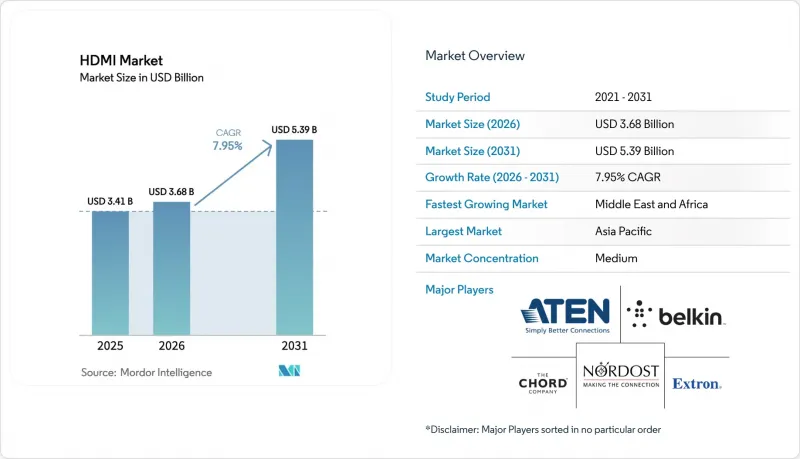
Mordor Intelligence에 의하면, HDMI 시장 규모는 2025년에 34억 1,000만 달러로 평가되었고 2026년 36억 8,000만 달러에서 2031년까지 53억 9,000만 달러에 이를 것으로 예측되며, 예측 기간(2026-2031년) CAGR은 7.95%를 나타낼 전망입니다.
본 보고서는 케이블 유형(표준, 고속 등), 커넥터 유형(유형 A 표준, 유형 B 듀얼 링크 등), HDMI 버전(1.4 이전 등), 용도(TV 및 프로젝터 등), 최종 사용자 산업(가전제품 OEM 등), 유통 채널(OEM 직접 판매, 소매 및 전자상거래), 그리고 지역별로 분류되어 있습니다. 시장 전망은 금액(달러) 기준으로 제시되어 있습니다.
전 세계 HDMI 시장 동향과 인사이트
8K TV의 보급 확대에 따라 울트라 하이 스피드 HDMI 2.1 케이블 수요가 급증
디스플레이 제조업체들이 포트 수를 2개에서 4개의 풀 대역폭 인터페이스로 확대함에 따라, 초고속 케이블이 일반 소매 채널에 보급되고 있습니다. MediaTek사의 'Pentonic 800' 시스템 온 칩(SoC)을 통해 중견 TV 브랜드도 4개의 HDMI 2.1 입력을 지원할 수 있게 되어, 기존의 멀티 디바이스 연결에서 발생하던 병목 현상이 해소되었습니다. 미국 소비자기술협회(CTA)에 따르면, 미국 가정의 4K TV 보급률은 현재 50%를 넘어선 것으로 확인되었으며, 이는 프리미엄 케이블 수요를 뒷받침할 8K로의 교체 주기의 기반을 마련하고 있습니다. 하이센스는 2025년형 모델에 4개의 HDMI 2.1 포트를 탑재해 출시할 것이라고 밝혔으며, 이는 하이엔드 I/O 기능이 일반 시장 부문으로 확산되고 있음을 보여줍니다.
첨단 인포테인먼트 및 ADAS 연결 기능을 통합하는 자동차 제조업체
각 자동차 제조업체는 각각 멀티 기가비트 링크가 필요한 여러 대의 4K 차량용 디스플레이, 제스처 인터페이스, 증강현실(AR) 헤드업 디스플레이를 탑재하고 있습니다. 내환경성이 뛰어난 유형 E HDMI 커넥터는 자동차 업계의 진동 및 온도 기준을 충족하며, 이 폼 팩터의 연평균 성장률(CAGR)을 8.7%로 끌어올리고 있습니다. MIPI A-PHY는 더 강력한 EMI 내성을 제공하지만, HDMI의 광범위한 생태계와 하위 호환성으로 인해 컨소시엄은 차량용 용도를 위한 신뢰성 사양을 강화하기 위한 노력을 추진하고 있습니다.
모바일 및 노트북 분야에서의 USB-C Alt-Mode 채택 확대
USB-C Alt-Mode는 양면 사용이 가능한 커넥터를 통해 4K 영상을 전송하므로, 더 얇은 기기에서 별도의 HDMI 잭을 생략할 수 있게 됩니다. 그러나 4개의 고속 레인을 모두 점유하기 때문에 USB 데이터의 동시 전송이 불가능해지며, HDMI 1.4의 성능 수준을 뛰어넘는 확장성에는 한계가 생깁니다. 업계 관측통들은 특히 전체 대역폭의 HDMI 2.1 출력이 필요한 게이밍 노트북이나 크리에이터용 노트북의 경우, 대체가 아닌 공존이 진행될 것으로 예상하고 있습니다.
부문 분석
2025년, HDMI 시장에서 고속 케이블은 40.65%라는 최대 점유율을 유지하며, 4K TV와 게임기의 막대한 보급 대수를 뒷받침하고 있습니다. 한편, 울트라 하이 스피드는 8K60 및 4K144의 게이밍 요구 사항에 힘입어 연평균 성장률(CAGR) 9.28%로 성장을 주도하고 있습니다. 각 OEM 업체들이 앰프를 사용하지 않고 10m를 넘는 배선 거리를 실현하기 위해 모색하는 가운데, 하이브리드형 액티브 광학 설계가 양산 단계에 접어들고 있으며, 이는 광섬유를 다용하는 아키텍처로의 질적 전환을 시사하고 있습니다.
액티브 광 기술의 혁신으로 전송 용량은 48 Gbps 이상으로 향상되는 동시에 전자기 간섭이 감소합니다. 이는 의료용 영상 진단실이나 방송용 백본에서 필수적인 요소입니다. 앰페놀(Anfenol)사의 100m HDMI 2.0 AOC는 장거리 및 제로 레이턴시 전송의 상업적 타당성을 입증하고 있습니다. 부품 비용의 하락에 따라 액티브 광학 기술은 구리 케이블의 우위를 서서히 잠식하며, 기업 및 방위 분야 설비에서 HDMI 시장의 적용 범위를 확대할 것으로 예측됩니다.
2025년에는 HDMI 시장 규모의 75.92%를 유형 A 커넥터가 차지할 것으로 예상되며, 이는 TV, 셋톱박스, PC 등에 거의 보편적으로 탑재되고 있음을 반영합니다. 진동 및 액체 침투를 방지하는 밀폐 구조를 갖춘 자동차 등급 유형 E는 콕핏의 디지털화가 가속화됨에 따라 2031년까지 연평균 성장률(CAGR) 8.32%로 가장 높은 성장률을 나타낼 것으로 예측됩니다. 미니(유형 C) 및 마이크로(유형 D) 커넥터는 액션 카메라나 싱글 보드 컴퓨터에서 여전히 널리 사용되고 있지만, USB-C의 Alt-Mode와의 통합으로 인한 압박에 직면해 있습니다.
자동차 제조업체들은 주변 온도 125℃ 및 1,000시간의 주기 진동 시험을 통과한 커넥터를 요구하고 있는데, 이는 대부분의 소비자용 HDMI 소켓이 충족할 수 없는 요건입니다. 따라서 AEC-Q100 및 ISO 16750 시험 요건을 충족할 수 있는 공급업체는 가격 면에서 우위를 점하고 있으며, 경쟁 구도는 이 분야에서 탄탄한 실적을 보유한 인터커넥트 전문 기업 쪽으로 기울고 있습니다. 또한, 유형 E의 특수성으로 인해 대체 위험이 낮아졌으며, 광범위한 HDMI 시장에서 견조한 성장이 예상되는 틈새 시장으로서의 입지를 확고히 하고 있습니다.
지역별 분석
2025년에는 중국의 대규모 제조, 일본의 첨단 디스플레이 제조 공장, 그리고 한국의 주요 TV 브랜드를 배경으로 아시아태평양이 전 세계 매출의 38.12%를 차지했습니다. MediaTek 등 지역 반도체 제조업체들이 HDMI 포트의 보급을 가속화하는 한편, 현지 표준화 이니셔티브에서는 해외 지적 재산권에 대한 의존을 피하기 위해 차세대 192 Gbps 인터페이스에 대한 검토가 진행되고 있습니다. 통합된 공급망은 개발 주기를 단축하고 경쟁력 있는 가격 책정을 뒷받침하며, 아시아가 HDMI 시장에서 리더십을 유지하는 데 기여하고 있습니다.
북미에서는 프리미엄 홈 시어터, e스포츠 아레나, 자동차 분야의 혁신에 대한 1인당 지출액이 높은 수준을 유지하고 있습니다. 이에 따라 48 Gbps 초고속 케이블 및 전문가용 매트릭스 스위처 분야에서 평균을 상회하는 평균 판매 가격(ASP)이 실현되고 있습니다. 유럽에서는 규제 준수가 우선시되고 있으며, 스마트 교실용 AV 솔루션에 대한 2억 1,000만 유로 규모의 조달을 통해 단일 케이블 사용 의무화가 공식적으로 규정됨에 따라, 인증 공급업체에 대한 예측 가능한 수요가 확보되고 있습니다.
중동 및 아프리카에서는 스마트 시티, 호텔·관광, 교육 프로젝트에 UHD 사이니지 및 원격 학습 플랫폼이 도입됨에 따라 2031년까지 연평균 성장률(CAGR) 9.41%를 나타낼 것으로 예측됩니다. 걸프협력회의(GCC)의 투자가 대형 행사장에서의 디스플레이 도입을 촉진하는 한편, 아프리카의 통신 인프라 확장이 셋톱박스 보급을 뒷받침하고 있습니다. 남미에서는 브라질을 필두로 꾸준한 보급세가 나타나고 있으나, 환율 변동으로 인해 가전제품 수입이 때때로 억제되기도 합니다.
기타 혜택:
- 엑셀 형식 시장 예측(ME) 시트
- 3개월간의 애널리스트 지원
자주 묻는 질문
목차
제1장 서론
제2장 조사 방법
제3장 주요 요약
제4장 시장 구도
제5장 시장 규모와 성장 예측
제6장 경쟁 구도
제7장 시장 기회와 향후 전망
JHS 26.08.11According to Mordor Intelligence, the HDMI market size was valued at USD 3.41 billion in 2025 and estimated to grow from USD 3.68 billion in 2026 to reach USD 5.39 billion by 2031, at a CAGR of 7.95% during the forecast period (2026-2031).
This report is Segmented by Cable Type (Standard, High-Speed, and More), Connector Type (Type A Standard, Type B Dual-Link, and More), HDMI Version (1. 4 and Earlier, and More), Application (Televisions and Projectors, and More), End-User Industry (Consumer Electronics OEMs, and More), Distribution Channel (OEM Direct, and Retail and E-Commerce), and Geography. The Market Forecasts are Provided in Terms of Value (USD).
Global HDMI Market Trends and Insights
Surge in 8K television adoption requiring Ultra High-Speed HDMI 2.1 cables
Ultra High-Speed cabling is moving into mainstream retail channels as display makers upgrade port counts from two to four full-bandwidth interfaces. MediaTek's Pentonic 800 system-on-chip allows mid-tier TV brands to support four HDMI 2.1 inputs, eliminating prior multi-device bottlenecks. The Consumer Technology Association confirms that 4K sets now exceed 50% penetration in US households, laying the groundwork for an 8K replacement cycle that will reinforce premium cable demand. Hisense has committed to ship 2025 models with four HDMI 2.1 ports, underscoring how high-end I/O is cascading into mass-market segments.
Automakers integrating advanced infotainment and ADAS connectivity
Automotive OEMs are embedding multiple 4K interior displays, gesture interfaces and augmented-reality head-up units that each require multi-gigabit links. Type E ruggedized HDMI connectors meet automotive vibration and temperature standards, propelling an 8.7% CAGR for this form-factor. While MIPI A-PHY offers stronger EMI immunity, HDMI's broad ecosystem and backward compatibility motivate consortium initiatives to tighten reliability specs for in-vehicle deployments.
Rising adoption of USB-C Alt-Mode in mobile & laptop segments
USB-C Alt-Mode transports 4K video over a reversible connector, permitting thinner devices to drop a discrete HDMI jack. Yet it commandeers all four high-speed lanes, precluding simultaneous USB data throughput and capping scalability beyond HDMI 1.4 performance levels. Industry observers expect coexistence rather than replacement, particularly in gaming laptops and creator notebooks that need full-bandwidth HDMI 2.1 outputs.
Other drivers and restraints analyzed in the detailed report include:
- Expansion of e-sports arenas demanding low-latency switchers
- EU mandates for single-cable smart-classroom AV infrastructure
- Copper and rare-earth volatility elevating average selling prices
For complete list of drivers and restraints, kindly check the Table Of Contents.
Segment Analysis
High-Speed cables retained the largest 40.65% share of the HDMI market in 2025, underpinning a sizeable installed base of 4K televisions and consoles. Ultra High-Speed, however, leads growth at a 9.28% CAGR, propelled by 8K60 and 4K144 gaming requirements. Hybrid active-optical designs are entering volume as OEMs seek to exceed 10 m runs without amplifiers, signalling a qualitative shift toward fiber-rich architectures.
Active optical innovation elevates carrying capacity to 48 Gbps and beyond while mitigating electromagnetic interference, essential in medical imaging theatres and broadcast back-bones. Amphenol's 100 m HDMI 2.0 AOC validates the commercial case for long-distance, zero-latency transport. As component costs fall, active optical is expected to erode copper's dominance and broaden the addressable HDMI market across enterprise and defense installations.
Type A connectors accounted for 75.92% of the HDMI market size in 2025, reflecting near-universal integration across TVs, set-top boxes and PCs. Automotive-grade Type E variants, sealed against vibration and fluid ingress, are forecast to record the fastest 8.32% CAGR through 2031 as cockpit digitization accelerates. Mini (Type C) and Micro (Type D) footprints remain common in action cameras and single-board computers but confront pressure from USB-C Alt-Mode convergence.
Vehicle OEMs demand connectors validated to 125 °C ambient and 1,000 h cyclic vibration, hurdles that most consumer-grade HDMI sockets cannot meet. Suppliers capable of meeting AEC-Q100 and ISO 16750 test regimens therefore command pricing premiums, tilting competitive balance toward entrenched interconnect specialists. The specialized nature of Type E also reduces substitution risk, underpinning a defensible growth niche within the broader HDMI market.
Complete Report Scope:
- By Cable Type
- Standard
- High-Speed
- Premium High-Speed
- Ultra High-Speed
- Active Optical
- By Connector Type
- Type A (Standard)
- Type B (Dual-link)
- Type C (Mini)
- Type D (Micro)
- Type E (Automotive)
- By HDMI Version
- 1.4 and Earlier
- 2
- 2.1
- By Application
- Gaming Consoles
- Televisions and Projectors
- Smartphones and Tablets
- Automotive Infotainment Systems
- PCs and Laptops
- Digital Signage and Commercial Displays
- Other Applications
- By End-user Industry
- Consumer Electronics OEMs
- Automotive OEMs and Tier-1s
- Media and Entertainment Venues
- IT and Telecom
- Healthcare
- Industrial and Others
- By Distribution Channel
- OEM Direct
- Retail and E-commerce
- By Geography
- North America
- United States
- Canada
- Mexico
- Europe
- Germany
- United Kingdom
- France
- Nordics
- Rest of Europe
- South America
- Brazil
- Rest of South America
- Asia-Pacific
- China
- Japan
- India
- South-East Asia
- Rest of Asia-Pacific
- Middle East and Africa
- Middle East
- Gulf Cooperation Council Countries
- Turkey
- Rest of Middle East
- Africa
- South Africa
- Rest of Africa
- Middle East
- North America
Geography Analysis
Asia-Pacific contributed 38.12% of global revenue in 2025 on the back of China's scale manufacturing, Japan's advanced display fabs and South Korea's leading TV brands. Regional chip houses such as MediaTek accelerate HDMI port proliferation, while local standards initiatives explore next-generation 192 Gbps interfaces to hedge against foreign IP reliance. Integrated supply chains compress development cycles and underpin competitive pricing, helping Asia maintain leadership in the HDMI market.
North America exhibits high per-capita spending on premium home theater, e-sports arenas and automotive innovation. This translates into above-average ASPs for 48 Gbps Ultra High-Speed cables and professional-grade matrix switchers. Europe prioritizes regulatory compliance; a EUR 210 million procurement for smart-classroom AV solutions formalizes single-cable mandates, ensuring predictable demand for certified vendors.
The Middle East & Africa is projected to chart a 9.41% CAGR through 2031 as smart-city, hospitality and education projects roll out UHD signage and distance-learning platforms. Gulf Cooperation Council investments catalyze large-venue display deployments, while African telecoms expansion stimulates set-top uptake. South America shows steady uptake led by Brazil, although currency volatility occasionally tempers consumer electronics imports.
- Amphenol Corp.
- Aten International Co. Ltd.
- Belkin International Inc.
- CE-Link Ltd.
- Cheng Uei Precision (Foxlink)
- Extron Electronics
- Foxconn Interconnect Technology
- Eaton Corp. plc
- Honeywell Connection (Honeywell Intl.)
- Kramer Electronics
- Koninklijke Philips N.V.
- Nordost Cables
- PureFi Inc.
- Shenzhen DNS Industries Co. Ltd.
- The Chord Company
- Sony Group Corp.
- Luxshare ICT
- Molex LLC
- Legrand AV
- Bizlink Tech.
- Wireworld Cable Tech.
Additional Benefits:
- The market estimate (ME) sheet in Excel format
- 3 months of analyst support
TABLE OF CONTENTS
1 INTRODUCTION
- 1.1 Study Assumptions and Market Definition
- 1.2 Scope of the Study
2 RESEARCH METHODOLOGY
3 EXECUTIVE SUMMARY
4 MARKET LANDSCAPE
- 4.1 Market Overview
- 4.2 Market Drivers
- 4.2.1 Surge in 8K Television Adoption Driving Demand for Ultra-High-Speed HDMI 2.1 Cables in East Asia
- 4.2.2 Automakers' Integration of Advanced Infotainment and ADAS Systems Requiring High-Bandwidth In-vehicle Connectivity
- 4.2.3 Proliferation of eSports Arenas in North America Boosting Professional-grade HDMI Switchers and Extenders
- 4.2.4 Government Mandates in EU for Single-Cable AV Infrastructure in Smart Classrooms
- 4.2.5 Rapid Growth of OTT Set-Top Boxes in South Asia Necessitating Low-cost HDMI Dongles
- 4.2.6 Semiconductor Advancements Enabling Active Optical HDMI Cables for Long-Distance Loss-less Transmission
- 4.3 Market Restraints
- 4.3.1 Rising Adoption of USB-C Alt-Mode Threatening HDMI Ports in Mobile and Laptop Segments
- 4.3.2 Supply-chain Volatility for Copper and Rare-earth Materials Elevating Cable ASPs
- 4.3.3 Thermal Reliability Issues in Automotive Extremes Limiting HDMI Penetration vs MIPI A-PHY
- 4.3.4 IP Royalty Costs for HDMI 2.1 FRL Technology Constraining Small OEM Adoption
- 4.4 Industry Ecosystem Analysis
- 4.5 Technological Outlook
- 4.6 Porter's Five Forces Analysis
- 4.6.1 Bargaining Power of Suppliers
- 4.6.2 Bargaining Power of Consumers
- 4.6.3 Threat of New Entrants
- 4.6.4 Threat of Substitutes
- 4.6.5 Intensity of Competitive Rivalry
5 MARKET SIZE AND GROWTH FORECASTS (VALUES)
- 5.1 By Cable Type
- 5.1.1 Standard
- 5.1.2 High-Speed
- 5.1.3 Premium High-Speed
- 5.1.4 Ultra High-Speed
- 5.1.5 Active Optical
- 5.2 By Connector Type
- 5.2.1 Type A (Standard)
- 5.2.2 Type B (Dual-link)
- 5.2.3 Type C (Mini)
- 5.2.4 Type D (Micro)
- 5.2.5 Type E (Automotive)
- 5.3 By HDMI Version
- 5.3.1 1.4 and Earlier
- 5.3.2 2
- 5.3.3 2.1
- 5.4 By Application
- 5.4.1 Gaming Consoles
- 5.4.2 Televisions and Projectors
- 5.4.3 Smartphones and Tablets
- 5.4.4 Automotive Infotainment Systems
- 5.4.5 PCs and Laptops
- 5.4.6 Digital Signage and Commercial Displays
- 5.4.7 Other Applications
- 5.5 By End-user Industry
- 5.5.1 Consumer Electronics OEMs
- 5.5.2 Automotive OEMs and Tier-1s
- 5.5.3 Media and Entertainment Venues
- 5.5.4 IT and Telecom
- 5.5.5 Healthcare
- 5.5.6 Industrial and Others
- 5.6 By Distribution Channel
- 5.6.1 OEM Direct
- 5.6.2 Retail and E-commerce
- 5.7 By Geography
- 5.7.1 North America
- 5.7.1.1 United States
- 5.7.1.2 Canada
- 5.7.1.3 Mexico
- 5.7.2 Europe
- 5.7.2.1 Germany
- 5.7.2.2 United Kingdom
- 5.7.2.3 France
- 5.7.2.4 Nordics
- 5.7.2.5 Rest of Europe
- 5.7.3 South America
- 5.7.3.1 Brazil
- 5.7.3.2 Rest of South America
- 5.7.4 Asia-Pacific
- 5.7.4.1 China
- 5.7.4.2 Japan
- 5.7.4.3 India
- 5.7.4.4 South-East Asia
- 5.7.4.5 Rest of Asia-Pacific
- 5.7.5 Middle East and Africa
- 5.7.5.1 Middle East
- 5.7.5.1.1 Gulf Cooperation Council Countries
- 5.7.5.1.2 Turkey
- 5.7.5.1.3 Rest of Middle East
- 5.7.5.2 Africa
- 5.7.5.2.1 South Africa
- 5.7.5.2.2 Rest of Africa
- 5.7.5.1 Middle East
- 5.7.1 North America
6 COMPETITIVE LANDSCAPE
- 6.1 Market Concentration
- 6.2 Strategic Moves
- 6.3 Market Share Analysis
- 6.4 Company Profiles (includes Global level Overview, Market level overview, Core Segments, Financials as available, Strategic Information, Market Rank/Share, Products and Services, Recent Developments)
- 6.4.1 Amphenol Corp.
- 6.4.2 Aten International Co. Ltd.
- 6.4.3 Belkin International Inc.
- 6.4.4 CE-Link Ltd.
- 6.4.5 Cheng Uei Precision (Foxlink)
- 6.4.6 Extron Electronics
- 6.4.7 Foxconn Interconnect Technology
- 6.4.8 Eaton Corp. plc
- 6.4.9 Honeywell Connection (Honeywell Intl.)
- 6.4.10 Kramer Electronics
- 6.4.11 Koninklijke Philips N.V.
- 6.4.12 Nordost Cables
- 6.4.13 PureFi Inc.
- 6.4.14 Shenzhen DNS Industries Co. Ltd.
- 6.4.15 The Chord Company
- 6.4.16 Sony Group Corp.
- 6.4.17 Luxshare ICT
- 6.4.18 Molex LLC
- 6.4.19 Legrand AV
- 6.4.20 Bizlink Tech.
- 6.4.21 Wireworld Cable Tech.
7 MARKET OPPORTUNITIES AND FUTURE OUTLOOK
- 7.1 White-space and Unmet-need Assessment