|
시장보고서
상품코드
2100034
금속 및 광업용 시험, 검사 및 인증(TIC) 시장 : 점유율 분석, 업계 동향 및 통계, 성장 예측(2026-2031년)Testing, Inspection, and Certification for the Metals and Minerals Industry - Market Share Analysis, Industry Trends & Statistics, Growth Forecasts (2026 - 2031) |
||||||
 Mordor Intelligence
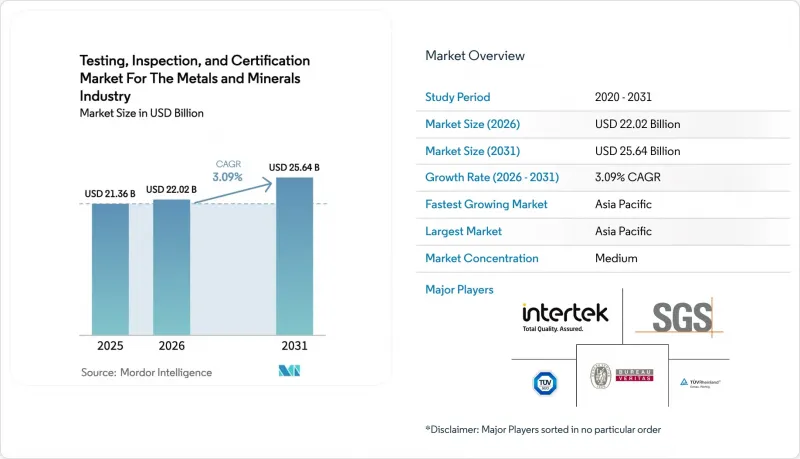
Mordor Intelligence에 의하면, 금속 및 광업용 시험, 검사 및 인증(TIC) 시장 규모는 2025년 213억 6,000만 달러에서 2026년에는 220억 2,000만 달러로 확대되어 2026년부터 2031년까지 CAGR 3.09%로 성장을 지속하여, 2031년에는 256억 4,000만 달러에 이를 것으로 예측됩니다.
본 보고서는 서비스 유형별(시험 서비스, 검사 서비스, 인증 서비스), 조달 형태별(사내 실시 및 외부 위탁), 지역별(북미, 남미, 유럽, 아시아태평양, 중동 및 아프리카)로 분류되어 있습니다. 시장 예측은 금액(달러) 기준으로 제시되어 있습니다.
전 세계 금속 및 광업용 시험, 검사 및 인증(TIC) 시장 동향 및 인사이트
더욱 엄격해진 지속가능성 및 미량 금속 공시 기준
EU의 기업 지속가능성 보고 지침(CSRD)에 따라 현재 5만 개 이상의 기업이 제3자 보증 의무화 대상이 되고 있으며, 광업 기업들은 스코프 3 배출량, 수자원 관리, 생물다양성 조사에 대해 외부 전문가에게 위탁할 수밖에 없는 상황입니다. SGS를 비롯한 주요 서비스 제공업체들은 2024년에 CSRD(지속가능성 보고 지침)에 부합하는 서비스를 확충하여, 지속가능성 검증의 잠재 시장 규모로 추정되는 23억 달러 규모 수요를 확보하고자 하고 있습니다. 기관 투자자들은 생산 기업의 신용등급을 매길 때 이러한 감사 결과를 참고하고 있기 때문에 다국적 광업 기업들은 전 세계 자산에 대해 EU의 가장 엄격한 기준을 따르고 있습니다. 이러한 기준의 통일로 인해 계약 입찰에서 지속가능성 검증은 필수 요건이 되었으며, 사실상 TIC(시험, 검사 및 인증) 수요가 장기 예산에 반영되게 되었습니다. 또한, 감사 주기를 단축하는 동시에 규제 당국 및 금융 기관을 대상으로 위조가 불가능한 데이터 세트를 제공하는 디지털 체인 오브 카스투디(Digital Chain of Custody) 도구의 도입도 가속화되고 있습니다. 지역별 ESG 규제가 통합됨에 따라, 금속 및 광업 분야 시험, 검사 및 인증 부문에서는 전문적인 환경 분석에 대한 수수료가 꾸준히 상승하고 있습니다.
배터리용 금속에 대한 하류 수요 증가
전기차(EV) OEM 제조업체와 배터리 제조업체들은 리튬, 니켈, 희토류 원소의 불순물 허용치를 더욱 엄격하게 적용하고 있으며, 업스트림 공급업체들에게 99.5% 이상의 순도와 ppm 미만의 오염 물질 수준을 입증할 것을 요구하고 있습니다. 테슬라의 2024년 조달 규정에서는 모든 중요 광물 로트에 대한 독립적인 검증을 의무화하고 있는 반면, CATL은 양극재의 내구성을 확보하기 위해 미량 원소의 완전한 프로파일을 요구하고 있습니다. 이러한 엄격해진 사양에 따라 TIC(시험, 검사 및 인증) 연구소 내에서는 첨단 ICP-OES, 질량 분석, 레이저 어블레이션 프로그램이 전개될 뿐만 아니라, 전고체 배터리 및 나트륨 이온 배터리에 맞춤화된 표준 물질도 개발되고 있습니다. 서비스 제공업체는 신속한 납기 보장을 부가가치로 제공함으로써 수익화를 도모하고 있으며, 이를 통해 광산 기업은 더 높은 이익률을 보장하는 오프테이크 계약을 확보할 수 있게 되었습니다. 이와 병행하여 배터리 재활용 업체들도 블랙매스(흑연) 투입 스트림에 대해 유사한 프로토콜을 채택하고 있으며, 이로 인해 금속 및 광물 산업 분야의 시험, 검사, 인증 범위가 더욱 확대되고 있습니다.
원자재 가격 변동
가격의 급격한 변동은 탐사 예산에 영향을 미쳐, 시추 작업의 연기나 필수적이지 않은 분석의 축소로 이어지고 있습니다. 구리 가격은 2024년 1분기부터 4분기에 걸쳐 23% 하락했으며, 프보고서 맥모란(Freeport-McMoRan)사는 수익성이 낮은 광산에서의 시료 채취를 축소할 수밖에 없게 되었습니다. 이와 유사한 축소 추세는 계약업체인 검사 기관에도 파급되어 가동률을 저하시키고 이익률을 압박하고 있습니다. 서비스 제공업체들은 성과 기반 계약을 체결하고, 광산 회사가 호황기에 서비스를 확대할 수 있는 모듈식 서비스 계층을 제공함으로써 위험을 헤지하고 있습니다. 가격 변동으로 인해 단기적인 처리량은 감소하겠지만, 규정 준수를 위해 필수적인 시험은 여전히 불가피하며, 이는 금속 및 광업용 시험, 검사 및 인증(TIC) 시장의 하방 리스크를 완화하고 있습니다.
부문 분석
시험 서비스는 2025년 매출의 61.84%를 차지하며, 필수적인 품위 관리 및 환경 모니터링 의무를 통해 금속 및 광업용 시험, 검사 및 인증(TIC) 시장 규모를 뒷받침하고 있습니다. 철광석, 구리, 금에 대한 대량 분석은 자동화가 진행되고 있음에도 불구하고 계속되고 있습니다. 이는 규제 당국이 수출 허가나 로열티 산정을 위해 외부 기관이 검증한 데이터를 요구하기 때문입니다. 인증 서비스는 규모는 작지만, 하류 구매자들이 ESG 인증이나 블록체인을 통한 원산지 증명을 강력히 요구함에 따라 연평균 성장률(CAGR) 3.72%로 확대되고 있습니다. 각 제공업체는 탄소 중립 광산 라벨, 책임 있는 조달 감사, ISO 14067에 기반한 탄소 발자국을 패키지로 묶어 프로젝트별 계약 규모를 확대되고 있습니다. 검사 서비스는 컨베이어, 광미 댐, 철도 화차의 건전성 검사가 의무화되어 있는 점에 힘입어 안정적인 중간 위치를 차지하고 있습니다. 로봇 기술을 활용한 시각 검사 도구나 드론을 이용한 사진 측량 기술은 검사의 부가가치를 높이는 동시에 작업자의 위험 노출을 줄이고 있습니다.
분석 서비스는 분석 빈도가 광체의 경제성을 결정짓는 벌크 상품 생산 지역에서 여전히 지배적인 지위를 유지하고 있습니다. 그러나 인증 서비스는 그 산출물에 대해 프리미엄 가격이 책정되고 지적 재산(IP)의 비중도 높기 때문에 이익률 동향을 좌우하게 될 것입니다. 예측 기간 동안, 화학 분석과 탄소 회계 검증을 융합한 통합 솔루션으로 인해 업계의 경계가 모호해지면서, 서비스 제공업체는 기존 분석 서비스 고객을 대상으로 인증 모듈의 업셀링이 가능해질 것입니다. 광산 사업자에게 있어 단일 공급업체의 서비스는 규정 준수 절차를 간소화하고, 금속 및 광업용 시험, 검사 및 인증(TIC) 분야 전반에 걸쳐 고객 유지율을 높일 것입니다.
지역별 분석
아시아태평양은 2025년에 전 세계 매출의 38.42%를 차지하며 연평균 성장률(CAGR) 3.76%로 성장하고 있으며, 이는 모든 지역 중 가장 높은 성장률입니다. 중국 내 희토류 처리 시설만 해도 엄격한 폐수 및 방사성 핵종 관련 규제의 영향으로 연간 32억 달러가 넘는 TIC 수요를 창출하고 있습니다. 인도네시아의 니켈 HPAL 프로젝트 급증과 호주의 성숙한 철광산이 지속적인 분석 물량을 늘리고 있어, 이 지역은 금속 및 광업용 시험, 검사 및 인증(TIC) 시장의 핵심 동력이 되고 있습니다. SGS와 같은 다국적 기업들은 RTI Laboratories와 같은 기업을 인수하여 사업 기반을 강화하고, 지역 고객들이 배터리용 금속에 대한 전문 지식을 쉽게 활용할 수 있도록 지원하고 있습니다.
북미에서는 EPA(미국 환경보호청) 및 MSHA(광산 안전보건국)의 엄격한 규제 체계에 힘입어 견조한 수요가 유지되고 있습니다. 캐나다의 광산 기업들은 첨단 부유법 및 습식 야금 공정을 채택하고 있으며, 이를 위해서는 복잡한 광물학적 시험이 필수적입니다. 그러나 인력 부족으로 인해, 특히 단일 광산에서는 투자 타당성을 입증하기 어려운 고처리량 자동화 설비의 경우 외부 검사 기관에 대한 의존도가 높아지고 있습니다. 이러한 아웃소싱 추세 덕분에 상품 주기의 변동에 따라 탐사량이 좌우되는 상황에서도 안정적인 수익을 확보하고 있습니다. 한편, 디지털 트윈, AI를 활용한 공정 제어, 실시간 센서 융합이 미국의 각 광산에서 보급되고 있어, TIC 제공업체에게는 컨설팅이나 교정과 같은 부가 서비스의 기회가 확대되고 있습니다.
유럽에서는 CSRD(광물 자원 공시 규정)의 광범위한 공시 요건을 계기로 그 기세가 더욱 거세지고 있습니다. EU 역외에서 EU 역내로 수출을 하는 비EU 생산자조차도 EU의 보고 템플릿을 채택하고 있으며, 이는 아프리카와 남미로 파급되는 수요를 창출하고 있습니다. 중동 및 아프리카에서는 에너지 전환에 따른 공급 부족을 배경으로 구리, 리튬, 인산염의 신규 개발 프로젝트를 통해 생산량이 증가하고 있습니다. TIC 기업들은 현지 파트너십을 활용하여 정부의 현지 조달 요건을 충족하는 동시에, 세계 품질 보증(QA) 프로토콜을 도입하고 있습니다. 이러한 동향은 지역별 교차 판매 기회를 뒷받침할 뿐만 아니라, 금속 및 광업용 시험, 검사 및 인증(TIC) 분야의 수익 구조 다각화를 더욱 공고히 하고 있습니다.
기타 혜택:
- 엑셀 형식 시장 예측(ME) 시트
- 3개월간의 애널리스트 지원
자주 묻는 질문
목차
제1장 서론
제2장 조사 방법
제3장 주요 요약
제4장 시장 구도
제5장 시장 규모와 성장 예측
제6장 경쟁 구도
제7장 시장 기회와 향후 전망
JHS 26.08.11According to Mordor Intelligence, the testing, inspection, and Certification market size for the metals and minerals industry is expected to grow from USD 21.36 billion in 2025 to USD 22.02 billion in 2026 and is forecast to reach USD 25.64 billion by 2031 at 3.09% CAGR over 2026-2031.
This report is Segmented by Service Type (Testing Services, Inspection Services, and Certification Services), Sourcing Type (In-House and Outsourced), and Geography (North America, South America, Europe, Asia-Pacific, and the Middle East and Africa). The Market Forecasts are Provided in Terms of Value (USD).
Global Testing, Inspection, and Certification for the Metals and Minerals Industry Trends and Insights
Stricter Sustainability and Trace-Metal Disclosure Norms
The EU Corporate Sustainability Reporting Directive now subjects more than 50,000 firms to mandatory third-party assurance, compelling miners to commission external experts for Scope 3 emissions, water stewardship, and biodiversity studies. Major providers, notably SGS, broadened CSRD-aligned services in 2024 to tap an estimated USD 2.3 billion addressable pool for sustainability verification. Institutional investors reference these audits when ranking producers, so mining multinationals replicate the strictest EU formats across global assets. This harmonization makes sustainability testing non-negotiable in contract bidding, effectively locking TIC demand into long-term budgets. It also accelerates the uptake of digital chain-of-custody tools that shorten audit cycles while providing immutable data sets for regulators and financiers. As regional ESG statutes converge, the Testing, Inspection, and Certification for the Metals and Minerals Industry registers stable fee escalations for specialized environmental assays.
Rising Downstream Demand for Battery-Grade Metals
Electric-vehicle OEMs and battery makers tighten impurity thresholds for lithium, nickel, and rare earths, forcing upstream suppliers to prove 99.5% plus purity and sub-ppm contaminant levels. Tesla's 2024 procurement code mandates independent verification of every critical-mineral batch, while CATL requires full trace-element profiles to ensure cathode longevity. These stricter specifications spawn advanced ICP-OES, mass-spectrometry, and laser-ablation programs within TIC labs, alongside tailored reference materials for solid-state and sodium-ion chemistries. Providers monetise premium turnaround guarantees, enabling miners to secure higher-margin offtake agreements. In parallel, battery recyclers employ identical protocols for black-mass input streams, further broadening the Testing, Inspection, and Certification for the Metals and Minerals Industry.
Volatility in Commodity Prices
Sharp price swings alter exploration budgets, deferring drilling campaigns and cut-backs in non-essential assays. Copper slid 23% between Q1 and Q4 2024, prompting Freeport-McMoRan to scale back sampling in marginal pits. Similar retrenchment cascades through contractor labs, eroding utilisation rates and pressuring margins. Providers hedge by structuring output-based contracts and offering modular service tiers that miners can ramp up in bullish cycles. Although volatility curtails near-term volumes, compliance-critical testing remains obligatory, cushioning downside exposure for the Testing, Inspection, and Certification Market for Metals and Minerals Industry.
Other drivers and restraints analyzed in the detailed report include:
- Consolidation of Global Mining Supply Chains
- Digitalization of On-Site Laboratories
- Shortage of Certified Laboratory Professionals
For complete list of drivers and restraints, kindly check the Table Of Contents.
Segment Analysis
Testing Services accounted for 61.84% of 2025 revenue, anchoring the Testing, Inspection, and Certification Market for Metals and Minerals Industry market size through indispensable grade-control and environmental monitoring obligations. High-volume assays for iron ore, copper, and gold continue despite automation because regulators require externally validated data for export permits and royalty calculations. Certification Services, although smaller, is expanding at a 3.72% CAGR as downstream buyers insist on ESG credentials and blockchain-verified provenance. Providers package carbon-neutral mine labels, responsible-sourcing audits, and ISO 14067 footprints, raising ticket sizes per engagement. Inspection Services occupies a steady middle ground, supported by mandatory conveyor, tailings dam, and rail-wagon integrity checks. Robotics-enabled visual tools and drone-based photogrammetry enrich inspection value propositions and mitigate workforce hazard exposure.
Testing's dominance endures in bulk-commodity jurisdictions where assay density defines ore-body economics. Yet certification will shape margin dynamics because its deliverables command premium pricing and entail higher IP content. Over the forecast period, integrated solutions blending chemical assays with carbon-accounting verification will blur boundaries, allowing providers to upsell certification modules to existing testing clients. For miners, a single supplier simplifies compliance, bolstering stickiness across the Testing, Inspection, and Certification for the Metals and Minerals Industry.
Complete Report Scope:
- By Service Type
- Testing Services
- Inspection Services
- Certification Services
- By Sourcing Type
- In-house
- Outsourced
- By Geography
- North America
- United States
- Canada
- Mexico
- South America
- Brazil
- Argentina
- Rest of South America
- Europe
- Germany
- United Kingdom
- France
- Italy
- Spain
- Rest of Europe
- Asia-Pacific
- China
- Japan
- India
- South Korea
- South-East Asia
- Rest of Asia-Pacific
- Middle East and Africa
- Middle East
- Saudi Arabia
- United Arab Emirates
- Turkey
- Rest of Middle East
- Africa
- South Africa
- Nigeria
- Rest of Africa
- Middle East
- North America
Geography Analysis
Asia-Pacific held 38.42% of global revenue in 2025 and is growing at a 3.76% CAGR, the quickest among all regions. China's rare-earth processing complex alone generates over USD 3.2 billion in annual TIC demand, driven by stringent wastewater and radionuclide regulations. Indonesia's surge in nickel HPAL projects and Australia's mature iron-ore mines add continuous assay volumes, making the region the core engine for the Testing, Inspection, and Certification Market for Metals and Minerals Industry. Multinationals such as SGS buttress their footprint through acquisitions like RTI Laboratories, ensuring ready access to battery-metal expertise for regional clients.
North America maintains a strong demand anchored in rigorous EPA and MSHA frameworks. Canadian miners leverage high-tech flotation and hydrometallurgical flowsheets that necessitate intricate mineralogical testing. Labor shortages, however, tip the balance toward external labs, especially for high-throughput automation investments that single mines cannot justify. This outsourcing trend ensures stable revenue even as commodity cycles sway exploration volumes. Meanwhile, digital twins, AI-assisted process control, and real-time sensor fusion proliferate across U.S. sites, opening consultancy and calibration add-ons for TIC providers.
Europe gains momentum from the CSRD's far-reaching disclosure requirements. Even non-EU producers exporting into the bloc adopt EU reporting templates, creating spill-over demand into Africa and South America. The Middle East and Africa contribute rising volumes via greenfield copper, lithium, and phosphate ventures, spurred by energy-transition supply deficits. TIC companies harness local partnerships to align with governmental content mandates while importing global QA protocols. Together, these dynamics confirm geography-based opportunities for cross-selling and reinforce the diversified revenue profile of the Testing, Inspection, and Certification for the Metals and Minerals Industry.
- SGS SA
- Bureau Veritas SA
- Intertek Group plc
- ALS Limited
- TUV SUD AG
- TUV Rheinland AG
- Applus+ Servicios Tecnologicos SL
- Eurofins Scientific SE
- Element Materials Technology Group Ltd
- Kiwa NV
- CCIC (China Certification and Inspection Group)
- Cotecna Inspection SA
- DNV AS
- Mistras Group Inc.
- LGC Standards Ltd
- Alex Stewart International Corporation
- Inspectorate International Ltd
- QIMA Ltd
- Mitra SK Testing Services
- Core Laboratories NV
- Scientific and Technical Services Limited
- Peterson and Control Union BV
- CSA Group
- Bureau of Veritas Minerals (AcmeLabs)
Additional Benefits:
- The market estimate (ME) sheet in Excel format
- 3 months of analyst support
TABLE OF CONTENTS
1 INTRODUCTION
- 1.1 Study Assumptions and Market Definition
- 1.2 Scope of the Study
2 RESEARCH METHODOLOGY
3 EXECUTIVE SUMMARY
4 MARKET LANDSCAPE
- 4.1 Market Overview
- 4.2 Market Drivers
- 4.2.1 Consolidation of global mining supply chains
- 4.2.2 Stricter sustainability and trace-metal disclosure norms
- 4.2.3 Rising downstream demand for battery-grade metals
- 4.2.4 Digitalisation of on-site laboratories
- 4.2.5 Blockchain-enabled provenance audits
- 4.2.6 Geo-political resource nationalism
- 4.3 Market Restraints
- 4.3.1 Volatility in commodity prices
- 4.3.2 Shortage of certified laboratory professionals
- 4.3.3 Consolidation of mining majors reduces vendor count
- 4.3.4 Emerging in-pit real-time sensors bypassing traditional labs
- 4.4 Industry Value Chain Analysis
- 4.5 Impact of Macroeconomic Factors
- 4.6 Regulatory Landscape
- 4.7 Technological Outlook
- 4.8 Porter's Five Forces Analysis
- 4.8.1 Threat of New Entrants
- 4.8.2 Bargaining Power of Suppliers
- 4.8.3 Bargaining Power of Buyers
- 4.8.4 Threat of Substitutes
- 4.8.5 Competitive Rivalry
5 MARKET SIZE AND GROWTH FORECASTS (VALUE)
- 5.1 By Service Type
- 5.1.1 Testing Services
- 5.1.2 Inspection Services
- 5.1.3 Certification Services
- 5.2 By Sourcing Type
- 5.2.1 In-house
- 5.2.2 Outsourced
- 5.3 By Geography
- 5.3.1 North America
- 5.3.1.1 United States
- 5.3.1.2 Canada
- 5.3.1.3 Mexico
- 5.3.2 South America
- 5.3.2.1 Brazil
- 5.3.2.2 Argentina
- 5.3.2.3 Rest of South America
- 5.3.3 Europe
- 5.3.3.1 Germany
- 5.3.3.2 United Kingdom
- 5.3.3.3 France
- 5.3.3.4 Italy
- 5.3.3.5 Spain
- 5.3.3.6 Rest of Europe
- 5.3.4 Asia-Pacific
- 5.3.4.1 China
- 5.3.4.2 Japan
- 5.3.4.3 India
- 5.3.4.4 South Korea
- 5.3.4.5 South-East Asia
- 5.3.4.6 Rest of Asia-Pacific
- 5.3.5 Middle East and Africa
- 5.3.5.1 Middle East
- 5.3.5.1.1 Saudi Arabia
- 5.3.5.1.2 United Arab Emirates
- 5.3.5.1.3 Turkey
- 5.3.5.1.4 Rest of Middle East
- 5.3.5.2 Africa
- 5.3.5.2.1 South Africa
- 5.3.5.2.2 Nigeria
- 5.3.5.2.3 Rest of Africa
- 5.3.5.1 Middle East
- 5.3.1 North America
6 COMPETITIVE LANDSCAPE
- 6.1 Market Concentration
- 6.2 Strategic Moves
- 6.3 Market Share Analysis
- 6.4 Company Profiles (includes Global level Overview, Market level overview, Core Segments, Financials as available, Strategic Information, Market Rank/Share for key companies, Products and Services, and Recent Developments)
- 6.4.1 SGS SA
- 6.4.2 Bureau Veritas SA
- 6.4.3 Intertek Group plc
- 6.4.4 ALS Limited
- 6.4.5 TUV SUD AG
- 6.4.6 TUV Rheinland AG
- 6.4.7 Applus+ Servicios Tecnologicos SL
- 6.4.8 Eurofins Scientific SE
- 6.4.9 Element Materials Technology Group Ltd
- 6.4.10 Kiwa NV
- 6.4.11 CCIC (China Certification and Inspection Group)
- 6.4.12 Cotecna Inspection SA
- 6.4.13 DNV AS
- 6.4.14 Mistras Group Inc.
- 6.4.15 LGC Standards Ltd
- 6.4.16 Alex Stewart International Corporation
- 6.4.17 Inspectorate International Ltd
- 6.4.18 QIMA Ltd
- 6.4.19 Mitra SK Testing Services
- 6.4.20 Core Laboratories NV
- 6.4.21 Scientific and Technical Services Limited
- 6.4.22 Peterson and Control Union BV
- 6.4.23 CSA Group
- 6.4.24 Bureau of Veritas Minerals (AcmeLabs)
7 MARKET OPPORTUNITIES AND FUTURE OUTLOOK
- 7.1 White-space and Unmet-Need Assessment

(주말 및 공휴일 제외)


