|
시장보고서
상품코드
2100035
지속적 양압 호흡(CPAP) 기기 시장 : 점유율 분석, 업계 동향 및 통계, 성장 예측(2026-2031년)Continuous Positive Airway Pressure (CPAP) Devices - Market Share Analysis, Industry Trends & Statistics, Growth Forecasts (2026 - 2031) |
||||||
 Mordor Intelligence
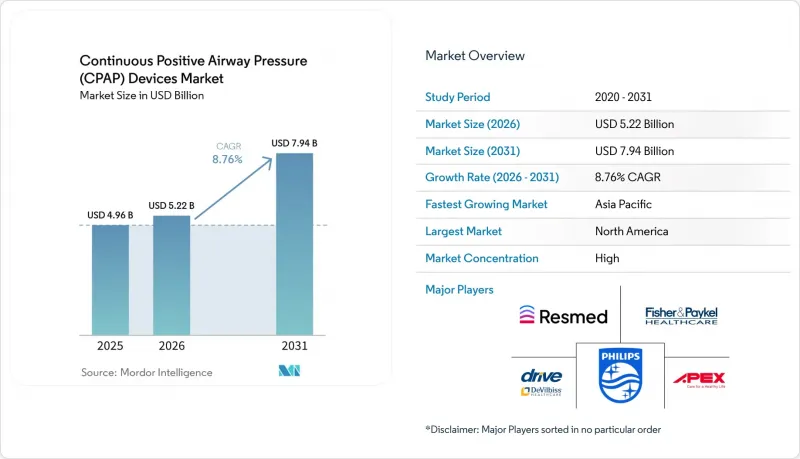
Mordor Intelligence에 의하면, 지속적 양압 호흡(CPAP) 기기 시장 규모는 2025년 49억 6,000만 달러에서 2026년에는 52억 2,000만 달러로 확대되어 2031년까지 79억 4,000만 달러에 이를 것으로 예상되고 있어 2026년부터 2031년까지 CAGR 8.76%로 성장할 전망입니다.
본 보고서는 제품 유형(CPAP 기기(정압식 CPAP 등), 액세서리(마스크 등)), 착용 방식(코용 마스크, 코용 필로우 마스크, 풀페이스 마스크, 구강용 마스크), 최종 사용자(재택 치료 환경 등), 판매 채널(오프라인, 온라인), 지역(북미 등)별로 분류되어 있습니다. 시장 전망은 금액(달러) 기준으로 제시되어 있습니다.
전 세계 지속적 양압 호흡(CPAP) 장치 시장 동향 및 인사이트
가정 내 수면 무호흡증 치료에 대한 보험 급여 전환
현재 보험사의 정책에 따라 자금 배분이 야간 수면 다원 검사에서 재택 타이테이션으로 전환되고 있으며, 이는 환자 1인당 진단 비용을 최대 60% 절감하는 동시에 의료 서비스가 미치지 않는 지역의 접근성을 확대되고 있습니다. 2024년, 메디케어는 자동 타이레이션 기기에 대한 사전 승인 요건을 철폐했으며, 이러한 움직임은 주요 민간 보험사들도 신속하게 따랐습니다. 의심 단계부터 처방까지의 과정이 합리화되면서 기기 보급은 가속화되고 있지만, 메디케어의 부활한 경쟁 입찰 체계 하에서 경쟁하는 공급업체들의 이익률은 압박받고 있습니다. 재향군인 보건국(VHA)은 원격 조정과 실시간 모니터링을 결합한 원격 수면 프로그램에 2만 명 이상의 수혜자를 등록함으로써 이 모델을 대규모로 입증했습니다. 이러한 정책들이 맞물리면서, 재택 치료 개시에 대응하는 휴대용 기기에 대한 수요가 재편되고 있습니다.
비만과 관련된 폐쇄성 수면 무호흡증(OSA) 유병률 증가
세계 비만율은 계속 상승하고 있으며, 세계보건기구(WHO)의 추산에 따르면 현재 9억 3,600만 명 이상의 성인이 OSA의 임상적 기준을 충족하고 있어 2019년 대비 15% 증가했습니다. 미국에서는 2024년에 성인의 42.4%가 비만으로 분류되었으며, 체질량 지수(BMI)와 무호흡의 중증도 사이에 직접적인 연관성이 확인되었습니다. 걸프협력회의(GCC) 회원국에서는 비만 유병률이 35% 이상의 것으로 보고되고 있으며, 이로 인해 해당 지역의 수면무호흡증 발생률이 더욱 높아지고 있습니다. 진단 건수는 증가하고 있지만, 대부분 시장에서 치료를 받고 있는 환자는 20% 미만에 그치고 있어, 각 제조업체들은 소비자 대상 광고 및 체중 관리 파트너십을 통해 이 큰 치료 격차를 해소하고자 하고 있습니다. 약물을 이용한 체중 감량 요법으로 인해 향후 의료기기에 대한 의존도는 낮아지겠지만, 현재의 처방 동향을 보면 광범위한 지속적 양압 호흡(CPAP) 기기 시장에서 중기적으로는 CPAP에 대한 수요가 지속될 것으로 보입니다.
빈번한 의료기기 리콜과 공급망 혼란
Philips의 ‘드림 스테이션’ 리콜에서는 방음 폼의 열화를 이유로 2021년부터 2024년까지 1,500만 대 이상이 회수되었습니다. Philips는 2024년 4월 11억 달러의 합의금을 지급하기로 합의했으며, 현재는 독립적인 감독을 의무화하는 합의 명령 하에 사업을 운영하고 있어 신제품 출시가 지연되고 있습니다. 이 사태는 부품 조달의 취약성을 여실히 드러냈으며, 경쟁사들이 공급망 감사를 실시하도록 촉발했습니다. 반도체 부족과 운임 급등이 혼란을 가중시키며, 수직 통합이 미흡한 중견 제조업체들을 압박하고 있습니다. 규제 당국의 감시 강화는 업계 전반에 걸쳐 규정 준수 비용을 상승시키고, 개발 기간을 장기화시키고 있습니다.
부문 분석
액세서리 부문은 2025년 매출의 36.48%를 차지하며, 연평균 성장률(CAGR) 11.46%로 확대되고 있습니다. 이는 기기 부문의 성장률 8.76%를 크게 상회하는 수치입니다. 필터, 튜브, 마스크는 정기적인 교체가 필요하기 때문에 구독형 서비스와 같은 현금 흐름을 창출하며, 하드웨어 수요의 주기성을 완화하고 있습니다. 자동 조절 기능이 탑재된 장치는 편의성 측면에서 지지를 얻고 있지만, 바이레벨 방식의 기기는 가격이 비싸기 때문에 여전히 틈새 시장 수준에 머물러 있습니다. ISO 80601-2-70 규격 준수 및 FDA의 심사 절차 강화로 인해 신규 진출기업의 진입 장벽이 높아지고 있습니다.
CPAP 기기 시장에서의 점유율 1위 자리는 여전히 흔들림이 없으나, 각 제조업체는 하류 부문인 액세서리 판매를 확보하기 위해 하드웨어에 대한 보조금을 증액하는 경향을 보이고 있습니다. CPAP 기기용 액세서리 시장 규모는 예측 기간 동안 12억 달러 증가할 것으로 예상되며, 이는 밸류체인 전반에 걸친 매출 총이익률 향상으로 이어질 것으로 전망됩니다.
2025년에는 비강용 마스크가 인터페이스 매출의 44.26%를 차지했으나, 비강 베개형 마스크는 증가분 매출에서 최대 점유율을 차지하며 연평균 성장률(CAGR) 10.57%로 확대될 것으로 예측됩니다. 경량 구조와 얼굴에 밀착되는 면적의 감소로 인해 밀폐 공포감이 완화되고, 치료 순응도가 향상됩니다. 구강 호흡자에게는 풀페이스 마스크가 여전히 필수적이지만, 누출 문제에 직면해 있어 이는 설계 혁신을 촉진하고 있습니다.
편안함의 향상은 치료 중단을 줄이기 위한 핵심 요소입니다. 환자들이 더 소형화된 인터페이스로 전환함에 따라, CPAP 기기 시장에서는 절대적인 성장보다는 대체 수요가 예상되지만, 고가 제품군과 짧은 교체 주기가 매출을 끌어올리고 있습니다. CPAP 기기 업계에서는 착용감과 소음 저감을 통해 차별화를 꾀하는 인터페이스 공급업체 간의 경쟁이 격화될 전망입니다.
지역별 분석
북미는 2025년 매출의 34.54%를 차지할 것으로 예상되며, 메디케어 적용 범위 확대, 견고한 의료용 내구기기 네트워크, 그리고 재향군인 보건국(VA)이 2만 명 이상의 환자를 대상으로 실시한 텔레-슬립(Tele-Sleep) 등록이 이를 뒷받침하고 있습니다. Philips의 리콜은 해당 지역 내 신뢰를 흔들었지만, 동시에 레스메드(ResMed)와 피셔 앤 페이켈(Fisher & Paykel)에게는 시장 점유율 확대의 기회를 제공했습니다. 그러나 경쟁 입찰로 인해 소규모 판매업체들은 압박을 받고 있으며, 판매 대수 증가세는 둔화되고 있습니다. 미국의 지속적 양압 호흡(CPAP) 기기 시장은 여전히 지역 수요에서 가장 큰 비중을 차지하고 있습니다.
유럽이 2위를 차지하고 있으며, 독일, 프랑스, 영국이 국민건강보험 제도와 엄격한 품질 기준을 바탕으로 수요를 주도하고 있습니다. 독일에서는 본인 부담금을 최소화하여 기기 비용을 환급받는 반면, 프랑스에서는 2024년에 가이드라인을 개정하여 자동 조절 기능을 우선시하는 방침을 내놨습니다. 남유럽 국가들은 치료 보급률에서 뒤처져 있지만, 그 격차를 줄이기 위해 수면 의학 인프라 구축에 투자를 진행하고 있습니다.
아시아태평양은 성장의 원동력이며, 연평균 성장률(CAGR)은 10.36%로 예측됩니다. 한국에서는 국민건강보험의 확대를 통해 2030년까지 150만 명의 치료 대상자를 목표로 하고 있습니다. 중국 기업들은 국내외에 300달러 미만의 기기를 공급하고 있지만, 품질에 대한 우려로 인해 프리미엄 부문으로의 진출은 제한적입니다. 인도의 도시 지역에서는 원격 수면 진단이 도입되고 있으며, 호주에서는 고령화가 진행되고 있음에도 이동성이 높은 인구층 사이에서 꾸준한 기기 교체 수요가 나타나고 있습니다.
기타 혜택:
- 엑셀 형식 시장 예측(ME) 시트
- 3개월간의 애널리스트 지원
자주 묻는 질문
목차
제1장 서론
제2장 조사 방법
제3장 주요 요약
제4장 시장 구도
제5장 시장 규모와 성장 예측
제6장 경쟁 구도
제7장 시장 기회와 향후 전망
JHS 26.08.11According to Mordor Intelligence, the continuous positive airway pressure devices market size is expected to increase from USD 4.96 billion in 2025 to USD 5.22 billion in 2026 and reach USD 7.94 billion by 2031, growing at a CAGR of 8.76% over 2026-2031.
This report is Segmented by Product Type (CPAP Devices [Fixed-Pressure CPAP and More], Accessories [Masks and More]), Interface (Nasal Mask, Nasal Pillow Mask, Full-Face Mask, Oral Mask), End-User (Homecare Settings, and More), Distribution Channel (Offline, Online), and Geography (North America, and More). The Market Forecasts are Provided in Terms of Value (USD).
Global Continuous Positive Airway Pressure (CPAP) Devices Market Trends and Insights
Reimbursement Shift Toward Home-Based Sleep Apnea Treatment
Payer policies now direct funding away from overnight polysomnography toward in-home titration, cutting per-patient diagnostic costs by up to 60% while expanding access in underserved areas. In 2024 Medicare dropped prior-authorization hurdles for auto-titrating units, a move quickly mirrored by large private insurers. The streamlined path from suspicion to prescription accelerates device uptake but compresses margins for suppliers competing under Medicare's revived competitive-bidding framework. The Veterans Health Administration proved the model at scale by enrolling more than 20,000 beneficiaries into a tele-sleep program that pairs remote titration with real-time monitoring. Together, these policies have reshaped demand toward portable devices configured for at-home initiation.
Rising Prevalence of Obesity-Linked Obstructive Sleep Apnea
Global obesity rates continue to climb; the World Health Organization now estimates more than 936 million adults meet clinical thresholds for OSA, up 15% since 2019. In the United States, 42.4% of adults were classified as obese in 2024, creating a direct link between body-mass index and apnea severity. Gulf Cooperation Council states report obesity prevalence above 35%, compounding regional sleep-apnea incidence. Despite rising diagnoses, fewer than 20% of patients in most markets receive therapy, leaving a sizeable treatment gap manufacturers target through consumer advertising and weight-management partnerships. Pharmacological weight-loss therapies will eventually taper device reliance, yet current prescription trends indicate sustained CPAP demand over the medium term across the broader positive air pressure device market.
Frequent Device Recalls and Supply-Chain Disruptions
The Philips DreamStation recall withdrew more than 15 million units between 2021 and 2024 because of degrading sound-abatement foam. Philips agreed to a USD 1.1 billion settlement in April 2024 and now operates under a consent decree that mandates independent oversight, slowing new product launches. The episode highlighted vulnerabilities in component sourcing and spurred competitors to audit supply chains. Semiconductor shortages and elevated freight costs compounded the disruption, squeezing mid-tier manufacturers lacking vertical integration. Heightened regulatory scrutiny raises compliance costs industry-wide and lengthens development timelines.
Other drivers and restraints analyzed in the detailed report include:
- Post-COVID Tele-Sleep Programs Accelerating CPAP Adoption
- Introduction of Ultra-Quiet Micro-Blowers Enabling Travel-Size CPAPs
- Patient Non-Adherence Due to Mask Discomfort and Claustrophobia
For complete list of drivers and restraints, kindly check the Table Of Contents.
Segment Analysis
The accessories segment generated 36.48% of 2025 revenue and is expanding at 11.46% CAGR, well above the 8.76% growth for devices. Filters, tubing, and masks require regular replacement, creating subscription-like cash flows that soften cyclicality in hardware demand. Auto-titrating units are gaining favor for their comfort advantages, while bilevel machines remain niche due to higher prices. Compliance with ISO 80601-2-70 standards and stricter FDA review processes elevate entry barriers for newcomers.
CPAP devices market share leadership in devices remains intact, yet manufacturers increasingly subsidize hardware to secure downstream accessory sales. The CPAP devices market size for accessories is projected to add USD 1.2 billion during the forecast, lifting gross-margin profiles across the value chain.
Nasal masks retained 44.26% interface revenue in 2025, but nasal-pillow masks are projected to capture the highest share of incremental sales, expanding at 10.57% CAGR. Lightweight construction and reduced facial coverage ease claustrophobia and improve adherence. Full-face masks remain essential for mouth breathers yet face leakage challenges that spur design innovation.
Improved comfort is key to reducing abandonment. As patients shift toward smaller interfaces, the CPAP devices market expects substitution rather than absolute growth, yet premium pricing and rapid replacement cycles buoy revenue. The CPAP devices industry is likely to witness intensified competition among interface suppliers seeking differentiation through fit and noise reduction.
Complete Report Scope:
- By Product Type
- CPAP Devices
- Fixed-pressure CPAP
- Auto-titrating (APAP)
- Bilevel PAP
- Accessories
- Masks
- Tubing & Filters
- Humidifiers
- CPAP Devices
- By Interface (Mask Type)
- Nasal Mask
- Nasal Pillow Mask
- Full-face Mask
- Oral Mask
- By End-User
- Homecare Settings
- Sleep Laboratories & Clinics
- Hospitals
- By Distribution Channel
- Offline (DME Stores, Hospital Pharmacies)
- Online (E-commerce, Company Webshops)
- By Geography
- North America
- United States
- Canada
- Mexico
- Europe
- Germany
- France
- United Kingdom
- Italy
- Spain
- Rest of Europe
- Asia-Pacific
- China
- Japan
- India
- South Korea
- Australia
- Rest of Asia-Pacific
- Middle East & Africa
- GCC
- South Africa
- Rest of Middle East & Africa
- South America
- Brazil
- Argentina
- Rest of South America
- North America
Geography Analysis
North America generated 34.54% of 2025 revenue, underpinned by Medicare coverage expansion, a robust durable-medical-equipment network, and the Veterans Health Administration's tele-sleep enrollment of more than 20,000 patients. The Philips recall shook regional confidence but simultaneously opened share for ResMed and Fisher & Paykel. Competitive bidding, however, is squeezing smaller distributors and slowing unit growth. The US continuous positive airway pressure CPAP devices market continues to account for the largest share of regional demand.
Europe ranks second, with Germany, France, and the United Kingdom leading demand amid universal health-care coverage and strict quality standards. Germany reimburses devices with minimal co-pay, while France updated guidelines in 2024 to prioritize auto-titration. Southern European nations lag on treatment penetration but are investing in sleep-medicine infrastructure to close the gap.
Asia-Pacific is the growth engine, forecast at 10.36% CAGR. South Korea's national insurance expansion aims for 1.5 million treated users by 2030. Chinese firms supply sub-USD 300 units domestically and abroad, but quality concerns limit penetration in premium segments. India's urban centers are adopting tele-sleep diagnostics, while Australia shows steady replacement demand among an aging yet mobile population.
- 3B Medical
- Apex Medical
- BMC Medical Co. Ltd.
- Cardinal Health
- Curative Medical Inc.
- Dehaier Medical Systems
- Drive DeVilbiss Healthcare
- Fisher & Paykel Healthcare Corporation Limited
- Invacare
- Koninklijke Philips N.V. (Philips Respironics)
- Lowenstein Medical GmbH & Co. KG
- Mercury Medical
- Nihon Kohden
- React Health
- Resmed
- Sefam Medical
- Mindray
- Smiths Group
- Somnetics International Inc.
- Teleflex
- Vyaire Medical
Additional Benefits:
- The market estimate (ME) sheet in Excel format
- 3 months of analyst support
TABLE OF CONTENTS
1 Introduction
- 1.1 Study Assumptions & Market Definition
- 1.2 Scope of the Study
2 Research Methodology
3 Executive Summary
4 Market Landscape
- 4.1 Market Overview
- 4.2 Market Drivers
- 4.2.1 Reimbursement Shift Toward Home-Based Sleep Apnea Treatment
- 4.2.2 Rising Prevalence Of Obesity-Linked Obstructive Sleep Apnea (OSA)
- 4.2.3 Post-COVID Tele-Sleep Programs Accelerating CPAP Adoption
- 4.2.4 Introduction Of Ultra-Quiet Micro-Blowers Enabling Travel-Size Cpaps
- 4.2.5 AI-Driven Adherence & Cloud Analytics Platforms
- 4.2.6 Pharmacy & Tech-Led Rollout Of Affordable Home-Sleep-Testing Kits
- 4.3 Market Restraints
- 4.3.1 Frequent Device Recalls & Supply-Chain Disruptions
- 4.3.2 Patient Non-Adherence Due To Mask Discomfort & Claustrophobia
- 4.3.3 Emergence Of Mandibular Advancement & Hypoglossal Nerve Stimulation Competing Therapies
- 4.3.4 Re-Activation Of Medicare DMEPOS Competitive Bidding & Similar Tender Reforms
- 4.4 Value / Supply-Chain Analysis
- 4.5 Regulatory Landscape
- 4.6 Technological Outlook
- 4.7 Porter's Five Forces Analysis
- 4.7.1 Threat of New Entrants
- 4.7.2 Bargaining Power of Suppliers
- 4.7.3 Bargaining Power of Buyers
- 4.7.4 Threat of Substitutes
- 4.7.5 Intensity of Competitive Rivalry
5 Market Size & Growth Forecasts (Value in USD)
- 5.1 By Product Type
- 5.1.1 CPAP Devices
- 5.1.1.1 Fixed-pressure CPAP
- 5.1.1.2 Auto-titrating (APAP)
- 5.1.1.3 Bilevel PAP
- 5.1.2 Accessories
- 5.1.2.1 Masks
- 5.1.2.2 Tubing & Filters
- 5.1.2.3 Humidifiers
- 5.1.1 CPAP Devices
- 5.2 By Interface (Mask Type)
- 5.2.1 Nasal Mask
- 5.2.2 Nasal Pillow Mask
- 5.2.3 Full-face Mask
- 5.2.4 Oral Mask
- 5.3 By End-User
- 5.3.1 Homecare Settings
- 5.3.2 Sleep Laboratories & Clinics
- 5.3.3 Hospitals
- 5.4 By Distribution Channel
- 5.4.1 Offline (DME Stores, Hospital Pharmacies)
- 5.4.2 Online (E-commerce, Company Webshops)
- 5.5 By Geography
- 5.5.1 North America
- 5.5.1.1 United States
- 5.5.1.2 Canada
- 5.5.1.3 Mexico
- 5.5.2 Europe
- 5.5.2.1 Germany
- 5.5.2.2 France
- 5.5.2.3 United Kingdom
- 5.5.2.4 Italy
- 5.5.2.5 Spain
- 5.5.2.6 Rest of Europe
- 5.5.3 Asia-Pacific
- 5.5.3.1 China
- 5.5.3.2 Japan
- 5.5.3.3 India
- 5.5.3.4 South Korea
- 5.5.3.5 Australia
- 5.5.3.6 Rest of Asia-Pacific
- 5.5.4 Middle East & Africa
- 5.5.4.1 GCC
- 5.5.4.2 South Africa
- 5.5.4.3 Rest of Middle East & Africa
- 5.5.5 South America
- 5.5.5.1 Brazil
- 5.5.5.2 Argentina
- 5.5.5.3 Rest of South America
- 5.5.1 North America
6 Competitive Landscape
- 6.1 Market Concentration
- 6.2 Market Share Analysis
- 6.3 Company Profiles (includes Global level Overview, Market level overview, Core Segments, Financials as available, Strategic Information, Market Rank/Share for key companies, Products and Services, and Recent Developments)
- 6.3.1 3B Medical Inc.
- 6.3.2 Apex Medical Corp.
- 6.3.3 BMC Medical Co. Ltd.
- 6.3.4 Cardinal Health, Inc.
- 6.3.5 Curative Medical Inc.
- 6.3.6 Dehaier Medical Systems
- 6.3.7 Drive DeVilbiss Healthcare LLC
- 6.3.8 Fisher & Paykel Healthcare Corporation Limited
- 6.3.9 Invacare Corporation
- 6.3.10 Koninklijke Philips N.V. (Philips Respironics)
- 6.3.11 Lowenstein Medical GmbH & Co. KG
- 6.3.12 Mercury Medical
- 6.3.13 Nihon Kohden Corporation
- 6.3.14 React Health
- 6.3.15 ResMed Inc.
- 6.3.16 Sefam Medical
- 6.3.17 Shenzhen Mindray Bio-Medical Electronics Co. Ltd.
- 6.3.18 Smiths Medical (ICU Medical)
- 6.3.19 Somnetics International Inc.
- 6.3.20 Teleflex Inc.
- 6.3.21 Vyaire Medical, Inc.
7 Market Opportunities & Future Outlook
- 7.1 White-space & unmet-need assessment